Mobile Banking
Security
Petr Dvořák
Partner & Mobile Strategy Consultant
petr@inmite.eu
SmartDevCon 2013 - Katowice
2008
Company founded in
with mission to improve
the world with high-tech
solutions.
100%
Year-by-year growth
in employee count and
financial results.
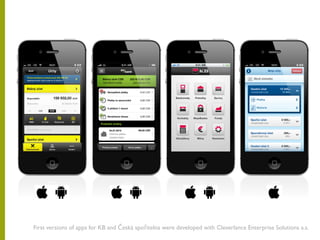
First versions of apps for KB and Česká spořitelna were developed with Cleverlance Enterprise Solutions a.s.
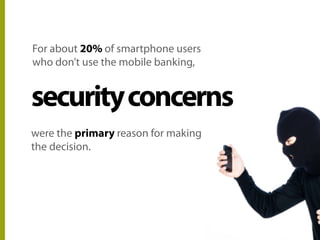
securityconcerns
For about 20% of smartphone users
who don’t use the mobile banking,
were the primary reason for making
the decision.
Mobile Banking
Security
Outline
• Features of the mobile devices.
• Mobile banking architecture.
• The current status of mobile banking
security.
• Topics for 2013/14.
Mobile Devices
Mobile Devices
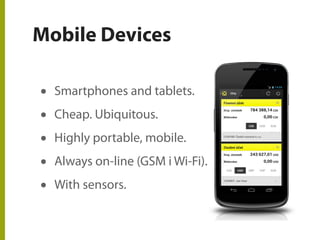
• Smartphones and tablets.
• Cheap. Ubiquitous.
• Highly portable, mobile.
• Always on-line (GSM i Wi-Fi).
• With sensors.
Mobile Operating Systems
• Rich application platform with stores.
• iOS: Mac OS X, Objective-C / Cocoa.
• Android: Linux, Java (Dalvik).
• Relatively simple runtime modification.
• Benevolent memory management.
Simple attack after
jailbreak or failbreak.
Mobile Bankig
Architecture
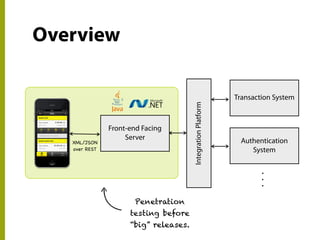
Overview
Front-end Facing
Server
IntegrationPlatform
Transaction System
Authentication
System
...
XML/JSON
over REST
Penetration
testing before
“big” releases.
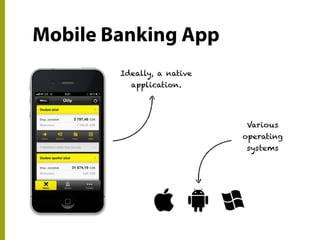
Mobile Banking App
Ideally, a native
application.
Various
operating
systems
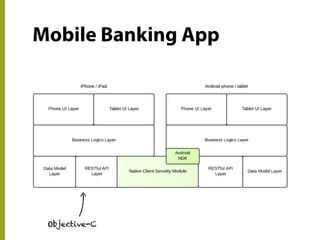
Mobile Banking App
Objective-C
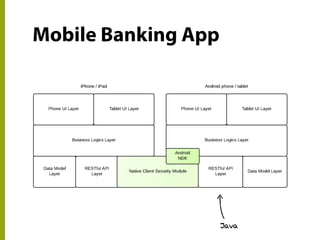
Mobile Banking App
Java
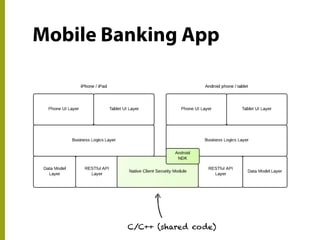
Mobile Banking App
C/C++ (shared code)
Current Status
Current Status
• Typically“adequate”level of security.
• No consensus on“How”.
• UX vs. security compromise.
• Old and new topics.
• Coming problems are foreseen.
The Good Old Attacks
• MITM attack.
• Fake app.
• After-theft attack.
• Reverse engineering.
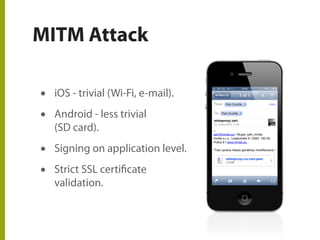
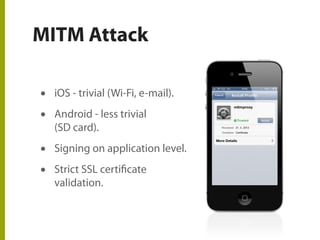
MITM Attack
• iOS - trivial (Wi-Fi, e-mail).
• Android - less trivial
(SD card).
• Signing on application level.
• Strict SSL certificate
validation.
MITM Attack
• iOS - trivial (Wi-Fi, e-mail).
• Android - less trivial
(SD card).
• Signing on application level.
• Strict SSL certificate
validation.
MITM Attack
• iOS - trivial (Wi-Fi, e-mail).
• Android - less trivial
(SD card).
• Signing on application level.
• Strict SSL certificate
validation.
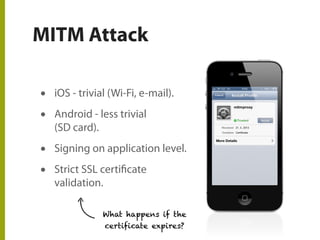
What happens if the
certificate expires?
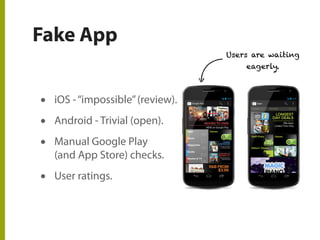
Fake App
• iOS -“impossible”(review).
• Android - Trivial (open).
• Manual Google Play
(and App Store) checks.
• User ratings.
Users are waiting
eagerly.
Fake App
• iOS -“impossible”(review).
• Android - Trivial (open).
• Manual Google Play
(and App Store) checks.
• User ratings.
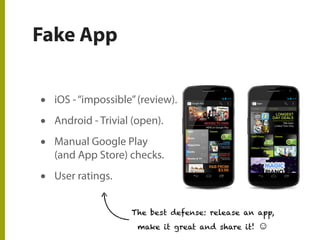
The best defense: release an app,
make it great and share it!
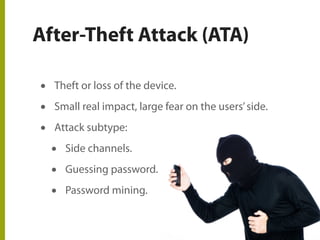
After-Theft Attack (ATA)
• Theft or loss of the device.
• Small real impact, large fear on the users’side.
• Attack subtype:
• Side channels.
• Guessing password.
• Password mining.
ATA: Side Channels
• Usage of the same password for many
apps.
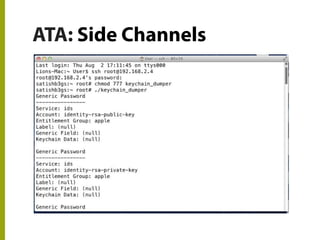
• Weak password storage.
• Fingerprints on the display.
Don’t attack the banking itself.
ATA: Side Channels
ATA: Password Guessing
• Limit the attempt count.
• Random shared key (symmetric cipher).
• Sequence / Freshness.
• The“unlocking password”may be simple.
In the case of the right
implementation of partial
verification.
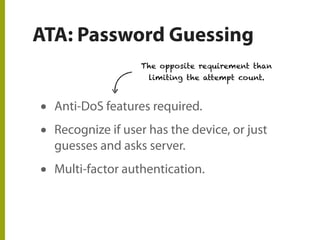
ATA: Password Guessing
• Anti-DoS features required.
• Recognize if user has the device, or just
guesses and asks server.
• Multi-factor authentication.
The opposite requirement than
limiting the attempt count.
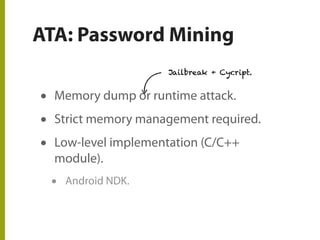
ATA: Password Mining
• Memory dump or runtime attack.
• Strict memory management required.
• Low-level implementation (C/C++
module).
• Android NDK.
Jailbreak + Cycript.
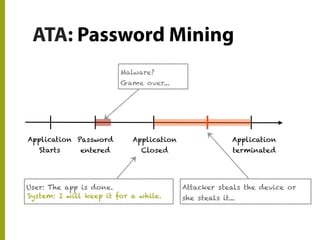
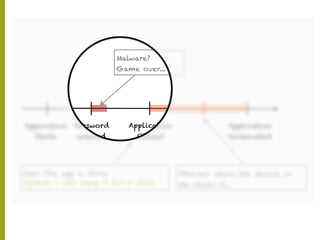
ATA: Password Mining
Application
Starts
Application
Closed
Application
terminated
User: The app is done. Attacker steals the device or
she steals it...
Malware?
Game over...
Password
entered
System: I will keep it for a while.
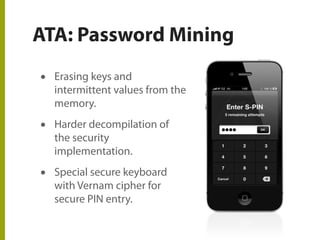
ATA: Password Mining
• Erasing keys and
intermittent values from the
memory.
• Harder decompilation of
the security
implementation.
• Special secure keyboard
with Vernam cipher for
secure PIN entry.
Reverse Engineering
• Uncovering implementation details
attracts“the curious guys”.
• Opens up unnecessary discussion
= reputation risk.
• Discovering other implementation
weaknesses.
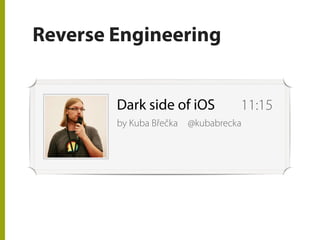
Reverse Engineering
Dark side of iOS
by Kuba Břečka @kubabrecka
11:15
Topics for 2013/14
Application
Starts
Application
Closed
Application
terminated
User: The app is done. Attacker steals the device or
she steals it...
Malware?
Game over...
Password
entered
System: I will keep it for a while.
Mobile Malware
• Problem mainly for Android OS.
• Intensity will increase.
• Hijacking authorization SMS (Eurograbber).
• Hijacking URL schemes and intents.
• Mobile anti-viruses will not save the day.
Quite easily...
Stronger Authorization
• Current mobile banks are retail oriented.
• Almost no SME and enterprise oriented
solutions.
• Feature-wise and security-wise.
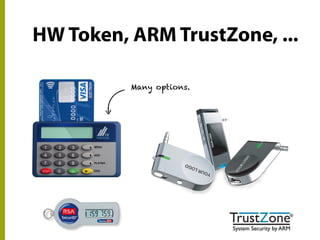
HW Token, ARM TrustZone, ...
Many options.
HW Token, ARM TrustZone, ...
Many options.None is totally great. ☹
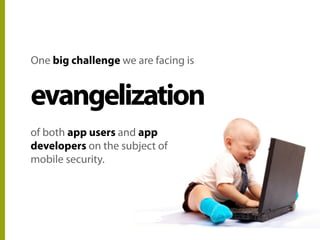
evangelization
One big challenge we are facing is
of both app users and app
developers on the subject of
mobile security.
Thank you!
Petr Dvořák
Partner & Mobile Strategy Consultant
petr@inmite.eu
finance.inmite.eu

SmartDevCon - Katowice - 2013