Presentation on   SECURITY FEATURES OF ATM
ABOUT THE ATM :- An ATM is an electronic device which allows a bank’s customer to  make  cash withdrawals and check their account balance at any time without the need for a human teller. 2. Many ATMs also allow to deposit  cash or cheques, transfer money between their bank accounts . The World’s first  ATM  was installed in ENFIELD town in the London on June 27, 1967 by Barclays bank .
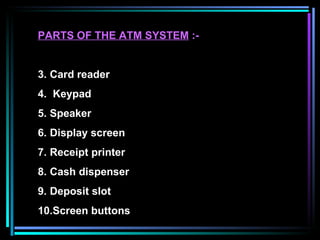
PARTS OF THE ATM SYSTEM  :- Card reader Keypad Speaker Display screen Receipt printer Cash dispenser Deposit slot Screen buttons
HOW ATM WORKS  :- 1.The ATM is act as a data terminal. ATM has to connect to or communicate through a host  computer .  2. The host computer in analogous to an Internet service provider (ISP) . 3. The host computer is the gateway through which all the various ATM network becomes available  to the user.
4. In ATM system customers authenticate themselves by using a plastic card with a magnetic stripe which is known as  “ ATM  CARD”. 5. The magnetic stripe encodes the customers  account number and a  numeric password which is known as PIN (Personal  Identification Number) . 6. The ATM  prompts the user to insert the card. 7.  When the card is entered the customer  personal identification number (PIN) is requested.
8.  The customer inputs his or her PIN. 9.  If the card is a valid  card  which can  be  processed by the machine then control transfer to next stages and prompts the user to either transfer, deposit or withdrawal of cash.  10.  If the number entered incorrectly several times in a row most ATMs will retain the card as a security precaution  to  prevent an unauthorized users . 11.  ATM reads and store customer’s data on a smart card.
NETWORKING CONCEPT  :- Most ATMs  are connected  to authorization of transaction by the card issuer or  other authorizing institution via the communication network. 2. Most host computers can support either leased-line or dial-up machines. 3. Leased-line machines connect directly to the host  computer through a four-wire, point-to-point  dedicated telephone line.
Dial-up ATMs connect the host computer through  a normal phone line  using a modem. 5. The host computer may be owned by a bank  or any financial institutions or it may be used by  an independent service provider.
HARDWARE  AND SOFTWARE  :- 1. ATM  contain secure crypto-processors, generally within an IBM PC  compatible  host computer in a secure enclosure . 2.  The security of the machine relies mostly on the integrity  of the secure crypto-processor. 3.  A crypto-processor is a type of processor which process encrypted  datas.
4.  ATMs typically connect  directly to their ATM transaction processor via a  modem over a dedicated telephone line. ATM machines runs with operating systems  such as Windows 2000 and Linux. 6. ATM transactions are usually encrypted with DES. 7. Most ATM are connected to inter-bank  network.
GENERAL SECURITY :- 1.Modern ATM physical security concentrate on denying the use of the money inside the machine to a thief or a fraud using some fraud detection  techniques. 2.Another trend in ATM security is the fortified cash dispenser is replaced with nothing more than a paper-tape printer. 3.The customer request a withdrawal from the machine which dispenses no money but merely prints a receipt. The customer then  takes the receipt to a sales clerk and exchange it for cash.
4. Some ATM system provides the security that if  you withdraw certain amount per day or you  deposit ,a prompt on the screen will ask you  to enter your birthday and month to confirm  your identity. By ensuring that you are the real card holder it can reduce the risk of the frauds. 6. An additional security measure limits the total amount of ATM withdrawal to some particular amount. 7. This aims to reduce the amount of fraud withdrawal.
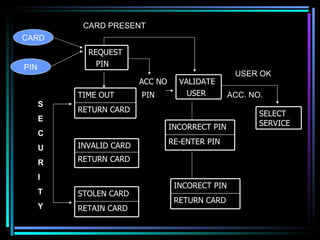
CARD PIN CARD PRESENT USER OK ACC. NO. S  E  C  U  R  I T  Y  ACC NO PIN REQUEST PIN VALIDATE USER SELECT SERVICE INCORRECT PIN RE-ENTER PIN INCORECT PIN RETURN CARD TIME OUT RETURN CARD INVALID CARD RETURN CARD STOLEN CARD RETAIN CARD
To provide security, ATM system follows three different mechanism 1. Time out 2. Invalid card 3.  Stolen card Time out   :- The customer may fail to enter the PIN within the allowed time limit then the card is returned. Invalid card   :-  The card is not recognized  and it is returned . Stolen card  :- The card is recognized as a stolen card and is retained by the machine.
DATABASE SECURITY   : 1. The ATM keeps all the information about the user and user’s account inside the centralized  database. Inside  the database all the  information are stored in the form of tables  (objects) which are more secured than the general file systems. 2.The database also provide locking mechanisms to maintain safety and security of  data.
NETWORK SECURITY   : The ATM network system  provides the  following features. 1. Authentication : The user is the one it claims to be. 2. Confidentiality : Only authorized users can access the content  of the data. 3. Integrity : The data is not be altered by the third party during the transmission.
4. Non-repudiation (refuse to access) : A user can’t deny the fact that it has accessed a service or data. ADDITIONAL FEATURES  : 1. Verifications of identity : Security system is able to establish and verify the claimed identity of any actor in an ATM network. 2.  Protection of confidentiality : Stored and communicate datas are confidential.
3. Strong accountability : The entity can’t deny the responsibility of its  performed action as well as their effects. Alarm reporting : The security system able to generate alarm  notification about certain selected security related events. Audit : When violations of security happens the system is able to analyze the data relevant to security.
6. Security recovery : The security system is able to recover from successful or attempted failures of security.
PRECAUTIONS TO TAKE  :- 1.Treat your ATM card like cash. Always keep your card in a safe place. 2. Keep your secret code as secret. Don’t use date of birth, address ,phone number as your PIN. 3. Take your receipt on every ATM transaction. Don’t leave it  at or near the ATM counter. 4. Report a lost or stolen card at once. 5. ATM users should seek  out a machine that is  located in a well-lighted area.
ANY QUESTIONS ?
THANK YOU.

Atm security

  • 1.
    Presentation on SECURITY FEATURES OF ATM
  • 2.
    ABOUT THE ATM:- An ATM is an electronic device which allows a bank’s customer to make cash withdrawals and check their account balance at any time without the need for a human teller. 2. Many ATMs also allow to deposit cash or cheques, transfer money between their bank accounts . The World’s first ATM was installed in ENFIELD town in the London on June 27, 1967 by Barclays bank .
  • 3.
    PARTS OF THEATM SYSTEM :- Card reader Keypad Speaker Display screen Receipt printer Cash dispenser Deposit slot Screen buttons
  • 4.
    HOW ATM WORKS :- 1.The ATM is act as a data terminal. ATM has to connect to or communicate through a host computer . 2. The host computer in analogous to an Internet service provider (ISP) . 3. The host computer is the gateway through which all the various ATM network becomes available to the user.
  • 5.
    4. In ATMsystem customers authenticate themselves by using a plastic card with a magnetic stripe which is known as “ ATM CARD”. 5. The magnetic stripe encodes the customers account number and a numeric password which is known as PIN (Personal Identification Number) . 6. The ATM prompts the user to insert the card. 7. When the card is entered the customer personal identification number (PIN) is requested.
  • 6.
    8. Thecustomer inputs his or her PIN. 9. If the card is a valid card which can be processed by the machine then control transfer to next stages and prompts the user to either transfer, deposit or withdrawal of cash. 10. If the number entered incorrectly several times in a row most ATMs will retain the card as a security precaution to prevent an unauthorized users . 11. ATM reads and store customer’s data on a smart card.
  • 7.
    NETWORKING CONCEPT :- Most ATMs are connected to authorization of transaction by the card issuer or other authorizing institution via the communication network. 2. Most host computers can support either leased-line or dial-up machines. 3. Leased-line machines connect directly to the host computer through a four-wire, point-to-point dedicated telephone line.
  • 8.
    Dial-up ATMs connectthe host computer through a normal phone line using a modem. 5. The host computer may be owned by a bank or any financial institutions or it may be used by an independent service provider.
  • 9.
    HARDWARE ANDSOFTWARE :- 1. ATM contain secure crypto-processors, generally within an IBM PC compatible host computer in a secure enclosure . 2. The security of the machine relies mostly on the integrity of the secure crypto-processor. 3. A crypto-processor is a type of processor which process encrypted datas.
  • 10.
    4. ATMstypically connect directly to their ATM transaction processor via a modem over a dedicated telephone line. ATM machines runs with operating systems such as Windows 2000 and Linux. 6. ATM transactions are usually encrypted with DES. 7. Most ATM are connected to inter-bank network.
  • 11.
    GENERAL SECURITY :-1.Modern ATM physical security concentrate on denying the use of the money inside the machine to a thief or a fraud using some fraud detection techniques. 2.Another trend in ATM security is the fortified cash dispenser is replaced with nothing more than a paper-tape printer. 3.The customer request a withdrawal from the machine which dispenses no money but merely prints a receipt. The customer then takes the receipt to a sales clerk and exchange it for cash.
  • 12.
    4. Some ATMsystem provides the security that if you withdraw certain amount per day or you deposit ,a prompt on the screen will ask you to enter your birthday and month to confirm your identity. By ensuring that you are the real card holder it can reduce the risk of the frauds. 6. An additional security measure limits the total amount of ATM withdrawal to some particular amount. 7. This aims to reduce the amount of fraud withdrawal.
  • 13.
    CARD PIN CARDPRESENT USER OK ACC. NO. S E C U R I T Y ACC NO PIN REQUEST PIN VALIDATE USER SELECT SERVICE INCORRECT PIN RE-ENTER PIN INCORECT PIN RETURN CARD TIME OUT RETURN CARD INVALID CARD RETURN CARD STOLEN CARD RETAIN CARD
  • 14.
    To provide security,ATM system follows three different mechanism 1. Time out 2. Invalid card 3. Stolen card Time out :- The customer may fail to enter the PIN within the allowed time limit then the card is returned. Invalid card :- The card is not recognized and it is returned . Stolen card :- The card is recognized as a stolen card and is retained by the machine.
  • 15.
    DATABASE SECURITY : 1. The ATM keeps all the information about the user and user’s account inside the centralized database. Inside the database all the information are stored in the form of tables (objects) which are more secured than the general file systems. 2.The database also provide locking mechanisms to maintain safety and security of data.
  • 16.
    NETWORK SECURITY : The ATM network system provides the following features. 1. Authentication : The user is the one it claims to be. 2. Confidentiality : Only authorized users can access the content of the data. 3. Integrity : The data is not be altered by the third party during the transmission.
  • 17.
    4. Non-repudiation (refuseto access) : A user can’t deny the fact that it has accessed a service or data. ADDITIONAL FEATURES : 1. Verifications of identity : Security system is able to establish and verify the claimed identity of any actor in an ATM network. 2. Protection of confidentiality : Stored and communicate datas are confidential.
  • 18.
    3. Strong accountability: The entity can’t deny the responsibility of its performed action as well as their effects. Alarm reporting : The security system able to generate alarm notification about certain selected security related events. Audit : When violations of security happens the system is able to analyze the data relevant to security.
  • 19.
    6. Security recovery: The security system is able to recover from successful or attempted failures of security.
  • 20.
    PRECAUTIONS TO TAKE :- 1.Treat your ATM card like cash. Always keep your card in a safe place. 2. Keep your secret code as secret. Don’t use date of birth, address ,phone number as your PIN. 3. Take your receipt on every ATM transaction. Don’t leave it at or near the ATM counter. 4. Report a lost or stolen card at once. 5. ATM users should seek out a machine that is located in a well-lighted area.
  • 21.
  • 22.