SMALL AIRWAYS DISEASE
DR.MITUSHA VERMA
DEPT.OF RADIODIAGNOSIS
DR.B.NANAVATI HOSPITAL.
CHEST RADIO MEET
DEFINITION…
 Small airways disease- pathologic condition in
which the small conducting airways are affected
either primarily or in addition to alveolar or
interstitial lung changes.
 Bronchiolitis- inflammation of small airways
 Abnormalities of airways 2-3mm in diameter.These small airways
form only 10% of total airways resistance.
ANATOMY
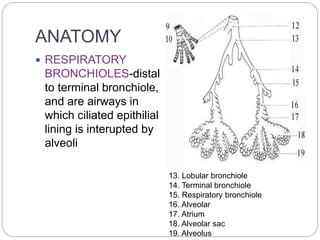
 RESPIRATORY
BRONCHIOLES-distal
to terminal bronchiole,
and are airways in
which ciliated epithilial
lining is interupted by
alveoli
13. Lobular bronchiole
14. Terminal bronchiole
15. Respiratory bronchiole
16. Alveolar
17. Atrium
18. Alveolar sac
19. Alveolus
CT – imaging modality of
choice….
 Can depict subtle abnormalities from tiny nodules
to slightly different attenuation…
 Frequently suggestive if not diagnostic…
 Reliable assessment of extent and severity of
disease…
 Assessing response to therapy…
HRCT- Technical aspects
 High spatial frequency reconstruction algorithm
and thin spacing.
 mAS - 110
 kV- 100
 Collimation -1.2
 Recon- B10f very smooth kernel.
Lung window- WW -1200 WC-600
Mediastinal window- WW-400 WC-40
 An approach to interpretation of HRCT findings….
 To see into the patho-radiologic classification of
these disorders.
Anatomic Consideration…
 The bronchiole lumen, wall, alveolar septa
airspaces are averaged togather into dark gray
background of lung parenchyma.
 Airways normally visible upto a point midway
between hilum &pleural surface.
 Vessels normally till 5-10mm from pleural surface.
SIGNS
DIRECT
 Direct visualisation of
diseased bronchioles.
INDIRECT
 Changes in the lung
parenchyma distal to
the diseased small
airway.
Direct signs
Thickened airway walls
 Dilated, ringlike
tubular or branching
tubular structure.
If airway is
obliterated,bronchiol
ar secretions,
peribronchiolar
inflammation
 Nodules
 Linear or branching
opacities
Indirect signs
AIR TRAPPING-
mosaic perfusion.
SUBSEGMENTA
L ATELECTASIS
CENTRILOBULAR
EMPHYSEMA
CENTRILOBULAR
AIRSPACE
NODULES.
AIR TRAPPING
SUBSEGMENTAL ATELECTASIS
CENTRILOBULAR EMPHYSEMA
CENTRILOBULAR AIRSPACE
NODULES.
Pitfalls…
 Air Trapping vs
Patchy ground glass
attenuation.
 Centrilobular emphysema vs cystic lung
disease.
HRCT CLASSIFICATION…
TREE IN BUD
PATTERN.
POORLY
DEFINED
CENTRILOBULAR
NODULES.
WITH
DECREASED
LUNG
ATTENUATION.
WITH GROUND
GLASS
OPACITIES AND
CONSOLIDATION.
TREE IN BUD
PATTERN• INFECTIONS- tb,mac,viral ,HIV.
• CYSTIC FIBROSIS
• Aspiration
• Connective tissue disorders
• Asthma
• ABPA
POORLY DEFINED
CENTRILOBULAR NODULES
• Subacute Hypersensitivity Pneumonitis.
• Respiratory Bronchiolitis with interstial lung
siease.
WITH DECREASED LUNG
ATTENUATION
• Post transplant constrictive bronchiolitis.
• Post infectious-Swyer James Syndrome.
• Toxic fumes inhalation.
WITH GROUND GLASS
OPACITIES AND
CONSOLIDATION
• Idiopathic bronchiolitis obliterans
organising pneumonia.
• Collagen vascular diseases
• Radiation therapy.
To conclude…
Small
airways
disease
Thickened
airways
Obliterated
Airways
Subsegmental
Atelectasis
Centrilobular
emphysema
Centrilobular
Nodularities.
Air trappeing
References
 HRCT of the Lungs-W.Richard Webb.
 Imaging Of Small Airways Disease- Radiographics 1996
16:27-41.
 Radiologic and Pathologic features of
Bronchiolitis-AJR:185 Aug 2005.
 Imaging of the small airways-Johny A Verschakelen.

Small airways