EN8592 – WASTE WATER
ENGINEERING
UNIT – 5 – SLUDGE TREATMENT AND
DISPOSAL
SESSION – 6 – SLUDGE DEWATERING
DEWATERING
• Digested sewage sludge is usually dewatered before disposal.
• Dewatered sludge still contains a significant amount of water—often as
much as 70 percent—but, even with that moisture content, sludge no
longer behaves as a liquid and can be handled as a solid material.
• Sludge-drying beds provide the simplest method of dewatering.
DEWATERING PROCESS
• A digested sludge slurry is spread on an open bed of sand and allowed to
remain until dry.
• Drying takes place by a combination of evaporation and gravity drainage
through the sand.
• A piping network built under the sand collects the water, which is pumped
back to the head of the plant.
• After about six weeks of drying, the sludge cake, as it is called, may have a
solids content of about 40 percent.
• It can then be removed from the sand with a pitchfork or a front-end
loader.
• In order to reduce drying time in wet or cold weather, a glass enclosure
may be built over the sand beds.
• Since a good deal of land area is needed for drying beds, this method of
dewatering is commonly used in rural or suburban towns rather than in
densely populated cities.
• Alternatives to sludge-drying beds include the rotary drum vacuum filter,
the centrifuge, and the belt filter press.
• These mechanical systems require less space than do sludge-drying beds,
and they offer a greater degree of operational control.
• However, they usually have to be preceded by a step called sludge
conditioning, in which chemicals are added to the liquid sludge to
coagulate solids and improve drainability.
CENTRIFUGE DEWATERING
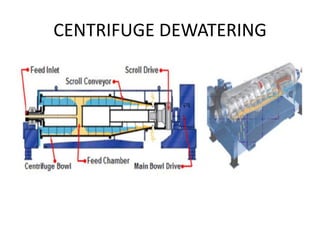
• The centrifuge consists of a solid bowl, which rotates and contains the
process. A screw conveyor, contained within the bowl, turns at a slightly
different speed from the bowl.
• The feed slurry is introduced into the feed chamber assembly by a
stationary feed tube. It is accelerated up to speed in the feed chamber and
discharged into the pond of the bowl through the feed ports.
• The liquid flows from the point where it is introduced to the pond to the
liquid weirs at the large end of the rotating assembly.
• As the liquid flows through the pond, the g force causes the solids to settle
out of the liquid and to sediment against the bowl wall. This causes a
blanket of solids to build up against the bowl wall.
• The solids that build up against the bowl wall are pushed to the opposite
end of the liquid discharge by the screw conveyor, which turns at a slightly
different speed than the bow.
• The solids are pushed in the horizontal direction, up an incline and
ultimately out of the liquid prior to being discharged from the bowl.
• Centrifugal force is constantly exerted on the solids in order to produce
the desired solids in the discharged product.
CENTRIFUGE DEWATERING
FACTORS OF CONSIDERATION
• The force that removes the solids from the liquid is the relative force in
the bowl. The faster the bowl turns, the greater the g force, and the
greater the driving force to remove the solids from the liquid. The greater
the g force, the better the centrate clarity will be.
• The solids are also affected by the same parameters as the liquid. As the g
force is increased, the force to compact the solids in the sludge blanket
increases and the solids become thicker. The increased g force will release
more free liquid and produce a drier cake.
• The differential speed between the bowl and conveyor has a direct effect
on the cake solids.
• The solids loading rate also has an effect on cake solids.
• polymer also improves the dewatering characteristics of the sludge by
agglomerating the solids and increasing the effective size of the solids.
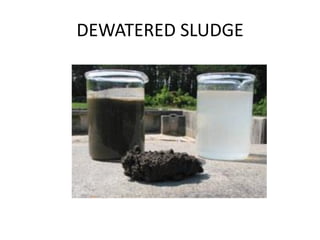
DEWATERED SLUDGE
Typical performance for dewatered
digested sludge
Inlet solids 2 to 4%-dws
Outlet solids 28 to 33%-dws
Polymer required 9 to 14-lbs/1000lbs-dws
Solids recovery > 97%
Centrate quality < 200-ppm

Sludge Dewatering

  • 1.
    EN8592 – WASTEWATER ENGINEERING UNIT – 5 – SLUDGE TREATMENT AND DISPOSAL SESSION – 6 – SLUDGE DEWATERING
  • 2.
    DEWATERING • Digested sewagesludge is usually dewatered before disposal. • Dewatered sludge still contains a significant amount of water—often as much as 70 percent—but, even with that moisture content, sludge no longer behaves as a liquid and can be handled as a solid material. • Sludge-drying beds provide the simplest method of dewatering.
  • 3.
    DEWATERING PROCESS • Adigested sludge slurry is spread on an open bed of sand and allowed to remain until dry. • Drying takes place by a combination of evaporation and gravity drainage through the sand. • A piping network built under the sand collects the water, which is pumped back to the head of the plant. • After about six weeks of drying, the sludge cake, as it is called, may have a solids content of about 40 percent.
  • 4.
    • It canthen be removed from the sand with a pitchfork or a front-end loader. • In order to reduce drying time in wet or cold weather, a glass enclosure may be built over the sand beds. • Since a good deal of land area is needed for drying beds, this method of dewatering is commonly used in rural or suburban towns rather than in densely populated cities.
  • 5.
    • Alternatives tosludge-drying beds include the rotary drum vacuum filter, the centrifuge, and the belt filter press. • These mechanical systems require less space than do sludge-drying beds, and they offer a greater degree of operational control. • However, they usually have to be preceded by a step called sludge conditioning, in which chemicals are added to the liquid sludge to coagulate solids and improve drainability.
  • 6.
    CENTRIFUGE DEWATERING • Thecentrifuge consists of a solid bowl, which rotates and contains the process. A screw conveyor, contained within the bowl, turns at a slightly different speed from the bowl. • The feed slurry is introduced into the feed chamber assembly by a stationary feed tube. It is accelerated up to speed in the feed chamber and discharged into the pond of the bowl through the feed ports.
  • 7.
    • The liquidflows from the point where it is introduced to the pond to the liquid weirs at the large end of the rotating assembly. • As the liquid flows through the pond, the g force causes the solids to settle out of the liquid and to sediment against the bowl wall. This causes a blanket of solids to build up against the bowl wall.
  • 8.
    • The solidsthat build up against the bowl wall are pushed to the opposite end of the liquid discharge by the screw conveyor, which turns at a slightly different speed than the bow. • The solids are pushed in the horizontal direction, up an incline and ultimately out of the liquid prior to being discharged from the bowl. • Centrifugal force is constantly exerted on the solids in order to produce the desired solids in the discharged product.
  • 9.
  • 10.
    FACTORS OF CONSIDERATION •The force that removes the solids from the liquid is the relative force in the bowl. The faster the bowl turns, the greater the g force, and the greater the driving force to remove the solids from the liquid. The greater the g force, the better the centrate clarity will be. • The solids are also affected by the same parameters as the liquid. As the g force is increased, the force to compact the solids in the sludge blanket increases and the solids become thicker. The increased g force will release more free liquid and produce a drier cake.
  • 11.
    • The differentialspeed between the bowl and conveyor has a direct effect on the cake solids. • The solids loading rate also has an effect on cake solids. • polymer also improves the dewatering characteristics of the sludge by agglomerating the solids and increasing the effective size of the solids.
  • 12.
  • 13.
    Typical performance fordewatered digested sludge Inlet solids 2 to 4%-dws Outlet solids 28 to 33%-dws Polymer required 9 to 14-lbs/1000lbs-dws Solids recovery > 97% Centrate quality < 200-ppm