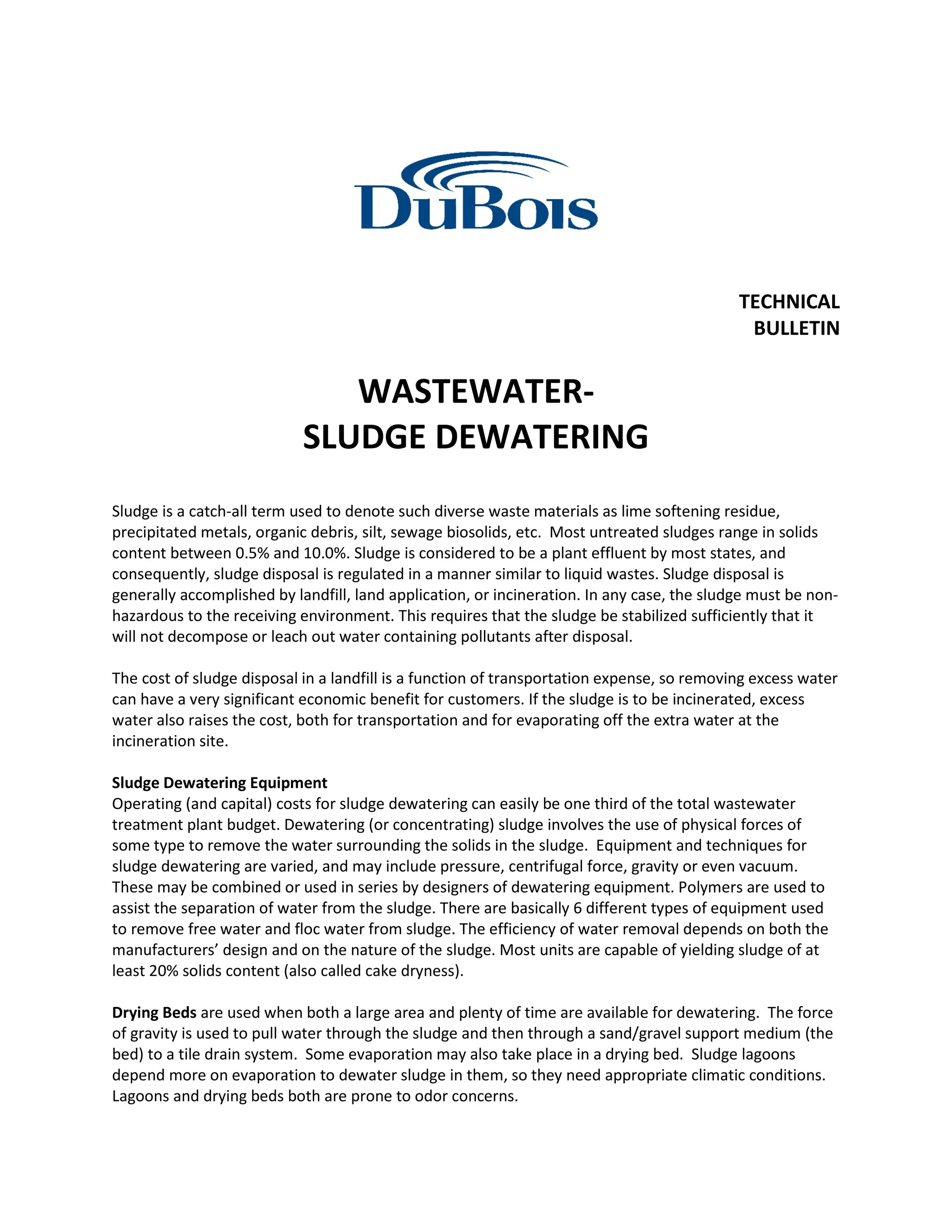
TECHNICAL
BULLETIN
WASTEWATER-
SLUDGE DEWATERING
Sludge is a catch-all term used to denote such diverse waste materials as lime softening residue,
precipitated metals, organic debris, silt, sewage biosolids, etc. Most untreated sludges range in solids
content between 0.5% and 10.0%. Sludge is considered to be a plant effluent by most states, and
consequently, sludge disposal is regulated in a manner similar to liquid wastes. Sludge disposal is
generally accomplished by landfill, land application, or incineration. In any case, the sludge must be non-
hazardous to the receiving environment. This requires that the sludge be stabilized sufficiently that it
will not decompose or leach out water containing pollutants after disposal.
The cost of sludge disposal in a landfill is a function of transportation expense, so removing excess water
can have a very significant economic benefit for customers. If the sludge is to be incinerated, excess
water also raises the cost, both for transportation and for evaporating off the extra water at the
incineration site.
Sludge Dewatering Equipment
Operating (and capital) costs for sludge dewatering can easily be one third of the total wastewater
treatment plant budget. Dewatering (or concentrating) sludge involves the use of physical forces of
some type to remove the water surrounding the solids in the sludge. Equipment and techniques for
sludge dewatering are varied, and may include pressure, centrifugal force, gravity or even vacuum.
These may be combined or used in series by designers of dewatering equipment. Polymers are used to
assist the separation of water from the sludge. There are basically 6 different types of equipment used
to remove free water and floc water from sludge. The efficiency of water removal depends on both the
manufacturers’ design and on the nature of the sludge. Most units are capable of yielding sludge of at
least 20% solids content (also called cake dryness).
Drying Beds are used when both a large area and plenty of time are available for dewatering. The force
of gravity is used to pull water through the sludge and then through a sand/gravel support medium (the
bed) to a tile drain system. Some evaporation may also take place in a drying bed. Sludge lagoons
depend more on evaporation to dewater sludge in them, so they need appropriate climatic conditions.
Lagoons and drying beds both are prone to odor concerns.
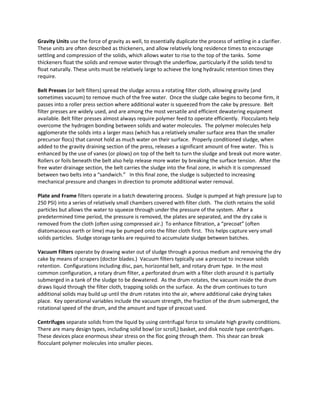
Gravity Units use the force of gravity as well, to essentially duplicate the process of settling in a clarifier.
These units are often described as thickeners, and allow relatively long residence times to encourage
settling and compression of the solids, which allows water to rise to the top of the tanks. Some
thickeners float the solids and remove water through the underflow, particularly if the solids tend to
float naturally. These units must be relatively large to achieve the long hydraulic retention times they
require.
Belt Presses (or belt filters) spread the sludge across a rotating filter cloth, allowing gravity (and
sometimes vacuum) to remove much of the free water. Once the sludge cake begins to become firm, it
passes into a roller press section where additional water is squeezed from the cake by pressure. Belt
filter presses are widely used, and are among the most versatile and efficient dewatering equipment
available. Belt filter presses almost always require polymer feed to operate efficiently. Flocculants help
overcome the hydrogen bonding between solids and water molecules. The polymer molecules help
agglomerate the solids into a larger mass (which has a relatively smaller surface area than the smaller
precursor flocs) that cannot hold as much water on their surface. Properly conditioned sludge, when
added to the gravity draining section of the press, releases a significant amount of free water. This is
enhanced by the use of vanes (or plows) on top of the belt to turn the sludge and break out more water.
Rollers or foils beneath the belt also help release more water by breaking the surface tension. After the
free water drainage section, the belt carries the sludge into the final zone, in which it is compressed
between two belts into a “sandwich.” In this final zone, the sludge is subjected to increasing
mechanical pressure and changes in direction to promote additional water removal.
Plate and Frame filters operate in a batch dewatering process. Sludge is pumped at high pressure (up to
250 PSI) into a series of relatively small chambers covered with filter cloth. The cloth retains the solid
particles but allows the water to squeeze through under the pressure of the system. After a
predetermined time period, the pressure is removed, the plates are separated, and the dry cake is
removed from the cloth (often using compressed air.) To enhance filtration, a “precoat” (often
diatomaceous earth or lime) may be pumped onto the filter cloth first. This helps capture very small
solids particles. Sludge storage tanks are required to accumulate sludge between batches.
Vacuum Filters operate by drawing water out of sludge through a porous medium and removing the dry
cake by means of scrapers (doctor blades.) Vacuum filters typically use a precoat to increase solids
retention. Configurations including disc, pan, horizontal belt, and rotary drum type. In the most
common configuration, a rotary drum filter, a perforated drum with a filter cloth around it is partially
submerged in a tank of the sludge to be dewatered. As the drum rotates, the vacuum inside the drum
draws liquid through the filter cloth, trapping solids on the surface. As the drum continues to turn
additional solids may build up until the drum rotates into the air, where additional cake drying takes
place. Key operational variables include the vacuum strength, the fraction of the drum submerged, the
rotational speed of the drum, and the amount and type of precoat used.
Centrifuges separate solids from the liquid by using centrifugal force to simulate high gravity conditions.
There are many design types, including solid bowl (or scroll,) basket, and disk nozzle type centrifuges.
These devices place enormous shear stress on the floc going through them. This shear can break
flocculant polymer molecules into smaller pieces.
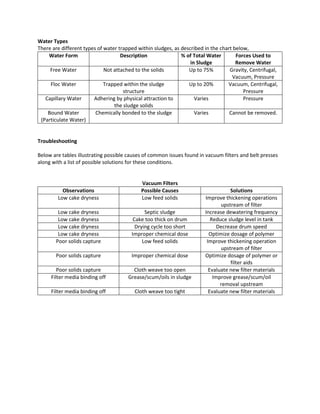
Water Types
There are different types of water trapped within sludges, as described in the chart below,
Water Form Description % of Total Water
in Sludge
Forces Used to
Remove Water
Free Water Not attached to the solids Up to 75% Gravity, Centrifugal,
Vacuum, Pressure
Floc Water Trapped within the sludge
structure
Up to 20% Vacuum, Centrifugal,
Pressure
Capillary Water Adhering by physical attraction to
the sludge solids
Varies Pressure
Bound Water
(Particulate Water)
Chemically bonded to the sludge Varies Cannot be removed.
Troubleshooting
Below are tables illustrating possible causes of common issues found in vacuum filters and belt presses
along with a list of possible solutions for these conditions.
Vacuum Filters
Observations Possible Causes Solutions
Low cake dryness Low feed solids Improve thickening operations
upstream of filter
Low cake dryness Septic sludge Increase dewatering frequency
Low cake dryness Cake too thick on drum Reduce sludge level in tank
Low cake dryness Drying cycle too short Decrease drum speed
Low cake dryness Improper chemical dose Optimize dosage of polymer
Poor solids capture Low feed solids Improve thickening operation
upstream of filter
Poor solids capture Improper chemical dose Optimize dosage of polymer or
filter aids
Poor solids capture Cloth weave too open Evaluate new filter materials
Filter media binding off Grease/scum/oils in sludge Improve grease/scum/oil
removal upstream
Filter media binding off Cloth weave too tight Evaluate new filter materials
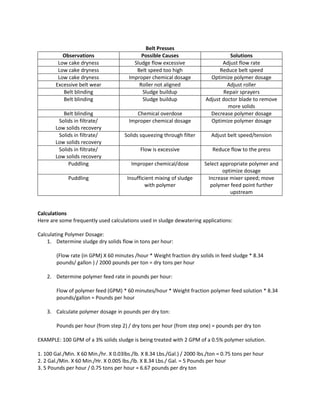
Belt Presses
Observations Possible Causes Solutions
Low cake dryness Sludge flow excessive Adjust flow rate
Low cake dryness Belt speed too high Reduce belt speed
Low cake dryness Improper chemical dosage Optimize polymer dosage
Excessive belt wear Roller not aligned Adjust roller
Belt blinding Sludge buildup Repair sprayers
Belt blinding Sludge buildup Adjust doctor blade to remove
more solids
Belt blinding Chemical overdose Decrease polymer dosage
Solids in filtrate/
Low solids recovery
Improper chemical dosage Optimize polymer dosage
Solids in filtrate/
Low solids recovery
Solids squeezing through filter Adjust belt speed/tension
Solids in filtrate/
Low solids recovery
Flow is excessive Reduce flow to the press
Puddling Improper chemical/dose Select appropriate polymer and
optimize dosage
Puddling Insufficient mixing of sludge
with polymer
Increase mixer speed; move
polymer feed point further
upstream
Calculations
Here are some frequently used calculations used in sludge dewatering applications:
Calculating Polymer Dosage:
1. Determine sludge dry solids flow in tons per hour:
(Flow rate (in GPM) X 60 minutes /hour * Weight fraction dry solids in feed sludge * 8.34
pounds/ gallon ) / 2000 pounds per ton = dry tons per hour
2. Determine polymer feed rate in pounds per hour:
Flow of polymer feed (GPM) * 60 minutes/hour * Weight fraction polymer feed solution * 8.34
pounds/gallon = Pounds per hour
3. Calculate polymer dosage in pounds per dry ton:
Pounds per hour (from step 2) / dry tons per hour (from step one) = pounds per dry ton
EXAMPLE: 100 GPM of a 3% solids sludge is being treated with 2 GPM of a 0.5% polymer solution.
1. 100 Gal./Min. X 60 Min./hr. X 0.03lbs./lb. X 8.34 Lbs./Gal.) / 2000 lbs./ton = 0.75 tons per hour
2. 2 Gal./Min. X 60 Min./Hr. X 0.005 lbs./lb. X 8.34 Lbs./ Gal. = 5 Pounds per hour
3. 5 Pounds per hour / 0.75 tons per hour = 6.67 pounds per dry ton

Technical-Bulletin-Sludge-Dewatering.pdf

  • 1.
    TECHNICAL BULLETIN WASTEWATER- SLUDGE DEWATERING Sludge isa catch-all term used to denote such diverse waste materials as lime softening residue, precipitated metals, organic debris, silt, sewage biosolids, etc. Most untreated sludges range in solids content between 0.5% and 10.0%. Sludge is considered to be a plant effluent by most states, and consequently, sludge disposal is regulated in a manner similar to liquid wastes. Sludge disposal is generally accomplished by landfill, land application, or incineration. In any case, the sludge must be non- hazardous to the receiving environment. This requires that the sludge be stabilized sufficiently that it will not decompose or leach out water containing pollutants after disposal. The cost of sludge disposal in a landfill is a function of transportation expense, so removing excess water can have a very significant economic benefit for customers. If the sludge is to be incinerated, excess water also raises the cost, both for transportation and for evaporating off the extra water at the incineration site. Sludge Dewatering Equipment Operating (and capital) costs for sludge dewatering can easily be one third of the total wastewater treatment plant budget. Dewatering (or concentrating) sludge involves the use of physical forces of some type to remove the water surrounding the solids in the sludge. Equipment and techniques for sludge dewatering are varied, and may include pressure, centrifugal force, gravity or even vacuum. These may be combined or used in series by designers of dewatering equipment. Polymers are used to assist the separation of water from the sludge. There are basically 6 different types of equipment used to remove free water and floc water from sludge. The efficiency of water removal depends on both the manufacturers’ design and on the nature of the sludge. Most units are capable of yielding sludge of at least 20% solids content (also called cake dryness). Drying Beds are used when both a large area and plenty of time are available for dewatering. The force of gravity is used to pull water through the sludge and then through a sand/gravel support medium (the bed) to a tile drain system. Some evaporation may also take place in a drying bed. Sludge lagoons depend more on evaporation to dewater sludge in them, so they need appropriate climatic conditions. Lagoons and drying beds both are prone to odor concerns.
  • 2.
    Gravity Units usethe force of gravity as well, to essentially duplicate the process of settling in a clarifier. These units are often described as thickeners, and allow relatively long residence times to encourage settling and compression of the solids, which allows water to rise to the top of the tanks. Some thickeners float the solids and remove water through the underflow, particularly if the solids tend to float naturally. These units must be relatively large to achieve the long hydraulic retention times they require. Belt Presses (or belt filters) spread the sludge across a rotating filter cloth, allowing gravity (and sometimes vacuum) to remove much of the free water. Once the sludge cake begins to become firm, it passes into a roller press section where additional water is squeezed from the cake by pressure. Belt filter presses are widely used, and are among the most versatile and efficient dewatering equipment available. Belt filter presses almost always require polymer feed to operate efficiently. Flocculants help overcome the hydrogen bonding between solids and water molecules. The polymer molecules help agglomerate the solids into a larger mass (which has a relatively smaller surface area than the smaller precursor flocs) that cannot hold as much water on their surface. Properly conditioned sludge, when added to the gravity draining section of the press, releases a significant amount of free water. This is enhanced by the use of vanes (or plows) on top of the belt to turn the sludge and break out more water. Rollers or foils beneath the belt also help release more water by breaking the surface tension. After the free water drainage section, the belt carries the sludge into the final zone, in which it is compressed between two belts into a “sandwich.” In this final zone, the sludge is subjected to increasing mechanical pressure and changes in direction to promote additional water removal. Plate and Frame filters operate in a batch dewatering process. Sludge is pumped at high pressure (up to 250 PSI) into a series of relatively small chambers covered with filter cloth. The cloth retains the solid particles but allows the water to squeeze through under the pressure of the system. After a predetermined time period, the pressure is removed, the plates are separated, and the dry cake is removed from the cloth (often using compressed air.) To enhance filtration, a “precoat” (often diatomaceous earth or lime) may be pumped onto the filter cloth first. This helps capture very small solids particles. Sludge storage tanks are required to accumulate sludge between batches. Vacuum Filters operate by drawing water out of sludge through a porous medium and removing the dry cake by means of scrapers (doctor blades.) Vacuum filters typically use a precoat to increase solids retention. Configurations including disc, pan, horizontal belt, and rotary drum type. In the most common configuration, a rotary drum filter, a perforated drum with a filter cloth around it is partially submerged in a tank of the sludge to be dewatered. As the drum rotates, the vacuum inside the drum draws liquid through the filter cloth, trapping solids on the surface. As the drum continues to turn additional solids may build up until the drum rotates into the air, where additional cake drying takes place. Key operational variables include the vacuum strength, the fraction of the drum submerged, the rotational speed of the drum, and the amount and type of precoat used. Centrifuges separate solids from the liquid by using centrifugal force to simulate high gravity conditions. There are many design types, including solid bowl (or scroll,) basket, and disk nozzle type centrifuges. These devices place enormous shear stress on the floc going through them. This shear can break flocculant polymer molecules into smaller pieces.
  • 3.
    Water Types There aredifferent types of water trapped within sludges, as described in the chart below, Water Form Description % of Total Water in Sludge Forces Used to Remove Water Free Water Not attached to the solids Up to 75% Gravity, Centrifugal, Vacuum, Pressure Floc Water Trapped within the sludge structure Up to 20% Vacuum, Centrifugal, Pressure Capillary Water Adhering by physical attraction to the sludge solids Varies Pressure Bound Water (Particulate Water) Chemically bonded to the sludge Varies Cannot be removed. Troubleshooting Below are tables illustrating possible causes of common issues found in vacuum filters and belt presses along with a list of possible solutions for these conditions. Vacuum Filters Observations Possible Causes Solutions Low cake dryness Low feed solids Improve thickening operations upstream of filter Low cake dryness Septic sludge Increase dewatering frequency Low cake dryness Cake too thick on drum Reduce sludge level in tank Low cake dryness Drying cycle too short Decrease drum speed Low cake dryness Improper chemical dose Optimize dosage of polymer Poor solids capture Low feed solids Improve thickening operation upstream of filter Poor solids capture Improper chemical dose Optimize dosage of polymer or filter aids Poor solids capture Cloth weave too open Evaluate new filter materials Filter media binding off Grease/scum/oils in sludge Improve grease/scum/oil removal upstream Filter media binding off Cloth weave too tight Evaluate new filter materials
  • 4.
    Belt Presses Observations PossibleCauses Solutions Low cake dryness Sludge flow excessive Adjust flow rate Low cake dryness Belt speed too high Reduce belt speed Low cake dryness Improper chemical dosage Optimize polymer dosage Excessive belt wear Roller not aligned Adjust roller Belt blinding Sludge buildup Repair sprayers Belt blinding Sludge buildup Adjust doctor blade to remove more solids Belt blinding Chemical overdose Decrease polymer dosage Solids in filtrate/ Low solids recovery Improper chemical dosage Optimize polymer dosage Solids in filtrate/ Low solids recovery Solids squeezing through filter Adjust belt speed/tension Solids in filtrate/ Low solids recovery Flow is excessive Reduce flow to the press Puddling Improper chemical/dose Select appropriate polymer and optimize dosage Puddling Insufficient mixing of sludge with polymer Increase mixer speed; move polymer feed point further upstream Calculations Here are some frequently used calculations used in sludge dewatering applications: Calculating Polymer Dosage: 1. Determine sludge dry solids flow in tons per hour: (Flow rate (in GPM) X 60 minutes /hour * Weight fraction dry solids in feed sludge * 8.34 pounds/ gallon ) / 2000 pounds per ton = dry tons per hour 2. Determine polymer feed rate in pounds per hour: Flow of polymer feed (GPM) * 60 minutes/hour * Weight fraction polymer feed solution * 8.34 pounds/gallon = Pounds per hour 3. Calculate polymer dosage in pounds per dry ton: Pounds per hour (from step 2) / dry tons per hour (from step one) = pounds per dry ton EXAMPLE: 100 GPM of a 3% solids sludge is being treated with 2 GPM of a 0.5% polymer solution. 1. 100 Gal./Min. X 60 Min./hr. X 0.03lbs./lb. X 8.34 Lbs./Gal.) / 2000 lbs./ton = 0.75 tons per hour 2. 2 Gal./Min. X 60 Min./Hr. X 0.005 lbs./lb. X 8.34 Lbs./ Gal. = 5 Pounds per hour 3. 5 Pounds per hour / 0.75 tons per hour = 6.67 pounds per dry ton