ENVE 301
Environmental Engineering Unit Operations
Design of
Rapid mixing (Coagulation)
CHAPTER: 9
1
Assist. Prof. Bilge Alpaslan Kocamemi
Marmara University
Department of Environmental Engineering
Istanbul, Turkey
Rapid mixing (Coagulation)
Slow mixing (Flocculation)
Units
DESIGN OF RAPID MIXING (COAGULATION) UNITS
Rapid mixing unit : provide complete mixing of the coagulant and raw water.
Destabilization of colloidal particle
Early stages of floc formation
→ Hydraulic mixing units (see Chp.6 )
occur in rapid mixing unit
→ Hydraulic mixing units (see Chp.6 )
→ Mechanically mixing units (see Chp.6)
Design Criteria:
G for rapid mix 700-1000 sec-1
t (detention time) for rapid mixing 20-60 sec 2
→ may be single compartment or double compartment
→ Single compartment basins are usually circular or square in plan view
Liquid depth = 1-1,25 x (basin diameter or width) (See Chp.6)Liquid depth = 1-1,25 x (basin diameter or width) (See Chp.6)
→ Small baffles are desirable to minimize vortexing.(See Chp.6)
3
DESIGN OF SLOW MIXING (FLOCCULATION) UNITS
Destabilized colloids resulting from coagulation may still settle very slowly
Flocculation is a slow mixing process in which these particles are bought
into contact in order to promote their agglomeration.
The objective of flocculation is to provide increase in the number of
contacts between coagulated particles by gentle and prolonged agitation
4
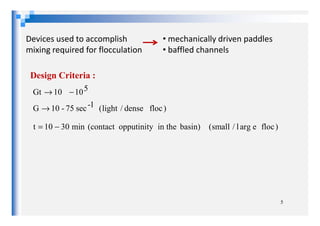
Devices used to accomplish
mixing required for flocculation
• mechanically driven paddles
• baffled channels
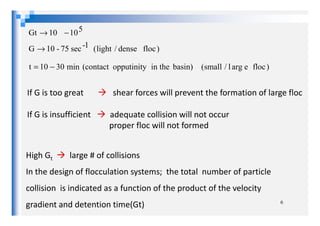
)flocdense/light(G
510Gt
1-sec75-10
10
→
−→
Design Criteria :
5
)floceargl/small(min3010t basin)in theopputinity(contact−=
)floceargl/small(min3010t
)flocdense/light(G
510Gt
basin)in theopputinity(contact
1-sec75-10
10
−=
→
−→
If G is too great shear forces will prevent the formation of large floc
If G is insufficient adequate collision will not occur
6
If G is insufficient adequate collision will not occur
proper floc will not formed
High Gt large # of collisions
In the design of flocculation systems; the total number of particle
collision is indicated as a function of the product of the velocity
gradient and detention time(Gt)
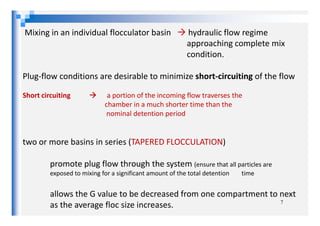
Mixing in an individual flocculator basin hydraulic flow regime
approaching complete mix
condition.
Plug-flow conditions are desirable to minimize short-circuiting of the flow
Short circuiting a portion of the incoming flow traverses the
chamber in a much shorter time than the
nominal detention periodnominal detention period
two or more basins in series (TAPERED FLOCCULATION)
promote plug flow through the system (ensure that all particles are
exposed to mixing for a significant amount of the total detention time
allows the G value to be decreased from one compartment to next
as the average floc size increases. 7
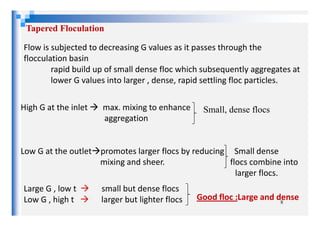
High G at the inlet max. mixing to enhance
aggregation
Tapered Floculation
Flow is subjected to decreasing G values as it passes through the
flocculation basin
rapid build up of small dense floc which subsequently aggregates at
lower G values into larger , dense, rapid settling floc particles.
Small, dense flocs
8
Large G , low t small but dense flocs
Low G , high t larger but lighter flocs Good floc :Large and dense
aggregation
Low G at the outlet promotes larger flocs by reducing Small dense
mixing and sheer. flocs combine into
larger flocs.
Small, dense flocs
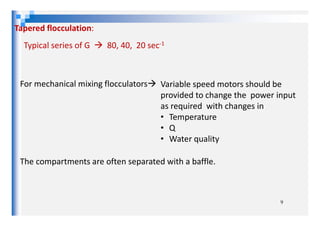
Tapered flocculation:
Typical series of G 80, 40, 20 sec-1
For mechanical mixing flocculators Variable speed motors should be
provided to change the power input
as required with changes in
• Temperature
9
• Temperature
• Q
• Water quality
The compartments are often separated with a baffle.
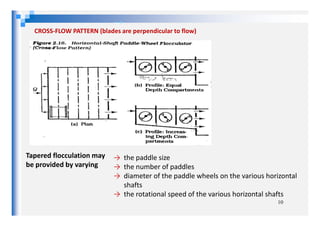
CROSS-FLOW PATTERN (blades are perpendicular to flow)
→ the paddle size
→ the number of paddles
→ diameter of the paddle wheels on the various horizontal
shafts
→ the rotational speed of the various horizontal shafts
10
Tapered flocculation may
be provided by varying
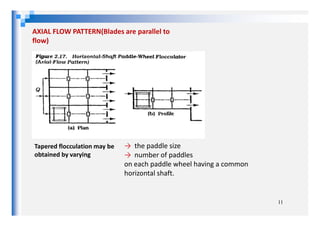
AXIAL FLOW PATTERN(Blades are parallel to
flow)
→ the paddle size
→ number of paddles
on each paddle wheel having a common
horizontal shaft.
11
Tapered flocculation may be
obtained by varying
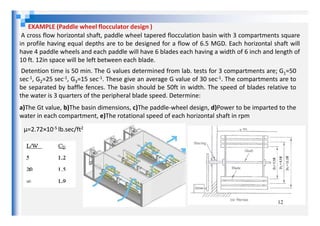
EXAMPLE (Paddle wheel flocculator design )
A cross flow horizontal shaft, paddle wheel tapered flocculation basin with 3 compartments square
in profile having equal depths are to be designed for a flow of 6.5 MGD. Each horizontal shaft will
have 4 paddle wheels and each paddle will have 6 blades each having a width of 6 inch and length of
10 ft. 12in space will be left between each blade.
Detention time is 50 min. The G values determined from lab. tests for 3 compartments are; G1=50
sec-1, G2=25 sec-1, G3=15 sec-1. These give an average G value of 30 sec-1. The compartments are to
be separated by baffle fences. The basin should be 50ft in width. The speed of blades relative to
the water is 3 quarters of the peripheral blade speed. Determine:
a)The Gt value, b)The basin dimensions, c)The paddle-wheel design, d)Power to be imparted to the
water in each compartment, e)The rotational speed of each horizontal shaft in rpm
12
water in each compartment, e)The rotational speed of each horizontal shaft in rpm
µ=2.72×10⁻⁵ lb.sec/ft2
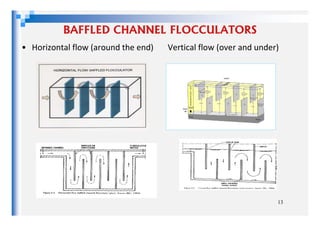
• Horizontal flow (around the end) Vertical flow (over and under)
BAFFLED CHANNEL FLOCCULATORS
13
→can be used for large treatment plants (Q>10000m3/day) where the
flowrates can maintain sufficient headlosses in the channels for slow
mixing without requiring that baffles be spaced too close together (which
would make cleaning difficult)
14
A distinct advantage They operate under plug
of such flocculators flow conditions
free from short
circuiting problems
The number of baffles needed to achieve a desired velocity gradient:
FOR HORIZONTAL FLOW
(around the end) BAFFLED
FLOCCULATOR
( )
3
1
2
Q
HLG
f44.1
t2
n
















+ρ
µ
=
n = number of baffles in the basin
H = depth of water in the basin (m)
L = length of the basin (m)
G = velocity gradient (sec-1)
15
G = velocity gradient (sec-1)
Q = flowrate (m3/sec)
t = time of flocculation (sec)
µ = dynamic viscosity (kg/m.sec)
ρ =density of water (kg/m3)
f = coefficient of friction of the baffles
w = width of the basin (m)
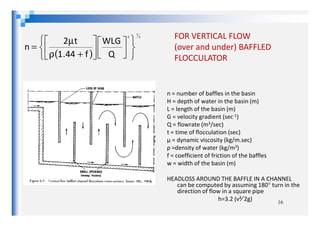
HEADLOSS AROUND THE BAFFLE IN A CHANNEL
can be computed by assuming 180° turn in the
direction of flow in a square pipe
h=3.2 (v²⁄ 2g)
( )
3
1
2
Q
WLG
f44.1
t2
n
















+ρ
µ
=
FOR VERTICAL FLOW
(over and under) BAFFLED
FLOCCULATOR
n = number of baffles in the basin
H = depth of water in the basin (m)
L = length of the basin (m)
G = velocity gradient (sec-1)
16
G = velocity gradient (sec-1)
Q = flowrate (m3/sec)
t = time of flocculation (sec)
µ = dynamic viscosity (kg/m.sec)
ρ =density of water (kg/m3)
f = coefficient of friction of the baffles
w = width of the basin (m)
HEADLOSS AROUND THE BAFFLE IN A CHANNEL
can be computed by assuming 180° turn in the
direction of flow in a square pipe
h=3.2 (v²⁄ 2g)
Water velocity in both horizontal flow and vertical flow units generally varies
0.1-0.3 m/sec
Detention time varies from 15-30 min
G = 10-100 sec-1
Other design criteria: Table 6.3 (Okun)
Tapered energy flocculation in baffled channels generally is achieved by
varying the spacing of the baffles. That is;
Close spacing of baffles for high velocity gradients
Wider spacing of baffles for low velocity gradients
17
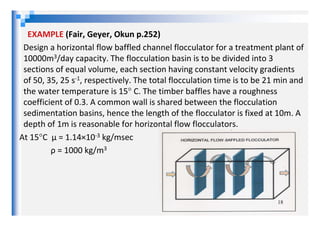
EXAMPLE (Fair, Geyer, Okun p.252)
Design a horizontal flow baffled channel flocculator for a treatment plant of
10000m3/day capacity. The flocculation basin is to be divided into 3
sections of equal volume, each section having constant velocity gradients
of 50, 35, 25 s-1, respectively. The total flocculation time is to be 21 min and
the water temperature is 15° C. The timber baffles have a roughness
coefficient of 0.3. A common wall is shared between the flocculation
sedimentation basins, hence the length of the flocculator is fixed at 10m. Asedimentation basins, hence the length of the flocculator is fixed at 10m. A
depth of 1m is reasonable for horizontal flow flocculators.
At 15°C µ = 1.14×10⁻³ kg/msec
ρ = 1000 kg/m3
18

Chp 9

  • 1.
    ENVE 301 Environmental EngineeringUnit Operations Design of Rapid mixing (Coagulation) CHAPTER: 9 1 Assist. Prof. Bilge Alpaslan Kocamemi Marmara University Department of Environmental Engineering Istanbul, Turkey Rapid mixing (Coagulation) Slow mixing (Flocculation) Units
  • 2.
    DESIGN OF RAPIDMIXING (COAGULATION) UNITS Rapid mixing unit : provide complete mixing of the coagulant and raw water. Destabilization of colloidal particle Early stages of floc formation → Hydraulic mixing units (see Chp.6 ) occur in rapid mixing unit → Hydraulic mixing units (see Chp.6 ) → Mechanically mixing units (see Chp.6) Design Criteria: G for rapid mix 700-1000 sec-1 t (detention time) for rapid mixing 20-60 sec 2
  • 3.
    → may besingle compartment or double compartment → Single compartment basins are usually circular or square in plan view Liquid depth = 1-1,25 x (basin diameter or width) (See Chp.6)Liquid depth = 1-1,25 x (basin diameter or width) (See Chp.6) → Small baffles are desirable to minimize vortexing.(See Chp.6) 3
  • 4.
    DESIGN OF SLOWMIXING (FLOCCULATION) UNITS Destabilized colloids resulting from coagulation may still settle very slowly Flocculation is a slow mixing process in which these particles are bought into contact in order to promote their agglomeration. The objective of flocculation is to provide increase in the number of contacts between coagulated particles by gentle and prolonged agitation 4
  • 5.
    Devices used toaccomplish mixing required for flocculation • mechanically driven paddles • baffled channels )flocdense/light(G 510Gt 1-sec75-10 10 → −→ Design Criteria : 5 )floceargl/small(min3010t basin)in theopputinity(contact−=
  • 6.
    )floceargl/small(min3010t )flocdense/light(G 510Gt basin)in theopputinity(contact 1-sec75-10 10 −= → −→ If Gis too great shear forces will prevent the formation of large floc If G is insufficient adequate collision will not occur 6 If G is insufficient adequate collision will not occur proper floc will not formed High Gt large # of collisions In the design of flocculation systems; the total number of particle collision is indicated as a function of the product of the velocity gradient and detention time(Gt)
  • 7.
    Mixing in anindividual flocculator basin hydraulic flow regime approaching complete mix condition. Plug-flow conditions are desirable to minimize short-circuiting of the flow Short circuiting a portion of the incoming flow traverses the chamber in a much shorter time than the nominal detention periodnominal detention period two or more basins in series (TAPERED FLOCCULATION) promote plug flow through the system (ensure that all particles are exposed to mixing for a significant amount of the total detention time allows the G value to be decreased from one compartment to next as the average floc size increases. 7
  • 8.
    High G atthe inlet max. mixing to enhance aggregation Tapered Floculation Flow is subjected to decreasing G values as it passes through the flocculation basin rapid build up of small dense floc which subsequently aggregates at lower G values into larger , dense, rapid settling floc particles. Small, dense flocs 8 Large G , low t small but dense flocs Low G , high t larger but lighter flocs Good floc :Large and dense aggregation Low G at the outlet promotes larger flocs by reducing Small dense mixing and sheer. flocs combine into larger flocs. Small, dense flocs
  • 9.
    Tapered flocculation: Typical seriesof G 80, 40, 20 sec-1 For mechanical mixing flocculators Variable speed motors should be provided to change the power input as required with changes in • Temperature 9 • Temperature • Q • Water quality The compartments are often separated with a baffle.
  • 10.
    CROSS-FLOW PATTERN (bladesare perpendicular to flow) → the paddle size → the number of paddles → diameter of the paddle wheels on the various horizontal shafts → the rotational speed of the various horizontal shafts 10 Tapered flocculation may be provided by varying
  • 11.
    AXIAL FLOW PATTERN(Bladesare parallel to flow) → the paddle size → number of paddles on each paddle wheel having a common horizontal shaft. 11 Tapered flocculation may be obtained by varying
  • 12.
    EXAMPLE (Paddle wheelflocculator design ) A cross flow horizontal shaft, paddle wheel tapered flocculation basin with 3 compartments square in profile having equal depths are to be designed for a flow of 6.5 MGD. Each horizontal shaft will have 4 paddle wheels and each paddle will have 6 blades each having a width of 6 inch and length of 10 ft. 12in space will be left between each blade. Detention time is 50 min. The G values determined from lab. tests for 3 compartments are; G1=50 sec-1, G2=25 sec-1, G3=15 sec-1. These give an average G value of 30 sec-1. The compartments are to be separated by baffle fences. The basin should be 50ft in width. The speed of blades relative to the water is 3 quarters of the peripheral blade speed. Determine: a)The Gt value, b)The basin dimensions, c)The paddle-wheel design, d)Power to be imparted to the water in each compartment, e)The rotational speed of each horizontal shaft in rpm 12 water in each compartment, e)The rotational speed of each horizontal shaft in rpm µ=2.72×10⁻⁵ lb.sec/ft2
  • 13.
    • Horizontal flow(around the end) Vertical flow (over and under) BAFFLED CHANNEL FLOCCULATORS 13
  • 14.
    →can be usedfor large treatment plants (Q>10000m3/day) where the flowrates can maintain sufficient headlosses in the channels for slow mixing without requiring that baffles be spaced too close together (which would make cleaning difficult) 14 A distinct advantage They operate under plug of such flocculators flow conditions free from short circuiting problems
  • 15.
    The number ofbaffles needed to achieve a desired velocity gradient: FOR HORIZONTAL FLOW (around the end) BAFFLED FLOCCULATOR ( ) 3 1 2 Q HLG f44.1 t2 n                 +ρ µ = n = number of baffles in the basin H = depth of water in the basin (m) L = length of the basin (m) G = velocity gradient (sec-1) 15 G = velocity gradient (sec-1) Q = flowrate (m3/sec) t = time of flocculation (sec) µ = dynamic viscosity (kg/m.sec) ρ =density of water (kg/m3) f = coefficient of friction of the baffles w = width of the basin (m) HEADLOSS AROUND THE BAFFLE IN A CHANNEL can be computed by assuming 180° turn in the direction of flow in a square pipe h=3.2 (v²⁄ 2g)
  • 16.
    ( ) 3 1 2 Q WLG f44.1 t2 n                 +ρ µ = FOR VERTICALFLOW (over and under) BAFFLED FLOCCULATOR n = number of baffles in the basin H = depth of water in the basin (m) L = length of the basin (m) G = velocity gradient (sec-1) 16 G = velocity gradient (sec-1) Q = flowrate (m3/sec) t = time of flocculation (sec) µ = dynamic viscosity (kg/m.sec) ρ =density of water (kg/m3) f = coefficient of friction of the baffles w = width of the basin (m) HEADLOSS AROUND THE BAFFLE IN A CHANNEL can be computed by assuming 180° turn in the direction of flow in a square pipe h=3.2 (v²⁄ 2g)
  • 17.
    Water velocity inboth horizontal flow and vertical flow units generally varies 0.1-0.3 m/sec Detention time varies from 15-30 min G = 10-100 sec-1 Other design criteria: Table 6.3 (Okun) Tapered energy flocculation in baffled channels generally is achieved by varying the spacing of the baffles. That is; Close spacing of baffles for high velocity gradients Wider spacing of baffles for low velocity gradients 17
  • 18.
    EXAMPLE (Fair, Geyer,Okun p.252) Design a horizontal flow baffled channel flocculator for a treatment plant of 10000m3/day capacity. The flocculation basin is to be divided into 3 sections of equal volume, each section having constant velocity gradients of 50, 35, 25 s-1, respectively. The total flocculation time is to be 21 min and the water temperature is 15° C. The timber baffles have a roughness coefficient of 0.3. A common wall is shared between the flocculation sedimentation basins, hence the length of the flocculator is fixed at 10m. Asedimentation basins, hence the length of the flocculator is fixed at 10m. A depth of 1m is reasonable for horizontal flow flocculators. At 15°C µ = 1.14×10⁻³ kg/msec ρ = 1000 kg/m3 18