Dr.N.G.P. Institute of Technology
(An autonomous Institution)
Coimbatore-48
Campus Sustainability and Resource Management
Modelathon
Organises by
Student Development Cell, NGPiTech
Presented By:
1.R Sivaprashad (710721103007)
2.R.Gowtham (710721103303)
3.V
.Manoj (710721103004)
4.J.Jayakumar (710721103002)
Final Year, Civil Engineering
Guided By:
Mr.V
.K.Shankar,
Assistant Professor,
Department of Civil Engineering
Dr.N.G.P
. Institute of Technology
Coimbatore-48
• Problem Statement Title- Water Purifier Maintenance
• Problem Statement- Many water purifiers on campus are frequently out of
order, limiting access to clean drinking water. How can we implement a
system to regularly maintain and monitor water purifiers for consistent
access to safe drinking water?
• Team Name: NEERTHULIKAL
Campus Sustainability and Resource Management Modelathon
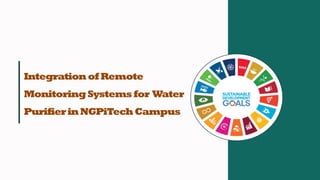
IntegrationofRemote
MonitoringSystemsfor Water
PurifierinNGPiTechCampus
A potential technical solution to address the frequent
breakdowns of water purifiers on our campus could be
“Integrating IoT-based sensors for real-time monitoring
and predictive maintenance”.
Technical Solution for Problem Statement
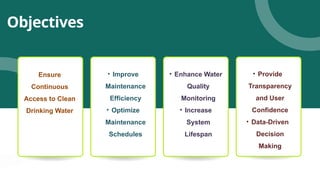
Ensure
Continuous
Access to Clean
Drinking Water
• Improve
Maintenance
Efficiency
• Optimize
Maintenance
Schedules
• Enhance Water
Quality
Monitoring
• Increase
System
Lifespan
• Provide
Transparency
and User
Confidence
• Data-Driven
Decision
Making
Objectives
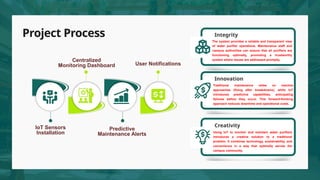
Project Process
IoT Sensors
Installation
Centralized
Monitoring Dashboard
Predictive
Maintenance Alerts
User Notifications
The system provides a reliable and transparent view
of water purifier operations. Maintenance staff and
campus authorities can ensure that all purifiers are
functioning optimally, promoting a trustworthy
system where issues are addressed promptly.
Integrity
Traditional maintenance relies on reactive
approaches (fixing after breakdowns), while IoT
introduces predictive capabilities, anticipating
failures before they occur. This forward-thinking
approach reduces downtime and operational costs.
Innovation
Using IoT to monitor and maintain water purifiers
introduces a creative solution to a traditional
problem. It combines technology, sustainability, and
convenience in a way that optimally serves the
campus community.
Creativity
IMPACT AND BENEFITS
Integrating IoT-based sensors for real-time monitoring and predictive maintenance of
water purifiers on the NGP campus would have significant benefits. First, it would
enhance the reliability of the purifiers by continuously tracking their operational status,
ensuring that maintenance teams are promptly alerted to potential issues before they
lead to breakdowns. This predictive maintenance approach would minimize downtime
and extend the lifespan of the equipment, ultimately reducing repair and replacement
costs. Additionally, the system would provide real-time insights into water quality,
ensuring the safety of drinking water for students and staff. With a centralized
monitoring platform, maintenance becomes more efficient and proactive, leading to
improved resource management and better planning of maintenance schedules.
The system would also foster greater user trust in campus facilities, as users can be
confident in the consistent availability of safe drinking water. Overall, this smart solution
would promote a more sustainable, cost-effective, and health-conscious campus
environment.
Cost Analysis for IoT-Based Water Purifier Monitoring System
Initial Hardware Costs:
IoT Sensors (Water Quality, Flow Rate, and Filter Condition Sensors): 2,000 - 5,000 per
₹ ₹
unit, depending on the complexity of sensors and the number of parameters monitored.
Microcontroller/IoT Gateway (e.g., Raspberry Pi, Arduino): 2,500 - 4,000 per purifier for
₹ ₹
connecting sensors to the network.
Installation Charges: 1,000 - 1,500 per purifier for sensor setup and integration with the
₹ ₹
cloud platform.
Cloud Hosting and Storage: 5,000 - 10,000 per annum for storing and processing the
₹ ₹
data.
Total Initial Setup Cost per Water Purifier: 10,500 -
₹ ₹20,500
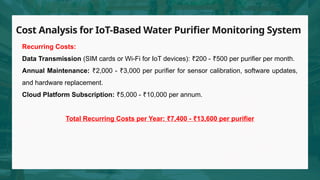
Cost Analysis for IoT-Based Water Purifier Monitoring System
Recurring Costs:
Data Transmission (SIM cards or Wi-Fi for IoT devices): 200 - 500 per purifier per month.
₹ ₹
Annual Maintenance: 2,000 - 3,000 per purifier for sensor calibration, software updates,
₹ ₹
and hardware replacement.
Cloud Platform Subscription: 5,000 - 10,000 per annum.
₹ ₹
Total Recurring Costs per Year: 7,400 - 13,600 per purifier
₹ ₹
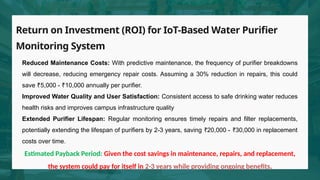
Return on Investment (ROI) for IoT-Based Water Purifier
Monitoring System
Reduced Maintenance Costs: With predictive maintenance, the frequency of purifier breakdowns
will decrease, reducing emergency repair costs. Assuming a 30% reduction in repairs, this could
save 5,000 - 10,000 annually per purifier.
₹ ₹
Improved Water Quality and User Satisfaction: Consistent access to safe drinking water reduces
health risks and improves campus infrastructure quality
Extended Purifier Lifespan: Regular monitoring ensures timely repairs and filter replacements,
potentially extending the lifespan of purifiers by 2-3 years, saving 20,000 - 30,000 in replacement
₹ ₹
costs over time.
Estimated Payback Period: Given the cost savings in maintenance, repairs, and replacement,
the system could pay for itself in 2-3 years while providing ongoing benefits.
Resource Page
THANKYOU

water purificatiocccffffn maintenance.ppt

  • 1.
    Dr.N.G.P. Institute ofTechnology (An autonomous Institution) Coimbatore-48 Campus Sustainability and Resource Management Modelathon Organises by Student Development Cell, NGPiTech Presented By: 1.R Sivaprashad (710721103007) 2.R.Gowtham (710721103303) 3.V .Manoj (710721103004) 4.J.Jayakumar (710721103002) Final Year, Civil Engineering Guided By: Mr.V .K.Shankar, Assistant Professor, Department of Civil Engineering Dr.N.G.P . Institute of Technology Coimbatore-48
  • 2.
    • Problem StatementTitle- Water Purifier Maintenance • Problem Statement- Many water purifiers on campus are frequently out of order, limiting access to clean drinking water. How can we implement a system to regularly maintain and monitor water purifiers for consistent access to safe drinking water? • Team Name: NEERTHULIKAL Campus Sustainability and Resource Management Modelathon
  • 3.
  • 4.
    A potential technicalsolution to address the frequent breakdowns of water purifiers on our campus could be “Integrating IoT-based sensors for real-time monitoring and predictive maintenance”. Technical Solution for Problem Statement
  • 5.
    Ensure Continuous Access to Clean DrinkingWater • Improve Maintenance Efficiency • Optimize Maintenance Schedules • Enhance Water Quality Monitoring • Increase System Lifespan • Provide Transparency and User Confidence • Data-Driven Decision Making Objectives
  • 6.
    Project Process IoT Sensors Installation Centralized MonitoringDashboard Predictive Maintenance Alerts User Notifications The system provides a reliable and transparent view of water purifier operations. Maintenance staff and campus authorities can ensure that all purifiers are functioning optimally, promoting a trustworthy system where issues are addressed promptly. Integrity Traditional maintenance relies on reactive approaches (fixing after breakdowns), while IoT introduces predictive capabilities, anticipating failures before they occur. This forward-thinking approach reduces downtime and operational costs. Innovation Using IoT to monitor and maintain water purifiers introduces a creative solution to a traditional problem. It combines technology, sustainability, and convenience in a way that optimally serves the campus community. Creativity
  • 7.
    IMPACT AND BENEFITS IntegratingIoT-based sensors for real-time monitoring and predictive maintenance of water purifiers on the NGP campus would have significant benefits. First, it would enhance the reliability of the purifiers by continuously tracking their operational status, ensuring that maintenance teams are promptly alerted to potential issues before they lead to breakdowns. This predictive maintenance approach would minimize downtime and extend the lifespan of the equipment, ultimately reducing repair and replacement costs. Additionally, the system would provide real-time insights into water quality, ensuring the safety of drinking water for students and staff. With a centralized monitoring platform, maintenance becomes more efficient and proactive, leading to improved resource management and better planning of maintenance schedules. The system would also foster greater user trust in campus facilities, as users can be confident in the consistent availability of safe drinking water. Overall, this smart solution would promote a more sustainable, cost-effective, and health-conscious campus environment.
  • 8.
    Cost Analysis forIoT-Based Water Purifier Monitoring System Initial Hardware Costs: IoT Sensors (Water Quality, Flow Rate, and Filter Condition Sensors): 2,000 - 5,000 per ₹ ₹ unit, depending on the complexity of sensors and the number of parameters monitored. Microcontroller/IoT Gateway (e.g., Raspberry Pi, Arduino): 2,500 - 4,000 per purifier for ₹ ₹ connecting sensors to the network. Installation Charges: 1,000 - 1,500 per purifier for sensor setup and integration with the ₹ ₹ cloud platform. Cloud Hosting and Storage: 5,000 - 10,000 per annum for storing and processing the ₹ ₹ data. Total Initial Setup Cost per Water Purifier: 10,500 - ₹ ₹20,500
  • 9.
    Cost Analysis forIoT-Based Water Purifier Monitoring System Recurring Costs: Data Transmission (SIM cards or Wi-Fi for IoT devices): 200 - 500 per purifier per month. ₹ ₹ Annual Maintenance: 2,000 - 3,000 per purifier for sensor calibration, software updates, ₹ ₹ and hardware replacement. Cloud Platform Subscription: 5,000 - 10,000 per annum. ₹ ₹ Total Recurring Costs per Year: 7,400 - 13,600 per purifier ₹ ₹
  • 10.
    Return on Investment(ROI) for IoT-Based Water Purifier Monitoring System Reduced Maintenance Costs: With predictive maintenance, the frequency of purifier breakdowns will decrease, reducing emergency repair costs. Assuming a 30% reduction in repairs, this could save 5,000 - 10,000 annually per purifier. ₹ ₹ Improved Water Quality and User Satisfaction: Consistent access to safe drinking water reduces health risks and improves campus infrastructure quality Extended Purifier Lifespan: Regular monitoring ensures timely repairs and filter replacements, potentially extending the lifespan of purifiers by 2-3 years, saving 20,000 - 30,000 in replacement ₹ ₹ costs over time. Estimated Payback Period: Given the cost savings in maintenance, repairs, and replacement, the system could pay for itself in 2-3 years while providing ongoing benefits.
  • 11.
  • 12.