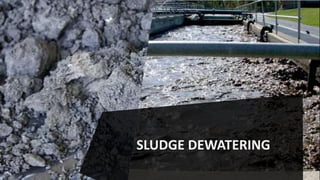
SLUDGE DEWATERING
SLUDGE
The semi solid slurry obtained as
the by-product from treatment
plants such as waste from coal
washery or suspended solids
from water treatment plants
termed as “SLUDGE”.
If the sludge is organic in origin (major constituents N
and P and energy (C)) is termed as biosolids either
obtained from industrial or municipal treatment plants
[2].
SLUDGE
Secondary Mixed
Activated/
Digested
Physicoche
mical
Mineral
Primary
Types of Sludge
The dumping of raw sludge in
ocean was banned in 1987
under the Helsinki Agreement
Why its need to be treated?
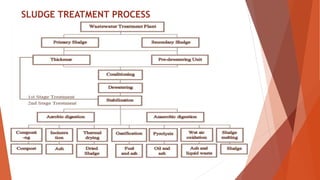
SLUDGE TREATMENT PROCESS
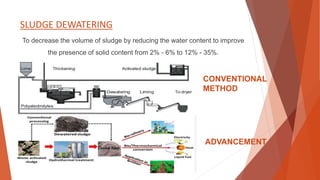
SLUDGE DEWATERING
To decrease the volume of sludge by reducing the water content to improve
the presence of solid content from 2% - 6% to 12% - 35%.
CONVENTIONAL
METHOD
ADVANCEMENT
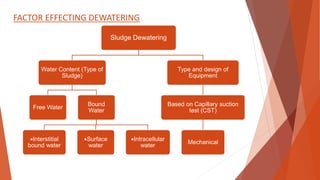
Sludge Dewatering
Water Content (Type of
Sludge)
Free Water
Bound
Water
Interstitial
bound water
Surface
water
Intracellular
water
Type and design of
Equipment
Based on Capillary suction
test (CST)
Mechanical
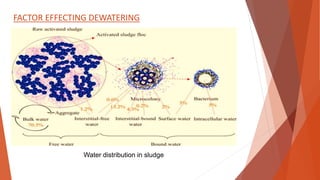
FACTOR EFFECTING DEWATERING
Water distribution in sludge
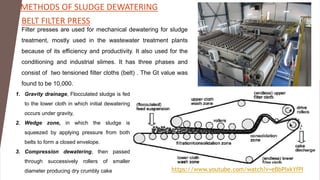
BELT FILTER PRESS
https://www.youtube.com/watch?v=eBbPIxkYfPI
Filter presses are used for mechanical dewatering for sludge
treatment, mostly used in the wastewater treatment plants
because of its efficiency and productivity. It also used for the
conditioning and industrial slimes. It has three phases and
consist of two tensioned filter cloths (belt) . The Gt value was
found to be 10,000.
1. Gravity drainage, Flocculated sludge is fed
to the lower cloth in which initial dewatering
occurs under gravity,
2. Wedge zone, in which the sludge is
squeezed by applying pressure from both
belts to form a closed envelope.
3. Compression dewatering, then passed
through successively rollers of smaller
diameter producing dry crumbly cake
METHODS OF SLUDGE DEWATERING
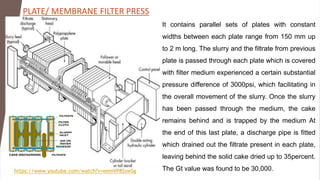
PLATE/ MEMBRANE FILTER PRESS
https://www.youtube.com/watch?v=eemVP8SswSg
It contains parallel sets of plates with constant
widths between each plate range from 150 mm up
to 2 m long. The slurry and the filtrate from previous
plate is passed through each plate which is covered
with filter medium experienced a certain substantial
pressure difference of 3000psi, which facilitating in
the overall movement of the slurry. Once the slurry
has been passed through the medium, the cake
remains behind and is trapped by the medium At
the end of this last plate, a discharge pipe is fitted
which drained out the filtrate present in each plate,
leaving behind the solid cake dried up to 35percent.
The Gt value was found to be 30,000.
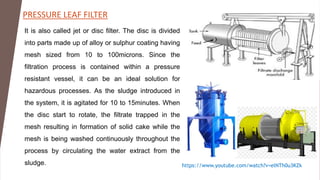
PRESSURE LEAF FILTER
https://www.youtube.com/watch?v=elNTh0u3KZk
It is also called jet or disc filter. The disc is divided
into parts made up of alloy or sulphur coating having
mesh sized from 10 to 100microns. Since the
filtration process is contained within a pressure
resistant vessel, it can be an ideal solution for
hazardous processes. As the sludge introduced in
the system, it is agitated for 10 to 15minutes. When
the disc start to rotate, the filtrate trapped in the
mesh resulting in formation of solid cake while the
mesh is being washed continuously throughout the
process by circulating the water extract from the
sludge.
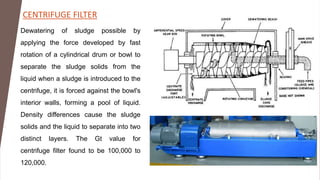
CENTRIFUGE FILTER
Dewatering of sludge possible by
applying the force developed by fast
rotation of a cylindrical drum or bowl to
separate the sludge solids from the
liquid when a sludge is introduced to the
centrifuge, it is forced against the bowl's
interior walls, forming a pool of liquid.
Density differences cause the sludge
solids and the liquid to separate into two
distinct layers. The Gt value for
centrifuge filter found to be 100,000 to
120,000.
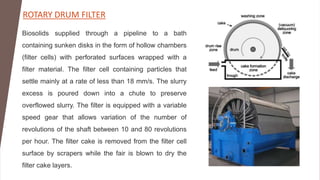
ROTARY DRUM FILTER
Biosolids supplied through a pipeline to a bath
containing sunken disks in the form of hollow chambers
(filter cells) with perforated surfaces wrapped with a
filter material. The filter cell containing particles that
settle mainly at a rate of less than 18 mm/s. The slurry
excess is poured down into a chute to preserve
overflowed slurry. The filter is equipped with a variable
speed gear that allows variation of the number of
revolutions of the shaft between 10 and 80 revolutions
per hour. The filter cake is removed from the filter cell
surface by scrapers while the fair is blown to dry the
filter cake layers.
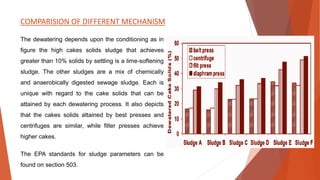
COMPARISION OF DIFFERENT MECHANISM
The dewatering depends upon the conditioning as in
figure the high cakes solids sludge that achieves
greater than 10% solids by settling is a lime-softening
sludge. The other sludges are a mix of chemically
and anaerobically digested sewage sludge. Each is
unique with regard to the cake solids that can be
attained by each dewatering process. It also depicts
that the cakes solids attained by best presses and
centrifuges are similar, while filter presses achieve
higher cakes.
The EPA standards for sludge parameters can be
found on section 503.
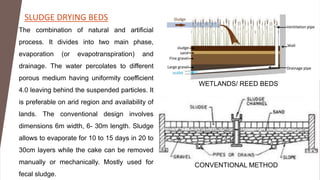
SLUDGE DRYING BEDS
The combination of natural and artificial
process. It divides into two main phase,
evaporation (or evapotranspiration) and
drainage. The water percolates to different
porous medium having uniformity coefficient
4.0 leaving behind the suspended particles. It
is preferable on arid region and availability of
lands. The conventional design involves
dimensions 6m width, 6- 30m length. Sludge
allows to evaporate for 10 to 15 days in 20 to
30cm layers while the cake can be removed
manually or mechanically. Mostly used for
fecal sludge.
WETLANDS/ REED BEDS
CONVENTIONAL METHOD
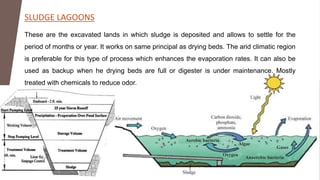
SLUDGE LAGOONS
These are the excavated lands in which sludge is deposited and allows to settle for the
period of months or year. It works on same principal as drying beds. The arid climatic region
is preferable for this type of process which enhances the evaporation rates. It can also be
used as backup when he drying beds are full or digester is under maintenance. Mostly
treated with chemicals to reduce odor.
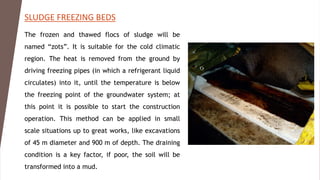
SLUDGE FREEZING BEDS
The frozen and thawed flocs of sludge will be
named “zots”. It is suitable for the cold climatic
region. The heat is removed from the ground by
driving freezing pipes (in which a refrigerant liquid
circulates) into it, until the temperature is below
the freezing point of the groundwater system; at
this point it is possible to start the construction
operation. This method can be applied in small
scale situations up to great works, like excavations
of 45 m diameter and 900 m of depth. The draining
condition is a key factor, if poor, the soil will be
transformed into a mud.
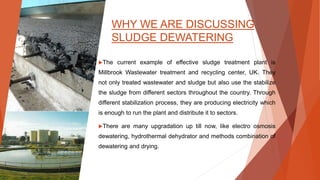
WHY WE ARE DISCUSSING
SLUDGE DEWATERING
The current example of effective sludge treatment plant is
Millbrook Wastewater treatment and recycling center, UK. They
not only treated wastewater and sludge but also use the stabilize
the sludge from different sectors throughout the country. Through
different stabilization process, they are producing electricity which
is enough to run the plant and distribute it to sectors.
There are many upgradation up till now, like electro osmosis
dewatering, hydrothermal dehydrator and methods combination of
dewatering and drying.
CONCLUSION
Dewatering of sludge is environmentally friendly methods as its by-products can be
used in many different ways. Conditioning prior to dewatering is necessary to
enhance the efficiency of process. Different equipment can be used based on the
requirement, type of sludge to be treated and climatic condition.
It helps to manage the disposal by reducing the volume of the waste while the
water extracted from sludge can be recycle and used for the process hence reduce
the amount of water used for the treatment.
With the advancement of technologies, not only reduce space occupancy but
increase the efficiency of entire process.
REFERENCES
[1] Naem Sadiq, “Karachi sinking in its own sewage,” The Express Turbine, Karachi, Aug. 18, 2018.
[2] “Sludge Dewatering,” Hiller Separation & Process. http://www.hiller-us.com/sludge-
dewatering.php#:~:text=Sludge%20dewatering%20is%20the%20separation,(%22the%20centrate%22).
[3] G. Kiely, Environmental Engineering. McGraw- Hill, 1998.
[4] G. Chen, P. L. Yue, and A. S. Mujumdar, “Sludge dewatering and drying,” Drying Technology, vol. 20, no.
4–5, pp. 883–916, 2002, doi: 10.1081/DRT-120003768.
[5] J. T. Novak, “Dewatering of sewage sludge,” Drying Technology, vol. 24, no. 10, pp. 1257–1262, 2006,
doi: 10.1080/07373930600840419.
[6] “Water distribution in sludge.” https://www.sciencedirect.com/science/article/abs/pii/S0964830516303924.
[7] R. J. Wakeman, “Separation technologies for sludge dewatering,” Journal of Hazardous Materials, vol.
144, no. 3, pp. 614–619, Jun. 2007, doi: 10.1016/j.jhazmat.2007.01.084.
[8] https://steemit.com/steemstem/@akeelsingh/equipment-of-filtration-part-2, “Filter press.” .
[9] http://www.chinafilterpress.net/application/sludge-dewatering-centrifuge.html, “Centrifuge.”
http://www.chinafilterpress.net/application/sludge-dewatering-centrifuge.html (accessed Sep. 25, 2020).
[10] O. Franceschini, “Dewatering of sludge by freezing.” 2010.
[11] Rohit Bhagwat (Ecosan Services Foundation (ESF)), “Sludge drying beds.”
[12] “Sludge Lagoons,” Eurocode Standards, Aug. 01, 2019.
THANK YOU
EN-15 MINZA MUMTAZ

Sludge Dewatering

  • 1.
  • 2.
    SLUDGE The semi solidslurry obtained as the by-product from treatment plants such as waste from coal washery or suspended solids from water treatment plants termed as “SLUDGE”. If the sludge is organic in origin (major constituents N and P and energy (C)) is termed as biosolids either obtained from industrial or municipal treatment plants [2]. SLUDGE Secondary Mixed Activated/ Digested Physicoche mical Mineral Primary Types of Sludge The dumping of raw sludge in ocean was banned in 1987 under the Helsinki Agreement Why its need to be treated?
  • 3.
  • 4.
    SLUDGE DEWATERING To decreasethe volume of sludge by reducing the water content to improve the presence of solid content from 2% - 6% to 12% - 35%. CONVENTIONAL METHOD ADVANCEMENT
  • 5.
    Sludge Dewatering Water Content(Type of Sludge) Free Water Bound Water Interstitial bound water Surface water Intracellular water Type and design of Equipment Based on Capillary suction test (CST) Mechanical FACTOR EFFECTING DEWATERING
  • 6.
    FACTOR EFFECTING DEWATERING Waterdistribution in sludge
  • 7.
    BELT FILTER PRESS https://www.youtube.com/watch?v=eBbPIxkYfPI Filterpresses are used for mechanical dewatering for sludge treatment, mostly used in the wastewater treatment plants because of its efficiency and productivity. It also used for the conditioning and industrial slimes. It has three phases and consist of two tensioned filter cloths (belt) . The Gt value was found to be 10,000. 1. Gravity drainage, Flocculated sludge is fed to the lower cloth in which initial dewatering occurs under gravity, 2. Wedge zone, in which the sludge is squeezed by applying pressure from both belts to form a closed envelope. 3. Compression dewatering, then passed through successively rollers of smaller diameter producing dry crumbly cake METHODS OF SLUDGE DEWATERING
  • 8.
    PLATE/ MEMBRANE FILTERPRESS https://www.youtube.com/watch?v=eemVP8SswSg It contains parallel sets of plates with constant widths between each plate range from 150 mm up to 2 m long. The slurry and the filtrate from previous plate is passed through each plate which is covered with filter medium experienced a certain substantial pressure difference of 3000psi, which facilitating in the overall movement of the slurry. Once the slurry has been passed through the medium, the cake remains behind and is trapped by the medium At the end of this last plate, a discharge pipe is fitted which drained out the filtrate present in each plate, leaving behind the solid cake dried up to 35percent. The Gt value was found to be 30,000.
  • 9.
    PRESSURE LEAF FILTER https://www.youtube.com/watch?v=elNTh0u3KZk Itis also called jet or disc filter. The disc is divided into parts made up of alloy or sulphur coating having mesh sized from 10 to 100microns. Since the filtration process is contained within a pressure resistant vessel, it can be an ideal solution for hazardous processes. As the sludge introduced in the system, it is agitated for 10 to 15minutes. When the disc start to rotate, the filtrate trapped in the mesh resulting in formation of solid cake while the mesh is being washed continuously throughout the process by circulating the water extract from the sludge.
  • 10.
    CENTRIFUGE FILTER Dewatering ofsludge possible by applying the force developed by fast rotation of a cylindrical drum or bowl to separate the sludge solids from the liquid when a sludge is introduced to the centrifuge, it is forced against the bowl's interior walls, forming a pool of liquid. Density differences cause the sludge solids and the liquid to separate into two distinct layers. The Gt value for centrifuge filter found to be 100,000 to 120,000.
  • 11.
    ROTARY DRUM FILTER Biosolidssupplied through a pipeline to a bath containing sunken disks in the form of hollow chambers (filter cells) with perforated surfaces wrapped with a filter material. The filter cell containing particles that settle mainly at a rate of less than 18 mm/s. The slurry excess is poured down into a chute to preserve overflowed slurry. The filter is equipped with a variable speed gear that allows variation of the number of revolutions of the shaft between 10 and 80 revolutions per hour. The filter cake is removed from the filter cell surface by scrapers while the fair is blown to dry the filter cake layers.
  • 12.
    COMPARISION OF DIFFERENTMECHANISM The dewatering depends upon the conditioning as in figure the high cakes solids sludge that achieves greater than 10% solids by settling is a lime-softening sludge. The other sludges are a mix of chemically and anaerobically digested sewage sludge. Each is unique with regard to the cake solids that can be attained by each dewatering process. It also depicts that the cakes solids attained by best presses and centrifuges are similar, while filter presses achieve higher cakes. The EPA standards for sludge parameters can be found on section 503.
  • 13.
    SLUDGE DRYING BEDS Thecombination of natural and artificial process. It divides into two main phase, evaporation (or evapotranspiration) and drainage. The water percolates to different porous medium having uniformity coefficient 4.0 leaving behind the suspended particles. It is preferable on arid region and availability of lands. The conventional design involves dimensions 6m width, 6- 30m length. Sludge allows to evaporate for 10 to 15 days in 20 to 30cm layers while the cake can be removed manually or mechanically. Mostly used for fecal sludge. WETLANDS/ REED BEDS CONVENTIONAL METHOD
  • 14.
    SLUDGE LAGOONS These arethe excavated lands in which sludge is deposited and allows to settle for the period of months or year. It works on same principal as drying beds. The arid climatic region is preferable for this type of process which enhances the evaporation rates. It can also be used as backup when he drying beds are full or digester is under maintenance. Mostly treated with chemicals to reduce odor.
  • 15.
    SLUDGE FREEZING BEDS Thefrozen and thawed flocs of sludge will be named “zots”. It is suitable for the cold climatic region. The heat is removed from the ground by driving freezing pipes (in which a refrigerant liquid circulates) into it, until the temperature is below the freezing point of the groundwater system; at this point it is possible to start the construction operation. This method can be applied in small scale situations up to great works, like excavations of 45 m diameter and 900 m of depth. The draining condition is a key factor, if poor, the soil will be transformed into a mud.
  • 16.
    WHY WE AREDISCUSSING SLUDGE DEWATERING The current example of effective sludge treatment plant is Millbrook Wastewater treatment and recycling center, UK. They not only treated wastewater and sludge but also use the stabilize the sludge from different sectors throughout the country. Through different stabilization process, they are producing electricity which is enough to run the plant and distribute it to sectors. There are many upgradation up till now, like electro osmosis dewatering, hydrothermal dehydrator and methods combination of dewatering and drying.
  • 17.
    CONCLUSION Dewatering of sludgeis environmentally friendly methods as its by-products can be used in many different ways. Conditioning prior to dewatering is necessary to enhance the efficiency of process. Different equipment can be used based on the requirement, type of sludge to be treated and climatic condition. It helps to manage the disposal by reducing the volume of the waste while the water extracted from sludge can be recycle and used for the process hence reduce the amount of water used for the treatment. With the advancement of technologies, not only reduce space occupancy but increase the efficiency of entire process.
  • 18.
    REFERENCES [1] Naem Sadiq,“Karachi sinking in its own sewage,” The Express Turbine, Karachi, Aug. 18, 2018. [2] “Sludge Dewatering,” Hiller Separation & Process. http://www.hiller-us.com/sludge- dewatering.php#:~:text=Sludge%20dewatering%20is%20the%20separation,(%22the%20centrate%22). [3] G. Kiely, Environmental Engineering. McGraw- Hill, 1998. [4] G. Chen, P. L. Yue, and A. S. Mujumdar, “Sludge dewatering and drying,” Drying Technology, vol. 20, no. 4–5, pp. 883–916, 2002, doi: 10.1081/DRT-120003768. [5] J. T. Novak, “Dewatering of sewage sludge,” Drying Technology, vol. 24, no. 10, pp. 1257–1262, 2006, doi: 10.1080/07373930600840419. [6] “Water distribution in sludge.” https://www.sciencedirect.com/science/article/abs/pii/S0964830516303924. [7] R. J. Wakeman, “Separation technologies for sludge dewatering,” Journal of Hazardous Materials, vol. 144, no. 3, pp. 614–619, Jun. 2007, doi: 10.1016/j.jhazmat.2007.01.084. [8] https://steemit.com/steemstem/@akeelsingh/equipment-of-filtration-part-2, “Filter press.” . [9] http://www.chinafilterpress.net/application/sludge-dewatering-centrifuge.html, “Centrifuge.” http://www.chinafilterpress.net/application/sludge-dewatering-centrifuge.html (accessed Sep. 25, 2020). [10] O. Franceschini, “Dewatering of sludge by freezing.” 2010. [11] Rohit Bhagwat (Ecosan Services Foundation (ESF)), “Sludge drying beds.” [12] “Sludge Lagoons,” Eurocode Standards, Aug. 01, 2019.
  • 19.

Editor's Notes

  • #6 Bound water: the water that will not freeze at -20 degree centigrade.
  • #7 Bound water: the water that will not freeze at -20 degree centigrade.
  • #14 D60/D10