Construction Dewatering
Seb Fisher
Managing Director, Groundwater Engineering
January 2014

www.groundwaterinternational.com
Company Profile
Groundwater Engineering is an international company specializing in
dewatering, groundwater control and water well engineering for
clients in the construction, mining and oil & gas industries
Backed by decades of industry experience and technical expertise we
are committed to providing our clients with high quality and costeffective solutions to their groundwater problems based on offering
services in:
• Contracting
• Consultancy
• Equipment sales and rental

www.groundwaterinternational.com
Synopsis
• Definition of dewatering

• Surface water control
• Widely used dewatering techniques

• Less commonly used dewatering techniques

www.groundwaterinternational.com
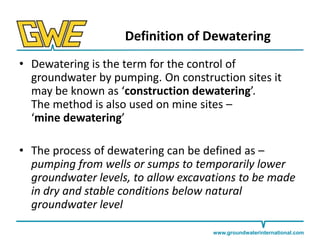
Definition of Dewatering
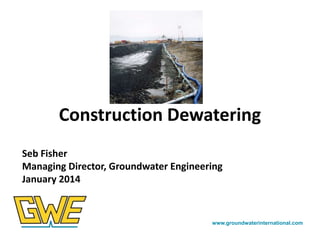
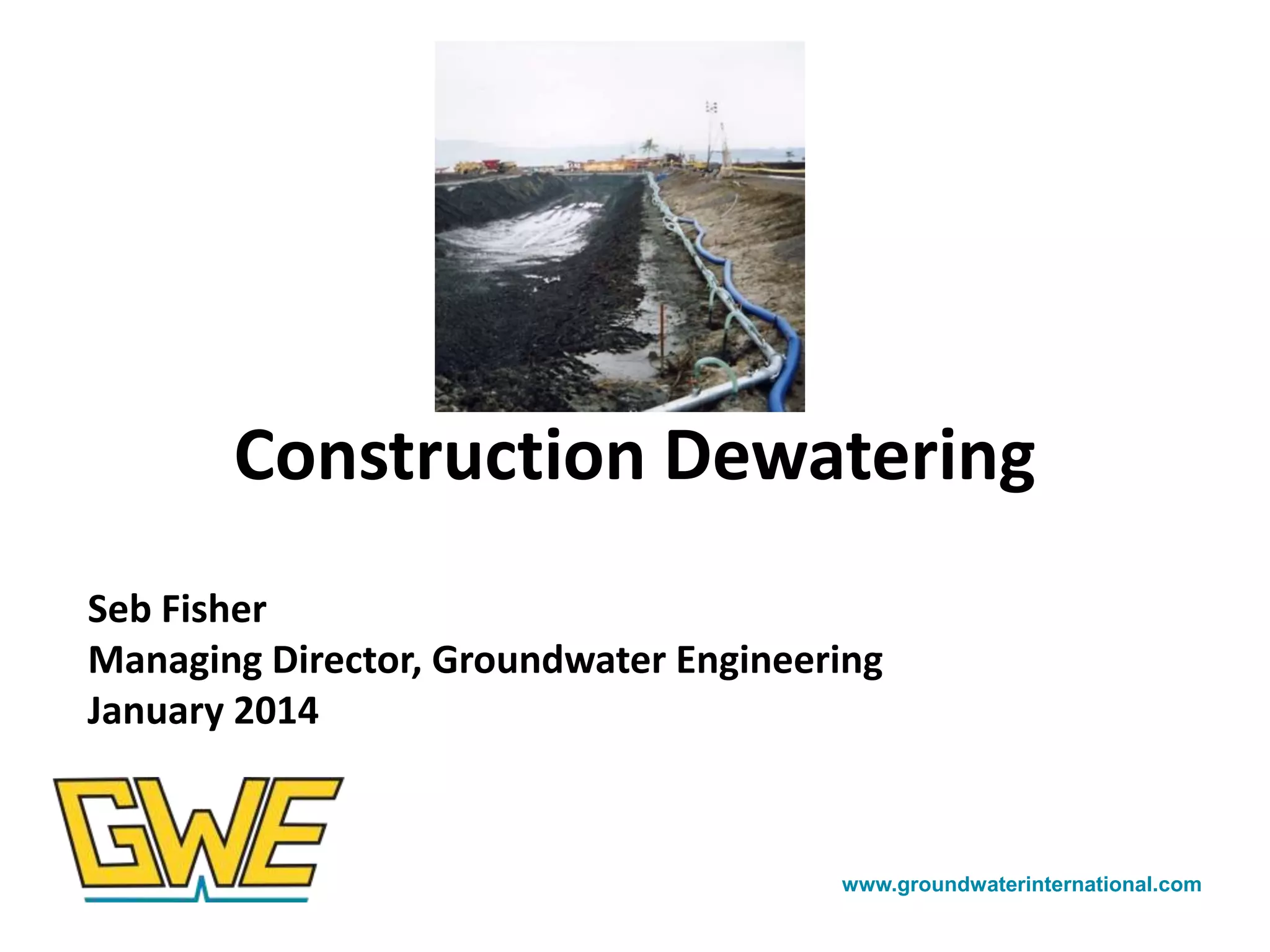
• Dewatering is the term for the control of
groundwater by pumping. On construction sites it
may be known as ‘construction dewatering’.
The method is also used on mine sites –
‘mine dewatering’
• The process of dewatering can be defined as –
pumping from wells or sumps to temporarily lower
groundwater levels, to allow excavations to be made
in dry and stable conditions below natural
groundwater level
www.groundwaterinternational.com
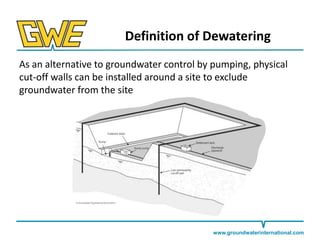
Definition of Dewatering
As an alternative to groundwater control by pumping, physical
cut-off walls can be installed around a site to exclude
groundwater from the site

www.groundwaterinternational.com
Surface Water Control
Surface water must also be controlled:

Sources of surface water

• Rainfall
• Construction operations (e.g. concreting, washing of plant)
• Seepage through cut-off walls

Detrimental effects of poorly-managed surface water
• Risk of localised flooding
• Softening of soil exposed in excavation

www.groundwaterinternational.com
Methods of Surface Water Control
Source control

• intercept run-off before it reaches the excavation
• prevent unnecessary generation of water in the excavation
• collect water as soon as it reaches the work area (or before!)

Water collection

• French drains to intercept run off
• collector drains and sumps
• pumping systems (keep it simple!)

Water treatment

• solids removal (settlement tanks, Siltbusters)

www.groundwaterinternational.com
Dewatering Techniques
Widely used dewatering techniques
• Sump Pumping
• Wellpoints
• Deepwells
• Ejector wells

www.groundwaterinternational.com
Sump Pumping

www.groundwaterinternational.com
Sump Pumping
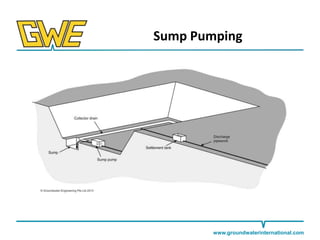
• Water is collected in deeper parts of the excavation (called
sumps) and pumped away
• Simple and cheap method of dewatering in favourable ground
conditions

• Limited to use in relatively coarse soils or fissured rock – if
used in fine grained soils can lead to erosion and loss of fines
with the risk of resulting instability
• The sump takes up space within an excavation
• Can lead to water pollution problems due to silt-laden water
www.groundwaterinternational.com
Wellpoints

www.groundwaterinternational.com
Wellpoints

www.groundwaterinternational.com
Wellpoints
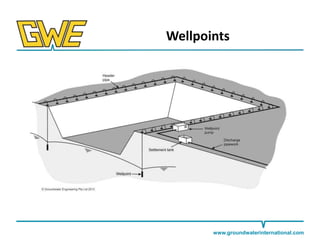
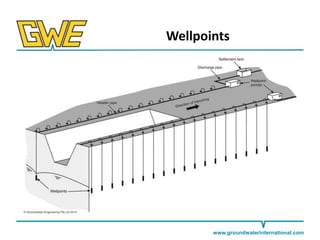
• A line or ring of small diameter shallow wells (called wellpoints)
installed at close spacing (1 to 3 m centres) around the excavation.

• Commonly used for dewatering of pipeline trenches
• Can be a very flexible and effective method of dewatering in sands
or sands and gravels

• Drawdown limited to 5 or 6 m below level of pump due to suction
lift limits
• Individual wellpoints may need to be carefully adjusted
(“trimming”)

www.groundwaterinternational.com
Deepwells

www.groundwaterinternational.com
Deepwells
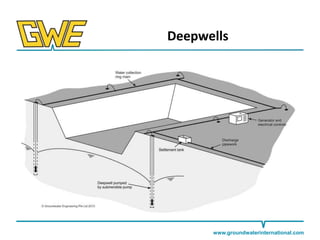
• Wells are drilled at wide spacing (10 to 60 m
between wells) to form a ring around the outside of
the excavation
• An electric submersible pump is installed in each
well. Drawdown limited only by well depth and soil
stratification
• Effective in a wide range of ground
conditions, sands, gravels, fissured rocks
www.groundwaterinternational.com
Eductor Wells

www.groundwaterinternational.com
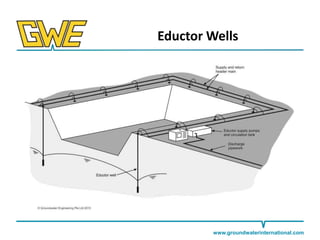
Eductor Wells
• Effective in stabilising fine soils (silts, silty sands) by
reducing pore water pressures

• Wells are drilled around or alongside the excavation
• Suitable when well yields are low. Flow capacity 30 to 50
litres/min per well
• Drawdown generally limited to 25 to 30 m below pump
level
• Vacuum of 0.95 Bar can be generated in the well, making
this very effective in low permeability soils
www.groundwaterinternational.com
Dewatering Techniques
Less commonly used dewatering techniques
• Horizontal wellpoints
• Relief wells
• Artificial recharge
• Groundwater remediation

www.groundwaterinternational.com
Horizontal Wellpoints

www.groundwaterinternational.com
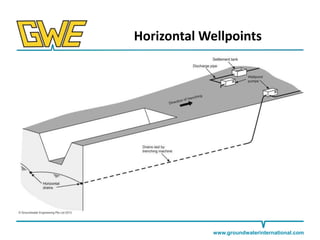
Horizontal Wellpoints
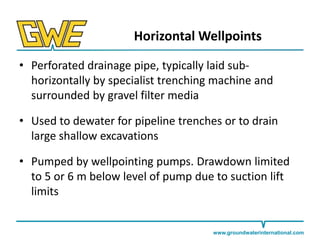
• Perforated drainage pipe, typically laid subhorizontally by specialist trenching machine and
surrounded by gravel filter media
• Used to dewater for pipeline trenches or to drain
large shallow excavations
• Pumped by wellpointing pumps. Drawdown limited
to 5 or 6 m below level of pump due to suction lift
limits

www.groundwaterinternational.com
Relief Wells

www.groundwaterinternational.com
Relief Wells
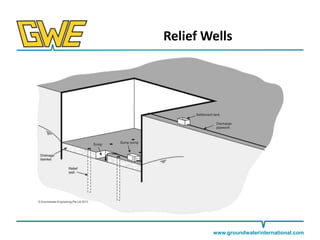
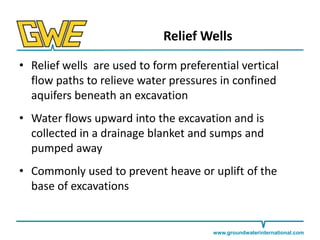
• Relief wells are used to form preferential vertical
flow paths to relieve water pressures in confined
aquifers beneath an excavation
• Water flows upward into the excavation and is
collected in a drainage blanket and sumps and
pumped away
• Commonly used to prevent heave or uplift of the
base of excavations

www.groundwaterinternational.com
Artificial Recharge

www.groundwaterinternational.com
Artificial Recharge
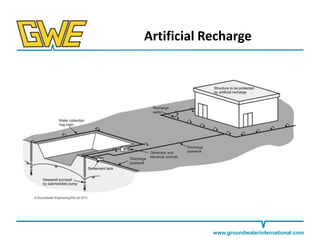
• Artificial recharge involves re-injecting or re-infiltrating
the discharge water into the ground
• Can be used to reduce external drawdowns around a
dewatering system. This is sometimes necessary to
reduce ground settlements in compressible caused by
effective stress increases
• Also sometimes used to help protect groundwater
resources by reducing net abstraction from the aquifer –
used in aquifers which are important sources of public or
private water supply
www.groundwaterinternational.com
Groundwater Remediation

www.groundwaterinternational.com
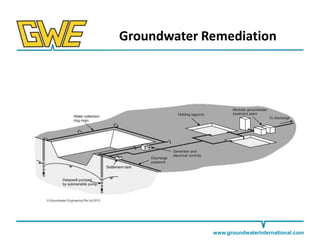
Groundwater Remediation
• Dewatering technologies may used as part of the
remediation strategy on contaminated sites
• Pumping from wells may be used to manipulate
hydraulic gradients to control the migration of
contaminated groundwater
• The pumped groundwater will require treatment to
remove contamination prior to discharge

www.groundwaterinternational.com
Thank you for your attention!
Seb Fisher
Managing Director, Groundwater Engineering
sf@groundwaterinternational.com
January 2014

www.groundwaterinternational.com

Dewatering techniques

  • 1.
    Construction Dewatering Seb Fisher ManagingDirector, Groundwater Engineering January 2014 www.groundwaterinternational.com
  • 2.
    Company Profile Groundwater Engineeringis an international company specializing in dewatering, groundwater control and water well engineering for clients in the construction, mining and oil & gas industries Backed by decades of industry experience and technical expertise we are committed to providing our clients with high quality and costeffective solutions to their groundwater problems based on offering services in: • Contracting • Consultancy • Equipment sales and rental www.groundwaterinternational.com
  • 3.
    Synopsis • Definition ofdewatering • Surface water control • Widely used dewatering techniques • Less commonly used dewatering techniques www.groundwaterinternational.com
  • 4.
    Definition of Dewatering •Dewatering is the term for the control of groundwater by pumping. On construction sites it may be known as ‘construction dewatering’. The method is also used on mine sites – ‘mine dewatering’ • The process of dewatering can be defined as – pumping from wells or sumps to temporarily lower groundwater levels, to allow excavations to be made in dry and stable conditions below natural groundwater level www.groundwaterinternational.com
  • 5.
    Definition of Dewatering Asan alternative to groundwater control by pumping, physical cut-off walls can be installed around a site to exclude groundwater from the site www.groundwaterinternational.com
  • 6.
    Surface Water Control Surfacewater must also be controlled: Sources of surface water • Rainfall • Construction operations (e.g. concreting, washing of plant) • Seepage through cut-off walls Detrimental effects of poorly-managed surface water • Risk of localised flooding • Softening of soil exposed in excavation www.groundwaterinternational.com
  • 7.
    Methods of SurfaceWater Control Source control • intercept run-off before it reaches the excavation • prevent unnecessary generation of water in the excavation • collect water as soon as it reaches the work area (or before!) Water collection • French drains to intercept run off • collector drains and sumps • pumping systems (keep it simple!) Water treatment • solids removal (settlement tanks, Siltbusters) www.groundwaterinternational.com
  • 8.
    Dewatering Techniques Widely useddewatering techniques • Sump Pumping • Wellpoints • Deepwells • Ejector wells www.groundwaterinternational.com
  • 9.
  • 10.
    Sump Pumping • Wateris collected in deeper parts of the excavation (called sumps) and pumped away • Simple and cheap method of dewatering in favourable ground conditions • Limited to use in relatively coarse soils or fissured rock – if used in fine grained soils can lead to erosion and loss of fines with the risk of resulting instability • The sump takes up space within an excavation • Can lead to water pollution problems due to silt-laden water www.groundwaterinternational.com
  • 11.
  • 12.
  • 13.
    Wellpoints • A lineor ring of small diameter shallow wells (called wellpoints) installed at close spacing (1 to 3 m centres) around the excavation. • Commonly used for dewatering of pipeline trenches • Can be a very flexible and effective method of dewatering in sands or sands and gravels • Drawdown limited to 5 or 6 m below level of pump due to suction lift limits • Individual wellpoints may need to be carefully adjusted (“trimming”) www.groundwaterinternational.com
  • 14.
  • 15.
    Deepwells • Wells aredrilled at wide spacing (10 to 60 m between wells) to form a ring around the outside of the excavation • An electric submersible pump is installed in each well. Drawdown limited only by well depth and soil stratification • Effective in a wide range of ground conditions, sands, gravels, fissured rocks www.groundwaterinternational.com
  • 16.
  • 17.
    Eductor Wells • Effectivein stabilising fine soils (silts, silty sands) by reducing pore water pressures • Wells are drilled around or alongside the excavation • Suitable when well yields are low. Flow capacity 30 to 50 litres/min per well • Drawdown generally limited to 25 to 30 m below pump level • Vacuum of 0.95 Bar can be generated in the well, making this very effective in low permeability soils www.groundwaterinternational.com
  • 18.
    Dewatering Techniques Less commonlyused dewatering techniques • Horizontal wellpoints • Relief wells • Artificial recharge • Groundwater remediation www.groundwaterinternational.com
  • 19.
  • 20.
    Horizontal Wellpoints • Perforateddrainage pipe, typically laid subhorizontally by specialist trenching machine and surrounded by gravel filter media • Used to dewater for pipeline trenches or to drain large shallow excavations • Pumped by wellpointing pumps. Drawdown limited to 5 or 6 m below level of pump due to suction lift limits www.groundwaterinternational.com
  • 21.
  • 22.
    Relief Wells • Reliefwells are used to form preferential vertical flow paths to relieve water pressures in confined aquifers beneath an excavation • Water flows upward into the excavation and is collected in a drainage blanket and sumps and pumped away • Commonly used to prevent heave or uplift of the base of excavations www.groundwaterinternational.com
  • 23.
  • 24.
    Artificial Recharge • Artificialrecharge involves re-injecting or re-infiltrating the discharge water into the ground • Can be used to reduce external drawdowns around a dewatering system. This is sometimes necessary to reduce ground settlements in compressible caused by effective stress increases • Also sometimes used to help protect groundwater resources by reducing net abstraction from the aquifer – used in aquifers which are important sources of public or private water supply www.groundwaterinternational.com
  • 25.
  • 26.
    Groundwater Remediation • Dewateringtechnologies may used as part of the remediation strategy on contaminated sites • Pumping from wells may be used to manipulate hydraulic gradients to control the migration of contaminated groundwater • The pumped groundwater will require treatment to remove contamination prior to discharge www.groundwaterinternational.com
  • 27.
    Thank you foryour attention! Seb Fisher Managing Director, Groundwater Engineering sf@groundwaterinternational.com January 2014 www.groundwaterinternational.com