Slit lamp
HAAG ZEISS
TOPCON
BASICS
What are the three systems present in a slit lamp ?
OBSERVATION SYSTEM ILLUMINATION SYSTEM MECHANICAL SYSTEM
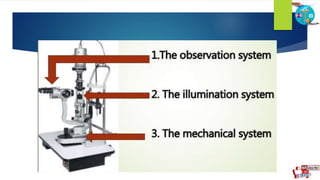
Observation system
Illumination system
Mechanical system
Illumination techniques
DIFFUSE DIRECT
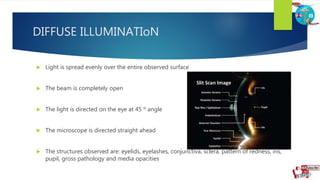
DIFFUSE ILLUMINATIoN
 Light is spread evenly over the entire observed surface
 The beam is completely open
 The light is directed on the eye at 45 º angle
 The microscope is directed straight ahead
 The structures observed are: eyelids, eyelashes, conjunctiva, sclera, pattern of redness, iris,
pupil, gross pathology and media opacities
Optic section
 A narrow focal slit beam is projected at a 45-60˚ angle
 It cuts an optical section through the cornea like a knife
 With this technique it is possible to locate the layer of the pathological changes
 Magnification approximately 10X
 Width: Narrow slit 1mm
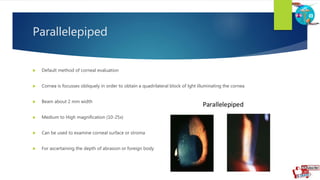
Parallelepiped
 Default method of corneal evaluation
 Cornea is focusses obliquely in order to obtain a quadrilateral block of lght illuminating the cornea
 Beam about 2 mm width
 Medium to High magnification (10-25x)
 Can be used to examine corneal surface or stroma
 For ascertaining the depth of abrasion or foreign body
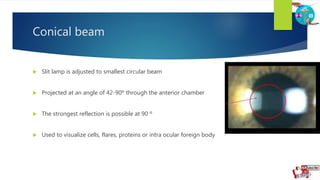
Conical beam
 Slit lamp is adjusted to smallest circular beam
 Projected at an angle of 42-90º through the anterior chamber
 The strongest reflection is possible at 90 º
 Used to visualize cells, flares, proteins or intra ocular foreign body
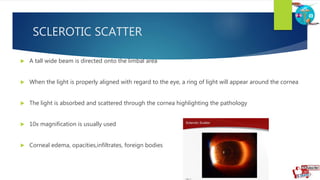
SCLEROTIC SCATTER
 A tall wide beam is directed onto the limbal area
 When the light is properly aligned with regard to the eye, a ring of light will appear around the cornea
 The light is absorbed and scattered through the cornea highlighting the pathology
 10x magnification is usually used
 Corneal edema, opacities,infiltrates, foreign bodies
THANKS FOR WATCHING

Slit lamp

  • 1.
  • 2.
  • 3.
    BASICS What are thethree systems present in a slit lamp ? OBSERVATION SYSTEM ILLUMINATION SYSTEM MECHANICAL SYSTEM
  • 5.
  • 6.
  • 7.
  • 8.
  • 9.
    DIFFUSE ILLUMINATIoN  Lightis spread evenly over the entire observed surface  The beam is completely open  The light is directed on the eye at 45 º angle  The microscope is directed straight ahead  The structures observed are: eyelids, eyelashes, conjunctiva, sclera, pattern of redness, iris, pupil, gross pathology and media opacities
  • 10.
    Optic section  Anarrow focal slit beam is projected at a 45-60˚ angle  It cuts an optical section through the cornea like a knife  With this technique it is possible to locate the layer of the pathological changes  Magnification approximately 10X  Width: Narrow slit 1mm
  • 11.
    Parallelepiped  Default methodof corneal evaluation  Cornea is focusses obliquely in order to obtain a quadrilateral block of lght illuminating the cornea  Beam about 2 mm width  Medium to High magnification (10-25x)  Can be used to examine corneal surface or stroma  For ascertaining the depth of abrasion or foreign body
  • 12.
    Conical beam  Slitlamp is adjusted to smallest circular beam  Projected at an angle of 42-90º through the anterior chamber  The strongest reflection is possible at 90 º  Used to visualize cells, flares, proteins or intra ocular foreign body
  • 13.
    SCLEROTIC SCATTER  Atall wide beam is directed onto the limbal area  When the light is properly aligned with regard to the eye, a ring of light will appear around the cornea  The light is absorbed and scattered through the cornea highlighting the pathology  10x magnification is usually used  Corneal edema, opacities,infiltrates, foreign bodies
  • 22.