CASTING PROCESS
7/28/2017 1
Terms involved in casting
7/28/2017 2
Terms involved in casting process
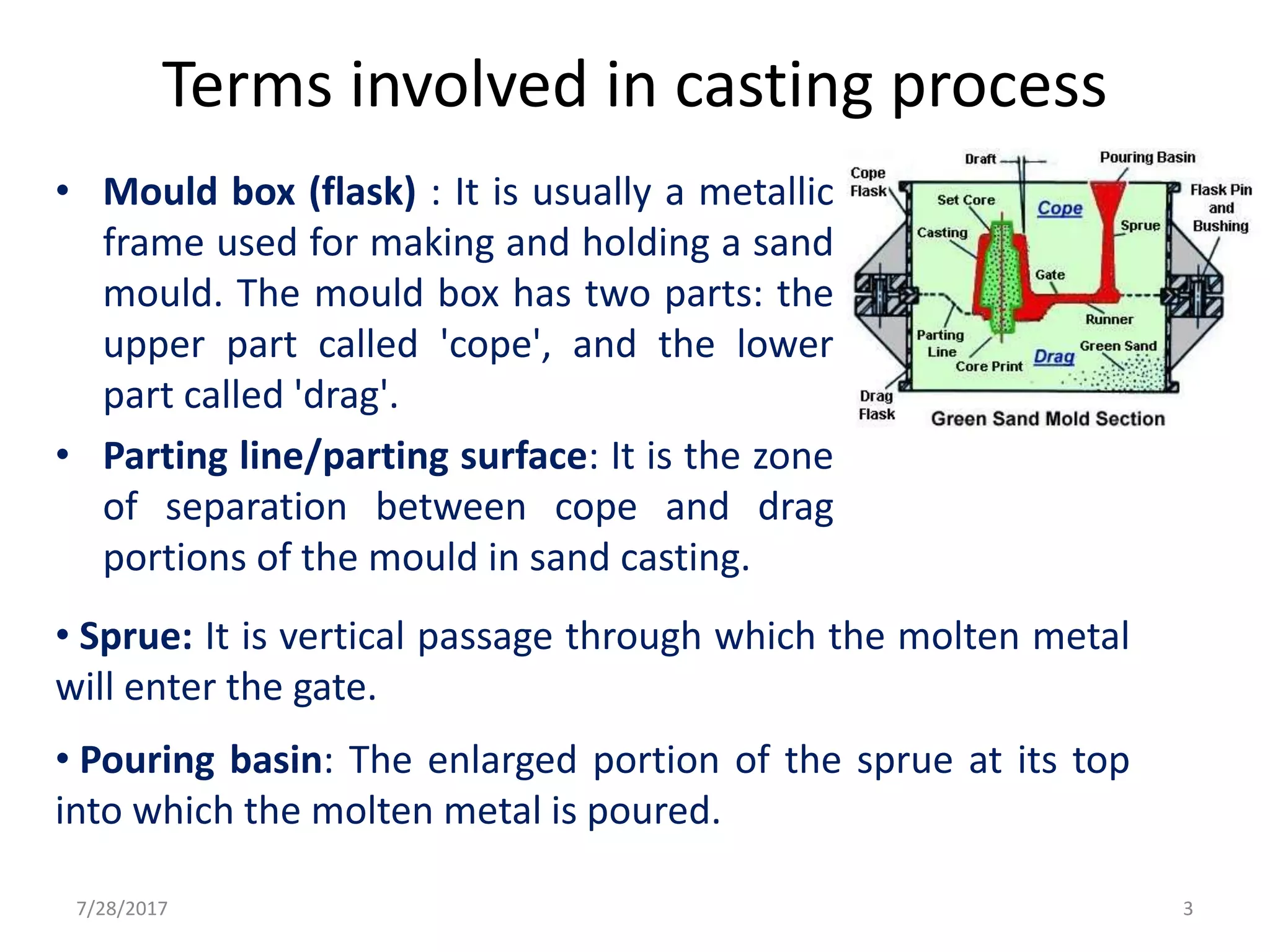
• Mould box (flask) : It is usually a metallic
frame used for making and holding a sand
mould. The mould box has two parts: the
upper part called 'cope', and the lower
part called 'drag'.
• Parting line/parting surface: It is the zone
of separation between cope and drag
portions of the mould in sand casting.
• Sprue: It is vertical passage through which the molten metal
will enter the gate.
• Pouring basin: The enlarged portion of the sprue at its top
into which the molten metal is poured.
7/28/2017 3
Terms involved in casting process
• Gate/ingate: It is a short passage way which
carries the molten metal from the runner/
sprue into the mould cavity.
• Riser: A riser or feed-head is a vertical
passage that stores the molten metal and
supplies (feed) the same to the casting as it
solidifies.
• Gate/ingate: It is a short passage way which carries the molten metal from the
runner/ sprue into the mould cavity.
• Riser: A riser or feed-head is a vertical passage that stores the molten metal
and supplies (feed) the same to the casting as it solidifies.
• Mould cavity: The space in a mould that is filled with molten metal to form the
casting upon solidification.
• Core: A core is a pre-formed (shaped) mass of sand placed in the mould cavity
to form hollow cavities in castings.
• Core print: It is a projection attached to the pattern to help for support and
correct location of core in the mould cavity.7/28/2017 4
STEPS INVOLVED IN MAKING A CASTING
The basic steps in making a casting are:
(a) Pattern making
(b) Mould preparation (including gating and risering)
(c) Core making
(d) Melting and Pouring
(e) Cleaning and Inspection
7/28/2017 5
a) Pattern making
• A pattern is a replica of the object to be cast.
• It is used to prepare a cavity into which the molten
metal is poured.
• A skilled pattern maker prepares the pattern using
wood, metal, plastic or other materials with the help
of machines and special tools.
• Many factors viz., durability, allowance for shrinkage
and machining etc., are considered while making a
pattern.
7/28/2017 6
b) Mould preparation
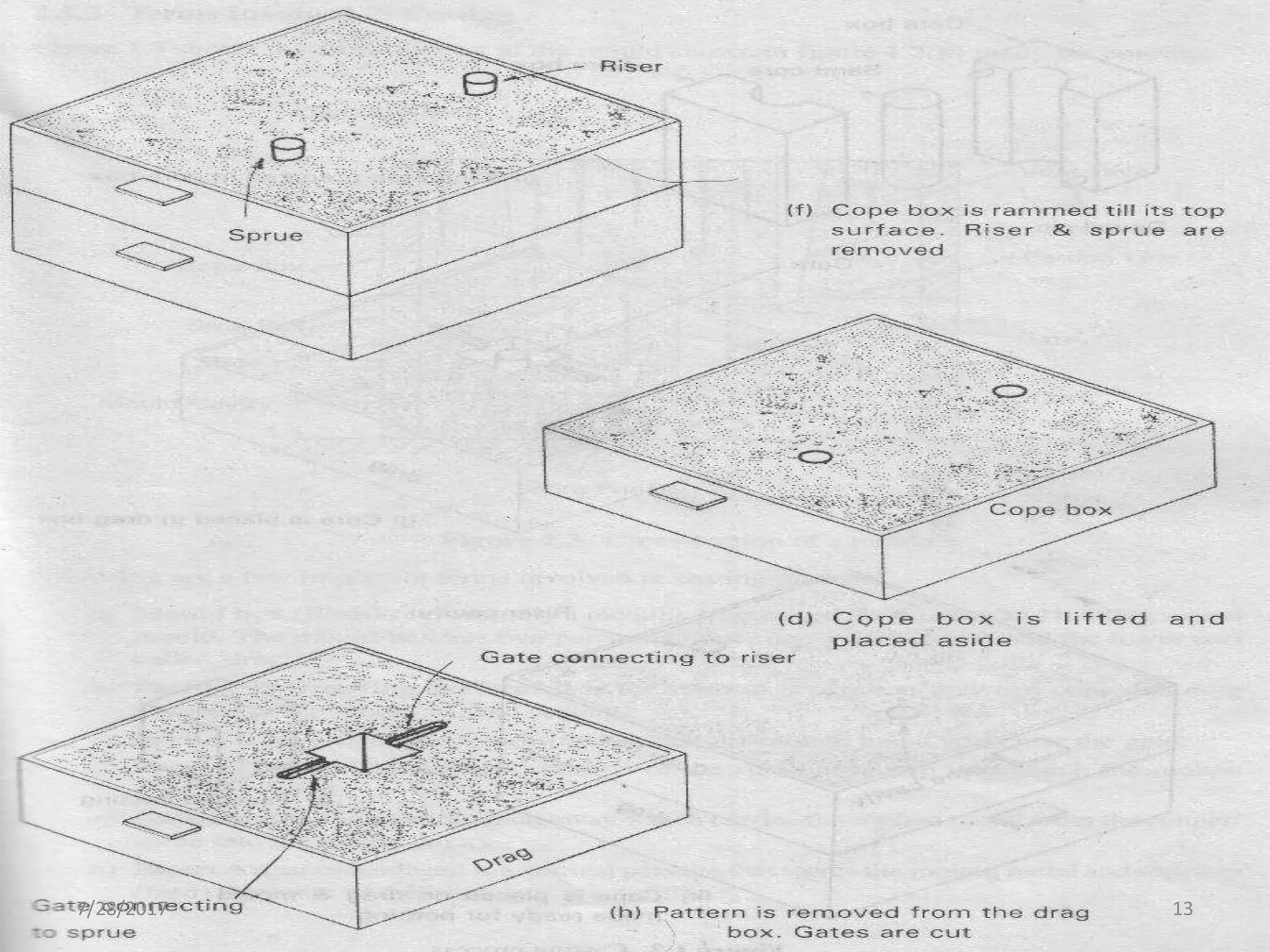
• Mould preparation involves forming a cavity by packing
sand around a pattern enclosed in a supporting metallic
frame called 'flask' (mould box).
• When the pattern is removed from the mould, an exact
shaped cavity remains into which the molten metal is
poured.
• Gating and risering are provided at suitable locations in
the mould.
– Gating - Passage through which molten metal flows and enter the mould
cavity.
– Risering - A reservoir of molten metal connected to the mould cavity to
supply additional metal so as to compensate for losses due to shrinkage, as
the metal solidifies.
7/28/2017 7
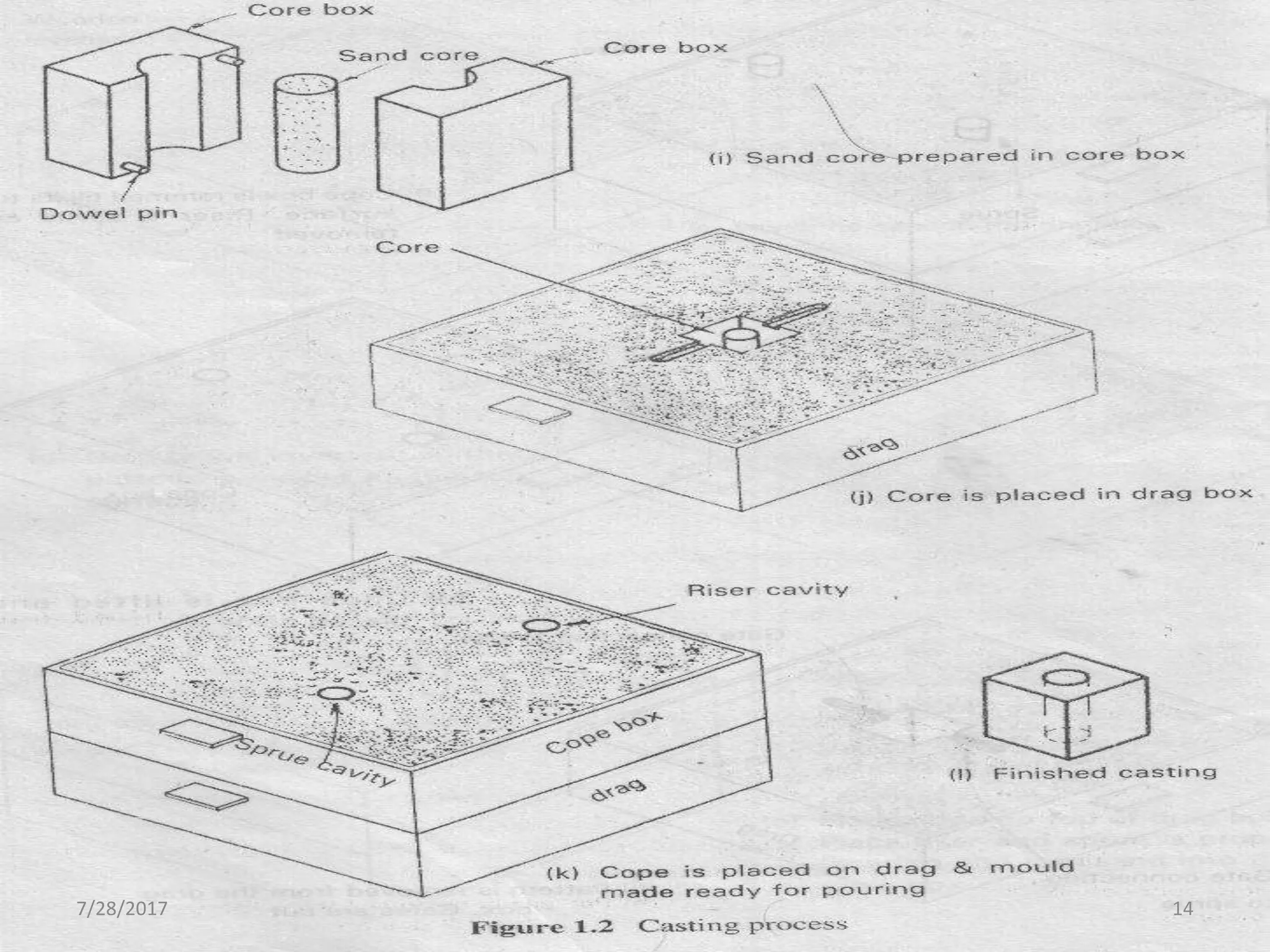
c) Core making
• In some cases, a hole or cavity is required in the
casting.
• This is obtained by placing a core in the mould
cavity.
• The shape of the core corresponds to the shape
of the hole required.
7/28/2017 8
d) Melting and Pouring
• Metals or alloys of the required composition are
melted in a furnace and poured into the mould
cavity.
• Many factors viz., temperature of molten metal,
pouring time, turbulence etc., should be considered
while melting and pouring.
7/28/2017 9
e) Cleaning and Inspection
• After the molten metal has solidified and cooled, the
rough casting is removed from the mould, cleaned
and dressed.
• This involves removing cores, adhered sand particles,
gating and risering systems, fins, blisters etc., from
the casting surface.
• then sent for inspection to check for dimensions or
any defects like blow holes, cracks etc.
7/28/2017 10
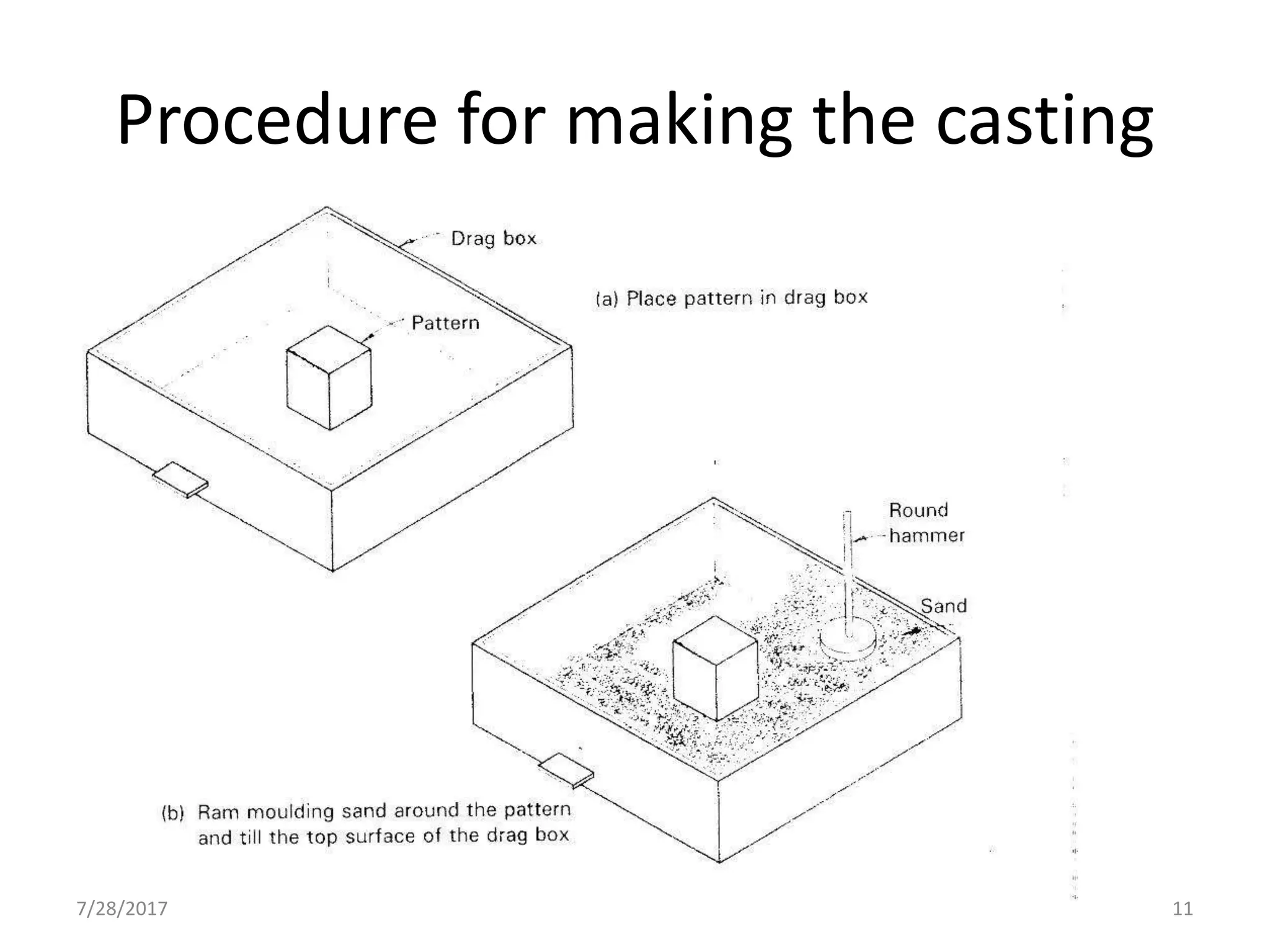
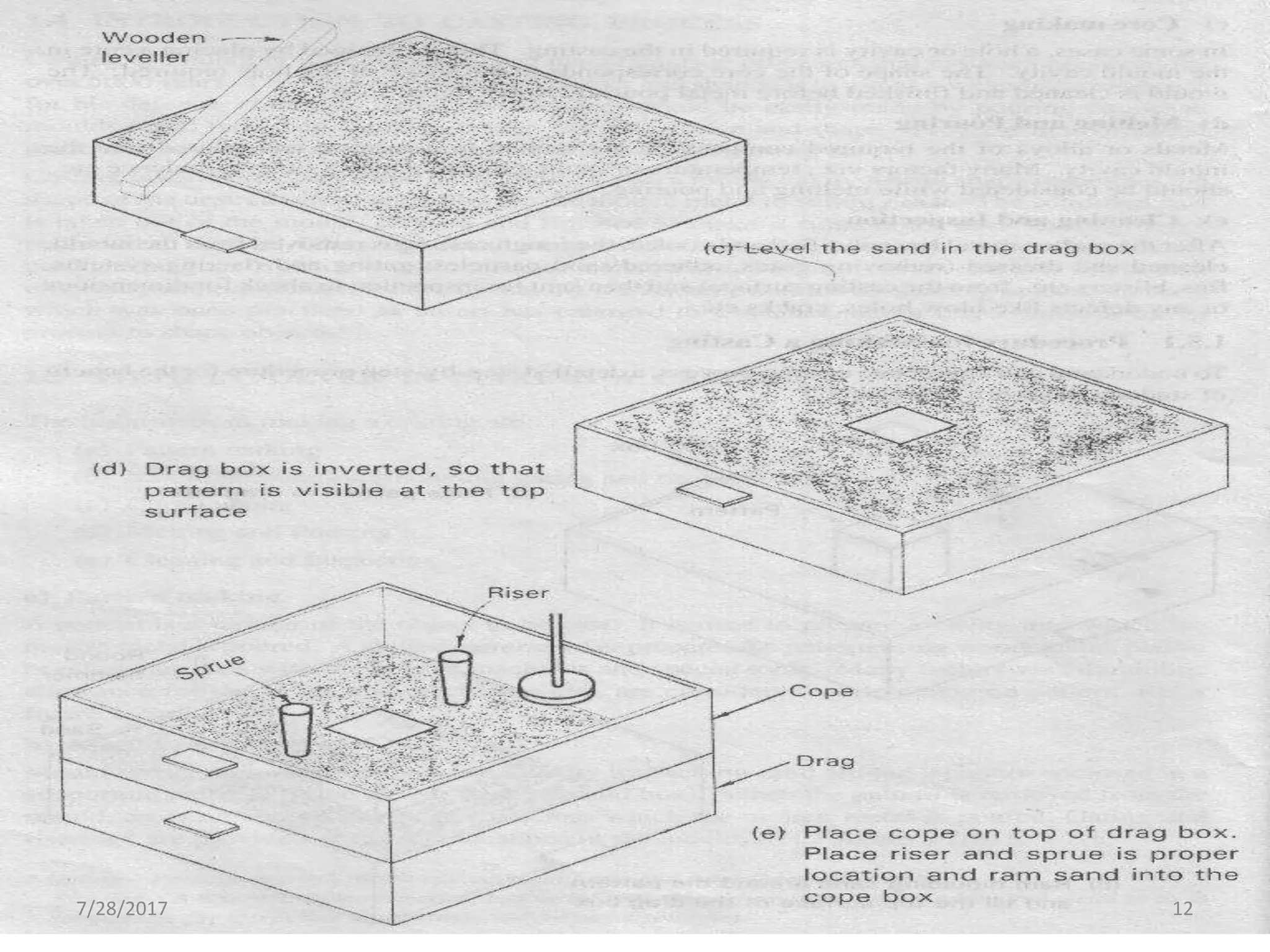
Procedure for making the casting
7/28/2017 11
7/28/2017 12
7/28/2017 13
7/28/2017 14
Components Produced by
Casting Process
• Casting is the first step and the primary process for shaping
any material.
• All materials have to be cast before it is put to use.
• The ingots produced by casting process are used as raw
material for secondary processes like machining, forging,
rolling etc.
• More than 90 % of all manufactured goods and capital
equipment use castings for their manufacture.
• To list the components produced by casting is an endless
process. A few major components produced by casting are
given below.
7/28/2017 15
Components Produced by Casting Process
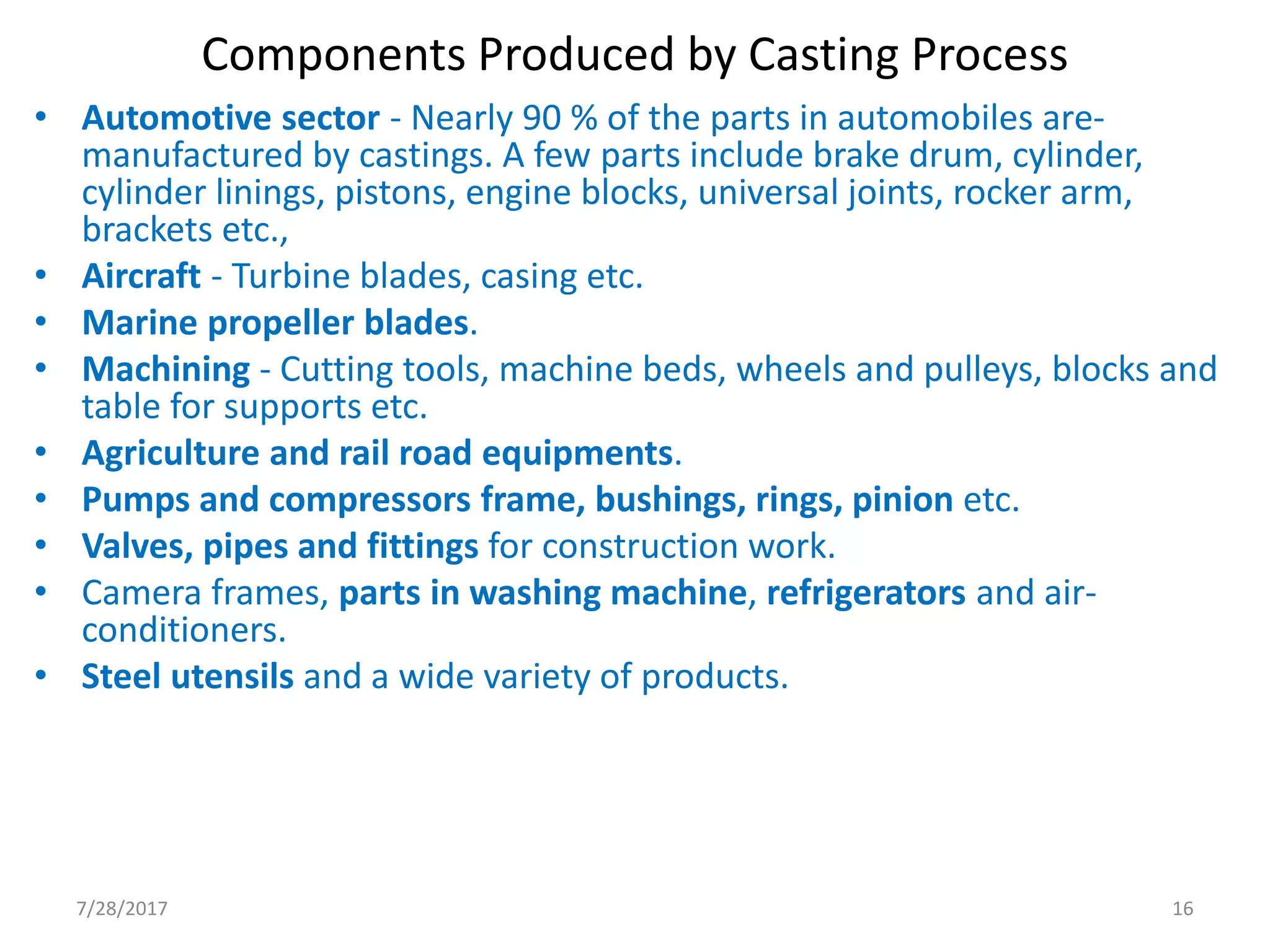
• Automotive sector - Nearly 90 % of the parts in automobiles are-
manufactured by castings. A few parts include brake drum, cylinder,
cylinder linings, pistons, engine blocks, universal joints, rocker arm,
brackets etc.,
• Aircraft - Turbine blades, casing etc.
• Marine propeller blades.
• Machining - Cutting tools, machine beds, wheels and pulleys, blocks and
table for supports etc.
• Agriculture and rail road equipments.
• Pumps and compressors frame, bushings, rings, pinion etc.
• Valves, pipes and fittings for construction work.
• Camera frames, parts in washing machine, refrigerators and air-
conditioners.
• Steel utensils and a wide variety of products.
7/28/2017 16
Advantages of casting process
• Large hollow and intricate shapes can be easily cast.
• Quick process, and hence suitable for mass production.
• No limit to size and shape. Parts ranging from few millimeters to meters
and few grams to tons can be cast efficiently and economically.
• Better dimensional tolerances and surface finish can be obtained by
good casting practice.
• Castings exhibit uniform properties in all the directions - longitudinal,
lateral and diagonal.
• The casting process is usually the cheapest process.
• Unrelieved internal stresses are absent in cast components.
• Certain metals and alloys can be manufactured by means of casting only,
e.g., Phosphor-Bronze.
7/28/2017 17
Limitations of casting process
• Presence of defects in cast parts is a major disadvantage.
• Casting process is not economical for small number of parts.
• Properties of cast materials are generally inferior when
compared to those made by machining or forging process.
• Casting process mostly deals with elevated temperatures.
• There are limitations regarding thin sections.
• Casting process is not suitable for very small number of
components.
7/28/2017 18

2.casting process

  • 1.
  • 2.
    Terms involved incasting 7/28/2017 2
  • 3.
    Terms involved incasting process • Mould box (flask) : It is usually a metallic frame used for making and holding a sand mould. The mould box has two parts: the upper part called 'cope', and the lower part called 'drag'. • Parting line/parting surface: It is the zone of separation between cope and drag portions of the mould in sand casting. • Sprue: It is vertical passage through which the molten metal will enter the gate. • Pouring basin: The enlarged portion of the sprue at its top into which the molten metal is poured. 7/28/2017 3
  • 4.
    Terms involved incasting process • Gate/ingate: It is a short passage way which carries the molten metal from the runner/ sprue into the mould cavity. • Riser: A riser or feed-head is a vertical passage that stores the molten metal and supplies (feed) the same to the casting as it solidifies. • Gate/ingate: It is a short passage way which carries the molten metal from the runner/ sprue into the mould cavity. • Riser: A riser or feed-head is a vertical passage that stores the molten metal and supplies (feed) the same to the casting as it solidifies. • Mould cavity: The space in a mould that is filled with molten metal to form the casting upon solidification. • Core: A core is a pre-formed (shaped) mass of sand placed in the mould cavity to form hollow cavities in castings. • Core print: It is a projection attached to the pattern to help for support and correct location of core in the mould cavity.7/28/2017 4
  • 5.
    STEPS INVOLVED INMAKING A CASTING The basic steps in making a casting are: (a) Pattern making (b) Mould preparation (including gating and risering) (c) Core making (d) Melting and Pouring (e) Cleaning and Inspection 7/28/2017 5
  • 6.
    a) Pattern making •A pattern is a replica of the object to be cast. • It is used to prepare a cavity into which the molten metal is poured. • A skilled pattern maker prepares the pattern using wood, metal, plastic or other materials with the help of machines and special tools. • Many factors viz., durability, allowance for shrinkage and machining etc., are considered while making a pattern. 7/28/2017 6
  • 7.
    b) Mould preparation •Mould preparation involves forming a cavity by packing sand around a pattern enclosed in a supporting metallic frame called 'flask' (mould box). • When the pattern is removed from the mould, an exact shaped cavity remains into which the molten metal is poured. • Gating and risering are provided at suitable locations in the mould. – Gating - Passage through which molten metal flows and enter the mould cavity. – Risering - A reservoir of molten metal connected to the mould cavity to supply additional metal so as to compensate for losses due to shrinkage, as the metal solidifies. 7/28/2017 7
  • 8.
    c) Core making •In some cases, a hole or cavity is required in the casting. • This is obtained by placing a core in the mould cavity. • The shape of the core corresponds to the shape of the hole required. 7/28/2017 8
  • 9.
    d) Melting andPouring • Metals or alloys of the required composition are melted in a furnace and poured into the mould cavity. • Many factors viz., temperature of molten metal, pouring time, turbulence etc., should be considered while melting and pouring. 7/28/2017 9
  • 10.
    e) Cleaning andInspection • After the molten metal has solidified and cooled, the rough casting is removed from the mould, cleaned and dressed. • This involves removing cores, adhered sand particles, gating and risering systems, fins, blisters etc., from the casting surface. • then sent for inspection to check for dimensions or any defects like blow holes, cracks etc. 7/28/2017 10
  • 11.
    Procedure for makingthe casting 7/28/2017 11
  • 12.
  • 13.
  • 14.
  • 15.
    Components Produced by CastingProcess • Casting is the first step and the primary process for shaping any material. • All materials have to be cast before it is put to use. • The ingots produced by casting process are used as raw material for secondary processes like machining, forging, rolling etc. • More than 90 % of all manufactured goods and capital equipment use castings for their manufacture. • To list the components produced by casting is an endless process. A few major components produced by casting are given below. 7/28/2017 15
  • 16.
    Components Produced byCasting Process • Automotive sector - Nearly 90 % of the parts in automobiles are- manufactured by castings. A few parts include brake drum, cylinder, cylinder linings, pistons, engine blocks, universal joints, rocker arm, brackets etc., • Aircraft - Turbine blades, casing etc. • Marine propeller blades. • Machining - Cutting tools, machine beds, wheels and pulleys, blocks and table for supports etc. • Agriculture and rail road equipments. • Pumps and compressors frame, bushings, rings, pinion etc. • Valves, pipes and fittings for construction work. • Camera frames, parts in washing machine, refrigerators and air- conditioners. • Steel utensils and a wide variety of products. 7/28/2017 16
  • 17.
    Advantages of castingprocess • Large hollow and intricate shapes can be easily cast. • Quick process, and hence suitable for mass production. • No limit to size and shape. Parts ranging from few millimeters to meters and few grams to tons can be cast efficiently and economically. • Better dimensional tolerances and surface finish can be obtained by good casting practice. • Castings exhibit uniform properties in all the directions - longitudinal, lateral and diagonal. • The casting process is usually the cheapest process. • Unrelieved internal stresses are absent in cast components. • Certain metals and alloys can be manufactured by means of casting only, e.g., Phosphor-Bronze. 7/28/2017 17
  • 18.
    Limitations of castingprocess • Presence of defects in cast parts is a major disadvantage. • Casting process is not economical for small number of parts. • Properties of cast materials are generally inferior when compared to those made by machining or forging process. • Casting process mostly deals with elevated temperatures. • There are limitations regarding thin sections. • Casting process is not suitable for very small number of components. 7/28/2017 18