Ceramic Uses and Processes
R. R. Lindeke
Engr 2110
• Properties:
-- Tm for glass is moderate, but large for other ceramics.
-- Small toughness, ductility; large moduli & creep resist.
• Applications:
-- High T, wear resistant, novel uses from charge neutrality.
• Fabrication
-- some glasses can be easily formed
-- other ceramics can not be formed or cast.
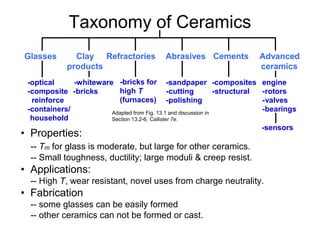
Glasses Clay
products
Refractories Abrasives Cements Advanced
ceramics
-optical
-composite
reinforce
-containers/
household
-whiteware
-bricks
-bricks for
high T
(furnaces)
-sandpaper
-cutting
-polishing
-composites
-structural
engine
-rotors
-valves
-bearings
-sensors
Adapted from Fig. 13.1 and discussion in
Section 13.2-6, Callister 7e.
Taxonomy of Ceramics
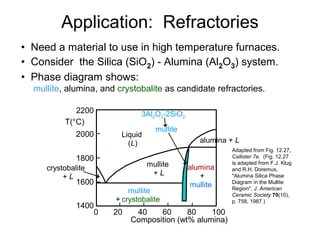
• Need a material to use in high temperature furnaces.
• Consider the Silica (SiO2) - Alumina (Al2O3) system.
• Phase diagram shows:
mullite, alumina, and crystobalite as candidate refractories.
Adapted from Fig. 12.27,
Callister 7e. (Fig. 12.27
is adapted from F.J. Klug
and R.H. Doremus,
"Alumina Silica Phase
Diagram in the Mullite
Region", J. American
Ceramic Society 70(10),
p. 758, 1987.)
Application: Refractories
Composition (wt% alumina)
T(°C)
1400
1600
1800
2000
2200
20 40 60 80 1000
alumina
+
mullite
mullite
+ L
mullite
Liquid
(L)
mullite
+ crystobalite
crystobalite
+ L
alumina + L
3Al2O3-2SiO2
tensile
force
Ao
Addie
die
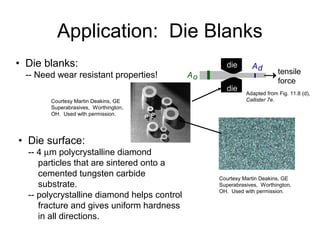
• Die blanks:
-- Need wear resistant properties!
• Die surface:
-- 4 µm polycrystalline diamond
particles that are sintered onto a
cemented tungsten carbide
substrate.
-- polycrystalline diamond helps control
fracture and gives uniform hardness
in all directions.
Courtesy Martin Deakins, GE
Superabrasives, Worthington,
OH. Used with permission.
Adapted from Fig. 11.8 (d),
Callister 7e.Courtesy Martin Deakins, GE
Superabrasives, Worthington,
OH. Used with permission.
Application: Die Blanks
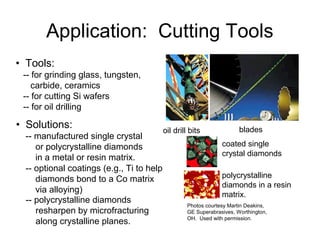
• Tools:
-- for grinding glass, tungsten,
carbide, ceramics
-- for cutting Si wafers
-- for oil drilling
bladesoil drill bits
• Solutions:
coated single
crystal diamonds
polycrystalline
diamonds in a resin
matrix.
Photos courtesy Martin Deakins,
GE Superabrasives, Worthington,
OH. Used with permission.
Application: Cutting Tools
-- manufactured single crystal
or polycrystalline diamonds
in a metal or resin matrix.
-- optional coatings (e.g., Ti to help
diamonds bond to a Co matrix
via alloying)
-- polycrystalline diamonds
resharpen by microfracturing
along crystalline planes.
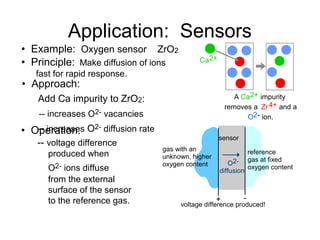
• Example: Oxygen sensor ZrO2
• Principle: Make diffusion of ions
fast for rapid response.
Application: Sensors
A Ca2+ impurity
removes a Zr4+ and a
O2- ion.
Ca2+
• Approach:
Add Ca impurity to ZrO2:
-- increases O2- vacancies
-- increases O2- diffusion rate
reference
gas at fixed
oxygen content
O2-
diffusion
gas with an
unknown, higher
oxygen content
-+
voltage difference produced!
sensor
• Operation:
-- voltage difference
produced when
O2- ions diffuse
from the external
surface of the sensor
to the reference gas.
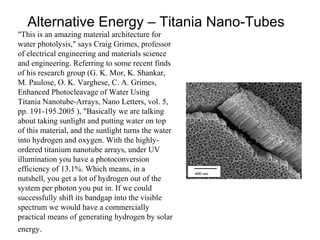
Alternative Energy – Titania Nano-Tubes
"This is an amazing material architecture for
water photolysis," says Craig Grimes, professor
of electrical engineering and materials science
and engineering. Referring to some recent finds
of his research group (G. K. Mor, K. Shankar,
M. Paulose, O. K. Varghese, C. A. Grimes,
Enhanced Photocleavage of Water Using
Titania Nanotube-Arrays, Nano Letters, vol. 5,
pp. 191-195.2005 ), "Basically we are talking
about taking sunlight and putting water on top
of this material, and the sunlight turns the water
into hydrogen and oxygen. With the highly-
ordered titanium nanotube arrays, under UV
illumination you have a photoconversion
efficiency of 13.1%. Which means, in a
nutshell, you get a lot of hydrogen out of the
system per photon you put in. If we could
successfully shift its bandgap into the visible
spectrum we would have a commercially
practical means of generating hydrogen by solar
energy.
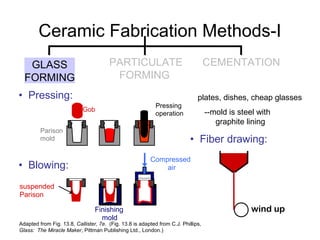
• Pressing:
GLASS
FORMING
Adapted from Fig. 13.8, Callister, 7e. (Fig. 13.8 is adapted from C.J. Phillips,
Glass: The Miracle Maker, Pittman Publishing Ltd., London.)
Ceramic Fabrication Methods-I
Gob
Parison
mold
Pressing
operation
• Blowing:
suspended
Parison
Finishing
mold
Compressed
air
plates, dishes, cheap glasses
--mold is steel with
graphite lining
• Fiber drawing:
wind up
PARTICULATE
FORMING
CEMENTATION
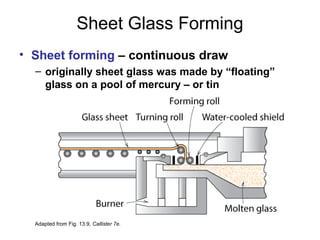
Sheet Glass Forming
• Sheet forming – continuous draw
– originally sheet glass was made by “floating”
glass on a pool of mercury – or tin
Adapted from Fig. 13.9, Callister 7e.
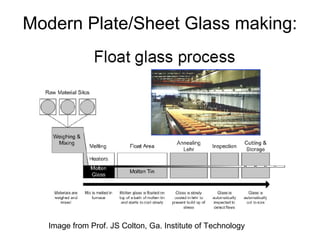
Modern Plate/Sheet Glass making:
Image from Prof. JS Colton, Ga. Institute of Technology
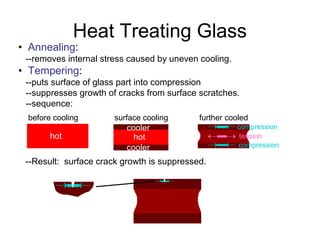
• Annealing:
--removes internal stress caused by uneven cooling.
• Tempering:
--puts surface of glass part into compression
--suppresses growth of cracks from surface scratches.
--sequence:
Heat Treating Glass
further cooled
tension
compression
compression
before cooling
hot
surface cooling
hot
cooler
cooler
--Result: surface crack growth is suppressed.
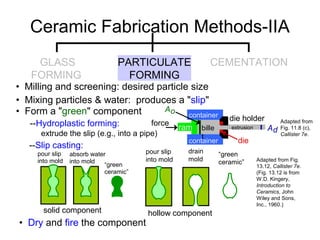
• Milling and screening: desired particle size
• Mixing particles & water: produces a "slip"
• Form a "green" component
• Dry and fire the component
ram bille
t
container
container
force
die holder
die
Ao
Adextrusion
--Hydroplastic forming:
extrude the slip (e.g., into a pipe)
Adapted from
Fig. 11.8 (c),
Callister 7e.
Ceramic Fabrication Methods-IIA
solid component
--Slip casting:
Adapted from Fig.
13.12, Callister 7e.
(Fig. 13.12 is from
W.D. Kingery,
Introduction to
Ceramics, John
Wiley and Sons,
Inc., 1960.)
hollow component
pour slip
into mold
drain
mold
“green
ceramic”
pour slip
into mold
absorb water
into mold
“green
ceramic”
GLASS
FORMING
PARTICULATE
FORMING
CEMENTATION
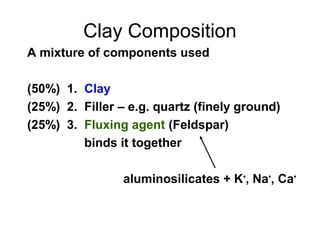
Clay Composition
A mixture of components used
(50%) 1. Clay
(25%) 2. Filler – e.g. quartz (finely ground)
(25%) 3. Fluxing agent (Feldspar)
binds it together
aluminosilicates + K+
, Na+
, Ca+
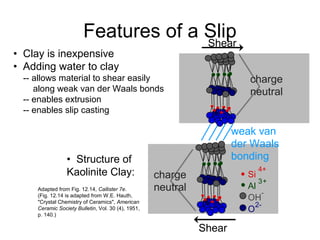
• Clay is inexpensive
• Adding water to clay
-- allows material to shear easily
along weak van der Waals bonds
-- enables extrusion
-- enables slip casting
• Structure of
Kaolinite Clay:
Adapted from Fig. 12.14, Callister 7e.
(Fig. 12.14 is adapted from W.E. Hauth,
"Crystal Chemistry of Ceramics", American
Ceramic Society Bulletin, Vol. 30 (4), 1951,
p. 140.)
Features of a Slip
weak van
der Waals
bonding
charge
neutral
charge
neutral
Si
4+
Al
3+
-
OH
O
2-
Shear
Shear
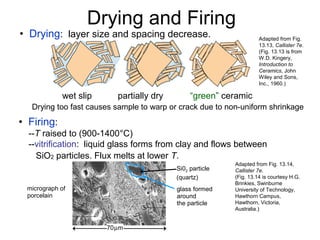
• Drying: layer size and spacing decrease. Adapted from Fig.
13.13, Callister 7e.
(Fig. 13.13 is from
W.D. Kingery,
Introduction to
Ceramics, John
Wiley and Sons,
Inc., 1960.)
Drying and Firing
Drying too fast causes sample to warp or crack due to non-uniform shrinkage
wet slip partially dry “green” ceramic
• Firing:
--T raised to (900-1400°C)
--vitrification: liquid glass forms from clay and flows between
SiO2 particles. Flux melts at lower T.
Adapted from Fig. 13.14,
Callister 7e.
(Fig. 13.14 is courtesy H.G.
Brinkies, Swinburne
University of Technology,
Hawthorn Campus,
Hawthorn, Victoria,
Australia.)
Si02 particle
(quartz)
glass formed
around
the particle
micrograph of
porcelain
70µm
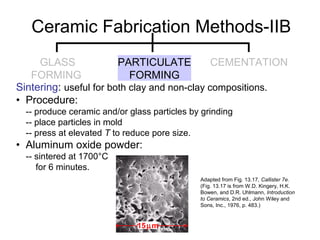
Sintering: useful for both clay and non-clay compositions.
• Procedure:
-- produce ceramic and/or glass particles by grinding
-- place particles in mold
-- press at elevated T to reduce pore size.
• Aluminum oxide powder:
-- sintered at 1700°C
for 6 minutes.
Adapted from Fig. 13.17, Callister 7e.
(Fig. 13.17 is from W.D. Kingery, H.K.
Bowen, and D.R. Uhlmann, Introduction
to Ceramics, 2nd ed., John Wiley and
Sons, Inc., 1976, p. 483.)
Ceramic Fabrication Methods-IIB
15µm
GLASS
FORMING
PARTICULATE
FORMING
CEMENTATION
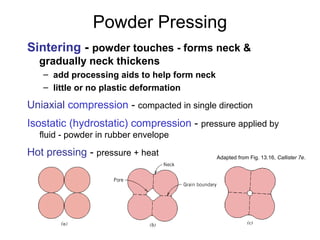
Powder Pressing
Sintering - powder touches - forms neck &
gradually neck thickens
– add processing aids to help form neck
– little or no plastic deformation
Adapted from Fig. 13.16, Callister 7e.
Uniaxial compression - compacted in single direction
Isostatic (hydrostatic) compression - pressure applied by
fluid - powder in rubber envelope
Hot pressing - pressure + heat
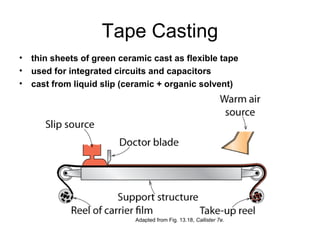
Tape Casting
• thin sheets of green ceramic cast as flexible tape
• used for integrated circuits and capacitors
• cast from liquid slip (ceramic + organic solvent)
Adapted from Fig. 13.18, Callister 7e.
• Produced in extremely large quantities.
• Portland cement:
-- mix clay and lime bearing materials
-- calcinate (heat to 1400°C)
-- primary constituents:
tri-calcium silicate
di-calcium silicate
• Adding water
-- produces a paste which hardens
-- hardening occurs due to hydration (chemical reactions
with the water).
• Forming: done usually minutes after hydration begins.
Ceramic Fabrication Methods-III
GLASS
FORMING
PARTICULATE
FORMING
CEMENTATION
Applications: Advanced Ceramics
Heat Engines
• Advantages:
– Run at higher temperature
– Excellent wear &
corrosion resistance
– Low frictional losses
– Ability to operate without
a cooling system
– Low density
• Disadvantages:
– Brittle
– Too easy to have voids-
weaken the engine
– Difficult to machine
• Possible parts – engine block, piston coatings, jet engines
Ex: Si3N4, SiC, & ZrO2
Applications: Advanced Ceramics
• Ceramic Armor
– Al2O3, B4C, SiC & TiB2
– Extremely hard materials
• shatter the incoming projectile
• energy absorbent material underneath
Applications: Advanced Ceramics
Electronic Packaging
• Chosen to securely hold microelectronics &
provide heat transfer
• Must match the thermal expansion coefficient of
the microelectronic chip & the electronic
packaging material. Additional requirements
include:
– good heat transfer coefficient
– poor electrical conductivity
• Materials currently used include:
• Boron nitride (BN)
• Silicon Carbide (SiC)
• Aluminum nitride (AlN)
– thermal conductivity 10x that for Alumina
– good expansion match with Si

Ceramic uses and processes

  • 1.
    Ceramic Uses andProcesses R. R. Lindeke Engr 2110
  • 2.
    • Properties: -- Tmfor glass is moderate, but large for other ceramics. -- Small toughness, ductility; large moduli & creep resist. • Applications: -- High T, wear resistant, novel uses from charge neutrality. • Fabrication -- some glasses can be easily formed -- other ceramics can not be formed or cast. Glasses Clay products Refractories Abrasives Cements Advanced ceramics -optical -composite reinforce -containers/ household -whiteware -bricks -bricks for high T (furnaces) -sandpaper -cutting -polishing -composites -structural engine -rotors -valves -bearings -sensors Adapted from Fig. 13.1 and discussion in Section 13.2-6, Callister 7e. Taxonomy of Ceramics
  • 3.
    • Need amaterial to use in high temperature furnaces. • Consider the Silica (SiO2) - Alumina (Al2O3) system. • Phase diagram shows: mullite, alumina, and crystobalite as candidate refractories. Adapted from Fig. 12.27, Callister 7e. (Fig. 12.27 is adapted from F.J. Klug and R.H. Doremus, "Alumina Silica Phase Diagram in the Mullite Region", J. American Ceramic Society 70(10), p. 758, 1987.) Application: Refractories Composition (wt% alumina) T(°C) 1400 1600 1800 2000 2200 20 40 60 80 1000 alumina + mullite mullite + L mullite Liquid (L) mullite + crystobalite crystobalite + L alumina + L 3Al2O3-2SiO2
  • 4.
    tensile force Ao Addie die • Die blanks: --Need wear resistant properties! • Die surface: -- 4 µm polycrystalline diamond particles that are sintered onto a cemented tungsten carbide substrate. -- polycrystalline diamond helps control fracture and gives uniform hardness in all directions. Courtesy Martin Deakins, GE Superabrasives, Worthington, OH. Used with permission. Adapted from Fig. 11.8 (d), Callister 7e.Courtesy Martin Deakins, GE Superabrasives, Worthington, OH. Used with permission. Application: Die Blanks
  • 5.
    • Tools: -- forgrinding glass, tungsten, carbide, ceramics -- for cutting Si wafers -- for oil drilling bladesoil drill bits • Solutions: coated single crystal diamonds polycrystalline diamonds in a resin matrix. Photos courtesy Martin Deakins, GE Superabrasives, Worthington, OH. Used with permission. Application: Cutting Tools -- manufactured single crystal or polycrystalline diamonds in a metal or resin matrix. -- optional coatings (e.g., Ti to help diamonds bond to a Co matrix via alloying) -- polycrystalline diamonds resharpen by microfracturing along crystalline planes.
  • 6.
    • Example: Oxygensensor ZrO2 • Principle: Make diffusion of ions fast for rapid response. Application: Sensors A Ca2+ impurity removes a Zr4+ and a O2- ion. Ca2+ • Approach: Add Ca impurity to ZrO2: -- increases O2- vacancies -- increases O2- diffusion rate reference gas at fixed oxygen content O2- diffusion gas with an unknown, higher oxygen content -+ voltage difference produced! sensor • Operation: -- voltage difference produced when O2- ions diffuse from the external surface of the sensor to the reference gas.
  • 7.
    Alternative Energy –Titania Nano-Tubes "This is an amazing material architecture for water photolysis," says Craig Grimes, professor of electrical engineering and materials science and engineering. Referring to some recent finds of his research group (G. K. Mor, K. Shankar, M. Paulose, O. K. Varghese, C. A. Grimes, Enhanced Photocleavage of Water Using Titania Nanotube-Arrays, Nano Letters, vol. 5, pp. 191-195.2005 ), "Basically we are talking about taking sunlight and putting water on top of this material, and the sunlight turns the water into hydrogen and oxygen. With the highly- ordered titanium nanotube arrays, under UV illumination you have a photoconversion efficiency of 13.1%. Which means, in a nutshell, you get a lot of hydrogen out of the system per photon you put in. If we could successfully shift its bandgap into the visible spectrum we would have a commercially practical means of generating hydrogen by solar energy.
  • 8.
    • Pressing: GLASS FORMING Adapted fromFig. 13.8, Callister, 7e. (Fig. 13.8 is adapted from C.J. Phillips, Glass: The Miracle Maker, Pittman Publishing Ltd., London.) Ceramic Fabrication Methods-I Gob Parison mold Pressing operation • Blowing: suspended Parison Finishing mold Compressed air plates, dishes, cheap glasses --mold is steel with graphite lining • Fiber drawing: wind up PARTICULATE FORMING CEMENTATION
  • 9.
    Sheet Glass Forming •Sheet forming – continuous draw – originally sheet glass was made by “floating” glass on a pool of mercury – or tin Adapted from Fig. 13.9, Callister 7e.
  • 10.
    Modern Plate/Sheet Glassmaking: Image from Prof. JS Colton, Ga. Institute of Technology
  • 11.
    • Annealing: --removes internalstress caused by uneven cooling. • Tempering: --puts surface of glass part into compression --suppresses growth of cracks from surface scratches. --sequence: Heat Treating Glass further cooled tension compression compression before cooling hot surface cooling hot cooler cooler --Result: surface crack growth is suppressed.
  • 12.
    • Milling andscreening: desired particle size • Mixing particles & water: produces a "slip" • Form a "green" component • Dry and fire the component ram bille t container container force die holder die Ao Adextrusion --Hydroplastic forming: extrude the slip (e.g., into a pipe) Adapted from Fig. 11.8 (c), Callister 7e. Ceramic Fabrication Methods-IIA solid component --Slip casting: Adapted from Fig. 13.12, Callister 7e. (Fig. 13.12 is from W.D. Kingery, Introduction to Ceramics, John Wiley and Sons, Inc., 1960.) hollow component pour slip into mold drain mold “green ceramic” pour slip into mold absorb water into mold “green ceramic” GLASS FORMING PARTICULATE FORMING CEMENTATION
  • 13.
    Clay Composition A mixtureof components used (50%) 1. Clay (25%) 2. Filler – e.g. quartz (finely ground) (25%) 3. Fluxing agent (Feldspar) binds it together aluminosilicates + K+ , Na+ , Ca+
  • 14.
    • Clay isinexpensive • Adding water to clay -- allows material to shear easily along weak van der Waals bonds -- enables extrusion -- enables slip casting • Structure of Kaolinite Clay: Adapted from Fig. 12.14, Callister 7e. (Fig. 12.14 is adapted from W.E. Hauth, "Crystal Chemistry of Ceramics", American Ceramic Society Bulletin, Vol. 30 (4), 1951, p. 140.) Features of a Slip weak van der Waals bonding charge neutral charge neutral Si 4+ Al 3+ - OH O 2- Shear Shear
  • 15.
    • Drying: layersize and spacing decrease. Adapted from Fig. 13.13, Callister 7e. (Fig. 13.13 is from W.D. Kingery, Introduction to Ceramics, John Wiley and Sons, Inc., 1960.) Drying and Firing Drying too fast causes sample to warp or crack due to non-uniform shrinkage wet slip partially dry “green” ceramic • Firing: --T raised to (900-1400°C) --vitrification: liquid glass forms from clay and flows between SiO2 particles. Flux melts at lower T. Adapted from Fig. 13.14, Callister 7e. (Fig. 13.14 is courtesy H.G. Brinkies, Swinburne University of Technology, Hawthorn Campus, Hawthorn, Victoria, Australia.) Si02 particle (quartz) glass formed around the particle micrograph of porcelain 70µm
  • 16.
    Sintering: useful forboth clay and non-clay compositions. • Procedure: -- produce ceramic and/or glass particles by grinding -- place particles in mold -- press at elevated T to reduce pore size. • Aluminum oxide powder: -- sintered at 1700°C for 6 minutes. Adapted from Fig. 13.17, Callister 7e. (Fig. 13.17 is from W.D. Kingery, H.K. Bowen, and D.R. Uhlmann, Introduction to Ceramics, 2nd ed., John Wiley and Sons, Inc., 1976, p. 483.) Ceramic Fabrication Methods-IIB 15µm GLASS FORMING PARTICULATE FORMING CEMENTATION
  • 17.
    Powder Pressing Sintering -powder touches - forms neck & gradually neck thickens – add processing aids to help form neck – little or no plastic deformation Adapted from Fig. 13.16, Callister 7e. Uniaxial compression - compacted in single direction Isostatic (hydrostatic) compression - pressure applied by fluid - powder in rubber envelope Hot pressing - pressure + heat
  • 18.
    Tape Casting • thinsheets of green ceramic cast as flexible tape • used for integrated circuits and capacitors • cast from liquid slip (ceramic + organic solvent) Adapted from Fig. 13.18, Callister 7e.
  • 19.
    • Produced inextremely large quantities. • Portland cement: -- mix clay and lime bearing materials -- calcinate (heat to 1400°C) -- primary constituents: tri-calcium silicate di-calcium silicate • Adding water -- produces a paste which hardens -- hardening occurs due to hydration (chemical reactions with the water). • Forming: done usually minutes after hydration begins. Ceramic Fabrication Methods-III GLASS FORMING PARTICULATE FORMING CEMENTATION
  • 20.
    Applications: Advanced Ceramics HeatEngines • Advantages: – Run at higher temperature – Excellent wear & corrosion resistance – Low frictional losses – Ability to operate without a cooling system – Low density • Disadvantages: – Brittle – Too easy to have voids- weaken the engine – Difficult to machine • Possible parts – engine block, piston coatings, jet engines Ex: Si3N4, SiC, & ZrO2
  • 21.
    Applications: Advanced Ceramics •Ceramic Armor – Al2O3, B4C, SiC & TiB2 – Extremely hard materials • shatter the incoming projectile • energy absorbent material underneath
  • 22.
    Applications: Advanced Ceramics ElectronicPackaging • Chosen to securely hold microelectronics & provide heat transfer • Must match the thermal expansion coefficient of the microelectronic chip & the electronic packaging material. Additional requirements include: – good heat transfer coefficient – poor electrical conductivity • Materials currently used include: • Boron nitride (BN) • Silicon Carbide (SiC) • Aluminum nitride (AlN) – thermal conductivity 10x that for Alumina – good expansion match with Si