“ExpandablePattern Casting,
&
PlasterMold Casting”
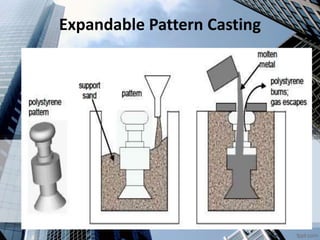
Expandable Pattern Casting
Also known as Expanded Polystyrene Molding or Full Mold
Process, the EPC or Lost Foam process is an economical method
for producing complex, close-tolerance castings using an
expandablepolystyrene patternand unboundedsand.
The EPC process involves attaching expandable polystyrene
patterns to an expandable polystyrene gating system and applying a
refractory coating to the entire assembly. After the coating has dried,
the foam pattern assembly is positioned on several inches of loose
dry sand in a vented flask. Additional sand is then added while the
flask is vibrated until the pattern assembly is completely embedded
insand.
A suitable downsprue is located above the gating system and sand is
again added until it is level to the top of the sprue. Molten metal is
poured into the sprue, vaporizing the foam polystyrene, perfectly
reproducing the pattern. Gases formed from the vaporized pattern
permeate through the coating on the pattern, the sand and finally
through theflaskvents.
In this process, a pattern refers to the expandable polystyrene or
foamed polystyrene part that is vaporized by the molten metal. A
patternisrequired foreachcasting.
Expendablemoldcastingis ageneric classificationthatincludes
sand, plastic,shell, plaster,and investment(lost-waxtechnique)
moldings.This methodofmoldcastinginvolves theuse of
temporary,non-reusablemolds.
Advantages
Nocores arerequired.
Reductionincapitalinvestmentandoperatingcosts.
Closer tolerancesandwallsasthinas0.120 in.
No binders or other additives are required for the sand, which is
reusable.
Flasks for containing the mold assembly are inexpensive, and
shakeout of the castings in unbounded sand is simplified and do not
require the heavy shakeout machinery required for other sand
castingmethods.
Needforskilledlaborisgreatlyreduced.
Casting cleaning is minimized since there are no parting lines or core
fins.
Disadvantages
The pattern coating process is time-consuming, and pattern
handlingrequires great care.
Good process control is required as a scrapped casting means
replacementnotonly of themold butthepattern as well.
Expandable Pattern Casting
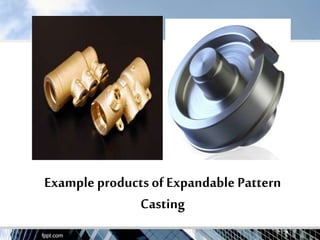
Example products of Expandable Pattern
Casting
Plaster mold casting
Plaster mold casting is a metalworking casting process similar
to sand casting except the molding material is plaster of Paris instead
of sand. Like sand casting, plaster mold casting is an expendable mold
process; however it can only be used with non-ferrous materials. It is
used for castings as small as 30 g (1 oz) to as large as 45 kg (99 lb).
Generally, the form takes less than a week to prepare. Production
ratesof1–10 units/hrcan beachievedwithplastermolds.
Plaster mold casting is a manufacturing process having a similar
technique to sand casting. Plaster of Paris is used to form the mold for
the casting, instead of sand. In industry parts such as valves, tooling,
gears, and lock components may be manufactured by plaster mold
casting.
Details
The plaster is not pure plaster of Paris, but rather has additives to
improve green strength, dry strength, permeability, and castability. For
instance, talc or magnesium oxide are added to prevent cracking and
reduce setting time; lime and cement limit expansion during baking;
glass fibers increase strength; sand can be used as a filler. The ratio of
ingredientsis70–80% gypsumand20–30% additives.
Typical tolerances are 0.1 mm (0.0039 in) for the first 50 mm (2.0 in)
and 0.02 mm per additional centimeter (0.002 in per additional inch).
A draft of 0.5 to 1 degree is required. Standard surface finishes that are
attainableare1.3to4 micrometres(50–125 μin).
The pattern is usually made from metal, however rubber molds
may be used for complex geometry; these molds are
called Rubber plaster molds. For example, if the casting
includes reentrant angles or complex angular surfaces then the
rubber is flexible enough to be removed, unlike metal. These
molds are also inexpensive, reusable, more accurate than steel
molds, fast toproduce, and easy tochange.
Process
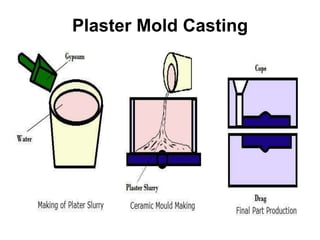
Initially plaster of Paris is mixed with water just like in the first step of the
formation of any plaster part. In the next step of the manufacture of a plaster
casting mold, the plaster of Paris and water are then mixed with various
additives such as talc and silica flour. The additives serve to control the setting
time of the plaster and improve its strength.
The plaster of Paris mixture is then poured over the casting pattern. The
slurry must sit for about 20 minutes before it sets enough to remove the
pattern. The pattern used for this type of metal casting manufacture should be
made from plastic or metal. Since it will experience prolonged exposure to
water from the plaster mix, wood casting patterns have a tendency to warp.
After striping the pattern, the mold must be baked for several hours, to
remove the moisture and become hard enough to pour the metal casting. The
two halves of the mold are then assembled for the casting process.
Advantages& disadvantages
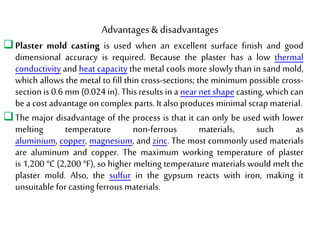
Plaster mold casting is used when an excellent surface finish and good
dimensional accuracy is required. Because the plaster has a low thermal
conductivity and heat capacity the metal cools more slowly than in sand mold,
which allows the metal to fill thin cross-sections; the minimum possible cross-
section is 0.6 mm (0.024 in). This results in a near net shape casting, which can
be a cost advantage on complex parts. It also produces minimal scrap material.
The major disadvantage of the process is that it can only be used with lower
melting temperature non-ferrous materials, such as
aluminium, copper, magnesium, and zinc. The most commonly used materials
are aluminum and copper. The maximum working temperature of plaster
is 1,200 °C (2,200 °F), so higher melting temperature materials would melt the
plaster mold. Also, the sulfur in the gypsum reacts with iron, making it
unsuitable for casting ferrous materials.
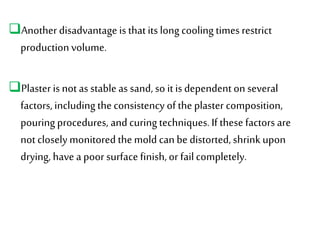
Anotherdisadvantage is thatits long cooling timesrestrict
production volume.
Plasteris not as stableas sand, so it is dependent on several
factors, including theconsistency of the plaster composition,
pouring procedures, and curing techniques.If these factors are
not closely monitored themold can be distorted, shrink upon
drying, have a poor surface finish,or failcompletely.
Plaster Mold Casting
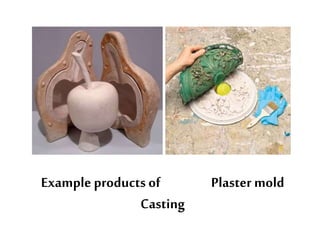
Example products of Plaster mold
Casting
Videoof ExpandablePatternCasting
Videoof PlasterMoldCasting
Expandable Pattern Casting and Plaster Mold Casting

Expandable Pattern Casting and Plaster Mold Casting

  • 1.
  • 2.
    Expandable Pattern Casting Alsoknown as Expanded Polystyrene Molding or Full Mold Process, the EPC or Lost Foam process is an economical method for producing complex, close-tolerance castings using an expandablepolystyrene patternand unboundedsand. The EPC process involves attaching expandable polystyrene patterns to an expandable polystyrene gating system and applying a refractory coating to the entire assembly. After the coating has dried, the foam pattern assembly is positioned on several inches of loose dry sand in a vented flask. Additional sand is then added while the flask is vibrated until the pattern assembly is completely embedded insand.
  • 3.
    A suitable downsprueis located above the gating system and sand is again added until it is level to the top of the sprue. Molten metal is poured into the sprue, vaporizing the foam polystyrene, perfectly reproducing the pattern. Gases formed from the vaporized pattern permeate through the coating on the pattern, the sand and finally through theflaskvents. In this process, a pattern refers to the expandable polystyrene or foamed polystyrene part that is vaporized by the molten metal. A patternisrequired foreachcasting. Expendablemoldcastingis ageneric classificationthatincludes sand, plastic,shell, plaster,and investment(lost-waxtechnique) moldings.This methodofmoldcastinginvolves theuse of temporary,non-reusablemolds.
  • 4.
    Advantages Nocores arerequired. Reductionincapitalinvestmentandoperatingcosts. Closer tolerancesandwallsasthinas0.120in. No binders or other additives are required for the sand, which is reusable. Flasks for containing the mold assembly are inexpensive, and shakeout of the castings in unbounded sand is simplified and do not require the heavy shakeout machinery required for other sand castingmethods. Needforskilledlaborisgreatlyreduced. Casting cleaning is minimized since there are no parting lines or core fins.
  • 5.
    Disadvantages The pattern coatingprocess is time-consuming, and pattern handlingrequires great care. Good process control is required as a scrapped casting means replacementnotonly of themold butthepattern as well.
  • 6.
  • 7.
    Example products ofExpandable Pattern Casting
  • 8.
    Plaster mold casting Plastermold casting is a metalworking casting process similar to sand casting except the molding material is plaster of Paris instead of sand. Like sand casting, plaster mold casting is an expendable mold process; however it can only be used with non-ferrous materials. It is used for castings as small as 30 g (1 oz) to as large as 45 kg (99 lb). Generally, the form takes less than a week to prepare. Production ratesof1–10 units/hrcan beachievedwithplastermolds. Plaster mold casting is a manufacturing process having a similar technique to sand casting. Plaster of Paris is used to form the mold for the casting, instead of sand. In industry parts such as valves, tooling, gears, and lock components may be manufactured by plaster mold casting.
  • 9.
    Details The plaster isnot pure plaster of Paris, but rather has additives to improve green strength, dry strength, permeability, and castability. For instance, talc or magnesium oxide are added to prevent cracking and reduce setting time; lime and cement limit expansion during baking; glass fibers increase strength; sand can be used as a filler. The ratio of ingredientsis70–80% gypsumand20–30% additives. Typical tolerances are 0.1 mm (0.0039 in) for the first 50 mm (2.0 in) and 0.02 mm per additional centimeter (0.002 in per additional inch). A draft of 0.5 to 1 degree is required. Standard surface finishes that are attainableare1.3to4 micrometres(50–125 μin).
  • 10.
    The pattern isusually made from metal, however rubber molds may be used for complex geometry; these molds are called Rubber plaster molds. For example, if the casting includes reentrant angles or complex angular surfaces then the rubber is flexible enough to be removed, unlike metal. These molds are also inexpensive, reusable, more accurate than steel molds, fast toproduce, and easy tochange.
  • 11.
    Process Initially plaster ofParis is mixed with water just like in the first step of the formation of any plaster part. In the next step of the manufacture of a plaster casting mold, the plaster of Paris and water are then mixed with various additives such as talc and silica flour. The additives serve to control the setting time of the plaster and improve its strength. The plaster of Paris mixture is then poured over the casting pattern. The slurry must sit for about 20 minutes before it sets enough to remove the pattern. The pattern used for this type of metal casting manufacture should be made from plastic or metal. Since it will experience prolonged exposure to water from the plaster mix, wood casting patterns have a tendency to warp. After striping the pattern, the mold must be baked for several hours, to remove the moisture and become hard enough to pour the metal casting. The two halves of the mold are then assembled for the casting process.
  • 12.
    Advantages& disadvantages Plaster moldcasting is used when an excellent surface finish and good dimensional accuracy is required. Because the plaster has a low thermal conductivity and heat capacity the metal cools more slowly than in sand mold, which allows the metal to fill thin cross-sections; the minimum possible cross- section is 0.6 mm (0.024 in). This results in a near net shape casting, which can be a cost advantage on complex parts. It also produces minimal scrap material. The major disadvantage of the process is that it can only be used with lower melting temperature non-ferrous materials, such as aluminium, copper, magnesium, and zinc. The most commonly used materials are aluminum and copper. The maximum working temperature of plaster is 1,200 °C (2,200 °F), so higher melting temperature materials would melt the plaster mold. Also, the sulfur in the gypsum reacts with iron, making it unsuitable for casting ferrous materials.
  • 13.
    Anotherdisadvantage is thatitslong cooling timesrestrict production volume. Plasteris not as stableas sand, so it is dependent on several factors, including theconsistency of the plaster composition, pouring procedures, and curing techniques.If these factors are not closely monitored themold can be distorted, shrink upon drying, have a poor surface finish,or failcompletely.
  • 14.
  • 15.
    Example products ofPlaster mold Casting
  • 16.
  • 18.