LIGHT AND VENTILATION
IN BASEMENTS
GROUP MEMBERS
FAHAD S
LULUA N
KARAN A
SATYA M
MASSARAT S
RUQAYYAH S
VENTILATION
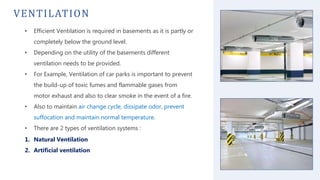
• Efficient Ventilation is required in basements as it is partly or
completely below the ground level.
• Depending on the utility of the basements different
ventilation needs to be provided.
• For Example, Ventilation of car parks is important to prevent
the build-up of toxic fumes and flammable gases from
motor exhaust and also to clear smoke in the event of a fire.
• Also to maintain air change cycle, dissipate odor, prevent
suffocation and maintain normal temperature.
• There are 2 types of ventilation systems :
1. Natural Ventilation
2. Artificial ventilation
NATURAL VENTILATION
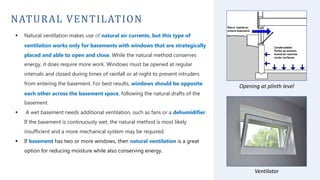
 Natural ventilation makes use of natural air currents, but this type of
ventilation works only for basements with windows that are strategically
placed and able to open and close. While the natural method conserves
energy, it does require more work. Windows must be opened at regular
intervals and closed during times of rainfall or at night to prevent intruders
from entering the basement. For best results, windows should be opposite
each other across the basement space, following the natural drafts of the
basement.
 A wet basement needs additional ventilation, such as fans or a dehumidifier.
If the basement is continuously wet, the natural method is most likely
insufficient and a more mechanical system may be required.
 If basement has two or more windows, then natural ventilation is a great
option for reducing moisture while also conserving energy.
Opening at plinth level
Ventilator
Wind Tunnel for ventilation Floor Grill Dehumidifiers
Working
Tunnel for light and ventilation
Section
Exterior view of floor grill
Working of dehumidifier
New Technology
Old Technology
MECHANICAL VENTILATION
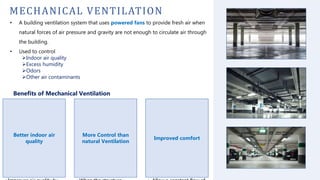
• A building ventilation system that uses powered fans to provide fresh air when
natural forces of air pressure and gravity are not enough to circulate air through
the building.
• Used to control
Indoor air quality
Excess humidity
Odors
Other air contaminants
Benefits of Mechanical Ventilation
Better indoor air
quality
More Control than
natural Ventilation
Improved comfort
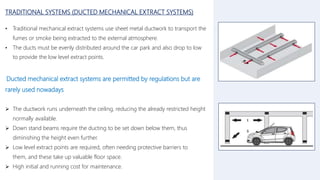
TRADITIONAL SYSTEMS (DUCTED MECHANICAL EXTRACT SYSTEMS)
• Traditional mechanical extract systems use sheet metal ductwork to transport the
fumes or smoke being extracted to the external atmosphere.
• The ducts must be evenly distributed around the car park and also drop to low
to provide the low level extract points.
Ducted mechanical extract systems are permitted by regulations but are
rarely used nowadays
 The ductwork runs underneath the ceiling, reducing the already restricted height
normally available.
 Down stand beams require the ducting to be set down below them, thus
diminishing the height even further.
 Low level extract points are required, often needing protective barriers to
them, and these take up valuable floor space.
 High initial and running cost for maintenance.
JET FAN, JET THRUST, JET VENT, IMPULSE OR INDUCTION SYSTEMS
• have become increasingly popular as they can overcome many of the problems associated with sheet
ductwork.
• Jet fans were developed for ventilating basements a small jet of air at extremely high velocity.
Jet thrust fan , jet fan , jet vent fan or impulse fan :
An axial flow fan mounted within an inlet and outlet cylindrical silencer.
Jet fans can provide up to 50 N of thrust.
Suitable for most small to medium sized car parks.
Induction fan:
A centrifugal fan with an air inlet positioned beneath the body of the fan and
discharging through a reduced size opening, induction fans can provide up to 100N
of thrust.
Suitable for medium to large car parks
• Impulse ventilation systems push the air through the car park towards a
single extract point, rather than pulling it to multiple extract points as a
ducted mechanical extract system would.
• The number and location of fans are carefully chosen to ensure that
there are no dead spots (where there is no airflow) for fumes and
to stagnate and collect.
• Low noise Because the main extract fans are relatively smaller than a
traditional system the noise generated is considerably lower.
• Low cost Jet fan systems cost less than a comparable ducted system.
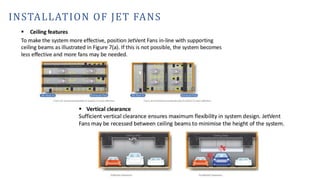
INSTALLATION OF JET FANS
• Lighting is one of the most important aspects of basements. Since
the basement is mostly below ground there is low visibility which
can lead to accidents.
• There are 2 types of lighting
 Natural lighting –
This is available only during day time. Also in large sized
basements light from the openings may not reach
throughout.
 Mechanical lighting –
Can be used at any time of the day. Not affected by climatic
factors. Can reach all parts of the basement.
LIGHTING
NATURAL LIGHTING
This system allows entry of sunlight into the basement through
openings.
Natural lighting also provides aesthetical value to the basement to
avoid making the user feel stuck in a cave.
DAYLIGHTING STRATEGIES IN BASEMENT-
 Partially sunken walls
 Internal or External Walk-On Roof lights
 Ingress walls
 Road constructed at same level as basement
 Use of lightwells
 All white wall
 Use of mirrors and reflectors
 Sun Pipe or Solar Tube
 Open Floor Plan
DF = SC + ERC + IRC 1 + IRC
2
(WHERE,
DF = DAYLIGHT FACTOR
SC = SKY COMPONENT
ERC = EXTERNALLY REFLECTED
COMPONENT
IRC = INTERNALLY REFLECTED
COMPONENT)
FORMULA FOR DAYLIGHT FACTOR
DF = Ei/ Eo X 100
( WHERE,
Ei = INTERNAL LIGHT LEVEL
Eo = EXTERNAL LIGHT LEVEL )
PARTIALLY SUNKEN WALLS ENGRESS WINDOWS
• By constructing a basement such that 3/4th of it
is underground and ¼ of it is above ground
level, it will allow space for installing a ventilator
of a window, allowing natural light to enter into
the basement.
• An emergency fire exit window or a casement
window with hinged sashes that swing free and
clear of opening. (Helps during emergency &
also brings in light and ventilation.)
• In terms of a basement parking, the road along
the basement can be constructed at the same level
as the basement allowing light and air ventilation
in the basement.
ROAD CONSTRUCTED AT BASEMENT
LEVEL
• Glass blocks or skylights could be used on the
internal or external roofs of the basement.
INTERNAL OR EXTERNAL WALK-ON
ROOFLIGHTS
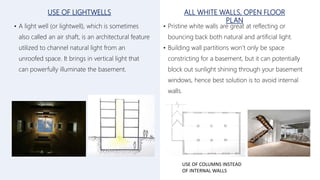
USE OF LIGHTWELLS ALL WHITE WALLS, OPEN FLOOR
PLAN
• A light well (or lightwell), which is sometimes
also called an air shaft, is an architectural feature
utilized to channel natural light from an
unroofed space. It brings in vertical light that
can powerfully illuminate the basement.
• Pristine white walls are great at reflecting or
bouncing back both natural and artificial light.
• Building wall partitions won’t only be space
constricting for a basement, but it can potentially
block out sunlight shining through your basement
windows, hence best solution is to avoid internal
walls.
USE OF COLUMNS INSTEAD
OF INTERNAL WALLS
SUN PIPES OR SOLAR TUBE
• Sun pipes, also known as solar tubes or sun
tunnels, is another architectural element to
channel natural light deep into the house. They
are installed on the roof or an exterior wall. The
pipe is fitted with a series of reflective mirrors,
facilitating light travel to the other end, located in
a dark room like your basement.
USE OF MIRRORS AND REFLECTORS
• Putting mirrors in strategic places is a smart
strategy to reflect light all over your basement.
Hanging a large mirror on a wall opposite your
basement window can double the natural light
streaming from it.
ARTIFICIAL LIGHTING
Car parks are often treated as an afterthought when new buildings are designed. This is
a pity because they are generally the first point of contact that people have with the
building they are visiting. A dark and dull car park can put visitors in the wrong mood
before they even climb out from behind the wheel.
Following are the requirements of basic lighting in a basement.
 Good vertical illumination is essential, so plenty of light on the perimeter walls
columns will hugely improve the overall look of a space.
 In essence, you need a 75 lux average and a uniformity of >40 percent.
 Higher levels still will be required for ramps . An average of 90 lux.
 Dimming is a useful energy saving option but take care when using passive infrared
infrared detectors; nobody wants to enter a dark car park, even if it does light up
once you are inside.
 A uniform light distribution leads to recognizable vehicles, people, and
signage.
 Care should be taken that the lighting doesn’t create a glare on the windshields ,
thus disturbing the driver’s vision.
 To meet the standards ,one can position the luminaires as follows:
1. Parking spaces: install 1 LED luminaire for every 2 parking spaces, halfway across
across the parking space and parallel to the traffic lane.
2. Traffic lane: install 1 LED luminaire for every 2 parking spaces, midway above the
traffic lane.
 Lighting in indoor car parks is responsible for over 60% of the energy
consumption. It is, therefore, obvious that large savings can be achieved by using
LED.
 Placement should be of utmost importance . Many a times , the lighting fixtures
are placed in the driveways to illuminate the path for drivers.
 Determine Minimum spacing between
luminaire
Minimum spacing = SHR * Hm
Hm= Mounting height
SHR= Space to height ratio.
 Determine Number of luminaire in each
row
Number of luminaire in each row= Total
luminaire / Number of rows
 Axial spacing along luminaire
Axial spacing= Length of the room/
of luminaire in each row
 Transverse spacing between luminaire
Transverse spacing = Width of the room/
Number of luminaire in each row
N = number of lamps required.
E = illuminance level required
(lux)
A = area at working plane height
(m2)
F = average luminous flux from
each lamp (lm)
UF = Utilization factor, 0.4 – 0.6
MF= maintenance factor( 0.65 for
basement )
Find required lux level
75 lux for car parking
basements.
Select luminaire
Determine room
index
STEPS TO CALCULATING OF ARTIFICIAL LIGHTING REQUIREMENTS
L = Length of room.
W = Width of room
Hm = Mounting height above
THANK YOU

Basements light and ventilation

  • 1.
    LIGHT AND VENTILATION INBASEMENTS GROUP MEMBERS FAHAD S LULUA N KARAN A SATYA M MASSARAT S RUQAYYAH S
  • 2.
    VENTILATION • Efficient Ventilationis required in basements as it is partly or completely below the ground level. • Depending on the utility of the basements different ventilation needs to be provided. • For Example, Ventilation of car parks is important to prevent the build-up of toxic fumes and flammable gases from motor exhaust and also to clear smoke in the event of a fire. • Also to maintain air change cycle, dissipate odor, prevent suffocation and maintain normal temperature. • There are 2 types of ventilation systems : 1. Natural Ventilation 2. Artificial ventilation
  • 3.
    NATURAL VENTILATION  Naturalventilation makes use of natural air currents, but this type of ventilation works only for basements with windows that are strategically placed and able to open and close. While the natural method conserves energy, it does require more work. Windows must be opened at regular intervals and closed during times of rainfall or at night to prevent intruders from entering the basement. For best results, windows should be opposite each other across the basement space, following the natural drafts of the basement.  A wet basement needs additional ventilation, such as fans or a dehumidifier. If the basement is continuously wet, the natural method is most likely insufficient and a more mechanical system may be required.  If basement has two or more windows, then natural ventilation is a great option for reducing moisture while also conserving energy. Opening at plinth level Ventilator
  • 4.
    Wind Tunnel forventilation Floor Grill Dehumidifiers Working Tunnel for light and ventilation Section Exterior view of floor grill Working of dehumidifier New Technology Old Technology
  • 5.
    MECHANICAL VENTILATION • Abuilding ventilation system that uses powered fans to provide fresh air when natural forces of air pressure and gravity are not enough to circulate air through the building. • Used to control Indoor air quality Excess humidity Odors Other air contaminants Benefits of Mechanical Ventilation Better indoor air quality More Control than natural Ventilation Improved comfort
  • 6.
    TRADITIONAL SYSTEMS (DUCTEDMECHANICAL EXTRACT SYSTEMS) • Traditional mechanical extract systems use sheet metal ductwork to transport the fumes or smoke being extracted to the external atmosphere. • The ducts must be evenly distributed around the car park and also drop to low to provide the low level extract points. Ducted mechanical extract systems are permitted by regulations but are rarely used nowadays  The ductwork runs underneath the ceiling, reducing the already restricted height normally available.  Down stand beams require the ducting to be set down below them, thus diminishing the height even further.  Low level extract points are required, often needing protective barriers to them, and these take up valuable floor space.  High initial and running cost for maintenance.
  • 7.
    JET FAN, JETTHRUST, JET VENT, IMPULSE OR INDUCTION SYSTEMS • have become increasingly popular as they can overcome many of the problems associated with sheet ductwork. • Jet fans were developed for ventilating basements a small jet of air at extremely high velocity. Jet thrust fan , jet fan , jet vent fan or impulse fan : An axial flow fan mounted within an inlet and outlet cylindrical silencer. Jet fans can provide up to 50 N of thrust. Suitable for most small to medium sized car parks. Induction fan: A centrifugal fan with an air inlet positioned beneath the body of the fan and discharging through a reduced size opening, induction fans can provide up to 100N of thrust. Suitable for medium to large car parks
  • 8.
    • Impulse ventilationsystems push the air through the car park towards a single extract point, rather than pulling it to multiple extract points as a ducted mechanical extract system would. • The number and location of fans are carefully chosen to ensure that there are no dead spots (where there is no airflow) for fumes and to stagnate and collect. • Low noise Because the main extract fans are relatively smaller than a traditional system the noise generated is considerably lower. • Low cost Jet fan systems cost less than a comparable ducted system.
  • 9.
  • 11.
    • Lighting isone of the most important aspects of basements. Since the basement is mostly below ground there is low visibility which can lead to accidents. • There are 2 types of lighting  Natural lighting – This is available only during day time. Also in large sized basements light from the openings may not reach throughout.  Mechanical lighting – Can be used at any time of the day. Not affected by climatic factors. Can reach all parts of the basement. LIGHTING
  • 12.
    NATURAL LIGHTING This systemallows entry of sunlight into the basement through openings. Natural lighting also provides aesthetical value to the basement to avoid making the user feel stuck in a cave. DAYLIGHTING STRATEGIES IN BASEMENT-  Partially sunken walls  Internal or External Walk-On Roof lights  Ingress walls  Road constructed at same level as basement  Use of lightwells  All white wall  Use of mirrors and reflectors  Sun Pipe or Solar Tube  Open Floor Plan DF = SC + ERC + IRC 1 + IRC 2 (WHERE, DF = DAYLIGHT FACTOR SC = SKY COMPONENT ERC = EXTERNALLY REFLECTED COMPONENT IRC = INTERNALLY REFLECTED COMPONENT) FORMULA FOR DAYLIGHT FACTOR DF = Ei/ Eo X 100 ( WHERE, Ei = INTERNAL LIGHT LEVEL Eo = EXTERNAL LIGHT LEVEL )
  • 13.
    PARTIALLY SUNKEN WALLSENGRESS WINDOWS • By constructing a basement such that 3/4th of it is underground and ¼ of it is above ground level, it will allow space for installing a ventilator of a window, allowing natural light to enter into the basement. • An emergency fire exit window or a casement window with hinged sashes that swing free and clear of opening. (Helps during emergency & also brings in light and ventilation.)
  • 14.
    • In termsof a basement parking, the road along the basement can be constructed at the same level as the basement allowing light and air ventilation in the basement. ROAD CONSTRUCTED AT BASEMENT LEVEL • Glass blocks or skylights could be used on the internal or external roofs of the basement. INTERNAL OR EXTERNAL WALK-ON ROOFLIGHTS
  • 15.
    USE OF LIGHTWELLSALL WHITE WALLS, OPEN FLOOR PLAN • A light well (or lightwell), which is sometimes also called an air shaft, is an architectural feature utilized to channel natural light from an unroofed space. It brings in vertical light that can powerfully illuminate the basement. • Pristine white walls are great at reflecting or bouncing back both natural and artificial light. • Building wall partitions won’t only be space constricting for a basement, but it can potentially block out sunlight shining through your basement windows, hence best solution is to avoid internal walls. USE OF COLUMNS INSTEAD OF INTERNAL WALLS
  • 16.
    SUN PIPES ORSOLAR TUBE • Sun pipes, also known as solar tubes or sun tunnels, is another architectural element to channel natural light deep into the house. They are installed on the roof or an exterior wall. The pipe is fitted with a series of reflective mirrors, facilitating light travel to the other end, located in a dark room like your basement. USE OF MIRRORS AND REFLECTORS • Putting mirrors in strategic places is a smart strategy to reflect light all over your basement. Hanging a large mirror on a wall opposite your basement window can double the natural light streaming from it.
  • 17.
    ARTIFICIAL LIGHTING Car parksare often treated as an afterthought when new buildings are designed. This is a pity because they are generally the first point of contact that people have with the building they are visiting. A dark and dull car park can put visitors in the wrong mood before they even climb out from behind the wheel. Following are the requirements of basic lighting in a basement.  Good vertical illumination is essential, so plenty of light on the perimeter walls columns will hugely improve the overall look of a space.  In essence, you need a 75 lux average and a uniformity of >40 percent.  Higher levels still will be required for ramps . An average of 90 lux.  Dimming is a useful energy saving option but take care when using passive infrared infrared detectors; nobody wants to enter a dark car park, even if it does light up once you are inside.
  • 18.
     A uniformlight distribution leads to recognizable vehicles, people, and signage.  Care should be taken that the lighting doesn’t create a glare on the windshields , thus disturbing the driver’s vision.  To meet the standards ,one can position the luminaires as follows: 1. Parking spaces: install 1 LED luminaire for every 2 parking spaces, halfway across across the parking space and parallel to the traffic lane. 2. Traffic lane: install 1 LED luminaire for every 2 parking spaces, midway above the traffic lane.  Lighting in indoor car parks is responsible for over 60% of the energy consumption. It is, therefore, obvious that large savings can be achieved by using LED.  Placement should be of utmost importance . Many a times , the lighting fixtures are placed in the driveways to illuminate the path for drivers.
  • 19.
     Determine Minimumspacing between luminaire Minimum spacing = SHR * Hm Hm= Mounting height SHR= Space to height ratio.  Determine Number of luminaire in each row Number of luminaire in each row= Total luminaire / Number of rows  Axial spacing along luminaire Axial spacing= Length of the room/ of luminaire in each row  Transverse spacing between luminaire Transverse spacing = Width of the room/ Number of luminaire in each row N = number of lamps required. E = illuminance level required (lux) A = area at working plane height (m2) F = average luminous flux from each lamp (lm) UF = Utilization factor, 0.4 – 0.6 MF= maintenance factor( 0.65 for basement ) Find required lux level 75 lux for car parking basements. Select luminaire Determine room index STEPS TO CALCULATING OF ARTIFICIAL LIGHTING REQUIREMENTS L = Length of room. W = Width of room Hm = Mounting height above
  • 20.