DR. BIJAY KR.YADAV
Holly vision technical campus
Shankhamul, Kathmandu
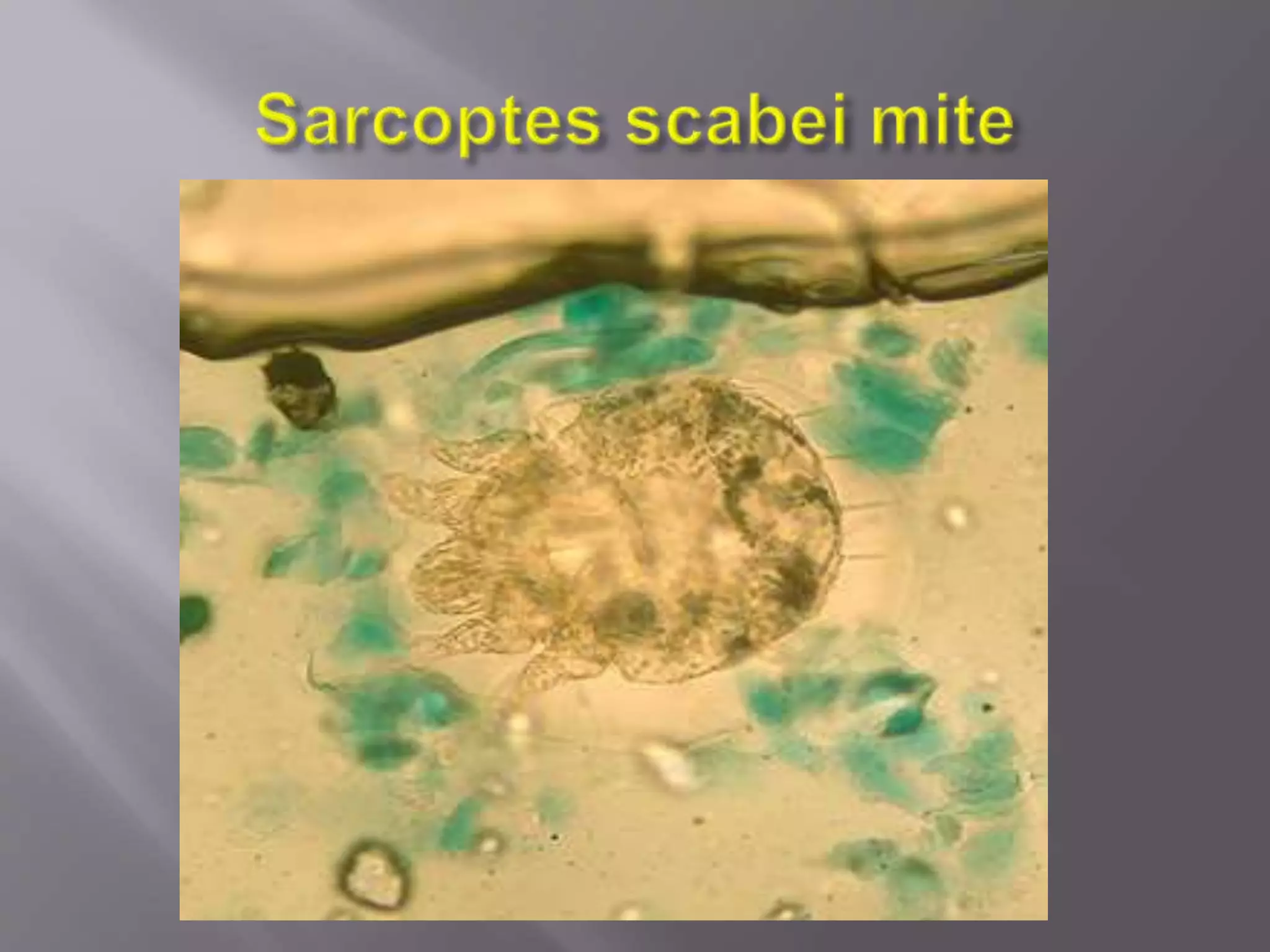
 Infestation of the skin caused by ITCH MITE Sarcoptes scabies
var. hominis.
 The scabies mite has four pairs of legs and measures 0.3 mm in
diameter.
 It lives its entire 30-day life cycle in and on the epidermis.
Incubation period : 2-4 weeks
Mode of transmission :
 Intimate prolonged contact
 Sexual transmission
 Fomite transmission
Common sites :
 Inter digital webs sides of the fingers,
 Volar aspects of the wrists
 Lateral palms
 Elbows
 Axillae
 Scrotum
 Penis
 Labia, and
 The areolae in women
 Severe itchy papules or vesicles
 Usually worst at night.(Noctural itch)
 Surrounding skin may be inflammed
 Some time on close examine burrow may be
seen
 Face is usually not involved except in infants
and immuni-compromised
 Usually secondary infectiona leading to
pustules, crusting and fever is the presentation
 Immuno-compromised patients
 HIV
 Psychiatric disorder patients
 Down’s syndrome
 Under immuno-supressive therapy
 All close contacts of the patient, even if asymptomatic
should be treated
1. Benzene Hexachloride ( BHC 1% lotion) - Scarb lotion
 Should be applied below neck over all body
 To be repeated for 3 nights
 Then bath the patient after 3rd night and boil all his/her
clothes, bed sheets, etc
2. Permethrin cream – to be applied over the lesion TDS to QID
till the lesion is cured.
3. Additional medications –
a. Antihistaminics : for itchings as Tab. Cetrizine 10 mg Po HS
b. Antibiotics : as Ampicillin/cloxacillin in case of secondary
infections
Oral therapy with IVERMECTIN 200 microgram / kg single
dose
 Maintain the proper personal hygiene.
 Proper handwashing practice.
 Treatment and proper isolation of the case
 Secondary infection leading to pus formation,
fever, lymphnode enlargement.
 Norwegain scabies :
 Extensive lesions
 Pustules, crusting
 Also involves face
 Seen in diabetic, immuno-compromised,
kidney disease patients.
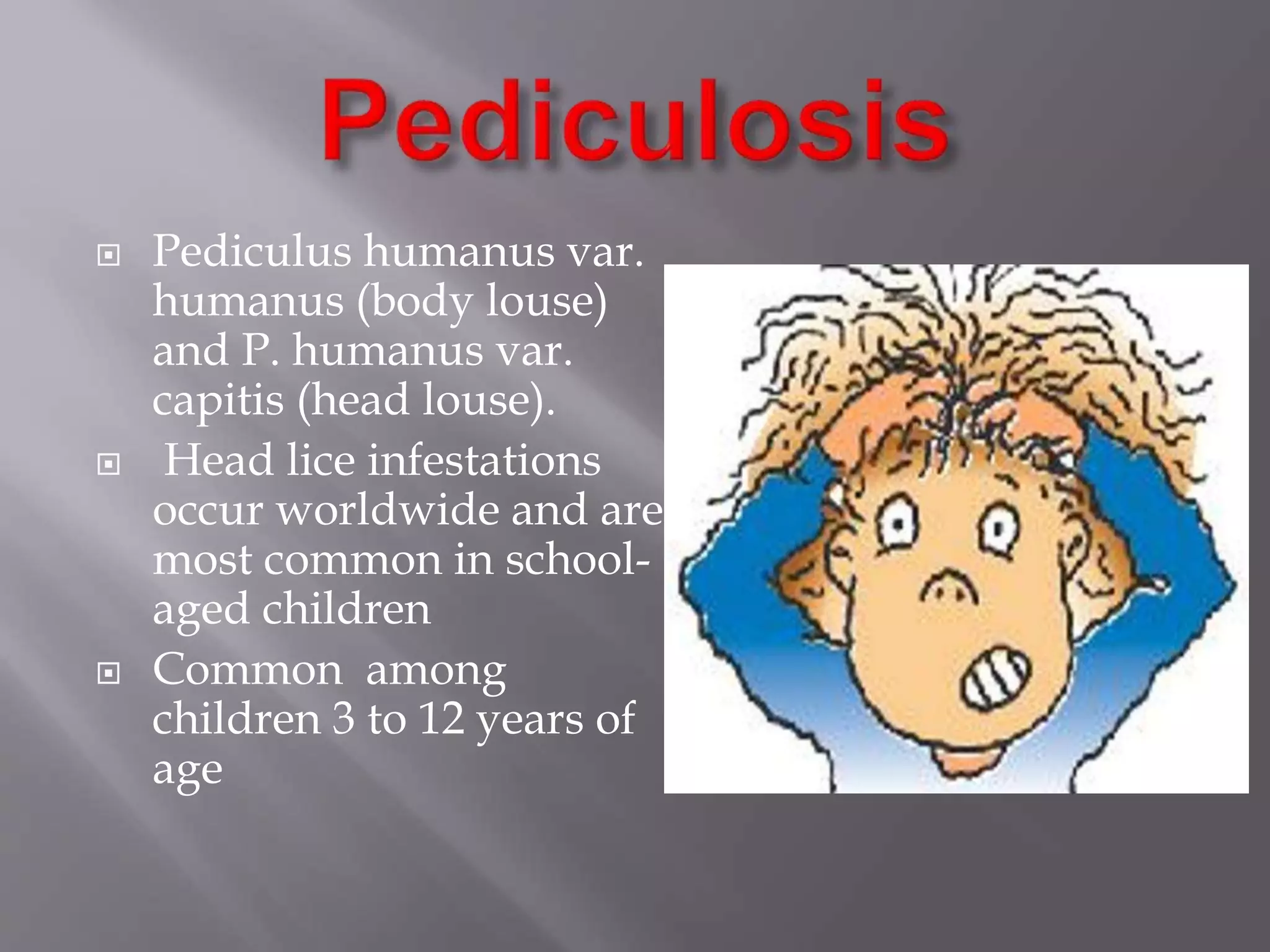
 Pediculus humanus var.
humanus (body louse)
and P. humanus var.
capitis (head louse).
 Head lice infestations
occur worldwide and are
most common in school-
aged children
 Common among
children 3 to 12 years of
age
1. Pediculus humanus : Two varieties
a. Pediculus humanus corporis
b. Pediculus humanus capitis
2. Phthirus pubis : The gravid louse lays a few egg daily, these
eggs are called nits. They are small-
oval greyish white & 0.5 mm in length.
 It is the infestation of the scalp by pediculosa humanus
capitis.
 It localizes in the scalp , favouring the occiput & temporal
area.
 They are laid close to the scalp surface, at the bottom of the
hair.
Clinical features :
 Itching
 Scratching causes trauma with result into oozing.
 Secondary infection usually resulting in pustulation &
absscess formation.
 It is the infestation of the body by pediculosa humanus corporis.
 The body louse inhibbits from the clothings.
 Lice bites the skin to suck blood
Release of mild toxin
Produces pruritic spot & strong itching
Results in excoriations ( Hall mark of the disease)
 Sites :
Shoulder
Trunk
Buttocks
 This is the infestation of the pubic & perianal hairs by
phthirus pubis.
 It is usually transmitted by sexual contact.
 The adult female lays eggs & nits remain firmly adhered to
the pubic hair.
Clinical features :
 The patients complains of itching which results in scratching.
 The hairs may be matted in the thick crusts of dried pus,
serum & blood.
 The patients may also notice tiny blood spot on the
underwear.
 The diagnosis is usually suspected on clinical
examination & finding the nits or the adult
louse on the hair of the fibers in the seams of
the clothing, if necessary the hair of the fibers
may be observed under the low power
microscope.
1. Pediculosis capitis :
a. 1% Gamma benzene hexacholoride
b. 25% Benzyl benzoate
c. 0.5 % malathion
Mode of applications :
 Three applications on the consecutive days followed by
tying a cloth on the scalp.
 Shampoo after 7 days.
2. Pediculosis corporis :
 Patients needs a scrub bath.
 Insecticidal dusting powder should be applied to the
garments lying close to the skin.
 Laundering & ironing of the clothes.
3. Pediculosis pubis :
a. 1% Gamma benzene hexachloride
b. 25% Benxyl benzoate
c. 0.5% malathion
Since application is usually sufficient, if necessary repeat
after 3 days.
1. Maintain good hygiene
2. Secondary bacterial infection treated with
broad spectrum antibiotics
3. Itching controlled by antihistaminics
5. Scabies and pediculosis

5. Scabies and pediculosis

  • 1.
    DR. BIJAY KR.YADAV Hollyvision technical campus Shankhamul, Kathmandu
  • 2.
     Infestation ofthe skin caused by ITCH MITE Sarcoptes scabies var. hominis.  The scabies mite has four pairs of legs and measures 0.3 mm in diameter.  It lives its entire 30-day life cycle in and on the epidermis. Incubation period : 2-4 weeks Mode of transmission :  Intimate prolonged contact  Sexual transmission  Fomite transmission
  • 5.
    Common sites : Inter digital webs sides of the fingers,  Volar aspects of the wrists  Lateral palms  Elbows  Axillae  Scrotum  Penis  Labia, and  The areolae in women
  • 6.
     Severe itchypapules or vesicles  Usually worst at night.(Noctural itch)  Surrounding skin may be inflammed  Some time on close examine burrow may be seen  Face is usually not involved except in infants and immuni-compromised  Usually secondary infectiona leading to pustules, crusting and fever is the presentation
  • 9.
     Immuno-compromised patients HIV  Psychiatric disorder patients  Down’s syndrome  Under immuno-supressive therapy
  • 10.
     All closecontacts of the patient, even if asymptomatic should be treated 1. Benzene Hexachloride ( BHC 1% lotion) - Scarb lotion  Should be applied below neck over all body  To be repeated for 3 nights  Then bath the patient after 3rd night and boil all his/her clothes, bed sheets, etc 2. Permethrin cream – to be applied over the lesion TDS to QID till the lesion is cured. 3. Additional medications – a. Antihistaminics : for itchings as Tab. Cetrizine 10 mg Po HS b. Antibiotics : as Ampicillin/cloxacillin in case of secondary infections Oral therapy with IVERMECTIN 200 microgram / kg single dose
  • 11.
     Maintain theproper personal hygiene.  Proper handwashing practice.  Treatment and proper isolation of the case
  • 12.
     Secondary infectionleading to pus formation, fever, lymphnode enlargement.  Norwegain scabies :  Extensive lesions  Pustules, crusting  Also involves face  Seen in diabetic, immuno-compromised, kidney disease patients.
  • 13.
     Pediculus humanusvar. humanus (body louse) and P. humanus var. capitis (head louse).  Head lice infestations occur worldwide and are most common in school- aged children  Common among children 3 to 12 years of age
  • 14.
    1. Pediculus humanus: Two varieties a. Pediculus humanus corporis b. Pediculus humanus capitis 2. Phthirus pubis : The gravid louse lays a few egg daily, these eggs are called nits. They are small- oval greyish white & 0.5 mm in length.
  • 15.
     It isthe infestation of the scalp by pediculosa humanus capitis.  It localizes in the scalp , favouring the occiput & temporal area.  They are laid close to the scalp surface, at the bottom of the hair. Clinical features :  Itching  Scratching causes trauma with result into oozing.  Secondary infection usually resulting in pustulation & absscess formation.
  • 16.
     It isthe infestation of the body by pediculosa humanus corporis.  The body louse inhibbits from the clothings.  Lice bites the skin to suck blood Release of mild toxin Produces pruritic spot & strong itching Results in excoriations ( Hall mark of the disease)  Sites : Shoulder Trunk Buttocks
  • 17.
     This isthe infestation of the pubic & perianal hairs by phthirus pubis.  It is usually transmitted by sexual contact.  The adult female lays eggs & nits remain firmly adhered to the pubic hair. Clinical features :  The patients complains of itching which results in scratching.  The hairs may be matted in the thick crusts of dried pus, serum & blood.  The patients may also notice tiny blood spot on the underwear.
  • 18.
     The diagnosisis usually suspected on clinical examination & finding the nits or the adult louse on the hair of the fibers in the seams of the clothing, if necessary the hair of the fibers may be observed under the low power microscope.
  • 19.
    1. Pediculosis capitis: a. 1% Gamma benzene hexacholoride b. 25% Benzyl benzoate c. 0.5 % malathion Mode of applications :  Three applications on the consecutive days followed by tying a cloth on the scalp.  Shampoo after 7 days.
  • 20.
    2. Pediculosis corporis:  Patients needs a scrub bath.  Insecticidal dusting powder should be applied to the garments lying close to the skin.  Laundering & ironing of the clothes. 3. Pediculosis pubis : a. 1% Gamma benzene hexachloride b. 25% Benxyl benzoate c. 0.5% malathion Since application is usually sufficient, if necessary repeat after 3 days.
  • 21.
    1. Maintain goodhygiene 2. Secondary bacterial infection treated with broad spectrum antibiotics 3. Itching controlled by antihistaminics