Contact Dermatitis

   What is it?
Contact Dermatitis

 •   Dermatitis is a blanket term meaning any
     "inflammation of the skin" (e.g. rashes
     etc.). There are several different types.
     Usually all of them have in common an
     allergic reaction to specific allergens.
     The term may be used to refer to
     eczema, which is also known as
     Dermatitis eczema.
Contact Dermatitis

  The variation of dermatitis which the hair
   and beauty trade suffer from most
   regularly is contact Dermatitis
Contact Dermatitis
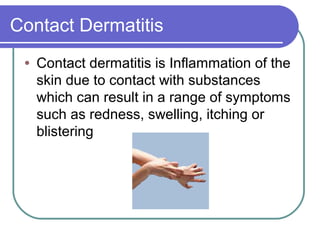
 •   Contact dermatitis is Inflammation of the
     skin due to contact with substances
     which can result in a range of symptoms
     such as redness, swelling, itching or
     blistering
Contact Dermatitis

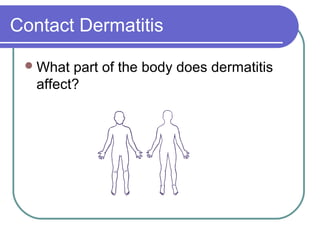
  What  part of the body does dermatitis
   affect?
Contact Dermatitis

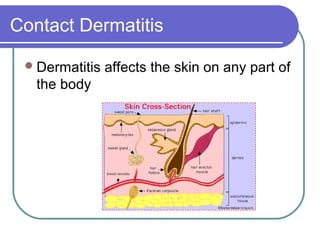
  Dermatitis   affects the skin on any part of
   the body
Contact Dermatitis

  What are the most commonly affected
   areas of the body?
Contact Dermatitis

  Hands
  Feet
  Groin
Contact Dermatitis


  Is   dermatitis contagious?
Contact Dermatitis

  The  simple answer is No
  However should the skin become
   broken, the possibility of infection
   increases and the area can become
   infected
Contact Dermatitis

  How   will you know if the area is
   infected?
Contact Dermatitis

  Yellow pus present, Weeping and
 Sore to the touch
Contact Dermatitis

  What  type of substances do you think
   might cause contact dermatitis?
Contact Dermatitis

  Most  commonly detergents,
   chemicals, toiletries and even natural
   products such as food or water!
  An allergy is a type of hypersensitivity, a
   reaction of the immune system.
  Because of this a variety of triggers can
   cause the same reaction in different
   people
Contact Dermatitis

  What steps can be taken to avoid
   dermatitis?
Contact Dermatitis


  Wear
      disposable, non-latex gloves when
  shampooing, colouring and bleaching
Contact Dermatitis

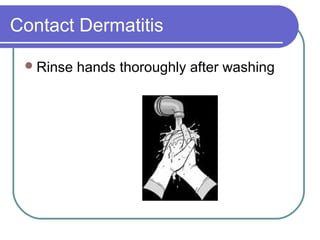
  Rinse   hands thoroughly after washing
Contact Dermatitis

  Dryhands thoroughly with soft cotton or
   paper towel
Contact Dermatitis

  Moisturise after washing your hands as
   well as the start and finish of each day
  Pay attention to the fingertips, webs and
   wrists
Contact Dermatitis

  Change gloves between clients.
  Make sure you don’t contaminate your
   hands when taking them off
Contact Dermatitis

  Check skin regularly for early signs of
   dermatitis
Dermatitis – Signs and Symptoms

 People often experience different signs
 and symptoms and they can include:
    Dryness
    Itching
    Redness
    Cracking
    Flaking
    Scaling
    Bleeding
    Swelling
    Blistering
Contact Dermatitis

 The following pictures will give you an
  idea of how differently dermatitis
  manifests itself on the body and the
  varying degrees of severity.
Contact Dermatitis
Contact Dermatitis
Contact Dermatitis
Contact Dermatitis
Contact Dermatitis
Contact Dermatitis
Contact Dermatitis
Contact Dermatitis

 Hopefully you will now know what Contact
  Dermatitis is and what steps can be
  taken to avoid it.


 Answer the questions at the front of the
  Dermatitis unit book

Dermatitis.ppt