ATHLETE’S FOOT 
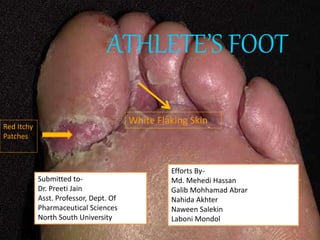
Red Itchy 
Patches 
White Flaking Skin 
Efforts By- 
Md. Mehedi Hassan 
Galib Mohhamad Abrar 
Nahida Akhter 
Naween Salekin 
Laboni Mondol 
Submitted to- 
Dr. Preeti Jain 
Asst. Professor, Dept. Of 
Pharmaceutical Sciences 
North South University
What is Athlete’s Foot? 
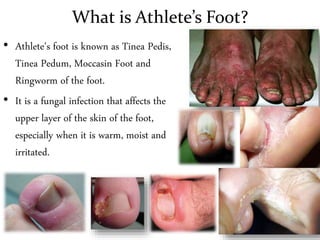
• Athlete's foot is known as Tinea Pedis, 
Tinea Pedum, Moccasin Foot and 
Ringworm of the foot. 
• It is a fungal infection that affects the 
upper layer of the skin of the foot, 
especially when it is warm, moist and 
irritated.
What Causes Athlete’s Foot?? 
• The fungus that causes athlete's foot is 
called Trichophyton. 
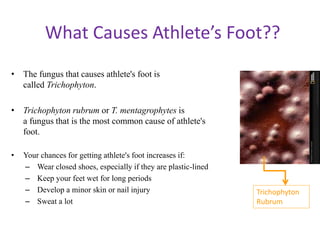
• Trichophyton rubrum or T. mentagrophytes is 
a fungus that is the most common cause of athlete's 
foot. 
• Your chances for getting athlete's foot increases if: 
– Wear closed shoes, especially if they are plastic-lined 
– Keep your feet wet for long periods 
– Develop a minor skin or nail injury 
– Sweat a lot 
Trichophyton 
Rubrum
Epidemiology 
• Athlete's foot is probably the most common dermatophyte 
infection in the World with up to 70% of the population having 
had this infection. 
• Athlete's foot is most common among adolescents and in 
individuals who wear occlusive shoes. 
• Men are infected 2–4 times more often than women. 
• The risk of getting athlete's foot increases with age. Most cases 
occur after puberty. Infection is most common between the ages 
of 20 and 50 years. 
• It is more common in the summer months.
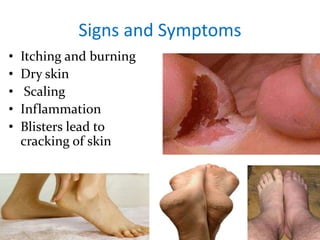
Signs and Symptoms 
• Itching and burning 
• Dry skin 
• Scaling 
• Inflammation 
• Blisters lead to 
cracking of skin
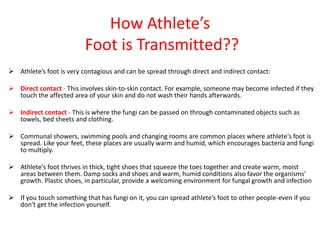
How Athlete’s 
Foot is Transmitted?? 
 Athlete’s foot is very contagious and can be spread through direct and indirect contact: 
 Direct contact - This involves skin-to-skin contact. For example, someone may become infected if they 
touch the affected area of your skin and do not wash their hands afterwards. 
 Indirect contact - This is where the fungi can be passed on through contaminated objects such as 
towels, bed sheets and clothing. 
 Communal showers, swimming pools and changing rooms are common places where athlete's foot is 
spread. Like your feet, these places are usually warm and humid, which encourages bacteria and fungi 
to multiply. 
 Athlete's foot thrives in thick, tight shoes that squeeze the toes together and create warm, moist 
areas between them. Damp socks and shoes and warm, humid conditions also favor the organisms' 
growth. Plastic shoes, in particular, provide a welcoming environment for fungal growth and infection 
 If you touch something that has fungi on it, you can spread athlete’s foot to other people-even if you 
don't get the infection yourself.
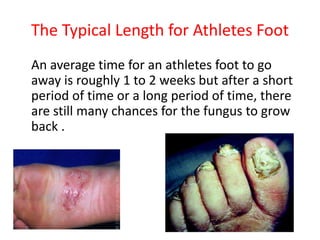
The Typical Length for Athletes Foot 
An average time for an athletes foot to go 
away is roughly 1 to 2 weeks but after a short 
period of time or a long period of time, there 
are still many chances for the fungus to grow 
back .
Types Of Athlete Foot….. 
Toe web infection 
A moccasin-type infection 
Vascular-type infections
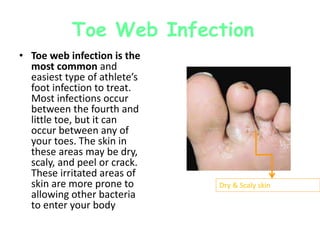
Toe Web Infection 
• Toe web infection is the 
most common and 
easiest type of athlete’s 
foot infection to treat. 
Most infections occur 
between the fourth and 
little toe, but it can 
occur between any of 
your toes. The skin in 
these areas may be dry, 
scaly, and peel or crack. 
These irritated areas of 
skin are more prone to 
allowing other bacteria 
to enter your body 
Dry & Scaly skin
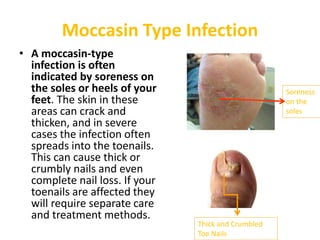
Moccasin Type Infection 
• A moccasin-type 
infection is often 
indicated by soreness on 
the soles or heels of your 
feet. The skin in these 
areas can crack and 
thicken, and in severe 
cases the infection often 
spreads into the toenails. 
This can cause thick or 
crumbly nails and even 
complete nail loss. If your 
toenails are affected they 
will require separate care 
and treatment methods. 
Soreness 
on the 
soles 
Thick and Crumbled 
Toe Nails
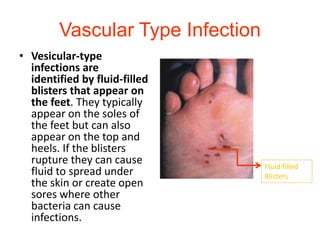
Vascular Type Infection 
• Vesicular-type 
infections are 
identified by fluid-filled 
blisters that appear on 
the feet. They typically 
appear on the soles of 
the feet but can also 
appear on the top and 
heels. If the blisters 
rupture they can cause 
fluid to spread under 
the skin or create open 
sores where other 
bacteria can cause 
infections. 
Fluid filled 
Blisters
Diagnosis 
• Usually diagnosed by visual inspection of the skin 
• KOH test- 
Direct microscopy of a potassium hydroxide preparation of a 
skin scraping 
• Using a wood's lamp (black light)- 
Although useful in diagnosing fungal infections of the scalp 
(tinea capitis), is not usually helpful in diagnosing athlete's 
foot, since the common dermatophytes that cause this 
disease do not fluoresce under ultraviolet light
How to Prevent Athlete’s Foot? 
To Prevent Athletes foot, you would need to follow some steps 
you could do these steps daily 
• At home, first take your shoes off and put them in the air to 
make them not moist 
• Change your socks and underwear everyday when you 
sweat or when it is hot outside 
• Dry your feet carefully and especially between your toes 
after using a shower or a locker room 
• Avoid walking in bare foot in especially on public areas 
• Throw away any type of worn out shoes or exercise of shoes 
and never borrow anybody’s shoes`
How to Avoid Athlete’s 
foot?? 
 Keep your feet dry, especially between your toes. 
 Go with natural materials. 
 Change socks and stockings regularly. 
 Wear light, well-ventilated shoes. 
 Alternate pairs of shoes. 
. 
 Protect your feet in public places. 
 Treat your feet. 
 Don't share shoes.
Treatment (self care) 
In addition the following steps can help treat athlete's 
foot: 
• Wash your feet regularly and thoroughly using soap 
and water. 
• After washing, dry your feet, paying particular 
attention to the areas between your toes. 
• Wear clean cotton socks. 
• Change your shoes and socks regularly to help keep 
your feet dry. 
• Do not share towels, and wash your towels regularly.
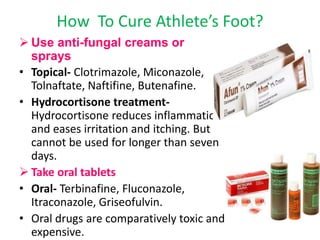
How To Cure Athlete’s Foot? 
 Use anti-fungal creams or 
sprays 
• Topical- Clotrimazole, Miconazole, 
Tolnaftate, Naftifine, Butenafine. 
• Hydrocortisone treatment- 
Hydrocortisone reduces inflammation 
and eases irritation and itching. But 
cannot be used for longer than seven 
days. 
 Take oral tablets 
• Oral- Terbinafine, Fluconazole, 
Itraconazole, Griseofulvin. 
• Oral drugs are comparatively toxic and 
expensive.
How To Cure Athlete’s Foot? 
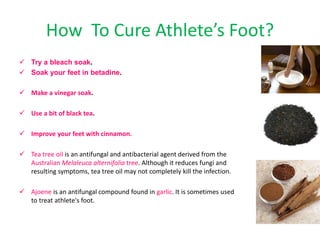
 Try a bleach soak. 
 Soak your feet in betadine. 
 Make a vinegar soak. 
 Use a bit of black tea. 
 Improve your feet with cinnamon. 
 Tea tree oil is an antifungal and antibacterial agent derived from the 
Australian Melaleuca alternifolia tree. Although it reduces fungi and 
resulting symptoms, tea tree oil may not completely kill the infection. 
 Ajoene is an antifungal compound found in garlic. It is sometimes used 
to treat athlete's foot.
Treatment During Pregnancy 
Dilute vinegar soaks or sprays (roughly one part 
white household vinegar to four parts water) 
and Clotrimazole cream twice a day for two to 
three weeks to the soles. 
Antifungal pills are generally not recommended 
during pregnancy because of the potential side 
effects and possible fetal harm.
Complications Faced if untreated… 
• If untreated, skin blisters and cracks caused by 
athlete's foot can lead to severe bacterial infections. In 
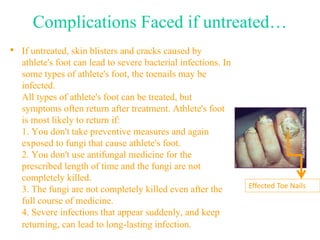
some types of athlete's foot, the toenails may be 
infected. 
All types of athlete's foot can be treated, but 
symptoms often return after treatment. Athlete's foot 
is most likely to return if: 
1. You don't take preventive measures and again 
exposed to fungi that cause athlete's foot. 
2. You don't use antifungal medicine for the 
prescribed length of time and the fungi are not 
completely killed. 
3. The fungi are not completely killed even after the 
full course of medicine. 
4. Severe infections that appear suddenly, and keep 
returning, can lead to long-lasting infection. 
Effected Toe Nails
Hope We Are Successful in Making 
you Aware About Athlete’s Foot… 
Scan this code for more information…<<< 
THANK YOU FOR YOUR KIND CO-OPERATION...

Athlete's foot

  • 1.
    ATHLETE’S FOOT RedItchy Patches White Flaking Skin Efforts By- Md. Mehedi Hassan Galib Mohhamad Abrar Nahida Akhter Naween Salekin Laboni Mondol Submitted to- Dr. Preeti Jain Asst. Professor, Dept. Of Pharmaceutical Sciences North South University
  • 2.
    What is Athlete’sFoot? • Athlete's foot is known as Tinea Pedis, Tinea Pedum, Moccasin Foot and Ringworm of the foot. • It is a fungal infection that affects the upper layer of the skin of the foot, especially when it is warm, moist and irritated.
  • 3.
    What Causes Athlete’sFoot?? • The fungus that causes athlete's foot is called Trichophyton. • Trichophyton rubrum or T. mentagrophytes is a fungus that is the most common cause of athlete's foot. • Your chances for getting athlete's foot increases if: – Wear closed shoes, especially if they are plastic-lined – Keep your feet wet for long periods – Develop a minor skin or nail injury – Sweat a lot Trichophyton Rubrum
  • 4.
    Epidemiology • Athlete'sfoot is probably the most common dermatophyte infection in the World with up to 70% of the population having had this infection. • Athlete's foot is most common among adolescents and in individuals who wear occlusive shoes. • Men are infected 2–4 times more often than women. • The risk of getting athlete's foot increases with age. Most cases occur after puberty. Infection is most common between the ages of 20 and 50 years. • It is more common in the summer months.
  • 5.
    Signs and Symptoms • Itching and burning • Dry skin • Scaling • Inflammation • Blisters lead to cracking of skin
  • 6.
    How Athlete’s Footis Transmitted??  Athlete’s foot is very contagious and can be spread through direct and indirect contact:  Direct contact - This involves skin-to-skin contact. For example, someone may become infected if they touch the affected area of your skin and do not wash their hands afterwards.  Indirect contact - This is where the fungi can be passed on through contaminated objects such as towels, bed sheets and clothing.  Communal showers, swimming pools and changing rooms are common places where athlete's foot is spread. Like your feet, these places are usually warm and humid, which encourages bacteria and fungi to multiply.  Athlete's foot thrives in thick, tight shoes that squeeze the toes together and create warm, moist areas between them. Damp socks and shoes and warm, humid conditions also favor the organisms' growth. Plastic shoes, in particular, provide a welcoming environment for fungal growth and infection  If you touch something that has fungi on it, you can spread athlete’s foot to other people-even if you don't get the infection yourself.
  • 7.
    The Typical Lengthfor Athletes Foot An average time for an athletes foot to go away is roughly 1 to 2 weeks but after a short period of time or a long period of time, there are still many chances for the fungus to grow back .
  • 8.
    Types Of AthleteFoot….. Toe web infection A moccasin-type infection Vascular-type infections
  • 9.
    Toe Web Infection • Toe web infection is the most common and easiest type of athlete’s foot infection to treat. Most infections occur between the fourth and little toe, but it can occur between any of your toes. The skin in these areas may be dry, scaly, and peel or crack. These irritated areas of skin are more prone to allowing other bacteria to enter your body Dry & Scaly skin
  • 10.
    Moccasin Type Infection • A moccasin-type infection is often indicated by soreness on the soles or heels of your feet. The skin in these areas can crack and thicken, and in severe cases the infection often spreads into the toenails. This can cause thick or crumbly nails and even complete nail loss. If your toenails are affected they will require separate care and treatment methods. Soreness on the soles Thick and Crumbled Toe Nails
  • 11.
    Vascular Type Infection • Vesicular-type infections are identified by fluid-filled blisters that appear on the feet. They typically appear on the soles of the feet but can also appear on the top and heels. If the blisters rupture they can cause fluid to spread under the skin or create open sores where other bacteria can cause infections. Fluid filled Blisters
  • 12.
    Diagnosis • Usuallydiagnosed by visual inspection of the skin • KOH test- Direct microscopy of a potassium hydroxide preparation of a skin scraping • Using a wood's lamp (black light)- Although useful in diagnosing fungal infections of the scalp (tinea capitis), is not usually helpful in diagnosing athlete's foot, since the common dermatophytes that cause this disease do not fluoresce under ultraviolet light
  • 13.
    How to PreventAthlete’s Foot? To Prevent Athletes foot, you would need to follow some steps you could do these steps daily • At home, first take your shoes off and put them in the air to make them not moist • Change your socks and underwear everyday when you sweat or when it is hot outside • Dry your feet carefully and especially between your toes after using a shower or a locker room • Avoid walking in bare foot in especially on public areas • Throw away any type of worn out shoes or exercise of shoes and never borrow anybody’s shoes`
  • 14.
    How to AvoidAthlete’s foot??  Keep your feet dry, especially between your toes.  Go with natural materials.  Change socks and stockings regularly.  Wear light, well-ventilated shoes.  Alternate pairs of shoes. .  Protect your feet in public places.  Treat your feet.  Don't share shoes.
  • 15.
    Treatment (self care) In addition the following steps can help treat athlete's foot: • Wash your feet regularly and thoroughly using soap and water. • After washing, dry your feet, paying particular attention to the areas between your toes. • Wear clean cotton socks. • Change your shoes and socks regularly to help keep your feet dry. • Do not share towels, and wash your towels regularly.
  • 16.
    How To CureAthlete’s Foot?  Use anti-fungal creams or sprays • Topical- Clotrimazole, Miconazole, Tolnaftate, Naftifine, Butenafine. • Hydrocortisone treatment- Hydrocortisone reduces inflammation and eases irritation and itching. But cannot be used for longer than seven days.  Take oral tablets • Oral- Terbinafine, Fluconazole, Itraconazole, Griseofulvin. • Oral drugs are comparatively toxic and expensive.
  • 17.
    How To CureAthlete’s Foot?  Try a bleach soak.  Soak your feet in betadine.  Make a vinegar soak.  Use a bit of black tea.  Improve your feet with cinnamon.  Tea tree oil is an antifungal and antibacterial agent derived from the Australian Melaleuca alternifolia tree. Although it reduces fungi and resulting symptoms, tea tree oil may not completely kill the infection.  Ajoene is an antifungal compound found in garlic. It is sometimes used to treat athlete's foot.
  • 18.
    Treatment During Pregnancy Dilute vinegar soaks or sprays (roughly one part white household vinegar to four parts water) and Clotrimazole cream twice a day for two to three weeks to the soles. Antifungal pills are generally not recommended during pregnancy because of the potential side effects and possible fetal harm.
  • 19.
    Complications Faced ifuntreated… • If untreated, skin blisters and cracks caused by athlete's foot can lead to severe bacterial infections. In some types of athlete's foot, the toenails may be infected. All types of athlete's foot can be treated, but symptoms often return after treatment. Athlete's foot is most likely to return if: 1. You don't take preventive measures and again exposed to fungi that cause athlete's foot. 2. You don't use antifungal medicine for the prescribed length of time and the fungi are not completely killed. 3. The fungi are not completely killed even after the full course of medicine. 4. Severe infections that appear suddenly, and keep returning, can lead to long-lasting infection. Effected Toe Nails
  • 20.
    Hope We AreSuccessful in Making you Aware About Athlete’s Foot… Scan this code for more information…<<< THANK YOU FOR YOUR KIND CO-OPERATION...

Editor's Notes

  • #6 Feet and the skin between toes burn and itch The skin may peel and crack Dry flaking skin on the soles of the feet Unpleasant foot odour Small itchy bubbles or blisters on the soles of the feet