Arthur Charpentier
Econometrics: Learning from ‘Statistical Learning’ Techniques
Arthur Charpentier (Université de Rennes 1 & UQàM)
Chaire ACTINFO
Covéa, Paris, June 2016
http://freakonometrics.hypotheses.org
@freakonometrics 1
Arthur Charpentier
Econometrics: Learning from ‘Statistical Learning’ Techniques
Arthur Charpentier (Université de Rennes 1 & UQàM)
Professor, Economics Department, Univ. Rennes 1
In charge of Data Science for Actuaries program, IA
Research Chair actinfo (Institut Louis Bachelier)
(previously Actuarial Sciences at UQàM & ENSAE Paristech
actuary in Hong Kong, IT & Stats FFSA)
PhD in Statistics (KU Leuven), Fellow Institute of Actuaries
MSc in Financial Mathematics (Paris Dauphine) & ENSAE
Editor of the freakonometrics.hypotheses.org’s blog
Editor of Computational Actuarial Science, CRC
@freakonometrics 2
Arthur Charpentier
Agenda
“the numbers have no way of speaking for them-
selves. We speak for them. [· · · ] Before we de-
mand more of our data, we need to demand more
of ourselves ” from Silver (2012).
- (big) data
- econometrics & probabilistic modeling
- algorithmics & statistical learning
- different perspectives on classification
- boostrapping, PCA & variable section
see Berk (2008), Hastie, Tibshirani & Friedman
(2009), but also Breiman (2001)
@freakonometrics 3
Arthur Charpentier
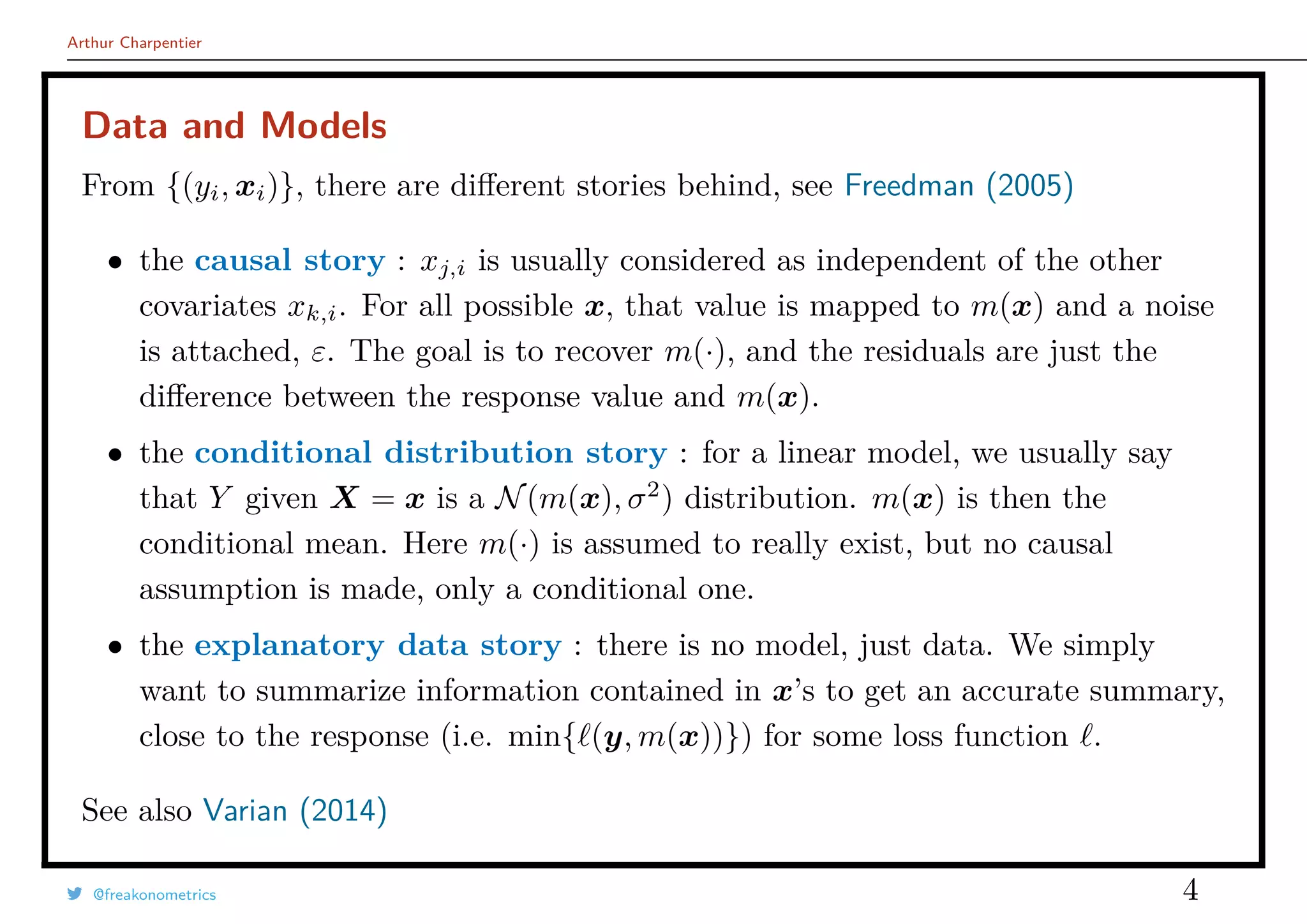
Data and Models
From {(yi, xi)}, there are different stories behind, see Freedman (2005)
• the causal story : xj,i is usually considered as independent of the other
covariates xk,i. For all possible x, that value is mapped to m(x) and a noise
is attached, ε. The goal is to recover m(·), and the residuals are just the
difference between the response value and m(x).
• the conditional distribution story : for a linear model, we usually say
that Y given X = x is a N(m(x), σ2
) distribution. m(x) is then the
conditional mean. Here m(·) is assumed to really exist, but no causal
assumption is made, only a conditional one.
• the explanatory data story : there is no model, just data. We simply
want to summarize information contained in x’s to get an accurate summary,
close to the response (i.e. min{ (y, m(x))}) for some loss function .
See also Varian (2014)
@freakonometrics 4
Arthur Charpentier
Data, Models & Causal Inference
We cannot differentiate data and model that easily..
After an operation, should I stay at hospital, or go back home ?
as in Angrist & Pischke (2008),
(health | hospital) − (health | stayed home) [observed]
should be written
(health | hospital) − (health | had stayed home) [treatment effect]
+ (health | had stayed home) − (health | stayed home) [selection bias]
Need randomization to solve selection bias.
@freakonometrics 5
Arthur Charpentier
Econometric Modeling
Data {(yi, xi)}, for i = 1, · · · , n, with xi ∈ X ⊂ Rp
and yi ∈ Y.
A model is a m : X → Y mapping
- regression, Y = R (but also Y = N)
- classification, Y = {0, 1}, {−1, +1}, {•, •}
(binary, or more)
Classification models are based on two steps,
• score function, s(x) = P(Y = 1|X = x) ∈ [0, 1]
• classifier s(x) → y ∈ {0, 1}.
q
q
q
q
q
q
q
q
q
q
0.0 0.2 0.4 0.6 0.8 1.0
0.00.20.40.60.81.0
q
q
q
q
q
q
q
q
q
q
@freakonometrics 6
Arthur Charpentier
High Dimensional Data (not to say ‘Big Data’)
See Bühlmann & van de Geer (2011) or Koch (2013), X is a n × p matrix
Portnoy (1988) proved that maximum likelihood estimators are asymptotically
normal when p2
/n → 0 as n, p → ∞. Hence, massive data, when p >
√
n.
More intersting is the sparcity concept, based not on p, but on the effective size.
Hence one can have p > n and convergent estimators.
High dimension might be scary because of curse of dimensionality, see
Bellman (1957). The volume of the unit sphere in Rp
tends to 0 as p → ∞,
i.e.space is sparse.
@freakonometrics 7
Arthur Charpentier
Computational & Nonparametric Econometrics
Linear Econometrics: estimate g : x → E[Y |X = x] by a linear function.
Nonlinear Econometrics: consider the approximation for some functional basis
g(x) =
∞
j=0
ωjgj(x) and g(x) =
h
j=0
ωjgj(x)
or a local model, on the neighborhood of x,
g(x) =
1
nx
i∈Ix
yi, with Ix = {x ∈ Rp
: xi−x ≤ h},
see Nadaraya (1964) and Watson (1964).
Here h is some tunning parameter: not estimated, but chosen (optimaly).
@freakonometrics 8
Arthur Charpentier
Econometrics & Probabilistic Model
from Cook & Weisberg (1999), see also Haavelmo (1965).
(Y |X = x) ∼ N(µ(x), σ2
) with µ(x) = β0 + xT
β, and β ∈ Rp
.
Linear Model: E[Y |X = x] = β0 + xT
β
Homoscedasticity: Var[Y |X = x] = σ2
.
@freakonometrics 9
Arthur Charpentier
Conditional Distribution and Likelihood
(Y |X = x) ∼ N(µ(x), σ2
) with µ(x) = β0 + xT
β, et β ∈ Rp
The log-likelihood is
log L(β0, β, σ2
|y, x) = −
n
2
log[2πσ2
] −
1
2σ2
n
i=1
(yi − β0 − xT
i β)2
.
Set
(β0, β, σ2
) = argmax log L(β0, β, σ2
|y, x) .
First order condition XT
[y − Xβ] = 0. If matrix X is a full rank matrix
β = (XT
X)−1
XT
y = β + (XT
X)−1
XT
ε.
Asymptotic properties of β,
√
n(β − β)
L
→ N(0, Σ) as n → ∞
@freakonometrics 10
Arthur Charpentier
Geometric Perspective
Define the orthogonal projection on X,
ΠX = X[XT
X]−1
XT
y = X[XT
X]−1
XT
ΠX
y = ΠXy.
Pythagoras’ theorem can be writen
y 2
= ΠXy 2
+ ΠX⊥ y 2
= ΠXy 2
+ y − ΠXy 2
which can be expressed as
n
i=1
y2
i
n×total variance
=
n
i=1
y2
i
n×explained variance
+
n
i=1
(yi − yi)2
n×residual variance
@freakonometrics 11
Arthur Charpentier
Geometric Perspective
Define the angle θ between y and ΠX y,
R2
=
ΠX y 2
y 2
= 1 −
ΠX⊥ y 2
y 2
= cos2
(θ)
see Davidson & MacKinnon (2003)
y = β0 + X1β1 + X2β2 + ε
If y2 = ΠX⊥
1
y and X2 = ΠX⊥
1
X2, then
β2 = [X2
T
X2]−1
X2
T
y2
X2 = X2 if X1 ⊥ X2,
Frisch-Waugh theorem.
@freakonometrics 12
Arthur Charpentier
From Linear to Non-Linear
y = Xβ = X[XT
X]−1
XT
H
y i.e. yi = hT
xi
y,
with - for the linear regression - hx = X[XT
X]−1
x.
One can consider some smoothed regression, see Nadaraya (1964) and Watson
(1964), with some smoothing matrix S
mh(x) = sT
xy =
n
i=1
sx,iyi withs sx,i =
Kh(x − xi)
Kh(x − x1) + · · · + Kh(x − xn)
for some kernel K(·) and some bandwidth h > 0.
@freakonometrics 13
Arthur Charpentier
From Linear to Non-Linear
T =
Sy − Hy
trace([S − H]T[S − H])
can be used to test for linearity, Simonoff (1996). trace(S) is the equivalent
number of parameters, and n − trace(S) the degrees of freedom, Ruppert et al.
(2003).
Nonlinear Model, but Homoscedastic - Gaussian
• (Y |X = x) ∼ N(µ(x), σ2
)
• E[Y |X = x] = µ(x)
@freakonometrics 14
Arthur Charpentier
Conditional Expectation
from Angrist & Pischke (2008), x → E[Y |X = x].
@freakonometrics 15
Arthur Charpentier
Exponential Distributions and Linear Models
f(yi|θi, φ) = exp
yiθi − b(θi)
a(φ)
+ c(yi, φ) with θi = h(xT
i β)
Log likelihood is expressed as
log L(θ, φ|y) =
n
i=1
log f(yi|θi, φ) =
n
i=1 yiθi −
n
i=1 b(θi)
a(φ)
+
n
i=1
c(yi, φ)
and first order conditions
∂ log L(θ, φ|y)
∂β
= XT
W −1
[y − µ] = 0
as in Müller (2001), where W is a weight matrix, function of β.
We usually specify the link function g(·) defined as
y = m(x) = E[Y |X = x] = g−1
(xT
β).
@freakonometrics 16
Arthur Charpentier
Exponential Distributions and Linear Models
Note that W = diag( g(y) · Var[y]), and set
z = g(y) + (y − y) · g(y)
the the maximum likelihood estimator is obtained iteratively
βk+1 = [XT
W −1
k X]−1
XT
W −1
k zk
Set β = β∞, so that
√
n(β − β)
L
→ N(0, I(β)−1
)
with I(β) = φ · [XT
W −1
∞ X].
Note that [XT
W −1
k X] is a p × p matrix.
@freakonometrics 17
Arthur Charpentier
Exponential Distributions and Linear Models
Generalized Linear Model:
• (Y |X = x) ∼ L(θx, ϕ)
• E[Y |X = x] = h−1
(θx) = g−1
(xT
β)
e.g. (Y |X = x) ∼ P(exp[xT
β]).
Use of maximum likelihood techniques for inference.
Actually, more a moment condition than a distribution assumption.
@freakonometrics 18
Arthur Charpentier
Goodness of Fit & Model Choice
From the variance decomposition
1
n
n
i=1
(yi − ¯y)2
total variance
=
1
n
n
i=1
(yi − yi)2
residual variance
+
1
n
n
i=1
(yi − ¯y)2
explained variance
and define
R2
=
n
i=1(yi − ¯y)2
−
n
i=1(yi − yi)2
n
i=1(yi − ¯y)2
More generally
Deviance(β) = −2 log[L] = 2
i=1
(yi − yi)2
= Deviance(y)
The null deviance is obtained using yi = y, so that
R2
=
Deviance(y) − Deviance(y)
Deviance(y)
= 1 −
Deviance(y)
Deviance(y)
= 1 −
D
D0
@freakonometrics 19
Arthur Charpentier
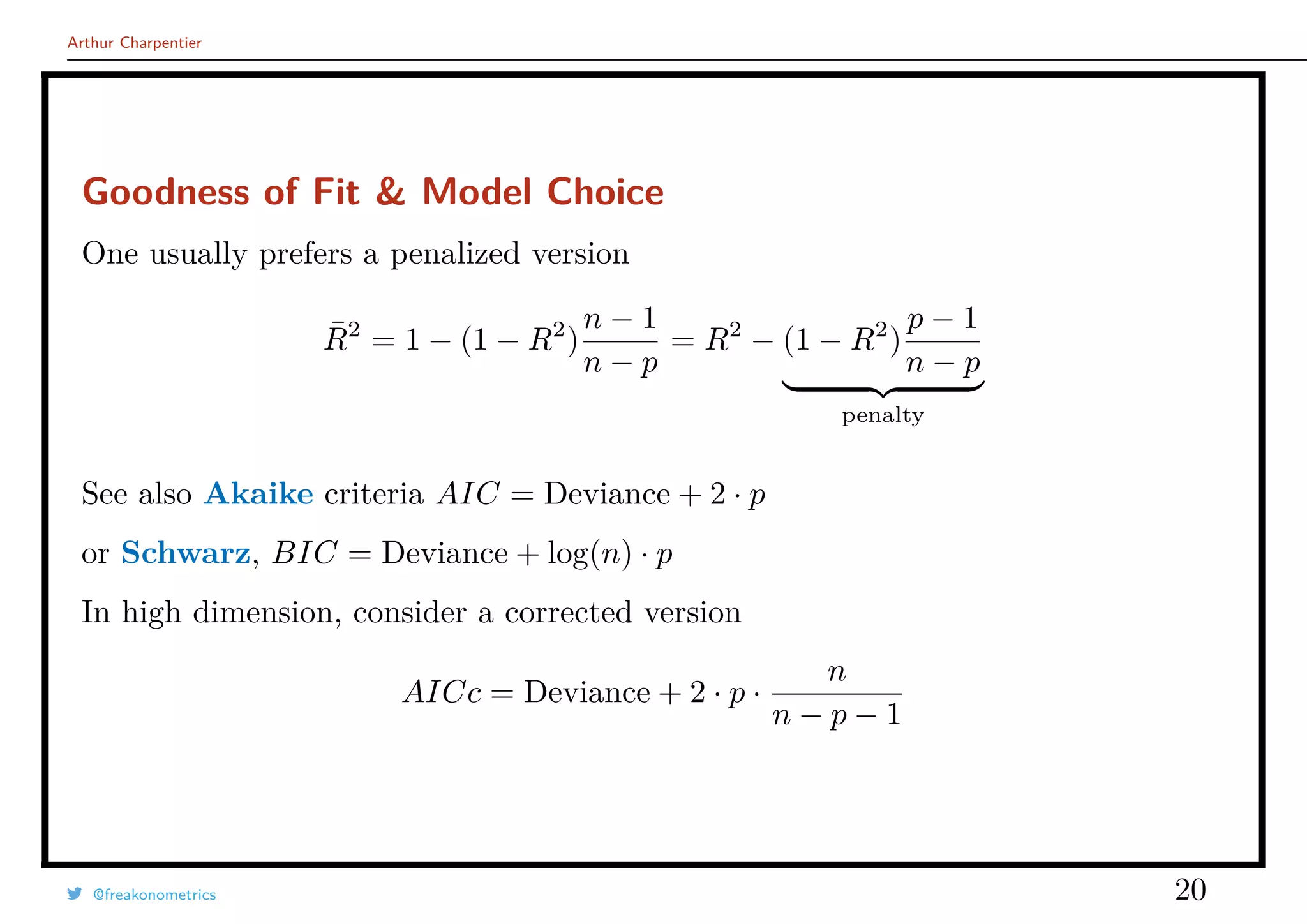
Goodness of Fit & Model Choice
One usually prefers a penalized version
¯R2
= 1 − (1 − R2
)
n − 1
n − p
= R2
− (1 − R2
)
p − 1
n − p
penalty
See also Akaike criteria AIC = Deviance + 2 · p
or Schwarz, BIC = Deviance + log(n) · p
In high dimension, consider a corrected version
AICc = Deviance + 2 · p ·
n
n − p − 1
@freakonometrics 20
Arthur Charpentier
Stepwise Procedures
Forward algorithm
1. set j1 = argmin
j∈{∅,1,··· ,n}
{AIC({j})}
2. set j2 = argmin
j∈{∅,1,··· ,n}{j1 }
{AIC({j1 , j})}
3. ... until j = ∅
Backward algorithm
1. set j1 = argmin
j∈{∅,1,··· ,n}
{AIC({1, · · · , n}{j})}
2. set j2 = argmin
j∈{∅,1,··· ,n}{j1 }
{AIC({1, · · · , n}{j1 , j})}
3. ... until j = ∅
@freakonometrics 21
Arthur Charpentier
Econometrics & Statistical Testing
Standard test for H0 : βk = 0 against H1 : βk = 0 is Student-t est tk = βk/seβk
,
Use the p-value P[|T| > |tk|] with T ∼ tν (and ν = trace(H)).
In high dimension, consider the FDR (False Discovery Ratio).
With α = 5%, 5% variables are wrongly significant.
If p = 100 with only 5 significant variables, one should expect also 5 false positive,
i.e. 50% FDR, see Benjamini & Hochberg (1995) and Andrew Gelman’s talk.
@freakonometrics 22
Arthur Charpentier
Under & Over-Identification
Under-identification is obtained when the true model is
y = β0 + xT
1 β1 + xT
2 β2 + ε, but we estimate y = β0 + xT
1 b1 + η.
Maximum likelihood estimator for b1 is
b1 = (XT
1 X1)−1
XT
1 y
= (XT
1 X1)−1
XT
1 [X1,iβ1 + X2,iβ2 + ε]
= β1 + (X1X1)−1
XT
1 X2β2
β12
+ (XT
1 X1)−1
XT
1 ε
νi
so that E[b1] = β1 + β12, and the bias is null when XT
1 X2 = 0 i.e. X1 ⊥ X2,
see Frisch-Waugh).
Over-identification is obtained when the true model is y = β0 + xT
1 β1ε, but we
fit y = β0 + xT
1 b1 + xT
2 b2 + η.
Inference is unbiased since E(b1) = β1 but the estimator is not efficient.
@freakonometrics 23
Arthur Charpentier
Statistical Learning & Loss Function
Here, no probabilistic model, but a loss function, . For some set of functions
M, X → Y, define
m = argmin
m∈M
n
i=1
(yi, m(xi))
Quadratic loss functions are interesting since
y = argmin
m∈R
n
i=1
1
n
[yi − m]2
which can be writen, with some underlying probabilistic model
E(Y ) = argmin
m∈R
Y − m 2
2
= argmin
m∈R
E [Y − m]2
For τ ∈ (0, 1), we obtain the quantile regression (see Koenker (2005))
m = argmin
m∈M0
n
i=1
τ (yi, m(xi)) avec τ (x, y) = |(x − y)(τ − 1x≤y)|
@freakonometrics 24
Arthur Charpentier
Boosting & Weak Learning
m = argmin
m∈M
n
i=1
(yi, m(xi))
is hard to solve for some very large and general space M of X → Y functions.
Consider some iterative procedure, where we learn from the errors,
m(k)
(·) = m1(·)
∼y
+ m2(·)
∼ε1
+ m3(·)
∼ε2
+ · · · + mk(·)
∼εk−1
= m(k−1)
(·) + mk(·).
Formely ε can be seen as , the gradient of the loss.
@freakonometrics 25
Arthur Charpentier
Boosting & Weak Learning
It is possible to see this algorithm as a gradient descent. Not
f(xk)
f,xk
∼ f(xk−1)
f,xk−1
+ (xk − xk−1)
αk
f(xk−1)
f,xk−1
but some kind of dual version
fk(x)
fk,x
∼ fk−1(x)
fk−1,x
+ (fk − fk−1)
ak
fk−1, x
where is a gradient is some functional space.
m(k)
(x) = m(k−1)
(x) + argmin
f∈F
n
i=1
(yi, m(k−1)
(x) + f(x))
for some simple space F so that we define some weak learner, e.g. step
functions (so called stumps)
@freakonometrics 26
Arthur Charpentier
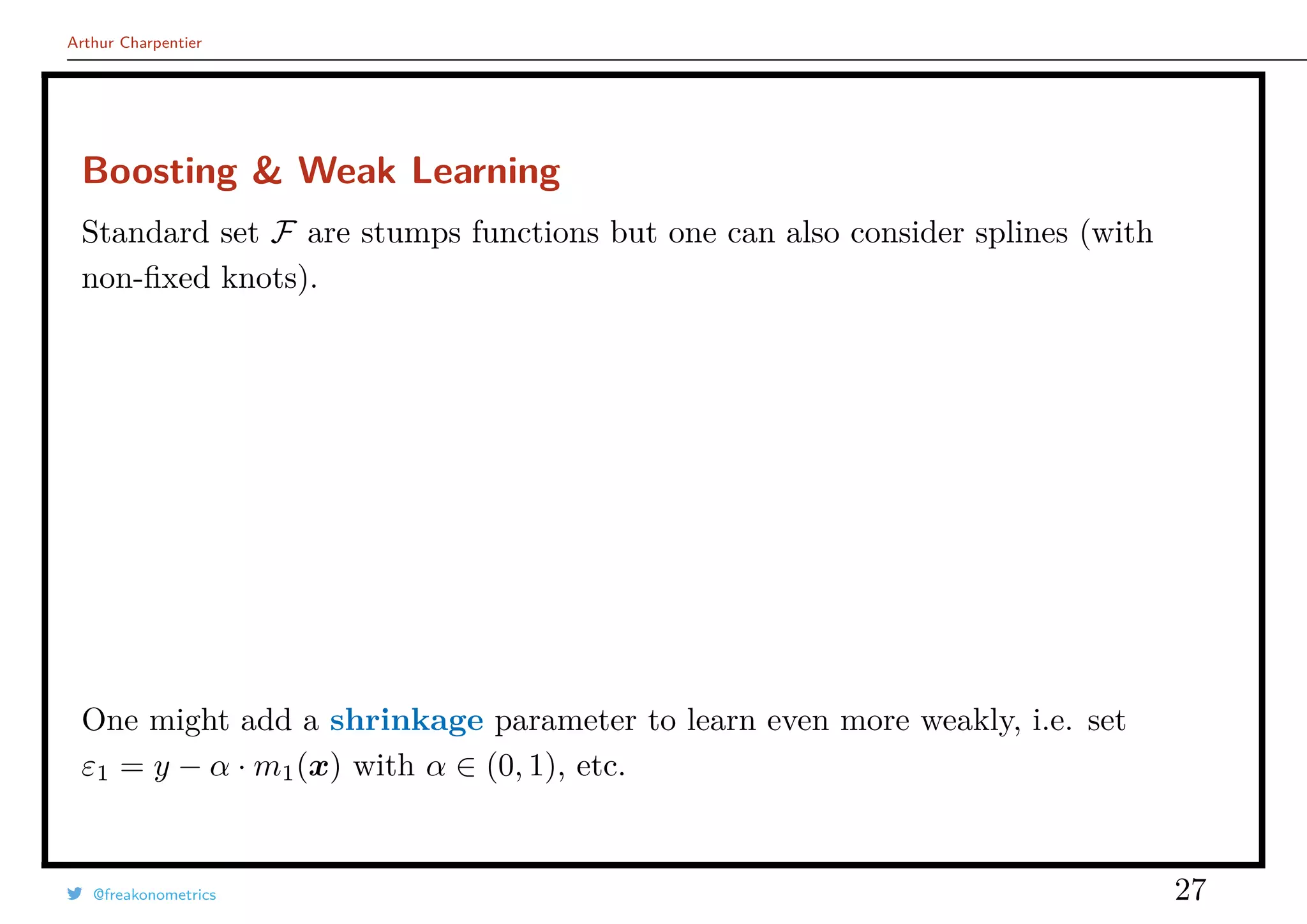
Boosting & Weak Learning
Standard set F are stumps functions but one can also consider splines (with
non-fixed knots).
One might add a shrinkage parameter to learn even more weakly, i.e. set
ε1 = y − α · m1(x) with α ∈ (0, 1), etc.
@freakonometrics 27
Arthur Charpentier
Big Data & Linear Model
Consider some linear model yi = xT
i β + εi for all i = 1, · · · , n.
Assume that εi are i.i.d. with E(ε) = 0 (and finite variance). Write





y1
...
yn





y,n×1
=





1 x1,1 · · · x1,p
...
...
...
...
1 xn,1 · · · xn,p





X,n×(p+1)








β0
β1
...
βp








β,(p+1)×1
+





ε1
...
εn





ε,n×1
.
Assuming ε ∼ N(0, σ2
I), the maximum likelihood estimator of β is
β = argmin{ y − XT
β 2
} = (XT
X)−1
XT
y
... under the assumtption that XT
X is a full-rank matrix.
What if XT
X cannot be inverted? Then β = [XT
X]−1
XT
y does not exist, but
βλ = [XT
X + λI]−1
XT
y always exist if λ > 0.
@freakonometrics 28
Arthur Charpentier
Ridge Regression & Regularization
The estimator β = [XT
X + λI]−1
XT
y is the Ridge estimate obtained as
solution of
β = argmin
β



n
i=1
[yi − β0 − xT
i β]2
+ λ β 2
2
1Tβ2



for some tuning parameter λ. One can also write
β = argmin
β; β 2 ≤s
{ Y − XT
β 2
}
There is a Bayesian interpretation of that regularization, when β has some prior
N(β0, τI).
@freakonometrics 29
Arthur Charpentier
Over-Fitting & Penalization
Solve here, for some norm · ,
min
n
i=1
(yi, β0 + xT
β) + λ β = min objective(β) + penality(β) .
Estimators are no longer unbiased, but might have a smaller mse.
Consider some i.id. sample {y1, · · · , yn} from N(θ, σ2
), and consider some
estimator proportional to y, i.e. θ = αy. α = 1 is the maximum likelihood
estimator.
Note that
mse[θ] = (α − 1)2
µ2
bias[θ]2
+
α2
σ2
n
Var[θ]
and α = µ2
· µ2
+
σ2
n
−1
< 1.
@freakonometrics 30
Arthur Charpentier
(β0, β) = argmin
n
i=1
(yi, β0 + xT
β) + λ β ,
can be seen as a Lagrangian minimization problem
(β0, β) = argmin
β; β ≤s
n
i=1
(yi, β0 + xT
β)
@freakonometrics 31
Arthur Charpentier
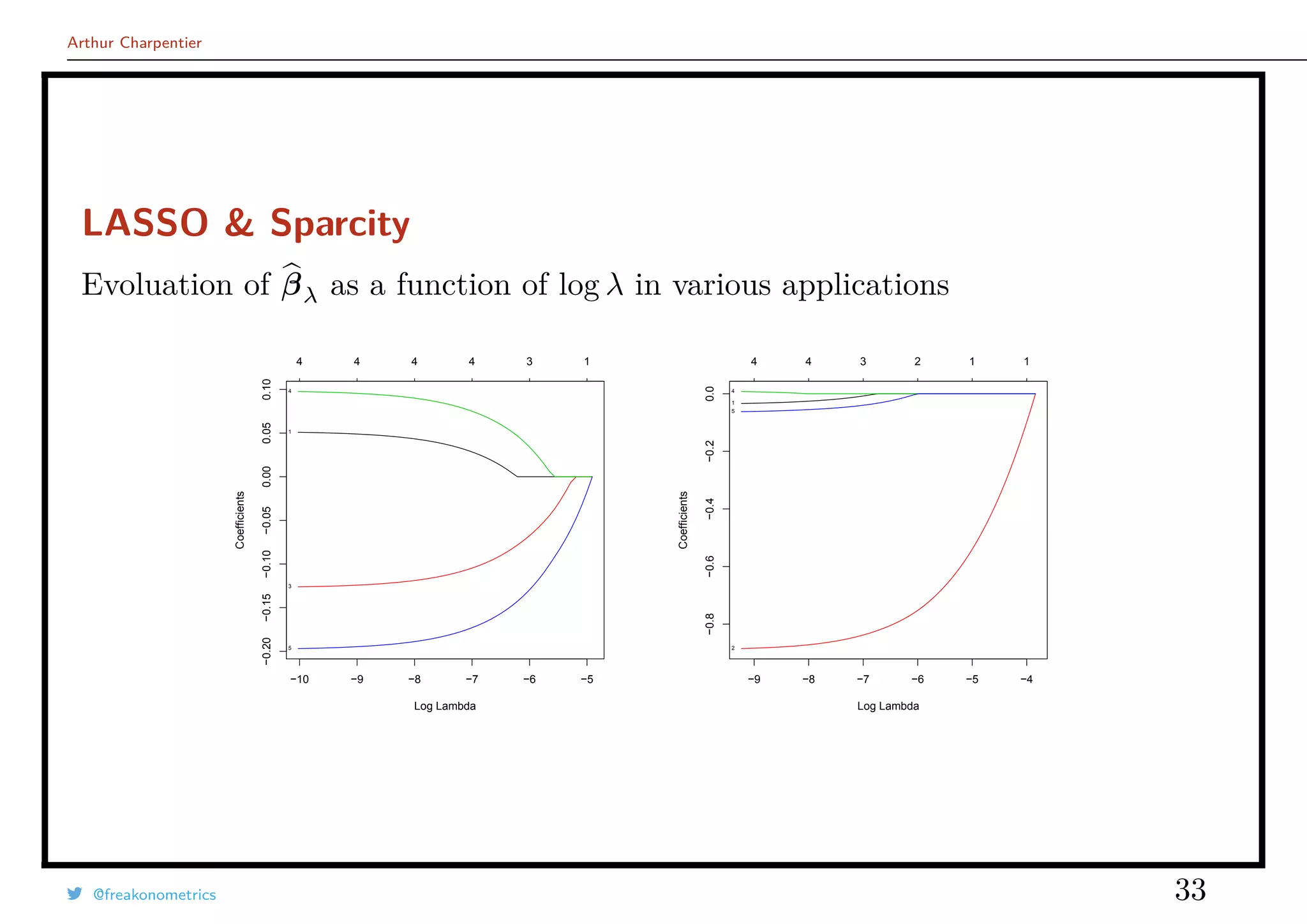
LASSO & Sparcity
In severall applications, p can be (very) large, but a lot of features are just noise:
βj = 0 for many j’s. Let s denote the number of relevent features, with
s << p, cf Hastie, Tibshirani & Wainwright (2015),
s = card{S} where S = {j; βj = 0}
The true model is now y = XT
SβS + ε, where XT
SXS is a full rank matrix.
@freakonometrics 32
Arthur Charpentier
LASSO & Sparcity
Evoluation of βλ as a function of log λ in various applications
−10 −9 −8 −7 −6 −5
−0.20−0.15−0.10−0.050.000.050.10
Log Lambda
Coefficients
4 4 4 4 3 1
1
3
4
5
−9 −8 −7 −6 −5 −4
−0.8−0.6−0.4−0.20.0 Log Lambda
Coefficients
4 4 3 2 1 1
1
2
4
5
@freakonometrics 33
Arthur Charpentier
In-Sample & Out-Sample
Write β = β((x1, y1), · · · , (xn, yn)). Then (for the linear model)
Deviance IS(β) =
n
i=1
[yi − xT
i β((x1, y1), · · · , (xn, yn))]2
Withe this “in-sample” deviance, we cannot use the central limit theorem
Deviance IS(β)
n
→ E [Y − XT
β]
Hence, we can compute some “out-of-sample” deviance
Deviance OS(β) =
m+n
i=n+1
[yi − xT
i β((x1, y1), · · · , (xn, yn)]2
@freakonometrics 34
Arthur Charpentier
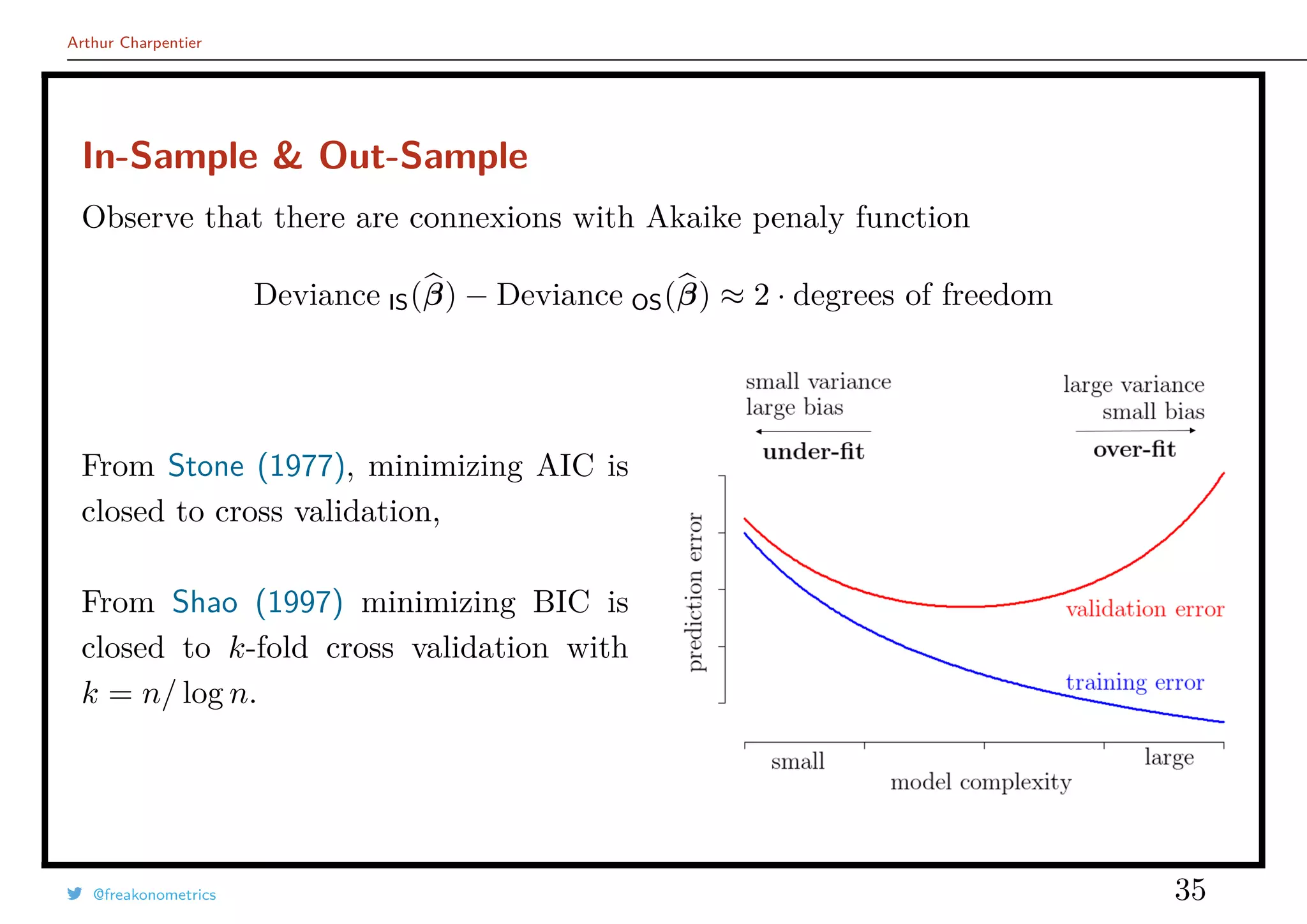
In-Sample & Out-Sample
Observe that there are connexions with Akaike penaly function
Deviance IS(β) − Deviance OS(β) ≈ 2 · degrees of freedom
From Stone (1977), minimizing AIC is
closed to cross validation,
From Shao (1997) minimizing BIC is
closed to k-fold cross validation with
k = n/ log n.
@freakonometrics 35
Arthur Charpentier
Overfit, Generalization & Model Complexity
Complexity of the model is the degree of the polynomial function
@freakonometrics 36
Arthur Charpentier
Cross-Validation
See Jacknife technique Quenouille (1956) or Tukey (1958) to reduce the bias.
If {y1, · · · , yn} is an i.id. sample from Fθ, with estimator Tn(y) = Tn(y1, · · · , yn),
such that E[Tn(Y )] = θ + O n−1
, consider
Tn(y) =
1
n
n
i=1
Tn−1(y(i)) avec y(i) = (y1, · · · , yi−1, yi+1, · · · , yn).
Then E[Tn(Y )] = θ + O n−2
.
Similar idea in leave-one-out cross validation
Risk =
1
n
n
i=1
(yi, m(i)(xi))
@freakonometrics 37
Arthur Charpentier
Rule of Thumb vs. Cross Validation
m[h ]
(x) = β
[x]
0 + β
[x]
1 x with (β
[x]
0 , β
[x]
1 ) = argmin
(β0,β1)
n
i=1
ω
[x]
h [yi − (β0 + β1xi)]2
q
q
q
q
q
q
q
q
q
q
q
q
q
q
q
q
q
q
q
q
q
q
q
q
q
q
q
qq
qq
q
q
q
q
q
q
q
q
q
q
qq
q
q
q
q
q
q
q
q
q
q
q
q
q
q
q
q
q
q
q
q
q
q
q
qq
q
q
q
q
q
qq
q
qq
q
q
q
q
q
q
q
q
q
q
q
q
q
q
q
q
q
q
q
q
q
q
0 2 4 6 8 10
−2−1012
set h = argmin mse(h) with mse(h) =
1
n
n
i=1
yi − m
[h]
(i)(xi)
2
@freakonometrics 38
Arthur Charpentier
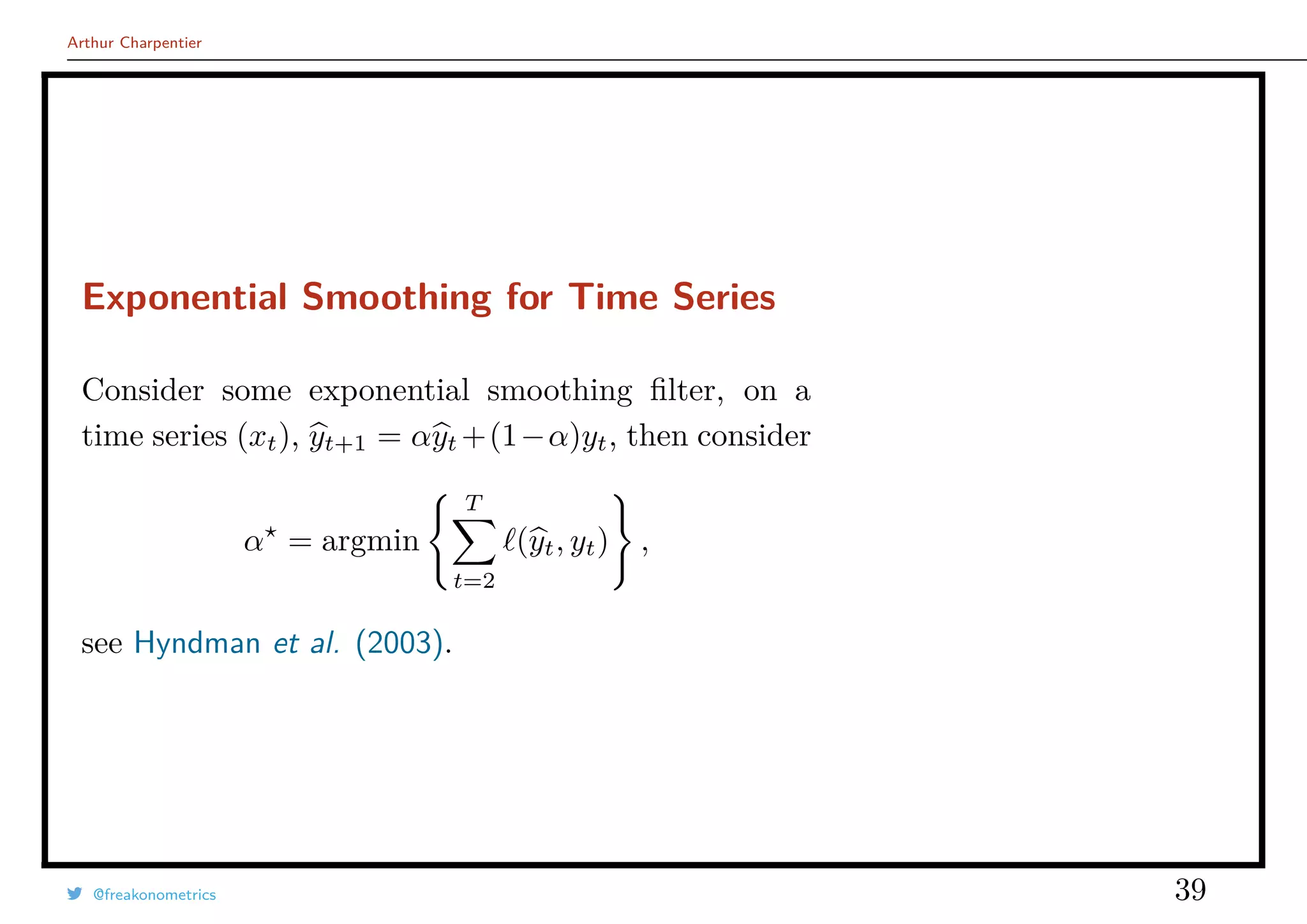
Exponential Smoothing for Time Series
Consider some exponential smoothing filter, on a
time series (xt), yt+1 = αyt +(1−α)yt, then consider
α = argmin
T
t=2
(yt, yt) ,
see Hyndman et al. (2003).
@freakonometrics 39
Arthur Charpentier
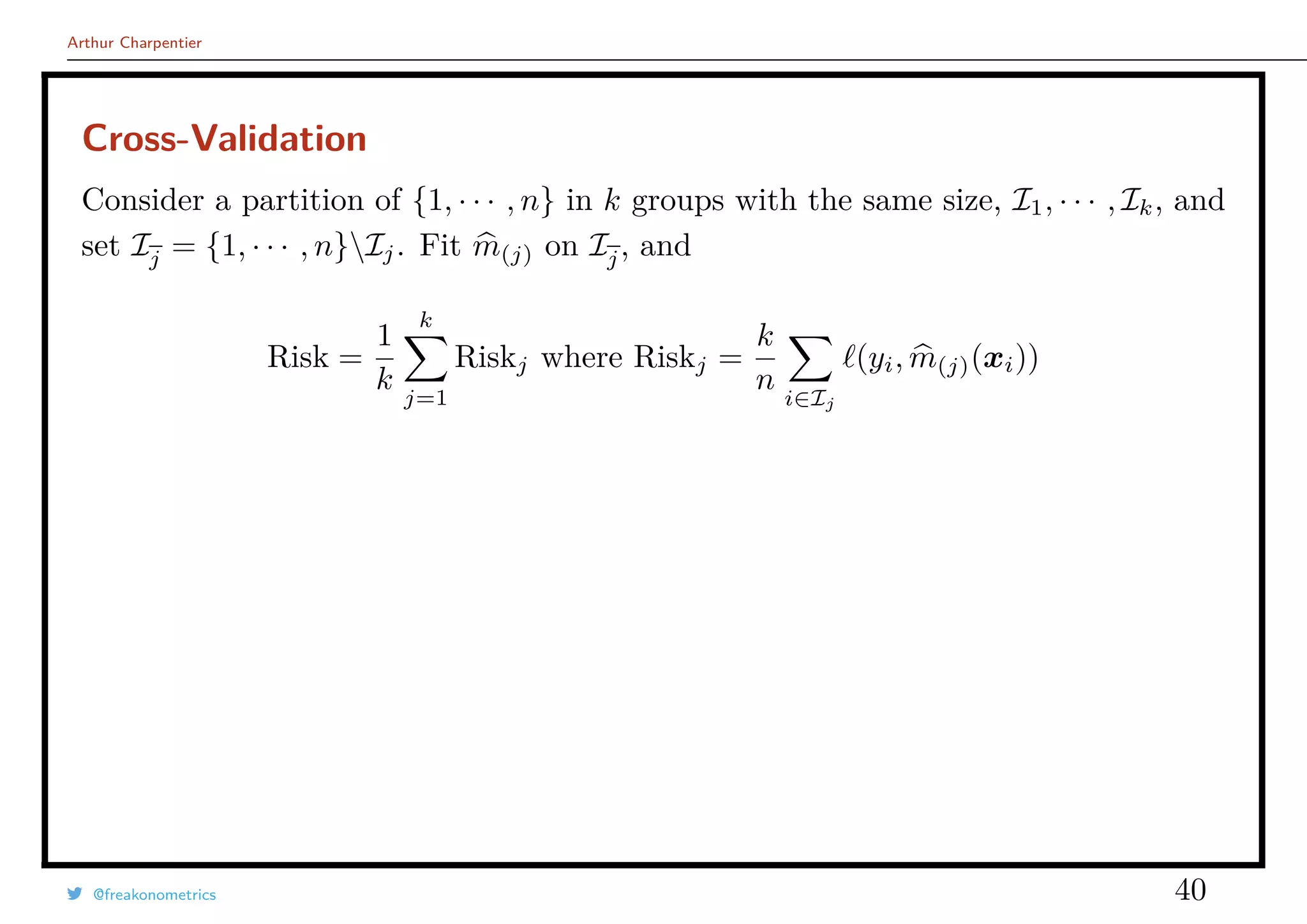
Cross-Validation
Consider a partition of {1, · · · , n} in k groups with the same size, I1, · · · , Ik, and
set Ij = {1, · · · , n}Ij. Fit m(j) on Ij, and
Risk =
1
k
k
j=1
Riskj where Riskj =
k
n
i∈Ij
(yi, m(j)(xi))
@freakonometrics 40
Arthur Charpentier
Randomization is too important to be left to chance!
Consider some bootstraped sample, Ib = {i1,b, · · · , in,b}, with ik,b ∈ {1, · · · , n}
Set ni = 1i/∈I1
+ · · · + 1i/∈vB
, and fit mb on Ib
Risk =
1
n
n
i=1
1
ni
b:i/∈Ib
(yi, mb(xi))
Probability that ith obs. is not selection (1 − n−1
)n
→ e−1
∼ 36.8%,
see training / validation samples (2/3-1/3).
@freakonometrics 41
Arthur Charpentier
Bootstrap
From Efron (1987), generate samples from (Ω, F, Pn)
Fn(y) =
1
n
n
i=1
1(yi ≤ y) and Fn(yi) =
rank(yi)
n
.
If U ∼ U([0, 1]), F−1
(U) ∼ F
If U ∼ U([0, 1]), F−1
n (U) is uniform
on
1
n
, · · · ,
n − 1
n
, 1 .
Consider some boostraped sample,
- either (yik
, xik
), ik ∈ {1, · · · , n}
- or (yk + εik
, xk), ik ∈ {1, · · · , n}
@freakonometrics 42
Arthur Charpentier
Classification & Logistic Regression
Generalized Linear Model when Y has a Bernoulli distribution, yi ∈ {0, 1},
m(x) = E[Y |X = x] =
eβ0+xT
β
1 + eβ0+xTβ
= H(β0 + xT
β)
Estimate (β0, β) using maximum likelihood techniques
L =
n
i=1
exT
i β
1 + exT
i
β
yi
1
1 + exT
i
β
1−yi
Deviance ∝
n
i=1
log(1 + exT
i β
) − yixT
i β
Observe that
D0 ∝
n
i=1
[yi log(y) + (1 − yi) log(1 − y)]
@freakonometrics 43
Arthur Charpentier
Classification Trees
To split {N} into two {NL, NR}, consider
I(NL, NR) =
x∈{L,R}
nx
n
I(Nx)
e.g. Gini index (used originally in CART, see Breiman et al. (1984))
gini(NL, NR) = −
x∈{L,R}
nx
n
y∈{0,1}
nx,y
nx
1 −
nx,y
nx
and the cross-entropy (used in C4.5 and C5.0)
entropy(NL, NR) = −
x∈{L,R}
nx
n
y∈{0,1}
nx,y
nx
log
nx,y
nx
@freakonometrics 44
Arthur Charpentier
Classification Trees
1.0 1.5 2.0 2.5 3.0
−0.45−0.35−0.25
INCAR
15 20 25 30
−0.45−0.35−0.25
INSYS
12 16 20 24
−0.45−0.35−0.25
PRDIA
20 25 30 35
−0.45−0.35−0.25
PAPUL
4 6 8 10 12 14 16
−0.45−0.35−0.25
PVENT
500 1000 1500 2000
−0.45−0.35−0.25
REPUL
NL: {xi,j ≤ s} NR: {xi,j > s}
solve max
j∈{1,··· ,k},s
{I(NL, NR)}
←− first split
second split −→
1.8 2.2 2.6 3.0
−0.20−0.18−0.16−0.14
INCAR
20 24 28 32
−0.20−0.18−0.16−0.14
INSYS
12 14 16 18 20 22
−0.20−0.18−0.16−0.14
PRDIA
16 18 20 22 24 26 28
−0.20−0.18−0.16−0.14
PAPUL
4 6 8 10 12 14
−0.20−0.18−0.16−0.14
PVENT
500 700 900 1100
−0.20−0.18−0.16−0.14
REPUL
@freakonometrics 45
Arthur Charpentier
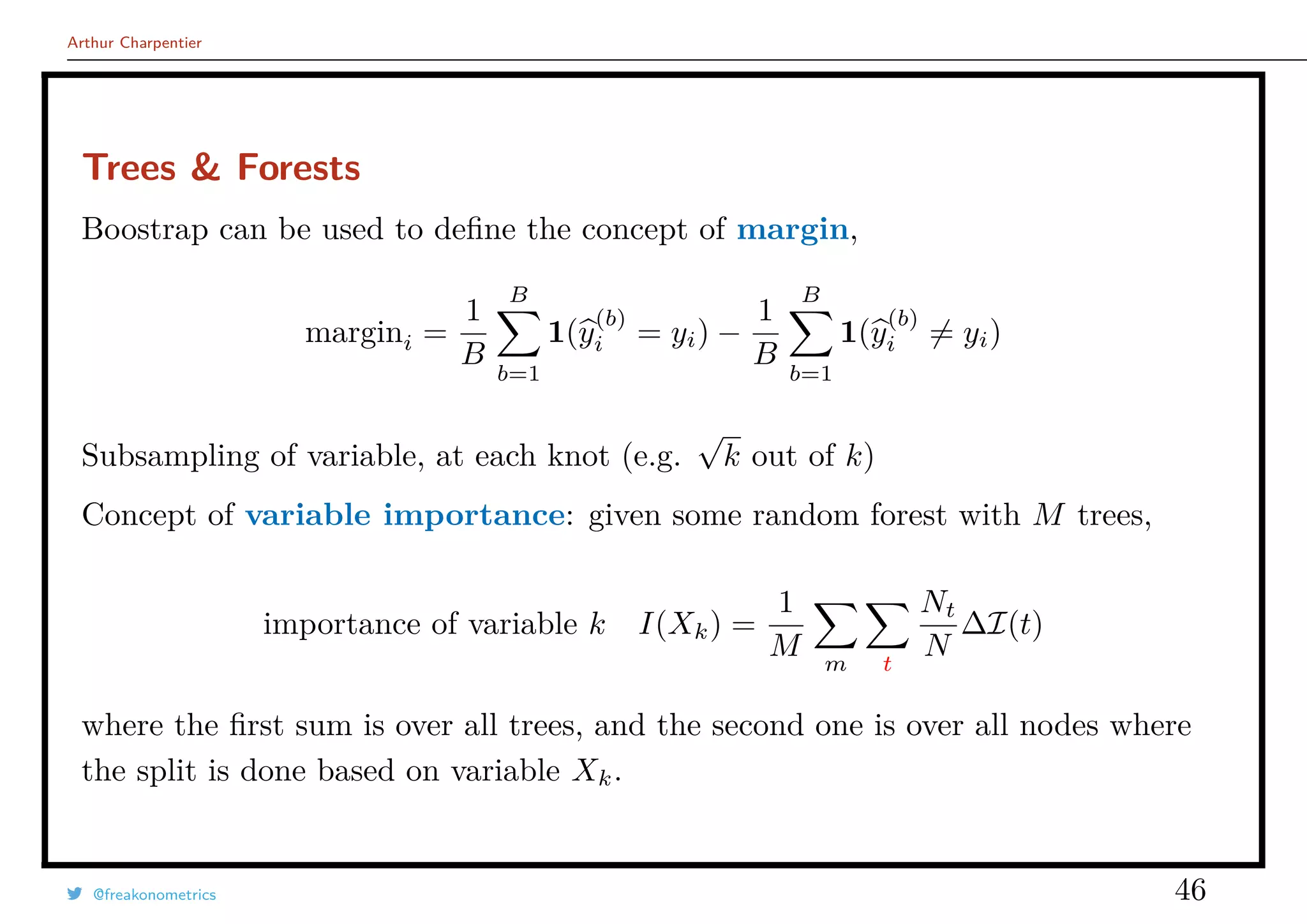
Trees & Forests
Boostrap can be used to define the concept of margin,
margini =
1
B
B
b=1
1(y
(b)
i = yi) −
1
B
B
b=1
1(y
(b)
i = yi)
Subsampling of variable, at each knot (e.g.
√
k out of k)
Concept of variable importance: given some random forest with M trees,
importance of variable k I(Xk) =
1
M m t
Nt
N
∆I(t)
where the first sum is over all trees, and the second one is over all nodes where
the split is done based on variable Xk.
@freakonometrics 46
Arthur Charpentier
Trees & Forests
0 5 10 15 20
50010001500200025003000
PVENT
REPUL
q
q
q
q
q
q
q
q
q
q
q
q
q qq
q
q
qq
q
q
q
q
q
q
q
q
q
q
q
q
q
q
q
q
q
q
q
q
q
q
q
q
q
q
q
q
q
q
q
q
q
q
q
q
q
q
q
q
q
q
q
q
q
q
q
q
q
q
q
q
See also discriminant analysis, SVM, neural networks, etc.
@freakonometrics 47
Arthur Charpentier
Model Selection & ROC Curves
Given a scoring function m(·), with m(x) = E[Y |X = x], and a threshold
s ∈ (0, 1), set
Y (s)
= 1[m(x) > s] =



1 if m(x) > s
0 if m(x) ≤ s
Define the confusion matrix as N = [Nu,v]
N(s)
u,v =
n
i=1
1(y
(s)
i = u, yj = v) for (u, v) ∈ {0, 1}.
Y = 0 Y = 1
Ys = 0 TNs FNs TNs+FNs
Ys = 1 FPs TPs FPs+TPs
TNs+FPs FNs+TPs n
@freakonometrics 48
Arthur Charpentier
Model Selection & ROC Curves
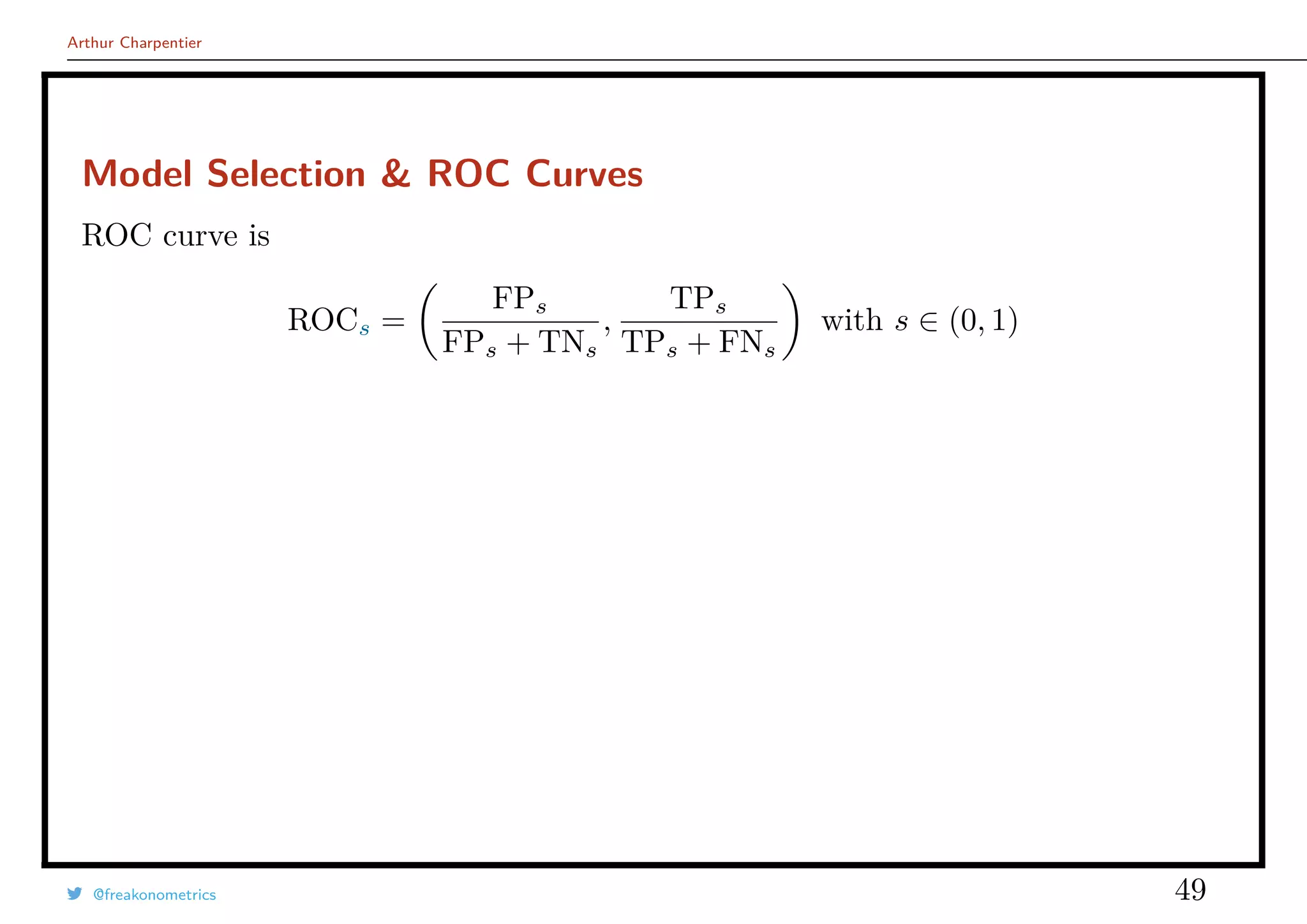
ROC curve is
ROCs =
FPs
FPs + TNs
,
TPs
TPs + FNs
with s ∈ (0, 1)
@freakonometrics 49
Arthur Charpentier
Model Selection & ROC Curves
In machine learning, the most popular measure is κ, see Landis & Koch (1977).
Define N⊥
from N as in the chi-square independence test. Set
total accuracy =
TP + TN
n
random accuracy =
TP⊥
+ TN⊥
n
=
[TN+FP] · [TP+FN] + [TP+FP] · [TN+FN]
n2
and
κ =
total accuracy − random accuracy
1 − random accuracy
.
See Kaggle competitions.
@freakonometrics 50
Arthur Charpentier
Reducing Dimension with PCA
Use principal components to reduce dimension (on centered and scaled
variables): we want d vectors z1, · · · , zd such that
First Compoment is z1 = Xω1 where
ω1 = argmax
ω =1
X · ω 2
= argmax
ω =1
ωT
XT
Xω
Second Compoment is z2 = Xω2 where
ω2 = argmax
ω =1
X
(1)
· ω 2
0 20 40 60 80
−8−6−4−2
Age
LogMortalityRate
−10 −5 0 5 10 15
−101234
PC score 1
PCscore2
q
q
qq
q
q
qqq
q
qqq
qq
q
qqq
q
q
q
qq
q
q
q
q
q
q
qqq
q
q
q
q
q
q
qq
q
qq
q
q
qq
q
q
q
q
q
q
qq
q
qqq
q
q
q
q
q
q
q
q
q
q
q
q
q
q
qq
q
q
qqq
q
qqq
qq
q
qqq
q
q
q
q
q
q
q
q
q
q
q
q
q
q
q
q
q
q
q
qq
q
q
q
q
qq
q
q
qq
q
q
qqqq
q
q
q
q
q
q
q
q
q
qqq
q
qqq
qq
q
qq
q
q
q
q
qq
q
q
q
q
q
q
q
q
q
q
q
q
q
1914
1915
1916
1917
1918
1919
1940
1942
1943
1944
0 20 40 60 80
−10−8−6−4−2
Age
LogMortalityRate
−10 −5 0 5 10 15
−10123
PC score 1
PCscore2
qq
q
q
q
q
q
qq
qq
qq
q
q
q
q
q
q
q
q
q
q
q
q
q
q
q
q
q
q
q
q
q
q
q
q
q
q
q
q
q
qq
qq
q
q
q
q
q
qq
q
q
q
q
q
q
q
q
q
q
q
q
q
q
q
q
q
q
q
q
q
q
q
q
q
q
qq
qq
q
q
q
q
q
q
q
q
q
q
q
q
q
q
q
q
q
q
q
q
q
qq
q
q
q
q
q
q
qq
q
q
q
q
q
q
q
q
q
qq
q
q
q
q
q
q
q
q
q
q
qq
qq
q
q
q
q
q
qq
qqqq
q
qqqq
q
q
q
q
q
q
with X
(1)
= X − Xω1
z1
ωT
1 .
@freakonometrics 51
Arthur Charpentier
Reducing Dimension with PCA
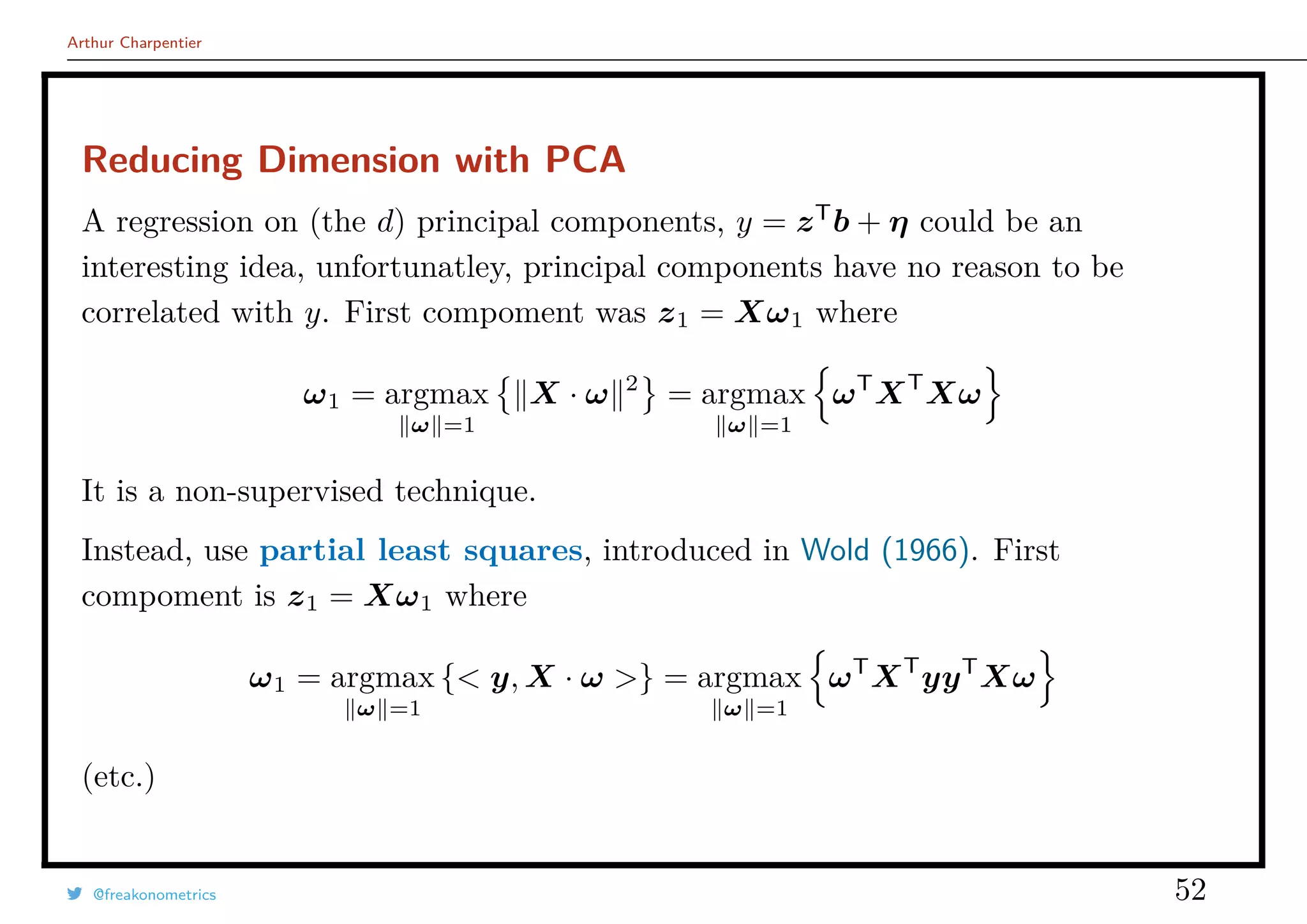
A regression on (the d) principal components, y = zT
b + η could be an
interesting idea, unfortunatley, principal components have no reason to be
correlated with y. First compoment was z1 = Xω1 where
ω1 = argmax
ω =1
X · ω 2
= argmax
ω =1
ωT
XT
Xω
It is a non-supervised technique.
Instead, use partial least squares, introduced in Wold (1966). First
compoment is z1 = Xω1 where
ω1 = argmax
ω =1
{< y, X · ω >} = argmax
ω =1
ωT
XT
yyT
Xω
(etc.)
@freakonometrics 52
Arthur Charpentier
Instrumental Variables
Consider some instrumental variable model, yi = xT
i β + εi such that
E[Yi|Z] = E[Xi|Z]T
β + E[εi|Z]
The estimator of β is
βIV = [ZT
X]−1
ZT
y
If dim(Z) > dim(X) use the Generalized Method of Moments,
βGMM = [XT
ΠZX]−1
XT
ΠZy with ΠZ = Z[ZT
Z]−1
ZT
@freakonometrics 53
Arthur Charpentier
Instrumental Variables
Consider a standard two step procedure
1) regress colums of X on Z, X = Zα + η, and derive predictions X = ΠZX
2) regress Y on X, yi = xT
i β + εi, i.e.
βIV = [ZT
X]−1
ZT
y
See Angrist & Krueger (1991) with 3 up to 1530 instruments : 12 instruments
seem to contain all necessary information.
Use LASSO to select necessary instruments, see Belloni, Chernozhukov & Hansen
(2010)
@freakonometrics 54
Arthur Charpentier
Take Away Conclusion
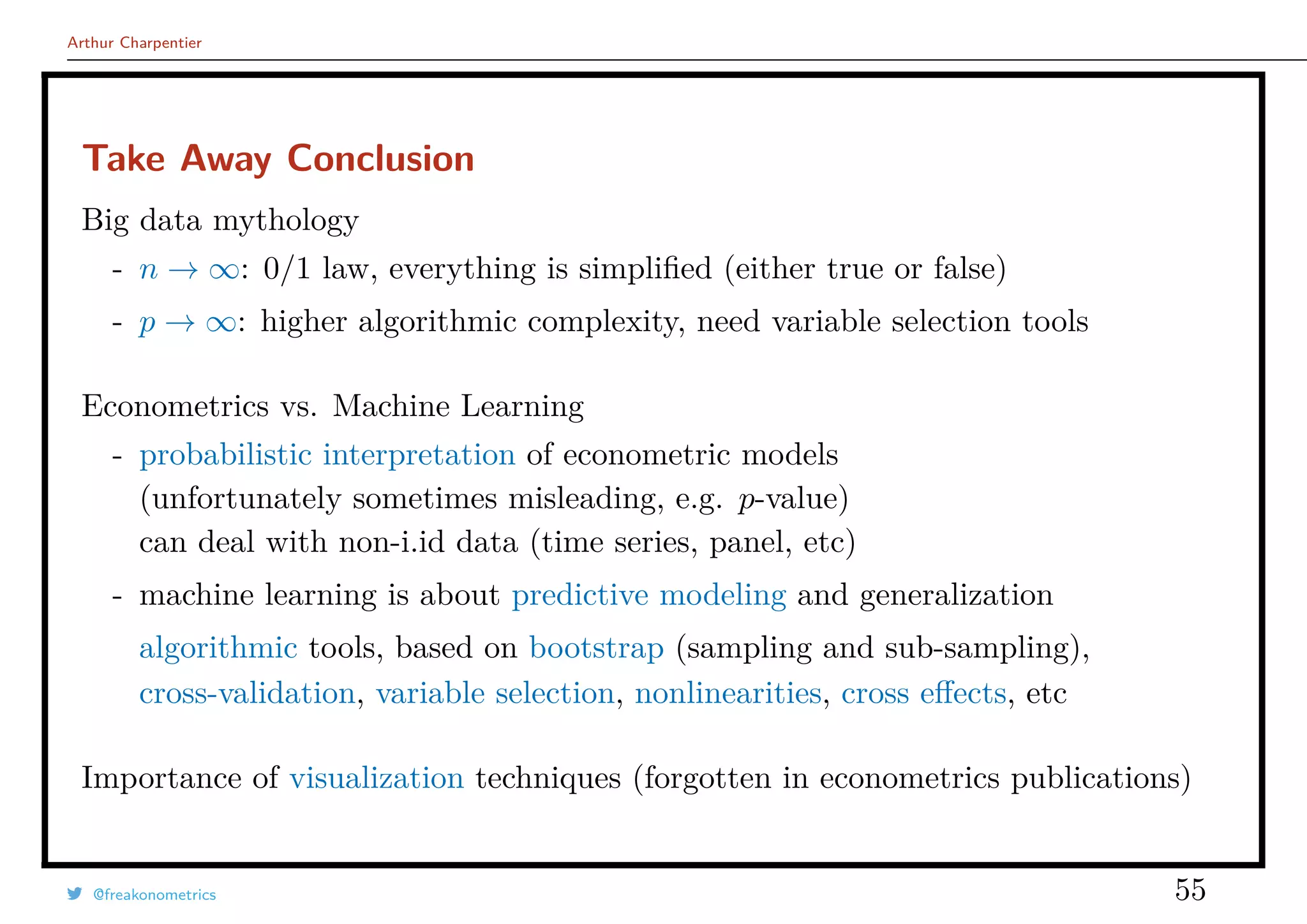
Big data mythology
- n → ∞: 0/1 law, everything is simplified (either true or false)
- p → ∞: higher algorithmic complexity, need variable selection tools
Econometrics vs. Machine Learning
- probabilistic interpretation of econometric models
(unfortunately sometimes misleading, e.g. p-value)
can deal with non-i.id data (time series, panel, etc)
- machine learning is about predictive modeling and generalization
algorithmic tools, based on bootstrap (sampling and sub-sampling),
cross-validation, variable selection, nonlinearities, cross effects, etc
Importance of visualization techniques (forgotten in econometrics publications)
@freakonometrics 55

Slides ACTINFO 2016

  • 1.
    Arthur Charpentier Econometrics: Learningfrom ‘Statistical Learning’ Techniques Arthur Charpentier (Université de Rennes 1 & UQàM) Chaire ACTINFO Covéa, Paris, June 2016 http://freakonometrics.hypotheses.org @freakonometrics 1
  • 2.
    Arthur Charpentier Econometrics: Learningfrom ‘Statistical Learning’ Techniques Arthur Charpentier (Université de Rennes 1 & UQàM) Professor, Economics Department, Univ. Rennes 1 In charge of Data Science for Actuaries program, IA Research Chair actinfo (Institut Louis Bachelier) (previously Actuarial Sciences at UQàM & ENSAE Paristech actuary in Hong Kong, IT & Stats FFSA) PhD in Statistics (KU Leuven), Fellow Institute of Actuaries MSc in Financial Mathematics (Paris Dauphine) & ENSAE Editor of the freakonometrics.hypotheses.org’s blog Editor of Computational Actuarial Science, CRC @freakonometrics 2
  • 3.
    Arthur Charpentier Agenda “the numbershave no way of speaking for them- selves. We speak for them. [· · · ] Before we de- mand more of our data, we need to demand more of ourselves ” from Silver (2012). - (big) data - econometrics & probabilistic modeling - algorithmics & statistical learning - different perspectives on classification - boostrapping, PCA & variable section see Berk (2008), Hastie, Tibshirani & Friedman (2009), but also Breiman (2001) @freakonometrics 3
  • 4.
    Arthur Charpentier Data andModels From {(yi, xi)}, there are different stories behind, see Freedman (2005) • the causal story : xj,i is usually considered as independent of the other covariates xk,i. For all possible x, that value is mapped to m(x) and a noise is attached, ε. The goal is to recover m(·), and the residuals are just the difference between the response value and m(x). • the conditional distribution story : for a linear model, we usually say that Y given X = x is a N(m(x), σ2 ) distribution. m(x) is then the conditional mean. Here m(·) is assumed to really exist, but no causal assumption is made, only a conditional one. • the explanatory data story : there is no model, just data. We simply want to summarize information contained in x’s to get an accurate summary, close to the response (i.e. min{ (y, m(x))}) for some loss function . See also Varian (2014) @freakonometrics 4
  • 5.
    Arthur Charpentier Data, Models& Causal Inference We cannot differentiate data and model that easily.. After an operation, should I stay at hospital, or go back home ? as in Angrist & Pischke (2008), (health | hospital) − (health | stayed home) [observed] should be written (health | hospital) − (health | had stayed home) [treatment effect] + (health | had stayed home) − (health | stayed home) [selection bias] Need randomization to solve selection bias. @freakonometrics 5
  • 6.
    Arthur Charpentier Econometric Modeling Data{(yi, xi)}, for i = 1, · · · , n, with xi ∈ X ⊂ Rp and yi ∈ Y. A model is a m : X → Y mapping - regression, Y = R (but also Y = N) - classification, Y = {0, 1}, {−1, +1}, {•, •} (binary, or more) Classification models are based on two steps, • score function, s(x) = P(Y = 1|X = x) ∈ [0, 1] • classifier s(x) → y ∈ {0, 1}. q q q q q q q q q q 0.0 0.2 0.4 0.6 0.8 1.0 0.00.20.40.60.81.0 q q q q q q q q q q @freakonometrics 6
  • 7.
    Arthur Charpentier High DimensionalData (not to say ‘Big Data’) See Bühlmann & van de Geer (2011) or Koch (2013), X is a n × p matrix Portnoy (1988) proved that maximum likelihood estimators are asymptotically normal when p2 /n → 0 as n, p → ∞. Hence, massive data, when p > √ n. More intersting is the sparcity concept, based not on p, but on the effective size. Hence one can have p > n and convergent estimators. High dimension might be scary because of curse of dimensionality, see Bellman (1957). The volume of the unit sphere in Rp tends to 0 as p → ∞, i.e.space is sparse. @freakonometrics 7
  • 8.
    Arthur Charpentier Computational &Nonparametric Econometrics Linear Econometrics: estimate g : x → E[Y |X = x] by a linear function. Nonlinear Econometrics: consider the approximation for some functional basis g(x) = ∞ j=0 ωjgj(x) and g(x) = h j=0 ωjgj(x) or a local model, on the neighborhood of x, g(x) = 1 nx i∈Ix yi, with Ix = {x ∈ Rp : xi−x ≤ h}, see Nadaraya (1964) and Watson (1964). Here h is some tunning parameter: not estimated, but chosen (optimaly). @freakonometrics 8
  • 9.
    Arthur Charpentier Econometrics &Probabilistic Model from Cook & Weisberg (1999), see also Haavelmo (1965). (Y |X = x) ∼ N(µ(x), σ2 ) with µ(x) = β0 + xT β, and β ∈ Rp . Linear Model: E[Y |X = x] = β0 + xT β Homoscedasticity: Var[Y |X = x] = σ2 . @freakonometrics 9
  • 10.
    Arthur Charpentier Conditional Distributionand Likelihood (Y |X = x) ∼ N(µ(x), σ2 ) with µ(x) = β0 + xT β, et β ∈ Rp The log-likelihood is log L(β0, β, σ2 |y, x) = − n 2 log[2πσ2 ] − 1 2σ2 n i=1 (yi − β0 − xT i β)2 . Set (β0, β, σ2 ) = argmax log L(β0, β, σ2 |y, x) . First order condition XT [y − Xβ] = 0. If matrix X is a full rank matrix β = (XT X)−1 XT y = β + (XT X)−1 XT ε. Asymptotic properties of β, √ n(β − β) L → N(0, Σ) as n → ∞ @freakonometrics 10
  • 11.
    Arthur Charpentier Geometric Perspective Definethe orthogonal projection on X, ΠX = X[XT X]−1 XT y = X[XT X]−1 XT ΠX y = ΠXy. Pythagoras’ theorem can be writen y 2 = ΠXy 2 + ΠX⊥ y 2 = ΠXy 2 + y − ΠXy 2 which can be expressed as n i=1 y2 i n×total variance = n i=1 y2 i n×explained variance + n i=1 (yi − yi)2 n×residual variance @freakonometrics 11
  • 12.
    Arthur Charpentier Geometric Perspective Definethe angle θ between y and ΠX y, R2 = ΠX y 2 y 2 = 1 − ΠX⊥ y 2 y 2 = cos2 (θ) see Davidson & MacKinnon (2003) y = β0 + X1β1 + X2β2 + ε If y2 = ΠX⊥ 1 y and X2 = ΠX⊥ 1 X2, then β2 = [X2 T X2]−1 X2 T y2 X2 = X2 if X1 ⊥ X2, Frisch-Waugh theorem. @freakonometrics 12
  • 13.
    Arthur Charpentier From Linearto Non-Linear y = Xβ = X[XT X]−1 XT H y i.e. yi = hT xi y, with - for the linear regression - hx = X[XT X]−1 x. One can consider some smoothed regression, see Nadaraya (1964) and Watson (1964), with some smoothing matrix S mh(x) = sT xy = n i=1 sx,iyi withs sx,i = Kh(x − xi) Kh(x − x1) + · · · + Kh(x − xn) for some kernel K(·) and some bandwidth h > 0. @freakonometrics 13
  • 14.
    Arthur Charpentier From Linearto Non-Linear T = Sy − Hy trace([S − H]T[S − H]) can be used to test for linearity, Simonoff (1996). trace(S) is the equivalent number of parameters, and n − trace(S) the degrees of freedom, Ruppert et al. (2003). Nonlinear Model, but Homoscedastic - Gaussian • (Y |X = x) ∼ N(µ(x), σ2 ) • E[Y |X = x] = µ(x) @freakonometrics 14
  • 15.
    Arthur Charpentier Conditional Expectation fromAngrist & Pischke (2008), x → E[Y |X = x]. @freakonometrics 15
  • 16.
    Arthur Charpentier Exponential Distributionsand Linear Models f(yi|θi, φ) = exp yiθi − b(θi) a(φ) + c(yi, φ) with θi = h(xT i β) Log likelihood is expressed as log L(θ, φ|y) = n i=1 log f(yi|θi, φ) = n i=1 yiθi − n i=1 b(θi) a(φ) + n i=1 c(yi, φ) and first order conditions ∂ log L(θ, φ|y) ∂β = XT W −1 [y − µ] = 0 as in Müller (2001), where W is a weight matrix, function of β. We usually specify the link function g(·) defined as y = m(x) = E[Y |X = x] = g−1 (xT β). @freakonometrics 16
  • 17.
    Arthur Charpentier Exponential Distributionsand Linear Models Note that W = diag( g(y) · Var[y]), and set z = g(y) + (y − y) · g(y) the the maximum likelihood estimator is obtained iteratively βk+1 = [XT W −1 k X]−1 XT W −1 k zk Set β = β∞, so that √ n(β − β) L → N(0, I(β)−1 ) with I(β) = φ · [XT W −1 ∞ X]. Note that [XT W −1 k X] is a p × p matrix. @freakonometrics 17
  • 18.
    Arthur Charpentier Exponential Distributionsand Linear Models Generalized Linear Model: • (Y |X = x) ∼ L(θx, ϕ) • E[Y |X = x] = h−1 (θx) = g−1 (xT β) e.g. (Y |X = x) ∼ P(exp[xT β]). Use of maximum likelihood techniques for inference. Actually, more a moment condition than a distribution assumption. @freakonometrics 18
  • 19.
    Arthur Charpentier Goodness ofFit & Model Choice From the variance decomposition 1 n n i=1 (yi − ¯y)2 total variance = 1 n n i=1 (yi − yi)2 residual variance + 1 n n i=1 (yi − ¯y)2 explained variance and define R2 = n i=1(yi − ¯y)2 − n i=1(yi − yi)2 n i=1(yi − ¯y)2 More generally Deviance(β) = −2 log[L] = 2 i=1 (yi − yi)2 = Deviance(y) The null deviance is obtained using yi = y, so that R2 = Deviance(y) − Deviance(y) Deviance(y) = 1 − Deviance(y) Deviance(y) = 1 − D D0 @freakonometrics 19
  • 20.
    Arthur Charpentier Goodness ofFit & Model Choice One usually prefers a penalized version ¯R2 = 1 − (1 − R2 ) n − 1 n − p = R2 − (1 − R2 ) p − 1 n − p penalty See also Akaike criteria AIC = Deviance + 2 · p or Schwarz, BIC = Deviance + log(n) · p In high dimension, consider a corrected version AICc = Deviance + 2 · p · n n − p − 1 @freakonometrics 20
  • 21.
    Arthur Charpentier Stepwise Procedures Forwardalgorithm 1. set j1 = argmin j∈{∅,1,··· ,n} {AIC({j})} 2. set j2 = argmin j∈{∅,1,··· ,n}{j1 } {AIC({j1 , j})} 3. ... until j = ∅ Backward algorithm 1. set j1 = argmin j∈{∅,1,··· ,n} {AIC({1, · · · , n}{j})} 2. set j2 = argmin j∈{∅,1,··· ,n}{j1 } {AIC({1, · · · , n}{j1 , j})} 3. ... until j = ∅ @freakonometrics 21
  • 22.
    Arthur Charpentier Econometrics &Statistical Testing Standard test for H0 : βk = 0 against H1 : βk = 0 is Student-t est tk = βk/seβk , Use the p-value P[|T| > |tk|] with T ∼ tν (and ν = trace(H)). In high dimension, consider the FDR (False Discovery Ratio). With α = 5%, 5% variables are wrongly significant. If p = 100 with only 5 significant variables, one should expect also 5 false positive, i.e. 50% FDR, see Benjamini & Hochberg (1995) and Andrew Gelman’s talk. @freakonometrics 22
  • 23.
    Arthur Charpentier Under &Over-Identification Under-identification is obtained when the true model is y = β0 + xT 1 β1 + xT 2 β2 + ε, but we estimate y = β0 + xT 1 b1 + η. Maximum likelihood estimator for b1 is b1 = (XT 1 X1)−1 XT 1 y = (XT 1 X1)−1 XT 1 [X1,iβ1 + X2,iβ2 + ε] = β1 + (X1X1)−1 XT 1 X2β2 β12 + (XT 1 X1)−1 XT 1 ε νi so that E[b1] = β1 + β12, and the bias is null when XT 1 X2 = 0 i.e. X1 ⊥ X2, see Frisch-Waugh). Over-identification is obtained when the true model is y = β0 + xT 1 β1ε, but we fit y = β0 + xT 1 b1 + xT 2 b2 + η. Inference is unbiased since E(b1) = β1 but the estimator is not efficient. @freakonometrics 23
  • 24.
    Arthur Charpentier Statistical Learning& Loss Function Here, no probabilistic model, but a loss function, . For some set of functions M, X → Y, define m = argmin m∈M n i=1 (yi, m(xi)) Quadratic loss functions are interesting since y = argmin m∈R n i=1 1 n [yi − m]2 which can be writen, with some underlying probabilistic model E(Y ) = argmin m∈R Y − m 2 2 = argmin m∈R E [Y − m]2 For τ ∈ (0, 1), we obtain the quantile regression (see Koenker (2005)) m = argmin m∈M0 n i=1 τ (yi, m(xi)) avec τ (x, y) = |(x − y)(τ − 1x≤y)| @freakonometrics 24
  • 25.
    Arthur Charpentier Boosting &Weak Learning m = argmin m∈M n i=1 (yi, m(xi)) is hard to solve for some very large and general space M of X → Y functions. Consider some iterative procedure, where we learn from the errors, m(k) (·) = m1(·) ∼y + m2(·) ∼ε1 + m3(·) ∼ε2 + · · · + mk(·) ∼εk−1 = m(k−1) (·) + mk(·). Formely ε can be seen as , the gradient of the loss. @freakonometrics 25
  • 26.
    Arthur Charpentier Boosting &Weak Learning It is possible to see this algorithm as a gradient descent. Not f(xk) f,xk ∼ f(xk−1) f,xk−1 + (xk − xk−1) αk f(xk−1) f,xk−1 but some kind of dual version fk(x) fk,x ∼ fk−1(x) fk−1,x + (fk − fk−1) ak fk−1, x where is a gradient is some functional space. m(k) (x) = m(k−1) (x) + argmin f∈F n i=1 (yi, m(k−1) (x) + f(x)) for some simple space F so that we define some weak learner, e.g. step functions (so called stumps) @freakonometrics 26
  • 27.
    Arthur Charpentier Boosting &Weak Learning Standard set F are stumps functions but one can also consider splines (with non-fixed knots). One might add a shrinkage parameter to learn even more weakly, i.e. set ε1 = y − α · m1(x) with α ∈ (0, 1), etc. @freakonometrics 27
  • 28.
    Arthur Charpentier Big Data& Linear Model Consider some linear model yi = xT i β + εi for all i = 1, · · · , n. Assume that εi are i.i.d. with E(ε) = 0 (and finite variance). Write      y1 ... yn      y,n×1 =      1 x1,1 · · · x1,p ... ... ... ... 1 xn,1 · · · xn,p      X,n×(p+1)         β0 β1 ... βp         β,(p+1)×1 +      ε1 ... εn      ε,n×1 . Assuming ε ∼ N(0, σ2 I), the maximum likelihood estimator of β is β = argmin{ y − XT β 2 } = (XT X)−1 XT y ... under the assumtption that XT X is a full-rank matrix. What if XT X cannot be inverted? Then β = [XT X]−1 XT y does not exist, but βλ = [XT X + λI]−1 XT y always exist if λ > 0. @freakonometrics 28
  • 29.
    Arthur Charpentier Ridge Regression& Regularization The estimator β = [XT X + λI]−1 XT y is the Ridge estimate obtained as solution of β = argmin β    n i=1 [yi − β0 − xT i β]2 + λ β 2 2 1Tβ2    for some tuning parameter λ. One can also write β = argmin β; β 2 ≤s { Y − XT β 2 } There is a Bayesian interpretation of that regularization, when β has some prior N(β0, τI). @freakonometrics 29
  • 30.
    Arthur Charpentier Over-Fitting &Penalization Solve here, for some norm · , min n i=1 (yi, β0 + xT β) + λ β = min objective(β) + penality(β) . Estimators are no longer unbiased, but might have a smaller mse. Consider some i.id. sample {y1, · · · , yn} from N(θ, σ2 ), and consider some estimator proportional to y, i.e. θ = αy. α = 1 is the maximum likelihood estimator. Note that mse[θ] = (α − 1)2 µ2 bias[θ]2 + α2 σ2 n Var[θ] and α = µ2 · µ2 + σ2 n −1 < 1. @freakonometrics 30
  • 31.
    Arthur Charpentier (β0, β)= argmin n i=1 (yi, β0 + xT β) + λ β , can be seen as a Lagrangian minimization problem (β0, β) = argmin β; β ≤s n i=1 (yi, β0 + xT β) @freakonometrics 31
  • 32.
    Arthur Charpentier LASSO &Sparcity In severall applications, p can be (very) large, but a lot of features are just noise: βj = 0 for many j’s. Let s denote the number of relevent features, with s << p, cf Hastie, Tibshirani & Wainwright (2015), s = card{S} where S = {j; βj = 0} The true model is now y = XT SβS + ε, where XT SXS is a full rank matrix. @freakonometrics 32
  • 33.
    Arthur Charpentier LASSO &Sparcity Evoluation of βλ as a function of log λ in various applications −10 −9 −8 −7 −6 −5 −0.20−0.15−0.10−0.050.000.050.10 Log Lambda Coefficients 4 4 4 4 3 1 1 3 4 5 −9 −8 −7 −6 −5 −4 −0.8−0.6−0.4−0.20.0 Log Lambda Coefficients 4 4 3 2 1 1 1 2 4 5 @freakonometrics 33
  • 34.
    Arthur Charpentier In-Sample &Out-Sample Write β = β((x1, y1), · · · , (xn, yn)). Then (for the linear model) Deviance IS(β) = n i=1 [yi − xT i β((x1, y1), · · · , (xn, yn))]2 Withe this “in-sample” deviance, we cannot use the central limit theorem Deviance IS(β) n → E [Y − XT β] Hence, we can compute some “out-of-sample” deviance Deviance OS(β) = m+n i=n+1 [yi − xT i β((x1, y1), · · · , (xn, yn)]2 @freakonometrics 34
  • 35.
    Arthur Charpentier In-Sample &Out-Sample Observe that there are connexions with Akaike penaly function Deviance IS(β) − Deviance OS(β) ≈ 2 · degrees of freedom From Stone (1977), minimizing AIC is closed to cross validation, From Shao (1997) minimizing BIC is closed to k-fold cross validation with k = n/ log n. @freakonometrics 35
  • 36.
    Arthur Charpentier Overfit, Generalization& Model Complexity Complexity of the model is the degree of the polynomial function @freakonometrics 36
  • 37.
    Arthur Charpentier Cross-Validation See Jacknifetechnique Quenouille (1956) or Tukey (1958) to reduce the bias. If {y1, · · · , yn} is an i.id. sample from Fθ, with estimator Tn(y) = Tn(y1, · · · , yn), such that E[Tn(Y )] = θ + O n−1 , consider Tn(y) = 1 n n i=1 Tn−1(y(i)) avec y(i) = (y1, · · · , yi−1, yi+1, · · · , yn). Then E[Tn(Y )] = θ + O n−2 . Similar idea in leave-one-out cross validation Risk = 1 n n i=1 (yi, m(i)(xi)) @freakonometrics 37
  • 38.
    Arthur Charpentier Rule ofThumb vs. Cross Validation m[h ] (x) = β [x] 0 + β [x] 1 x with (β [x] 0 , β [x] 1 ) = argmin (β0,β1) n i=1 ω [x] h [yi − (β0 + β1xi)]2 q q q q q q q q q q q q q q q q q q q q q q q q q q q qq qq q q q q q q q q q q qq q q q q q q q q q q q q q q q q q q q q q q q qq q q q q q qq q qq q q q q q q q q q q q q q q q q q q q q q q 0 2 4 6 8 10 −2−1012 set h = argmin mse(h) with mse(h) = 1 n n i=1 yi − m [h] (i)(xi) 2 @freakonometrics 38
  • 39.
    Arthur Charpentier Exponential Smoothingfor Time Series Consider some exponential smoothing filter, on a time series (xt), yt+1 = αyt +(1−α)yt, then consider α = argmin T t=2 (yt, yt) , see Hyndman et al. (2003). @freakonometrics 39
  • 40.
    Arthur Charpentier Cross-Validation Consider apartition of {1, · · · , n} in k groups with the same size, I1, · · · , Ik, and set Ij = {1, · · · , n}Ij. Fit m(j) on Ij, and Risk = 1 k k j=1 Riskj where Riskj = k n i∈Ij (yi, m(j)(xi)) @freakonometrics 40
  • 41.
    Arthur Charpentier Randomization istoo important to be left to chance! Consider some bootstraped sample, Ib = {i1,b, · · · , in,b}, with ik,b ∈ {1, · · · , n} Set ni = 1i/∈I1 + · · · + 1i/∈vB , and fit mb on Ib Risk = 1 n n i=1 1 ni b:i/∈Ib (yi, mb(xi)) Probability that ith obs. is not selection (1 − n−1 )n → e−1 ∼ 36.8%, see training / validation samples (2/3-1/3). @freakonometrics 41
  • 42.
    Arthur Charpentier Bootstrap From Efron(1987), generate samples from (Ω, F, Pn) Fn(y) = 1 n n i=1 1(yi ≤ y) and Fn(yi) = rank(yi) n . If U ∼ U([0, 1]), F−1 (U) ∼ F If U ∼ U([0, 1]), F−1 n (U) is uniform on 1 n , · · · , n − 1 n , 1 . Consider some boostraped sample, - either (yik , xik ), ik ∈ {1, · · · , n} - or (yk + εik , xk), ik ∈ {1, · · · , n} @freakonometrics 42
  • 43.
    Arthur Charpentier Classification &Logistic Regression Generalized Linear Model when Y has a Bernoulli distribution, yi ∈ {0, 1}, m(x) = E[Y |X = x] = eβ0+xT β 1 + eβ0+xTβ = H(β0 + xT β) Estimate (β0, β) using maximum likelihood techniques L = n i=1 exT i β 1 + exT i β yi 1 1 + exT i β 1−yi Deviance ∝ n i=1 log(1 + exT i β ) − yixT i β Observe that D0 ∝ n i=1 [yi log(y) + (1 − yi) log(1 − y)] @freakonometrics 43
  • 44.
    Arthur Charpentier Classification Trees Tosplit {N} into two {NL, NR}, consider I(NL, NR) = x∈{L,R} nx n I(Nx) e.g. Gini index (used originally in CART, see Breiman et al. (1984)) gini(NL, NR) = − x∈{L,R} nx n y∈{0,1} nx,y nx 1 − nx,y nx and the cross-entropy (used in C4.5 and C5.0) entropy(NL, NR) = − x∈{L,R} nx n y∈{0,1} nx,y nx log nx,y nx @freakonometrics 44
  • 45.
    Arthur Charpentier Classification Trees 1.01.5 2.0 2.5 3.0 −0.45−0.35−0.25 INCAR 15 20 25 30 −0.45−0.35−0.25 INSYS 12 16 20 24 −0.45−0.35−0.25 PRDIA 20 25 30 35 −0.45−0.35−0.25 PAPUL 4 6 8 10 12 14 16 −0.45−0.35−0.25 PVENT 500 1000 1500 2000 −0.45−0.35−0.25 REPUL NL: {xi,j ≤ s} NR: {xi,j > s} solve max j∈{1,··· ,k},s {I(NL, NR)} ←− first split second split −→ 1.8 2.2 2.6 3.0 −0.20−0.18−0.16−0.14 INCAR 20 24 28 32 −0.20−0.18−0.16−0.14 INSYS 12 14 16 18 20 22 −0.20−0.18−0.16−0.14 PRDIA 16 18 20 22 24 26 28 −0.20−0.18−0.16−0.14 PAPUL 4 6 8 10 12 14 −0.20−0.18−0.16−0.14 PVENT 500 700 900 1100 −0.20−0.18−0.16−0.14 REPUL @freakonometrics 45
  • 46.
    Arthur Charpentier Trees &Forests Boostrap can be used to define the concept of margin, margini = 1 B B b=1 1(y (b) i = yi) − 1 B B b=1 1(y (b) i = yi) Subsampling of variable, at each knot (e.g. √ k out of k) Concept of variable importance: given some random forest with M trees, importance of variable k I(Xk) = 1 M m t Nt N ∆I(t) where the first sum is over all trees, and the second one is over all nodes where the split is done based on variable Xk. @freakonometrics 46
  • 47.
    Arthur Charpentier Trees &Forests 0 5 10 15 20 50010001500200025003000 PVENT REPUL q q q q q q q q q q q q q qq q q qq q q q q q q q q q q q q q q q q q q q q q q q q q q q q q q q q q q q q q q q q q q q q q q q q q q q q See also discriminant analysis, SVM, neural networks, etc. @freakonometrics 47
  • 48.
    Arthur Charpentier Model Selection& ROC Curves Given a scoring function m(·), with m(x) = E[Y |X = x], and a threshold s ∈ (0, 1), set Y (s) = 1[m(x) > s] =    1 if m(x) > s 0 if m(x) ≤ s Define the confusion matrix as N = [Nu,v] N(s) u,v = n i=1 1(y (s) i = u, yj = v) for (u, v) ∈ {0, 1}. Y = 0 Y = 1 Ys = 0 TNs FNs TNs+FNs Ys = 1 FPs TPs FPs+TPs TNs+FPs FNs+TPs n @freakonometrics 48
  • 49.
    Arthur Charpentier Model Selection& ROC Curves ROC curve is ROCs = FPs FPs + TNs , TPs TPs + FNs with s ∈ (0, 1) @freakonometrics 49
  • 50.
    Arthur Charpentier Model Selection& ROC Curves In machine learning, the most popular measure is κ, see Landis & Koch (1977). Define N⊥ from N as in the chi-square independence test. Set total accuracy = TP + TN n random accuracy = TP⊥ + TN⊥ n = [TN+FP] · [TP+FN] + [TP+FP] · [TN+FN] n2 and κ = total accuracy − random accuracy 1 − random accuracy . See Kaggle competitions. @freakonometrics 50
  • 51.
    Arthur Charpentier Reducing Dimensionwith PCA Use principal components to reduce dimension (on centered and scaled variables): we want d vectors z1, · · · , zd such that First Compoment is z1 = Xω1 where ω1 = argmax ω =1 X · ω 2 = argmax ω =1 ωT XT Xω Second Compoment is z2 = Xω2 where ω2 = argmax ω =1 X (1) · ω 2 0 20 40 60 80 −8−6−4−2 Age LogMortalityRate −10 −5 0 5 10 15 −101234 PC score 1 PCscore2 q q qq q q qqq q qqq qq q qqq q q q qq q q q q q q qqq q q q q q q qq q qq q q qq q q q q q q qq q qqq q q q q q q q q q q q q q q qq q q qqq q qqq qq q qqq q q q q q q q q q q q q q q q q q q q qq q q q q qq q q qq q q qqqq q q q q q q q q q qqq q qqq qq q qq q q q q qq q q q q q q q q q q q q q 1914 1915 1916 1917 1918 1919 1940 1942 1943 1944 0 20 40 60 80 −10−8−6−4−2 Age LogMortalityRate −10 −5 0 5 10 15 −10123 PC score 1 PCscore2 qq q q q q q qq qq qq q q q q q q q q q q q q q q q q q q q q q q q q q q q q q qq qq q q q q q qq q q q q q q q q q q q q q q q q q q q q q q q q q q qq qq q q q q q q q q q q q q q q q q q q q q q qq q q q q q q qq q q q q q q q q q qq q q q q q q q q q q qq qq q q q q q qq qqqq q qqqq q q q q q q with X (1) = X − Xω1 z1 ωT 1 . @freakonometrics 51
  • 52.
    Arthur Charpentier Reducing Dimensionwith PCA A regression on (the d) principal components, y = zT b + η could be an interesting idea, unfortunatley, principal components have no reason to be correlated with y. First compoment was z1 = Xω1 where ω1 = argmax ω =1 X · ω 2 = argmax ω =1 ωT XT Xω It is a non-supervised technique. Instead, use partial least squares, introduced in Wold (1966). First compoment is z1 = Xω1 where ω1 = argmax ω =1 {< y, X · ω >} = argmax ω =1 ωT XT yyT Xω (etc.) @freakonometrics 52
  • 53.
    Arthur Charpentier Instrumental Variables Considersome instrumental variable model, yi = xT i β + εi such that E[Yi|Z] = E[Xi|Z]T β + E[εi|Z] The estimator of β is βIV = [ZT X]−1 ZT y If dim(Z) > dim(X) use the Generalized Method of Moments, βGMM = [XT ΠZX]−1 XT ΠZy with ΠZ = Z[ZT Z]−1 ZT @freakonometrics 53
  • 54.
    Arthur Charpentier Instrumental Variables Considera standard two step procedure 1) regress colums of X on Z, X = Zα + η, and derive predictions X = ΠZX 2) regress Y on X, yi = xT i β + εi, i.e. βIV = [ZT X]−1 ZT y See Angrist & Krueger (1991) with 3 up to 1530 instruments : 12 instruments seem to contain all necessary information. Use LASSO to select necessary instruments, see Belloni, Chernozhukov & Hansen (2010) @freakonometrics 54
  • 55.
    Arthur Charpentier Take AwayConclusion Big data mythology - n → ∞: 0/1 law, everything is simplified (either true or false) - p → ∞: higher algorithmic complexity, need variable selection tools Econometrics vs. Machine Learning - probabilistic interpretation of econometric models (unfortunately sometimes misleading, e.g. p-value) can deal with non-i.id data (time series, panel, etc) - machine learning is about predictive modeling and generalization algorithmic tools, based on bootstrap (sampling and sub-sampling), cross-validation, variable selection, nonlinearities, cross effects, etc Importance of visualization techniques (forgotten in econometrics publications) @freakonometrics 55