Arthur CHARPENTIER - Probit transformation for nonparametric kernel estimation of the copula
Probit transformation for nonparametric kernel estimation of the copula
A. Charpentier (Université de Rennes 1 & UQAM),
joint work with G. Geenens (UNSW) & D. Paindaveine (ULB)
CIRM Workshop “Extremes - Copulas - Actuarial science”, February 2016
http://arxiv.org/abs/1404.4414, to appear in Bernoulli
url: http://freakonometrics.hypotheses.org
email : charpentier.arthur@uqam.ca
: @freakonometrics
1
Arthur CHARPENTIER - Probit transformation for nonparametric kernel estimation of the copula
Motivation
Consider some n-i.i.d. sample {(Xi, Yi)} with cu-
mulative distribution function FXY and joint den-
sity fXY . Let FX and FY denote the marginal
distributions, and C the copula,
FXY (x, y) = C(FX(x), FY (y))
so that
fXY (x, y) = fX(x)fY (y)c(FX(x), FY (y))
We want a nonparametric estimate of c on [0, 1]2
. 1e+01 1e+03 1e+05
1e+011e+021e+031e+041e+05
2
Arthur CHARPENTIER - Probit transformation for nonparametric kernel estimation of the copula
Notations
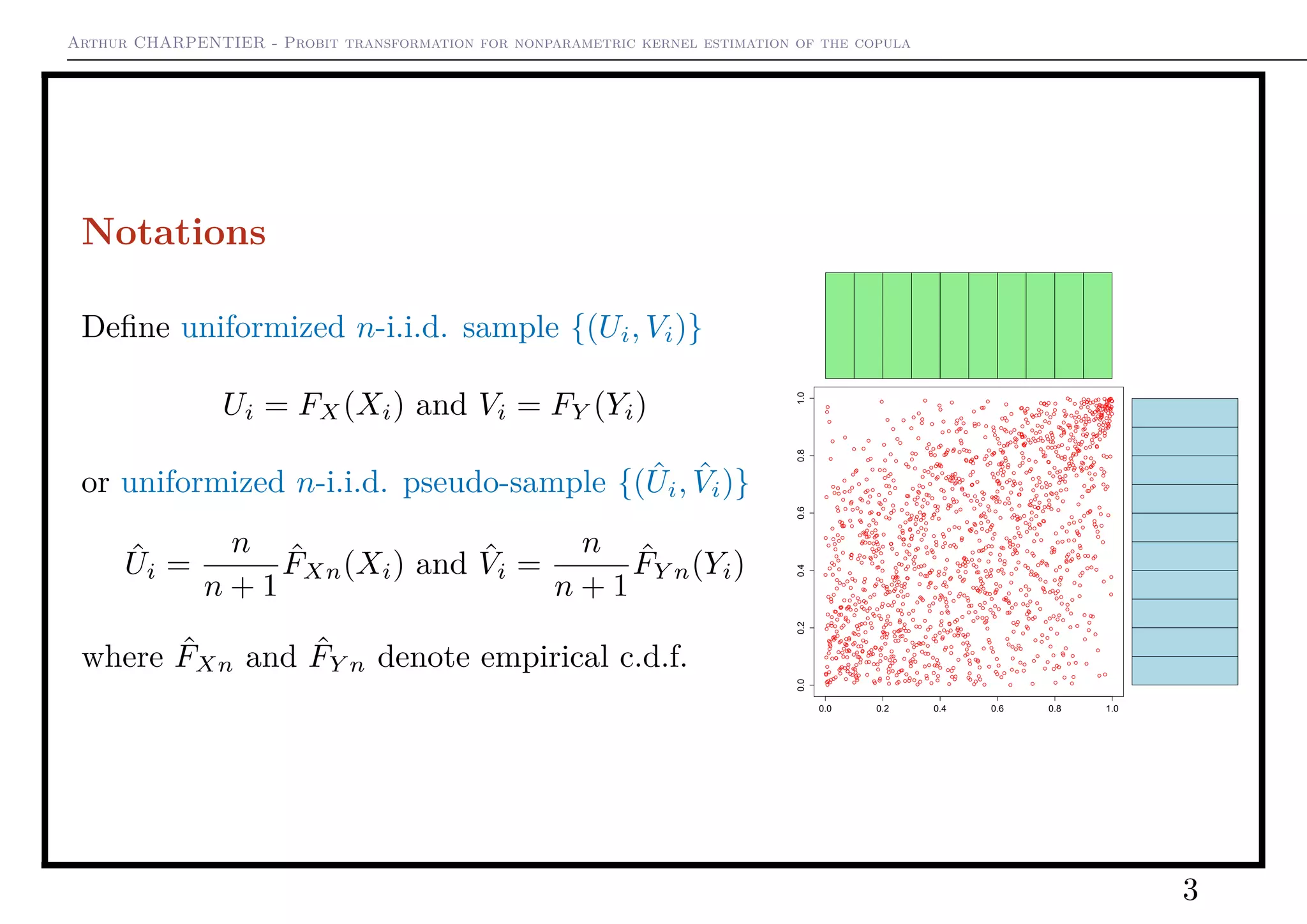
Define uniformized n-i.i.d. sample {(Ui, Vi)}
Ui = FX(Xi) and Vi = FY (Yi)
or uniformized n-i.i.d. pseudo-sample {( ˆUi, ˆVi)}
ˆUi =
n
n + 1
ˆFXn(Xi) and ˆVi =
n
n + 1
ˆFY n(Yi)
where ˆFXn and ˆFY n denote empirical c.d.f.
0.0 0.2 0.4 0.6 0.8 1.0
0.00.20.40.60.81.0
3
Arthur CHARPENTIER - Probit transformation for nonparametric kernel estimation of the copula
Standard Kernel Estimate
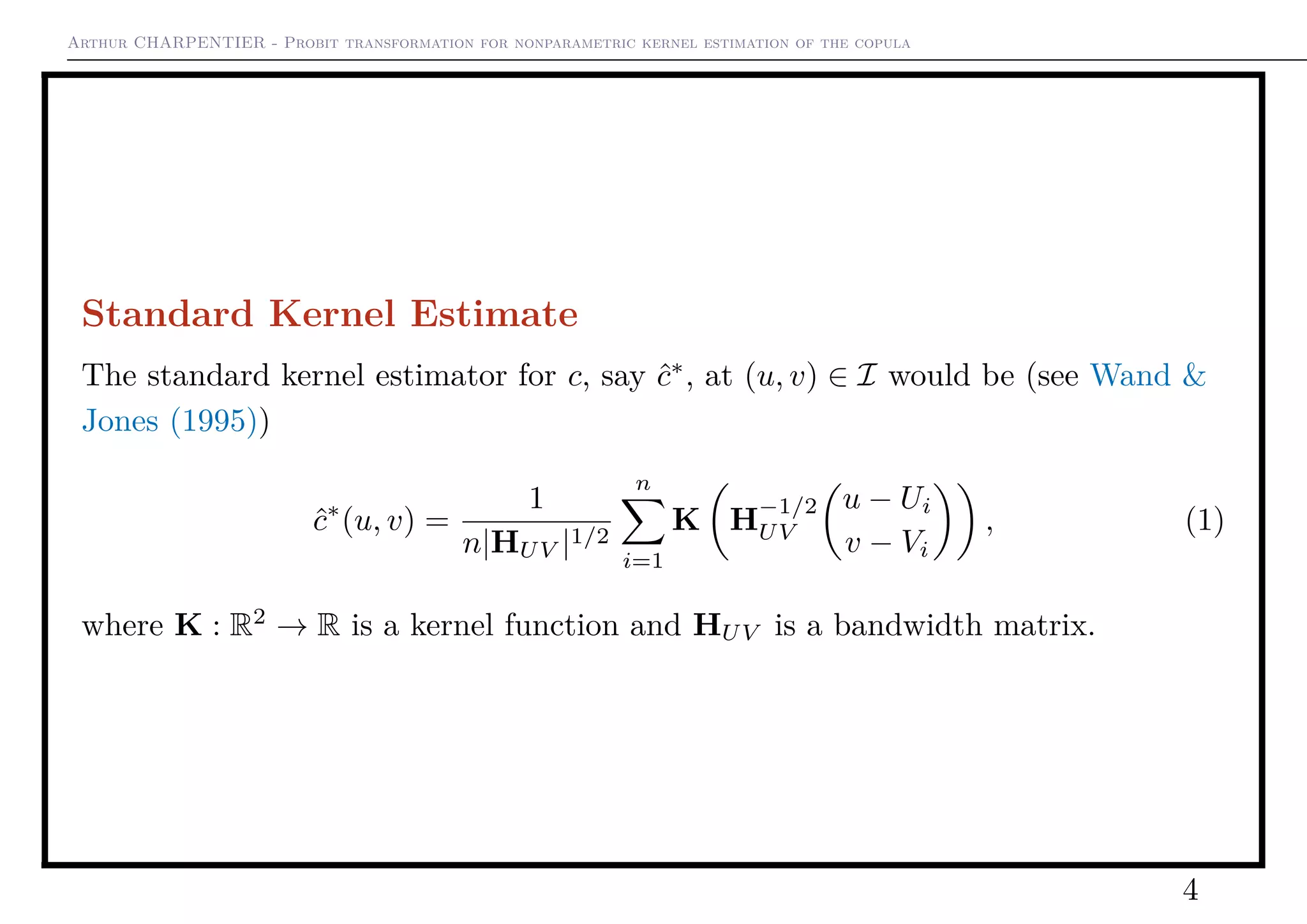
The standard kernel estimator for c, say ˆc∗
, at (u, v) ∈ I would be (see Wand &
Jones (1995))
ˆc∗
(u, v) =
1
n|HUV |1/2
n
i=1
K H
−1/2
UV
u − Ui
v − Vi
, (1)
where K : R2
→ R is a kernel function and HUV is a bandwidth matrix.
4
Arthur CHARPENTIER - Probit transformation for nonparametric kernel estimation of the copula
Standard Kernel Estimate
However, this estimator is not consistent along
boundaries of [0, 1]2
E(ˆc∗
(u, v)) =
1
4
c(u, v) + O(h) at corners
E(ˆc∗
(u, v)) =
1
2
c(u, v) + O(h) on the borders
if K is symmetric and HUV symmetric.
Corrections have been proposed, e.g. mirror reflec-
tion Gijbels (1990) or the usage of boundary kernels
Chen (2007), but with mixed results.
Remark: the graph on the bottom is ˆc∗
on the
(first) diagonal.
0.0
0.2
0.4
0.6
0.8
1.0 0.0
0.2
0.4
0.6
0.8
1.0
0
2
4
6
0.0 0.2 0.4 0.6 0.8 1.0
01234567
5
Arthur CHARPENTIER - Probit transformation for nonparametric kernel estimation of the copula
Mirror Kernel Estimate
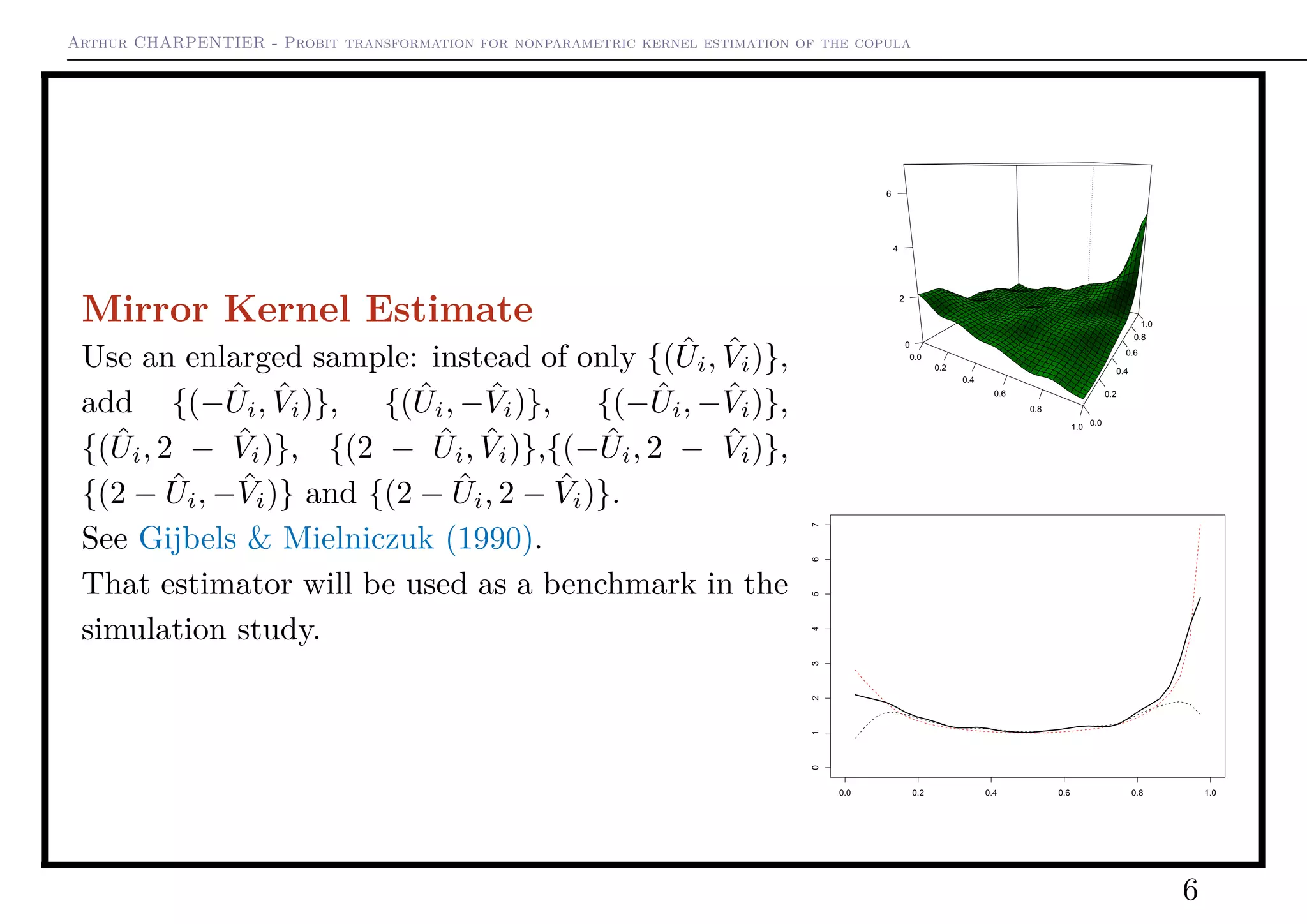
Use an enlarged sample: instead of only {( ˆUi, ˆVi)},
add {(− ˆUi, ˆVi)}, {( ˆUi, − ˆVi)}, {(− ˆUi, − ˆVi)},
{( ˆUi, 2 − ˆVi)}, {(2 − ˆUi, ˆVi)},{(− ˆUi, 2 − ˆVi)},
{(2 − ˆUi, − ˆVi)} and {(2 − ˆUi, 2 − ˆVi)}.
See Gijbels & Mielniczuk (1990).
That estimator will be used as a benchmark in the
simulation study.
0.0
0.2
0.4
0.6
0.8
1.0 0.0
0.2
0.4
0.6
0.8
1.0
0
2
4
6
0.0 0.2 0.4 0.6 0.8 1.0
01234567
6
Arthur CHARPENTIER - Probit transformation for nonparametric kernel estimation of the copula
Using Beta Kernels
Use a Kernel which is a product of beta kernels
Kxi
(u)) ∝ u
x1,i
b
1 [1 − u1]
x1,i
b · u
x2,i
b
2 [1 − u2]
x2,i
b
See Chen (1999).
0.0
0.2
0.4
0.6
0.8
1.0 0.0
0.2
0.4
0.6
0.8
1.0
0
2
4
6
0.0 0.2 0.4 0.6 0.8 1.0
01234567
7
Arthur CHARPENTIER - Probit transformation for nonparametric kernel estimation of the copula
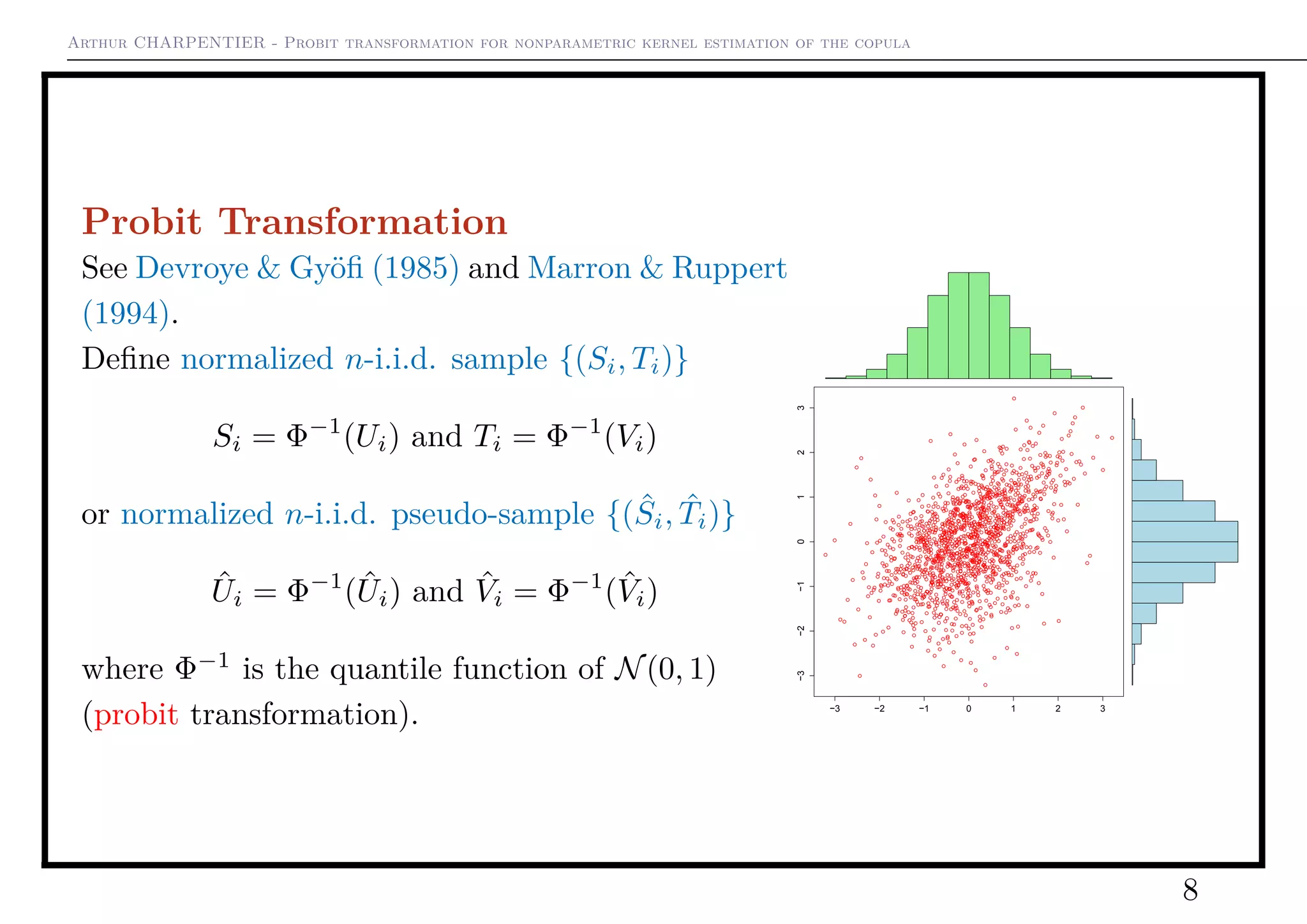
Probit Transformation
See Devroye & Gyöfi (1985) and Marron & Ruppert
(1994).
Define normalized n-i.i.d. sample {(Si, Ti)}
Si = Φ−1
(Ui) and Ti = Φ−1
(Vi)
or normalized n-i.i.d. pseudo-sample {( ˆSi, ˆTi)}
ˆUi = Φ−1
( ˆUi) and ˆVi = Φ−1
( ˆVi)
where Φ−1
is the quantile function of N(0, 1)
(probit transformation). −3 −2 −1 0 1 2 3
−3−2−10123
8
Arthur CHARPENTIER - Probit transformation for nonparametric kernel estimation of the copula
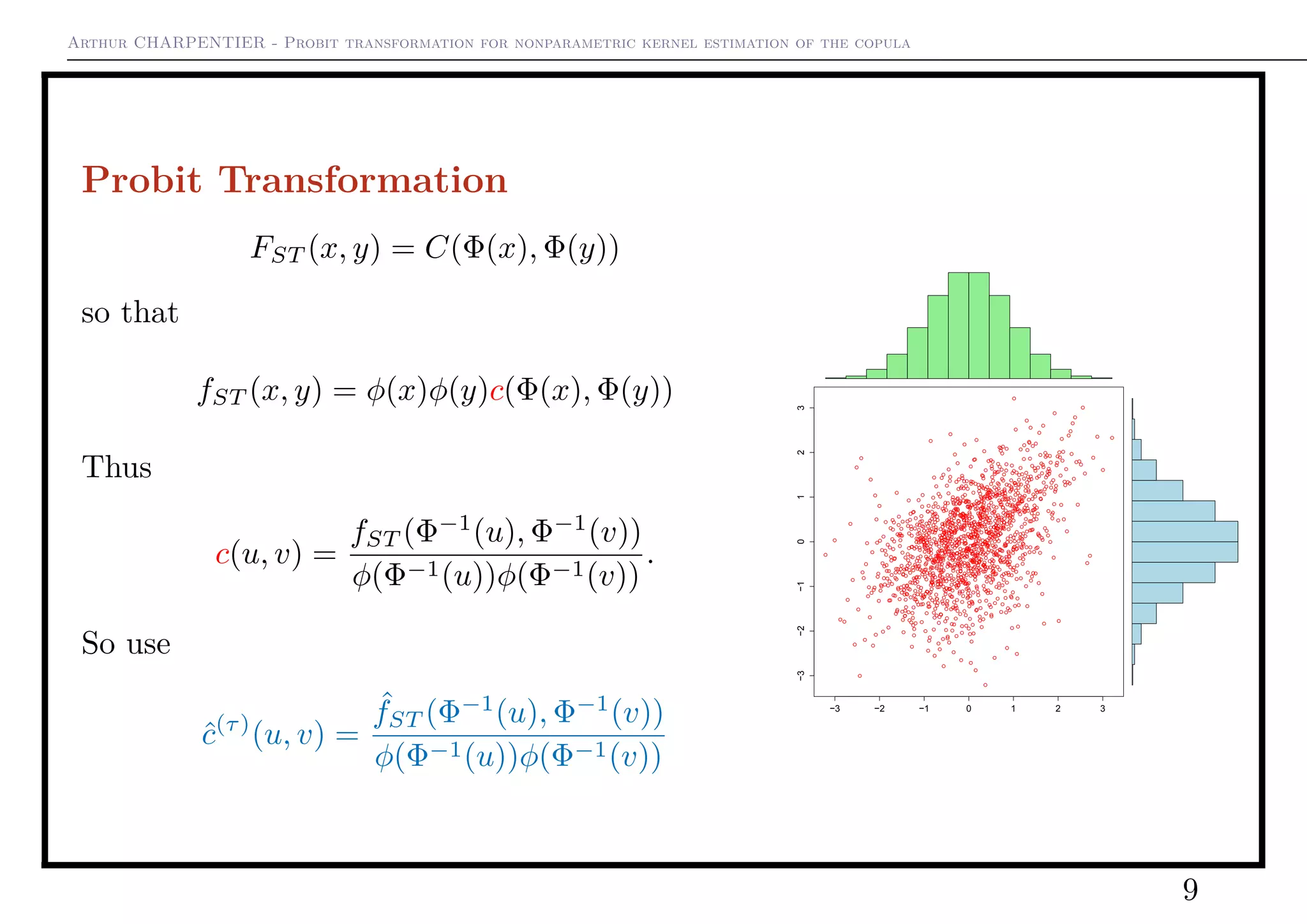
Probit Transformation
FST (x, y) = C(Φ(x), Φ(y))
so that
fST (x, y) = φ(x)φ(y)c(Φ(x), Φ(y))
Thus
c(u, v) =
fST (Φ−1
(u), Φ−1
(v))
φ(Φ−1(u))φ(Φ−1(v))
.
So use
ˆc(τ)
(u, v) =
ˆfST (Φ−1
(u), Φ−1
(v))
φ(Φ−1(u))φ(Φ−1(v))
−3 −2 −1 0 1 2 3
−3−2−10123
9
Arthur CHARPENTIER - Probit transformation for nonparametric kernel estimation of the copula
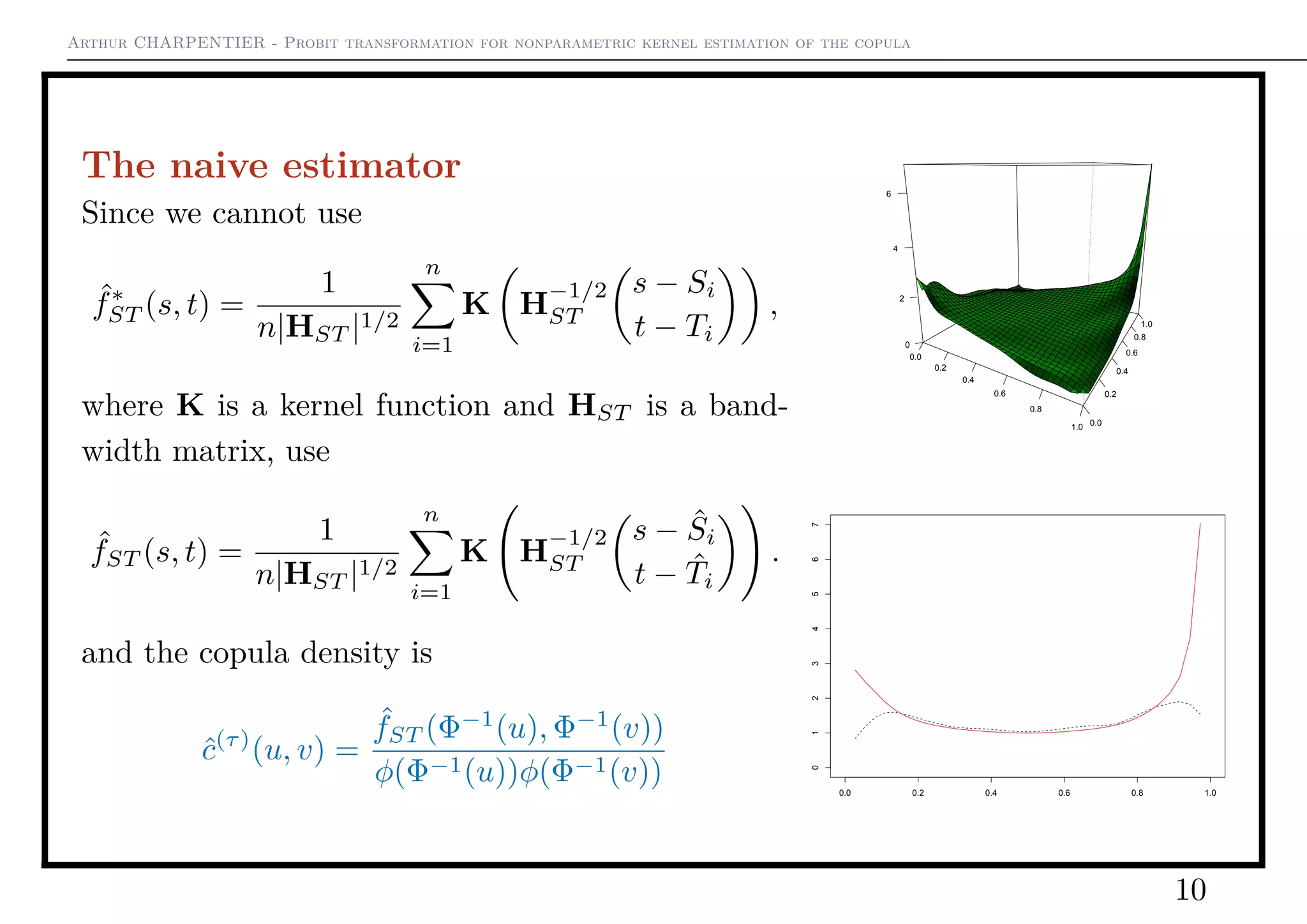
The naive estimator
Since we cannot use
ˆf∗
ST (s, t) =
1
n|HST |1/2
n
i=1
K H
−1/2
ST
s − Si
t − Ti
,
where K is a kernel function and HST is a band-
width matrix, use
ˆfST (s, t) =
1
n|HST |1/2
n
i=1
K H
−1/2
ST
s − ˆSi
t − ˆTi
.
and the copula density is
ˆc(τ)
(u, v) =
ˆfST (Φ−1
(u), Φ−1
(v))
φ(Φ−1(u))φ(Φ−1(v))
0.0
0.2
0.4
0.6
0.8
1.0 0.0
0.2
0.4
0.6
0.8
1.0
0
2
4
6
0.0 0.2 0.4 0.6 0.8 1.0
01234567
10
Arthur CHARPENTIER - Probit transformation for nonparametric kernel estimation of the copula
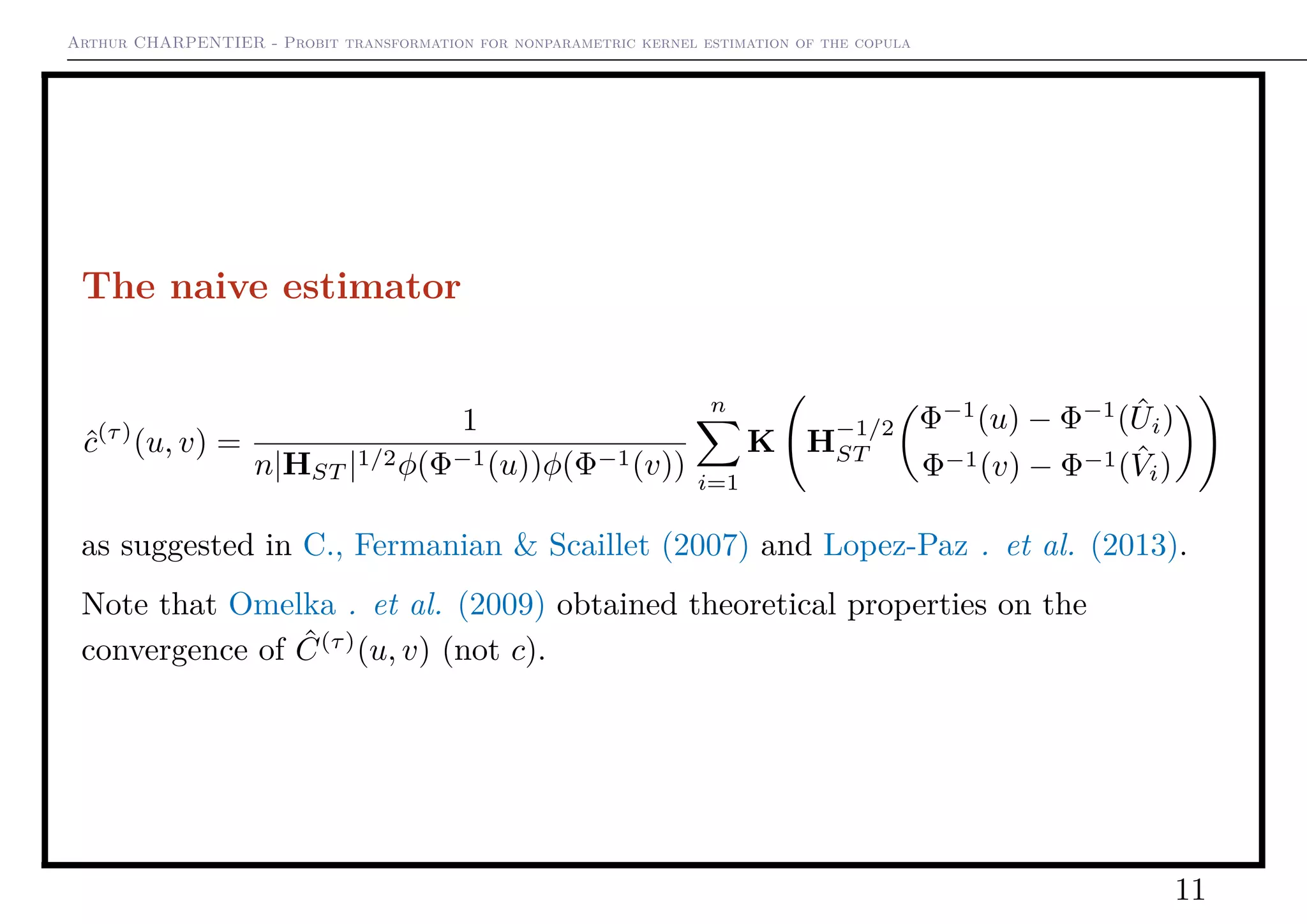
The naive estimator
ˆc(τ)
(u, v) =
1
n|HST |1/2φ(Φ−1(u))φ(Φ−1(v))
n
i=1
K H
−1/2
ST
Φ−1
(u) − Φ−1
( ˆUi)
Φ−1(v) − Φ−1( ˆVi)
as suggested in C., Fermanian & Scaillet (2007) and Lopez-Paz . et al. (2013).
Note that Omelka . et al. (2009) obtained theoretical properties on the
convergence of ˆC(τ)
(u, v) (not c).
11
Arthur CHARPENTIER - Probit transformation for nonparametric kernel estimation of the copula
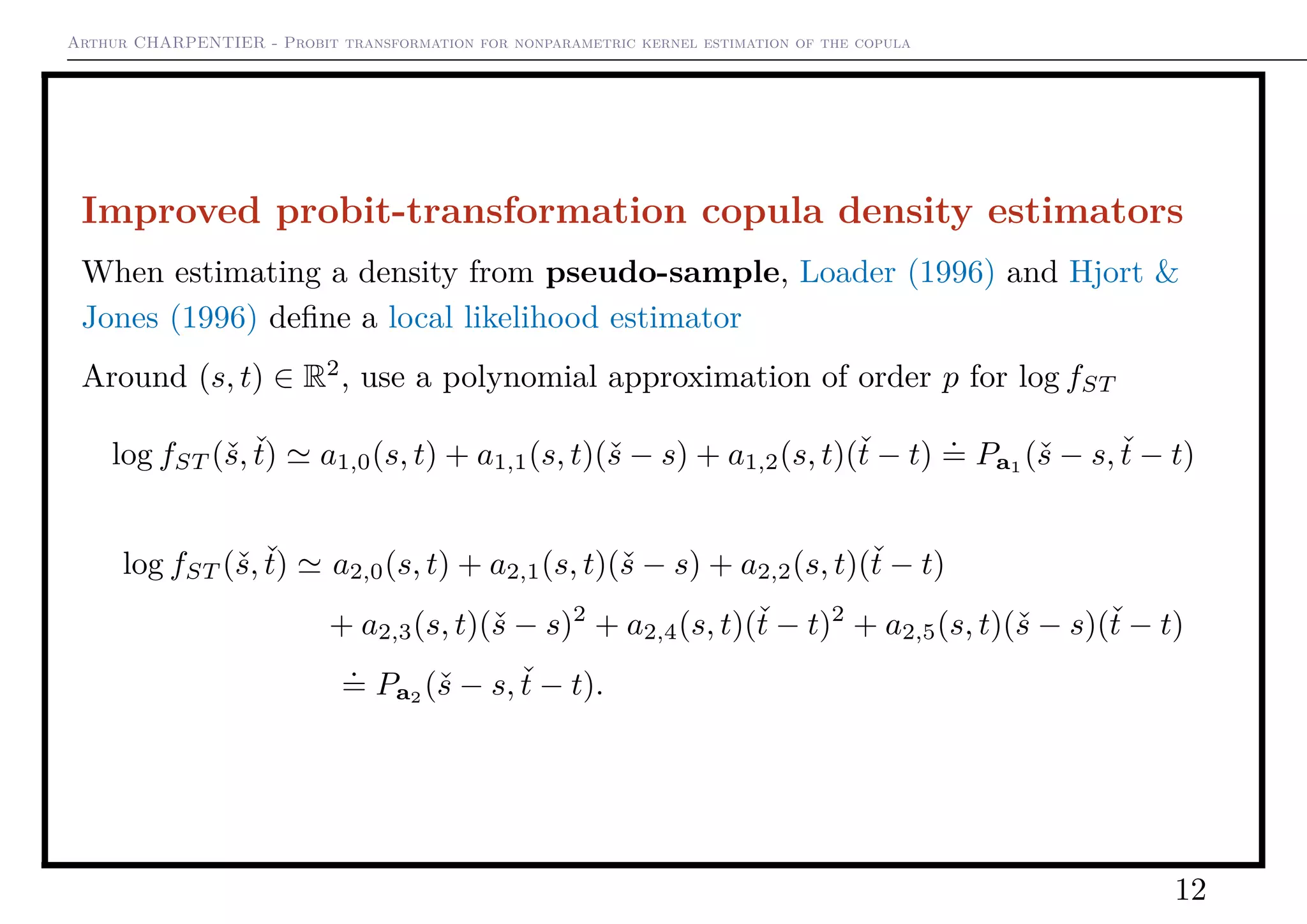
Improved probit-transformation copula density estimators
When estimating a density from pseudo-sample, Loader (1996) and Hjort &
Jones (1996) define a local likelihood estimator
Around (s, t) ∈ R2
, use a polynomial approximation of order p for log fST
log fST (ˇs, ˇt) a1,0(s, t) + a1,1(s, t)(ˇs − s) + a1,2(s, t)(ˇt − t)
.
= Pa1
(ˇs − s, ˇt − t)
log fST (ˇs, ˇt) a2,0(s, t) + a2,1(s, t)(ˇs − s) + a2,2(s, t)(ˇt − t)
+ a2,3(s, t)(ˇs − s)2
+ a2,4(s, t)(ˇt − t)2
+ a2,5(s, t)(ˇs − s)(ˇt − t)
.
= Pa2 (ˇs − s, ˇt − t).
12
Arthur CHARPENTIER - Probit transformation for nonparametric kernel estimation of the copula
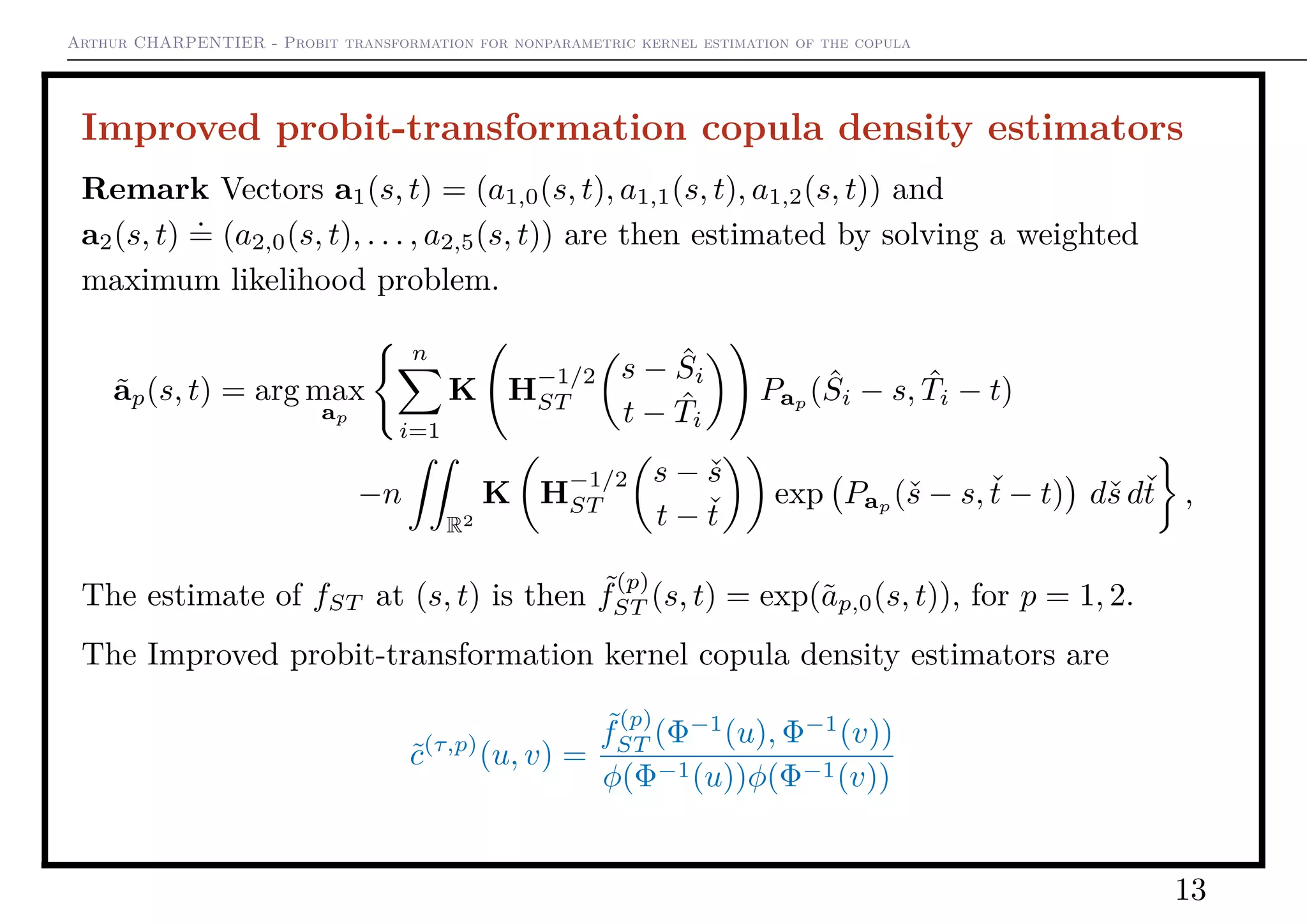
Improved probit-transformation copula density estimators
Remark Vectors a1(s, t) = (a1,0(s, t), a1,1(s, t), a1,2(s, t)) and
a2(s, t)
.
= (a2,0(s, t), . . . , a2,5(s, t)) are then estimated by solving a weighted
maximum likelihood problem.
˜ap(s, t) = arg max
ap
n
i=1
K H
−1/2
ST
s − ˆSi
t − ˆTi
Pap
( ˆSi − s, ˆTi − t)
−n
R2
K H
−1/2
ST
s − ˇs
t − ˇt
exp Pap (ˇs − s, ˇt − t) dˇs dˇt ,
The estimate of fST at (s, t) is then ˜f
(p)
ST (s, t) = exp(˜ap,0(s, t)), for p = 1, 2.
The Improved probit-transformation kernel copula density estimators are
˜c(τ,p)
(u, v) =
˜f
(p)
ST (Φ−1
(u), Φ−1
(v))
φ(Φ−1(u))φ(Φ−1(v))
13
Arthur CHARPENTIER - Probit transformation for nonparametric kernel estimation of the copula
Improved probit-transformation
copula density estimators
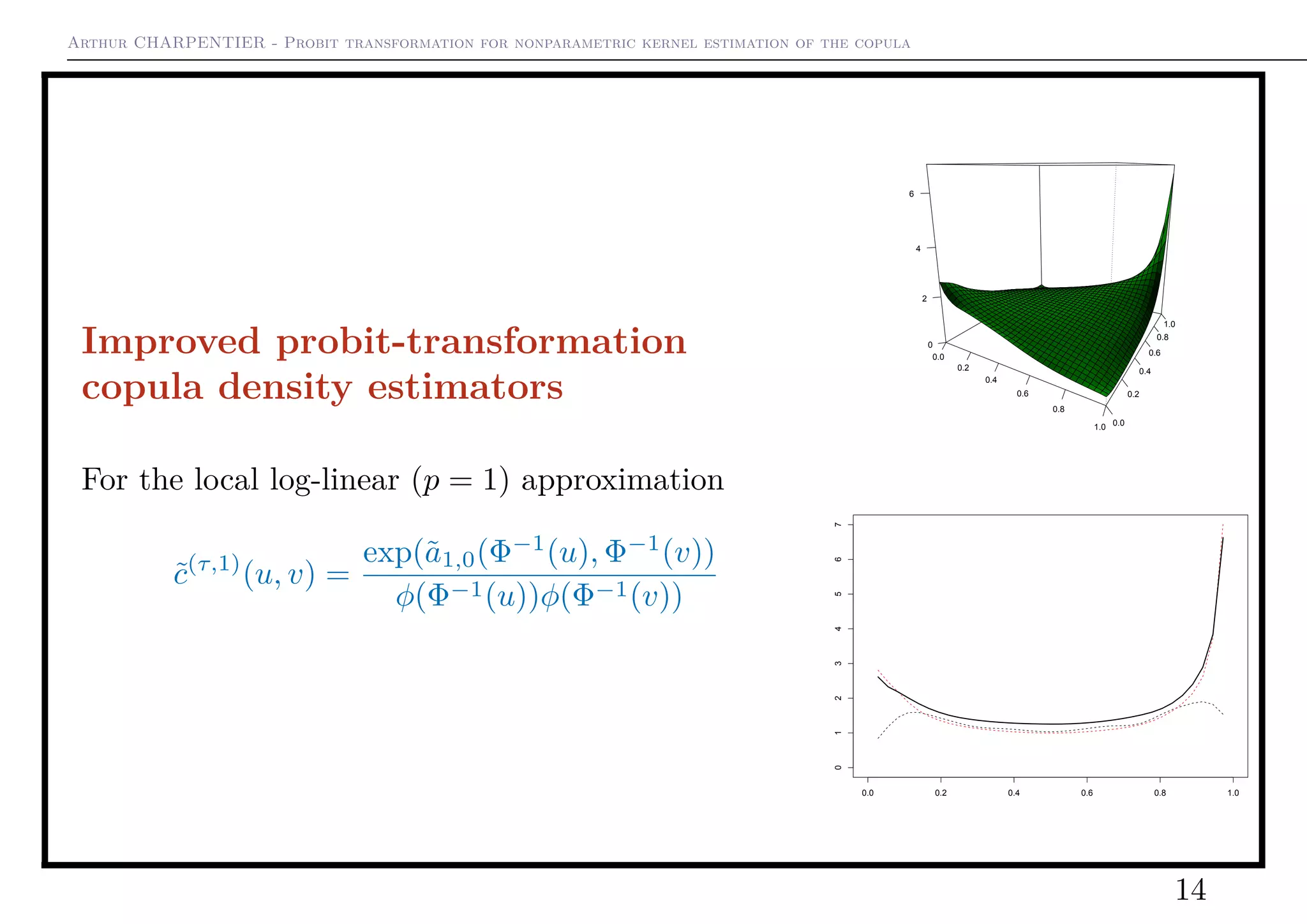
For the local log-linear (p = 1) approximation
˜c(τ,1)
(u, v) =
exp(˜a1,0(Φ−1
(u), Φ−1
(v))
φ(Φ−1(u))φ(Φ−1(v))
0.0
0.2
0.4
0.6
0.8
1.0 0.0
0.2
0.4
0.6
0.8
1.0
0
2
4
6
0.0 0.2 0.4 0.6 0.8 1.0
01234567
14
Arthur CHARPENTIER - Probit transformation for nonparametric kernel estimation of the copula
Improved probit-transformation
copula density estimators
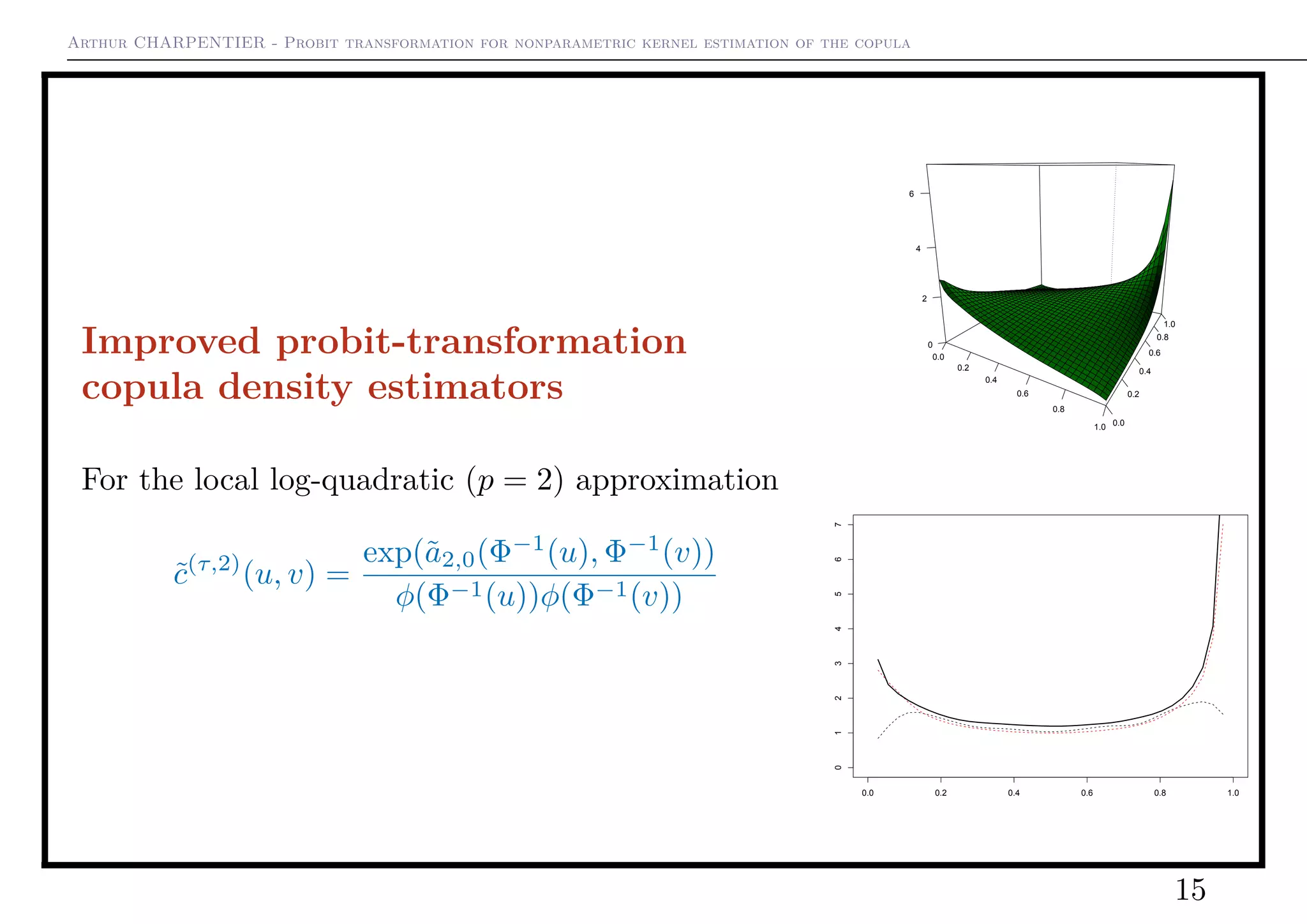
For the local log-quadratic (p = 2) approximation
˜c(τ,2)
(u, v) =
exp(˜a2,0(Φ−1
(u), Φ−1
(v))
φ(Φ−1(u))φ(Φ−1(v))
0.0
0.2
0.4
0.6
0.8
1.0 0.0
0.2
0.4
0.6
0.8
1.0
0
2
4
6
0.0 0.2 0.4 0.6 0.8 1.0
01234567
15
Arthur CHARPENTIER - Probit transformation for nonparametric kernel estimation of the copula
Asymptotic properties
A1. The sample {(Xi, Yi)} is a n- i.i.d. sample from the joint distribution FXY ,
an absolutely continuous distribution with marginals FX and FY strictly
increasing on their support;
(uniqueness of the copula)
16
Arthur CHARPENTIER - Probit transformation for nonparametric kernel estimation of the copula
Asymptotic properties
A2. The copula C of FXY is such that (∂C/∂u)(u, v) and (∂2
C/∂u2
)(u, v) exist
and are continuous on {(u, v) : u ∈ (0, 1), v ∈ [0, 1]}, and (∂C/∂v)(u, v) and
(∂2
C/∂v2
)(u, v) exist and are continuous on {(u, v) : u ∈ [0, 1], v ∈ (0, 1)}. In
addition, there are constants K1 and K2 such that



∂2
C
∂u2
(u, v) ≤
K1
u(1 − u)
for (u, v) ∈ (0, 1) × [0, 1];
∂2
C
∂v2
(u, v) ≤
K2
v(1 − v)
for (u, v) ∈ [0, 1] × (0, 1);
A3. The density c of C exists, is positive and admits continuous second-order
partial derivatives on the interior of the unit square I. In addition, there is a
constant K00 such that
c(u, v) ≤ K00 min
1
u(1 − u)
,
1
v(1 − v)
∀(u, v) ∈ (0, 1)2
.
see Segers (2012).
17
Arthur CHARPENTIER - Probit transformation for nonparametric kernel estimation of the copula
Asymptotic properties
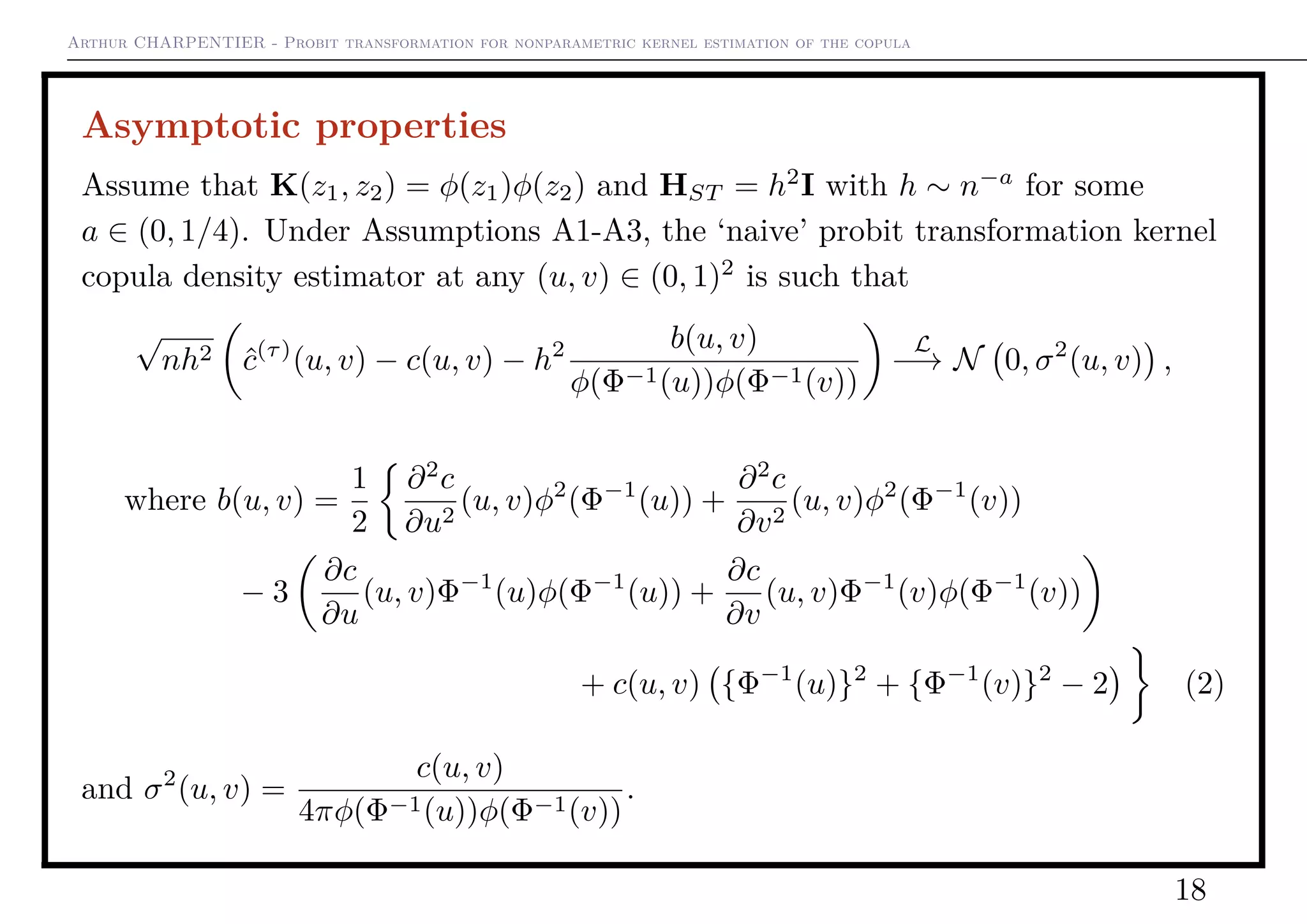
Assume that K(z1, z2) = φ(z1)φ(z2) and HST = h2
I with h ∼ n−a
for some
a ∈ (0, 1/4). Under Assumptions A1-A3, the ‘naive’ probit transformation kernel
copula density estimator at any (u, v) ∈ (0, 1)2
is such that
√
nh2 ˆc(τ)
(u, v) − c(u, v) − h2 b(u, v)
φ(Φ−1(u))φ(Φ−1(v))
L
−→ N 0, σ2
(u, v) ,
where b(u, v) =
1
2
∂2
c
∂u2
(u, v)φ2
(Φ−1
(u)) +
∂2
c
∂v2
(u, v)φ2
(Φ−1
(v))
− 3
∂c
∂u
(u, v)Φ−1
(u)φ(Φ−1
(u)) +
∂c
∂v
(u, v)Φ−1
(v)φ(Φ−1
(v))
+ c(u, v) {Φ−1
(u)}2
+ {Φ−1
(v)}2
− 2 (2)
and σ2
(u, v) =
c(u, v)
4πφ(Φ−1(u))φ(Φ−1(v))
.
18
Arthur CHARPENTIER - Probit transformation for nonparametric kernel estimation of the copula
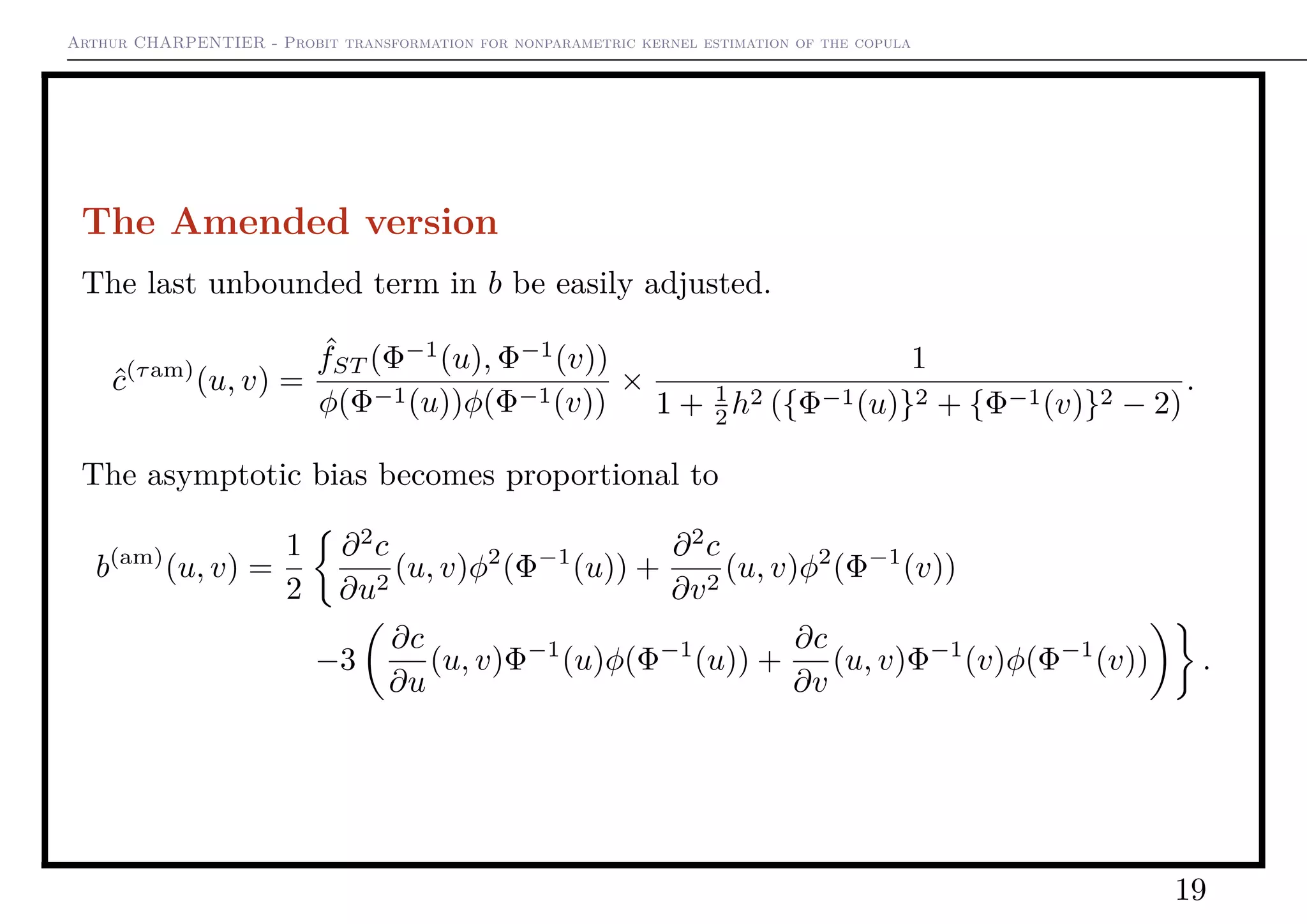
The Amended version
The last unbounded term in b be easily adjusted.
ˆc(τam)
(u, v) =
ˆfST (Φ−1
(u), Φ−1
(v))
φ(Φ−1(u))φ(Φ−1(v))
×
1
1 + 1
2 h2 ({Φ−1(u)}2 + {Φ−1(v)}2 − 2)
.
The asymptotic bias becomes proportional to
b(am)
(u, v) =
1
2
∂2
c
∂u2
(u, v)φ2
(Φ−1
(u)) +
∂2
c
∂v2
(u, v)φ2
(Φ−1
(v))
−3
∂c
∂u
(u, v)Φ−1
(u)φ(Φ−1
(u)) +
∂c
∂v
(u, v)Φ−1
(v)φ(Φ−1
(v)) .
19
Arthur CHARPENTIER - Probit transformation for nonparametric kernel estimation of the copula
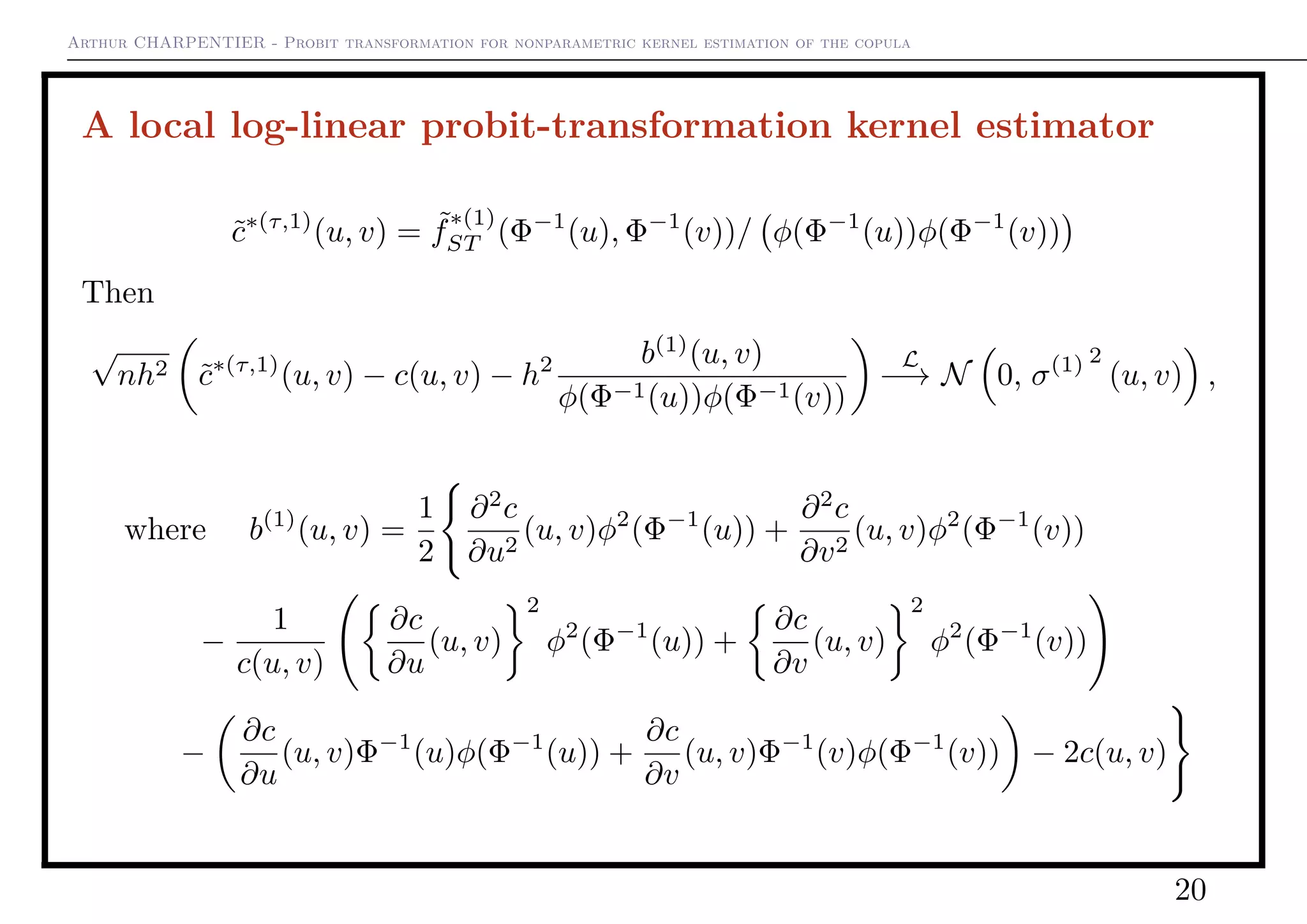
A local log-linear probit-transformation kernel estimator
˜c∗(τ,1)
(u, v) = ˜f
∗(1)
ST (Φ−1
(u), Φ−1
(v))/ φ(Φ−1
(u))φ(Φ−1
(v))
Then
√
nh2 ˜c∗(τ,1)
(u, v) − c(u, v) − h2 b(1)
(u, v)
φ(Φ−1(u))φ(Φ−1(v))
L
−→ N 0, σ(1) 2
(u, v) ,
where b(1)
(u, v) =
1
2
∂2
c
∂u2
(u, v)φ2
(Φ−1
(u)) +
∂2
c
∂v2
(u, v)φ2
(Φ−1
(v))
−
1
c(u, v)
∂c
∂u
(u, v)
2
φ2
(Φ−1
(u)) +
∂c
∂v
(u, v)
2
φ2
(Φ−1
(v))
−
∂c
∂u
(u, v)Φ−1
(u)φ(Φ−1
(u)) +
∂c
∂v
(u, v)Φ−1
(v)φ(Φ−1
(v)) − 2c(u, v)
20
Arthur CHARPENTIER - Probit transformation for nonparametric kernel estimation of the copula
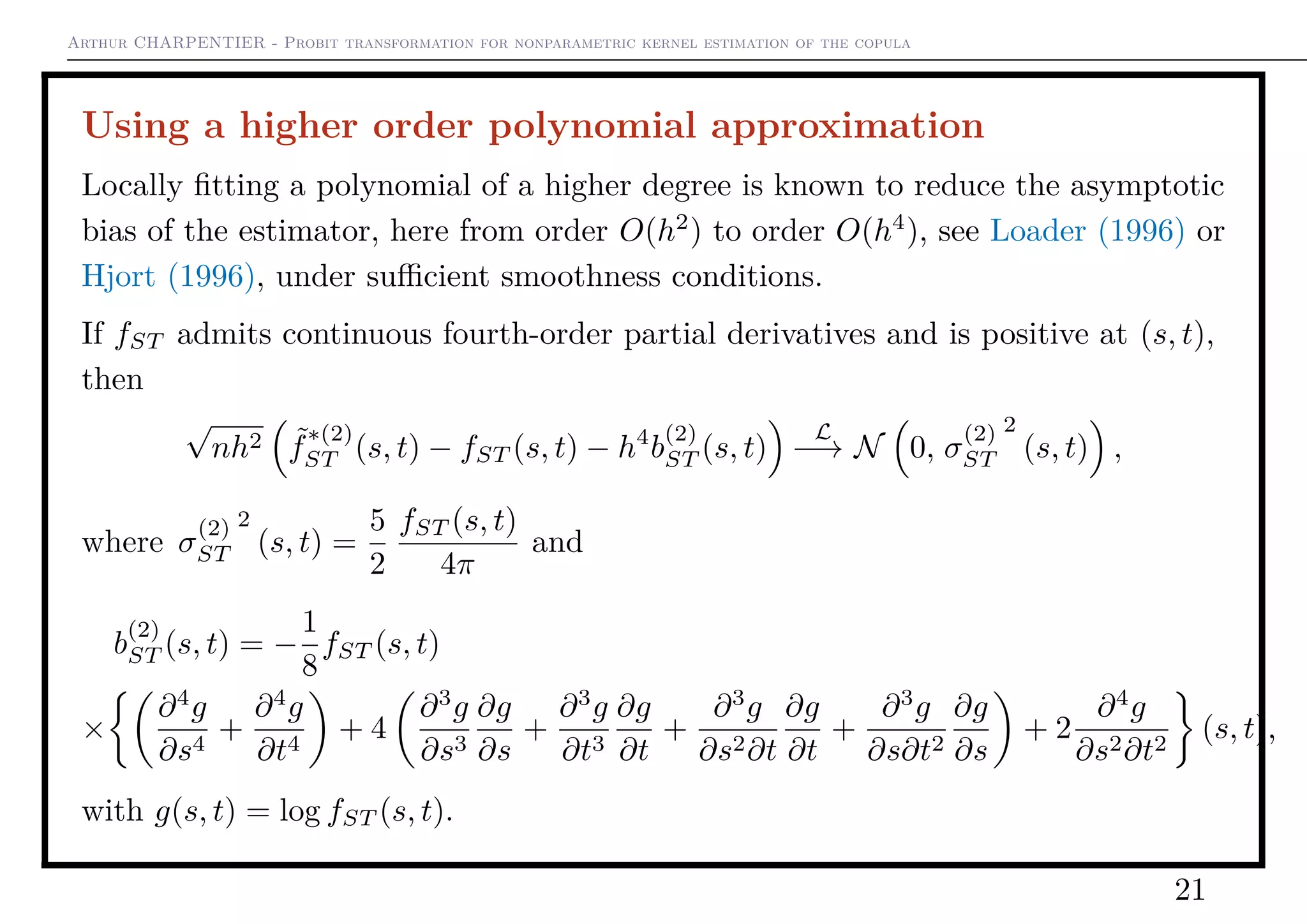
Using a higher order polynomial approximation
Locally fitting a polynomial of a higher degree is known to reduce the asymptotic
bias of the estimator, here from order O(h2
) to order O(h4
), see Loader (1996) or
Hjort (1996), under sufficient smoothness conditions.
If fST admits continuous fourth-order partial derivatives and is positive at (s, t),
then
√
nh2 ˜f
∗(2)
ST (s, t) − fST (s, t) − h4
b
(2)
ST (s, t)
L
−→ N 0, σ
(2)
ST
2
(s, t) ,
where σ
(2)
ST
2
(s, t) =
5
2
fST (s, t)
4π
and
b
(2)
ST (s, t) = −
1
8
fST (s, t)
×
∂4
g
∂s4
+
∂4
g
∂t4
+ 4
∂3
g
∂s3
∂g
∂s
+
∂3
g
∂t3
∂g
∂t
+
∂3
g
∂s2∂t
∂g
∂t
+
∂3
g
∂s∂t2
∂g
∂s
+ 2
∂4
g
∂s2∂t2
(s, t),
with g(s, t) = log fST (s, t).
21
Arthur CHARPENTIER - Probit transformation for nonparametric kernel estimation of the copula
Using a higher order polynomial approximation
A4. The copula density c(u, v) = (∂2
C/∂u∂v)(u, v) admits continuous
fourth-order partial derivatives on the interior of the unit square [0, 1]2
.
Then
√
nh2 ˜c∗(τ,2)
(u, v) − c(u, v) − h4 b(2)
(u, v)
φ(Φ−1(u))φ(Φ−1(v))
L
−→ N 0, σ(2) 2
(u, v)
where σ(2) 2
(u, v) =
5
2
c(u, v)
4πφ(Φ−1(u))φ(Φ−1(v))
22
Arthur CHARPENTIER - Probit transformation for nonparametric kernel estimation of the copula
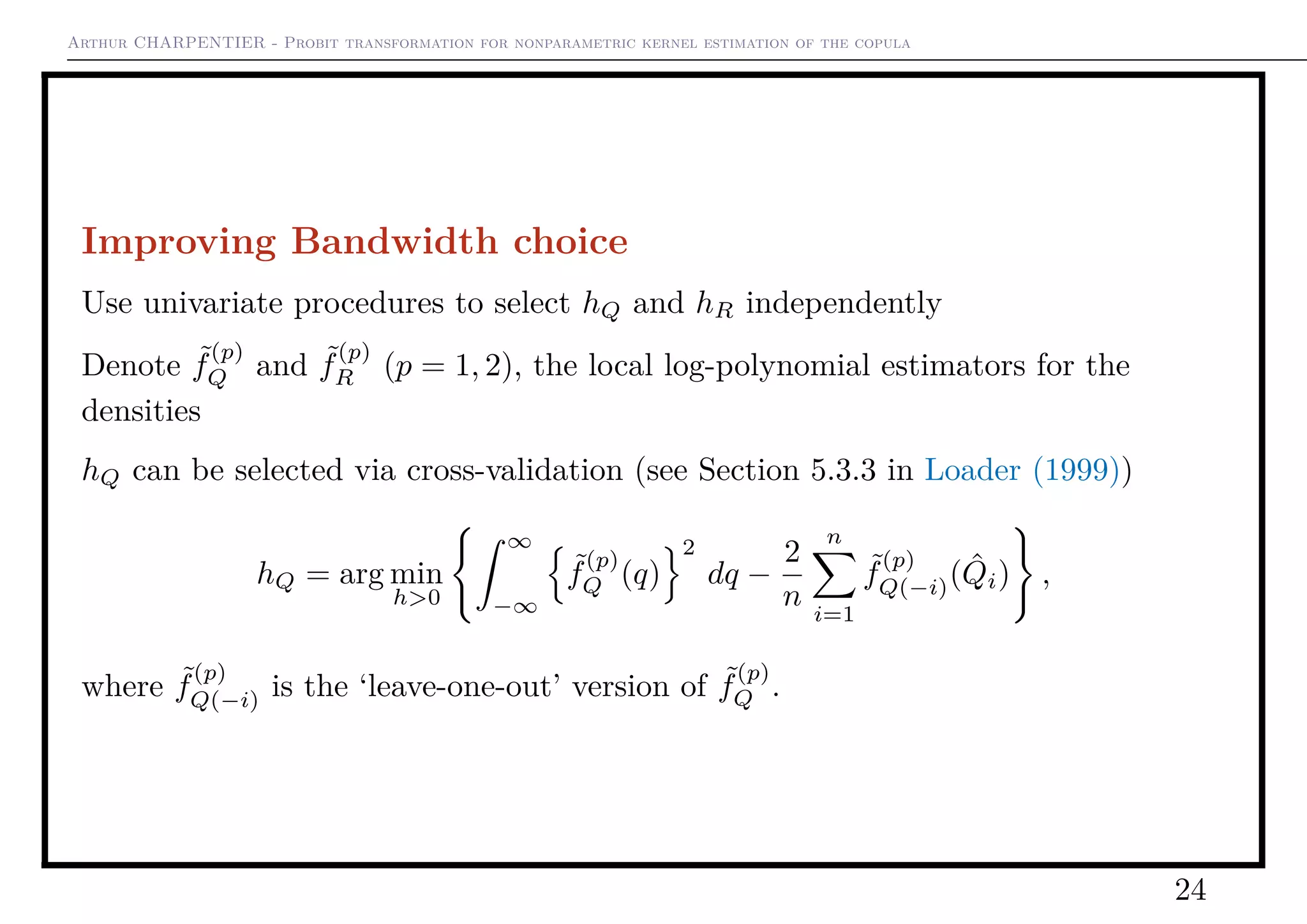
Improving Bandwidth choice
Consider the principal components decomposition of the (n × 2) matrix
[ˆS, ˆT ] = M.
Let W1 = (W11, W12)T
and W2 = (W21, W22)T
be the eigenvectors of MT
M. Set
Q
R
=


W11 W12
W21 W22

 S
T
= W
S
T
which is only a linear reparametrization of R2
, so
an estimate of fST can be readily obtained from an
estimate of the density of (Q, R)
Since { ˆQi} and { ˆRi} are empirically uncorrelated,
consider a diagonal bandwidth matrix HQR =
diag(h2
Q, h2
R).
−4 −2 0 2 4
−3−2−1012
23
Arthur CHARPENTIER - Probit transformation for nonparametric kernel estimation of the copula
Improving Bandwidth choice
Use univariate procedures to select hQ and hR independently
Denote ˜f
(p)
Q and ˜f
(p)
R (p = 1, 2), the local log-polynomial estimators for the
densities
hQ can be selected via cross-validation (see Section 5.3.3 in Loader (1999))
hQ = arg min
h>0
∞
−∞
˜f
(p)
Q (q)
2
dq −
2
n
n
i=1
˜f
(p)
Q(−i)( ˆQi) ,
where ˜f
(p)
Q(−i) is the ‘leave-one-out’ version of ˜f
(p)
Q .
24
Arthur CHARPENTIER - Probit transformation for nonparametric kernel estimation of the copula
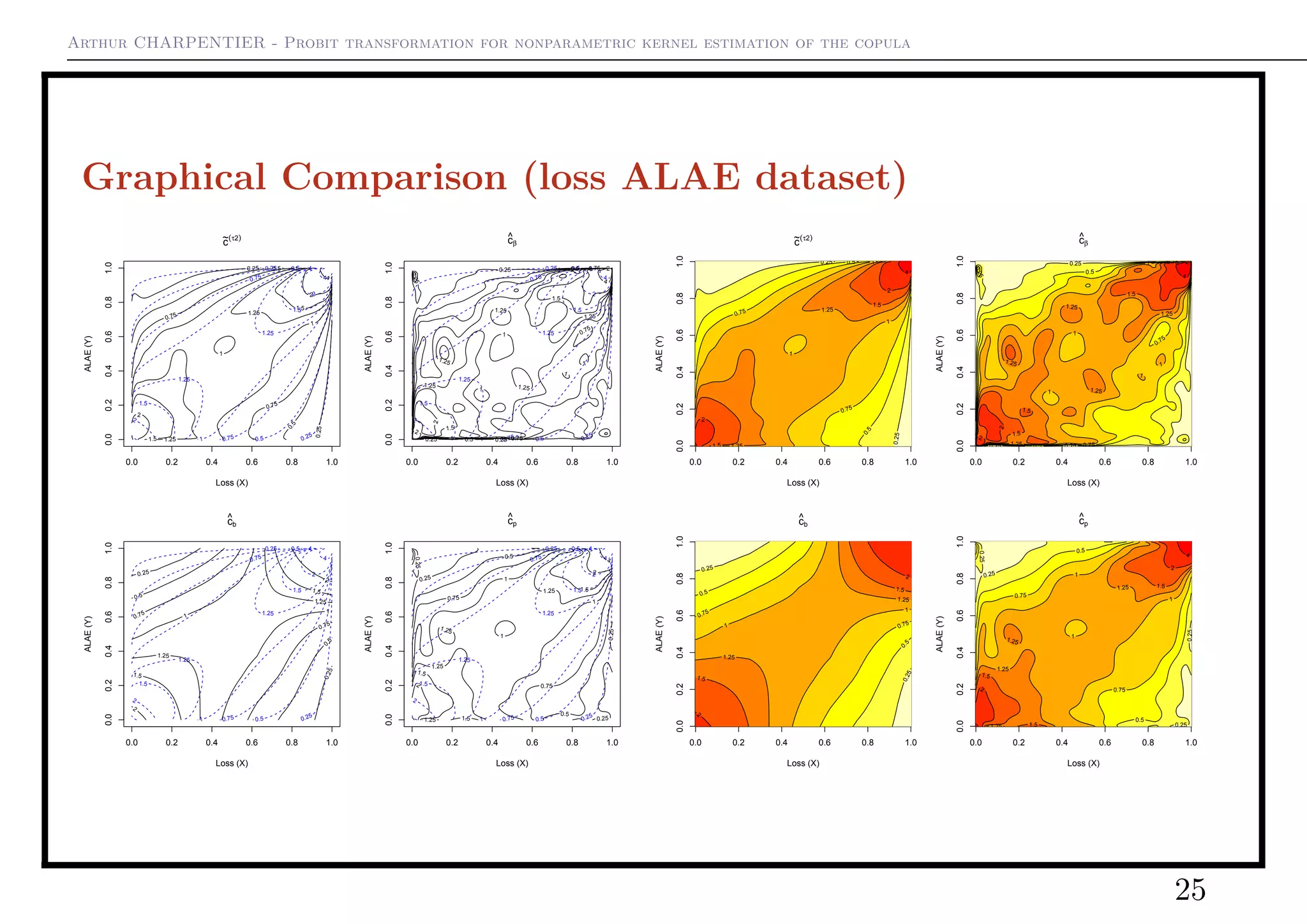
Graphical Comparison (loss ALAE dataset)
c~(τ2)
Loss (X)
ALAE(Y)
0.25
0.25
0.5
0.5
0.75
0.75
1
1
1.25
1.25
1.5
1.5
2
2
4
0.0 0.2 0.4 0.6 0.8 1.0
0.00.20.40.60.81.0
0.25
0.25
0.5
0.5
0.75
0.75
1
1
1
1.25
1.25
1.5
1.5
2
2
4
c^
β
Loss (X)
ALAE(Y)
0.25
0.25
0.5
0.5
0.75
0.75
1
1
1.25
1.25
1.5
1.5
2
2
4
0.0 0.2 0.4 0.6 0.8 1.0
0.00.20.40.60.81.0
0.25
0.25
0.25 0.25
0.5
0.5
0.75
0.75
0.75
1
1
1
1
1
1.25
1.25
1.25
1.25
1.25
1.5
1.5
2
2
2
4
c^
b
Loss (X)
ALAE(Y)
0.25
0.25
0.5
0.5
0.75
0.75
1
1
1.25
1.25
1.5
1.5
2
2
4
0.0 0.2 0.4 0.6 0.8 1.0
0.00.20.40.60.81.0
0.25
0.25
0.5
0.5
0.75
0.75
1
1
1.25
1.25
1.5
1.5
2
2
c^
p
Loss (X)
ALAE(Y)
0.25
0.25
0.5
0.5
0.75
0.75
1
1
1.25
1.25
1.5
1.5
2
2
4
0.0 0.2 0.4 0.6 0.8 1.0
0.00.20.40.60.81.0
0.25
0.25
0.25
0.25
0.5
0.5
0.75
0.75
1
1
1
1.25
1.25
1.25
1.25
1.5
1.5
1.5
2
2
4
0.0 0.2 0.4 0.6 0.8 1.0
0.00.20.40.60.81.0
c~(τ2)
Loss (X)
ALAE(Y)
0.25
0.25
0.5
0.5
0.75
0.75
1
1
1
1.25
1.25
1.5
1.5
2
2
4
0.0 0.2 0.4 0.6 0.8 1.0
0.00.20.40.60.81.0
c^
β
Loss (X)
ALAE(Y)
0.25
0.25
0.25 0.25
0.5
0.5
0.75
0.75
0.75
1
1
1
1
1
1.25
1.25
1.25
1.25
1.25
1.5
1.5
1.5
2
2
2
4
0.0 0.2 0.4 0.6 0.8 1.0
0.00.20.40.60.81.0
c^
b
Loss (X)
ALAE(Y)
0.25
0.25
0.5
0.5
0.75
0.751
1
1.25
1.25
1.5
1.5
2
2
0.0 0.2 0.4 0.6 0.8 1.0
0.00.20.40.60.81.0
c^
p
Loss (X)
ALAE(Y)
0.25
0.25
0.25
0.25
0.5
0.5
0.75
0.75
1
1
1
1.25
1.25
1.25
1.25
1.5
1.5
1.5
2
2
4
25
Arthur CHARPENTIER - Probit transformation for nonparametric kernel estimation of the copula
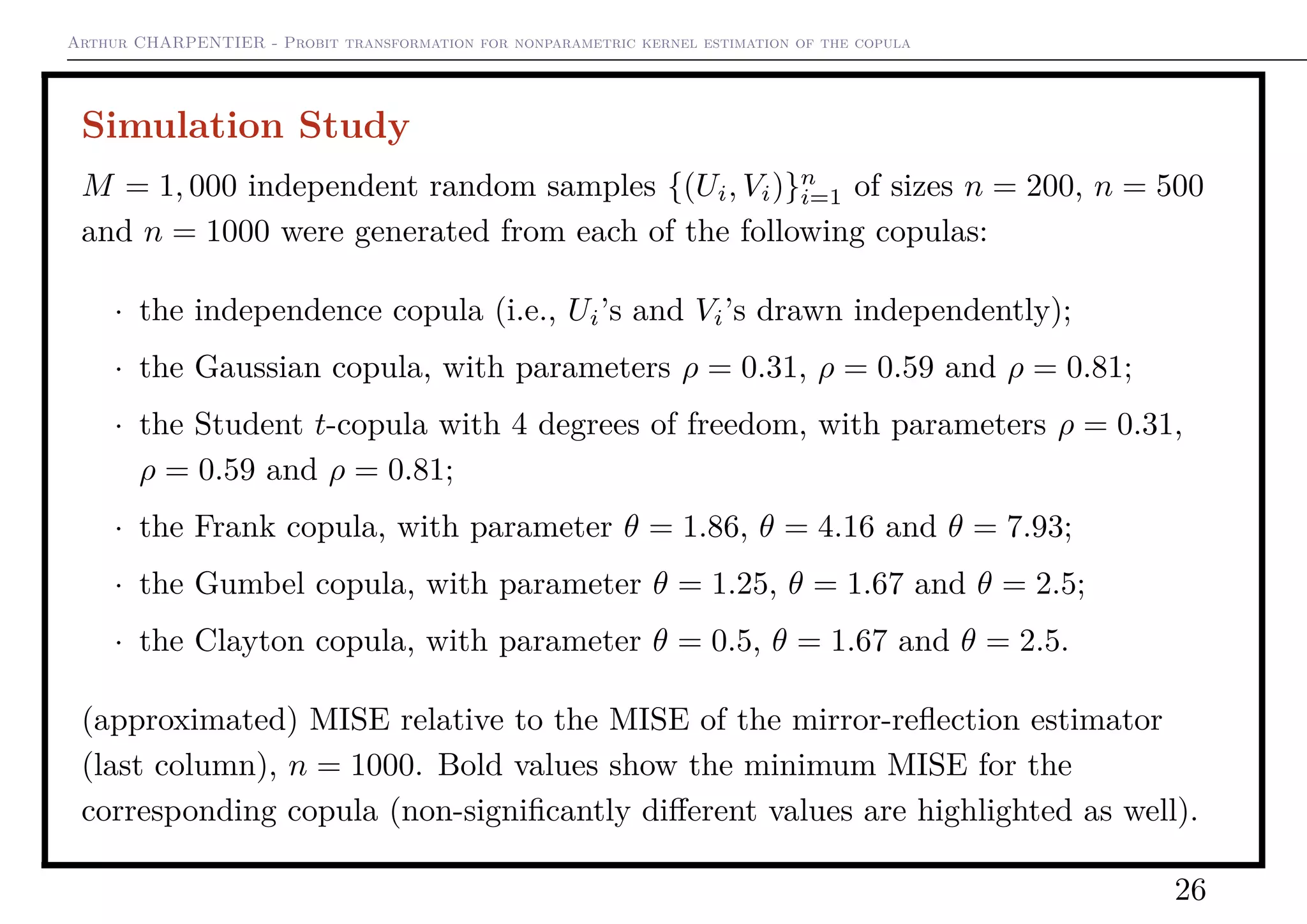
Simulation Study
M = 1, 000 independent random samples {(Ui, Vi)}n
i=1 of sizes n = 200, n = 500
and n = 1000 were generated from each of the following copulas:
· the independence copula (i.e., Ui’s and Vi’s drawn independently);
· the Gaussian copula, with parameters ρ = 0.31, ρ = 0.59 and ρ = 0.81;
· the Student t-copula with 4 degrees of freedom, with parameters ρ = 0.31,
ρ = 0.59 and ρ = 0.81;
· the Frank copula, with parameter θ = 1.86, θ = 4.16 and θ = 7.93;
· the Gumbel copula, with parameter θ = 1.25, θ = 1.67 and θ = 2.5;
· the Clayton copula, with parameter θ = 0.5, θ = 1.67 and θ = 2.5.
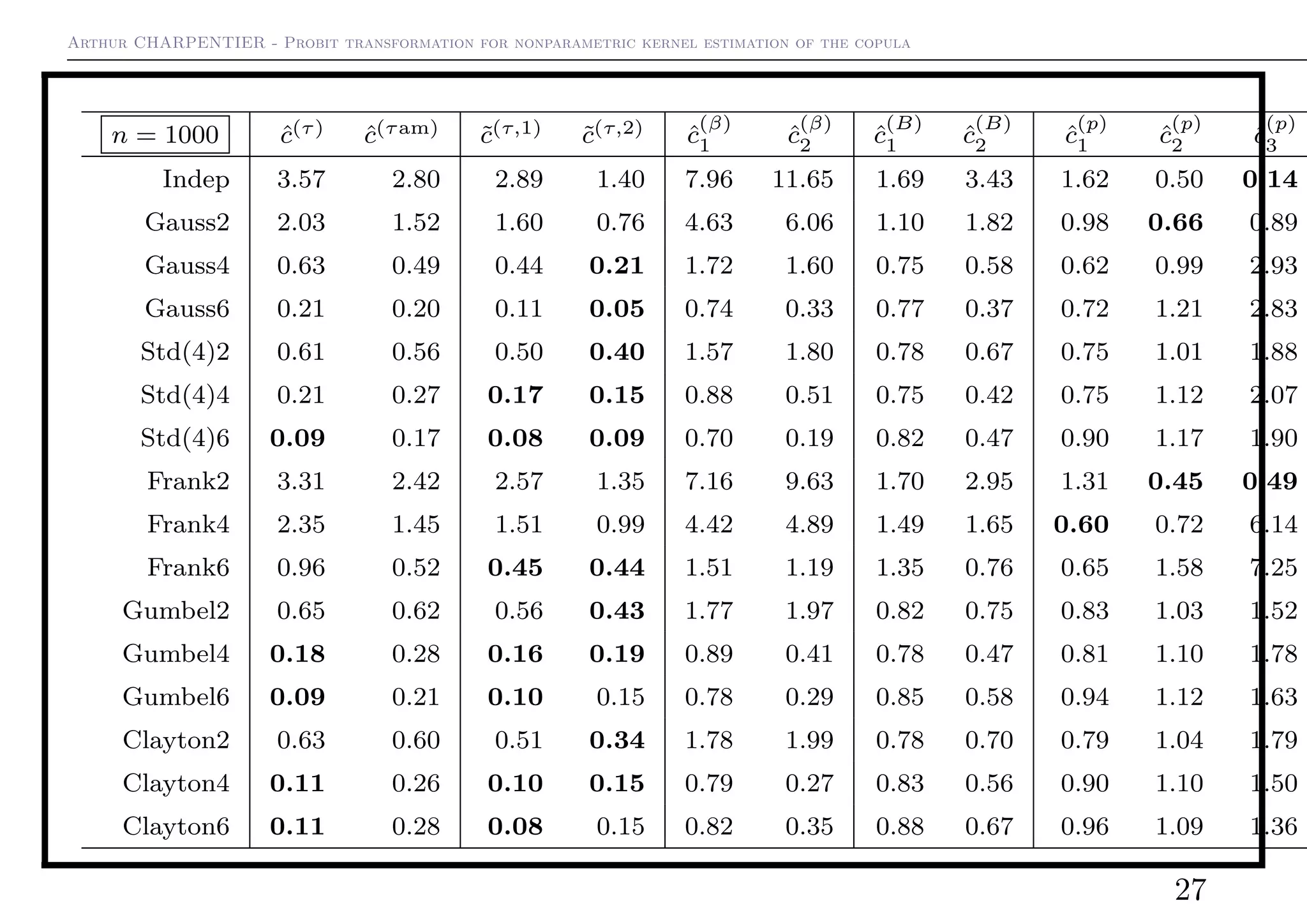
(approximated) MISE relative to the MISE of the mirror-reflection estimator
(last column), n = 1000. Bold values show the minimum MISE for the
corresponding copula (non-significantly different values are highlighted as well).
26
Arthur CHARPENTIER - Probit transformation for nonparametric kernel estimation of the copula
n = 1000 ˆc(τ) ˆc(τam) ˜c(τ,1) ˜c(τ,2) ˆc
(β)
1 ˆc
(β)
2 ˆc
(B)
1 ˆc
(B)
2 ˆc
(p)
1 ˆc
(p)
2 ˆc
(p)
3
Indep 3.57 2.80 2.89 1.40 7.96 11.65 1.69 3.43 1.62 0.50 0.14
Gauss2 2.03 1.52 1.60 0.76 4.63 6.06 1.10 1.82 0.98 0.66 0.89
Gauss4 0.63 0.49 0.44 0.21 1.72 1.60 0.75 0.58 0.62 0.99 2.93
Gauss6 0.21 0.20 0.11 0.05 0.74 0.33 0.77 0.37 0.72 1.21 2.83
Std(4)2 0.61 0.56 0.50 0.40 1.57 1.80 0.78 0.67 0.75 1.01 1.88
Std(4)4 0.21 0.27 0.17 0.15 0.88 0.51 0.75 0.42 0.75 1.12 2.07
Std(4)6 0.09 0.17 0.08 0.09 0.70 0.19 0.82 0.47 0.90 1.17 1.90
Frank2 3.31 2.42 2.57 1.35 7.16 9.63 1.70 2.95 1.31 0.45 0.49
Frank4 2.35 1.45 1.51 0.99 4.42 4.89 1.49 1.65 0.60 0.72 6.14
Frank6 0.96 0.52 0.45 0.44 1.51 1.19 1.35 0.76 0.65 1.58 7.25
Gumbel2 0.65 0.62 0.56 0.43 1.77 1.97 0.82 0.75 0.83 1.03 1.52
Gumbel4 0.18 0.28 0.16 0.19 0.89 0.41 0.78 0.47 0.81 1.10 1.78
Gumbel6 0.09 0.21 0.10 0.15 0.78 0.29 0.85 0.58 0.94 1.12 1.63
Clayton2 0.63 0.60 0.51 0.34 1.78 1.99 0.78 0.70 0.79 1.04 1.79
Clayton4 0.11 0.26 0.10 0.15 0.79 0.27 0.83 0.56 0.90 1.10 1.50
Clayton6 0.11 0.28 0.08 0.15 0.82 0.35 0.88 0.67 0.96 1.09 1.36
27

slides CIRM copulas, extremes and actuarial science

  • 1.
    Arthur CHARPENTIER -Probit transformation for nonparametric kernel estimation of the copula Probit transformation for nonparametric kernel estimation of the copula A. Charpentier (Université de Rennes 1 & UQAM), joint work with G. Geenens (UNSW) & D. Paindaveine (ULB) CIRM Workshop “Extremes - Copulas - Actuarial science”, February 2016 http://arxiv.org/abs/1404.4414, to appear in Bernoulli url: http://freakonometrics.hypotheses.org email : charpentier.arthur@uqam.ca : @freakonometrics 1
  • 2.
    Arthur CHARPENTIER -Probit transformation for nonparametric kernel estimation of the copula Motivation Consider some n-i.i.d. sample {(Xi, Yi)} with cu- mulative distribution function FXY and joint den- sity fXY . Let FX and FY denote the marginal distributions, and C the copula, FXY (x, y) = C(FX(x), FY (y)) so that fXY (x, y) = fX(x)fY (y)c(FX(x), FY (y)) We want a nonparametric estimate of c on [0, 1]2 . 1e+01 1e+03 1e+05 1e+011e+021e+031e+041e+05 2
  • 3.
    Arthur CHARPENTIER -Probit transformation for nonparametric kernel estimation of the copula Notations Define uniformized n-i.i.d. sample {(Ui, Vi)} Ui = FX(Xi) and Vi = FY (Yi) or uniformized n-i.i.d. pseudo-sample {( ˆUi, ˆVi)} ˆUi = n n + 1 ˆFXn(Xi) and ˆVi = n n + 1 ˆFY n(Yi) where ˆFXn and ˆFY n denote empirical c.d.f. 0.0 0.2 0.4 0.6 0.8 1.0 0.00.20.40.60.81.0 3
  • 4.
    Arthur CHARPENTIER -Probit transformation for nonparametric kernel estimation of the copula Standard Kernel Estimate The standard kernel estimator for c, say ˆc∗ , at (u, v) ∈ I would be (see Wand & Jones (1995)) ˆc∗ (u, v) = 1 n|HUV |1/2 n i=1 K H −1/2 UV u − Ui v − Vi , (1) where K : R2 → R is a kernel function and HUV is a bandwidth matrix. 4
  • 5.
    Arthur CHARPENTIER -Probit transformation for nonparametric kernel estimation of the copula Standard Kernel Estimate However, this estimator is not consistent along boundaries of [0, 1]2 E(ˆc∗ (u, v)) = 1 4 c(u, v) + O(h) at corners E(ˆc∗ (u, v)) = 1 2 c(u, v) + O(h) on the borders if K is symmetric and HUV symmetric. Corrections have been proposed, e.g. mirror reflec- tion Gijbels (1990) or the usage of boundary kernels Chen (2007), but with mixed results. Remark: the graph on the bottom is ˆc∗ on the (first) diagonal. 0.0 0.2 0.4 0.6 0.8 1.0 0.0 0.2 0.4 0.6 0.8 1.0 0 2 4 6 0.0 0.2 0.4 0.6 0.8 1.0 01234567 5
  • 6.
    Arthur CHARPENTIER -Probit transformation for nonparametric kernel estimation of the copula Mirror Kernel Estimate Use an enlarged sample: instead of only {( ˆUi, ˆVi)}, add {(− ˆUi, ˆVi)}, {( ˆUi, − ˆVi)}, {(− ˆUi, − ˆVi)}, {( ˆUi, 2 − ˆVi)}, {(2 − ˆUi, ˆVi)},{(− ˆUi, 2 − ˆVi)}, {(2 − ˆUi, − ˆVi)} and {(2 − ˆUi, 2 − ˆVi)}. See Gijbels & Mielniczuk (1990). That estimator will be used as a benchmark in the simulation study. 0.0 0.2 0.4 0.6 0.8 1.0 0.0 0.2 0.4 0.6 0.8 1.0 0 2 4 6 0.0 0.2 0.4 0.6 0.8 1.0 01234567 6
  • 7.
    Arthur CHARPENTIER -Probit transformation for nonparametric kernel estimation of the copula Using Beta Kernels Use a Kernel which is a product of beta kernels Kxi (u)) ∝ u x1,i b 1 [1 − u1] x1,i b · u x2,i b 2 [1 − u2] x2,i b See Chen (1999). 0.0 0.2 0.4 0.6 0.8 1.0 0.0 0.2 0.4 0.6 0.8 1.0 0 2 4 6 0.0 0.2 0.4 0.6 0.8 1.0 01234567 7
  • 8.
    Arthur CHARPENTIER -Probit transformation for nonparametric kernel estimation of the copula Probit Transformation See Devroye & Gyöfi (1985) and Marron & Ruppert (1994). Define normalized n-i.i.d. sample {(Si, Ti)} Si = Φ−1 (Ui) and Ti = Φ−1 (Vi) or normalized n-i.i.d. pseudo-sample {( ˆSi, ˆTi)} ˆUi = Φ−1 ( ˆUi) and ˆVi = Φ−1 ( ˆVi) where Φ−1 is the quantile function of N(0, 1) (probit transformation). −3 −2 −1 0 1 2 3 −3−2−10123 8
  • 9.
    Arthur CHARPENTIER -Probit transformation for nonparametric kernel estimation of the copula Probit Transformation FST (x, y) = C(Φ(x), Φ(y)) so that fST (x, y) = φ(x)φ(y)c(Φ(x), Φ(y)) Thus c(u, v) = fST (Φ−1 (u), Φ−1 (v)) φ(Φ−1(u))φ(Φ−1(v)) . So use ˆc(τ) (u, v) = ˆfST (Φ−1 (u), Φ−1 (v)) φ(Φ−1(u))φ(Φ−1(v)) −3 −2 −1 0 1 2 3 −3−2−10123 9
  • 10.
    Arthur CHARPENTIER -Probit transformation for nonparametric kernel estimation of the copula The naive estimator Since we cannot use ˆf∗ ST (s, t) = 1 n|HST |1/2 n i=1 K H −1/2 ST s − Si t − Ti , where K is a kernel function and HST is a band- width matrix, use ˆfST (s, t) = 1 n|HST |1/2 n i=1 K H −1/2 ST s − ˆSi t − ˆTi . and the copula density is ˆc(τ) (u, v) = ˆfST (Φ−1 (u), Φ−1 (v)) φ(Φ−1(u))φ(Φ−1(v)) 0.0 0.2 0.4 0.6 0.8 1.0 0.0 0.2 0.4 0.6 0.8 1.0 0 2 4 6 0.0 0.2 0.4 0.6 0.8 1.0 01234567 10
  • 11.
    Arthur CHARPENTIER -Probit transformation for nonparametric kernel estimation of the copula The naive estimator ˆc(τ) (u, v) = 1 n|HST |1/2φ(Φ−1(u))φ(Φ−1(v)) n i=1 K H −1/2 ST Φ−1 (u) − Φ−1 ( ˆUi) Φ−1(v) − Φ−1( ˆVi) as suggested in C., Fermanian & Scaillet (2007) and Lopez-Paz . et al. (2013). Note that Omelka . et al. (2009) obtained theoretical properties on the convergence of ˆC(τ) (u, v) (not c). 11
  • 12.
    Arthur CHARPENTIER -Probit transformation for nonparametric kernel estimation of the copula Improved probit-transformation copula density estimators When estimating a density from pseudo-sample, Loader (1996) and Hjort & Jones (1996) define a local likelihood estimator Around (s, t) ∈ R2 , use a polynomial approximation of order p for log fST log fST (ˇs, ˇt) a1,0(s, t) + a1,1(s, t)(ˇs − s) + a1,2(s, t)(ˇt − t) . = Pa1 (ˇs − s, ˇt − t) log fST (ˇs, ˇt) a2,0(s, t) + a2,1(s, t)(ˇs − s) + a2,2(s, t)(ˇt − t) + a2,3(s, t)(ˇs − s)2 + a2,4(s, t)(ˇt − t)2 + a2,5(s, t)(ˇs − s)(ˇt − t) . = Pa2 (ˇs − s, ˇt − t). 12
  • 13.
    Arthur CHARPENTIER -Probit transformation for nonparametric kernel estimation of the copula Improved probit-transformation copula density estimators Remark Vectors a1(s, t) = (a1,0(s, t), a1,1(s, t), a1,2(s, t)) and a2(s, t) . = (a2,0(s, t), . . . , a2,5(s, t)) are then estimated by solving a weighted maximum likelihood problem. ˜ap(s, t) = arg max ap n i=1 K H −1/2 ST s − ˆSi t − ˆTi Pap ( ˆSi − s, ˆTi − t) −n R2 K H −1/2 ST s − ˇs t − ˇt exp Pap (ˇs − s, ˇt − t) dˇs dˇt , The estimate of fST at (s, t) is then ˜f (p) ST (s, t) = exp(˜ap,0(s, t)), for p = 1, 2. The Improved probit-transformation kernel copula density estimators are ˜c(τ,p) (u, v) = ˜f (p) ST (Φ−1 (u), Φ−1 (v)) φ(Φ−1(u))φ(Φ−1(v)) 13
  • 14.
    Arthur CHARPENTIER -Probit transformation for nonparametric kernel estimation of the copula Improved probit-transformation copula density estimators For the local log-linear (p = 1) approximation ˜c(τ,1) (u, v) = exp(˜a1,0(Φ−1 (u), Φ−1 (v)) φ(Φ−1(u))φ(Φ−1(v)) 0.0 0.2 0.4 0.6 0.8 1.0 0.0 0.2 0.4 0.6 0.8 1.0 0 2 4 6 0.0 0.2 0.4 0.6 0.8 1.0 01234567 14
  • 15.
    Arthur CHARPENTIER -Probit transformation for nonparametric kernel estimation of the copula Improved probit-transformation copula density estimators For the local log-quadratic (p = 2) approximation ˜c(τ,2) (u, v) = exp(˜a2,0(Φ−1 (u), Φ−1 (v)) φ(Φ−1(u))φ(Φ−1(v)) 0.0 0.2 0.4 0.6 0.8 1.0 0.0 0.2 0.4 0.6 0.8 1.0 0 2 4 6 0.0 0.2 0.4 0.6 0.8 1.0 01234567 15
  • 16.
    Arthur CHARPENTIER -Probit transformation for nonparametric kernel estimation of the copula Asymptotic properties A1. The sample {(Xi, Yi)} is a n- i.i.d. sample from the joint distribution FXY , an absolutely continuous distribution with marginals FX and FY strictly increasing on their support; (uniqueness of the copula) 16
  • 17.
    Arthur CHARPENTIER -Probit transformation for nonparametric kernel estimation of the copula Asymptotic properties A2. The copula C of FXY is such that (∂C/∂u)(u, v) and (∂2 C/∂u2 )(u, v) exist and are continuous on {(u, v) : u ∈ (0, 1), v ∈ [0, 1]}, and (∂C/∂v)(u, v) and (∂2 C/∂v2 )(u, v) exist and are continuous on {(u, v) : u ∈ [0, 1], v ∈ (0, 1)}. In addition, there are constants K1 and K2 such that    ∂2 C ∂u2 (u, v) ≤ K1 u(1 − u) for (u, v) ∈ (0, 1) × [0, 1]; ∂2 C ∂v2 (u, v) ≤ K2 v(1 − v) for (u, v) ∈ [0, 1] × (0, 1); A3. The density c of C exists, is positive and admits continuous second-order partial derivatives on the interior of the unit square I. In addition, there is a constant K00 such that c(u, v) ≤ K00 min 1 u(1 − u) , 1 v(1 − v) ∀(u, v) ∈ (0, 1)2 . see Segers (2012). 17
  • 18.
    Arthur CHARPENTIER -Probit transformation for nonparametric kernel estimation of the copula Asymptotic properties Assume that K(z1, z2) = φ(z1)φ(z2) and HST = h2 I with h ∼ n−a for some a ∈ (0, 1/4). Under Assumptions A1-A3, the ‘naive’ probit transformation kernel copula density estimator at any (u, v) ∈ (0, 1)2 is such that √ nh2 ˆc(τ) (u, v) − c(u, v) − h2 b(u, v) φ(Φ−1(u))φ(Φ−1(v)) L −→ N 0, σ2 (u, v) , where b(u, v) = 1 2 ∂2 c ∂u2 (u, v)φ2 (Φ−1 (u)) + ∂2 c ∂v2 (u, v)φ2 (Φ−1 (v)) − 3 ∂c ∂u (u, v)Φ−1 (u)φ(Φ−1 (u)) + ∂c ∂v (u, v)Φ−1 (v)φ(Φ−1 (v)) + c(u, v) {Φ−1 (u)}2 + {Φ−1 (v)}2 − 2 (2) and σ2 (u, v) = c(u, v) 4πφ(Φ−1(u))φ(Φ−1(v)) . 18
  • 19.
    Arthur CHARPENTIER -Probit transformation for nonparametric kernel estimation of the copula The Amended version The last unbounded term in b be easily adjusted. ˆc(τam) (u, v) = ˆfST (Φ−1 (u), Φ−1 (v)) φ(Φ−1(u))φ(Φ−1(v)) × 1 1 + 1 2 h2 ({Φ−1(u)}2 + {Φ−1(v)}2 − 2) . The asymptotic bias becomes proportional to b(am) (u, v) = 1 2 ∂2 c ∂u2 (u, v)φ2 (Φ−1 (u)) + ∂2 c ∂v2 (u, v)φ2 (Φ−1 (v)) −3 ∂c ∂u (u, v)Φ−1 (u)φ(Φ−1 (u)) + ∂c ∂v (u, v)Φ−1 (v)φ(Φ−1 (v)) . 19
  • 20.
    Arthur CHARPENTIER -Probit transformation for nonparametric kernel estimation of the copula A local log-linear probit-transformation kernel estimator ˜c∗(τ,1) (u, v) = ˜f ∗(1) ST (Φ−1 (u), Φ−1 (v))/ φ(Φ−1 (u))φ(Φ−1 (v)) Then √ nh2 ˜c∗(τ,1) (u, v) − c(u, v) − h2 b(1) (u, v) φ(Φ−1(u))φ(Φ−1(v)) L −→ N 0, σ(1) 2 (u, v) , where b(1) (u, v) = 1 2 ∂2 c ∂u2 (u, v)φ2 (Φ−1 (u)) + ∂2 c ∂v2 (u, v)φ2 (Φ−1 (v)) − 1 c(u, v) ∂c ∂u (u, v) 2 φ2 (Φ−1 (u)) + ∂c ∂v (u, v) 2 φ2 (Φ−1 (v)) − ∂c ∂u (u, v)Φ−1 (u)φ(Φ−1 (u)) + ∂c ∂v (u, v)Φ−1 (v)φ(Φ−1 (v)) − 2c(u, v) 20
  • 21.
    Arthur CHARPENTIER -Probit transformation for nonparametric kernel estimation of the copula Using a higher order polynomial approximation Locally fitting a polynomial of a higher degree is known to reduce the asymptotic bias of the estimator, here from order O(h2 ) to order O(h4 ), see Loader (1996) or Hjort (1996), under sufficient smoothness conditions. If fST admits continuous fourth-order partial derivatives and is positive at (s, t), then √ nh2 ˜f ∗(2) ST (s, t) − fST (s, t) − h4 b (2) ST (s, t) L −→ N 0, σ (2) ST 2 (s, t) , where σ (2) ST 2 (s, t) = 5 2 fST (s, t) 4π and b (2) ST (s, t) = − 1 8 fST (s, t) × ∂4 g ∂s4 + ∂4 g ∂t4 + 4 ∂3 g ∂s3 ∂g ∂s + ∂3 g ∂t3 ∂g ∂t + ∂3 g ∂s2∂t ∂g ∂t + ∂3 g ∂s∂t2 ∂g ∂s + 2 ∂4 g ∂s2∂t2 (s, t), with g(s, t) = log fST (s, t). 21
  • 22.
    Arthur CHARPENTIER -Probit transformation for nonparametric kernel estimation of the copula Using a higher order polynomial approximation A4. The copula density c(u, v) = (∂2 C/∂u∂v)(u, v) admits continuous fourth-order partial derivatives on the interior of the unit square [0, 1]2 . Then √ nh2 ˜c∗(τ,2) (u, v) − c(u, v) − h4 b(2) (u, v) φ(Φ−1(u))φ(Φ−1(v)) L −→ N 0, σ(2) 2 (u, v) where σ(2) 2 (u, v) = 5 2 c(u, v) 4πφ(Φ−1(u))φ(Φ−1(v)) 22
  • 23.
    Arthur CHARPENTIER -Probit transformation for nonparametric kernel estimation of the copula Improving Bandwidth choice Consider the principal components decomposition of the (n × 2) matrix [ˆS, ˆT ] = M. Let W1 = (W11, W12)T and W2 = (W21, W22)T be the eigenvectors of MT M. Set Q R =   W11 W12 W21 W22   S T = W S T which is only a linear reparametrization of R2 , so an estimate of fST can be readily obtained from an estimate of the density of (Q, R) Since { ˆQi} and { ˆRi} are empirically uncorrelated, consider a diagonal bandwidth matrix HQR = diag(h2 Q, h2 R). −4 −2 0 2 4 −3−2−1012 23
  • 24.
    Arthur CHARPENTIER -Probit transformation for nonparametric kernel estimation of the copula Improving Bandwidth choice Use univariate procedures to select hQ and hR independently Denote ˜f (p) Q and ˜f (p) R (p = 1, 2), the local log-polynomial estimators for the densities hQ can be selected via cross-validation (see Section 5.3.3 in Loader (1999)) hQ = arg min h>0 ∞ −∞ ˜f (p) Q (q) 2 dq − 2 n n i=1 ˜f (p) Q(−i)( ˆQi) , where ˜f (p) Q(−i) is the ‘leave-one-out’ version of ˜f (p) Q . 24
  • 25.
    Arthur CHARPENTIER -Probit transformation for nonparametric kernel estimation of the copula Graphical Comparison (loss ALAE dataset) c~(τ2) Loss (X) ALAE(Y) 0.25 0.25 0.5 0.5 0.75 0.75 1 1 1.25 1.25 1.5 1.5 2 2 4 0.0 0.2 0.4 0.6 0.8 1.0 0.00.20.40.60.81.0 0.25 0.25 0.5 0.5 0.75 0.75 1 1 1 1.25 1.25 1.5 1.5 2 2 4 c^ β Loss (X) ALAE(Y) 0.25 0.25 0.5 0.5 0.75 0.75 1 1 1.25 1.25 1.5 1.5 2 2 4 0.0 0.2 0.4 0.6 0.8 1.0 0.00.20.40.60.81.0 0.25 0.25 0.25 0.25 0.5 0.5 0.75 0.75 0.75 1 1 1 1 1 1.25 1.25 1.25 1.25 1.25 1.5 1.5 2 2 2 4 c^ b Loss (X) ALAE(Y) 0.25 0.25 0.5 0.5 0.75 0.75 1 1 1.25 1.25 1.5 1.5 2 2 4 0.0 0.2 0.4 0.6 0.8 1.0 0.00.20.40.60.81.0 0.25 0.25 0.5 0.5 0.75 0.75 1 1 1.25 1.25 1.5 1.5 2 2 c^ p Loss (X) ALAE(Y) 0.25 0.25 0.5 0.5 0.75 0.75 1 1 1.25 1.25 1.5 1.5 2 2 4 0.0 0.2 0.4 0.6 0.8 1.0 0.00.20.40.60.81.0 0.25 0.25 0.25 0.25 0.5 0.5 0.75 0.75 1 1 1 1.25 1.25 1.25 1.25 1.5 1.5 1.5 2 2 4 0.0 0.2 0.4 0.6 0.8 1.0 0.00.20.40.60.81.0 c~(τ2) Loss (X) ALAE(Y) 0.25 0.25 0.5 0.5 0.75 0.75 1 1 1 1.25 1.25 1.5 1.5 2 2 4 0.0 0.2 0.4 0.6 0.8 1.0 0.00.20.40.60.81.0 c^ β Loss (X) ALAE(Y) 0.25 0.25 0.25 0.25 0.5 0.5 0.75 0.75 0.75 1 1 1 1 1 1.25 1.25 1.25 1.25 1.25 1.5 1.5 1.5 2 2 2 4 0.0 0.2 0.4 0.6 0.8 1.0 0.00.20.40.60.81.0 c^ b Loss (X) ALAE(Y) 0.25 0.25 0.5 0.5 0.75 0.751 1 1.25 1.25 1.5 1.5 2 2 0.0 0.2 0.4 0.6 0.8 1.0 0.00.20.40.60.81.0 c^ p Loss (X) ALAE(Y) 0.25 0.25 0.25 0.25 0.5 0.5 0.75 0.75 1 1 1 1.25 1.25 1.25 1.25 1.5 1.5 1.5 2 2 4 25
  • 26.
    Arthur CHARPENTIER -Probit transformation for nonparametric kernel estimation of the copula Simulation Study M = 1, 000 independent random samples {(Ui, Vi)}n i=1 of sizes n = 200, n = 500 and n = 1000 were generated from each of the following copulas: · the independence copula (i.e., Ui’s and Vi’s drawn independently); · the Gaussian copula, with parameters ρ = 0.31, ρ = 0.59 and ρ = 0.81; · the Student t-copula with 4 degrees of freedom, with parameters ρ = 0.31, ρ = 0.59 and ρ = 0.81; · the Frank copula, with parameter θ = 1.86, θ = 4.16 and θ = 7.93; · the Gumbel copula, with parameter θ = 1.25, θ = 1.67 and θ = 2.5; · the Clayton copula, with parameter θ = 0.5, θ = 1.67 and θ = 2.5. (approximated) MISE relative to the MISE of the mirror-reflection estimator (last column), n = 1000. Bold values show the minimum MISE for the corresponding copula (non-significantly different values are highlighted as well). 26
  • 27.
    Arthur CHARPENTIER -Probit transformation for nonparametric kernel estimation of the copula n = 1000 ˆc(τ) ˆc(τam) ˜c(τ,1) ˜c(τ,2) ˆc (β) 1 ˆc (β) 2 ˆc (B) 1 ˆc (B) 2 ˆc (p) 1 ˆc (p) 2 ˆc (p) 3 Indep 3.57 2.80 2.89 1.40 7.96 11.65 1.69 3.43 1.62 0.50 0.14 Gauss2 2.03 1.52 1.60 0.76 4.63 6.06 1.10 1.82 0.98 0.66 0.89 Gauss4 0.63 0.49 0.44 0.21 1.72 1.60 0.75 0.58 0.62 0.99 2.93 Gauss6 0.21 0.20 0.11 0.05 0.74 0.33 0.77 0.37 0.72 1.21 2.83 Std(4)2 0.61 0.56 0.50 0.40 1.57 1.80 0.78 0.67 0.75 1.01 1.88 Std(4)4 0.21 0.27 0.17 0.15 0.88 0.51 0.75 0.42 0.75 1.12 2.07 Std(4)6 0.09 0.17 0.08 0.09 0.70 0.19 0.82 0.47 0.90 1.17 1.90 Frank2 3.31 2.42 2.57 1.35 7.16 9.63 1.70 2.95 1.31 0.45 0.49 Frank4 2.35 1.45 1.51 0.99 4.42 4.89 1.49 1.65 0.60 0.72 6.14 Frank6 0.96 0.52 0.45 0.44 1.51 1.19 1.35 0.76 0.65 1.58 7.25 Gumbel2 0.65 0.62 0.56 0.43 1.77 1.97 0.82 0.75 0.83 1.03 1.52 Gumbel4 0.18 0.28 0.16 0.19 0.89 0.41 0.78 0.47 0.81 1.10 1.78 Gumbel6 0.09 0.21 0.10 0.15 0.78 0.29 0.85 0.58 0.94 1.12 1.63 Clayton2 0.63 0.60 0.51 0.34 1.78 1.99 0.78 0.70 0.79 1.04 1.79 Clayton4 0.11 0.26 0.10 0.15 0.79 0.27 0.83 0.56 0.90 1.10 1.50 Clayton6 0.11 0.28 0.08 0.15 0.82 0.35 0.88 0.67 0.96 1.09 1.36 27