Arthur Charpentier, SIDE Summer School, July 2019
# 9 Updates & Missing Values
Arthur Charpentier (Universit´e du Qu´ebec `a Montr´eal)
Machine Learning & Econometrics
SIDE Summer School - July 2019
@freakonometrics freakonometrics freakonometrics.hypotheses.org 1
Arthur Charpentier, SIDE Summer School, July 2019
Machine Learning, Practical Issues
Two important practical issue :
• what if we cannot access the entire dataset ?
• what if there is an update ? (new observation or new variable)
Consider the case where datasets are located on various
servers, and cannot be downloaded (e.g. hospitals), but
one can run functions and obtain outputs.
see Wolfson et al. (2010, Data Shield)
or http://www.datashield.ac.uk/
Consider a regression model y = Xβ + ε
@freakonometrics freakonometrics freakonometrics.hypotheses.org 2
Arthur Charpentier, SIDE Summer School, July 2019
Machine Learning, Practical Issues
Use the QR decomposition of X, X = QR where Q is an orthogonal matrix
QT
Q = I. Then
β = [XT
X]−1
XT
y = R−1
QT
y
Consider m blocks - map part
y =








y1
y2
...
ym








and X =








X1
X2
...
Xm








=








Q
(1)
1 R
(1)
1
Q
(1)
2 R
(1)
2
...
Q(1)
m R(1)
m








@freakonometrics freakonometrics freakonometrics.hypotheses.org 3
Arthur Charpentier, SIDE Summer School, July 2019
Machine Learning, Practical Issues
Consider the QR decomposition of R(1)
- step 1 of reduce part
R(1)
=








R1
R2
...
Rm








= Q(2)
R(2)
where Q(2)
=








Q
(2)
1
Q
(2)
2
...
Q(2)
m








define - step 2 of reduce part
Q
(3)
j = Q
(2)
j Q
(1)
j and V j = Q
(3)
j
T
yj
and finally set - step 3 of reduce part
β = [R(2)
]−1
m
j=1
V j
@freakonometrics freakonometrics freakonometrics.hypotheses.org 4
Arthur Charpentier, SIDE Summer School, July 2019
Online Learning
Let Tn = {(y1, x1), · · · , (yn, xn)} denote the training dataset, with y ∈ Y.
Learning
A learning algorithm is a map A : Tn → Y
Online Learning
A pure online learning algorithm is a sequence of recursive algorithms
(i) m0 is the initialization
(ii) for k = 1, 2 · · · , mk = A(mk−1, (yn, xn))
Recall that the risk is R(m) = E (Y, mX)
As in gradient boosting, consider some approximation of the gradient of R(m),
mk = mk−1 + γkG(mk−1, (yn, xn))
@freakonometrics freakonometrics freakonometrics.hypotheses.org 5
Arthur Charpentier, SIDE Summer School, July 2019
• Update with a new observation, as Ridell (1975, Recursive Estimation Algorithms
for Economic Research)
Let X1:n denote the matrix of covariates, with n observations (rows), and xn+1
denote a new one. Recall that
βn = [X1:n
T
X1:n]−1
X1:n
T
y1:n = C−1
n X1:n
T
y1:n
Since Cn+1 = X1:n+1X1:n+1 = Cn + xn+1xn+1, then
βn+1 = βn + C−1
n+1xn+1[yn+1 − xn+1βn]
This updating formation is also called a differential correction, since it is
proportional to the prediction error.
Note that the residual sum of squares can also be updated, with
Sn+1 = Sn +
1
d
[yn+1 − xn+1
T
βn]2
@freakonometrics freakonometrics freakonometrics.hypotheses.org 6
Arthur Charpentier, SIDE Summer School, July 2019
Online Learning
Online Learning for OLS
βn+1 = βn + C−1
n+1xn+1[yn+1 − xn+1βn]
is a recursive formula, requires storing all the data
(and inverting a matrix at each step).
Good news, [A + BCD]−1
= A−1
− A−1
B DA−1
B + C−1 −1
DA−1
, so
C−1
n+1 = C−1
n −
C−1
n xn+1xn+1C−1
n
1 + xn+1C−1
n xn+1
We have an algorithm of the form for k = 1, 2 · · · , mk = A(mk−1, (yn, Cn, xn))
for some matrix Cn
@freakonometrics freakonometrics freakonometrics.hypotheses.org 7
Arthur Charpentier, SIDE Summer School, July 2019
Online Learning
Online Learning for OLS
βn+1 = βn + C−1
n+1xn+1[yn+1 − xn+1βn]
is also a gradient-type algorithm, since
yn+1 − xn+1β
2
= 2xn+1[yn+1 − xn+1β]
One might consider using γn+1 ∈ R instead of Cn+1 (p × p matrix)
Polyak-Ruppert Averaging suggests to use γn = n−α
where α ∈ (1/2, 1) to ensure
convergence
@freakonometrics freakonometrics freakonometrics.hypotheses.org 8
Arthur Charpentier, SIDE Summer School, July 2019
Update Formulas
• Update with a new variable
Let X1:k denote the matrix of covariates, with k explanatory variables
(columns), and xk+1 denote a new one. Recall that
βk = [X1:k
T
X1:k]−1
X1:k
T
y
Then βk+1 = (βk , βk+1)T
where
βk = βk −
[X1:k
T
X1:k]−1
X1:k
T
xk+1xk+1P⊥
k y
xk+1
TP⊥
k xk+1
with P⊥
k = I − X1:k(X1:k
T
X1:k)−1
X1:k
T
, while
βk+1 =
xk+1
T
P⊥
k y
xk+1
TP⊥
k xk+1
If xk+1 is orthogonal to previous variables - X1:k
T
xk+1 = 0, then βk = βk.
Observe that P⊥
k y = εk.
@freakonometrics freakonometrics freakonometrics.hypotheses.org 9
Arthur Charpentier, SIDE Summer School, July 2019
Missing Values
“There are two kinds of model in the world : those who can extrapolate from incomplete data...”
From Tropical Atmosphere Ocean (TAO) dataset, see VIM::tao
@freakonometrics freakonometrics freakonometrics.hypotheses.org 10
Arthur Charpentier, SIDE Summer School, July 2019
Missing Values
With lm function, rows with missing values (in y or x) are deleted
To deal with them, one should understand the mechanism leading to missing values
Expectation - Maximization, see Dempster et al. (1977, Maximum Likelihood from Incomplete
Data via the EM Algorithm)
Consider a mixture model dF(y) = p1dFθ1 (y) + p2dFθ2 (y), i.e. there is Θ ∈ {1, 2} (with
pj = P[Θ = j]) such that
yi =
y1,i with Y1 ∼ Fθ1 , if Θ = 1
y2,i with Y2 ∼ Fθ2 , if Θ = 2
see mixtools::normalmixEM for Gaussian mixtures
@freakonometrics freakonometrics freakonometrics.hypotheses.org 11
Arthur Charpentier, SIDE Summer School, July 2019
Observable and Non-Obsevable Heterogeneity
Mixture distribution (with two classes) :
• if θ = A, Y ∼ N(µA, σ2
A)
• if θ = B, Y ∼ N(µB, σ2
B)
f(y) = pAfA(y) + pBfB(y)
5 parameters to estimate,
no interpretation of the mixture parameter θ
Height (in cm)
Density
150 160 170 180 190 200
0.000.010.020.030.040.05
@freakonometrics freakonometrics freakonometrics.hypotheses.org 12
Arthur Charpentier, SIDE Summer School, July 2019
Observable and Non-Observable Heterogeneity
One categorical variable (e.g. gender)
• if gender=M, Y ∼ N(µM , σ2
M )
• if gender=F, Y ∼ N(µF , σ2
F )
f(y) = pM fM (y) + pF fF (y)
4 parameters to estimate,
(pM and pF are known)
clear interpretation of the mixture parameter
Height (in cm)
Density
150 160 170 180 190 200
0.000.010.020.030.040.05
@freakonometrics freakonometrics freakonometrics.hypotheses.org 13
Arthur Charpentier, SIDE Summer School, July 2019
Expectation - Maximization
EM for Mixtures
(i) start with initial values θ1,0 and θ2,0, pj,0
(ii) for k = 1, 2, · · ·
E step : γk,j,i =
dF
θj,k−1
(yi)
p1,k−1dF
θ1,k−1
(yi) + p2,k−1dF
θ2,k−1
(yi)
M step : use ML techniques with weights γk,j,i
M step with a Gaussian mixture, µj,k =
γk,j,iyi
γk,j,i
and σ2
j,k =
γk,j,i[yi − µj,k]2
γk,j,i
@freakonometrics freakonometrics freakonometrics.hypotheses.org 14
Arthur Charpentier, SIDE Summer School, July 2019
Expectation - Maximization
E step expectation : compute Q(θ, θk
) = E log f(Y |θ)|yobs, θk
M step maximization : θk+1 = argmax
θ
Q(θ, θk
)
Stochastic EM (for Mixtures)
(i) start with initial values θ1,0 and θ2,0, pj,0
(ii) for k = 1, 2, · · ·
E step : γk,j,i =
dF
θj,k−1
(yi)
p1,k−1dF
θ1,k−1
(yi) + p2,k−1dF
θ2,k−1
(yi)
S step : generate ξk,i in {1, 2} with probabilities γk,1,i and γk,2,i
M step : compute ML estimate θk,j on sample {yi : ξk,i = j}
@freakonometrics freakonometrics freakonometrics.hypotheses.org 15
Arthur Charpentier, SIDE Summer School, July 2019
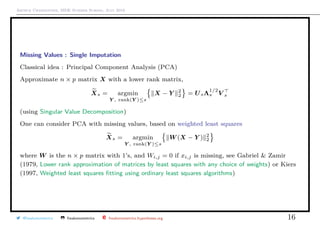
Missing Values : Single Imputation
Classical idea : Principal Component Analysis (PCA)
Approximate n × p matrix X with a lower rank matrix,
Xs = argmin
Y , rank(Y )≤s
X − Y 2
2 = UsΛ
1/2
s V s
(using Singular Value Decomposition)
One can consider PCA with missing values, based on weighted least squares
Xs = argmin
Y , rank(Y )≤s
W (X − Y ) 2
2
where W is the n × p matrix with 1’s, and Wi,j = 0 if xi,j is missing, see Gabriel & Zamir
(1979, Lower rank approximation of matrices by least squares with any choice of weights) or Kiers
(1997, Weighted least squares fitting using ordinary least squares algorithms)
@freakonometrics freakonometrics freakonometrics.hypotheses.org 16
Arthur Charpentier, SIDE Summer School, July 2019
Missing Values : Single Imputation
Iterative PCA
(i) if xi,j is missing, Wi,j = 0,
x1
i,j = Wi,j · x0
i,j + (1 − Wi,j) · 0
(ii) for k = 1, 2, · · ·
• Xs = argmin
Y , rank(Y )≤s
W (X − Y ) 2
2
• xk+1
i,j = Wi,j · xk
i,j + (1 − Wi,j) · xi,j
q
q
q
q
q
q
q
q
−0.5 0.0 0.5 1.0 1.5
−0.50.00.51.01.5
Connections with fixed effects model, xi,j =
s
k=1
fi,kuj,k + εi,j with εi,j ∼ N(0, σ2)
and random effects model, xi = Γzi + εi with εi ∼ N(0, σ2I) and zi ∼ N(0, I)
@freakonometrics freakonometrics freakonometrics.hypotheses.org 17
Arthur Charpentier, SIDE Summer School, July 2019
Missing Values : Single Imputation
Iterative PCA
(i) if xi,j is missing, Wi,j = 0,
x1
i,j = Wi,j · x0
i,j + (1 − Wi,j) · 0
(ii) for k = 1, 2, · · ·
• Xs = argmin
Y , rank(Y )≤s
W (X − Y ) 2
2
• xk+1
i,j = Wi,j · xk
i,j + (1 − Wi,j) · xi,j
q
q
q
q
q
q
q
q
−0.5 0.0 0.5 1.0 1.5
−0.50.00.51.01.5
q
q
Connections with fixed effects model, xi,j =
s
k=1
fi,kuj,k + εi,j with εi,j ∼ N(0, σ2)
and random effects model, xi = Γzi + εi with εi ∼ N(0, σ2I) and zi ∼ N(0, I)
@freakonometrics freakonometrics freakonometrics.hypotheses.org 18
Arthur Charpentier, SIDE Summer School, July 2019
Missing Values : Single Imputation
Iterative PCA
(i) if xi,j is missing, Wi,j = 0,
x1
i,j = Wi,j · x0
i,j + (1 − Wi,j) · 0
(ii) for k = 1, 2, · · ·
• Xs = argmin
Y , rank(Y )≤s
W (X − Y ) 2
2
• xk+1
i,j = Wi,j · xk
i,j + (1 − Wi,j) · xi,j
q
q
q
q
q
q
q
q
−0.5 0.0 0.5 1.0 1.5
−0.50.00.51.01.5
q
q
Connections with fixed effects model, xi,j =
s
k=1
fi,kuj,k + εi,j with εi,j ∼ N(0, σ2)
and random effects model, xi = Γzi + εi with εi ∼ N(0, σ2I) and zi ∼ N(0, I)
@freakonometrics freakonometrics freakonometrics.hypotheses.org 19
Arthur Charpentier, SIDE Summer School, July 2019
Missing Values : Single Imputation
Iterative PCA
(i) if xi,j is missing, Wi,j = 0,
x1
i,j = Wi,j · x0
i,j + (1 − Wi,j) · 0
(ii) for k = 1, 2, · · ·
• Xs = argmin
Y , rank(Y )≤s
W (X − Y ) 2
2
• xk+1
i,j = Wi,j · xk
i,j + (1 − Wi,j) · xi,j q
q
q
q
q
q
q
q
q
q
−0.5 0.0 0.5 1.0 1.5
−0.50.00.51.01.5
q
q
q
q
Connections with fixed effects model, xi,j =
s
k=1
fi,kuj,k + εi,j with εi,j ∼ N(0, σ2)
and random effects model, xi = Γzi + εi with εi ∼ N(0, σ2I) and zi ∼ N(0, I)
@freakonometrics freakonometrics freakonometrics.hypotheses.org 20
Arthur Charpentier, SIDE Summer School, July 2019
Missing Values : Single Imputation
Iterative PCA
(i) if xi,j is missing, Wi,j = 0,
x1
i,j = Wi,j · x0
i,j + (1 − Wi,j) · 0
(ii) for k = 1, 2, · · ·
• Xs = argmin
Y , rank(Y )≤s
W (X − Y ) 2
2
• xk+1
i,j = Wi,j · xk
i,j + (1 − Wi,j) · xi,j q
q
q
q
q
q
q
q
q
q
−0.5 0.0 0.5 1.0 1.5
−0.50.00.51.01.5
q
q
Connections with fixed effects model, xi,j =
s
k=1
fi,kuj,k + εi,j with εi,j ∼ N(0, σ2)
and random effects model, xi = Γzi + εi with εi ∼ N(0, σ2I) and zi ∼ N(0, I)
@freakonometrics freakonometrics freakonometrics.hypotheses.org 21
Arthur Charpentier, SIDE Summer School, July 2019
Missing Values : Single Imputation
The iterative PCA is simply using EM on fixed effects model,
xi,j =
s
i=1
fi,jui,j + εi,j with εi,j ∼ N(0, σ2
)
X
n×p
= F
n×s
U
p×s
Log-likelihood is here
log L(F , u, σ2
) = −
np
2
log 2πσ2
−
1
2σ2
X − F u 2
E step : compute E Xi,j X, F k, Uk, σ2
k (imputation)
M step : maximize the log-likelihood
Uk+1 = Xk F k F k F k
−1
and F k+1 = XkUk Uk Uk
−1
@freakonometrics freakonometrics freakonometrics.hypotheses.org 22
Arthur Charpentier, SIDE Summer School, July 2019
Missing Values : Single Imputation
One can use regularized iterative PCA. So far, we used (SVD) XsUsΛ
1/2
s V s
Xi,j =
s
k=1
λkUi,kVj,k
Following Efron & Morris (1972, Limiting the Risk of Bayes and Empirical Bayes Estimators)
consider a shrinkage version
Xi,j =
s
k=1
λk − σ2
λk
λkUi,kVj,k =
s
k=1
λk −
σ2
λk
Ui,kVj,k
where σ2
=
n[λs + 1 + · · · + λp]
np − p − ns − ps + s2 + s
See package missMDA
@freakonometrics freakonometrics freakonometrics.hypotheses.org 23
Arthur Charpentier, SIDE Summer School, July 2019
Missing Values : Single Imputation
One can use soft-thresholding PCA. Following Hastie & Mazumber (2015, Matrix Completion
and Low-Rank SVD)
Xi,j =
s
k=1
λk − λ
+
Ui,kVj,k
solution of
Xs = argmin
Y , rank(Y )≤s
W (X − Y ) 2
2 + λ Y
where the penalty is based on the nuclear norm (sum of the singular values).
Complicated to select λ...
See package softImpute
@freakonometrics freakonometrics freakonometrics.hypotheses.org 24
Arthur Charpentier, SIDE Summer School, July 2019
Missing Values : Single Imputation
One can also use k-nearest neigbors
with missMDA::imputePCA(y,ncp=1) and VIM::kNN(y,k=5)
@freakonometrics freakonometrics freakonometrics.hypotheses.org 25
Arthur Charpentier, SIDE Summer School, July 2019
Missing Values : Multiple Imputation
It aims to allow for the uncertainty about the missing data by creating several different
plausible imputed data sets (via Sterne et al. (2009, Multiple imputation for missing data)
Reference, Rubin (2007, Multiple imputation for nonresponse in surveys)
The idea is to generate N possible values for each missing value, see Honaker, King & Blackwell
(2010, Amelia) and library Amelia using boostrap samples or van Buuren (2018, Multivariate
Imputation by Chained Equations) with mice using bootstrap and regression
The idea of imputation is both seductive and dangerous. It is seductive because it can lull the
user into the pleasurable state of believing that the data are complete after all, and it is
dangerous because it lumps together situations where the problem is sufficiently minor that it
can be legitimately handled in this way and situations where standard estimators applied to the
real and imputed data have substantial biases Dempster & Rubin (1983, Incomplete Data in
Sample Surveys)
@freakonometrics freakonometrics freakonometrics.hypotheses.org 26
Arthur Charpentier, SIDE Summer School, July 2019
Missing Values : Gaussian process regression (and krigging)
Extrapolation or interpolation ?
x y
1 y1
2 y2
3 ?
x y
1 y1
2 ?
3 y3



y1
y2
y3


 ∼ N


0,



σ1,1 σ1,2 σ1,3
σ2,1 σ2,2 σ2,3
σ3,1 σ3,2 σ3,3






y
y
∼ N 0,
Σ Σ
Σ Σ
(y |y) ∼ N(µy, Σy) where
µy = Σ Σ−1y
Σy = Σ − Σ Σ−1Σ
see Roberts et al. (2012, Gaussian Processes for Time Series) or Rasmussen & Williams (2006,
Gaussian Processes for Machine Learning)
@freakonometrics freakonometrics freakonometrics.hypotheses.org 27

Side 2019 #9

  • 1.
    Arthur Charpentier, SIDESummer School, July 2019 # 9 Updates & Missing Values Arthur Charpentier (Universit´e du Qu´ebec `a Montr´eal) Machine Learning & Econometrics SIDE Summer School - July 2019 @freakonometrics freakonometrics freakonometrics.hypotheses.org 1
  • 2.
    Arthur Charpentier, SIDESummer School, July 2019 Machine Learning, Practical Issues Two important practical issue : • what if we cannot access the entire dataset ? • what if there is an update ? (new observation or new variable) Consider the case where datasets are located on various servers, and cannot be downloaded (e.g. hospitals), but one can run functions and obtain outputs. see Wolfson et al. (2010, Data Shield) or http://www.datashield.ac.uk/ Consider a regression model y = Xβ + ε @freakonometrics freakonometrics freakonometrics.hypotheses.org 2
  • 3.
    Arthur Charpentier, SIDESummer School, July 2019 Machine Learning, Practical Issues Use the QR decomposition of X, X = QR where Q is an orthogonal matrix QT Q = I. Then β = [XT X]−1 XT y = R−1 QT y Consider m blocks - map part y =         y1 y2 ... ym         and X =         X1 X2 ... Xm         =         Q (1) 1 R (1) 1 Q (1) 2 R (1) 2 ... Q(1) m R(1) m         @freakonometrics freakonometrics freakonometrics.hypotheses.org 3
  • 4.
    Arthur Charpentier, SIDESummer School, July 2019 Machine Learning, Practical Issues Consider the QR decomposition of R(1) - step 1 of reduce part R(1) =         R1 R2 ... Rm         = Q(2) R(2) where Q(2) =         Q (2) 1 Q (2) 2 ... Q(2) m         define - step 2 of reduce part Q (3) j = Q (2) j Q (1) j and V j = Q (3) j T yj and finally set - step 3 of reduce part β = [R(2) ]−1 m j=1 V j @freakonometrics freakonometrics freakonometrics.hypotheses.org 4
  • 5.
    Arthur Charpentier, SIDESummer School, July 2019 Online Learning Let Tn = {(y1, x1), · · · , (yn, xn)} denote the training dataset, with y ∈ Y. Learning A learning algorithm is a map A : Tn → Y Online Learning A pure online learning algorithm is a sequence of recursive algorithms (i) m0 is the initialization (ii) for k = 1, 2 · · · , mk = A(mk−1, (yn, xn)) Recall that the risk is R(m) = E (Y, mX) As in gradient boosting, consider some approximation of the gradient of R(m), mk = mk−1 + γkG(mk−1, (yn, xn)) @freakonometrics freakonometrics freakonometrics.hypotheses.org 5
  • 6.
    Arthur Charpentier, SIDESummer School, July 2019 • Update with a new observation, as Ridell (1975, Recursive Estimation Algorithms for Economic Research) Let X1:n denote the matrix of covariates, with n observations (rows), and xn+1 denote a new one. Recall that βn = [X1:n T X1:n]−1 X1:n T y1:n = C−1 n X1:n T y1:n Since Cn+1 = X1:n+1X1:n+1 = Cn + xn+1xn+1, then βn+1 = βn + C−1 n+1xn+1[yn+1 − xn+1βn] This updating formation is also called a differential correction, since it is proportional to the prediction error. Note that the residual sum of squares can also be updated, with Sn+1 = Sn + 1 d [yn+1 − xn+1 T βn]2 @freakonometrics freakonometrics freakonometrics.hypotheses.org 6
  • 7.
    Arthur Charpentier, SIDESummer School, July 2019 Online Learning Online Learning for OLS βn+1 = βn + C−1 n+1xn+1[yn+1 − xn+1βn] is a recursive formula, requires storing all the data (and inverting a matrix at each step). Good news, [A + BCD]−1 = A−1 − A−1 B DA−1 B + C−1 −1 DA−1 , so C−1 n+1 = C−1 n − C−1 n xn+1xn+1C−1 n 1 + xn+1C−1 n xn+1 We have an algorithm of the form for k = 1, 2 · · · , mk = A(mk−1, (yn, Cn, xn)) for some matrix Cn @freakonometrics freakonometrics freakonometrics.hypotheses.org 7
  • 8.
    Arthur Charpentier, SIDESummer School, July 2019 Online Learning Online Learning for OLS βn+1 = βn + C−1 n+1xn+1[yn+1 − xn+1βn] is also a gradient-type algorithm, since yn+1 − xn+1β 2 = 2xn+1[yn+1 − xn+1β] One might consider using γn+1 ∈ R instead of Cn+1 (p × p matrix) Polyak-Ruppert Averaging suggests to use γn = n−α where α ∈ (1/2, 1) to ensure convergence @freakonometrics freakonometrics freakonometrics.hypotheses.org 8
  • 9.
    Arthur Charpentier, SIDESummer School, July 2019 Update Formulas • Update with a new variable Let X1:k denote the matrix of covariates, with k explanatory variables (columns), and xk+1 denote a new one. Recall that βk = [X1:k T X1:k]−1 X1:k T y Then βk+1 = (βk , βk+1)T where βk = βk − [X1:k T X1:k]−1 X1:k T xk+1xk+1P⊥ k y xk+1 TP⊥ k xk+1 with P⊥ k = I − X1:k(X1:k T X1:k)−1 X1:k T , while βk+1 = xk+1 T P⊥ k y xk+1 TP⊥ k xk+1 If xk+1 is orthogonal to previous variables - X1:k T xk+1 = 0, then βk = βk. Observe that P⊥ k y = εk. @freakonometrics freakonometrics freakonometrics.hypotheses.org 9
  • 10.
    Arthur Charpentier, SIDESummer School, July 2019 Missing Values “There are two kinds of model in the world : those who can extrapolate from incomplete data...” From Tropical Atmosphere Ocean (TAO) dataset, see VIM::tao @freakonometrics freakonometrics freakonometrics.hypotheses.org 10
  • 11.
    Arthur Charpentier, SIDESummer School, July 2019 Missing Values With lm function, rows with missing values (in y or x) are deleted To deal with them, one should understand the mechanism leading to missing values Expectation - Maximization, see Dempster et al. (1977, Maximum Likelihood from Incomplete Data via the EM Algorithm) Consider a mixture model dF(y) = p1dFθ1 (y) + p2dFθ2 (y), i.e. there is Θ ∈ {1, 2} (with pj = P[Θ = j]) such that yi = y1,i with Y1 ∼ Fθ1 , if Θ = 1 y2,i with Y2 ∼ Fθ2 , if Θ = 2 see mixtools::normalmixEM for Gaussian mixtures @freakonometrics freakonometrics freakonometrics.hypotheses.org 11
  • 12.
    Arthur Charpentier, SIDESummer School, July 2019 Observable and Non-Obsevable Heterogeneity Mixture distribution (with two classes) : • if θ = A, Y ∼ N(µA, σ2 A) • if θ = B, Y ∼ N(µB, σ2 B) f(y) = pAfA(y) + pBfB(y) 5 parameters to estimate, no interpretation of the mixture parameter θ Height (in cm) Density 150 160 170 180 190 200 0.000.010.020.030.040.05 @freakonometrics freakonometrics freakonometrics.hypotheses.org 12
  • 13.
    Arthur Charpentier, SIDESummer School, July 2019 Observable and Non-Observable Heterogeneity One categorical variable (e.g. gender) • if gender=M, Y ∼ N(µM , σ2 M ) • if gender=F, Y ∼ N(µF , σ2 F ) f(y) = pM fM (y) + pF fF (y) 4 parameters to estimate, (pM and pF are known) clear interpretation of the mixture parameter Height (in cm) Density 150 160 170 180 190 200 0.000.010.020.030.040.05 @freakonometrics freakonometrics freakonometrics.hypotheses.org 13
  • 14.
    Arthur Charpentier, SIDESummer School, July 2019 Expectation - Maximization EM for Mixtures (i) start with initial values θ1,0 and θ2,0, pj,0 (ii) for k = 1, 2, · · · E step : γk,j,i = dF θj,k−1 (yi) p1,k−1dF θ1,k−1 (yi) + p2,k−1dF θ2,k−1 (yi) M step : use ML techniques with weights γk,j,i M step with a Gaussian mixture, µj,k = γk,j,iyi γk,j,i and σ2 j,k = γk,j,i[yi − µj,k]2 γk,j,i @freakonometrics freakonometrics freakonometrics.hypotheses.org 14
  • 15.
    Arthur Charpentier, SIDESummer School, July 2019 Expectation - Maximization Expectation - Maximization E step expectation : compute Q(θ, θk ) = E log f(Y |θ)|yobs, θk M step maximization : θk+1 = argmax θ Q(θ, θk ) Stochastic EM (for Mixtures) (i) start with initial values θ1,0 and θ2,0, pj,0 (ii) for k = 1, 2, · · · E step : γk,j,i = dF θj,k−1 (yi) p1,k−1dF θ1,k−1 (yi) + p2,k−1dF θ2,k−1 (yi) S step : generate ξk,i in {1, 2} with probabilities γk,1,i and γk,2,i M step : compute ML estimate θk,j on sample {yi : ξk,i = j} @freakonometrics freakonometrics freakonometrics.hypotheses.org 15
  • 16.
    Arthur Charpentier, SIDESummer School, July 2019 Missing Values : Single Imputation Classical idea : Principal Component Analysis (PCA) Approximate n × p matrix X with a lower rank matrix, Xs = argmin Y , rank(Y )≤s X − Y 2 2 = UsΛ 1/2 s V s (using Singular Value Decomposition) One can consider PCA with missing values, based on weighted least squares Xs = argmin Y , rank(Y )≤s W (X − Y ) 2 2 where W is the n × p matrix with 1’s, and Wi,j = 0 if xi,j is missing, see Gabriel & Zamir (1979, Lower rank approximation of matrices by least squares with any choice of weights) or Kiers (1997, Weighted least squares fitting using ordinary least squares algorithms) @freakonometrics freakonometrics freakonometrics.hypotheses.org 16
  • 17.
    Arthur Charpentier, SIDESummer School, July 2019 Missing Values : Single Imputation Iterative PCA (i) if xi,j is missing, Wi,j = 0, x1 i,j = Wi,j · x0 i,j + (1 − Wi,j) · 0 (ii) for k = 1, 2, · · · • Xs = argmin Y , rank(Y )≤s W (X − Y ) 2 2 • xk+1 i,j = Wi,j · xk i,j + (1 − Wi,j) · xi,j q q q q q q q q −0.5 0.0 0.5 1.0 1.5 −0.50.00.51.01.5 Connections with fixed effects model, xi,j = s k=1 fi,kuj,k + εi,j with εi,j ∼ N(0, σ2) and random effects model, xi = Γzi + εi with εi ∼ N(0, σ2I) and zi ∼ N(0, I) @freakonometrics freakonometrics freakonometrics.hypotheses.org 17
  • 18.
    Arthur Charpentier, SIDESummer School, July 2019 Missing Values : Single Imputation Iterative PCA (i) if xi,j is missing, Wi,j = 0, x1 i,j = Wi,j · x0 i,j + (1 − Wi,j) · 0 (ii) for k = 1, 2, · · · • Xs = argmin Y , rank(Y )≤s W (X − Y ) 2 2 • xk+1 i,j = Wi,j · xk i,j + (1 − Wi,j) · xi,j q q q q q q q q −0.5 0.0 0.5 1.0 1.5 −0.50.00.51.01.5 q q Connections with fixed effects model, xi,j = s k=1 fi,kuj,k + εi,j with εi,j ∼ N(0, σ2) and random effects model, xi = Γzi + εi with εi ∼ N(0, σ2I) and zi ∼ N(0, I) @freakonometrics freakonometrics freakonometrics.hypotheses.org 18
  • 19.
    Arthur Charpentier, SIDESummer School, July 2019 Missing Values : Single Imputation Iterative PCA (i) if xi,j is missing, Wi,j = 0, x1 i,j = Wi,j · x0 i,j + (1 − Wi,j) · 0 (ii) for k = 1, 2, · · · • Xs = argmin Y , rank(Y )≤s W (X − Y ) 2 2 • xk+1 i,j = Wi,j · xk i,j + (1 − Wi,j) · xi,j q q q q q q q q −0.5 0.0 0.5 1.0 1.5 −0.50.00.51.01.5 q q Connections with fixed effects model, xi,j = s k=1 fi,kuj,k + εi,j with εi,j ∼ N(0, σ2) and random effects model, xi = Γzi + εi with εi ∼ N(0, σ2I) and zi ∼ N(0, I) @freakonometrics freakonometrics freakonometrics.hypotheses.org 19
  • 20.
    Arthur Charpentier, SIDESummer School, July 2019 Missing Values : Single Imputation Iterative PCA (i) if xi,j is missing, Wi,j = 0, x1 i,j = Wi,j · x0 i,j + (1 − Wi,j) · 0 (ii) for k = 1, 2, · · · • Xs = argmin Y , rank(Y )≤s W (X − Y ) 2 2 • xk+1 i,j = Wi,j · xk i,j + (1 − Wi,j) · xi,j q q q q q q q q q q −0.5 0.0 0.5 1.0 1.5 −0.50.00.51.01.5 q q q q Connections with fixed effects model, xi,j = s k=1 fi,kuj,k + εi,j with εi,j ∼ N(0, σ2) and random effects model, xi = Γzi + εi with εi ∼ N(0, σ2I) and zi ∼ N(0, I) @freakonometrics freakonometrics freakonometrics.hypotheses.org 20
  • 21.
    Arthur Charpentier, SIDESummer School, July 2019 Missing Values : Single Imputation Iterative PCA (i) if xi,j is missing, Wi,j = 0, x1 i,j = Wi,j · x0 i,j + (1 − Wi,j) · 0 (ii) for k = 1, 2, · · · • Xs = argmin Y , rank(Y )≤s W (X − Y ) 2 2 • xk+1 i,j = Wi,j · xk i,j + (1 − Wi,j) · xi,j q q q q q q q q q q −0.5 0.0 0.5 1.0 1.5 −0.50.00.51.01.5 q q Connections with fixed effects model, xi,j = s k=1 fi,kuj,k + εi,j with εi,j ∼ N(0, σ2) and random effects model, xi = Γzi + εi with εi ∼ N(0, σ2I) and zi ∼ N(0, I) @freakonometrics freakonometrics freakonometrics.hypotheses.org 21
  • 22.
    Arthur Charpentier, SIDESummer School, July 2019 Missing Values : Single Imputation The iterative PCA is simply using EM on fixed effects model, xi,j = s i=1 fi,jui,j + εi,j with εi,j ∼ N(0, σ2 ) X n×p = F n×s U p×s Log-likelihood is here log L(F , u, σ2 ) = − np 2 log 2πσ2 − 1 2σ2 X − F u 2 E step : compute E Xi,j X, F k, Uk, σ2 k (imputation) M step : maximize the log-likelihood Uk+1 = Xk F k F k F k −1 and F k+1 = XkUk Uk Uk −1 @freakonometrics freakonometrics freakonometrics.hypotheses.org 22
  • 23.
    Arthur Charpentier, SIDESummer School, July 2019 Missing Values : Single Imputation One can use regularized iterative PCA. So far, we used (SVD) XsUsΛ 1/2 s V s Xi,j = s k=1 λkUi,kVj,k Following Efron & Morris (1972, Limiting the Risk of Bayes and Empirical Bayes Estimators) consider a shrinkage version Xi,j = s k=1 λk − σ2 λk λkUi,kVj,k = s k=1 λk − σ2 λk Ui,kVj,k where σ2 = n[λs + 1 + · · · + λp] np − p − ns − ps + s2 + s See package missMDA @freakonometrics freakonometrics freakonometrics.hypotheses.org 23
  • 24.
    Arthur Charpentier, SIDESummer School, July 2019 Missing Values : Single Imputation One can use soft-thresholding PCA. Following Hastie & Mazumber (2015, Matrix Completion and Low-Rank SVD) Xi,j = s k=1 λk − λ + Ui,kVj,k solution of Xs = argmin Y , rank(Y )≤s W (X − Y ) 2 2 + λ Y where the penalty is based on the nuclear norm (sum of the singular values). Complicated to select λ... See package softImpute @freakonometrics freakonometrics freakonometrics.hypotheses.org 24
  • 25.
    Arthur Charpentier, SIDESummer School, July 2019 Missing Values : Single Imputation One can also use k-nearest neigbors with missMDA::imputePCA(y,ncp=1) and VIM::kNN(y,k=5) @freakonometrics freakonometrics freakonometrics.hypotheses.org 25
  • 26.
    Arthur Charpentier, SIDESummer School, July 2019 Missing Values : Multiple Imputation It aims to allow for the uncertainty about the missing data by creating several different plausible imputed data sets (via Sterne et al. (2009, Multiple imputation for missing data) Reference, Rubin (2007, Multiple imputation for nonresponse in surveys) The idea is to generate N possible values for each missing value, see Honaker, King & Blackwell (2010, Amelia) and library Amelia using boostrap samples or van Buuren (2018, Multivariate Imputation by Chained Equations) with mice using bootstrap and regression The idea of imputation is both seductive and dangerous. It is seductive because it can lull the user into the pleasurable state of believing that the data are complete after all, and it is dangerous because it lumps together situations where the problem is sufficiently minor that it can be legitimately handled in this way and situations where standard estimators applied to the real and imputed data have substantial biases Dempster & Rubin (1983, Incomplete Data in Sample Surveys) @freakonometrics freakonometrics freakonometrics.hypotheses.org 26
  • 27.
    Arthur Charpentier, SIDESummer School, July 2019 Missing Values : Gaussian process regression (and krigging) Extrapolation or interpolation ? x y 1 y1 2 y2 3 ? x y 1 y1 2 ? 3 y3    y1 y2 y3    ∼ N   0,    σ1,1 σ1,2 σ1,3 σ2,1 σ2,2 σ2,3 σ3,1 σ3,2 σ3,3       y y ∼ N 0, Σ Σ Σ Σ (y |y) ∼ N(µy, Σy) where µy = Σ Σ−1y Σy = Σ − Σ Σ−1Σ see Roberts et al. (2012, Gaussian Processes for Time Series) or Rasmussen & Williams (2006, Gaussian Processes for Machine Learning) @freakonometrics freakonometrics freakonometrics.hypotheses.org 27