Arthur CHARPENTIER - Rennes Risk Workshop - April, 2015
Local utility and multivariate risk aversion
Arthur Charpentier, Alfred Galichon & Marc Henry
Rennes Risk Workshop, April 2015
to appear in Mathematics of Operations Research
http ://papers.ssrn.com/id=1982293
1
Arthur CHARPENTIER - Rennes Risk Workshop - April, 2015
Choice between multivariate risky prospects
– In view of violations of expected utility, a vast literature has emerged on other
functional evaluations of risky prospects, particularly Rank Dependent
Preferences (RDU).
– Simultaneously, a literature developed on the characterization of attitudes to
multiple non substitutable risks and multivariate risk premia within the
framework of expected utility.
– Here we characterize attitude to multivariate generalizations of standard
notions of increasing risk with local utility
– Rothschild-Stiglitz mean preserving increase in risk
– Quiggin monotone mean preserving increase in risk
2
Arthur CHARPENTIER - Rennes Risk Workshop - April, 2015
Expected utility
– Decision maker ranks random vectors X with law invariant functional
Φ(X) = Φ(FX), with FX the cdf of X.
– Utility x → U(x) :
Φ(F) = U(x)dF(x)
Quiggin-Yaari functional
– Distortion x → φ(x) :
Φ(F) = φ(t)F−1
(t)dt =
x
−∞
φ(F(s))ds
U(x,F )
dF(x)
3
Arthur CHARPENTIER - Rennes Risk Workshop - April, 2015
Aumann & Serrano Riskiness
– Given X, the index of risk R(X) is defined to be the unique positive solution
(if exists) of E[exp(−X/R(X))] = 1
– Index of Riskiness x → R :
R such that exp −
x
R
U(x)
dF(x) = 1
where U is CARA.
4
Arthur CHARPENTIER - Rennes Risk Workshop - April, 2015
Local utility
– Decision maker ranks random vectors X with law invariant functional
Φ(X) = Φ(FX), with FX the cdf of X.
– Local utility x → U(x; F) is the Fréchet derivative of Φ at F :
Φ(F ) − Φ(F) − U(x; F)[dF (x) − dF(x)] → 0
– If Φ is expected utility, local and global utilities coincide
– If Φ is the Quiggin-Yaari functional Φ(X) = φ(t)F−1
X (t)dt, then local
utility is U(x; F) =
x
−∞
φ(F(z))dz
– If Φ is the Aumann-Serrano index of riskiness, the local utility
cst[1 − exp(−αx)] is CARA
5
Arthur CHARPENTIER - Rennes Risk Workshop - April, 2015
Rothschild-Stiglitz mean preserving increase in risk
One of the most commonly used stochastic orderings to compare risky prospects
is the mean preserving increase in risk (MPIR or concave ordering). Let X and Y
be two prospects.
Definition :
Y MP IR X if E[u(X)] ≥ E[u(Y )] for all concave utility u.
Characterization :
∗ Y
L
= X + Z with E[Z|X] = 0 (where “
L
=” denotes equality in distribution).
6
Arthur CHARPENTIER - Rennes Risk Workshop - April, 2015
Local utility and MPIR
– Aversion to MPIR is equivalent to concavity of local utility (Machina 1982 for
the univariate result)
– Still holds for multivariate risks :
– Φ is MPIR averse (Schur concave) if Φ(Y ) ≤ Φ(X) when Y is an MPIR of
X.
– Equivalent to concavity of U(x; F) in x for all distributions F
Proof : Φ Schur concave iff Φ decreasing along all martingales Xt
Φ(Xt+dt) − Φ(Xt) = E [U(Xt+dt; FXt ) − U(Xt; FXt )]
= E Tr D2
U(Xt; FXt )σT
t σt Itô
≤ 0 iff U(x; F) concave
7
Arthur CHARPENTIER - Rennes Risk Workshop - April, 2015
Two shortcomings of MPIR in the theory of risk sharing
– Arrow-Pratt more risk averse decision makers do not necessarily pay more
(than less risk averse ones) for a mean preserving decrease in risk.
– Ross (Econometrica 1981)
– Partial insurance contracts offering mean preserving reduction in risk can be
Pareto dominated.
– Landsberger and Meilijson (Annals of OR 1994)
8
Arthur CHARPENTIER - Rennes Risk Workshop - April, 2015
Bickel-Lehmann dispersion order
These shortcomings are not shared by the Bickel-Lehmann dispersion order
(Bickel and Lehmann 1979). Let X and Y have cdfs FX and FY and quantiles
QX = F−1
X and QY = F−1
Y .
Definition :
Y Disp X if QY (s) − QY (s ) ≥ QX(s) − QX(s ).
Characterization (Landsberger-Meilijson) :
Y
L
= X + Z with Z and X comonotonic,
Examples :
– Normal, exponential and uniform families are dispersion ordered by the variance.
– Arrow (1970) stretches of a distribution X → x + α(X − x), α > 1, are more
dispersed.
9
Arthur CHARPENTIER - Rennes Risk Workshop - April, 2015
Local utility and attitude to mean preserving dispersion
increase (Quiggin’s monotone MPIR)
– Φ is MMPIR averse if and only if
E
U (X; FX)
E[U (X; FX)]
1{X > x} ≤ E [1{X > x}]
– Example : Quiggin-Yaari functional
Φ(X) = φ(t)F−1
X (t)dt
with local utility is
U(x; F) =
x
−∞
φ(FX(z))dz
is MMPIR averse iff density φ(u) is stochastically dominated by the uniform
(called pessimism by Quiggin)
10
Arthur CHARPENTIER - Rennes Risk Workshop - April, 2015
Risk sharing and dispersion
– More risk averse decision makers will always pay at least as much (as less risk
averse agents) for a decrease in risk if and only if it is Bickel-Lehmann less
dispersed.
– Landsberger and Meilijson (Management Science 1994)
– Unless the uninsured position is Bickel-Lehmann more dispersed than the
insured position, the existing contract can be improved so as to raise the
expected utility of both parties, regardless of their (concave) utility functions.
– Landsberger and Meilijson (Annals of OR 1994)
11
Arthur CHARPENTIER - Rennes Risk Workshop - April, 2015
Partial insurance
Consider the following insurance contract :
Insuree Insurer
Before Y 0
After X1 X2
– By construction Y = X1 + X2.
– (X1, X2) is Pareto efficient if and only if comonotonic (Landsberger-Meilijson).
– Hence the contract is efficient iff Y = X1 + X2 Disp X1.
We generalize this result to the case of multivariate risks.
12
Arthur CHARPENTIER - Rennes Risk Workshop - April, 2015
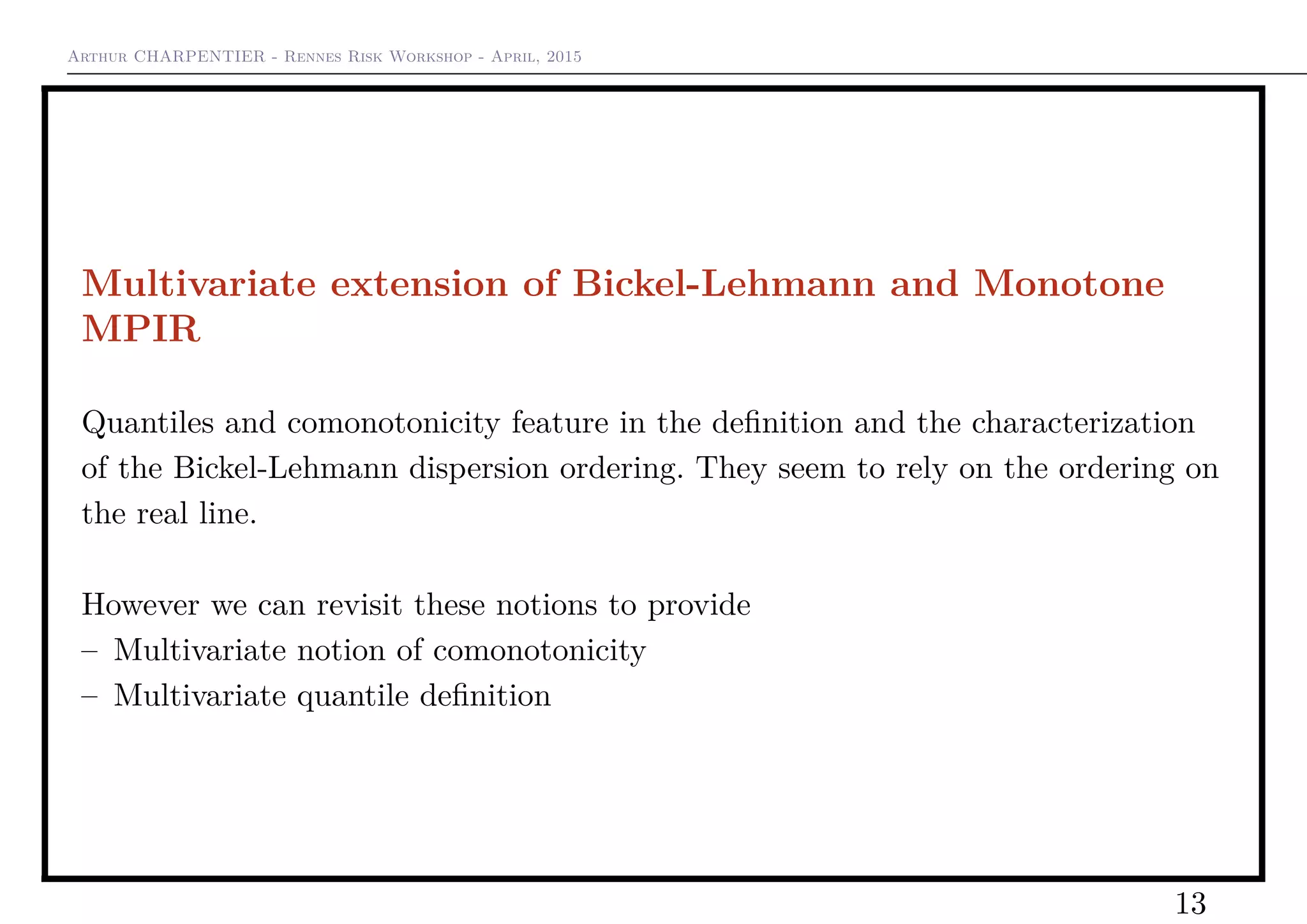
Multivariate extension of Bickel-Lehmann and Monotone
MPIR
Quantiles and comonotonicity feature in the definition and the characterization
of the Bickel-Lehmann dispersion ordering. They seem to rely on the ordering on
the real line.
However we can revisit these notions to provide
– Multivariate notion of comonotonicity
– Multivariate quantile definition
13
Arthur CHARPENTIER - Rennes Risk Workshop - April, 2015
Revisiting comonotonicity
– X and Y are comonotonic if there exists Z such that X = TX(Z) and
Y = TY (Z), TX, TY increasing functions.
– Example :
– If X(ωi) = xi and Y (ωi) = yi, i = 1 . . . , n, with x1 ≤ . . . ≤ xn and
y1 ≤ . . . ≤ yn, then X and Y are comonotonic.
– By the simple rearrangement inequality,
i=1,...,n
xiyi = max



i=1,...,n
xiyσ(i) : σ permutation



.
– General characterization : X and Y are comonotonic iff
E[XY ] = sup E[X ˜Y ] : ˜Y
L
= Y .
14
Arthur CHARPENTIER - Rennes Risk Workshop - April, 2015
Revisiting the quantile function
The quantile function of a prospect X is the generalized inverse of the cumulative
distribution function :
u → QX(u) = inf{x : P(X ≤ x) ≥ u}
Equivalent characterizations :
– The quantile function QX of a prospect X is an increasing rearrangement of X,
– The quantile QX(U) of X is the version of X which is comonotonic with the
uniform random variable U on [0, 1].
– QX is the only l.s.c. increasing function such that
E[QX(U)U] = sup{E[ ˜XU]; ˜X
L
= X}.
15
Arthur CHARPENTIER - Rennes Risk Workshop - April, 2015
Multivariate µ-quantiles and µ-comonotonicity, (Galichon and
Henry, JET 2012)
– The univariate quantile function of a random variable X is the only l.s.c.
increasing function such that
E[QX(U)U] = sup{E[ ˜XU]; ˜X
L
= X}.
– Similarly, the µ-quantile QX is the essentially unique gradient of a l.s.c.
convex function (Brenier, CPAM 1991),
E[ QX(U), U ] = sup{E[ ˜X, U ]; ˜X
L
= X}, for some U
L
= µ.
– X and Y are µ-comonotonic if for some U
L
= µ,
X = QX(U) and Y = QY (U),
namely if X and Y can be simultaneously rearranged relative to a reference
distribution µ.
16
Arthur CHARPENTIER - Rennes Risk Workshop - April, 2015
Example : Gaussian prospects
Suppose the baseline U is standard normal,
– X ∼ N(0, ΣX), hence X = Σ
1/2
X OXU, with OX orthogonal,
– Y ∼ N(0, ΣY ), hence Y = Σ
1/2
Y OY U, with OY orthogonal,
E[ ˜X, U ] is minimized for ˜X = Σ
1/2
X U, so when OX is the identity. Hence the
generalized quantile of X relative to U is
QX(U) = Σ
1/2
X U.
X and Y are N(0, I)-comonotonic if OX = OY (they have the same orientation).
The correlation is
E[XY T
] = Σ
1/2
X OXOT
Y Σ
1/2
Y = Σ
1/2
X Σ
1/2
Y .
17
Arthur CHARPENTIER - Rennes Risk Workshop - April, 2015
Computation of generalized quantiles
The optimal transportation map between µ on [0, 1]d
and the empirical
distribution relative to (X1, . . . , Xn) satisfies
– ˆQX(U) ∈ {X1, . . . , Xn}
– µ( ˆQ−1
X ({Xk})) = 1/n, for each k = 1, . . . , n
– ˆQX is the gradient of a convex function V : Rd
→ R.
The solution for the “potential” V is
V (u) = max
k
{ u, Xk − wk},
where w = (w1, . . . , wn) minimizes the convex function
w → V (u)dµ(u) +
n
k=1
wk/n.
18
Arthur CHARPENTIER - Rennes Risk Workshop - April, 2015
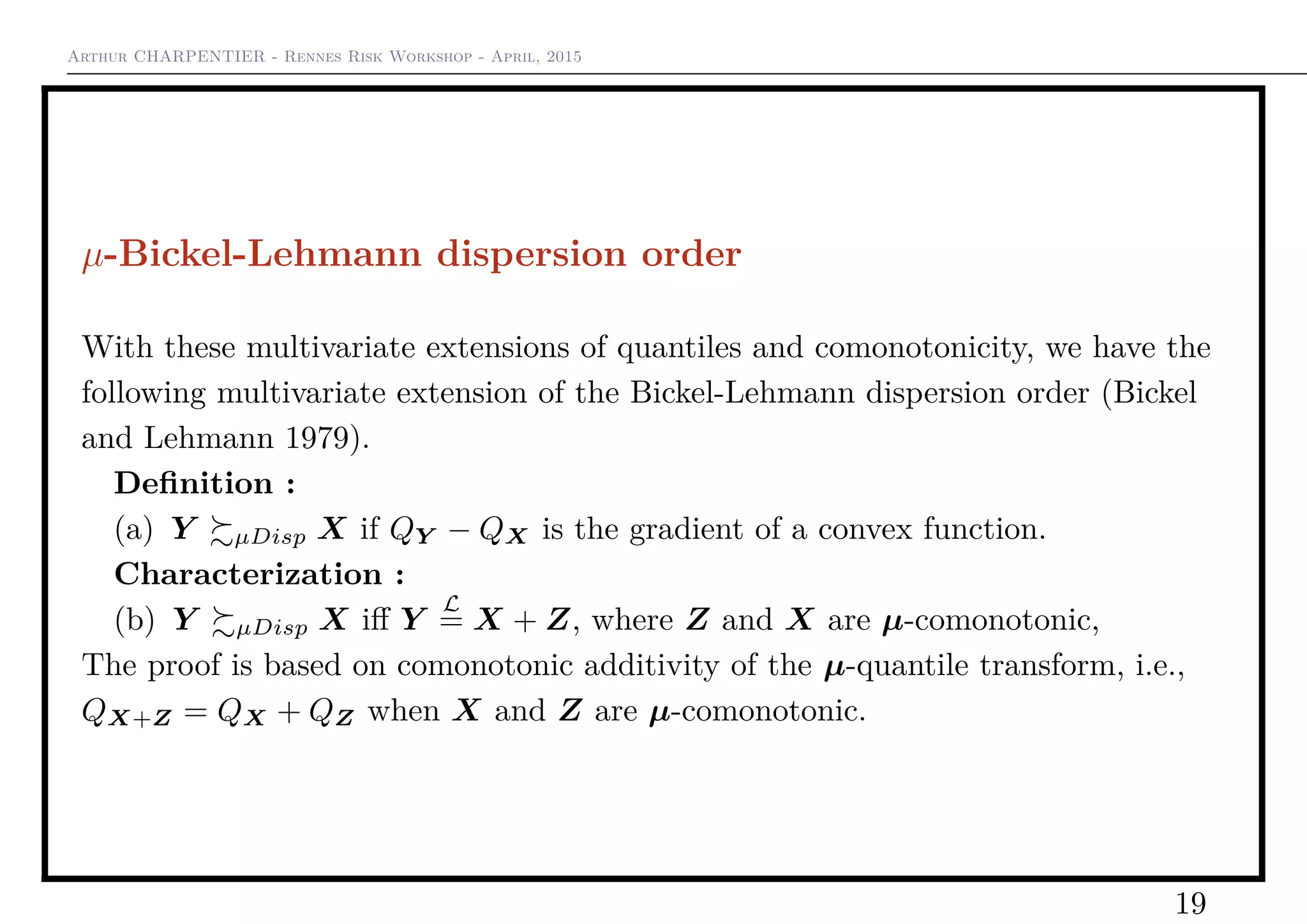
µ-Bickel-Lehmann dispersion order
With these multivariate extensions of quantiles and comonotonicity, we have the
following multivariate extension of the Bickel-Lehmann dispersion order (Bickel
and Lehmann 1979).
Definition :
(a) Y µDisp X if QY − QX is the gradient of a convex function.
Characterization :
(b) Y µDisp X iff Y
L
= X + Z, where Z and X are µ-comonotonic,
The proof is based on comonotonic additivity of the µ-quantile transform, i.e.,
QX+Z = QX + QZ when X and Z are µ-comonotonic.
19
Arthur CHARPENTIER - Rennes Risk Workshop - April, 2015
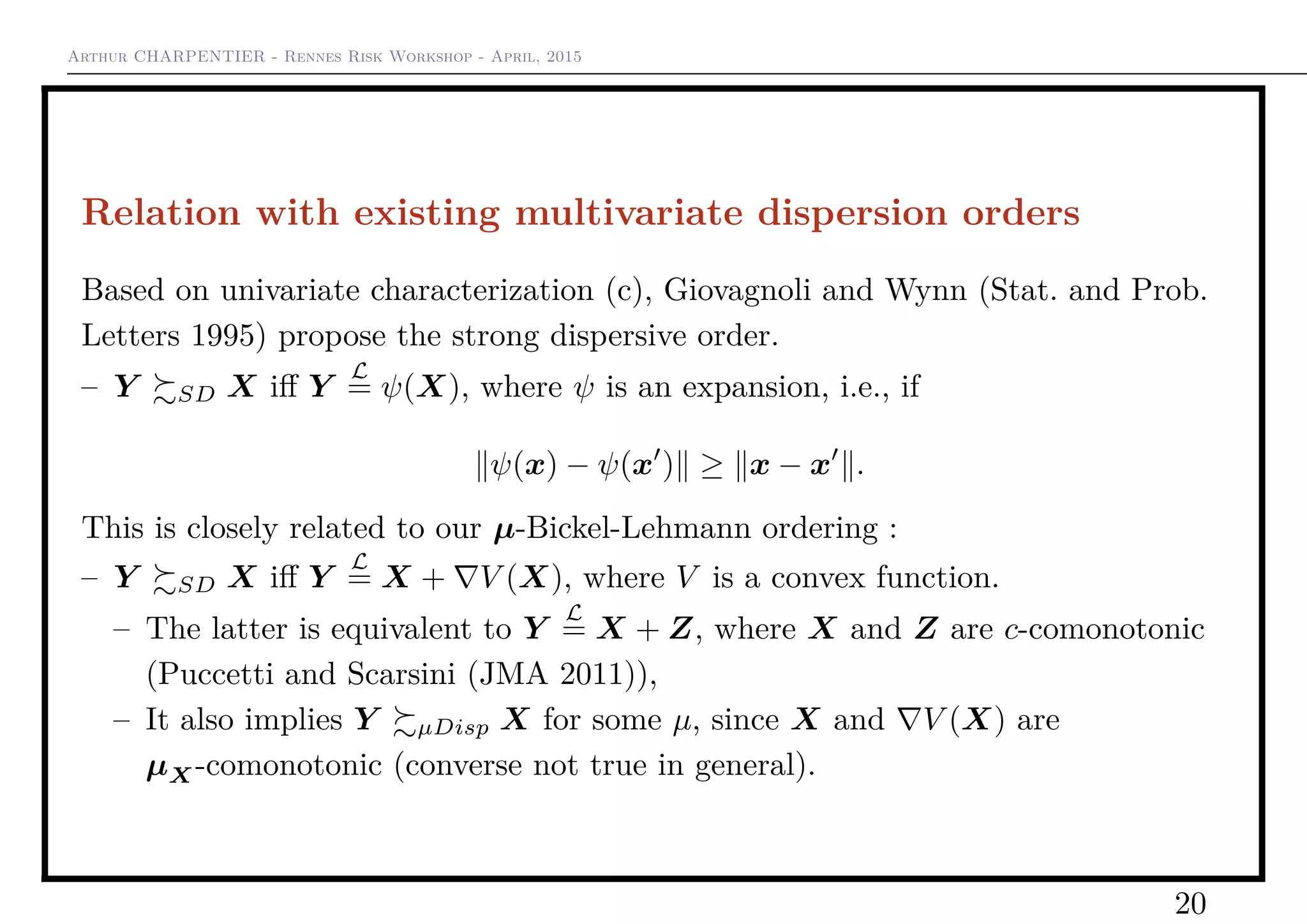
Relation with existing multivariate dispersion orders
Based on univariate characterization (c), Giovagnoli and Wynn (Stat. and Prob.
Letters 1995) propose the strong dispersive order.
– Y SD X iff Y
L
= ψ(X), where ψ is an expansion, i.e., if
ψ(x) − ψ(x ) ≥ x − x .
This is closely related to our µ-Bickel-Lehmann ordering :
– Y SD X iff Y
L
= X + V (X), where V is a convex function.
– The latter is equivalent to Y
L
= X + Z, where X and Z are c-comonotonic
(Puccetti and Scarsini (JMA 2011)),
– It also implies Y µDisp X for some µ, since X and V (X) are
µX-comonotonic (converse not true in general).
20
Arthur CHARPENTIER - Rennes Risk Workshop - April, 2015
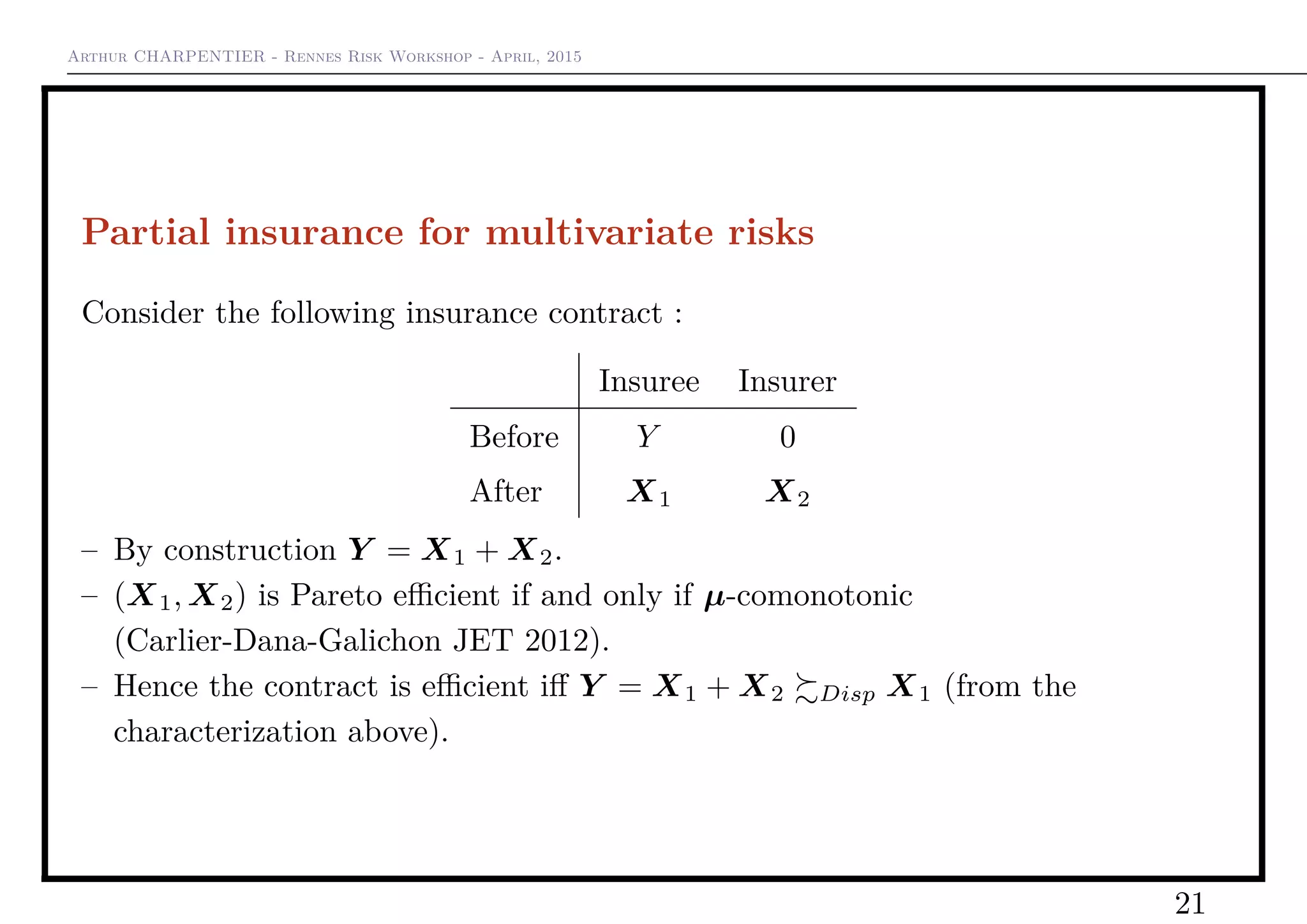
Partial insurance for multivariate risks
Consider the following insurance contract :
Insuree Insurer
Before Y 0
After X1 X2
– By construction Y = X1 + X2.
– (X1, X2) is Pareto efficient if and only if µ-comonotonic
(Carlier-Dana-Galichon JET 2012).
– Hence the contract is efficient iff Y = X1 + X2 Disp X1 (from the
characterization above).
21
Arthur CHARPENTIER - Rennes Risk Workshop - April, 2015
Multivariate Quiggin-Yaari functional and risk attitude
– Given a baseline U ∼ µ, decision maker evaluates risks with the functional
Φ(X) = E[QX(U) · φ(U)]
(Equivalent to monotonicity relative to stochastic dominance and comonotonic
additivity of Φ - Galichon and Henry JET 2012)
– Aversion to MPIR is equivalent to Φ(U) = −U
– Aversion to MMPIR is equivalent to Φ(X) ≤ Φ(E[X]) (obtains immediately
from the comonotonicity characterization of Bickel-Lehmann dispersion)
22

Slides risk-rennes

  • 1.
    Arthur CHARPENTIER -Rennes Risk Workshop - April, 2015 Local utility and multivariate risk aversion Arthur Charpentier, Alfred Galichon & Marc Henry Rennes Risk Workshop, April 2015 to appear in Mathematics of Operations Research http ://papers.ssrn.com/id=1982293 1
  • 2.
    Arthur CHARPENTIER -Rennes Risk Workshop - April, 2015 Choice between multivariate risky prospects – In view of violations of expected utility, a vast literature has emerged on other functional evaluations of risky prospects, particularly Rank Dependent Preferences (RDU). – Simultaneously, a literature developed on the characterization of attitudes to multiple non substitutable risks and multivariate risk premia within the framework of expected utility. – Here we characterize attitude to multivariate generalizations of standard notions of increasing risk with local utility – Rothschild-Stiglitz mean preserving increase in risk – Quiggin monotone mean preserving increase in risk 2
  • 3.
    Arthur CHARPENTIER -Rennes Risk Workshop - April, 2015 Expected utility – Decision maker ranks random vectors X with law invariant functional Φ(X) = Φ(FX), with FX the cdf of X. – Utility x → U(x) : Φ(F) = U(x)dF(x) Quiggin-Yaari functional – Distortion x → φ(x) : Φ(F) = φ(t)F−1 (t)dt = x −∞ φ(F(s))ds U(x,F ) dF(x) 3
  • 4.
    Arthur CHARPENTIER -Rennes Risk Workshop - April, 2015 Aumann & Serrano Riskiness – Given X, the index of risk R(X) is defined to be the unique positive solution (if exists) of E[exp(−X/R(X))] = 1 – Index of Riskiness x → R : R such that exp − x R U(x) dF(x) = 1 where U is CARA. 4
  • 5.
    Arthur CHARPENTIER -Rennes Risk Workshop - April, 2015 Local utility – Decision maker ranks random vectors X with law invariant functional Φ(X) = Φ(FX), with FX the cdf of X. – Local utility x → U(x; F) is the Fréchet derivative of Φ at F : Φ(F ) − Φ(F) − U(x; F)[dF (x) − dF(x)] → 0 – If Φ is expected utility, local and global utilities coincide – If Φ is the Quiggin-Yaari functional Φ(X) = φ(t)F−1 X (t)dt, then local utility is U(x; F) = x −∞ φ(F(z))dz – If Φ is the Aumann-Serrano index of riskiness, the local utility cst[1 − exp(−αx)] is CARA 5
  • 6.
    Arthur CHARPENTIER -Rennes Risk Workshop - April, 2015 Rothschild-Stiglitz mean preserving increase in risk One of the most commonly used stochastic orderings to compare risky prospects is the mean preserving increase in risk (MPIR or concave ordering). Let X and Y be two prospects. Definition : Y MP IR X if E[u(X)] ≥ E[u(Y )] for all concave utility u. Characterization : ∗ Y L = X + Z with E[Z|X] = 0 (where “ L =” denotes equality in distribution). 6
  • 7.
    Arthur CHARPENTIER -Rennes Risk Workshop - April, 2015 Local utility and MPIR – Aversion to MPIR is equivalent to concavity of local utility (Machina 1982 for the univariate result) – Still holds for multivariate risks : – Φ is MPIR averse (Schur concave) if Φ(Y ) ≤ Φ(X) when Y is an MPIR of X. – Equivalent to concavity of U(x; F) in x for all distributions F Proof : Φ Schur concave iff Φ decreasing along all martingales Xt Φ(Xt+dt) − Φ(Xt) = E [U(Xt+dt; FXt ) − U(Xt; FXt )] = E Tr D2 U(Xt; FXt )σT t σt Itô ≤ 0 iff U(x; F) concave 7
  • 8.
    Arthur CHARPENTIER -Rennes Risk Workshop - April, 2015 Two shortcomings of MPIR in the theory of risk sharing – Arrow-Pratt more risk averse decision makers do not necessarily pay more (than less risk averse ones) for a mean preserving decrease in risk. – Ross (Econometrica 1981) – Partial insurance contracts offering mean preserving reduction in risk can be Pareto dominated. – Landsberger and Meilijson (Annals of OR 1994) 8
  • 9.
    Arthur CHARPENTIER -Rennes Risk Workshop - April, 2015 Bickel-Lehmann dispersion order These shortcomings are not shared by the Bickel-Lehmann dispersion order (Bickel and Lehmann 1979). Let X and Y have cdfs FX and FY and quantiles QX = F−1 X and QY = F−1 Y . Definition : Y Disp X if QY (s) − QY (s ) ≥ QX(s) − QX(s ). Characterization (Landsberger-Meilijson) : Y L = X + Z with Z and X comonotonic, Examples : – Normal, exponential and uniform families are dispersion ordered by the variance. – Arrow (1970) stretches of a distribution X → x + α(X − x), α > 1, are more dispersed. 9
  • 10.
    Arthur CHARPENTIER -Rennes Risk Workshop - April, 2015 Local utility and attitude to mean preserving dispersion increase (Quiggin’s monotone MPIR) – Φ is MMPIR averse if and only if E U (X; FX) E[U (X; FX)] 1{X > x} ≤ E [1{X > x}] – Example : Quiggin-Yaari functional Φ(X) = φ(t)F−1 X (t)dt with local utility is U(x; F) = x −∞ φ(FX(z))dz is MMPIR averse iff density φ(u) is stochastically dominated by the uniform (called pessimism by Quiggin) 10
  • 11.
    Arthur CHARPENTIER -Rennes Risk Workshop - April, 2015 Risk sharing and dispersion – More risk averse decision makers will always pay at least as much (as less risk averse agents) for a decrease in risk if and only if it is Bickel-Lehmann less dispersed. – Landsberger and Meilijson (Management Science 1994) – Unless the uninsured position is Bickel-Lehmann more dispersed than the insured position, the existing contract can be improved so as to raise the expected utility of both parties, regardless of their (concave) utility functions. – Landsberger and Meilijson (Annals of OR 1994) 11
  • 12.
    Arthur CHARPENTIER -Rennes Risk Workshop - April, 2015 Partial insurance Consider the following insurance contract : Insuree Insurer Before Y 0 After X1 X2 – By construction Y = X1 + X2. – (X1, X2) is Pareto efficient if and only if comonotonic (Landsberger-Meilijson). – Hence the contract is efficient iff Y = X1 + X2 Disp X1. We generalize this result to the case of multivariate risks. 12
  • 13.
    Arthur CHARPENTIER -Rennes Risk Workshop - April, 2015 Multivariate extension of Bickel-Lehmann and Monotone MPIR Quantiles and comonotonicity feature in the definition and the characterization of the Bickel-Lehmann dispersion ordering. They seem to rely on the ordering on the real line. However we can revisit these notions to provide – Multivariate notion of comonotonicity – Multivariate quantile definition 13
  • 14.
    Arthur CHARPENTIER -Rennes Risk Workshop - April, 2015 Revisiting comonotonicity – X and Y are comonotonic if there exists Z such that X = TX(Z) and Y = TY (Z), TX, TY increasing functions. – Example : – If X(ωi) = xi and Y (ωi) = yi, i = 1 . . . , n, with x1 ≤ . . . ≤ xn and y1 ≤ . . . ≤ yn, then X and Y are comonotonic. – By the simple rearrangement inequality, i=1,...,n xiyi = max    i=1,...,n xiyσ(i) : σ permutation    . – General characterization : X and Y are comonotonic iff E[XY ] = sup E[X ˜Y ] : ˜Y L = Y . 14
  • 15.
    Arthur CHARPENTIER -Rennes Risk Workshop - April, 2015 Revisiting the quantile function The quantile function of a prospect X is the generalized inverse of the cumulative distribution function : u → QX(u) = inf{x : P(X ≤ x) ≥ u} Equivalent characterizations : – The quantile function QX of a prospect X is an increasing rearrangement of X, – The quantile QX(U) of X is the version of X which is comonotonic with the uniform random variable U on [0, 1]. – QX is the only l.s.c. increasing function such that E[QX(U)U] = sup{E[ ˜XU]; ˜X L = X}. 15
  • 16.
    Arthur CHARPENTIER -Rennes Risk Workshop - April, 2015 Multivariate µ-quantiles and µ-comonotonicity, (Galichon and Henry, JET 2012) – The univariate quantile function of a random variable X is the only l.s.c. increasing function such that E[QX(U)U] = sup{E[ ˜XU]; ˜X L = X}. – Similarly, the µ-quantile QX is the essentially unique gradient of a l.s.c. convex function (Brenier, CPAM 1991), E[ QX(U), U ] = sup{E[ ˜X, U ]; ˜X L = X}, for some U L = µ. – X and Y are µ-comonotonic if for some U L = µ, X = QX(U) and Y = QY (U), namely if X and Y can be simultaneously rearranged relative to a reference distribution µ. 16
  • 17.
    Arthur CHARPENTIER -Rennes Risk Workshop - April, 2015 Example : Gaussian prospects Suppose the baseline U is standard normal, – X ∼ N(0, ΣX), hence X = Σ 1/2 X OXU, with OX orthogonal, – Y ∼ N(0, ΣY ), hence Y = Σ 1/2 Y OY U, with OY orthogonal, E[ ˜X, U ] is minimized for ˜X = Σ 1/2 X U, so when OX is the identity. Hence the generalized quantile of X relative to U is QX(U) = Σ 1/2 X U. X and Y are N(0, I)-comonotonic if OX = OY (they have the same orientation). The correlation is E[XY T ] = Σ 1/2 X OXOT Y Σ 1/2 Y = Σ 1/2 X Σ 1/2 Y . 17
  • 18.
    Arthur CHARPENTIER -Rennes Risk Workshop - April, 2015 Computation of generalized quantiles The optimal transportation map between µ on [0, 1]d and the empirical distribution relative to (X1, . . . , Xn) satisfies – ˆQX(U) ∈ {X1, . . . , Xn} – µ( ˆQ−1 X ({Xk})) = 1/n, for each k = 1, . . . , n – ˆQX is the gradient of a convex function V : Rd → R. The solution for the “potential” V is V (u) = max k { u, Xk − wk}, where w = (w1, . . . , wn) minimizes the convex function w → V (u)dµ(u) + n k=1 wk/n. 18
  • 19.
    Arthur CHARPENTIER -Rennes Risk Workshop - April, 2015 µ-Bickel-Lehmann dispersion order With these multivariate extensions of quantiles and comonotonicity, we have the following multivariate extension of the Bickel-Lehmann dispersion order (Bickel and Lehmann 1979). Definition : (a) Y µDisp X if QY − QX is the gradient of a convex function. Characterization : (b) Y µDisp X iff Y L = X + Z, where Z and X are µ-comonotonic, The proof is based on comonotonic additivity of the µ-quantile transform, i.e., QX+Z = QX + QZ when X and Z are µ-comonotonic. 19
  • 20.
    Arthur CHARPENTIER -Rennes Risk Workshop - April, 2015 Relation with existing multivariate dispersion orders Based on univariate characterization (c), Giovagnoli and Wynn (Stat. and Prob. Letters 1995) propose the strong dispersive order. – Y SD X iff Y L = ψ(X), where ψ is an expansion, i.e., if ψ(x) − ψ(x ) ≥ x − x . This is closely related to our µ-Bickel-Lehmann ordering : – Y SD X iff Y L = X + V (X), where V is a convex function. – The latter is equivalent to Y L = X + Z, where X and Z are c-comonotonic (Puccetti and Scarsini (JMA 2011)), – It also implies Y µDisp X for some µ, since X and V (X) are µX-comonotonic (converse not true in general). 20
  • 21.
    Arthur CHARPENTIER -Rennes Risk Workshop - April, 2015 Partial insurance for multivariate risks Consider the following insurance contract : Insuree Insurer Before Y 0 After X1 X2 – By construction Y = X1 + X2. – (X1, X2) is Pareto efficient if and only if µ-comonotonic (Carlier-Dana-Galichon JET 2012). – Hence the contract is efficient iff Y = X1 + X2 Disp X1 (from the characterization above). 21
  • 22.
    Arthur CHARPENTIER -Rennes Risk Workshop - April, 2015 Multivariate Quiggin-Yaari functional and risk attitude – Given a baseline U ∼ µ, decision maker evaluates risks with the functional Φ(X) = E[QX(U) · φ(U)] (Equivalent to monotonicity relative to stochastic dominance and comonotonic additivity of Φ - Galichon and Henry JET 2012) – Aversion to MPIR is equivalent to Φ(U) = −U – Aversion to MMPIR is equivalent to Φ(X) ≤ Φ(E[X]) (obtains immediately from the comonotonicity characterization of Bickel-Lehmann dispersion) 22