Arthur CHARPENTIER - Rennes, SMART Workshop, 2014
Kernel Based Estimation
of Inequality Indices and Risk Measures
Arthur Charpentier
arthur.charpentier@univ-rennes1.fr
http://freakonometrics.hypotheses.org/
based on joint work with E. Flachaire
initiated by some joint work with
A. Oulidi, J.D. Fermanian, O. Scaillet, G. Geenens and D. Paindaveine
(Université de Rennes 1, 2015)
1
Arthur CHARPENTIER - Rennes, SMART Workshop, 2014
Stochastic Dominance and Related Indices
• First Order Stochastic Dominance (cf standard stochastic order, st)
X 1 Y ⇐⇒ FX(t) ≥ FY (t), ∀t ⇐⇒ VaRX(u) ≤ VaRY (u), ∀u
• Convex Stochastic Dominance (cf martingale property)
X cx Y ⇐⇒ E[ ˜Y | ˜X] = ˜X ⇐⇒ ESX(u) ≤ ESY (u), ∀u and E(X) = E(Y )
• Second Order Stochastic Dominance (cf submartingale property,
stop-loss order, icx)
X 2 Y ⇐⇒ E[ ˜Y | ˜X] ≥ ˜X ⇐⇒ ESX(u) ≤ ESY (u), ∀u
• Lorenz Stochastic Dominance (cf dilatation order)
X L Y ⇐⇒
X
E[X]
cx
X
E[Y ]
⇐⇒ LX(u) ≤ LY (u), ∀u
2
Arthur CHARPENTIER - Rennes, SMART Workshop, 2014
Stochastic Dominance and Related Indices
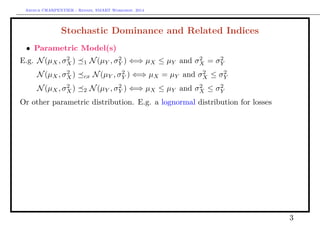
• Parametric Model(s)
E.g. N(µX, σ2
X) 1 N(µY , σ2
Y ) ⇐⇒ µX ≤ µY and σ2
X = σ2
Y
E.g. N(µX, σ2
X) cx N(µY , σ2
Y ) ⇐⇒ µX = µY and σ2
X ≤ σ2
Y
E.g. N(µX, σ2
X) 2 N(µY , σ2
Y ) ⇐⇒ µX ≤ µY and σ2
X ≤ σ2
Y
Or other parametric distribution. E.g. a lognormal distribution for losses
3
Density
0 5 10 15 20 25
0.000.050.100.150.200.250.30
CumulatedDensity
0 5 10 15 20 25
0.00.20.40.60.81.0
Arthur CHARPENTIER - Rennes, SMART Workshop, 2014
Stochastic Dominance and Related Indices
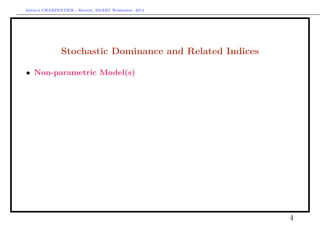
• Non-parametric Model(s)
4
Density
0 5 10 15 20 25
0.000.050.100.150.200.250.30
CumulatedDensity
0 5 10 15 20 250.00.20.40.60.81.0
Arthur CHARPENTIER - Rennes, SMART Workshop, 2014
Nonparametric estimation of the density
5
density
0 20 40 60 80
0.00.10.20.30.40.50.6
Arthur CHARPENTIER - Rennes, SMART Workshop, 2014
Agenda
sample {y1, · · · , yn} −→ fn(·)
Fn(·) or F−1
n (·)
R(fn)
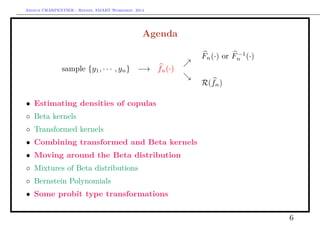
• Estimating densities of copulas
◦ Beta kernels
◦ Transformed kernels
• Combining transformed and Beta kernels
• Moving around the Beta distribution
◦ Mixtures of Beta distributions
◦ Bernstein Polynomials
• Some probit type transformations
6
Arthur CHARPENTIER - Rennes, SMART Workshop, 2014
Non parametric estimation of copula density
see C., Fermanian & Scaillet (2005), bias of kernel estimators at endpoints
0.0 0.2 0.4 0.6 0.8 1.0
0.00.20.40.60.81.01.2
Kernel based estimation of the uniform density on [0,1]
Density
0.0 0.2 0.4 0.6 0.8 1.00.00.20.40.60.81.01.2
Kernel based estimation of the uniform density on [0,1]
Density
7
Arthur CHARPENTIER - Rennes, SMART Workshop, 2014
Non parametric estimation of copula density
e.g. E(c(0, 0, h)) =
1
4
· c(u, v) −
1
2
[c1(0, 0) + c2(0, 0)]
1
0
ωK(ω)dω · h + o(h)
0.2 0.4 0.6 0.8
0.2
0.4
0.6
0.8
0
1
2
3
4
5
Estimation of Frank copula
0.2 0.4 0.6 0.8
0.2
0.4
0.6
0.8
0
1
2
3
4
5
Estimation of Frank copula
0.0 0.2 0.4 0.6 0.8 1.0
0.00.20.40.60.81.0
with a symmetric kernel (here a Gaussian kernel).
8
Arthur CHARPENTIER - Rennes, SMART Workshop, 2014
Non parametric estimation of copula density
0.0 0.2 0.4 0.6 0.8 1.0
01234
Standard Gaussian kernel estimator, n=100
Estimation of the density on the diagonal
Densityoftheestimator
0.0 0.2 0.4 0.6 0.8 1.0
01234
Standard Gaussian kernel estimator, n=1000
Estimation of the density on the diagonal
Densityoftheestimator
0.0 0.2 0.4 0.6 0.8 1.0
01234
Standard Gaussian kernel estimator, n=10000
Estimation of the density on the diagonal
Densityoftheestimator
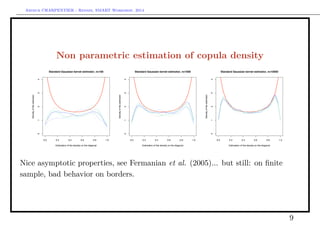
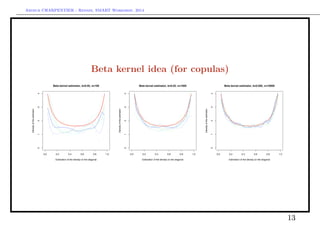
Nice asymptotic properties, see Fermanian et al. (2005)... but still: on finite
sample, bad behavior on borders.
9
Arthur CHARPENTIER - Rennes, SMART Workshop, 2014
Beta kernel idea (for copulas)
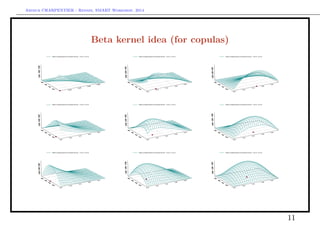
see Chen (1999, 2000), Bouezmarni & Rolin (2003),
Kxi (u) ∝ exp −
(u − xi)2
h2
vs. Kxi (u) ∝ u
x1,i
b
1 [1 − u1]
x1,i
b · u
x2,i
b
2 [1 − u2]
x2,i
b
10
q
q
q
q
q
q
q
q
q
q
q
q
q
q
q
q
q
q
q
q
q
q
q
q
q
q q
q
q
q
q
q
q
q
q
q
q
q
q
q
q
q
q
q
q
q
q
q
q
q
q
q
q
q
q
q
q
q
q q
q
q
qq
q
q
q
q
q
qq
q
q
q
q
q
q
q
q
q
q
q q
q
q
q
q
q
q
q
q
q
q
q
q
q
q
q
q
q
q
q
q
q
q
q
q
q
q
q
q
q
q
q
q q
q
q
q
q q
q
q
q
q
q
q
q
q
q
q
q
q
q
q
qq
q
q
q
q
q
q
q
q
q
q
q
q
q
q
q
q
q
q
q
q
q
q
q
q q
q
q
q
q
q
q
q
q
q
q
q
q
q
q q
q
q
q
q
q
q
q
q
q
q
q
q
qq
q
q
q
q
q
q
q
q
q
q
q
q
q
q
q
q
q
q
qq
q
q
q
q
q
q
q
q
q
q
q
q
q
q
q
q
q
q
q
q
q
q
q
q
q
q
q
q
q
q
q
q
q
q
q
q
q
q
q
q
q
q
qq
qq
q
q
q
q q
q
q q
q
q
q
q
q
q
q
q
q
q
q
q
q
q
q
q
q
q
q
q
q
q
q
q
q
q
q
q
q
q
q
q
q
q
q
q
q
q
q
qq
q
q
q
q
q
q
q
q
q
q
q
q
q
q q
q
q
q
q
q
q
q
q
q
q
q
q
q
q
q
q
q
q
q
q
q
q
q
q
q q
q
q
q
q
q
q q
q
q
q
q
q
q
q
q
q
q
q
q
q
q
q
q
q
q
q
q
q
q
q q
q
q
q
q
q
q
q
q
q
q
q
q
q
q
q
q
q
q
q
q
q
q
Arthur CHARPENTIER - Rennes, SMART Workshop, 2014
Beta kernel idea (for copulas)
Beta (independent) bivariate kernel , x=0.0, y=0.0 Beta (independent) bivariate kernel , x=0.2, y=0.0 Beta (independent) bivariate kernel , x=0.5, y=0.0
Beta (independent) bivariate kernel , x=0.0, y=0.2 Beta (independent) bivariate kernel , x=0.2, y=0.2 Beta (independent) bivariate kernel , x=0.5, y=0.2
Beta (independent) bivariate kernel , x=0.0, y=0.5 Beta (independent) bivariate kernel , x=0.2, y=0.5 Beta (independent) bivariate kernel , x=0.5, y=0.5
11
Arthur CHARPENTIER - Rennes, SMART Workshop, 2014
Beta kernel idea (for copulas)
0.2 0.4 0.6 0.8
0.2
0.4
0.6
0.8
0
1
2
3
4
5
Estimation of Frank copula
0.2 0.4 0.6 0.8
0.2
0.4
0.6
0.8
0.0
0.5
1.0
1.5
2.0
2.5
3.0
Estimation of the copula density (Beta kernel, b=0.1)
0.2 0.4 0.6 0.8
0.2
0.4
0.6
0.8
0.0
0.5
1.0
1.5
2.0
2.5
3.0
Estimation of the copula density (Beta kernel, b=0.05)
12
Arthur CHARPENTIER - Rennes, SMART Workshop, 2014
Beta kernel idea (for copulas)
0.0 0.2 0.4 0.6 0.8 1.0
01234
Beta kernel estimator, b=0.05, n=100
Estimation of the density on the diagonal
Densityoftheestimator
0.0 0.2 0.4 0.6 0.8 1.0
01234
Beta kernel estimator, b=0.02, n=1000
Estimation of the density on the diagonal
Densityoftheestimator
0.0 0.2 0.4 0.6 0.8 1.0
01234
Beta kernel estimator, b=0.005, n=10000
Estimation of the density on the diagonal
Densityoftheestimator
13
Arthur CHARPENTIER - Rennes, SMART Workshop, 2014
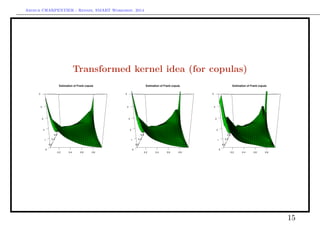
Transformed kernel idea (for copulas)
[0, 1] × [0, 1] → R × R → [0, 1] × [0, 1]
14
Arthur CHARPENTIER - Rennes, SMART Workshop, 2014
Transformed kernel idea (for copulas)
0.2 0.4 0.6 0.8
0.2
0.4
0.6
0.8
0
1
2
3
4
5
Estimation of Frank copula
0.2 0.4 0.6 0.8
0.2
0.4
0.6
0.8
0
1
2
3
4
5
Estimation of Frank copula
0.2 0.4 0.6 0.8
0.2
0.4
0.6
0.8
0
1
2
3
4
5
Estimation of Frank copula
15
Arthur CHARPENTIER - Rennes, SMART Workshop, 2014
Transformed kernel idea (for copulas)
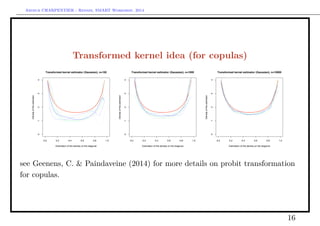
0.0 0.2 0.4 0.6 0.8 1.0
01234
Transformed kernel estimator (Gaussian), n=100
Estimation of the density on the diagonal
Densityoftheestimator
0.0 0.2 0.4 0.6 0.8 1.0
01234
Transformed kernel estimator (Gaussian), n=1000
Estimation of the density on the diagonal
Densityoftheestimator
0.0 0.2 0.4 0.6 0.8 1.0
01234
Transformed kernel estimator (Gaussian), n=10000
Estimation of the density on the diagonal
Densityoftheestimator
see Geenens, C. & Paindaveine (2014) for more details on probit transformation
for copulas.
16
Arthur CHARPENTIER - Rennes, SMART Workshop, 2014
Combining the two approaches
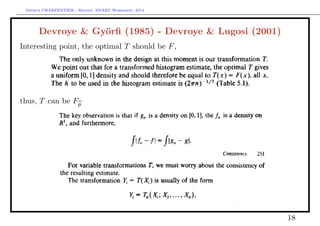
See Devroye & Györfi (1985), and Devroye & Lugosi (2001)
... use the transformed kernel the other way, R → [0, 1] → R
17
Arthur CHARPENTIER - Rennes, SMART Workshop, 2014
Devroye & Györfi (1985) - Devroye & Lugosi (2001)
Interesting point, the optimal T should be F,
thus, T can be Fθ
18
Arthur CHARPENTIER - Rennes, SMART Workshop, 2014
Heavy Tailed distribution
Let X denote a (heavy-tailed) random variable with tail index α ∈ (0, ∞), i.e.
P(X > x) = x−α
L1(x)
where L1 is some regularly varying function.
Let T denote a R → [0, 1] function, such that 1 − T is regularly varying at
infinity, with tail index β ∈ (0, ∞).
Define Q(x) = T−1
(1 − x−1
) the associated tail quantile function, then
Q(x) = x1/β
L2(1/x), where L2 is some regularly varying function (the de Bruyn
conjugate of the regular variation function associated with T). Assume here that
Q(x) = bx1/β
Let U = T(X). Then, as u → 1
P(U > u) ∼ (1 − u)α/β
.
19
Arthur CHARPENTIER - Rennes, SMART Workshop, 2014
Heavy Tailed distribution
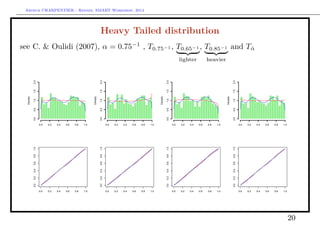
see C. & Oulidi (2007), α = 0.75−1
, T0.75−1 , T0.65−1
lighter
, T0.85−1
heavier
and Tˆα
Density
0.0 0.2 0.4 0.6 0.8 1.0
0.00.51.01.52.0
0.0 0.2 0.4 0.6 0.8 1.0
0.00.20.40.60.81.0
Density
0.0 0.2 0.4 0.6 0.8 1.0
0.00.51.01.52.0
0.0 0.2 0.4 0.6 0.8 1.0
0.00.20.40.60.81.0
Density
0.0 0.2 0.4 0.6 0.8 1.0
0.00.51.01.52.0
0.0 0.2 0.4 0.6 0.8 1.0
0.00.20.40.60.81.0
Density
0.0 0.2 0.4 0.6 0.8 1.0
0.00.51.01.52.0
0.0 0.2 0.4 0.6 0.8 1.0
0.00.20.40.60.81.0
20
Arthur CHARPENTIER - Rennes, SMART Workshop, 2014
Heavy Tailed distribution
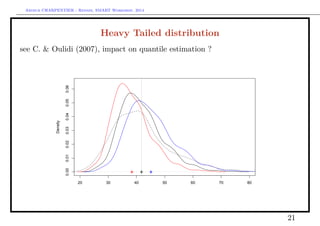
see C. & Oulidi (2007), impact on quantile estimation ?
20 30 40 50 60 70 80
0.000.010.020.030.040.050.06
Density
21
Arthur CHARPENTIER - Rennes, SMART Workshop, 2014
Heavy Tailed distribution
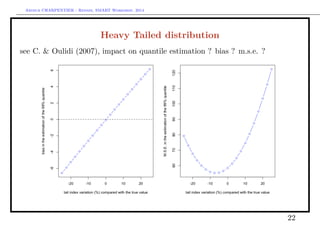
see C. & Oulidi (2007), impact on quantile estimation ? bias ? m.s.e. ?
22
Arthur CHARPENTIER - Rennes, SMART Workshop, 2014
Which transformation ?
GB2 : t(y; a, b, p, q) =
|a|yap−1
bapB(p, q)[1 + (y/b)a]p+q
, for y > 0,
GB2
q→∞

a=1

p=1
55
q=1
@@
GG
a→0
ÓÓ
a=1

p=1
%%
Beta2
q→∞
ww
SM
q→∞
xx
q=1
99
Dagum
p=1

Lognormal Gamma Weibull Champernowne
23
Arthur CHARPENTIER - Rennes, SMART Workshop, 2014
Estimating a density on R+
• Stay on R+ : xi’s
• Get on [0, 1] : ui = Tθ
(xi) (distribution as uniform as possible)
◦ Use Beta Kernels on ui’s
◦ Mixtures of Beta distributions on ui’s
◦ Bernstein Polynomials on ui’s
• Get on R : use standard kernels (e.g. Gaussian)
◦ On xi = log(xi)
◦ On xi = BoxCoxλ
(xi)
◦ On xi = Φ−1
[Tθ
(xi)]
24
Arthur CHARPENTIER - Rennes, SMART Workshop, 2014
Beta kernel
g(u) =
n
i=1
1
n
· b u;
Ui
h
,
1 − Ui
h
u ∈ [0, 1].
with some possible boundary correction, as suggested in Chen (1999),
u
h
→ ρ(u, h) = 2h2
+ 2.5 − (4h4
+ 6h2
+ 2.25 − u2
− u/h)1/2
Problem : choice of the bandwidth h ? Standard loss function
L(h) = [gn(u) − g(u)]2
du = [gn(u)]2
du − 2 gn(u) · g(u)du
CV (h)
+ [g(u)]2
du
where
CV (h) = gn(u)du
2
−
2
n
n
i=1
g(−i)(Ui)
25
Arthur CHARPENTIER - Rennes, SMART Workshop, 2014
Mixture of Beta distributions
g(u) =
k
j=1
πj · b u; αj, βj u ∈ [0, 1].
Problem : choice the number of components k (and estimation...). Use of
stochastic EM algorithm (or sort of) see Celeux  Diebolt (1985).
Bernstein approximation
g(u) =
m
k=1
[mωk] · b (u; k, m − k) u ∈ [0, 1].
where ωk = G
k
m
− G
k − 1
m
.
26
Arthur CHARPENTIER - Rennes, SMART Workshop, 2014
On the log-transform
With a standard Gaussian kernel
fX(x) =
1
n
n
i=1
φ(x; xi, h)
A Gaussian kernel on a log transform,
fX(x) =
1
x
fX (log x) =
1
n
n
i=1
λ(x; log xi, h)
where λ(·; µ, σ) is the density of the log-normal distribution. Here, in 0,
bias[fX(x)] ∼
h2
2
[fX(x) + 3x · fX(x) + x2
· fX(x)]
and
Var[fX(x)] ∼
fX(x)
xnh
27
Arthur CHARPENTIER - Rennes, SMART Workshop, 2014
On the Box-Cox-transform
More generally, instead of transformed sample Yi = log[Xi], consider
Yi =
Xλ
i − 1
λ
when λ = 0.
Find the optimal transformation using standard regression techniques (least
squares)
Xi =
Xλ
i − 1
λ
when λ = 0
and Xi = log[Xi] if λ = 0. The density estimation is here
fX(x) = xλ −1
fX
xλ
− 1
λ
28
Arthur CHARPENTIER - Rennes, SMART Workshop, 2014
Illustration with Log-normal samples
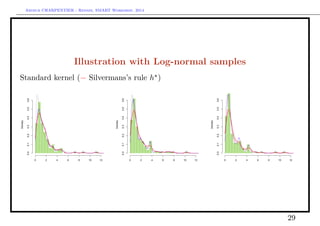
Standard kernel (− Silvermans’s rule h )
Density
0 2 4 6 8 10 12
0.00.10.20.30.40.50.6
Density
0 2 4 6 8 10 12
0.00.10.20.30.40.50.6
Density
0 2 4 6 8 10 12
0.00.10.20.30.40.50.6
29
Arthur CHARPENTIER - Rennes, SMART Workshop, 2014
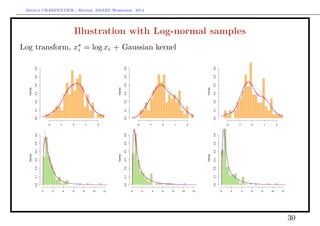
Illustration with Log-normal samples
Log transform, xi = log xi + Gaussian kernel
Density
−2 −1 0 1 2
0.00.10.20.30.40.50.6
Density
−2 −1 0 1 20.00.10.20.30.40.50.6
Density
−2 −1 0 1 2
0.00.10.20.30.40.50.6
Density
0 2 4 6 8 10 12
0.00.10.20.30.40.50.6
Density
0 2 4 6 8 10 12
0.00.10.20.30.40.50.6
Density
0 2 4 6 8 10 12
0.00.10.20.30.40.50.6
30
Arthur CHARPENTIER - Rennes, SMART Workshop, 2014
Illustration with Log-normal samples
Probit-type transform, xi = Φ−1
[Tθ
(xi)] + Gaussian kernel
Density
−2 −1 0 1 2
0.00.10.20.30.40.50.6
Density
−2 −1 0 1 20.00.10.20.30.40.50.6
Density
−2 −1 0 1 2
0.00.10.20.30.40.50.6
Density
0 2 4 6 8 10 12
0.00.10.20.30.40.50.6
Density
0 2 4 6 8 10 12
0.00.10.20.30.40.50.6
Density
0 2 4 6 8 10 12
0.00.10.20.30.40.50.6
31
Arthur CHARPENTIER - Rennes, SMART Workshop, 2014
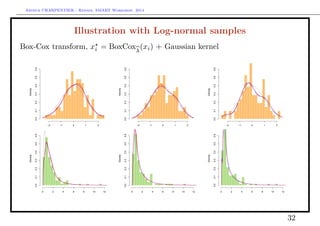
Illustration with Log-normal samples
Box-Cox transform, xi = BoxCoxλ
(xi) + Gaussian kernel
Density
−2 −1 0 1 2
0.00.10.20.30.40.50.6
Density
−2 −1 0 1 20.00.10.20.30.40.50.6
Density
−2 −1 0 1 2
0.00.10.20.30.40.50.6
Density
0 2 4 6 8 10 12
0.00.10.20.30.40.50.6
Density
0 2 4 6 8 10 12
0.00.10.20.30.40.50.6
Density
0 2 4 6 8 10 12
0.00.10.20.30.40.50.6
32
Arthur CHARPENTIER - Rennes, SMART Workshop, 2014
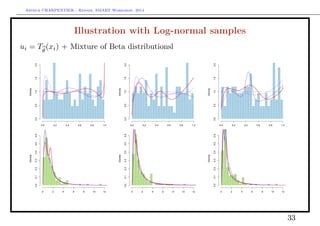
Illustration with Log-normal samples
ui = Tθ
(xi) + Mixture of Beta distributionsl
Density
0.0 0.2 0.4 0.6 0.8 1.0
0.00.51.01.52.0
Density
0.0 0.2 0.4 0.6 0.8 1.00.00.51.01.52.0
Density
0.0 0.2 0.4 0.6 0.8 1.0
0.00.51.01.52.0
Density
0 2 4 6 8 10 12
0.00.10.20.30.40.50.6
Density
0 2 4 6 8 10 12
0.00.10.20.30.40.50.6
Density
0 2 4 6 8 10 12
0.00.10.20.30.40.50.6
33
Arthur CHARPENTIER - Rennes, SMART Workshop, 2014
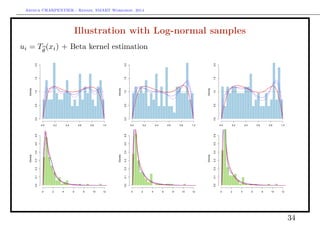
Illustration with Log-normal samples
ui = Tθ
(xi) + Beta kernel estimation
Density
0.0 0.2 0.4 0.6 0.8 1.0
0.00.51.01.52.0
Density
0.0 0.2 0.4 0.6 0.8 1.00.00.51.01.52.0
Density
0.0 0.2 0.4 0.6 0.8 1.0
0.00.51.01.52.0
Density
0 2 4 6 8 10 12
0.00.10.20.30.40.50.6
Density
0 2 4 6 8 10 12
0.00.10.20.30.40.50.6
Density
0 2 4 6 8 10 12
0.00.10.20.30.40.50.6
34
Arthur CHARPENTIER - Rennes, SMART Workshop, 2014
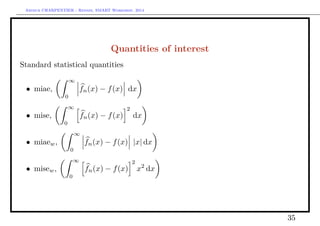
Quantities of interest
Standard statistical quantities
• miae,
∞
0
fn(x) − f(x) dx
• mise,
∞
0
fn(x) − f(x)
2
dx
• miaew,
∞
0
fn(x) − f(x) |x| dx
• misew,
∞
0
fn(x) − f(x)
2
x2
dx
35
Arthur CHARPENTIER - Rennes, SMART Workshop, 2014
Quantities of interest
Inequality indices and risk measures, based on F(x) =
x
0
f(t)dt,
• Gini,
1
µ
∞
0
F(t)[1 − F(t)]dt
• Theil,
∞
0
t
µ
log
t
µ
f(t)dt
• Entropy −
∞
0
f(t) log[f(t)]dt
• VaR-quantile, x such that F(x) = P(X ≤ x) = α, i.e. F−1
(α)
• TVaR-expected shorfall, E[X|X  F−1
(α)]
where µ =
∞
0
[1 − F(x)]dx.
36
Arthur CHARPENTIER - Rennes, SMART Workshop, 2014
Computations Aspects
Here, for each method, we return two functions,
• function fn(·)
• a random generator for distribution fn(·)
◦ H-transform and Gaussian kernel
draw i ∈ {1, · · · , n} and X = H−1
(Z) where Z ∼ N(H(xi), b2
)
◦ H-transform and Beta kernel
draw i ∈ {1, · · · , n} and X = H−1
(U) where U ∼ B(H(xi)/h, [1 − H(xi)]/h)
◦ H-transform and Beta mixture
draw k ∈ {1, · · · , K} and X = H−1
(U) where U ∼ B(αk, βk)
37
Arthur CHARPENTIER - Rennes, SMART Workshop, 2014
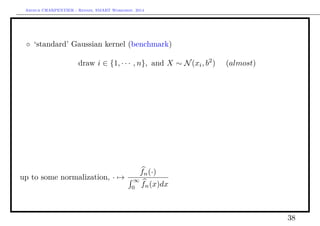
◦ ‘standard’ Gaussian kernel (benchmark)
draw i ∈ {1, · · · , n}, and X ∼ N(xi, b2
) (almost)
up to some normalization, · →
fn(·)
∞
0
fn(x)dx
38
Density
−2 0 2 4 6 8
0.00.10.20.30.4
q qq qqq q qqq
Arthur CHARPENTIER - Rennes, SMART Workshop, 2014
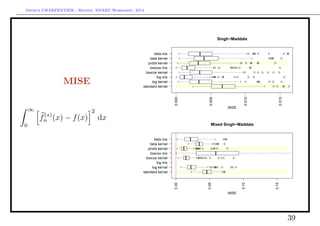
MISE
∞
0
f(s)
n (x) − f(x)
2
dx
q
Singh−Maddala
MISE
qqq qq
qqqqqq q
q qqq qq qqq qq q
qqqq qq q
q qqq qq qqq qq q
qqqq qq q q
qqq qq
qq qq q qq qqq q
standard kernel
log kernel
log mix
boxcox kernel
boxcox mix
probit kernel
beta kernel
beta mix
0.000
0.005
0.010
0.015
q
Mixed Singh−Maddala
MISE
qq
q qqq qqq qqq q
q qq qqq qq qqq q
q qq qq qqq qq qqqq q
qqq qq
qqq
standard kernel
log kernel
log mix
boxcox kernel
boxcox mix
probit kernel
beta kernel
beta mix
0.00
0.05
0.10
0.15
39
Arthur CHARPENTIER - Rennes, SMART Workshop, 2014
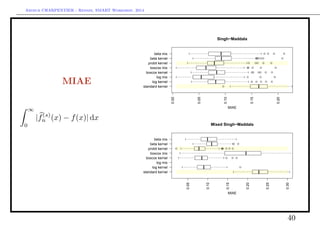
MIAE
∞
0
|f(s)
n (x) − f(x)| dx
q
Singh−Maddala
MIAE
q qqq q
qq qq qq
q qq
qqqq qq
q qq qq
qqqq q
qq qqq q
q qqq
standard kernel
log kernel
log mix
boxcox kernel
boxcox mix
probit kernel
beta kernel
beta mix
0.00
0.05
0.10
0.15
0.20
q
Mixed Singh−Maddala
MIAE
q
qq q
q qqqqq q
q q
standard kernel
log kernel
log mix
boxcox kernel
boxcox mix
probit kernel
beta kernel
beta mix
0.05
0.10
0.15
0.20
0.25
0.30
40
Arthur CHARPENTIER - Rennes, SMART Workshop, 2014
Gini Index
1
µ
(s)
n
∞
0
F(s)
n (t)[1 − F(s)
n (t)]dt
Singh−Maddala
Gini Index
q q
qq
q q
qq
q
qqq
q q
standard kernel
log kernel
log mix
boxcox kernel
boxcox mix
probit kernel
beta kernel
beta mix
0.45
0.50
0.55
0.60
Mixed Singh−Maddala
Gini Index
q
qq
q
q
q qq
qq
standard kernel
log kernel
log mix
boxcox kernel
boxcox mix
probit kernel
beta kernel
beta mix
0.55
0.60
0.65
0.70
41
Arthur CHARPENTIER - Rennes, SMART Workshop, 2014
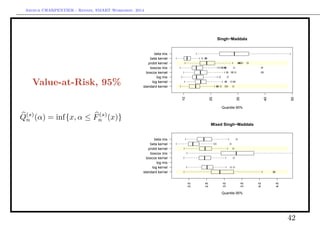
Value-at-Risk, 95%
Q(s)
n (α) = inf{x, α ≤ F(s)
n (x)}
q
Singh−Maddala
Quantile 95%
qq qqqq q
q q qq q
qq
q qqqqq q
q qqqqqq qq
qq qqqqqq
qqq q
qq
standard kernel
log kernel
log mix
boxcox kernel
boxcox mix
probit kernel
beta kernel
beta mix
10
20
30
40
50
Mixed Singh−Maddala
Quantile 95%
qq
q q
q
q
q q
q
standard kernel
log kernel
log mix
boxcox kernel
boxcox mix
probit kernel
beta kernel
beta mix
2.0
2.5
3.0
3.5
4.0
4.5
42
Arthur CHARPENTIER - Rennes, SMART Workshop, 2014
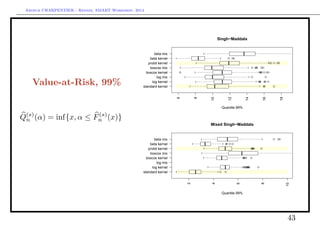
Value-at-Risk, 99%
Q(s)
n (α) = inf{x, α ≤ F(s)
n (x)}
Singh−Maddala
Quantile 99%
q qqq
qq q qqq
qq
qqq qq qqqq
qq qqqq
qq qqqq
qq q
qq
standard kernel
log kernel
log mix
boxcox kernel
boxcox mix
probit kernel
beta kernel
beta mix
6
8
10
12
14
16
18
q
Mixed Singh−Maddala
Quantile 99%
q q
q qqqqqq qqqq
qqq qqq
q qqqqq
q q qq
qq q
standard kernel
log kernel
log mix
boxcox kernel
boxcox mix
probit kernel
beta kernel
beta mix
2
4
6
8
10
43
Arthur CHARPENTIER - Rennes, SMART Workshop, 2014
Tail Value-at-Risk, 95%
E[X|X  Q(s)
n (α)]
Singh−Maddala
Expected Shortfall 95%
q
q
qq
q
qq
q
standard kernel
log kernel
log mix
boxcox kernel
boxcox mix
probit kernel
beta kernel
beta mix
4.0
4.5
5.0
5.5
6.0
6.5
q
Mixed Singh−Maddala
Expected Shortfall 95%
q qqq
q qqq
q qqq
q qqq
q
standard kernel
log kernel
log mix
boxcox kernel
boxcox mix
probit kernel
beta kernel
beta mix
4
6
8
10
12
44
Arthur CHARPENTIER - Rennes, SMART Workshop, 2014
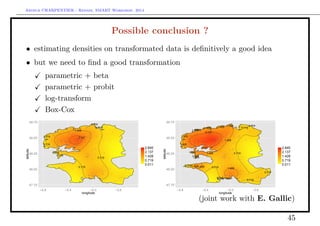
Possible conclusion ?
• estimating densities on transformated data is definitively a good idea
• but we need to find a good transformation
parametric + beta
parametric + probit
log-transform
Box-Cox
0.719
0.719
0.719
0.719
0.719
0.719
0.719
0.719
1.428
2.137
47.75
48.00
48.25
48.50
48.75
−4.8 −4.4 −4.0 −3.6
longitude
latitude
0.011
0.719
1.428
2.137
2.845
0.719
0.719
0.7190.719
0.719
0.719
0.719
0.719
0.719
1.428
1.428
1.428
1.428
1.428
1.4281.428
1.428
1.428
1.428
1.428
1.428
1.428
1.428
1.428
1.428
2.137
2.137
47.75
48.00
48.25
48.50
48.75
−4.8 −4.4 −4.0 −3.6
longitude
latitude 0.011
0.719
1.428
2.137
2.845
(joint work with E. Gallic)
45

Slides smart-2015

  • 1.
    Arthur CHARPENTIER -Rennes, SMART Workshop, 2014 Kernel Based Estimation of Inequality Indices and Risk Measures Arthur Charpentier arthur.charpentier@univ-rennes1.fr http://freakonometrics.hypotheses.org/ based on joint work with E. Flachaire initiated by some joint work with A. Oulidi, J.D. Fermanian, O. Scaillet, G. Geenens and D. Paindaveine (Université de Rennes 1, 2015) 1
  • 2.
    Arthur CHARPENTIER -Rennes, SMART Workshop, 2014 Stochastic Dominance and Related Indices • First Order Stochastic Dominance (cf standard stochastic order, st) X 1 Y ⇐⇒ FX(t) ≥ FY (t), ∀t ⇐⇒ VaRX(u) ≤ VaRY (u), ∀u • Convex Stochastic Dominance (cf martingale property) X cx Y ⇐⇒ E[ ˜Y | ˜X] = ˜X ⇐⇒ ESX(u) ≤ ESY (u), ∀u and E(X) = E(Y ) • Second Order Stochastic Dominance (cf submartingale property, stop-loss order, icx) X 2 Y ⇐⇒ E[ ˜Y | ˜X] ≥ ˜X ⇐⇒ ESX(u) ≤ ESY (u), ∀u • Lorenz Stochastic Dominance (cf dilatation order) X L Y ⇐⇒ X E[X] cx X E[Y ] ⇐⇒ LX(u) ≤ LY (u), ∀u 2
  • 3.
    Arthur CHARPENTIER -Rennes, SMART Workshop, 2014 Stochastic Dominance and Related Indices • Parametric Model(s) E.g. N(µX, σ2 X) 1 N(µY , σ2 Y ) ⇐⇒ µX ≤ µY and σ2 X = σ2 Y E.g. N(µX, σ2 X) cx N(µY , σ2 Y ) ⇐⇒ µX = µY and σ2 X ≤ σ2 Y E.g. N(µX, σ2 X) 2 N(µY , σ2 Y ) ⇐⇒ µX ≤ µY and σ2 X ≤ σ2 Y Or other parametric distribution. E.g. a lognormal distribution for losses 3 Density 0 5 10 15 20 25 0.000.050.100.150.200.250.30 CumulatedDensity 0 5 10 15 20 25 0.00.20.40.60.81.0
  • 4.
    Arthur CHARPENTIER -Rennes, SMART Workshop, 2014 Stochastic Dominance and Related Indices • Non-parametric Model(s) 4 Density 0 5 10 15 20 25 0.000.050.100.150.200.250.30 CumulatedDensity 0 5 10 15 20 250.00.20.40.60.81.0
  • 5.
    Arthur CHARPENTIER -Rennes, SMART Workshop, 2014 Nonparametric estimation of the density 5 density 0 20 40 60 80 0.00.10.20.30.40.50.6
  • 6.
    Arthur CHARPENTIER -Rennes, SMART Workshop, 2014 Agenda sample {y1, · · · , yn} −→ fn(·) Fn(·) or F−1 n (·) R(fn) • Estimating densities of copulas ◦ Beta kernels ◦ Transformed kernels • Combining transformed and Beta kernels • Moving around the Beta distribution ◦ Mixtures of Beta distributions ◦ Bernstein Polynomials • Some probit type transformations 6
  • 7.
    Arthur CHARPENTIER -Rennes, SMART Workshop, 2014 Non parametric estimation of copula density see C., Fermanian & Scaillet (2005), bias of kernel estimators at endpoints 0.0 0.2 0.4 0.6 0.8 1.0 0.00.20.40.60.81.01.2 Kernel based estimation of the uniform density on [0,1] Density 0.0 0.2 0.4 0.6 0.8 1.00.00.20.40.60.81.01.2 Kernel based estimation of the uniform density on [0,1] Density 7
  • 8.
    Arthur CHARPENTIER -Rennes, SMART Workshop, 2014 Non parametric estimation of copula density e.g. E(c(0, 0, h)) = 1 4 · c(u, v) − 1 2 [c1(0, 0) + c2(0, 0)] 1 0 ωK(ω)dω · h + o(h) 0.2 0.4 0.6 0.8 0.2 0.4 0.6 0.8 0 1 2 3 4 5 Estimation of Frank copula 0.2 0.4 0.6 0.8 0.2 0.4 0.6 0.8 0 1 2 3 4 5 Estimation of Frank copula 0.0 0.2 0.4 0.6 0.8 1.0 0.00.20.40.60.81.0 with a symmetric kernel (here a Gaussian kernel). 8
  • 9.
    Arthur CHARPENTIER -Rennes, SMART Workshop, 2014 Non parametric estimation of copula density 0.0 0.2 0.4 0.6 0.8 1.0 01234 Standard Gaussian kernel estimator, n=100 Estimation of the density on the diagonal Densityoftheestimator 0.0 0.2 0.4 0.6 0.8 1.0 01234 Standard Gaussian kernel estimator, n=1000 Estimation of the density on the diagonal Densityoftheestimator 0.0 0.2 0.4 0.6 0.8 1.0 01234 Standard Gaussian kernel estimator, n=10000 Estimation of the density on the diagonal Densityoftheestimator Nice asymptotic properties, see Fermanian et al. (2005)... but still: on finite sample, bad behavior on borders. 9
  • 10.
    Arthur CHARPENTIER -Rennes, SMART Workshop, 2014 Beta kernel idea (for copulas) see Chen (1999, 2000), Bouezmarni & Rolin (2003), Kxi (u) ∝ exp − (u − xi)2 h2 vs. Kxi (u) ∝ u x1,i b 1 [1 − u1] x1,i b · u x2,i b 2 [1 − u2] x2,i b 10 q q q q q q q q q q q q q q q q q q q q q q q q q q q q q q q q q q q q q q q q q q q q q q q q q q q q q q q q q q q q q q qq q q q q q qq q q q q q q q q q q q q q q q q q q q q q q q q q q q q q q q q q q q q q q q q q q q q q q q q q q q q q q q q q q q q q q q q qq q q q q q q q q q q q q q q q q q q q q q q q q q q q q q q q q q q q q q q q q q q q q q q q q q q q q qq q q q q q q q q q q q q q q q q q q qq q q q q q q q q q q q q q q q q q q q q q q q q q q q q q q q q q q q q q q q q q q qq qq q q q q q q q q q q q q q q q q q q q q q q q q q q q q q q q q q q q q q q q q q q q q q q q qq q q q q q q q q q q q q q q q q q q q q q q q q q q q q q q q q q q q q q q q q q q q q q q q q q q q q q q q q q q q q q q q q q q q q q q q q q q q q q q q q q q q q q q q q q q q q q q
  • 11.
    Arthur CHARPENTIER -Rennes, SMART Workshop, 2014 Beta kernel idea (for copulas) Beta (independent) bivariate kernel , x=0.0, y=0.0 Beta (independent) bivariate kernel , x=0.2, y=0.0 Beta (independent) bivariate kernel , x=0.5, y=0.0 Beta (independent) bivariate kernel , x=0.0, y=0.2 Beta (independent) bivariate kernel , x=0.2, y=0.2 Beta (independent) bivariate kernel , x=0.5, y=0.2 Beta (independent) bivariate kernel , x=0.0, y=0.5 Beta (independent) bivariate kernel , x=0.2, y=0.5 Beta (independent) bivariate kernel , x=0.5, y=0.5 11
  • 12.
    Arthur CHARPENTIER -Rennes, SMART Workshop, 2014 Beta kernel idea (for copulas) 0.2 0.4 0.6 0.8 0.2 0.4 0.6 0.8 0 1 2 3 4 5 Estimation of Frank copula 0.2 0.4 0.6 0.8 0.2 0.4 0.6 0.8 0.0 0.5 1.0 1.5 2.0 2.5 3.0 Estimation of the copula density (Beta kernel, b=0.1) 0.2 0.4 0.6 0.8 0.2 0.4 0.6 0.8 0.0 0.5 1.0 1.5 2.0 2.5 3.0 Estimation of the copula density (Beta kernel, b=0.05) 12
  • 13.
    Arthur CHARPENTIER -Rennes, SMART Workshop, 2014 Beta kernel idea (for copulas) 0.0 0.2 0.4 0.6 0.8 1.0 01234 Beta kernel estimator, b=0.05, n=100 Estimation of the density on the diagonal Densityoftheestimator 0.0 0.2 0.4 0.6 0.8 1.0 01234 Beta kernel estimator, b=0.02, n=1000 Estimation of the density on the diagonal Densityoftheestimator 0.0 0.2 0.4 0.6 0.8 1.0 01234 Beta kernel estimator, b=0.005, n=10000 Estimation of the density on the diagonal Densityoftheestimator 13
  • 14.
    Arthur CHARPENTIER -Rennes, SMART Workshop, 2014 Transformed kernel idea (for copulas) [0, 1] × [0, 1] → R × R → [0, 1] × [0, 1] 14
  • 15.
    Arthur CHARPENTIER -Rennes, SMART Workshop, 2014 Transformed kernel idea (for copulas) 0.2 0.4 0.6 0.8 0.2 0.4 0.6 0.8 0 1 2 3 4 5 Estimation of Frank copula 0.2 0.4 0.6 0.8 0.2 0.4 0.6 0.8 0 1 2 3 4 5 Estimation of Frank copula 0.2 0.4 0.6 0.8 0.2 0.4 0.6 0.8 0 1 2 3 4 5 Estimation of Frank copula 15
  • 16.
    Arthur CHARPENTIER -Rennes, SMART Workshop, 2014 Transformed kernel idea (for copulas) 0.0 0.2 0.4 0.6 0.8 1.0 01234 Transformed kernel estimator (Gaussian), n=100 Estimation of the density on the diagonal Densityoftheestimator 0.0 0.2 0.4 0.6 0.8 1.0 01234 Transformed kernel estimator (Gaussian), n=1000 Estimation of the density on the diagonal Densityoftheestimator 0.0 0.2 0.4 0.6 0.8 1.0 01234 Transformed kernel estimator (Gaussian), n=10000 Estimation of the density on the diagonal Densityoftheestimator see Geenens, C. & Paindaveine (2014) for more details on probit transformation for copulas. 16
  • 17.
    Arthur CHARPENTIER -Rennes, SMART Workshop, 2014 Combining the two approaches See Devroye & Györfi (1985), and Devroye & Lugosi (2001) ... use the transformed kernel the other way, R → [0, 1] → R 17
  • 18.
    Arthur CHARPENTIER -Rennes, SMART Workshop, 2014 Devroye & Györfi (1985) - Devroye & Lugosi (2001) Interesting point, the optimal T should be F, thus, T can be Fθ 18
  • 19.
    Arthur CHARPENTIER -Rennes, SMART Workshop, 2014 Heavy Tailed distribution Let X denote a (heavy-tailed) random variable with tail index α ∈ (0, ∞), i.e. P(X > x) = x−α L1(x) where L1 is some regularly varying function. Let T denote a R → [0, 1] function, such that 1 − T is regularly varying at infinity, with tail index β ∈ (0, ∞). Define Q(x) = T−1 (1 − x−1 ) the associated tail quantile function, then Q(x) = x1/β L2(1/x), where L2 is some regularly varying function (the de Bruyn conjugate of the regular variation function associated with T). Assume here that Q(x) = bx1/β Let U = T(X). Then, as u → 1 P(U > u) ∼ (1 − u)α/β . 19
  • 20.
    Arthur CHARPENTIER -Rennes, SMART Workshop, 2014 Heavy Tailed distribution see C. & Oulidi (2007), α = 0.75−1 , T0.75−1 , T0.65−1 lighter , T0.85−1 heavier and Tˆα Density 0.0 0.2 0.4 0.6 0.8 1.0 0.00.51.01.52.0 0.0 0.2 0.4 0.6 0.8 1.0 0.00.20.40.60.81.0 Density 0.0 0.2 0.4 0.6 0.8 1.0 0.00.51.01.52.0 0.0 0.2 0.4 0.6 0.8 1.0 0.00.20.40.60.81.0 Density 0.0 0.2 0.4 0.6 0.8 1.0 0.00.51.01.52.0 0.0 0.2 0.4 0.6 0.8 1.0 0.00.20.40.60.81.0 Density 0.0 0.2 0.4 0.6 0.8 1.0 0.00.51.01.52.0 0.0 0.2 0.4 0.6 0.8 1.0 0.00.20.40.60.81.0 20
  • 21.
    Arthur CHARPENTIER -Rennes, SMART Workshop, 2014 Heavy Tailed distribution see C. & Oulidi (2007), impact on quantile estimation ? 20 30 40 50 60 70 80 0.000.010.020.030.040.050.06 Density 21
  • 22.
    Arthur CHARPENTIER -Rennes, SMART Workshop, 2014 Heavy Tailed distribution see C. & Oulidi (2007), impact on quantile estimation ? bias ? m.s.e. ? 22
  • 23.
    Arthur CHARPENTIER -Rennes, SMART Workshop, 2014 Which transformation ? GB2 : t(y; a, b, p, q) = |a|yap−1 bapB(p, q)[1 + (y/b)a]p+q , for y > 0, GB2 q→∞  a=1 p=1 55 q=1 @@ GG a→0 ÓÓ a=1 p=1 %% Beta2 q→∞ ww SM q→∞ xx q=1 99 Dagum p=1 Lognormal Gamma Weibull Champernowne 23
  • 24.
    Arthur CHARPENTIER -Rennes, SMART Workshop, 2014 Estimating a density on R+ • Stay on R+ : xi’s • Get on [0, 1] : ui = Tθ (xi) (distribution as uniform as possible) ◦ Use Beta Kernels on ui’s ◦ Mixtures of Beta distributions on ui’s ◦ Bernstein Polynomials on ui’s • Get on R : use standard kernels (e.g. Gaussian) ◦ On xi = log(xi) ◦ On xi = BoxCoxλ (xi) ◦ On xi = Φ−1 [Tθ (xi)] 24
  • 25.
    Arthur CHARPENTIER -Rennes, SMART Workshop, 2014 Beta kernel g(u) = n i=1 1 n · b u; Ui h , 1 − Ui h u ∈ [0, 1]. with some possible boundary correction, as suggested in Chen (1999), u h → ρ(u, h) = 2h2 + 2.5 − (4h4 + 6h2 + 2.25 − u2 − u/h)1/2 Problem : choice of the bandwidth h ? Standard loss function L(h) = [gn(u) − g(u)]2 du = [gn(u)]2 du − 2 gn(u) · g(u)du CV (h) + [g(u)]2 du where CV (h) = gn(u)du 2 − 2 n n i=1 g(−i)(Ui) 25
  • 26.
    Arthur CHARPENTIER -Rennes, SMART Workshop, 2014 Mixture of Beta distributions g(u) = k j=1 πj · b u; αj, βj u ∈ [0, 1]. Problem : choice the number of components k (and estimation...). Use of stochastic EM algorithm (or sort of) see Celeux Diebolt (1985). Bernstein approximation g(u) = m k=1 [mωk] · b (u; k, m − k) u ∈ [0, 1]. where ωk = G k m − G k − 1 m . 26
  • 27.
    Arthur CHARPENTIER -Rennes, SMART Workshop, 2014 On the log-transform With a standard Gaussian kernel fX(x) = 1 n n i=1 φ(x; xi, h) A Gaussian kernel on a log transform, fX(x) = 1 x fX (log x) = 1 n n i=1 λ(x; log xi, h) where λ(·; µ, σ) is the density of the log-normal distribution. Here, in 0, bias[fX(x)] ∼ h2 2 [fX(x) + 3x · fX(x) + x2 · fX(x)] and Var[fX(x)] ∼ fX(x) xnh 27
  • 28.
    Arthur CHARPENTIER -Rennes, SMART Workshop, 2014 On the Box-Cox-transform More generally, instead of transformed sample Yi = log[Xi], consider Yi = Xλ i − 1 λ when λ = 0. Find the optimal transformation using standard regression techniques (least squares) Xi = Xλ i − 1 λ when λ = 0 and Xi = log[Xi] if λ = 0. The density estimation is here fX(x) = xλ −1 fX xλ − 1 λ 28
  • 29.
    Arthur CHARPENTIER -Rennes, SMART Workshop, 2014 Illustration with Log-normal samples Standard kernel (− Silvermans’s rule h ) Density 0 2 4 6 8 10 12 0.00.10.20.30.40.50.6 Density 0 2 4 6 8 10 12 0.00.10.20.30.40.50.6 Density 0 2 4 6 8 10 12 0.00.10.20.30.40.50.6 29
  • 30.
    Arthur CHARPENTIER -Rennes, SMART Workshop, 2014 Illustration with Log-normal samples Log transform, xi = log xi + Gaussian kernel Density −2 −1 0 1 2 0.00.10.20.30.40.50.6 Density −2 −1 0 1 20.00.10.20.30.40.50.6 Density −2 −1 0 1 2 0.00.10.20.30.40.50.6 Density 0 2 4 6 8 10 12 0.00.10.20.30.40.50.6 Density 0 2 4 6 8 10 12 0.00.10.20.30.40.50.6 Density 0 2 4 6 8 10 12 0.00.10.20.30.40.50.6 30
  • 31.
    Arthur CHARPENTIER -Rennes, SMART Workshop, 2014 Illustration with Log-normal samples Probit-type transform, xi = Φ−1 [Tθ (xi)] + Gaussian kernel Density −2 −1 0 1 2 0.00.10.20.30.40.50.6 Density −2 −1 0 1 20.00.10.20.30.40.50.6 Density −2 −1 0 1 2 0.00.10.20.30.40.50.6 Density 0 2 4 6 8 10 12 0.00.10.20.30.40.50.6 Density 0 2 4 6 8 10 12 0.00.10.20.30.40.50.6 Density 0 2 4 6 8 10 12 0.00.10.20.30.40.50.6 31
  • 32.
    Arthur CHARPENTIER -Rennes, SMART Workshop, 2014 Illustration with Log-normal samples Box-Cox transform, xi = BoxCoxλ (xi) + Gaussian kernel Density −2 −1 0 1 2 0.00.10.20.30.40.50.6 Density −2 −1 0 1 20.00.10.20.30.40.50.6 Density −2 −1 0 1 2 0.00.10.20.30.40.50.6 Density 0 2 4 6 8 10 12 0.00.10.20.30.40.50.6 Density 0 2 4 6 8 10 12 0.00.10.20.30.40.50.6 Density 0 2 4 6 8 10 12 0.00.10.20.30.40.50.6 32
  • 33.
    Arthur CHARPENTIER -Rennes, SMART Workshop, 2014 Illustration with Log-normal samples ui = Tθ (xi) + Mixture of Beta distributionsl Density 0.0 0.2 0.4 0.6 0.8 1.0 0.00.51.01.52.0 Density 0.0 0.2 0.4 0.6 0.8 1.00.00.51.01.52.0 Density 0.0 0.2 0.4 0.6 0.8 1.0 0.00.51.01.52.0 Density 0 2 4 6 8 10 12 0.00.10.20.30.40.50.6 Density 0 2 4 6 8 10 12 0.00.10.20.30.40.50.6 Density 0 2 4 6 8 10 12 0.00.10.20.30.40.50.6 33
  • 34.
    Arthur CHARPENTIER -Rennes, SMART Workshop, 2014 Illustration with Log-normal samples ui = Tθ (xi) + Beta kernel estimation Density 0.0 0.2 0.4 0.6 0.8 1.0 0.00.51.01.52.0 Density 0.0 0.2 0.4 0.6 0.8 1.00.00.51.01.52.0 Density 0.0 0.2 0.4 0.6 0.8 1.0 0.00.51.01.52.0 Density 0 2 4 6 8 10 12 0.00.10.20.30.40.50.6 Density 0 2 4 6 8 10 12 0.00.10.20.30.40.50.6 Density 0 2 4 6 8 10 12 0.00.10.20.30.40.50.6 34
  • 35.
    Arthur CHARPENTIER -Rennes, SMART Workshop, 2014 Quantities of interest Standard statistical quantities • miae, ∞ 0 fn(x) − f(x) dx • mise, ∞ 0 fn(x) − f(x) 2 dx • miaew, ∞ 0 fn(x) − f(x) |x| dx • misew, ∞ 0 fn(x) − f(x) 2 x2 dx 35
  • 36.
    Arthur CHARPENTIER -Rennes, SMART Workshop, 2014 Quantities of interest Inequality indices and risk measures, based on F(x) = x 0 f(t)dt, • Gini, 1 µ ∞ 0 F(t)[1 − F(t)]dt • Theil, ∞ 0 t µ log t µ f(t)dt • Entropy − ∞ 0 f(t) log[f(t)]dt • VaR-quantile, x such that F(x) = P(X ≤ x) = α, i.e. F−1 (α) • TVaR-expected shorfall, E[X|X F−1 (α)] where µ = ∞ 0 [1 − F(x)]dx. 36
  • 37.
    Arthur CHARPENTIER -Rennes, SMART Workshop, 2014 Computations Aspects Here, for each method, we return two functions, • function fn(·) • a random generator for distribution fn(·) ◦ H-transform and Gaussian kernel draw i ∈ {1, · · · , n} and X = H−1 (Z) where Z ∼ N(H(xi), b2 ) ◦ H-transform and Beta kernel draw i ∈ {1, · · · , n} and X = H−1 (U) where U ∼ B(H(xi)/h, [1 − H(xi)]/h) ◦ H-transform and Beta mixture draw k ∈ {1, · · · , K} and X = H−1 (U) where U ∼ B(αk, βk) 37
  • 38.
    Arthur CHARPENTIER -Rennes, SMART Workshop, 2014 ◦ ‘standard’ Gaussian kernel (benchmark) draw i ∈ {1, · · · , n}, and X ∼ N(xi, b2 ) (almost) up to some normalization, · → fn(·) ∞ 0 fn(x)dx 38 Density −2 0 2 4 6 8 0.00.10.20.30.4 q qq qqq q qqq
  • 39.
    Arthur CHARPENTIER -Rennes, SMART Workshop, 2014 MISE ∞ 0 f(s) n (x) − f(x) 2 dx q Singh−Maddala MISE qqq qq qqqqqq q q qqq qq qqq qq q qqqq qq q q qqq qq qqq qq q qqqq qq q q qqq qq qq qq q qq qqq q standard kernel log kernel log mix boxcox kernel boxcox mix probit kernel beta kernel beta mix 0.000 0.005 0.010 0.015 q Mixed Singh−Maddala MISE qq q qqq qqq qqq q q qq qqq qq qqq q q qq qq qqq qq qqqq q qqq qq qqq standard kernel log kernel log mix boxcox kernel boxcox mix probit kernel beta kernel beta mix 0.00 0.05 0.10 0.15 39
  • 40.
    Arthur CHARPENTIER -Rennes, SMART Workshop, 2014 MIAE ∞ 0 |f(s) n (x) − f(x)| dx q Singh−Maddala MIAE q qqq q qq qq qq q qq qqqq qq q qq qq qqqq q qq qqq q q qqq standard kernel log kernel log mix boxcox kernel boxcox mix probit kernel beta kernel beta mix 0.00 0.05 0.10 0.15 0.20 q Mixed Singh−Maddala MIAE q qq q q qqqqq q q q standard kernel log kernel log mix boxcox kernel boxcox mix probit kernel beta kernel beta mix 0.05 0.10 0.15 0.20 0.25 0.30 40
  • 41.
    Arthur CHARPENTIER -Rennes, SMART Workshop, 2014 Gini Index 1 µ (s) n ∞ 0 F(s) n (t)[1 − F(s) n (t)]dt Singh−Maddala Gini Index q q qq q q qq q qqq q q standard kernel log kernel log mix boxcox kernel boxcox mix probit kernel beta kernel beta mix 0.45 0.50 0.55 0.60 Mixed Singh−Maddala Gini Index q qq q q q qq qq standard kernel log kernel log mix boxcox kernel boxcox mix probit kernel beta kernel beta mix 0.55 0.60 0.65 0.70 41
  • 42.
    Arthur CHARPENTIER -Rennes, SMART Workshop, 2014 Value-at-Risk, 95% Q(s) n (α) = inf{x, α ≤ F(s) n (x)} q Singh−Maddala Quantile 95% qq qqqq q q q qq q qq q qqqqq q q qqqqqq qq qq qqqqqq qqq q qq standard kernel log kernel log mix boxcox kernel boxcox mix probit kernel beta kernel beta mix 10 20 30 40 50 Mixed Singh−Maddala Quantile 95% qq q q q q q q q standard kernel log kernel log mix boxcox kernel boxcox mix probit kernel beta kernel beta mix 2.0 2.5 3.0 3.5 4.0 4.5 42
  • 43.
    Arthur CHARPENTIER -Rennes, SMART Workshop, 2014 Value-at-Risk, 99% Q(s) n (α) = inf{x, α ≤ F(s) n (x)} Singh−Maddala Quantile 99% q qqq qq q qqq qq qqq qq qqqq qq qqqq qq qqqq qq q qq standard kernel log kernel log mix boxcox kernel boxcox mix probit kernel beta kernel beta mix 6 8 10 12 14 16 18 q Mixed Singh−Maddala Quantile 99% q q q qqqqqq qqqq qqq qqq q qqqqq q q qq qq q standard kernel log kernel log mix boxcox kernel boxcox mix probit kernel beta kernel beta mix 2 4 6 8 10 43
  • 44.
    Arthur CHARPENTIER -Rennes, SMART Workshop, 2014 Tail Value-at-Risk, 95% E[X|X Q(s) n (α)] Singh−Maddala Expected Shortfall 95% q q qq q qq q standard kernel log kernel log mix boxcox kernel boxcox mix probit kernel beta kernel beta mix 4.0 4.5 5.0 5.5 6.0 6.5 q Mixed Singh−Maddala Expected Shortfall 95% q qqq q qqq q qqq q qqq q standard kernel log kernel log mix boxcox kernel boxcox mix probit kernel beta kernel beta mix 4 6 8 10 12 44
  • 45.
    Arthur CHARPENTIER -Rennes, SMART Workshop, 2014 Possible conclusion ? • estimating densities on transformated data is definitively a good idea • but we need to find a good transformation parametric + beta parametric + probit log-transform Box-Cox 0.719 0.719 0.719 0.719 0.719 0.719 0.719 0.719 1.428 2.137 47.75 48.00 48.25 48.50 48.75 −4.8 −4.4 −4.0 −3.6 longitude latitude 0.011 0.719 1.428 2.137 2.845 0.719 0.719 0.7190.719 0.719 0.719 0.719 0.719 0.719 1.428 1.428 1.428 1.428 1.428 1.4281.428 1.428 1.428 1.428 1.428 1.428 1.428 1.428 1.428 1.428 2.137 2.137 47.75 48.00 48.25 48.50 48.75 −4.8 −4.4 −4.0 −3.6 longitude latitude 0.011 0.719 1.428 2.137 2.845 (joint work with E. Gallic) 45