Arthur Charpentier, SIDE Summer School, July 2019
# 8 Classification & Goodness of Fit (Practical)
Arthur Charpentier (Universit´e du Qu´ebec `a Montr´eal)
Machine Learning & Econometrics
SIDE Summer School - July 2019
@freakonometrics freakonometrics freakonometrics.hypotheses.org 1
Arthur Charpentier, SIDE Summer School, July 2019
Test and Decision
truth
- +
-
true
negative
false
negative
decision
+
false
positive
true
positive
truth
- +
-
good
decision
type 2
error
decision
+
type 1
error
true
positive
We usually have a tradeoff between the two types of error, see base rate fallacy
In statistical terminology, we want to test an assumption (H0) - which can be
valid, or not - and we need to take a decision : reject H0 or accept H0.
@freakonometrics freakonometrics freakonometrics.hypotheses.org 2
Arthur Charpentier, SIDE Summer School, July 2019
Test and Decision
Prevalence
200
10, 000
= 2%
Specificity
9, 751
9, 800
= 99.5%
Sensitivity
100
200
= 50%
Positive Predictive Value
100
149
∼ 67%
Specificity
9, 310
9, 800
= 95%
Positive Predictive Value
100
590
∼ 17%
- +
non-disease disease
- 9,751 100 9,851
decision
+ 49 100 149
9,800 200 10,000
non-disease disease
- 9,310 100 9,410
decision
+ 490 100 590
9,800 200 10,000
see Wainer & Savage (2008, Until proven guilty: False positives and war on terror).
@freakonometrics freakonometrics freakonometrics.hypotheses.org 3
Arthur Charpentier, SIDE Summer School, July 2019
Goodness of Fit: ROC Curve
Confusion matrix
Given a sample (yi, xi) and a model m, the confusion matrix is the contin-
gency table, with dimensions observed yi ∈ {0, 1} and predicted yi ∈ {0, 1}.
y
0(-) 1(+)
0(-) TN FN
y
1(+) FP TP
FP
TN+FP
TP
FN+TP
FPR TPR
Classical measures are
true positive rate (TPR) - or sensitivity
false positive rate (FPR) - or fall-out,
true negative rate (TNR) - or specificity
TNR = 1-FPR
among others (see wikipedia)
See ROCR::performance(prediction(Score,Y),"tpr","fpr")
@freakonometrics freakonometrics freakonometrics.hypotheses.org 4
Arthur Charpentier, SIDE Summer School, July 2019
Goodness of Fit: ROC Curve
ROC (Receiver Operating Characteristic) Curve
Assume that mt is define from a score function s, with mt(x) =
1(s(x) > t) for some threshold t. The ROC curve is the curve
(FPRt, TPRt) obtained from confusion matrices of mt’s.
n = 100 individuals
50 yi = 0 and 50 yi = 1
(well balanced)
@freakonometrics freakonometrics freakonometrics.hypotheses.org 5
q
q
Y=0 Y=1
OBSERVED
Y=1Y=0
PREDICTED
25 25
25 25
FPR TPR
25 25
50 50
~ 0.5 ~ 0.5
q
q
FALSE POSITIVE RATE
TRUEPOSITIVERATE
0.0 0.2 0.4 0.6 0.8 1.0
0.00.20.40.60.81.0
q
Arthur Charpentier, SIDE Summer School, July 2019
Goodness of Fit: ROC Curve
29 deaths (y = 0) and 42 survivals (y = 1)
y =



1 if P[Y = 1|X] > 0%
0 if P[Y = 1|X] ≤ 0%
0%
y
0 1
0 0 0
y
1 29 42
29
29+0
42
42+0
= 100% = 100%
FPR TPR
@freakonometrics freakonometrics freakonometrics.hypotheses.org 6
Arthur Charpentier, SIDE Summer School, July 2019
Goodness of Fit: ROC Curve
29 deaths (y = 0) and 42 survivals (y = 1)
y =



1 if P[Y = 1|X] > 15%
0 if P[Y = 1|X] ≤ 15%
15%
y
0 1
0 17 2
y
1 12 40
12
17+12
40
42+2
∼ 41.4% ∼ 95.2%
FPR TPR
@freakonometrics freakonometrics freakonometrics.hypotheses.org 7
Arthur Charpentier, SIDE Summer School, July 2019
Goodness of Fit: ROC Curve
29 deaths (y = 0) and 42 survivals (y = 1)
y =



1 if P[Y = 1|X] > 50%
0 if P[Y = 1|X] ≤ 50%
50%
y
0 1
0 25 3
y
1 4 39
4
25+4
39
39+3
∼ 13.8% ∼ 92.8%
FPR TPR
@freakonometrics freakonometrics freakonometrics.hypotheses.org 8
Arthur Charpentier, SIDE Summer School, July 2019
Goodness of Fit: ROC Curve
29 deaths (y = 0) and 42 survivals (y = 1)
y =



1 if P[Y = 1|X] > 85%
0 if P[Y = 1|X] ≤ 85%
50%
y
0 1
0 28 13
y
1 1 29
1
28+1
29
29+13
∼ 3.4% ∼ 69.9%
FPR TPR
@freakonometrics freakonometrics freakonometrics.hypotheses.org 9
Arthur Charpentier, SIDE Summer School, July 2019
Goodness of Fit: ROC Curve
29 deaths (y = 0) and 42 survivals (y = 1)
y =



1 if P[Y = 1|X] > 100%
0 if P[Y = 1|X] ≤ 100%
50%
y
0 1
0 29 42
y
0 0 29
0
29+0
0
42+0
= 0.0% = 0.0%
FPR TPR
@freakonometrics freakonometrics freakonometrics.hypotheses.org 10
Arthur Charpentier, SIDE Summer School, July 2019
Goodness of Fit: ROC Curve
See Fawcett (2006, An introduction to ROC analysis)
AUC (Area Under the Curve) for classification
The AUC is the area enclosed by the ROC
curve
Gini’s γ for classification
γ = 2AUC − 1
AUC= γ = 1 for a perfect classifier
AUC= 1/2 and γ = 0 for a random classifier
see chi-square independence test
@freakonometrics freakonometrics freakonometrics.hypotheses.org 11
Arthur Charpentier, SIDE Summer School, July 2019
Chi-Square Test for Contingency Tables
brown hazel green blue
black 63.0% 13.9% 4.6% 18.5% 100.0%
brown 41.6% 18.9% 10.1% 29.4% 100.0%
red 36.6% 19.7% 19.7% 23.9% 100.0%
blond 5.5% 7.9% 12.6% 74.0% 100.0%
37.2% 15.7% 10.8% 36.3%
brown hazel green blue
black 30.9% 16.1% 7.8% 9.3% 18.2%
brown 54.1% 58.1% 45.3% 39.1% 48.3%
red 11.8% 15.1% 21.9% 7.9% 12.0%
blond 3.2% 10.8% 25.0% 43.7% 21.5%
100.0% 100.0% 100.0% 100.0%
@freakonometrics freakonometrics freakonometrics.hypotheses.org 12
Arthur Charpentier, SIDE Summer School, July 2019
Chi-Square Test for Contingency Tables
brown hazel green blue
black 68 15 5 20 108
brown 119 54 29 84 286
red 26 14 14 17 71
blond 7 10 16 94 127
220 93 64 215
brown hazel green blue
black 40 17 12 39 108
brown 106 45 31 104 286
red 26 11 8 26 71
blond 47 20 14 46 127
220 93 64 215
Compare ni,j and n⊥
i,j
n⊥
i,j =
ni,· × n·,j
n
@freakonometrics freakonometrics freakonometrics.hypotheses.org 13
Arthur Charpentier, SIDE Summer School, July 2019
Goodness of Fit
Be carefull of overfit...
Important to use
training / validation
• classification tree
• boosting classifier
@freakonometrics freakonometrics freakonometrics.hypotheses.org 14
Arthur Charpentier, SIDE Summer School, July 2019
Goodness of Fit: ROC Curve
ROC (Receiver Operating Characteristic ) Curve
Assume that mt is define from a score function s, with mt(x) =
1(s(x) > t) for some threshold t. The ROC curve is the curve
(FPRt, TPRt obtained from confusion matrices of mt’s.
@freakonometrics freakonometrics freakonometrics.hypotheses.org 15
qq qqq qq
q
qq qqqq qqqq
q
qqqqq
q
qqq qqq qq
qq
qqqqqqqqqq qqq qq
q
qq qqq qqqq qq qq qq qqq
q
q qq qqq q qq qq q qqqqq qqq qqqq qqqq qq qqqq q
q
qqq qq qqq qqq qqq qq qqq qqqqqqq q qqqqq q qqq
q
qq qq qqq
q
q
q
qqq qq qqqq q qq q qqqq qqq q qq qqq qqq qq qqqq qqqq
q
q qqq qqqq
q
qq
q
q
qq
qq qqq q qqqq
q
qqq qqq qqqqqq qq q
q
qq qqq qqq q qqqqq qqq q
q
q qq qq qqqq
q
qqqq qqqqq q qqq qq
q
qqq q
q
q q qqq
q
qq qqq qqq qq qqq q
q
q qq qqq qq
q
q qqqq qq
q
q q
q
qq q
qq
qqq
q
q qqq q
q
qqqq qqqqq qqqq qqqq qqq
q
q qq qq qqqq q
q
qqq
q
qqq qqqq qq q qq q qq qqqqqq q qqqq q qqqq qqqqq
q
qq q qq qqqq qqqq
q
q
qq
qq q
q
qqq qqqq q
q
q
q
qq qq
qq
qqq q qq q qqqq qqqq qqqq qq qq qq qqqq qqqq q qqqq qqqq
q
q qqqq qqq qqq q
q
qq qqqq qqqqqqqq qq qqqq qqq q
q
qq qq
q
q q qqqq qqq q qqq q q qqqqqq q
q
q q qqqqq q q qqqq qqqq q qqqq qqqqq qq qqq q
q
qqq qq qqqq qq qq
qq
qqqqqq qq qqq
q
q qqqqqq
q
q qq qq q qqq q qqq q qq qq qqq q
q
qq q
q
q qq qq qq
q
q qqq qqq qqqqq qqqq q qqqqq
q
q
q
q q
qq
qq
q
qqqq
q
q qq q q
q
q
q
qqqq qq qq q qqq q qq qqqqqq qq qq qqqq qqqq q qqqq qq q qq qq qqqq q qq q
q
qqqqq qqqq qq qq qqqq q qqq
q
qq
q
qq qqqq qqqqq qqqq qq qqq qqq qqqq qq q q
q
qqq qq qq
q
qq qq qqq qq qqqqq qqq qqq qqqqq qqqqq qq qqq qqqq qqq q qq qq qqqq q qq qq qqqqq qq qqqq
qq
qqqqqqqq qqqq qq q
q
qqqqq qqq qq
q
qqqqq
q
q q
q
qqq qq q qqqq qq q qqqq qqqq qqqqq qq qqqqq
q
q q qq qqq qqq q
q
q
q
q qq q qqqq
q
qqq q qq qq q
SCORE S
OBSERVATIONY
0.0 0.2 0.4 0.6 0.8 1.0
Y=0
Y=1
FALSE POSITIVE RATE
TRUEPOSITIVERATE
0.0 0.2 0.4 0.6 0.8 1.0
0.00.20.40.60.81.0
q
Arthur Charpentier, SIDE Summer School, July 2019
Goodness of Fit: ROC Curve
With categorical variables, we have a collection of points
Need to interpolate between those points to have a curve, see convexification of
ROC curves, e.g. Flach (2012, Machine Learning)
@freakonometrics freakonometrics freakonometrics.hypotheses.org 16
q
q
FALSE SPAM RATE
TRUESPAMRATE
0.0 0.2 0.4 0.6 0.8 1.0
0.00.20.40.60.81.0
q
q
q
q
q
q
FALSE SPAM RATE
TRUESPAMRATE
0.0 0.2 0.4 0.6 0.8 1.0
0.00.20.40.60.81.0
q
q
Arthur Charpentier, SIDE Summer School, July 2019
Goodness of Fit
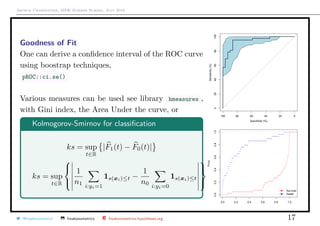
One can derive a confidence interval of the ROC curve
using boostrap techniques,
pROC::ci.se()
Various measures can be used see library hmeasures ,
with Gini index, the Area Under the curve, or
Kolmogorov-Smirnov for classification
ks = sup
t∈R
|F1(t) − F0(t)|
ks = sup
t∈R



1
n1 i:yi=1
1s(xi)≤t −
1
n0 i:yi=0
1s(xi)≤t



Specificity (%)
Sensitivity(%)
020406080100
100 80 60 40 20 0
0.0 0.2 0.4 0.6 0.8 1.0
0.00.20.40.60.81.0
Fn(x)
q
q
q
q
q
q
q
q
q
q
q
q
q
q
q
q
q
q
q
q
q
q
q
q
q
q
q
q
q
q
q
q
q
q
q
q
q
q
q
q
q
q
q
q
q
q
q
q
q
q
q
q
q
q
q
q
q
q
q
q
q
q
q
q
q
q
q
q
q
q
q
q
q
Survival
Death
@freakonometrics freakonometrics freakonometrics.hypotheses.org 17
Arthur Charpentier, SIDE Summer School, July 2019
Goodness of Fit
The Area Under the Curve, AUC, can be interpreted as the probability that a
classifier will rank a randomly chosen positive instance higher than a randomly
chosen negative one, see Swets, Dawes & Monahan (2000, Psychological Science
Can Improve Diagnostic Decisions)
Kappa statistic κ compares an Observed Accuracy with an Expected Accuracy
(random chance), see Landis & Koch (1977, The Measurement of Observer
Agreement for Categorical Data)
Y = 0 Y = 1
Y = 0 TN FN TN+FN
Y = 1 FP TP FP+TP
TN+FP FN+TP n
See also Obsersed and Random Confusion Tables
Y = 0 Y = 1
Y = 0 25 3 28
Y = 1 4 39 43
29 42 71
Y = 0 Y = 1
Y = 0 11.44 16.56 28
Y = 1 17.56 25.44 43
29 42 71
@freakonometrics freakonometrics freakonometrics.hypotheses.org 18
Arthur Charpentier, SIDE Summer School, July 2019
Goodness of Fit
Accuracy for classification
(total) accuracy =
TP + TN
n
total accuracy =
TP + TN
n
∼ 90.14%
random accuracy =
[TN + FP] · [TP + FN] + [TP + FP] · [TN + FN]
n2
∼ 51.93%
Cohen’s κ for classification
κ =
(total) accuracy − random accuracy
1 − random accuracy
from Cohen, Jacob (1960, A coefficient of agreement for nominal scales). Here
κ ∼ 79.48%.
@freakonometrics freakonometrics freakonometrics.hypotheses.org 19

Side 2019 #8

  • 1.
    Arthur Charpentier, SIDESummer School, July 2019 # 8 Classification & Goodness of Fit (Practical) Arthur Charpentier (Universit´e du Qu´ebec `a Montr´eal) Machine Learning & Econometrics SIDE Summer School - July 2019 @freakonometrics freakonometrics freakonometrics.hypotheses.org 1
  • 2.
    Arthur Charpentier, SIDESummer School, July 2019 Test and Decision truth - + - true negative false negative decision + false positive true positive truth - + - good decision type 2 error decision + type 1 error true positive We usually have a tradeoff between the two types of error, see base rate fallacy In statistical terminology, we want to test an assumption (H0) - which can be valid, or not - and we need to take a decision : reject H0 or accept H0. @freakonometrics freakonometrics freakonometrics.hypotheses.org 2
  • 3.
    Arthur Charpentier, SIDESummer School, July 2019 Test and Decision Prevalence 200 10, 000 = 2% Specificity 9, 751 9, 800 = 99.5% Sensitivity 100 200 = 50% Positive Predictive Value 100 149 ∼ 67% Specificity 9, 310 9, 800 = 95% Positive Predictive Value 100 590 ∼ 17% - + non-disease disease - 9,751 100 9,851 decision + 49 100 149 9,800 200 10,000 non-disease disease - 9,310 100 9,410 decision + 490 100 590 9,800 200 10,000 see Wainer & Savage (2008, Until proven guilty: False positives and war on terror). @freakonometrics freakonometrics freakonometrics.hypotheses.org 3
  • 4.
    Arthur Charpentier, SIDESummer School, July 2019 Goodness of Fit: ROC Curve Confusion matrix Given a sample (yi, xi) and a model m, the confusion matrix is the contin- gency table, with dimensions observed yi ∈ {0, 1} and predicted yi ∈ {0, 1}. y 0(-) 1(+) 0(-) TN FN y 1(+) FP TP FP TN+FP TP FN+TP FPR TPR Classical measures are true positive rate (TPR) - or sensitivity false positive rate (FPR) - or fall-out, true negative rate (TNR) - or specificity TNR = 1-FPR among others (see wikipedia) See ROCR::performance(prediction(Score,Y),"tpr","fpr") @freakonometrics freakonometrics freakonometrics.hypotheses.org 4
  • 5.
    Arthur Charpentier, SIDESummer School, July 2019 Goodness of Fit: ROC Curve ROC (Receiver Operating Characteristic) Curve Assume that mt is define from a score function s, with mt(x) = 1(s(x) > t) for some threshold t. The ROC curve is the curve (FPRt, TPRt) obtained from confusion matrices of mt’s. n = 100 individuals 50 yi = 0 and 50 yi = 1 (well balanced) @freakonometrics freakonometrics freakonometrics.hypotheses.org 5 q q Y=0 Y=1 OBSERVED Y=1Y=0 PREDICTED 25 25 25 25 FPR TPR 25 25 50 50 ~ 0.5 ~ 0.5 q q FALSE POSITIVE RATE TRUEPOSITIVERATE 0.0 0.2 0.4 0.6 0.8 1.0 0.00.20.40.60.81.0 q
  • 6.
    Arthur Charpentier, SIDESummer School, July 2019 Goodness of Fit: ROC Curve 29 deaths (y = 0) and 42 survivals (y = 1) y =    1 if P[Y = 1|X] > 0% 0 if P[Y = 1|X] ≤ 0% 0% y 0 1 0 0 0 y 1 29 42 29 29+0 42 42+0 = 100% = 100% FPR TPR @freakonometrics freakonometrics freakonometrics.hypotheses.org 6
  • 7.
    Arthur Charpentier, SIDESummer School, July 2019 Goodness of Fit: ROC Curve 29 deaths (y = 0) and 42 survivals (y = 1) y =    1 if P[Y = 1|X] > 15% 0 if P[Y = 1|X] ≤ 15% 15% y 0 1 0 17 2 y 1 12 40 12 17+12 40 42+2 ∼ 41.4% ∼ 95.2% FPR TPR @freakonometrics freakonometrics freakonometrics.hypotheses.org 7
  • 8.
    Arthur Charpentier, SIDESummer School, July 2019 Goodness of Fit: ROC Curve 29 deaths (y = 0) and 42 survivals (y = 1) y =    1 if P[Y = 1|X] > 50% 0 if P[Y = 1|X] ≤ 50% 50% y 0 1 0 25 3 y 1 4 39 4 25+4 39 39+3 ∼ 13.8% ∼ 92.8% FPR TPR @freakonometrics freakonometrics freakonometrics.hypotheses.org 8
  • 9.
    Arthur Charpentier, SIDESummer School, July 2019 Goodness of Fit: ROC Curve 29 deaths (y = 0) and 42 survivals (y = 1) y =    1 if P[Y = 1|X] > 85% 0 if P[Y = 1|X] ≤ 85% 50% y 0 1 0 28 13 y 1 1 29 1 28+1 29 29+13 ∼ 3.4% ∼ 69.9% FPR TPR @freakonometrics freakonometrics freakonometrics.hypotheses.org 9
  • 10.
    Arthur Charpentier, SIDESummer School, July 2019 Goodness of Fit: ROC Curve 29 deaths (y = 0) and 42 survivals (y = 1) y =    1 if P[Y = 1|X] > 100% 0 if P[Y = 1|X] ≤ 100% 50% y 0 1 0 29 42 y 0 0 29 0 29+0 0 42+0 = 0.0% = 0.0% FPR TPR @freakonometrics freakonometrics freakonometrics.hypotheses.org 10
  • 11.
    Arthur Charpentier, SIDESummer School, July 2019 Goodness of Fit: ROC Curve See Fawcett (2006, An introduction to ROC analysis) AUC (Area Under the Curve) for classification The AUC is the area enclosed by the ROC curve Gini’s γ for classification γ = 2AUC − 1 AUC= γ = 1 for a perfect classifier AUC= 1/2 and γ = 0 for a random classifier see chi-square independence test @freakonometrics freakonometrics freakonometrics.hypotheses.org 11
  • 12.
    Arthur Charpentier, SIDESummer School, July 2019 Chi-Square Test for Contingency Tables brown hazel green blue black 63.0% 13.9% 4.6% 18.5% 100.0% brown 41.6% 18.9% 10.1% 29.4% 100.0% red 36.6% 19.7% 19.7% 23.9% 100.0% blond 5.5% 7.9% 12.6% 74.0% 100.0% 37.2% 15.7% 10.8% 36.3% brown hazel green blue black 30.9% 16.1% 7.8% 9.3% 18.2% brown 54.1% 58.1% 45.3% 39.1% 48.3% red 11.8% 15.1% 21.9% 7.9% 12.0% blond 3.2% 10.8% 25.0% 43.7% 21.5% 100.0% 100.0% 100.0% 100.0% @freakonometrics freakonometrics freakonometrics.hypotheses.org 12
  • 13.
    Arthur Charpentier, SIDESummer School, July 2019 Chi-Square Test for Contingency Tables brown hazel green blue black 68 15 5 20 108 brown 119 54 29 84 286 red 26 14 14 17 71 blond 7 10 16 94 127 220 93 64 215 brown hazel green blue black 40 17 12 39 108 brown 106 45 31 104 286 red 26 11 8 26 71 blond 47 20 14 46 127 220 93 64 215 Compare ni,j and n⊥ i,j n⊥ i,j = ni,· × n·,j n @freakonometrics freakonometrics freakonometrics.hypotheses.org 13
  • 14.
    Arthur Charpentier, SIDESummer School, July 2019 Goodness of Fit Be carefull of overfit... Important to use training / validation • classification tree • boosting classifier @freakonometrics freakonometrics freakonometrics.hypotheses.org 14
  • 15.
    Arthur Charpentier, SIDESummer School, July 2019 Goodness of Fit: ROC Curve ROC (Receiver Operating Characteristic ) Curve Assume that mt is define from a score function s, with mt(x) = 1(s(x) > t) for some threshold t. The ROC curve is the curve (FPRt, TPRt obtained from confusion matrices of mt’s. @freakonometrics freakonometrics freakonometrics.hypotheses.org 15 qq qqq qq q qq qqqq qqqq q qqqqq q qqq qqq qq qq qqqqqqqqqq qqq qq q qq qqq qqqq qq qq qq qqq q q qq qqq q qq qq q qqqqq qqq qqqq qqqq qq qqqq q q qqq qq qqq qqq qqq qq qqq qqqqqqq q qqqqq q qqq q qq qq qqq q q q qqq qq qqqq q qq q qqqq qqq q qq qqq qqq qq qqqq qqqq q q qqq qqqq q qq q q qq qq qqq q qqqq q qqq qqq qqqqqq qq q q qq qqq qqq q qqqqq qqq q q q qq qq qqqq q qqqq qqqqq q qqq qq q qqq q q q q qqq q qq qqq qqq qq qqq q q q qq qqq qq q q qqqq qq q q q q qq q qq qqq q q qqq q q qqqq qqqqq qqqq qqqq qqq q q qq qq qqqq q q qqq q qqq qqqq qq q qq q qq qqqqqq q qqqq q qqqq qqqqq q qq q qq qqqq qqqq q q qq qq q q qqq qqqq q q q q qq qq qq qqq q qq q qqqq qqqq qqqq qq qq qq qqqq qqqq q qqqq qqqq q q qqqq qqq qqq q q qq qqqq qqqqqqqq qq qqqq qqq q q qq qq q q q qqqq qqq q qqq q q qqqqqq q q q q qqqqq q q qqqq qqqq q qqqq qqqqq qq qqq q q qqq qq qqqq qq qq qq qqqqqq qq qqq q q qqqqqq q q qq qq q qqq q qqq q qq qq qqq q q qq q q q qq qq qq q q qqq qqq qqqqq qqqq q qqqqq q q q q q qq qq q qqqq q q qq q q q q q qqqq qq qq q qqq q qq qqqqqq qq qq qqqq qqqq q qqqq qq q qq qq qqqq q qq q q qqqqq qqqq qq qq qqqq q qqq q qq q qq qqqq qqqqq qqqq qq qqq qqq qqqq qq q q q qqq qq qq q qq qq qqq qq qqqqq qqq qqq qqqqq qqqqq qq qqq qqqq qqq q qq qq qqqq q qq qq qqqqq qq qqqq qq qqqqqqqq qqqq qq q q qqqqq qqq qq q qqqqq q q q q qqq qq q qqqq qq q qqqq qqqq qqqqq qq qqqqq q q q qq qqq qqq q q q q q qq q qqqq q qqq q qq qq q SCORE S OBSERVATIONY 0.0 0.2 0.4 0.6 0.8 1.0 Y=0 Y=1 FALSE POSITIVE RATE TRUEPOSITIVERATE 0.0 0.2 0.4 0.6 0.8 1.0 0.00.20.40.60.81.0 q
  • 16.
    Arthur Charpentier, SIDESummer School, July 2019 Goodness of Fit: ROC Curve With categorical variables, we have a collection of points Need to interpolate between those points to have a curve, see convexification of ROC curves, e.g. Flach (2012, Machine Learning) @freakonometrics freakonometrics freakonometrics.hypotheses.org 16 q q FALSE SPAM RATE TRUESPAMRATE 0.0 0.2 0.4 0.6 0.8 1.0 0.00.20.40.60.81.0 q q q q q q FALSE SPAM RATE TRUESPAMRATE 0.0 0.2 0.4 0.6 0.8 1.0 0.00.20.40.60.81.0 q q
  • 17.
    Arthur Charpentier, SIDESummer School, July 2019 Goodness of Fit One can derive a confidence interval of the ROC curve using boostrap techniques, pROC::ci.se() Various measures can be used see library hmeasures , with Gini index, the Area Under the curve, or Kolmogorov-Smirnov for classification ks = sup t∈R |F1(t) − F0(t)| ks = sup t∈R    1 n1 i:yi=1 1s(xi)≤t − 1 n0 i:yi=0 1s(xi)≤t    Specificity (%) Sensitivity(%) 020406080100 100 80 60 40 20 0 0.0 0.2 0.4 0.6 0.8 1.0 0.00.20.40.60.81.0 Fn(x) q q q q q q q q q q q q q q q q q q q q q q q q q q q q q q q q q q q q q q q q q q q q q q q q q q q q q q q q q q q q q q q q q q q q q q q q q Survival Death @freakonometrics freakonometrics freakonometrics.hypotheses.org 17
  • 18.
    Arthur Charpentier, SIDESummer School, July 2019 Goodness of Fit The Area Under the Curve, AUC, can be interpreted as the probability that a classifier will rank a randomly chosen positive instance higher than a randomly chosen negative one, see Swets, Dawes & Monahan (2000, Psychological Science Can Improve Diagnostic Decisions) Kappa statistic κ compares an Observed Accuracy with an Expected Accuracy (random chance), see Landis & Koch (1977, The Measurement of Observer Agreement for Categorical Data) Y = 0 Y = 1 Y = 0 TN FN TN+FN Y = 1 FP TP FP+TP TN+FP FN+TP n See also Obsersed and Random Confusion Tables Y = 0 Y = 1 Y = 0 25 3 28 Y = 1 4 39 43 29 42 71 Y = 0 Y = 1 Y = 0 11.44 16.56 28 Y = 1 17.56 25.44 43 29 42 71 @freakonometrics freakonometrics freakonometrics.hypotheses.org 18
  • 19.
    Arthur Charpentier, SIDESummer School, July 2019 Goodness of Fit Accuracy for classification (total) accuracy = TP + TN n total accuracy = TP + TN n ∼ 90.14% random accuracy = [TN + FP] · [TP + FN] + [TP + FP] · [TN + FN] n2 ∼ 51.93% Cohen’s κ for classification κ = (total) accuracy − random accuracy 1 − random accuracy from Cohen, Jacob (1960, A coefficient of agreement for nominal scales). Here κ ∼ 79.48%. @freakonometrics freakonometrics freakonometrics.hypotheses.org 19