Ministry of Higher Education & Scientific Research
Foundation of Technical Education
Technical College of Basrah
CH5: Flow through Pipes
Training Package
in
Fluid Mechanics
Modular unit 5
Flow through Pipes
By
Risala A. Mohammed
M.Sc. Civil Engineering
Asst. Lect.
Environmental & Pollution Engineering Department
2011
1- Over view
1-1 Target population
CH5:Flow through Pipes
For the students of second class in
Environmental engineering Department in
Technical College
1-2 Rationale
CH5:Flow through Pipes
The study of flow in pipes is very important in
the design of networks of water pipes and sewage.
Where calculate the diameters of the pipes which
transfer of the fluid at specific flow rate, in addition
to estimating flow losses which are very important in
calculating the design of water treatment plant.
1-3 Central Idea
CH5:Flow through Pipes
The main goal of this chapter are to know the
Bernoulli equation and the losses of flow through
pipes.
1-4 Instructions
CH5:Flow through Pipes
1- Study over view thoroughly
2- Identify the goal of this modular unit
3- Do the Pretest and if you :-
*Get 9 or more you do not need to proceed
*Get less than 9 you have to study this modular
4- After studying the text of this modular unit , do the post test
and if you :-
*Get 9 or more , so go on studying modular unit six
*Get less than 9 , go back and study the modular unit five
1-5 Performance Objectives
CH5:Flow through Pipes
At the end of this modular unit the student will be able
to :-
1- Drive the Bernoulli and Energy equation.
2- Draw the energy line and hydraulic grid line.
3- Use the moody chart
4- Calculate the friction losses and minor losses of fluid
flow through pipes.
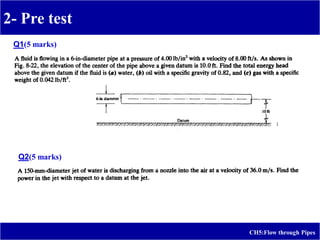
2- Pre test
-
CH5:Flow through Pipes
marks)
5
(
1
Q
marks)
5
(
2
Q
CH5:Flow through Pipes
Bernoulli´s Equation
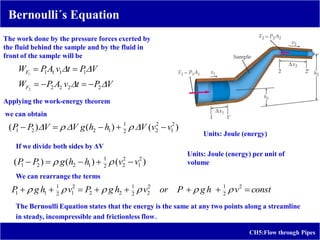
Consider a fluid flowing in a tube as shown in the figure
in a steady, incompressible, no viscous flow. We apply
the work-energy theorem to a sample of fluid initially
contained between point 1 and 2. During time Δt this
sample moves along the tube to the region between
points 1´and 2´. So,
Wall forces = ΔK [Change of kinetic Energy]
Wall forces include gravitational and pressure forces. We
neglecting internal frictional forces. Non-viscous flow.
No mechanical dissipation energy is considered.
Work of gravitational forces can be computed as the
variation of potential energy of sample. Considering the
continuity equation we can obtain
Change of kinetic energy of sample will be
Fluid moving in a pipe that varies in both height and
cross-sectional area. The net effect on the sample
during a time Δt is that a mass initially at height h1 and
speed v1 is transferred to a height h2 with speed v2
)
(
)
(
)
( 2
1
2
1 h
h
V
g
h
h
g
m
U 



 



)
(
)
)(
( 2
1
2
2
2
1
2
1
2
2
2
1
v
v
V
v
v
m
K 


 



CH5:Flow through Pipes
Bernoulli´s Equation
)
(
)
(
)
( 2
1
2
2
2
1
1
2
2
1 v
v
V
h
h
g
V
V
P
P 



 




V
P
t
v
A
P
W
V
P
t
v
A
P
W
F
F




2
2
2
2
1
1
1
1
2
1






Units: Joule (energy)
If we divide both sides by ΔV
)
(
)
(
)
( 2
1
2
2
2
1
1
2
2
1 v
v
h
h
g
P
P 



 

Units: Joule (energy) per unit of
volume
We can rearrange the terms
const
v
h
g
P
or
v
h
g
P
v
h
g
P 






 2
2
1
2
2
2
1
2
2
2
1
2
1
1
1 





The Bernoulli Equation states that the energy is the same at any two points along a streamline
in steady, incompressible and frictionless flow.
The work done by the pressure forces exerted by
the fluid behind the sample and by the fluid in
front of the sample will be
Applying the work-energy theorem
we can obtain
CH5:Flow through Pipes
Bernoulli´s Equation
const
v
h
g
P
v
h
g
P
v
h
g
P








2
2
1
2
2
2
1
2
2
2
1
2
1
1
1






Remarks about Bernoulli Equation
g
v
h
g
P
const
g
v
h
g
P
2
2
2
2
2





Flow work or pressure energy; Is the portion of the potential energy term
that the fluid is capable of yielding of its sustained pressure. IS Unit: Joule
per Newton (meter). Dimension : Length
(1)
(2)
Potential energy, due to the gravitational field. IS Unit: meter
Each term having the same units (1) [Energy per unit
of volume] (2) [Energy per unit of weight].
Expression (1) can also be considered as energy per
volume flow rate, and (2) as energy per weight flow
rate
Kinetic energy. IS Unit: meter (Joule per Newton)
CH5:Flow through Pipes
Bernoulli´s Equation
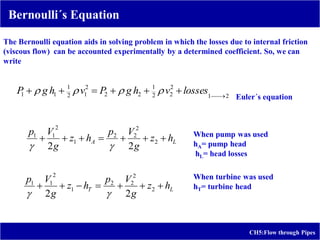
The Bernoulli equation aids in solving problem in which the losses due to internal friction
(viscous flow) can be accounted experimentally by a determined coefficient. So, we can
write
2
1
2
2
2
1
2
2
2
1
2
1
1
1 






 losses
v
h
g
P
v
h
g
P 



L
A h
z
g
V
p
h
z
g
V
p






 2
2
2
2
1
2
1
1
2
2 

L
T h
z
g
V
p
h
z
g
V
p






 2
2
2
2
1
2
1
1
2
2 

Euler´s equation
When pump was used
hA= pump head
hL= head losses
When turbine was used
hT= turbine head
-
CH5:Flow through Pipes
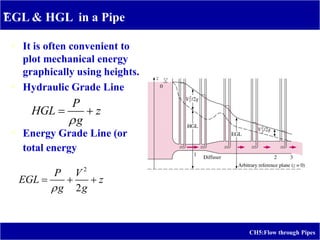
EGL & HGL in a Pipe
 It is often convenient to
plot mechanical energy
graphically using heights.
 Hydraulic Grade Line
 Energy Grade Line (or
total energy)
P
HGL z
g

 
2
2
P V
EGL z
g g

  
CH5:Flow through Pipes
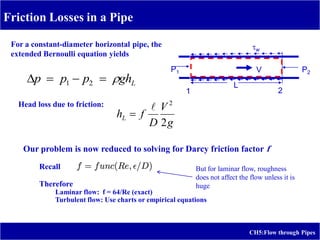
Friction Losses in a Pipe
For a constant-diameter horizontal pipe, the
extended Bernoulli equation yields
L
gh
p
p
p 
2
1 



Head loss due to friction:
g
V
D
f
hL
2
2


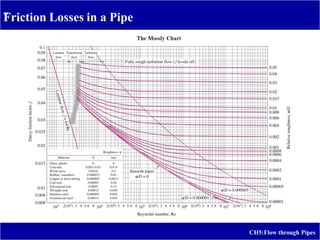
Our problem is now reduced to solving for Darcy friction factor f
Recall
Therefore
Laminar flow: f = 64/Re (exact)
Turbulent flow: Use charts or empirical equations
But for laminar flow, roughness
does not affect the flow unless it is
huge
1 2
L
w
P1 P2
V
-
CH5:Flow through Pipes
Friction Losses in a Pipe
-
CH5:Flow through Pipes
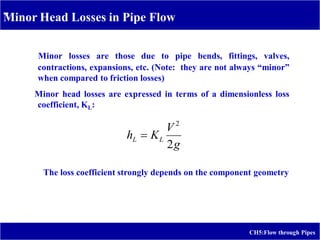
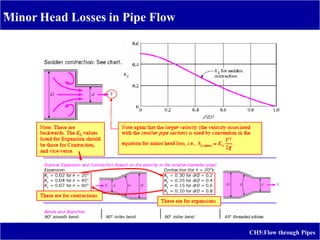
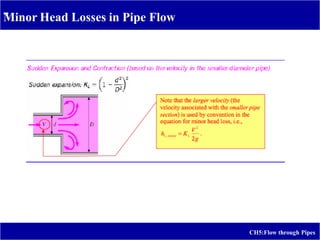
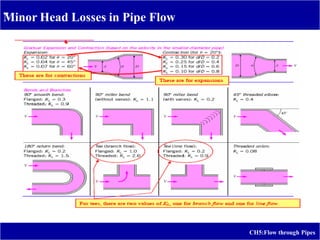
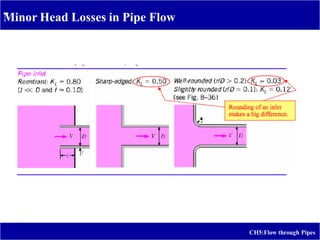
Minor Head Losses in Pipe Flow
Minor losses are those due to pipe bends, fittings, valves,
contractions, expansions, etc. (Note: they are not always “minor”
when compared to friction losses)
Minor head losses are expressed in terms of a dimensionless loss
coefficient, KL:
g
V
K
h L
L
2
2

The loss coefficient strongly depends on the component geometry
-
CH5:Flow through Pipes
Minor Head Losses in Pipe Flow
-
CH5:Flow through Pipes
Minor Head Losses in Pipe Flow
-
CH5:Flow through Pipes
Minor Head Losses in Pipe Flow
-
CH5:Flow through Pipes
Minor Head Losses in Pipe Flow
-
CH5:Flow through Pipes
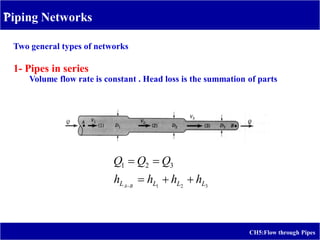
Piping Networks
Two general types of networks
1- Pipes in series
Volume flow rate is constant . Head loss is the summation of parts
is the same
3
2
1
3
2
1
L
L
L
L h
h
h
h
Q
Q
Q
B
A






-
CH5:Flow through Pipes
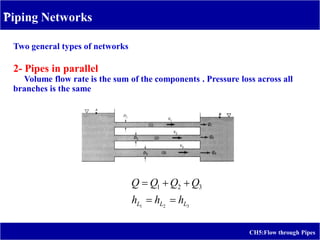
Piping Networks
Two general types of networks
2- Pipes in parallel
Volume flow rate is the sum of the components . Pressure loss across all
branches is the same
3
2
1
3
2
1
L
L
L h
h
h
Q
Q
Q
Q





2
/
62
.
0
,
/
300
,
12 m
Ns
m
N 
 

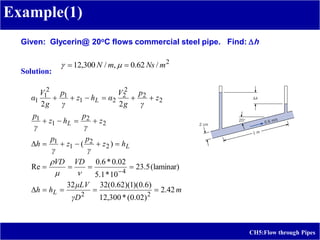
Given: Glycerin@ 20oC flows commercial steel pipe. Find: h
Solution:
m
γD
μLV
h
h
VD
VD
h
z
γ
p
z
γ
p
h
z
γ
p
h
z
γ
p
z
γ
p
g
V
α
h
z
γ
p
g
V
α
L
L
L
L
42
.
2
)
02
.
0
(
*
300
,
12
)
6
.
0
)(
1
)(
62
.
0
(
32
32
(laminar)
5
.
23
10
*
1
.
5
02
.
0
*
6
.
0
Re
)
(
2
2
2
2
4
2
2
1
1
2
2
1
1
2
2
2
2
2
1
1
2
1
1





























Example(1)
CH5:Flow through Pipes
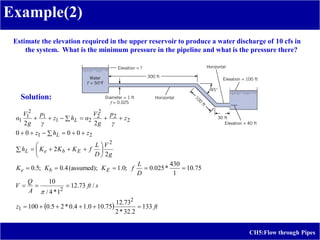
Estimate the elevation required in the upper reservoir to produce a water discharge of 10 cfs in
the system. What is the minimum pressure in the pipeline and what is the pressure there?
  ft
z
s
ft
A
Q
V
D
L
f
K
K
K
g
V
D
L
f
K
K
K
h
z
h
z
z
γ
p
g
V
α
h
z
γ
p
g
V
α
E
b
e
E
b
e
L
L
L
133
2
.
32
*
2
73
.
12
75
.
10
0
.
1
4
.
0
*
2
5
.
0
100
/
73
.
12
1
*
4
/
10
75
.
10
1
430
*
025
.
0
;
0
.
1
;
(assumed)
4
.
0
;
5
.
0
2
2
0
0
0
0
2
2
2
1
2
2
2
1
2
2
2
2
2
1
1
2
1
1








































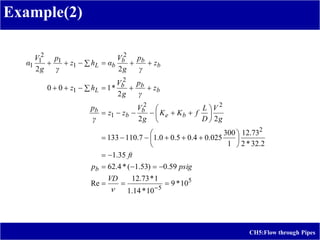
Example(2)
CH5:Flow through Pipes
Solution:
5
5
2
2
2
1
2
1
2
1
1
2
1
1
10
*
9
10
*
14
.
1
1
*
73
.
12
Re
59
.
0
)
53
.
1
(
*
4
.
62
35
.
1
2
.
32
*
2
73
.
12
1
300
025
.
0
4
.
0
5
.
0
0
.
1
7
.
110
133
2
2
2
*
1
0
0
2
2

















































VD
psig
p
ft
g
V
D
L
f
K
K
g
V
z
z
γ
p
z
γ
p
g
V
h
z
z
γ
p
g
V
α
h
z
γ
p
g
V
α
b
b
e
b
b
b
b
b
b
L
b
b
b
b
L
Example(2)
CH5:Flow through Pipes
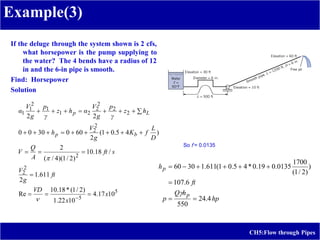
If the deluge through the system shown is 2 cfs,
what horsepower is the pump supplying to
the water? The 4 bends have a radius of 12
in and the 6-in pipe is smooth.
Find: Horsepower
Solution:
5
5
2
2
2
2
2
2
2
2
2
2
1
1
2
1
1
10
17
.
4
10
22
.
1
)
2
/
1
(
*
18
.
10
Re
611
.
1
2
/
18
.
10
)
2
/
1
)(
4
/
(
2
)
4
5
.
0
1
(
2
60
0
30
0
0
2
2
x
x
VD
ft
g
V
s
ft
A
Q
V
D
L
f
K
g
V
h
h
z
γ
p
g
V
α
h
z
γ
p
g
V
α
b
p
L
p



























hp
h
Q
p
ft
h
p
p
4
.
24
550
6
.
107
)
)
2
/
1
(
1700
0135
.
0
19
.
0
*
4
5
.
0
1
(
611
.
1
30
60










So f = 0.0135
Example(3)
CH5:Flow through Pipes
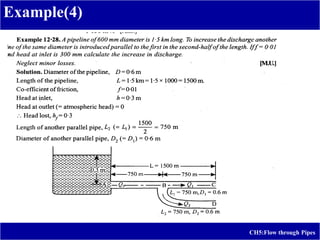
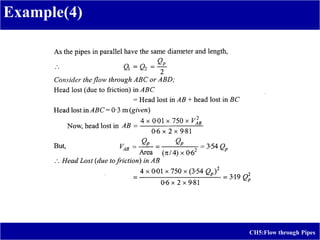
Example(4)
CH5:Flow through Pipes
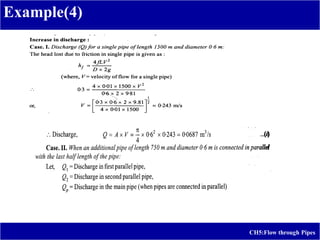
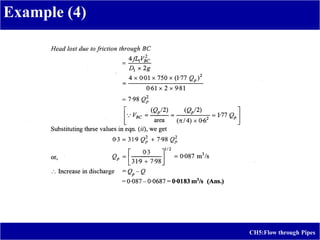
Example(4)
CH5:Flow through Pipes
Example(4)
CH5:Flow through Pipes
Example (4)
CH5:Flow through Pipes
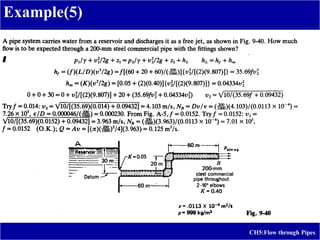
Example(5)
CH5:Flow through Pipes
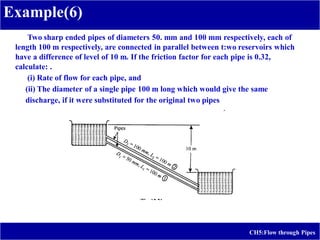
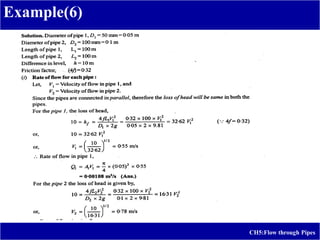
Example(6)
CH5:Flow through Pipes
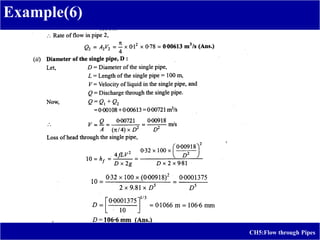
Two sharp ended pipes of diameters 50. mm and 100 mm respectively, each of
length 100 m respectively, are connected in parallel between t:wo reservoirs which
have a difference of level of 10 m. If the friction factor for each pipe is 0.32,
calculate: .
(i) Rate of flow for each pipe, and
(ii) The diameter of a single pipe 100 m long which would give the same
discharge, if it were substituted for the original two pipes
Example(6)
CH5:Flow through Pipes
Example(6)
CH5:Flow through Pipes
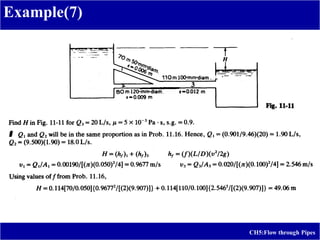
Example(7)
CH5:Flow through Pipes
Example(8)
CH5:Flow through Pipes
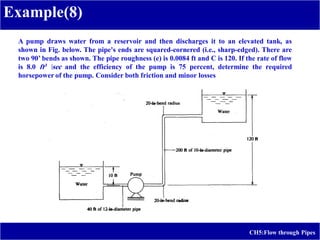
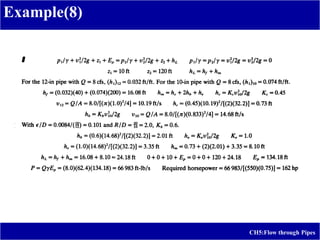
A pump draws water from a reservoir and then discharges it to an elevated tank, as
shown in Fig. below. The pipe's ends are squared-cornered (i.e., sharp-edged). There are
two 90’ bends as shown. The pipe roughness (e) is 0.0084 ft and C is 120. If the rate of flow
is 8.0 ft3 sec and the efficiency of the pump is 75 percent, determine the required
horsepower of the pump. Consider both friction and minor losses
Example(8)
CH5:Flow through Pipes
Example(9)
CH5:Flow through Pipes
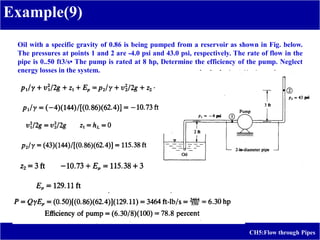
Oil with a specific gravity of 0.86 is being pumped from a reservoir as shown in Fig. below.
The pressures at points 1 and 2 are -4.0 psi and 43.0 psi, respectively. The rate of flow in the
pipe is 0..50 ft3/s• The pump is rated at 8 hp, Determine the efficiency of the pump. Neglect
energy losses in the system.
Post test
CH5:Flow through Pipes
"~,
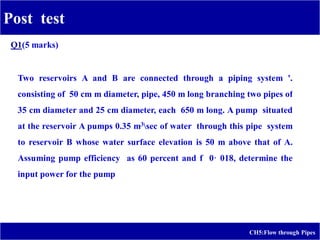
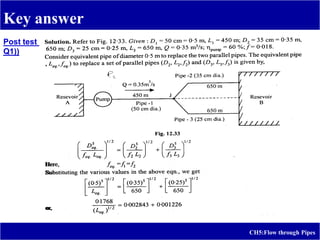
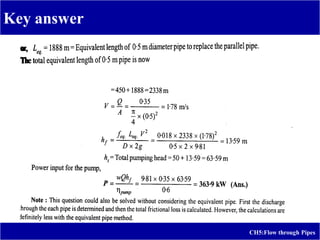
Two reservoirs A and B are connected through a piping system '.
consisting of 50 cm m diameter, pipe, 450 m long branching two pipes of
35 cm diameter and 25 cm diameter, each 650 m long. A pump situated
at the reservoir A pumps 0.35 m3sec of water through this pipe system
to reservoir B whose water surface elevation is 50 m above that of A.
Assuming pump efficiency as 60 percent and f 0· 018, determine the
input power for the pump",
Q1(5 marks)
Post test
CH5:Flow through Pipes
Q2(5 marks)
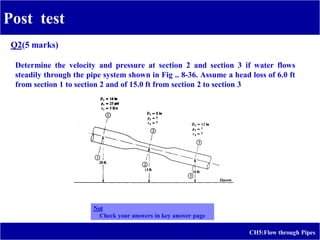
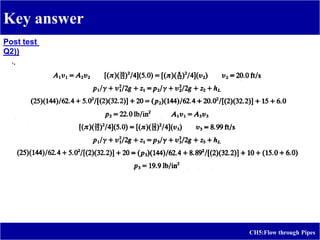
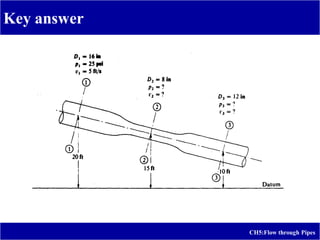
Determine the velocity and pressure at section 2 and section 3 if water flows
steadily through the pipe system shown in Fig .. 8-36. Assume a head loss of 6.0 ft
from section 1 to section 2 and of 15.0 ft from section 2 to section 3.
Not
Check your answers in key answer page
Key answer
CH5:Flow through Pipes
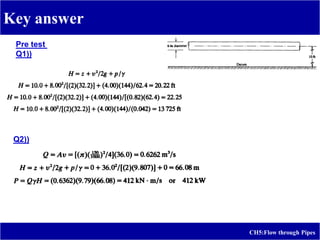
Pre test
))
1
Q
))
2
Q
Key answer
CH5:Flow through Pipes
Post test
))
1
Q
Key answer
CH5:Flow through Pipes
Key answer
CH5:Flow through Pipes
Post test
))
2
Q
Key answer
CH5:Flow through Pipes
References
CH1: Fluid Properties
1. Evett, J., B. and Liu, C. 1989 “2500 solved problems in fluid mechanics and
hydraulics” Library of Congress Cataloging- in-Publication Data, (Schaum's
solved problems series) ISBN 0-07-019783-0
2. Rajput, R.,K. 2000 “ A Text Book of Fluid Mechanics and Hydraulic
Machines”. S.Chand & Company LTD.
3. White, F., M. 2000 “ Fluid Mechanics”. McGraw-Hill Series in Mechanical
Engineering.
4. Wily, S., 1983 “ Fluid Mechanics”. McGraw-Hill Series in Mechanical
Engineering.

Flow through pipes

  • 1.
    Ministry of HigherEducation & Scientific Research Foundation of Technical Education Technical College of Basrah CH5: Flow through Pipes Training Package in Fluid Mechanics Modular unit 5 Flow through Pipes By Risala A. Mohammed M.Sc. Civil Engineering Asst. Lect. Environmental & Pollution Engineering Department 2011
  • 2.
    1- Over view 1-1Target population CH5:Flow through Pipes For the students of second class in Environmental engineering Department in Technical College
  • 3.
    1-2 Rationale CH5:Flow throughPipes The study of flow in pipes is very important in the design of networks of water pipes and sewage. Where calculate the diameters of the pipes which transfer of the fluid at specific flow rate, in addition to estimating flow losses which are very important in calculating the design of water treatment plant.
  • 4.
    1-3 Central Idea CH5:Flowthrough Pipes The main goal of this chapter are to know the Bernoulli equation and the losses of flow through pipes.
  • 5.
    1-4 Instructions CH5:Flow throughPipes 1- Study over view thoroughly 2- Identify the goal of this modular unit 3- Do the Pretest and if you :- *Get 9 or more you do not need to proceed *Get less than 9 you have to study this modular 4- After studying the text of this modular unit , do the post test and if you :- *Get 9 or more , so go on studying modular unit six *Get less than 9 , go back and study the modular unit five
  • 6.
    1-5 Performance Objectives CH5:Flowthrough Pipes At the end of this modular unit the student will be able to :- 1- Drive the Bernoulli and Energy equation. 2- Draw the energy line and hydraulic grid line. 3- Use the moody chart 4- Calculate the friction losses and minor losses of fluid flow through pipes.
  • 7.
    2- Pre test - CH5:Flowthrough Pipes marks) 5 ( 1 Q marks) 5 ( 2 Q
  • 8.
    CH5:Flow through Pipes Bernoulli´sEquation Consider a fluid flowing in a tube as shown in the figure in a steady, incompressible, no viscous flow. We apply the work-energy theorem to a sample of fluid initially contained between point 1 and 2. During time Δt this sample moves along the tube to the region between points 1´and 2´. So, Wall forces = ΔK [Change of kinetic Energy] Wall forces include gravitational and pressure forces. We neglecting internal frictional forces. Non-viscous flow. No mechanical dissipation energy is considered. Work of gravitational forces can be computed as the variation of potential energy of sample. Considering the continuity equation we can obtain Change of kinetic energy of sample will be Fluid moving in a pipe that varies in both height and cross-sectional area. The net effect on the sample during a time Δt is that a mass initially at height h1 and speed v1 is transferred to a height h2 with speed v2 ) ( ) ( ) ( 2 1 2 1 h h V g h h g m U          ) ( ) )( ( 2 1 2 2 2 1 2 1 2 2 2 1 v v V v v m K        
  • 9.
    CH5:Flow through Pipes Bernoulli´sEquation ) ( ) ( ) ( 2 1 2 2 2 1 1 2 2 1 v v V h h g V V P P           V P t v A P W V P t v A P W F F     2 2 2 2 1 1 1 1 2 1       Units: Joule (energy) If we divide both sides by ΔV ) ( ) ( ) ( 2 1 2 2 2 1 1 2 2 1 v v h h g P P        Units: Joule (energy) per unit of volume We can rearrange the terms const v h g P or v h g P v h g P         2 2 1 2 2 2 1 2 2 2 1 2 1 1 1       The Bernoulli Equation states that the energy is the same at any two points along a streamline in steady, incompressible and frictionless flow. The work done by the pressure forces exerted by the fluid behind the sample and by the fluid in front of the sample will be Applying the work-energy theorem we can obtain
  • 10.
    CH5:Flow through Pipes Bernoulli´sEquation const v h g P v h g P v h g P         2 2 1 2 2 2 1 2 2 2 1 2 1 1 1       Remarks about Bernoulli Equation g v h g P const g v h g P 2 2 2 2 2      Flow work or pressure energy; Is the portion of the potential energy term that the fluid is capable of yielding of its sustained pressure. IS Unit: Joule per Newton (meter). Dimension : Length (1) (2) Potential energy, due to the gravitational field. IS Unit: meter Each term having the same units (1) [Energy per unit of volume] (2) [Energy per unit of weight]. Expression (1) can also be considered as energy per volume flow rate, and (2) as energy per weight flow rate Kinetic energy. IS Unit: meter (Joule per Newton)
  • 11.
    CH5:Flow through Pipes Bernoulli´sEquation The Bernoulli equation aids in solving problem in which the losses due to internal friction (viscous flow) can be accounted experimentally by a determined coefficient. So, we can write 2 1 2 2 2 1 2 2 2 1 2 1 1 1         losses v h g P v h g P     L A h z g V p h z g V p        2 2 2 2 1 2 1 1 2 2   L T h z g V p h z g V p        2 2 2 2 1 2 1 1 2 2   Euler´s equation When pump was used hA= pump head hL= head losses When turbine was used hT= turbine head
  • 12.
    - CH5:Flow through Pipes EGL& HGL in a Pipe  It is often convenient to plot mechanical energy graphically using heights.  Hydraulic Grade Line  Energy Grade Line (or total energy) P HGL z g    2 2 P V EGL z g g    
  • 13.
    CH5:Flow through Pipes FrictionLosses in a Pipe For a constant-diameter horizontal pipe, the extended Bernoulli equation yields L gh p p p  2 1     Head loss due to friction: g V D f hL 2 2   Our problem is now reduced to solving for Darcy friction factor f Recall Therefore Laminar flow: f = 64/Re (exact) Turbulent flow: Use charts or empirical equations But for laminar flow, roughness does not affect the flow unless it is huge 1 2 L w P1 P2 V
  • 14.
  • 15.
    - CH5:Flow through Pipes MinorHead Losses in Pipe Flow Minor losses are those due to pipe bends, fittings, valves, contractions, expansions, etc. (Note: they are not always “minor” when compared to friction losses) Minor head losses are expressed in terms of a dimensionless loss coefficient, KL: g V K h L L 2 2  The loss coefficient strongly depends on the component geometry
  • 16.
    - CH5:Flow through Pipes MinorHead Losses in Pipe Flow
  • 17.
    - CH5:Flow through Pipes MinorHead Losses in Pipe Flow
  • 18.
    - CH5:Flow through Pipes MinorHead Losses in Pipe Flow
  • 19.
    - CH5:Flow through Pipes MinorHead Losses in Pipe Flow
  • 20.
    - CH5:Flow through Pipes PipingNetworks Two general types of networks 1- Pipes in series Volume flow rate is constant . Head loss is the summation of parts is the same 3 2 1 3 2 1 L L L L h h h h Q Q Q B A      
  • 21.
    - CH5:Flow through Pipes PipingNetworks Two general types of networks 2- Pipes in parallel Volume flow rate is the sum of the components . Pressure loss across all branches is the same 3 2 1 3 2 1 L L L h h h Q Q Q Q     
  • 22.
    2 / 62 . 0 , / 300 , 12 m Ns m N    Given: Glycerin@ 20oC flows commercial steel pipe. Find: h Solution: m γD μLV h h VD VD h z γ p z γ p h z γ p h z γ p z γ p g V α h z γ p g V α L L L L 42 . 2 ) 02 . 0 ( * 300 , 12 ) 6 . 0 )( 1 )( 62 . 0 ( 32 32 (laminar) 5 . 23 10 * 1 . 5 02 . 0 * 6 . 0 Re ) ( 2 2 2 2 4 2 2 1 1 2 2 1 1 2 2 2 2 2 1 1 2 1 1                              Example(1) CH5:Flow through Pipes
  • 23.
    Estimate the elevationrequired in the upper reservoir to produce a water discharge of 10 cfs in the system. What is the minimum pressure in the pipeline and what is the pressure there?   ft z s ft A Q V D L f K K K g V D L f K K K h z h z z γ p g V α h z γ p g V α E b e E b e L L L 133 2 . 32 * 2 73 . 12 75 . 10 0 . 1 4 . 0 * 2 5 . 0 100 / 73 . 12 1 * 4 / 10 75 . 10 1 430 * 025 . 0 ; 0 . 1 ; (assumed) 4 . 0 ; 5 . 0 2 2 0 0 0 0 2 2 2 1 2 2 2 1 2 2 2 2 2 1 1 2 1 1                                         Example(2) CH5:Flow through Pipes Solution:
  • 24.
  • 25.
    If the delugethrough the system shown is 2 cfs, what horsepower is the pump supplying to the water? The 4 bends have a radius of 12 in and the 6-in pipe is smooth. Find: Horsepower Solution: 5 5 2 2 2 2 2 2 2 2 2 2 1 1 2 1 1 10 17 . 4 10 22 . 1 ) 2 / 1 ( * 18 . 10 Re 611 . 1 2 / 18 . 10 ) 2 / 1 )( 4 / ( 2 ) 4 5 . 0 1 ( 2 60 0 30 0 0 2 2 x x VD ft g V s ft A Q V D L f K g V h h z γ p g V α h z γ p g V α b p L p                            hp h Q p ft h p p 4 . 24 550 6 . 107 ) ) 2 / 1 ( 1700 0135 . 0 19 . 0 * 4 5 . 0 1 ( 611 . 1 30 60           So f = 0.0135 Example(3) CH5:Flow through Pipes
  • 26.
  • 27.
  • 28.
  • 29.
  • 30.
  • 31.
    Example(6) CH5:Flow through Pipes Twosharp ended pipes of diameters 50. mm and 100 mm respectively, each of length 100 m respectively, are connected in parallel between t:wo reservoirs which have a difference of level of 10 m. If the friction factor for each pipe is 0.32, calculate: . (i) Rate of flow for each pipe, and (ii) The diameter of a single pipe 100 m long which would give the same discharge, if it were substituted for the original two pipes
  • 32.
  • 33.
  • 34.
  • 35.
    Example(8) CH5:Flow through Pipes Apump draws water from a reservoir and then discharges it to an elevated tank, as shown in Fig. below. The pipe's ends are squared-cornered (i.e., sharp-edged). There are two 90’ bends as shown. The pipe roughness (e) is 0.0084 ft and C is 120. If the rate of flow is 8.0 ft3 sec and the efficiency of the pump is 75 percent, determine the required horsepower of the pump. Consider both friction and minor losses
  • 36.
  • 37.
    Example(9) CH5:Flow through Pipes Oilwith a specific gravity of 0.86 is being pumped from a reservoir as shown in Fig. below. The pressures at points 1 and 2 are -4.0 psi and 43.0 psi, respectively. The rate of flow in the pipe is 0..50 ft3/s• The pump is rated at 8 hp, Determine the efficiency of the pump. Neglect energy losses in the system.
  • 38.
    Post test CH5:Flow throughPipes "~, Two reservoirs A and B are connected through a piping system '. consisting of 50 cm m diameter, pipe, 450 m long branching two pipes of 35 cm diameter and 25 cm diameter, each 650 m long. A pump situated at the reservoir A pumps 0.35 m3sec of water through this pipe system to reservoir B whose water surface elevation is 50 m above that of A. Assuming pump efficiency as 60 percent and f 0· 018, determine the input power for the pump", Q1(5 marks)
  • 39.
    Post test CH5:Flow throughPipes Q2(5 marks) Determine the velocity and pressure at section 2 and section 3 if water flows steadily through the pipe system shown in Fig .. 8-36. Assume a head loss of 6.0 ft from section 1 to section 2 and of 15.0 ft from section 2 to section 3. Not Check your answers in key answer page
  • 40.
    Key answer CH5:Flow throughPipes Pre test )) 1 Q )) 2 Q
  • 41.
    Key answer CH5:Flow throughPipes Post test )) 1 Q
  • 42.
  • 43.
    Key answer CH5:Flow throughPipes Post test )) 2 Q
  • 44.
  • 45.
    References CH1: Fluid Properties 1.Evett, J., B. and Liu, C. 1989 “2500 solved problems in fluid mechanics and hydraulics” Library of Congress Cataloging- in-Publication Data, (Schaum's solved problems series) ISBN 0-07-019783-0 2. Rajput, R.,K. 2000 “ A Text Book of Fluid Mechanics and Hydraulic Machines”. S.Chand & Company LTD. 3. White, F., M. 2000 “ Fluid Mechanics”. McGraw-Hill Series in Mechanical Engineering. 4. Wily, S., 1983 “ Fluid Mechanics”. McGraw-Hill Series in Mechanical Engineering.