Cloud Computing, Data Mining and CyberinfrastructureChemistry in the Digital Age Workshop, Penn State University, June 11, 2009Geoffrey Fox gcf@indiana.eduwww.infomall.org/salsahttp://grids.ucs.indiana.edu/ptliupages/(Presented by Marlon Pierce)Community Grids Laboratory, Chair Department of InformaticsSchool of InformaticsIndiana University
Cloud Computing: Infrastructure and RuntimesCloud infrastructure: outsourcing of servers, computing, data, file space, etc.Handled through Web services that control virtual machine lifecycles.Cloud runtimes:: tools for using clouds to do data-parallel computations. Apache Hadoop, Google MapReduce, Microsoft Dryad, and others Designed for information retrieval but are excellent for a wide range of machine learning and science applications.Apache Mahout Also may be a good match for 32-128 core computers available in the next 5 years.Can also do traditional parallel computingClustering algorithms: applications for cloud-based data mining. Run on cloud infrastructureImplement with cloud runtimes.
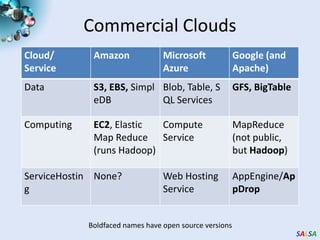
Commercial CloudsBoldfaced names have open source versions
Open Architecture CloudsAmazon, Google, Microsoft, et al., don’t tell you how to build a cloud.Proprietary knowledgeIndiana University and others want to document this publically. What is the right way to build a cloud?It is more than just running software.What is the minimum-sized organization to run a cloud?Department?  University? University Consortium? Outsource it all?Analogous issues in government, industry, and enterprise.Example issues:What hardware setups work best?  What are you getting into?What is the best virtualization technology for different problems?What is the right way to implement S3- and EBS-like data services?  Content Distribution Systems? Persistent, reliable service hosting?
Cloud RuntimesWhat science can you do on a cloud?
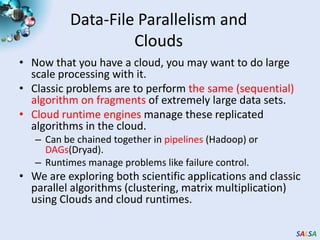
Data-File Parallelism and CloudsNow that you have a cloud, you may want to do large scale processing with it.Classic problems are to perform the same (sequential) algorithm on fragments of extremely large data sets.Cloud runtime engines manage these replicated algorithms in the cloud.Can be chained together in pipelines (Hadoop) or DAGs(Dryad).Runtimes manage problems like failure control.We are exploring both scientific applications and classic parallel algorithms (clustering, matrix multiplication) using Clouds and cloud runtimes.
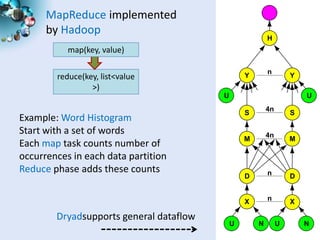
7HnYYUU4nSS4nMMnDDnXXUUNNMapReduce implemented by Hadoopmap(key, value)reduce(key, list<value>)Example: Word HistogramStart with a set of wordsEach map task counts number of occurrences in each data partitionReduce phase adds these countsDryadsupports general dataflow
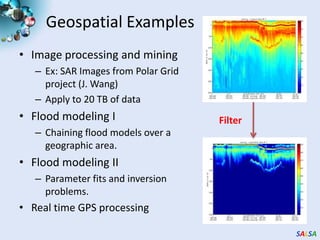
Geospatial ExamplesImage processing and miningEx: SAR Images from Polar Grid project (J. Wang) Apply to 20 TB of dataFlood modeling IChaining flood models over a geographic area. Flood modeling IIParameter fits and inversion problems.Real time GPS processingFilter
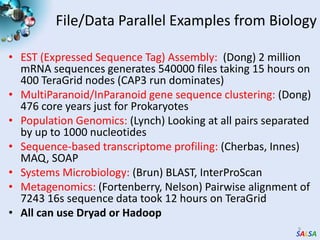
File/Data Parallel Examples from BiologyEST (Expressed Sequence Tag) Assembly:  (Dong) 2 million mRNA sequences generates 540000 files taking 15 hours on 400 TeraGrid nodes (CAP3 run dominates)MultiParanoid/InParanoid gene sequence clustering: (Dong) 476 core years just for ProkaryotesPopulation Genomics: (Lynch) Looking at all pairs separated by up to 1000 nucleotidesSequence-based transcriptome profiling: (Cherbas, Innes) MAQ, SOAPSystems Microbiology: (Brun) BLAST, InterProScanMetagenomics: (Fortenberry, Nelson) Pairwise alignment of 7243 16s sequence data took 12 hours on TeraGridAll can use Dryad or Hadoop9
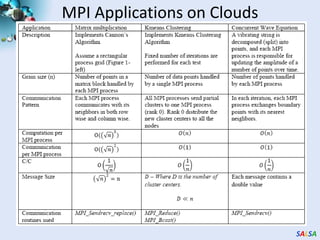
MPI Applications on Clouds
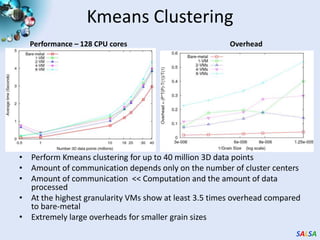
Kmeans ClusteringPerformance – 128 CPU coresOverheadPerform Kmeans clustering for up to 40 million 3D data pointsAmount of communication depends only on the number of cluster centersAmount of communication  << Computation and the amount of data processedAt the highest granularity VMs show at least 3.5 times overhead compared to bare-metalExtremely large overheads for smaller grain sizes
Deterministic Annealing for ClusteringHighly parallelizable algorithms for data-mining
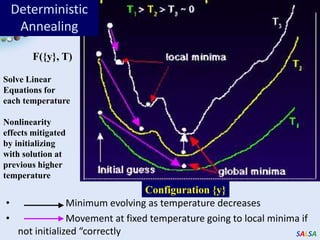
DeterministicAnnealingF({y}, T)Solve Linear Equations for each temperatureNonlinearity effects mitigated by initializing with solution at previous higher temperatureConfiguration {y}                    Minimum evolving as temperature decreases                    Movement at fixed temperature going to local minima if not initialized “correctly
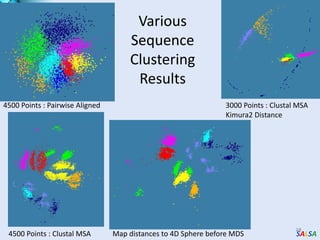
Various Sequence Clustering Results143000 Points : Clustal MSAKimura2 Distance4500 Points : Pairwise Aligned4500 Points : Clustal MSAMap distances to 4D Sphere before MDS
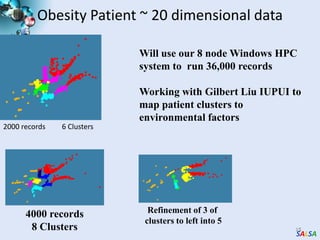
Obesity Patient ~ 20 dimensional data15Will use our 8 node Windows HPC system to  run 36,000 recordsWorking with Gilbert Liu IUPUI to map patient clusters to environmental factors2000 records         6 ClustersRefinement of 3 of clusters to left into 54000 records 8 Clusters
ConclusionsWe believe Cloud Computing will dramatically change scientific computing infrastructure.No more clusters in the closet?Controllable, sustainable computing.But we need to know what we are getting into.Even better, clouds (wherever they are) are well suited for a wide range of scientific and computer science applications.We are exploring some of these in biology, clustering, geospatial processing, and hopefully chemistry.

Slide 1

  • 1.
    Cloud Computing, DataMining and CyberinfrastructureChemistry in the Digital Age Workshop, Penn State University, June 11, 2009Geoffrey Fox gcf@indiana.eduwww.infomall.org/salsahttp://grids.ucs.indiana.edu/ptliupages/(Presented by Marlon Pierce)Community Grids Laboratory, Chair Department of InformaticsSchool of InformaticsIndiana University
  • 2.
    Cloud Computing: Infrastructureand RuntimesCloud infrastructure: outsourcing of servers, computing, data, file space, etc.Handled through Web services that control virtual machine lifecycles.Cloud runtimes:: tools for using clouds to do data-parallel computations. Apache Hadoop, Google MapReduce, Microsoft Dryad, and others Designed for information retrieval but are excellent for a wide range of machine learning and science applications.Apache Mahout Also may be a good match for 32-128 core computers available in the next 5 years.Can also do traditional parallel computingClustering algorithms: applications for cloud-based data mining. Run on cloud infrastructureImplement with cloud runtimes.
  • 3.
    Commercial CloudsBoldfaced nameshave open source versions
  • 4.
    Open Architecture CloudsAmazon,Google, Microsoft, et al., don’t tell you how to build a cloud.Proprietary knowledgeIndiana University and others want to document this publically. What is the right way to build a cloud?It is more than just running software.What is the minimum-sized organization to run a cloud?Department? University? University Consortium? Outsource it all?Analogous issues in government, industry, and enterprise.Example issues:What hardware setups work best? What are you getting into?What is the best virtualization technology for different problems?What is the right way to implement S3- and EBS-like data services? Content Distribution Systems? Persistent, reliable service hosting?
  • 5.
    Cloud RuntimesWhat sciencecan you do on a cloud?
  • 6.
    Data-File Parallelism andCloudsNow that you have a cloud, you may want to do large scale processing with it.Classic problems are to perform the same (sequential) algorithm on fragments of extremely large data sets.Cloud runtime engines manage these replicated algorithms in the cloud.Can be chained together in pipelines (Hadoop) or DAGs(Dryad).Runtimes manage problems like failure control.We are exploring both scientific applications and classic parallel algorithms (clustering, matrix multiplication) using Clouds and cloud runtimes.
  • 7.
    7HnYYUU4nSS4nMMnDDnXXUUNNMapReduce implemented byHadoopmap(key, value)reduce(key, list<value>)Example: Word HistogramStart with a set of wordsEach map task counts number of occurrences in each data partitionReduce phase adds these countsDryadsupports general dataflow
  • 8.
    Geospatial ExamplesImage processingand miningEx: SAR Images from Polar Grid project (J. Wang) Apply to 20 TB of dataFlood modeling IChaining flood models over a geographic area. Flood modeling IIParameter fits and inversion problems.Real time GPS processingFilter
  • 9.
    File/Data Parallel Examplesfrom BiologyEST (Expressed Sequence Tag) Assembly: (Dong) 2 million mRNA sequences generates 540000 files taking 15 hours on 400 TeraGrid nodes (CAP3 run dominates)MultiParanoid/InParanoid gene sequence clustering: (Dong) 476 core years just for ProkaryotesPopulation Genomics: (Lynch) Looking at all pairs separated by up to 1000 nucleotidesSequence-based transcriptome profiling: (Cherbas, Innes) MAQ, SOAPSystems Microbiology: (Brun) BLAST, InterProScanMetagenomics: (Fortenberry, Nelson) Pairwise alignment of 7243 16s sequence data took 12 hours on TeraGridAll can use Dryad or Hadoop9
  • 10.
  • 11.
    Kmeans ClusteringPerformance –128 CPU coresOverheadPerform Kmeans clustering for up to 40 million 3D data pointsAmount of communication depends only on the number of cluster centersAmount of communication << Computation and the amount of data processedAt the highest granularity VMs show at least 3.5 times overhead compared to bare-metalExtremely large overheads for smaller grain sizes
  • 12.
    Deterministic Annealing forClusteringHighly parallelizable algorithms for data-mining
  • 13.
    DeterministicAnnealingF({y}, T)Solve LinearEquations for each temperatureNonlinearity effects mitigated by initializing with solution at previous higher temperatureConfiguration {y} Minimum evolving as temperature decreases Movement at fixed temperature going to local minima if not initialized “correctly
  • 14.
    Various Sequence ClusteringResults143000 Points : Clustal MSAKimura2 Distance4500 Points : Pairwise Aligned4500 Points : Clustal MSAMap distances to 4D Sphere before MDS
  • 15.
    Obesity Patient ~20 dimensional data15Will use our 8 node Windows HPC system to run 36,000 recordsWorking with Gilbert Liu IUPUI to map patient clusters to environmental factors2000 records 6 ClustersRefinement of 3 of clusters to left into 54000 records 8 Clusters
  • 16.
    ConclusionsWe believe CloudComputing will dramatically change scientific computing infrastructure.No more clusters in the closet?Controllable, sustainable computing.But we need to know what we are getting into.Even better, clouds (wherever they are) are well suited for a wide range of scientific and computer science applications.We are exploring some of these in biology, clustering, geospatial processing, and hopefully chemistry.