

Sleep Apnea
     & the Eye
 Rick Trevino, OD, FAAO
 Rosenberg School of Optometry
 University of the Incarnate Word
Sleep Apnea & the Eye
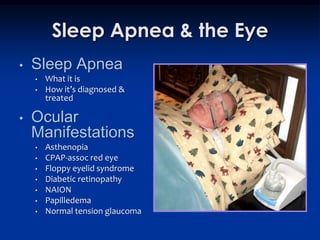
•   Sleep Apnea
    •   What it is
    •   How it’s diagnosed &
        treated

•   Ocular
    Manifestations
    •   Asthenopia
    •   CPAP-assoc red eye
    •   Floppy eyelid syndrome
    •   Diabetic retinopathy
    •   NAION
    •   Papilledema
    •   Normal tension glaucoma
Online Resources

Lecture Notes
 •   http://richardtrevino.net

Powerpoint Slides
 •   http://slideshare.net/rhodopsin

Free Texts
 •   http://jfponline.com (Aug 2008)
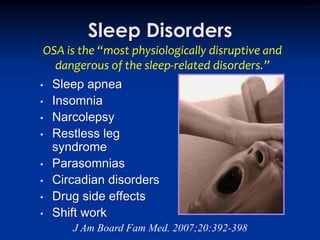
Sleep Disorders
OSA is the “most physiologically disruptive and
  dangerous of the sleep-related disorders.”
•   Sleep apnea
•   Insomnia
•   Narcolepsy
•   Restless leg
    syndrome
•   Parasomnias
•   Circadian disorders
•   Drug side effects
•   Shift work
       J Am Board Fam Med. 2007;20:392-398
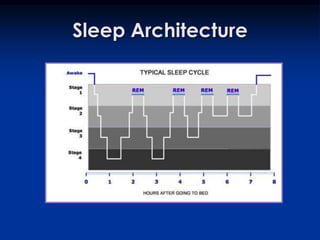
Sleep Architecture
Obstructive Sleep Apnea
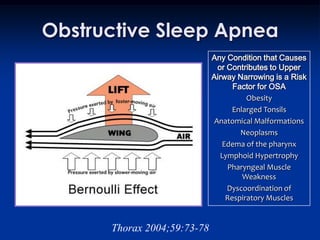
                             Any Condition that Causes
                               or Contributes to Upper
                             Airway Narrowing is a Risk
                                   Factor for OSA
                                       Obesity
                                   Enlarged Tonsils
                              Anatomical Malformations
                                     Neoplasms
                                Edema of the pharynx
                                Lymphoid Hypertrophy
                                  Pharyngeal Muscle
                                      Weakness
                                  Dyscoordination of
                                 Respiratory Muscles


      Thorax 2004;59:73-78
Obstructive Sleep Apnea
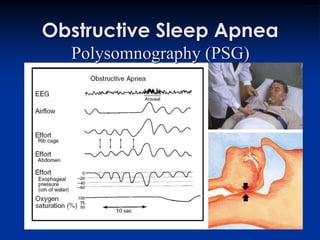
  Polysomnography (PSG)
Obstructive Sleep Apnea
             Clinical Characteristics
Excessive daytime                  Obesity
sleepiness                         •   30% of pts with a BMI > 30 have
                                       OSA, and 50% of pts with a BMI
•   Most common symptom
                                       > 40 have OSA.
Disruptive snoring                 Neck circumference
•   Also gasping/snorting during
                                   • ≥40 cm had a sensitivity of 61%
    arousals
                                     and a specificity of 93% for OSA
Apneic events                      • Correlates better than BMI

witnessed by bed                   Male
partner                            •   2-3x more common than female
                                   Family history of OSA
•   Disruptive snoring +
    witnessed apneas: 94%
    specificity                    •   Relatives have 2-4 fold  risk
Obstructive Sleep Apnea
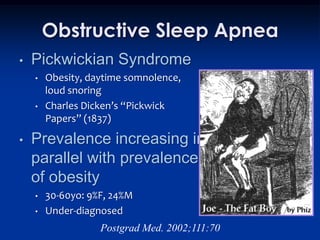
•   Pickwickian Syndrome
    •   Obesity, daytime somnolence,
        loud snoring
    •   Charles Dicken’s “Pickwick
        Papers” (1837)

•   Prevalence increasing in
    parallel with prevalence
    of obesity
    •   30-60yo: 9%F, 24%M
    •   Under-diagnosed
                   Postgrad Med. 2002;111:70
Obstructive Sleep Apnea
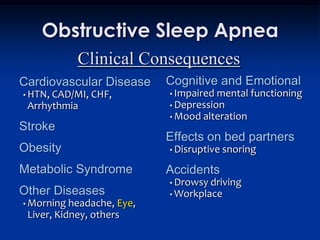
            Clinical Consequences
Cardiovascular Disease      Cognitive and Emotional
• HTN, CAD/MI,   CHF,       • Impaired mental functioning
 Arrhythmia                 • Depression
                            • Mood alteration
Stroke
                            Effects on bed partners
Obesity                     • Disruptive snoring

Metabolic Syndrome          Accidents
                            • Drowsy driving
Other Diseases              • Workplace
• Morning  headache, Eye,
 Liver, Kidney, others
Obstructive Sleep Apnea
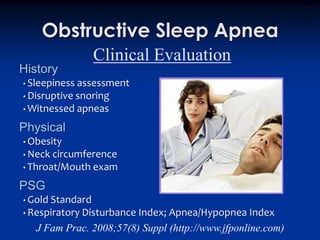
                  Clinical Evaluation
History
• Sleepiness assessment
• Disruptive snoring
• Witnessed apneas

Physical
• Obesity
• Neck circumference
• Throat/Mouth exam

PSG
• Gold Standard
• Respiratory DisturbanceIndex; Apnea/Hypopnea Index
   J Fam Prac. 2008;57(8) Suppl (http://www.jfponline.com)
Obstructive Sleep Apnea
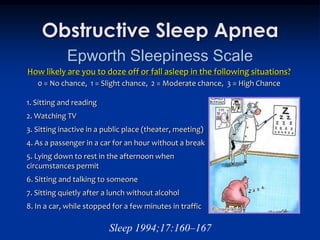
            Epworth Sleepiness Scale
How likely are you to doze off or fall asleep in the following situations?
   0 = No chance, 1 = Slight chance, 2 = Moderate chance, 3 = High Chance

1. Sitting and reading
2. Watching TV
3. Sitting inactive in a public place (theater, meeting)
4. As a passenger in a car for an hour without a break
5. Lying down to rest in the afternoon when
circumstances permit
6. Sitting and talking to someone
7. Sitting quietly after a lunch without alcohol
8. In a car, while stopped for a few minutes in traffic

                          Sleep 1994;17:160–167
Obstructive Sleep Apnea
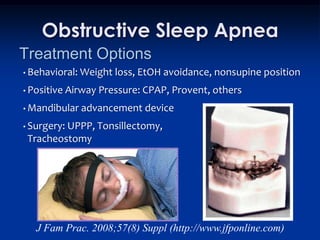
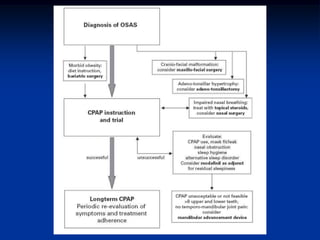
Treatment Options
• Behavioral: Weight   loss, EtOH avoidance, nonsupine position
• Positive Airway   Pressure: CPAP, Provent, others
• Mandibular   advancement device
• Surgery:
         UPPP, Tonsillectomy,
 Tracheostomy


   J Fam Prac. 2008;57(8) Suppl (http://www.jfponline.com)
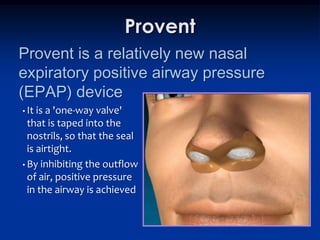
Provent
Provent is a relatively new nasal
expiratory positive airway pressure
(EPAP) device
• It is a 'one-way valve'
  that is taped into the
  nostrils, so that the seal
  is airtight.
• By inhibiting the outflow
  of air, positive pressure
  in the airway is achieved
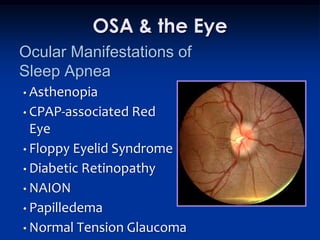
OSA & the Eye
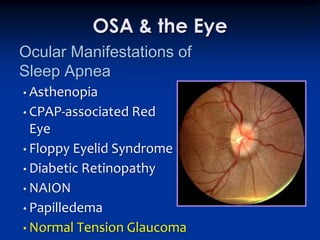
Ocular Manifestations of
Sleep Apnea
• Asthenopia
• CPAP-associated   Red
  Eye
• Floppy Eyelid Syndrome
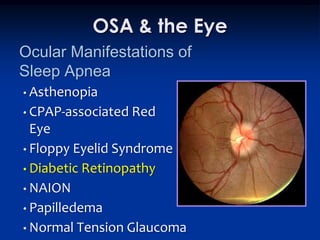
• Diabetic Retinopathy
• NAION
• Papilledema
• Normal Tension Glaucoma
Asthenopia
Common OSA-associated asthenopic
symptoms
• Unexplained symptoms                     of blur
  •   Trouble “focusing eyes”
  •   Vision is 20/20 but the patient is c/o blur
• Misinterpreting what                 is seen
  •   Incorrect recording or copying
  •   Work-related errors
• Eye strain
          and/or fatigue
• Headaches
  •   Worse in the morning
Asthenopia
If OSA is in the medical history
• Ask about sleepiness or fatigue
• Possibly due to poor compliance or residual fatigue
• Offer supportive management (eg. CPAP
  compliance)
If OSA is not in the medical history
• High index of suspicion whenever the chief complaint
  is fatigue or asthenopia
• Especially if habitus is Pickwickian
• Be prepared to screen for sleepiness
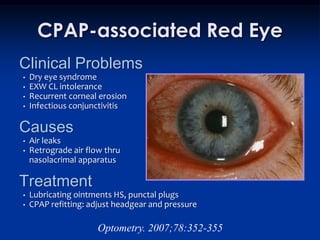
CPAP-associated Red Eye
Clinical Problems
•   Dry eye syndrome
•   EXW CL intolerance
•   Recurrent corneal erosion
•   Infectious conjunctivitis

Causes
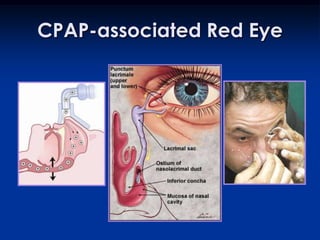
•   Air leaks
•   Retrograde air flow thru
    nasolacrimal apparatus

Treatment
•   Lubricating ointments HS, punctal plugs
•   CPAP refitting: adjust headgear and pressure

                      Optometry. 2007;78:352-355
CPAP-associated Red Eye
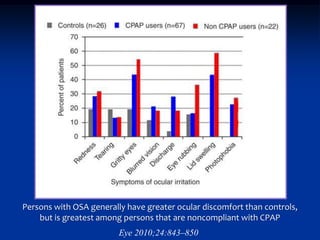
Persons with OSA generally have greater ocular discomfort than controls,
    but is greatest among persons that are noncompliant with CPAP
                         Eye 2010;24:843–850
Floppy Eyelid Syndrome
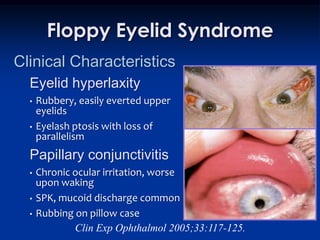
Clinical Characteristics
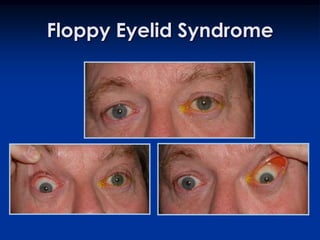
  Eyelid hyperlaxity
  •   Rubbery, easily everted upper
      eyelids
  •   Eyelash ptosis with loss of
      parallelism
  Papillary conjunctivitis
  •   Chronic ocular irritation, worse
      upon waking
  •   SPK, mucoid discharge common
  •   Rubbing on pillow case
              Clin Exp Ophthalmol 2005;33:117-125.
Floppy Eyelid Syndrome
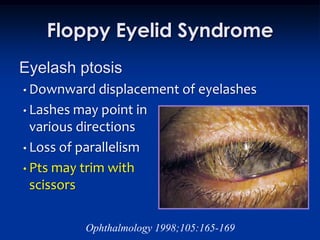
Eyelash ptosis
• Downward displacement       of eyelashes
• Lashes may  point in
  various directions
• Loss of parallelism

• Pts may trim with
  scissors

           Ophthalmology 1998;105:165-169
Floppy Eyelid Syndrome
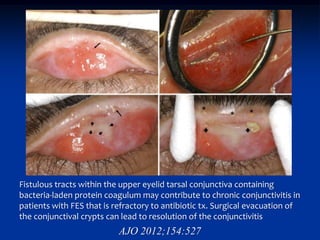
Fistulous tracts within the upper eyelid tarsal conjunctiva containing
bacteria-laden protein coagulum may contribute to chronic conjunctivitis in
patients with FES that is refractory to antibiotic tx. Surgical evacuation of
the conjunctival crypts can lead to resolution of the conjunctivitis
                           AJO 2012;154:527
Floppy Eyelid Syndrome
Etiopathogenesis
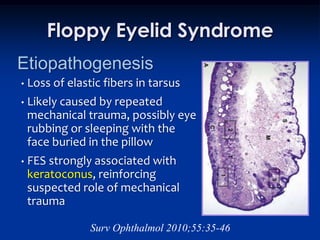
•   Loss of elastic fibers in tarsus
•   Likely caused by repeated
    mechanical trauma, possibly eye
    rubbing or sleeping with the
    face buried in the pillow
•   FES strongly associated with
    keratoconus, reinforcing
    suspected role of mechanical
    trauma

                 Surv Ophthalmol 2010;55:35-46
Floppy Eyelid Syndrome
Treatment
• CPAP     therapy
 •   Treatment of OSA can improve
     sxs

• Protect eye      during sleep
 •   Ointments HS
 •   Patching, taping, sleep mask

• Surgery isconsidered the
 definitive treatment
 •   25-50% failure rate within 2yrs
                Ophthalmology 2010;117:839-846
Floppy Eyelid Syndrome

Relation to OSA
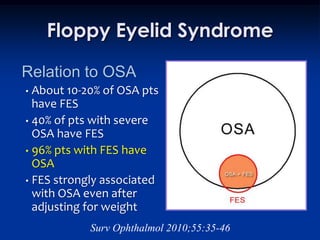
• About 10-20% of OSA pts
  have FES
• 40% of pts with severe
  OSA have FES
• 96% pts with FES have
  OSA
• FES strongly associated
  with OSA even after
  adjusting for weight
            Surv Ophthalmol 2010;55:35-46
OSA & the Eye
Ocular Manifestations of
Sleep Apnea
• Asthenopia
• CPAP-associated   Red
  Eye
• Floppy Eyelid Syndrome
• Diabetic Retinopathy
• NAION
• Papilledema
• Normal Tension Glaucoma
Diabetic Retinopathy
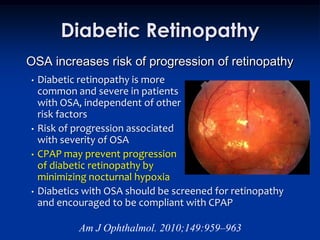
OSA increases risk of progression of retinopathy
•   Diabetic retinopathy is more
    common and severe in patients
    with OSA, independent of other
    risk factors
•   Risk of progression associated
    with severity of OSA
•   CPAP may prevent progression
    of diabetic retinopathy by
    minimizing nocturnal hypoxia
•   Diabetics with OSA should be screened for retinopathy
    and encouraged to be compliant with CPAP

            Am J Ophthalmol. 2010;149:959–963
Other Retinal Disorders
          Associated with OSA
Central Serous Chorioretinopathy
•   OSA associated with increased catecholamine levels and
    sympathetic activation
•   CSCR has been associated with increased adrenergic and
    sympathetic activity
•   Treatment of OSA has been reported to hasten recovery of
    CSCR (Graefe’s 2010;248:1037)

Retinal Vein Occlusion
•   OSA has been identified as an independent risk factor for
    RVO (hazard ratio: 1.94) (AJO 2012;154:20)
NAION
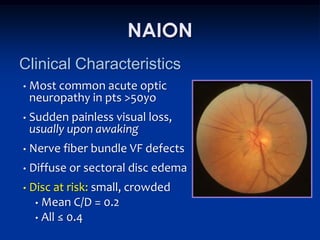
Clinical Characteristics
•   Most common acute optic
    neuropathy in pts >50yo
•   Sudden painless visual loss,
    usually upon awaking
•   Nerve fiber bundle VF defects
•   Diffuse or sectoral disc edema
•   Disc at risk: small, crowded
     • Mean C/D = 0.2
     • All ≤ 0.4
NAION
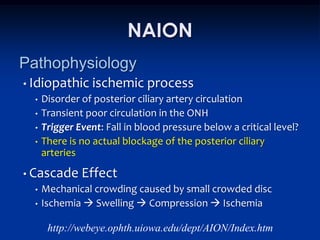
Pathophysiology
• Idiopathic      ischemic process
  •   Disorder of posterior ciliary artery circulation
  •   Transient poor circulation in the ONH
  •   Trigger Event: Fall in blood pressure below a critical level?
  •   There is no actual blockage of the posterior ciliary
      arteries
• Cascade      Effect
  •   Mechanical crowding caused by small crowded disc
  •   Ischemia  Swelling  Compression  Ischemia

       http://webeye.ophth.uiowa.edu/dept/AION/Index.htm
NAION
Diagnosis: Must exclude GCA in
every case
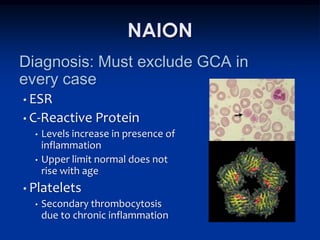
• ESR
• C-Reactive      Protein
  •   Levels increase in presence of
      inflammation
  •   Upper limit normal does not
      rise with age
• Platelets
  •   Secondary thrombocytosis
      due to chronic inflammation
NAION
Treatment
• Aspirin
  •   Decreases incidence in fellow eye at 2 yrs, but not at 5 yrs
• Surgical    decompression
  •   No benefit (Ischemic Optic Neuropathy Decompression
      Trial)
• Control     of predisposing systemic disease
  •   May slow progression or reduce incidence in fellow eye
  •   Hypertension, Diabetes, Hyperlipidemia, OSA
• Avoidphosphodiesterase 5 inhibitors
 (Viagra, Cialis, etc)
  •   May increase risk of NAION in fellow eye
NAION
Medicolegal obligation to inform pts of
          risk to fellow eye
NAION
Relation to OSA
NAION Patients with OSA
       Mojon (2002)     71%   Controls: 18%
       Palombi (2006)   89%   HTN: 59%, DM: 37%
       Li (2007)        30%   Controls: 18%
       Arda (2013)      85%   Controls: 65% (matched for DM, HTN)

Conclusions
•   OSA may play an important role in pathogenesis of NAION
•   OSA may be the systemic disorder most frequently
    associated with NAION
•   Every patient newly diagnosed with NAION should be
    tested for OSA
Papilledema
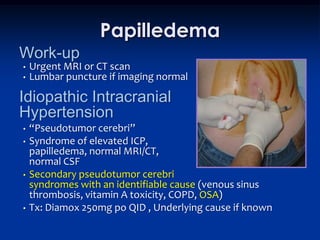
Clinical Characteristics
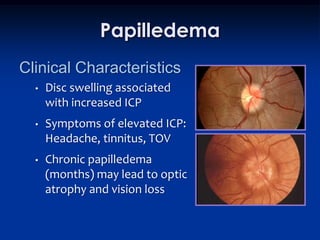
  •   Disc swelling associated
      with increased ICP
  •   Symptoms of elevated ICP:
      Headache, tinnitus, TOV
  •   Chronic papilledema
      (months) may lead to optic
      atrophy and vision loss
Papilledema
Work-up
•   Urgent MRI or CT scan
•   Lumbar puncture if imaging normal

Idiopathic Intracranial
Hypertension
•   “Pseudotumor cerebri”
•   Syndrome of elevated ICP,
    papilledema, normal MRI/CT,
    normal CSF
•   Secondary pseudotumor cerebri
    syndromes with an identifiable cause (venous sinus
    thrombosis, vitamin A toxicity, COPD, OSA)
•   Tx: Diamox 250mg po QID , Underlying cause if known
Papilledema
Relation to OSA
•   Stein (2011)
    •   Reviewed 2.3 million insurance company billing records
    •   Persons with OSA have 30% to 100% increased risk of
        developing papilledema
•   Parvin (2000)
    •   4 pts with unexplained papilledema that resolved with
        successful treatment of OSA
    •   ICP is normal during the day but elevated at night
    •   Intermittent (nocturnal) ↑ ICP can cause sustained
        papilledema
    •   Hypercapnia-induced cerebral vasodilatation elevates ICP
OSA & the Eye
Ocular Manifestations of
Sleep Apnea
• Asthenopia
• CPAP-associated   Red
  Eye
• Floppy Eyelid Syndrome
• Diabetic Retinopathy
• NAION
• Papilledema
• Normal Tension Glaucoma
Normal Tension Glaucoma
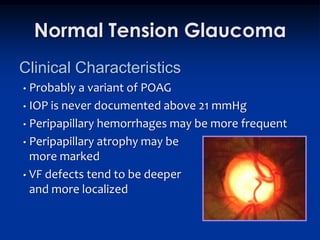
Clinical Characteristics
• Probably a variant of POAG
• IOP is never documented above 21 mmHg

• Peripapillary hemorrhages may be more frequent

• Peripapillary atrophy may be
  more marked
• VF defects tend to be deeper
  and more localized
Normal Tension Glaucoma
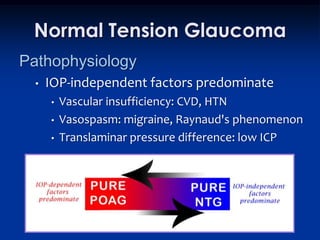
Pathophysiology
  •   IOP-independent factors predominate
      •   Vascular insufficiency: CVD, HTN
      •   Vasospasm: migraine, Raynaud's phenomenon
      •   Translaminar pressure difference: low ICP
Normal Tension Glaucoma
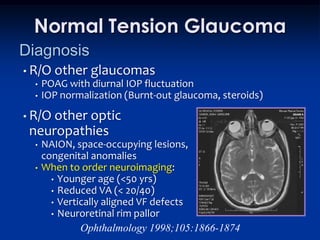
Diagnosis
• R/O   other glaucomas
  •   POAG with diurnal IOP fluctuation
  •   IOP normalization (Burnt-out glaucoma, steroids)
• R/Oother optic
 neuropathies
  •   NAION, space-occupying lesions,
      congenital anomalies
  •   When to order neuroimaging:
        • Younger age (<50 yrs)
        • Reduced VA (< 20/40)
        • Vertically aligned VF defects
        • Neuroretinal rim pallor
               Ophthalmology 1998;105:1866-1874
Normal Tension Glaucoma
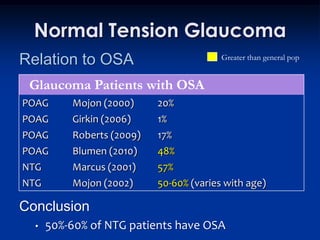
Relation to OSA                          Greater than general pop


 Glaucoma Patients with OSA
POAG      Mojon (2000)     20%
POAG      Girkin (2006)    1%
POAG      Roberts (2009)   17%
POAG      Blumen (2010)    48%
NTG       Marcus (2001)    57%
NTG       Mojon (2002)     50-60% (varies with age)

Conclusion
  •   50%-60% of NTG patients have OSA
Normal Tension Glaucoma
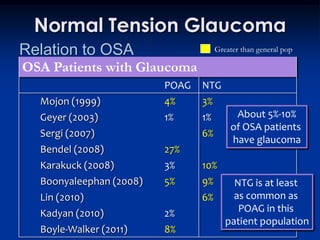
Relation to OSA                      Greater than general pop

OSA Patients with Glaucoma
                         POAG   NTG
  Mojon (1999)           4%     3%
  Geyer (2003)           1%     1%        About 5%-10%
                                         of OSA patients
  Sergi (2007)                  6%
                                         have glaucoma
  Bendel (2008)          27%
  Karakuck (2008)        3%     10%
  Boonyaleephan (2008)   5%     9%        NTG is at least
  Lin (2010)                    6%        as common as
  Kadyan (2010)          2%                POAG in this
                                        patient population
  Boyle-Walker (2011)    8%
Normal Tension Glaucoma
Relation to OSA
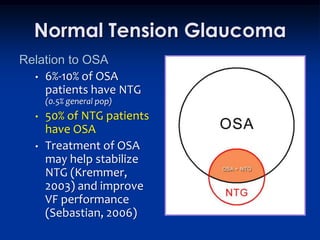
  • 6%-10% of OSA
    patients have NTG
      (0.5% general pop)
  •   50% of NTG patients
      have OSA
  •   Treatment of OSA
      may help stabilize
      NTG (Kremmer,
      2003) and improve
      VF performance
      (Sebastian, 2006)
Normal Tension Glaucoma
CPAP Increases IOP
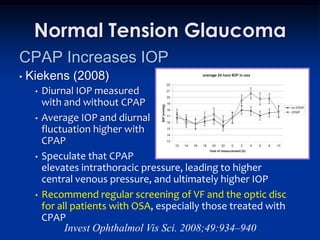
•   Kiekens (2008)
     •   Diurnal IOP measured
         with and without CPAP
     •   Average IOP and diurnal
         fluctuation higher with
         CPAP
     •   Speculate that CPAP
         elevates intrathoracic pressure, leading to higher
         central venous pressure, and ultimately higher IOP
     •   Recommend regular screening of VF and the optic disc
         for all patients with OSA, especially those treated with
         CPAP
               Invest Ophthalmol Vis Sci. 2008;49:934–940
Normal Tension Glaucoma
CPAP Increases IOP
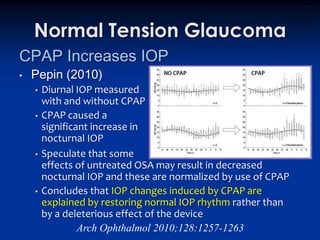
•   Pepin (2010)
    •   Diurnal IOP measured
        with and without CPAP
    •   CPAP caused a
        significant increase in
        nocturnal IOP
    •   Speculate that some
        effects of untreated OSA may result in decreased
        nocturnal IOP and these are normalized by use of CPAP
    •   Concludes that IOP changes induced by CPAP are
        explained by restoring normal IOP rhythm rather than
        by a deleterious effect of the device
                 Arch Ophthalmol 2010;128:1257-1263
Normal Tension Glaucoma
OSA May Cause NFL Loss Without Glaucoma
• NFL thinning may represent preclinical NTG
• Numerous studies (using both OCT and GDx) have
  found that NFL thickness is reduced in patients
  with OSA compared to healthy controls
    •   Degree of thinning has been correlated with severity of
        OSA
•   Functional loss in these patients may be detected
    with mfVEP, but standard automated perimetry
    may still be normal
•   This “silent optic neuropathy” may in some
    patients evolve into NTG
Normal Tension Glaucoma
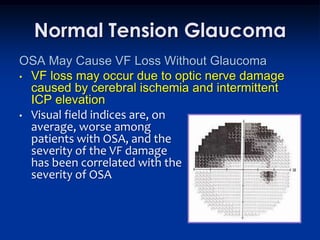
OSA May Cause VF Loss Without Glaucoma
• VF loss may occur due to optic nerve damage
  caused by cerebral ischemia and intermittent
  ICP elevation
• Visual field indices are, on
  average, worse among
  patients with OSA, and the
  severity of the VF damage
  has been correlated with the
  severity of OSA
Normal Tension Glaucoma
Conclusions & Recommendations
• Persons with     OSA should be screened for
 glaucoma
  •   Risk of glaucoma is correlated with severity of OSA
• Patientswith NTG should be screened or at
 least questioned about OSA
  •   Treatment of uncontrolled OSA may help stabilize
      glaucoma and improve VF performance
• Initiation
          of CPAP therapy may increase
 nocturnal IOP
  •   The clinical significance of this in unknown
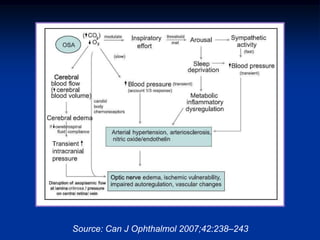
Source: Can J Ophthalmol 2007;42:238–243
Thank
 You!

Sleep Apnea & The Eye - 2013

  • 1.
    Sleep Apnea & the Eye Rick Trevino, OD, FAAO Rosenberg School of Optometry University of the Incarnate Word
  • 2.
    Sleep Apnea &the Eye • Sleep Apnea • What it is • How it’s diagnosed & treated • Ocular Manifestations • Asthenopia • CPAP-assoc red eye • Floppy eyelid syndrome • Diabetic retinopathy • NAION • Papilledema • Normal tension glaucoma
  • 3.
    Online Resources Lecture Notes • http://richardtrevino.net Powerpoint Slides • http://slideshare.net/rhodopsin Free Texts • http://jfponline.com (Aug 2008)
  • 4.
    Sleep Disorders OSA isthe “most physiologically disruptive and dangerous of the sleep-related disorders.” • Sleep apnea • Insomnia • Narcolepsy • Restless leg syndrome • Parasomnias • Circadian disorders • Drug side effects • Shift work J Am Board Fam Med. 2007;20:392-398
  • 5.
  • 6.
    Obstructive Sleep Apnea Any Condition that Causes or Contributes to Upper Airway Narrowing is a Risk Factor for OSA Obesity Enlarged Tonsils Anatomical Malformations Neoplasms Edema of the pharynx Lymphoid Hypertrophy Pharyngeal Muscle Weakness Dyscoordination of Respiratory Muscles Thorax 2004;59:73-78
  • 7.
    Obstructive Sleep Apnea Polysomnography (PSG)
  • 8.
    Obstructive Sleep Apnea Clinical Characteristics Excessive daytime Obesity sleepiness • 30% of pts with a BMI > 30 have OSA, and 50% of pts with a BMI • Most common symptom > 40 have OSA. Disruptive snoring Neck circumference • Also gasping/snorting during • ≥40 cm had a sensitivity of 61% arousals and a specificity of 93% for OSA Apneic events • Correlates better than BMI witnessed by bed Male partner • 2-3x more common than female Family history of OSA • Disruptive snoring + witnessed apneas: 94% specificity • Relatives have 2-4 fold  risk
  • 9.
    Obstructive Sleep Apnea • Pickwickian Syndrome • Obesity, daytime somnolence, loud snoring • Charles Dicken’s “Pickwick Papers” (1837) • Prevalence increasing in parallel with prevalence of obesity • 30-60yo: 9%F, 24%M • Under-diagnosed Postgrad Med. 2002;111:70
  • 10.
    Obstructive Sleep Apnea Clinical Consequences Cardiovascular Disease Cognitive and Emotional • HTN, CAD/MI, CHF, • Impaired mental functioning Arrhythmia • Depression • Mood alteration Stroke Effects on bed partners Obesity • Disruptive snoring Metabolic Syndrome Accidents • Drowsy driving Other Diseases • Workplace • Morning headache, Eye, Liver, Kidney, others
  • 11.
    Obstructive Sleep Apnea Clinical Evaluation History • Sleepiness assessment • Disruptive snoring • Witnessed apneas Physical • Obesity • Neck circumference • Throat/Mouth exam PSG • Gold Standard • Respiratory DisturbanceIndex; Apnea/Hypopnea Index J Fam Prac. 2008;57(8) Suppl (http://www.jfponline.com)
  • 12.
    Obstructive Sleep Apnea Epworth Sleepiness Scale How likely are you to doze off or fall asleep in the following situations? 0 = No chance, 1 = Slight chance, 2 = Moderate chance, 3 = High Chance 1. Sitting and reading 2. Watching TV 3. Sitting inactive in a public place (theater, meeting) 4. As a passenger in a car for an hour without a break 5. Lying down to rest in the afternoon when circumstances permit 6. Sitting and talking to someone 7. Sitting quietly after a lunch without alcohol 8. In a car, while stopped for a few minutes in traffic Sleep 1994;17:160–167
  • 13.
    Obstructive Sleep Apnea TreatmentOptions • Behavioral: Weight loss, EtOH avoidance, nonsupine position • Positive Airway Pressure: CPAP, Provent, others • Mandibular advancement device • Surgery: UPPP, Tonsillectomy, Tracheostomy J Fam Prac. 2008;57(8) Suppl (http://www.jfponline.com)
  • 14.
    Provent Provent is arelatively new nasal expiratory positive airway pressure (EPAP) device • It is a 'one-way valve' that is taped into the nostrils, so that the seal is airtight. • By inhibiting the outflow of air, positive pressure in the airway is achieved
  • 16.
    OSA & theEye Ocular Manifestations of Sleep Apnea • Asthenopia • CPAP-associated Red Eye • Floppy Eyelid Syndrome • Diabetic Retinopathy • NAION • Papilledema • Normal Tension Glaucoma
  • 17.
    Asthenopia Common OSA-associated asthenopic symptoms •Unexplained symptoms of blur • Trouble “focusing eyes” • Vision is 20/20 but the patient is c/o blur • Misinterpreting what is seen • Incorrect recording or copying • Work-related errors • Eye strain and/or fatigue • Headaches • Worse in the morning
  • 18.
    Asthenopia If OSA isin the medical history • Ask about sleepiness or fatigue • Possibly due to poor compliance or residual fatigue • Offer supportive management (eg. CPAP compliance) If OSA is not in the medical history • High index of suspicion whenever the chief complaint is fatigue or asthenopia • Especially if habitus is Pickwickian • Be prepared to screen for sleepiness
  • 19.
    CPAP-associated Red Eye ClinicalProblems • Dry eye syndrome • EXW CL intolerance • Recurrent corneal erosion • Infectious conjunctivitis Causes • Air leaks • Retrograde air flow thru nasolacrimal apparatus Treatment • Lubricating ointments HS, punctal plugs • CPAP refitting: adjust headgear and pressure Optometry. 2007;78:352-355
  • 20.
  • 21.
    Persons with OSAgenerally have greater ocular discomfort than controls, but is greatest among persons that are noncompliant with CPAP Eye 2010;24:843–850
  • 22.
    Floppy Eyelid Syndrome ClinicalCharacteristics Eyelid hyperlaxity • Rubbery, easily everted upper eyelids • Eyelash ptosis with loss of parallelism Papillary conjunctivitis • Chronic ocular irritation, worse upon waking • SPK, mucoid discharge common • Rubbing on pillow case Clin Exp Ophthalmol 2005;33:117-125.
  • 23.
    Floppy Eyelid Syndrome Eyelashptosis • Downward displacement of eyelashes • Lashes may point in various directions • Loss of parallelism • Pts may trim with scissors Ophthalmology 1998;105:165-169
  • 24.
  • 25.
    Fistulous tracts withinthe upper eyelid tarsal conjunctiva containing bacteria-laden protein coagulum may contribute to chronic conjunctivitis in patients with FES that is refractory to antibiotic tx. Surgical evacuation of the conjunctival crypts can lead to resolution of the conjunctivitis AJO 2012;154:527
  • 26.
    Floppy Eyelid Syndrome Etiopathogenesis • Loss of elastic fibers in tarsus • Likely caused by repeated mechanical trauma, possibly eye rubbing or sleeping with the face buried in the pillow • FES strongly associated with keratoconus, reinforcing suspected role of mechanical trauma Surv Ophthalmol 2010;55:35-46
  • 27.
    Floppy Eyelid Syndrome Treatment •CPAP therapy • Treatment of OSA can improve sxs • Protect eye during sleep • Ointments HS • Patching, taping, sleep mask • Surgery isconsidered the definitive treatment • 25-50% failure rate within 2yrs Ophthalmology 2010;117:839-846
  • 28.
    Floppy Eyelid Syndrome Relationto OSA • About 10-20% of OSA pts have FES • 40% of pts with severe OSA have FES • 96% pts with FES have OSA • FES strongly associated with OSA even after adjusting for weight Surv Ophthalmol 2010;55:35-46
  • 29.
    OSA & theEye Ocular Manifestations of Sleep Apnea • Asthenopia • CPAP-associated Red Eye • Floppy Eyelid Syndrome • Diabetic Retinopathy • NAION • Papilledema • Normal Tension Glaucoma
  • 30.
    Diabetic Retinopathy OSA increasesrisk of progression of retinopathy • Diabetic retinopathy is more common and severe in patients with OSA, independent of other risk factors • Risk of progression associated with severity of OSA • CPAP may prevent progression of diabetic retinopathy by minimizing nocturnal hypoxia • Diabetics with OSA should be screened for retinopathy and encouraged to be compliant with CPAP Am J Ophthalmol. 2010;149:959–963
  • 31.
    Other Retinal Disorders Associated with OSA Central Serous Chorioretinopathy • OSA associated with increased catecholamine levels and sympathetic activation • CSCR has been associated with increased adrenergic and sympathetic activity • Treatment of OSA has been reported to hasten recovery of CSCR (Graefe’s 2010;248:1037) Retinal Vein Occlusion • OSA has been identified as an independent risk factor for RVO (hazard ratio: 1.94) (AJO 2012;154:20)
  • 32.
    NAION Clinical Characteristics • Most common acute optic neuropathy in pts >50yo • Sudden painless visual loss, usually upon awaking • Nerve fiber bundle VF defects • Diffuse or sectoral disc edema • Disc at risk: small, crowded • Mean C/D = 0.2 • All ≤ 0.4
  • 33.
    NAION Pathophysiology • Idiopathic ischemic process • Disorder of posterior ciliary artery circulation • Transient poor circulation in the ONH • Trigger Event: Fall in blood pressure below a critical level? • There is no actual blockage of the posterior ciliary arteries • Cascade Effect • Mechanical crowding caused by small crowded disc • Ischemia  Swelling  Compression  Ischemia http://webeye.ophth.uiowa.edu/dept/AION/Index.htm
  • 34.
    NAION Diagnosis: Must excludeGCA in every case • ESR • C-Reactive Protein • Levels increase in presence of inflammation • Upper limit normal does not rise with age • Platelets • Secondary thrombocytosis due to chronic inflammation
  • 35.
    NAION Treatment • Aspirin • Decreases incidence in fellow eye at 2 yrs, but not at 5 yrs • Surgical decompression • No benefit (Ischemic Optic Neuropathy Decompression Trial) • Control of predisposing systemic disease • May slow progression or reduce incidence in fellow eye • Hypertension, Diabetes, Hyperlipidemia, OSA • Avoidphosphodiesterase 5 inhibitors (Viagra, Cialis, etc) • May increase risk of NAION in fellow eye
  • 36.
    NAION Medicolegal obligation toinform pts of risk to fellow eye
  • 37.
    NAION Relation to OSA NAIONPatients with OSA Mojon (2002) 71% Controls: 18% Palombi (2006) 89% HTN: 59%, DM: 37% Li (2007) 30% Controls: 18% Arda (2013) 85% Controls: 65% (matched for DM, HTN) Conclusions • OSA may play an important role in pathogenesis of NAION • OSA may be the systemic disorder most frequently associated with NAION • Every patient newly diagnosed with NAION should be tested for OSA
  • 38.
    Papilledema Clinical Characteristics • Disc swelling associated with increased ICP • Symptoms of elevated ICP: Headache, tinnitus, TOV • Chronic papilledema (months) may lead to optic atrophy and vision loss
  • 39.
    Papilledema Work-up • Urgent MRI or CT scan • Lumbar puncture if imaging normal Idiopathic Intracranial Hypertension • “Pseudotumor cerebri” • Syndrome of elevated ICP, papilledema, normal MRI/CT, normal CSF • Secondary pseudotumor cerebri syndromes with an identifiable cause (venous sinus thrombosis, vitamin A toxicity, COPD, OSA) • Tx: Diamox 250mg po QID , Underlying cause if known
  • 40.
    Papilledema Relation to OSA • Stein (2011) • Reviewed 2.3 million insurance company billing records • Persons with OSA have 30% to 100% increased risk of developing papilledema • Parvin (2000) • 4 pts with unexplained papilledema that resolved with successful treatment of OSA • ICP is normal during the day but elevated at night • Intermittent (nocturnal) ↑ ICP can cause sustained papilledema • Hypercapnia-induced cerebral vasodilatation elevates ICP
  • 41.
    OSA & theEye Ocular Manifestations of Sleep Apnea • Asthenopia • CPAP-associated Red Eye • Floppy Eyelid Syndrome • Diabetic Retinopathy • NAION • Papilledema • Normal Tension Glaucoma
  • 42.
    Normal Tension Glaucoma ClinicalCharacteristics • Probably a variant of POAG • IOP is never documented above 21 mmHg • Peripapillary hemorrhages may be more frequent • Peripapillary atrophy may be more marked • VF defects tend to be deeper and more localized
  • 43.
    Normal Tension Glaucoma Pathophysiology • IOP-independent factors predominate • Vascular insufficiency: CVD, HTN • Vasospasm: migraine, Raynaud's phenomenon • Translaminar pressure difference: low ICP
  • 44.
    Normal Tension Glaucoma Diagnosis •R/O other glaucomas • POAG with diurnal IOP fluctuation • IOP normalization (Burnt-out glaucoma, steroids) • R/Oother optic neuropathies • NAION, space-occupying lesions, congenital anomalies • When to order neuroimaging: • Younger age (<50 yrs) • Reduced VA (< 20/40) • Vertically aligned VF defects • Neuroretinal rim pallor Ophthalmology 1998;105:1866-1874
  • 45.
    Normal Tension Glaucoma Relationto OSA Greater than general pop Glaucoma Patients with OSA POAG Mojon (2000) 20% POAG Girkin (2006) 1% POAG Roberts (2009) 17% POAG Blumen (2010) 48% NTG Marcus (2001) 57% NTG Mojon (2002) 50-60% (varies with age) Conclusion • 50%-60% of NTG patients have OSA
  • 46.
    Normal Tension Glaucoma Relationto OSA Greater than general pop OSA Patients with Glaucoma POAG NTG Mojon (1999) 4% 3% Geyer (2003) 1% 1% About 5%-10% of OSA patients Sergi (2007) 6% have glaucoma Bendel (2008) 27% Karakuck (2008) 3% 10% Boonyaleephan (2008) 5% 9% NTG is at least Lin (2010) 6% as common as Kadyan (2010) 2% POAG in this patient population Boyle-Walker (2011) 8%
  • 47.
    Normal Tension Glaucoma Relationto OSA • 6%-10% of OSA patients have NTG (0.5% general pop) • 50% of NTG patients have OSA • Treatment of OSA may help stabilize NTG (Kremmer, 2003) and improve VF performance (Sebastian, 2006)
  • 48.
    Normal Tension Glaucoma CPAPIncreases IOP • Kiekens (2008) • Diurnal IOP measured with and without CPAP • Average IOP and diurnal fluctuation higher with CPAP • Speculate that CPAP elevates intrathoracic pressure, leading to higher central venous pressure, and ultimately higher IOP • Recommend regular screening of VF and the optic disc for all patients with OSA, especially those treated with CPAP Invest Ophthalmol Vis Sci. 2008;49:934–940
  • 49.
    Normal Tension Glaucoma CPAPIncreases IOP • Pepin (2010) • Diurnal IOP measured with and without CPAP • CPAP caused a significant increase in nocturnal IOP • Speculate that some effects of untreated OSA may result in decreased nocturnal IOP and these are normalized by use of CPAP • Concludes that IOP changes induced by CPAP are explained by restoring normal IOP rhythm rather than by a deleterious effect of the device Arch Ophthalmol 2010;128:1257-1263
  • 50.
    Normal Tension Glaucoma OSAMay Cause NFL Loss Without Glaucoma • NFL thinning may represent preclinical NTG • Numerous studies (using both OCT and GDx) have found that NFL thickness is reduced in patients with OSA compared to healthy controls • Degree of thinning has been correlated with severity of OSA • Functional loss in these patients may be detected with mfVEP, but standard automated perimetry may still be normal • This “silent optic neuropathy” may in some patients evolve into NTG
  • 51.
    Normal Tension Glaucoma OSAMay Cause VF Loss Without Glaucoma • VF loss may occur due to optic nerve damage caused by cerebral ischemia and intermittent ICP elevation • Visual field indices are, on average, worse among patients with OSA, and the severity of the VF damage has been correlated with the severity of OSA
  • 52.
    Normal Tension Glaucoma Conclusions& Recommendations • Persons with OSA should be screened for glaucoma • Risk of glaucoma is correlated with severity of OSA • Patientswith NTG should be screened or at least questioned about OSA • Treatment of uncontrolled OSA may help stabilize glaucoma and improve VF performance • Initiation of CPAP therapy may increase nocturnal IOP • The clinical significance of this in unknown
  • 53.
    Source: Can JOphthalmol 2007;42:238–243
  • 54.

Editor's Notes

  • #15 Each nasal opening lets air in easily but then retards the flow of air coming out. Technically, airway resistance is very low going into the nose, very high exiting the nose. By increasing airway resistance on exhaling, the air pressure backs up in the throat and helps &apos;stent open&apos; the airway, to keep it from collapsing. This is the same principle used in CPAP, which creates an increased pressure to keep the (otherwise collapsing) airway open.Does it work? In one large, controlled study published in the journal Sleep, about 250 patients were divided into a treatment group and a &apos;sham group&apos;. The treatment group got the Provent device, which they used nightly. The sham group used something that looks just like Provent, but it did not offer any resistance on breathing out. The results? Sleep apnea was signficantly improved with Provent, but not with the sham device. Also, the amount of daytime sleepiness in the treatment group was much better compared to the sham group.Advantages of Provent include no tight-fitting mask or head straps required, no machine needed, and much easier portability. Disadvatages include the fact that it&apos;s not suitable for people who have low oxygen during sleep, and it&apos;s generally not as effective as CPAP. So in summary: not as good as CPAP, but much better than nothing. Expect more such devices to be developed and brought to market.
  • #19 IF OSA IS IN THE MED HX - be on the lookout for sxs of fatigue - possibly due to poor compliance or residual fatigueIF OSA NOT IN THE MED HX - high index of suspicion for OSA whenever cc is fatigue or asthenopia - esp if habitus is pickwickian - screen for sleepinessIf the pt is dx with OSA and presents with these sxs - compliance? - residual fatigueIf pt is not dx with OSA - pickwickian? - sleepiness screening - question bed partner
  • #22 One possible explanation why CPAP noncompliance increases risk of ocular discomfort is that CPAP helps decrease sxs associated with FES
  • #26  We describe 3 patients with signs that were similar to the giant fornix syndrome. They also had chronic mucopurulentconjunctival discharge that was refractory to multiple courses of antibiotic therapy. Although the superior forniceal space is the site of involvement in patients with giant fornix syndrome, the anatomic sources of the persistent purulent discharge in our patients were the fistulous tracts within the upper eyelid tarsal conjunctiva. We have termed this condition tarsoconjunctival crypts.Clinically, all patients had purulent conjunctival discharge ranging from moderate (Case 1) to copious (Cases 2 and 3). The upper eyelid tarsal conjunctiva was the principal anatomic site of the pathologic features, and the eyelids were characterized by the retention of a yellowish coagulum within horizontally oriented epitarsal fistulous tracts. A Bowman probe was passed through the length of the tracts to confirm their epitarsal location, which also verified that the tarsal plate was not involved. All of the fistulous tracts were managed by marsupialization of the individual fistulous tracts with either a no. 11 Bard-Parker blade or sharp Westcott scissors.We postulate that the formation of the tarsoconjunctival crypts was initiated by trauma to the tarsal conjunctival epithelium by mechanical abrasion resulting from nocturnal lid eversion in the floppy eyelid syndrome in. Partial sloughing of the tarsal conjunctiva and subsequent re-epithelialization over a lamellar layer of epithelium formed an epithelialized tunnel to trap the bacterial.
  • #44 We know from the CNTGS that decreasing IOP by at least 30% can help slow the progression of NTG