Sleep Apnea  & the Eye Rick Trevino, OD Rosenberg School of Optometry University of the Incarnate Word [email_address]
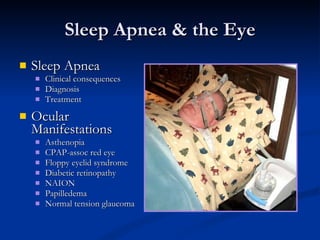
Sleep Apnea & the Eye Sleep Apnea Clinical consequences Diagnosis Treatment Ocular Manifestations Asthenopia CPAP-assoc red eye Floppy eyelid syndrome Diabetic retinopathy NAION Papilledema Normal tension glaucoma
Online Resources Lecture Notes http://richardtrevino.net/sleepapnea Powerpoint Slides http://slideshare.net/rhodopsin Free Texts http://jfponline.com (Aug 2008) http://www.eyesite.ca Can J Ophthalmol (April 2007) 2007;42(2):238-43
Sleep Disorders Sleep apnea  Insomnia Narcolepsy Restless leg syndrome Parasomnias Circadian disorders Drug side effects Shift work Source: J Am Board Fam Med. 2007;20:392-398 OSA is the “most physiologically disruptive and dangerous  of the sleep-related disorders.”
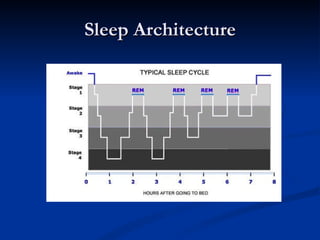
Sleep Architecture
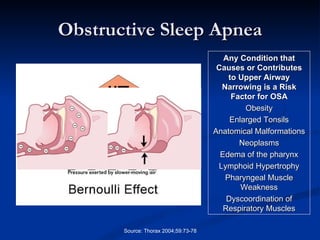
Obstructive Sleep Apnea Source: Thorax 2004;59:73-78 Any Condition that Causes or Contributes to Upper Airway Narrowing is a Risk Factor for OSA Obesity Enlarged Tonsils Anatomical Malformations Neoplasms Edema of the pharynx Lymphoid Hypertrophy Pharyngeal Muscle Weakness Dyscoordination of Respiratory Muscles
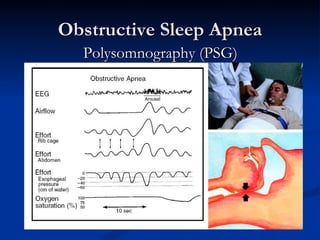
Obstructive Sleep Apnea Polysomnography (PSG)
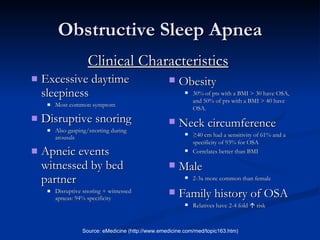
Obstructive Sleep Apnea Excessive daytime sleepiness Most common symptom Disruptive snoring Also gasping/snorting during arousals Apneic events witnessed by bed partner Disruptive snoring + witnessed apneas: 94% specificity Source: eMedicine (http://www.emedicine.com/med/topic163.htm) Obesity 30% of pts with a BMI > 30 have OSA, and 50% of pts with a BMI > 40 have OSA. Neck circumference   ≥ 40 cm had a sensitivity of 61% and a specificity of 93% for OSA Correlates better than BMI Male 2-3x more common than female Family history of OSA Relatives have 2-4 fold    risk Clinical Characteristics
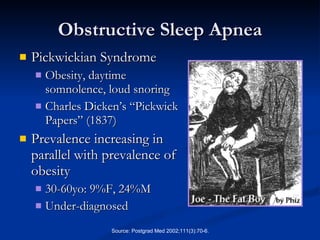
Obstructive Sleep Apnea Pickwickian Syndrome Obesity, daytime somnolence, loud snoring Charles Dicken’s “Pickwick Papers” (1837) Prevalence increasing in parallel with prevalence of obesity 30-60yo: 9%F, 24%M Under-diagnosed Source: Postgrad Med 2002;111(3):70-6.
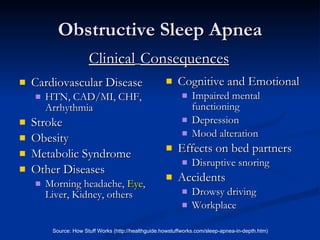
Obstructive Sleep Apnea Cardiovascular Disease HTN, CAD/MI, CHF, Arrhythmia Stroke Obesity Metabolic Syndrome Other Diseases Morning headache,  Eye , Liver, Kidney, others Cognitive and Emotional Impaired mental functioning Depression Mood alteration Effects on bed partners Disruptive snoring Accidents Drowsy driving Workplace Source: How Stuff Works (http://healthguide.howstuffworks.com/sleep-apnea-in-depth.htm) Clinical   Consequences
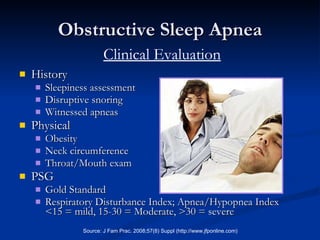
Obstructive Sleep Apnea History Sleepiness assessment Disruptive snoring Witnessed apneas Physical Obesity Neck circumference Throat/Mouth exam PSG Gold Standard Respiratory Disturbance Index; Apnea/Hypopnea Index <15 = mild, 15-30 = Moderate, >30 = severe Source: J Fam Prac. 2008;57(8) Suppl (http://www.jfponline.com) Clinical Evaluation
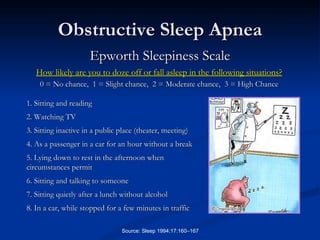
Obstructive Sleep Apnea Epworth Sleepiness Scale Source: Sleep 1994;17:160–167 How likely are you to doze off or fall asleep in the following situations? 0 = No chance,  1 = Slight chance,  2 = Moderate chance,  3 = High Chance 1. Sitting and reading 2. Watching TV 3. Sitting inactive in a public place (theater, meeting) 4. As a passenger in a car for an hour without a break 5. Lying down to rest in the afternoon when  circumstances permit 6. Sitting and talking to someone 7. Sitting quietly after a lunch without alcohol 8. In a car, while stopped for a few minutes in traffic
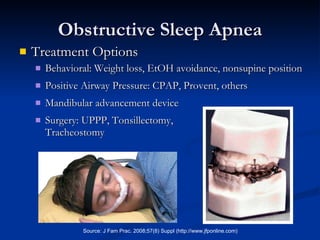
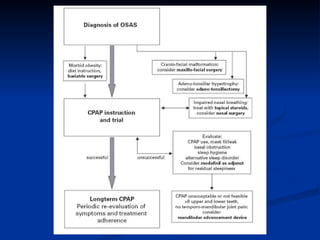
Obstructive Sleep Apnea Treatment Options Behavioral: Weight loss, EtOH avoidance, nonsupine position Positive Airway Pressure: CPAP, Provent, others Mandibular advancement device Surgery: UPPP, Tonsillectomy, Tracheostomy Source: J Fam Prac. 2008;57(8) Suppl (http://www.jfponline.com)
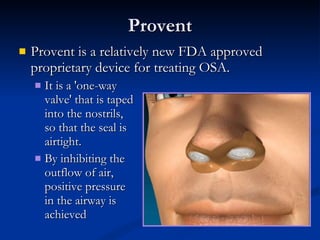
Provent Provent is a relatively new FDA approved proprietary device for treating OSA.  It is a 'one-way  valve' that is taped  into the nostrils,  so that the seal is  airtight.  By inhibiting the  outflow of air,  positive pressure  in the airway is  achieved
 
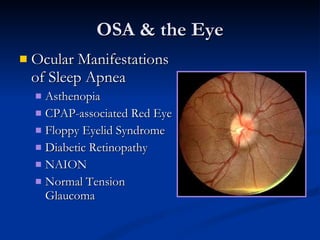
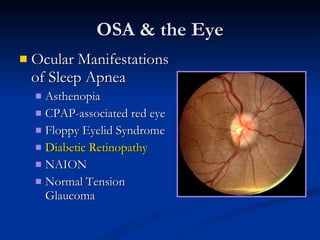
OSA & the Eye Ocular Manifestations of Sleep Apnea Asthenopia CPAP-associated Red Eye Floppy Eyelid Syndrome Diabetic Retinopathy NAION Normal Tension Glaucoma
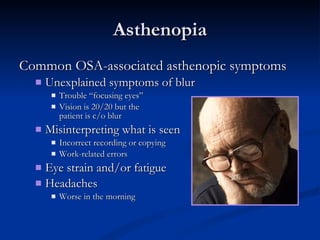
Asthenopia Common OSA-associated asthenopic symptoms Unexplained symptoms of blur Trouble “focusing eyes” Vision is 20/20 but the  patient is c/o blur Misinterpreting what is seen Incorrect recording or copying Work-related errors Eye strain and/or fatigue Headaches Worse in the morning
Asthenopia If OSA is in the medical history Be on the lookout for sxs of fatigue Possibly due to poor compliance or residual fatigue Offer supportive management (eg. CPAP compliance) If OSA is not in the medical history High index of suspicion whenever the chief complaint is fatigue or asthenopia Especially if habitus is Pickwickian Be prepared to  screen for sleepiness
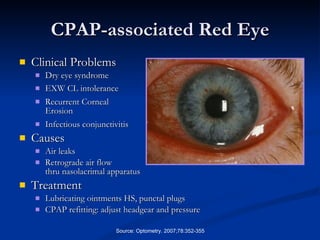
CPAP-associated Red Eye Clinical Problems Dry eye syndrome EXW CL intolerance   Recurrent Corneal  Erosion Infectious conjunctivitis Causes Air leaks Retrograde air flow  thru nasolacrimal apparatus Treatment Lubricating ointments HS, punctal plugs CPAP refitting: adjust headgear and pressure Source: Optometry. 2007;78:352-355
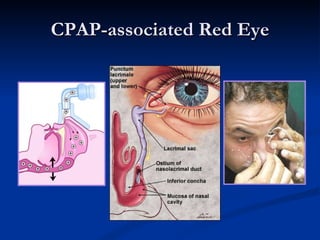
CPAP-associated Red Eye
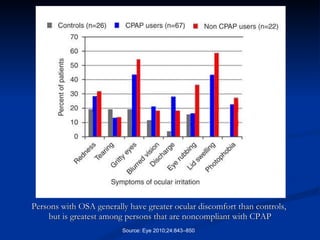
Persons with OSA generally have greater ocular discomfort than controls,  but is greatest among persons that are noncompliant with CPAP Source: Eye 2010;24:843–850
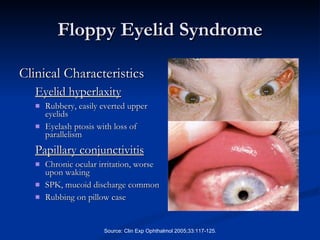
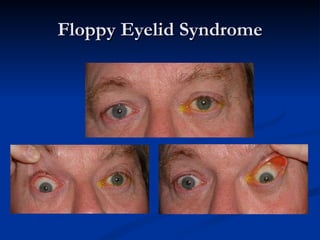
Floppy Eyelid Syndrome Clinical Characteristics Eyelid hyperlaxity Rubbery, easily everted upper eyelids Eyelash ptosis with loss of parallelism Papillary conjunctivitis Chronic ocular irritation, worse upon waking  SPK, mucoid discharge common Rubbing on pillow case Source: Clin Exp Ophthalmol 2005;33:117-125.
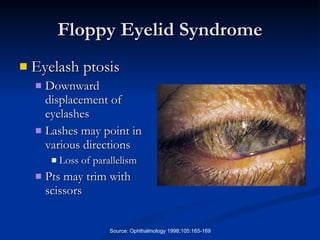
Floppy Eyelid Syndrome Eyelash ptosis Downward displacement of eyelashes Lashes may point in various directions  Loss of parallelism Pts may trim with scissors Source: Ophthalmology 1998;105:165-169
Floppy Eyelid Syndrome
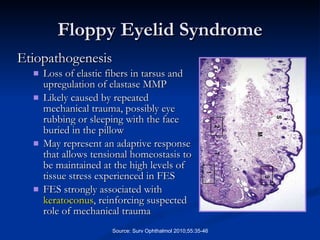
Floppy Eyelid Syndrome Etiopathogenesis Loss of elastic fibers in tarsus and upregulation of elastase MMP Likely caused by repeated mechanical trauma, possibly eye rubbing or sleeping with the face buried in the pillow May represent an adaptive response that allows tensional homeostasis to be maintained at the high levels of tissue stress experienced in FES FES strongly associated with  keratoconus , reinforcing suspected role of mechanical trauma Source: Surv Ophthalmol 2010;55:35-46
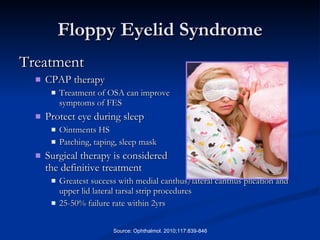
Floppy Eyelid Syndrome Treatment CPAP therapy Treatment of OSA can improve  symptoms of FES Protect eye during sleep Ointments HS Patching, taping, sleep mask Surgical therapy is considered  the definitive treatment Greatest success with medial canthus/lateral canthus plication and upper lid lateral tarsal strip procedures 25-50% failure rate within 2yrs Source: Ophthalmol. 2010;117:839-846
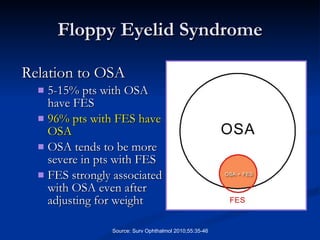
Floppy Eyelid Syndrome Relation to OSA 5-15% pts with OSA have FES 96% pts with FES have OSA   OSA tends to be more severe in pts with FES FES strongly associated with OSA even after adjusting for weight Source: Surv Ophthalmol 2010;55:35-46
OSA & the Eye Ocular Manifestations of Sleep Apnea Asthenopia CPAP-associated red eye Floppy Eyelid Syndrome Diabetic Retinopathy NAION Normal Tension Glaucoma
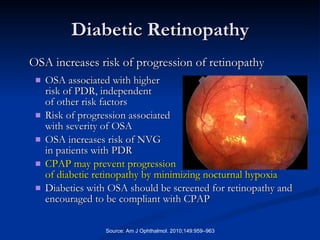
Diabetic Retinopathy OSA associated with higher  risk of PDR, independent  of other risk factors Risk of progression associated with severity of OSA OSA increases risk of NVG in patients with PDR CPAP may prevent progression  of diabetic retinopathy by minimizing nocturnal hypoxia Diabetics with OSA should be screened for retinopathy and encouraged to be compliant with CPAP Source: Am J Ophthalmol. 2010;149:959–963 OSA increases risk of progression of retinopathy
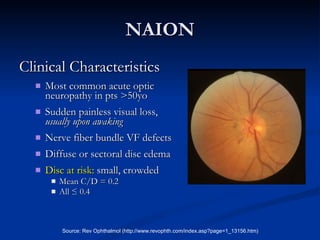
NAION Clinical Characteristics Most common acute optic neuropathy in pts >50yo Sudden painless visual loss,  usually upon awaking Nerve fiber bundle VF defects Diffuse or sectoral disc edema Disc at risk:  small, crowded Mean C/D = 0.2 All ≤ 0.4 Source: Rev Ophthalmol (http://www.revophth.com/index.asp?page=1_13156.htm)
NAION Pathophysiology Idiopathic ischemic process  Disorder of posterior ciliary artery circulation Transient poor circulation in the ONH Trigger Event : Fall in blood pressure below a critical level? There is no actual blockage of the posterior ciliary arteries Cascade Effect Mechanical crowding caused by small crowded disc Ischemia    Swelling    Compression    Ischemia Source: http://webeye.ophth.uiowa.edu/dept/AION/Index.htm
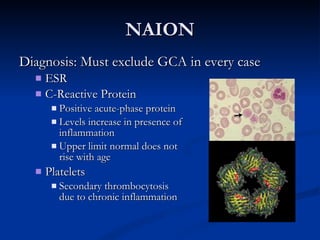
Diagnosis: Must exclude GCA in every case ESR C-Reactive Protein Positive acute-phase protein Levels increase in presence of  inflammation  Upper limit normal does not  rise with age  Platelets Secondary thrombocytosis  due to chronic inflammation NAION
NAION Treatment Aspirin Decreases incidence in fellow eye at 2 years, but not at 5 years Surgical decompression No benefit (Ischemic Optic Neuropathy Decompression Trial) Control of predisposing systemic disease   May slow progression or reduce incidence in fellow eye Hypertension, Diabetes, Hyperlipidemia, OSA Avoid  phosphodiesterase 5 inhibitors (Viagra, Levitra, Cialis) May increase risk of NAION in fellow eye
NAION Medicolegal obligation to inform pts of risk to fellow eye
NAION Relation to OSA Conclusions OSA may play an important role in pathogenesis of NAION OSA may be the systemic disorder most frequently associated with NAION Patients with NAION should be screened for OSA NAION Patients with OSA Mojon (2002) 71%  (Controls: 18%) Palombi (2006) 89%  (HTN: 59%, DM: 37%) Li (2007) 30%  (Controls: 18%)
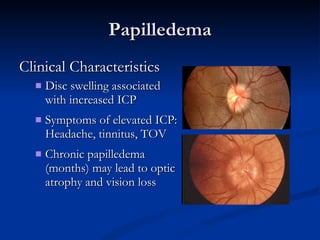
Papilledema Clinical Characteristics Disc swelling associated with increased ICP Symptoms of elevated ICP: Headache, tinnitus, TOV  Chronic papilledema (months) may lead to optic atrophy and vision loss
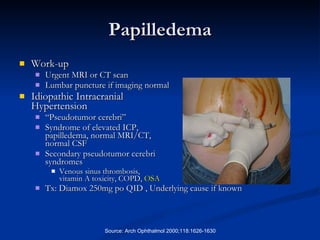
Papilledema Work-up Urgent MRI or CT scan Lumbar puncture if imaging normal Idiopathic Intracranial  Hypertension “ Pseudotumor cerebri” Syndrome of elevated ICP,  papilledema, normal MRI/CT,  normal CSF Secondary pseudotumor cerebri  syndromes  Venous sinus thrombosis,  vitamin A toxicity, COPD,  OSA   Tx: Diamox 250mg po QID , Underlying cause if known Source: Arch Ophthalmol 2000;118:1626-1630
Papilledema Relation to OSA Stein (2011)  Reviewed 2.3 million insurance  company billing records  Persons with OSA have 30%  to 100% increased risk of  developing papilledema Parvin (2000) 4 pts with unexplained papilledema that resolved with successful tx of OSA ICP is normal during the day but elevated at night Intermittent ↑ ICP can cause sustained papilledema Hypercapnia-induced cerebral vasodilatation elevates ICP
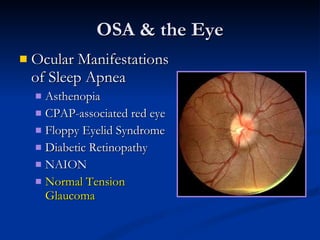
OSA & the Eye Ocular Manifestations of Sleep Apnea Asthenopia CPAP-associated red eye Floppy Eyelid Syndrome Diabetic Retinopathy NAION Normal Tension Glaucoma
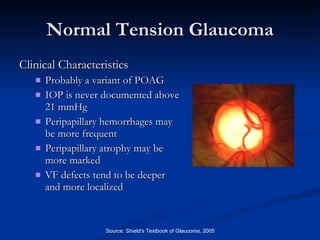
Normal Tension Glaucoma Clinical Characteristics Probably a variant of POAG IOP is never documented above 21 mmHg  Peripapillary hemorrhages may be more frequent Peripapillary atrophy may be more marked  VF defects tend to be deeper and more localized  Source: Shield's Textbook of Glaucoma, 2005
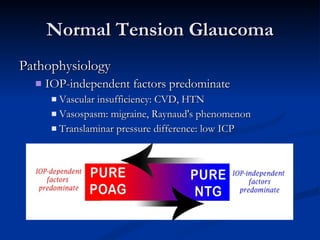
Normal Tension Glaucoma Pathophysiology IOP-independent factors predominate Vascular insufficiency: CVD, HTN Vasospasm: migraine, Raynaud's phenomenon  Translaminar pressure difference: low ICP
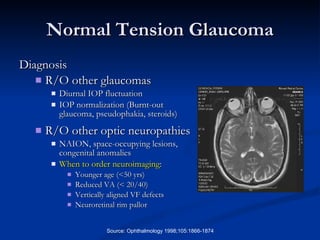
Normal Tension Glaucoma Diagnosis R/O other glaucomas Diurnal IOP fluctuation IOP normalization (Burnt-out glaucoma, pseudophakia, steroids) R/O other optic neuropathies NAION, space-occupying lesions, congenital anomalies When to order neuroimaging :  Younger age (<50 yrs) Reduced VA (< 20/40) Vertically aligned VF defects Neuroretinal rim pallor Source: Ophthalmology 1998;105:1866-1874
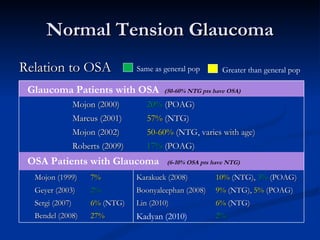
Normal Tension Glaucoma Relation to OSA Glaucoma Patients with OSA  (50-60% NTG pts have OSA) Mojon (2000) 20%  (POAG) Marcus (2001) 57%  (NTG) Mojon (2002) 50-60%  (NTG, varies with age) Roberts (2009) 17%  (POAG) OSA Patients with Glaucoma  (6-10% OSA pts have NTG) Mojon (1999) 7% Karakuck (2008) 10%  (NTG),  3%  (POAG) Geyer (2003) 2% Boonyaleephan (2008) 9%  (NTG),  5%  (POAG) Sergi (2007) 6%  (NTG) Lin (2010) 6%  (NTG) Bendel (2008) 27% Kadyan (2010) 2% Same as general pop Greater than general pop
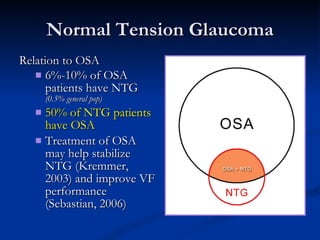
Normal Tension Glaucoma Relation to OSA 6%-10% of OSA patients have NTG   (0.5% general pop) 50% of NTG patients have OSA Treatment of OSA may help stabilize NTG (Kremmer, 2003) and improve VF performance (Sebastian, 2006)
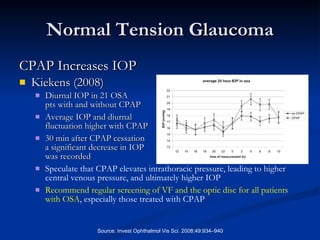
Normal Tension Glaucoma CPAP Increases IOP Kiekens (2008) Diurnal IOP in 21 OSA  pts with and without CPAP Average IOP and diurnal  fluctuation higher with CPAP  30 min after CPAP cessation  a significant decrease in IOP  was recorded  Speculate that CPAP elevates intrathoracic pressure, leading to higher central venous pressure, and ultimately higher IOP Recommend regular screening of VF and the optic disc for all patients with OSA , especially those treated with CPAP   Source: Invest Ophthalmol Vis Sci. 2008;49:934–940
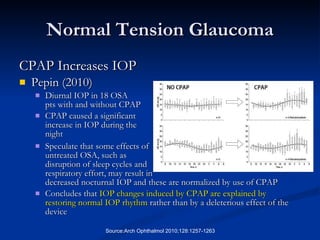
Normal Tension Glaucoma CPAP Increases IOP Pepin (2010) Diurnal IOP in 18 OSA  pts with and without CPAP CPAP caused a significant  increase in IOP during the  night Speculate that some effects of untreated OSA, such as  disruption of sleep cycles and  respiratory effort, may result in decreased nocturnal IOP and these are normalized by use of CPAP Concludes that  IOP changes induced by CPAP are explained by restoring normal IOP rhythm  rather than by a deleterious effect of the device Source:Arch Ophthalmol 2010;128:1257-1263
Normal Tension Glaucoma OSA May Cause VF Loss Without Glaucoma VF loss may occur due to optic nerve damage caused by cerebral ischemia and intermittent ICP elevation Batisse (2004) Eye exam on 35 consecutive patients undergoing PSG  VF mean deviation correlated with RDI Tsang  (2006) Compared VF and ONH changes between 41 pts with moderate-severe OSA with 35 age-matched controls  In OSA pts the VF indices were significantly subnormal Karakucuk (2008)  Eye exams and orbital blood flow studies on 31 pts with OSA and 25 normal control subjects  VF defects were detected in 10 pts despite normal eye exam.
Normal Tension Glaucoma OSA May Cause NFL Loss Without Glaucoma NFL thinning may place patients with OSA at increased risk of glaucoma Kargi (2005) Compared NFL in 34 pts with OSA and 20 controls using GDx NFL thickness was reduced in patients with OSA Thinning was correlated to severity of OSA (AHI) Pts with VF defects were excluded from the study Lin (2010) Compared NFL in 105 pts with OSA and 22 controls using OCT NFL thickness was reduced in patients with OSA Thinning was correlated to severity of OSA (lowest oxygenation saturation on PSG) Pts with OSA did not have an increased prevalence of VF defects ( “silent optic neuropathy” )
Normal Tension Glaucoma Conclusions & Recommendations Persons with OSA should be screened for glaucoma Risk of glaucoma is correlated with severity of OSA Patients with NTG should be screened or at least questioned about OSA to determine if that is part of the explanation for their glaucomatous damage at normal IOPs Treatment of uncontrolled OSA may help stabilize glaucoma and improve VF performance Initiation of CPAP therapy may increase nocturnal IOP The clinical significance of this in unknown
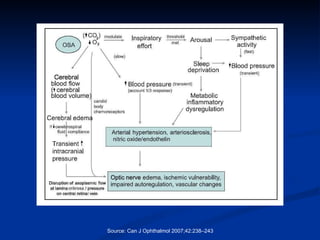
Source: Can J Ophthalmol 2007;42:238–243
Thank  You!

Sleep Apnea & The Eye - 2011

  • 1.
    Sleep Apnea & the Eye Rick Trevino, OD Rosenberg School of Optometry University of the Incarnate Word [email_address]
  • 2.
    Sleep Apnea &the Eye Sleep Apnea Clinical consequences Diagnosis Treatment Ocular Manifestations Asthenopia CPAP-assoc red eye Floppy eyelid syndrome Diabetic retinopathy NAION Papilledema Normal tension glaucoma
  • 3.
    Online Resources LectureNotes http://richardtrevino.net/sleepapnea Powerpoint Slides http://slideshare.net/rhodopsin Free Texts http://jfponline.com (Aug 2008) http://www.eyesite.ca Can J Ophthalmol (April 2007) 2007;42(2):238-43
  • 4.
    Sleep Disorders Sleepapnea Insomnia Narcolepsy Restless leg syndrome Parasomnias Circadian disorders Drug side effects Shift work Source: J Am Board Fam Med. 2007;20:392-398 OSA is the “most physiologically disruptive and dangerous of the sleep-related disorders.”
  • 5.
  • 6.
    Obstructive Sleep ApneaSource: Thorax 2004;59:73-78 Any Condition that Causes or Contributes to Upper Airway Narrowing is a Risk Factor for OSA Obesity Enlarged Tonsils Anatomical Malformations Neoplasms Edema of the pharynx Lymphoid Hypertrophy Pharyngeal Muscle Weakness Dyscoordination of Respiratory Muscles
  • 7.
    Obstructive Sleep ApneaPolysomnography (PSG)
  • 8.
    Obstructive Sleep ApneaExcessive daytime sleepiness Most common symptom Disruptive snoring Also gasping/snorting during arousals Apneic events witnessed by bed partner Disruptive snoring + witnessed apneas: 94% specificity Source: eMedicine (http://www.emedicine.com/med/topic163.htm) Obesity 30% of pts with a BMI > 30 have OSA, and 50% of pts with a BMI > 40 have OSA. Neck circumference ≥ 40 cm had a sensitivity of 61% and a specificity of 93% for OSA Correlates better than BMI Male 2-3x more common than female Family history of OSA Relatives have 2-4 fold  risk Clinical Characteristics
  • 9.
    Obstructive Sleep ApneaPickwickian Syndrome Obesity, daytime somnolence, loud snoring Charles Dicken’s “Pickwick Papers” (1837) Prevalence increasing in parallel with prevalence of obesity 30-60yo: 9%F, 24%M Under-diagnosed Source: Postgrad Med 2002;111(3):70-6.
  • 10.
    Obstructive Sleep ApneaCardiovascular Disease HTN, CAD/MI, CHF, Arrhythmia Stroke Obesity Metabolic Syndrome Other Diseases Morning headache, Eye , Liver, Kidney, others Cognitive and Emotional Impaired mental functioning Depression Mood alteration Effects on bed partners Disruptive snoring Accidents Drowsy driving Workplace Source: How Stuff Works (http://healthguide.howstuffworks.com/sleep-apnea-in-depth.htm) Clinical Consequences
  • 11.
    Obstructive Sleep ApneaHistory Sleepiness assessment Disruptive snoring Witnessed apneas Physical Obesity Neck circumference Throat/Mouth exam PSG Gold Standard Respiratory Disturbance Index; Apnea/Hypopnea Index <15 = mild, 15-30 = Moderate, >30 = severe Source: J Fam Prac. 2008;57(8) Suppl (http://www.jfponline.com) Clinical Evaluation
  • 12.
    Obstructive Sleep ApneaEpworth Sleepiness Scale Source: Sleep 1994;17:160–167 How likely are you to doze off or fall asleep in the following situations? 0 = No chance, 1 = Slight chance, 2 = Moderate chance, 3 = High Chance 1. Sitting and reading 2. Watching TV 3. Sitting inactive in a public place (theater, meeting) 4. As a passenger in a car for an hour without a break 5. Lying down to rest in the afternoon when circumstances permit 6. Sitting and talking to someone 7. Sitting quietly after a lunch without alcohol 8. In a car, while stopped for a few minutes in traffic
  • 13.
    Obstructive Sleep ApneaTreatment Options Behavioral: Weight loss, EtOH avoidance, nonsupine position Positive Airway Pressure: CPAP, Provent, others Mandibular advancement device Surgery: UPPP, Tonsillectomy, Tracheostomy Source: J Fam Prac. 2008;57(8) Suppl (http://www.jfponline.com)
  • 14.
    Provent Provent isa relatively new FDA approved proprietary device for treating OSA. It is a 'one-way valve' that is taped into the nostrils, so that the seal is airtight. By inhibiting the outflow of air, positive pressure in the airway is achieved
  • 15.
  • 16.
    OSA & theEye Ocular Manifestations of Sleep Apnea Asthenopia CPAP-associated Red Eye Floppy Eyelid Syndrome Diabetic Retinopathy NAION Normal Tension Glaucoma
  • 17.
    Asthenopia Common OSA-associatedasthenopic symptoms Unexplained symptoms of blur Trouble “focusing eyes” Vision is 20/20 but the patient is c/o blur Misinterpreting what is seen Incorrect recording or copying Work-related errors Eye strain and/or fatigue Headaches Worse in the morning
  • 18.
    Asthenopia If OSAis in the medical history Be on the lookout for sxs of fatigue Possibly due to poor compliance or residual fatigue Offer supportive management (eg. CPAP compliance) If OSA is not in the medical history High index of suspicion whenever the chief complaint is fatigue or asthenopia Especially if habitus is Pickwickian Be prepared to screen for sleepiness
  • 19.
    CPAP-associated Red EyeClinical Problems Dry eye syndrome EXW CL intolerance Recurrent Corneal Erosion Infectious conjunctivitis Causes Air leaks Retrograde air flow thru nasolacrimal apparatus Treatment Lubricating ointments HS, punctal plugs CPAP refitting: adjust headgear and pressure Source: Optometry. 2007;78:352-355
  • 20.
  • 21.
    Persons with OSAgenerally have greater ocular discomfort than controls, but is greatest among persons that are noncompliant with CPAP Source: Eye 2010;24:843–850
  • 22.
    Floppy Eyelid SyndromeClinical Characteristics Eyelid hyperlaxity Rubbery, easily everted upper eyelids Eyelash ptosis with loss of parallelism Papillary conjunctivitis Chronic ocular irritation, worse upon waking SPK, mucoid discharge common Rubbing on pillow case Source: Clin Exp Ophthalmol 2005;33:117-125.
  • 23.
    Floppy Eyelid SyndromeEyelash ptosis Downward displacement of eyelashes Lashes may point in various directions Loss of parallelism Pts may trim with scissors Source: Ophthalmology 1998;105:165-169
  • 24.
  • 25.
    Floppy Eyelid SyndromeEtiopathogenesis Loss of elastic fibers in tarsus and upregulation of elastase MMP Likely caused by repeated mechanical trauma, possibly eye rubbing or sleeping with the face buried in the pillow May represent an adaptive response that allows tensional homeostasis to be maintained at the high levels of tissue stress experienced in FES FES strongly associated with keratoconus , reinforcing suspected role of mechanical trauma Source: Surv Ophthalmol 2010;55:35-46
  • 26.
    Floppy Eyelid SyndromeTreatment CPAP therapy Treatment of OSA can improve symptoms of FES Protect eye during sleep Ointments HS Patching, taping, sleep mask Surgical therapy is considered the definitive treatment Greatest success with medial canthus/lateral canthus plication and upper lid lateral tarsal strip procedures 25-50% failure rate within 2yrs Source: Ophthalmol. 2010;117:839-846
  • 27.
    Floppy Eyelid SyndromeRelation to OSA 5-15% pts with OSA have FES 96% pts with FES have OSA OSA tends to be more severe in pts with FES FES strongly associated with OSA even after adjusting for weight Source: Surv Ophthalmol 2010;55:35-46
  • 28.
    OSA & theEye Ocular Manifestations of Sleep Apnea Asthenopia CPAP-associated red eye Floppy Eyelid Syndrome Diabetic Retinopathy NAION Normal Tension Glaucoma
  • 29.
    Diabetic Retinopathy OSAassociated with higher risk of PDR, independent of other risk factors Risk of progression associated with severity of OSA OSA increases risk of NVG in patients with PDR CPAP may prevent progression of diabetic retinopathy by minimizing nocturnal hypoxia Diabetics with OSA should be screened for retinopathy and encouraged to be compliant with CPAP Source: Am J Ophthalmol. 2010;149:959–963 OSA increases risk of progression of retinopathy
  • 30.
    NAION Clinical CharacteristicsMost common acute optic neuropathy in pts >50yo Sudden painless visual loss, usually upon awaking Nerve fiber bundle VF defects Diffuse or sectoral disc edema Disc at risk: small, crowded Mean C/D = 0.2 All ≤ 0.4 Source: Rev Ophthalmol (http://www.revophth.com/index.asp?page=1_13156.htm)
  • 31.
    NAION Pathophysiology Idiopathicischemic process Disorder of posterior ciliary artery circulation Transient poor circulation in the ONH Trigger Event : Fall in blood pressure below a critical level? There is no actual blockage of the posterior ciliary arteries Cascade Effect Mechanical crowding caused by small crowded disc Ischemia  Swelling  Compression  Ischemia Source: http://webeye.ophth.uiowa.edu/dept/AION/Index.htm
  • 32.
    Diagnosis: Must excludeGCA in every case ESR C-Reactive Protein Positive acute-phase protein Levels increase in presence of inflammation Upper limit normal does not rise with age Platelets Secondary thrombocytosis due to chronic inflammation NAION
  • 33.
    NAION Treatment AspirinDecreases incidence in fellow eye at 2 years, but not at 5 years Surgical decompression No benefit (Ischemic Optic Neuropathy Decompression Trial) Control of predisposing systemic disease May slow progression or reduce incidence in fellow eye Hypertension, Diabetes, Hyperlipidemia, OSA Avoid phosphodiesterase 5 inhibitors (Viagra, Levitra, Cialis) May increase risk of NAION in fellow eye
  • 34.
    NAION Medicolegal obligationto inform pts of risk to fellow eye
  • 35.
    NAION Relation toOSA Conclusions OSA may play an important role in pathogenesis of NAION OSA may be the systemic disorder most frequently associated with NAION Patients with NAION should be screened for OSA NAION Patients with OSA Mojon (2002) 71% (Controls: 18%) Palombi (2006) 89% (HTN: 59%, DM: 37%) Li (2007) 30% (Controls: 18%)
  • 36.
    Papilledema Clinical CharacteristicsDisc swelling associated with increased ICP Symptoms of elevated ICP: Headache, tinnitus, TOV Chronic papilledema (months) may lead to optic atrophy and vision loss
  • 37.
    Papilledema Work-up UrgentMRI or CT scan Lumbar puncture if imaging normal Idiopathic Intracranial Hypertension “ Pseudotumor cerebri” Syndrome of elevated ICP, papilledema, normal MRI/CT, normal CSF Secondary pseudotumor cerebri syndromes Venous sinus thrombosis, vitamin A toxicity, COPD, OSA Tx: Diamox 250mg po QID , Underlying cause if known Source: Arch Ophthalmol 2000;118:1626-1630
  • 38.
    Papilledema Relation toOSA Stein (2011) Reviewed 2.3 million insurance company billing records Persons with OSA have 30% to 100% increased risk of developing papilledema Parvin (2000) 4 pts with unexplained papilledema that resolved with successful tx of OSA ICP is normal during the day but elevated at night Intermittent ↑ ICP can cause sustained papilledema Hypercapnia-induced cerebral vasodilatation elevates ICP
  • 39.
    OSA & theEye Ocular Manifestations of Sleep Apnea Asthenopia CPAP-associated red eye Floppy Eyelid Syndrome Diabetic Retinopathy NAION Normal Tension Glaucoma
  • 40.
    Normal Tension GlaucomaClinical Characteristics Probably a variant of POAG IOP is never documented above 21 mmHg Peripapillary hemorrhages may be more frequent Peripapillary atrophy may be more marked VF defects tend to be deeper and more localized Source: Shield's Textbook of Glaucoma, 2005
  • 41.
    Normal Tension GlaucomaPathophysiology IOP-independent factors predominate Vascular insufficiency: CVD, HTN Vasospasm: migraine, Raynaud's phenomenon Translaminar pressure difference: low ICP
  • 42.
    Normal Tension GlaucomaDiagnosis R/O other glaucomas Diurnal IOP fluctuation IOP normalization (Burnt-out glaucoma, pseudophakia, steroids) R/O other optic neuropathies NAION, space-occupying lesions, congenital anomalies When to order neuroimaging : Younger age (<50 yrs) Reduced VA (< 20/40) Vertically aligned VF defects Neuroretinal rim pallor Source: Ophthalmology 1998;105:1866-1874
  • 43.
    Normal Tension GlaucomaRelation to OSA Glaucoma Patients with OSA (50-60% NTG pts have OSA) Mojon (2000) 20% (POAG) Marcus (2001) 57% (NTG) Mojon (2002) 50-60% (NTG, varies with age) Roberts (2009) 17% (POAG) OSA Patients with Glaucoma (6-10% OSA pts have NTG) Mojon (1999) 7% Karakuck (2008) 10% (NTG), 3% (POAG) Geyer (2003) 2% Boonyaleephan (2008) 9% (NTG), 5% (POAG) Sergi (2007) 6% (NTG) Lin (2010) 6% (NTG) Bendel (2008) 27% Kadyan (2010) 2% Same as general pop Greater than general pop
  • 44.
    Normal Tension GlaucomaRelation to OSA 6%-10% of OSA patients have NTG (0.5% general pop) 50% of NTG patients have OSA Treatment of OSA may help stabilize NTG (Kremmer, 2003) and improve VF performance (Sebastian, 2006)
  • 45.
    Normal Tension GlaucomaCPAP Increases IOP Kiekens (2008) Diurnal IOP in 21 OSA pts with and without CPAP Average IOP and diurnal fluctuation higher with CPAP 30 min after CPAP cessation a significant decrease in IOP was recorded Speculate that CPAP elevates intrathoracic pressure, leading to higher central venous pressure, and ultimately higher IOP Recommend regular screening of VF and the optic disc for all patients with OSA , especially those treated with CPAP Source: Invest Ophthalmol Vis Sci. 2008;49:934–940
  • 46.
    Normal Tension GlaucomaCPAP Increases IOP Pepin (2010) Diurnal IOP in 18 OSA pts with and without CPAP CPAP caused a significant increase in IOP during the night Speculate that some effects of untreated OSA, such as disruption of sleep cycles and respiratory effort, may result in decreased nocturnal IOP and these are normalized by use of CPAP Concludes that IOP changes induced by CPAP are explained by restoring normal IOP rhythm rather than by a deleterious effect of the device Source:Arch Ophthalmol 2010;128:1257-1263
  • 47.
    Normal Tension GlaucomaOSA May Cause VF Loss Without Glaucoma VF loss may occur due to optic nerve damage caused by cerebral ischemia and intermittent ICP elevation Batisse (2004) Eye exam on 35 consecutive patients undergoing PSG VF mean deviation correlated with RDI Tsang (2006) Compared VF and ONH changes between 41 pts with moderate-severe OSA with 35 age-matched controls In OSA pts the VF indices were significantly subnormal Karakucuk (2008) Eye exams and orbital blood flow studies on 31 pts with OSA and 25 normal control subjects VF defects were detected in 10 pts despite normal eye exam.
  • 48.
    Normal Tension GlaucomaOSA May Cause NFL Loss Without Glaucoma NFL thinning may place patients with OSA at increased risk of glaucoma Kargi (2005) Compared NFL in 34 pts with OSA and 20 controls using GDx NFL thickness was reduced in patients with OSA Thinning was correlated to severity of OSA (AHI) Pts with VF defects were excluded from the study Lin (2010) Compared NFL in 105 pts with OSA and 22 controls using OCT NFL thickness was reduced in patients with OSA Thinning was correlated to severity of OSA (lowest oxygenation saturation on PSG) Pts with OSA did not have an increased prevalence of VF defects ( “silent optic neuropathy” )
  • 49.
    Normal Tension GlaucomaConclusions & Recommendations Persons with OSA should be screened for glaucoma Risk of glaucoma is correlated with severity of OSA Patients with NTG should be screened or at least questioned about OSA to determine if that is part of the explanation for their glaucomatous damage at normal IOPs Treatment of uncontrolled OSA may help stabilize glaucoma and improve VF performance Initiation of CPAP therapy may increase nocturnal IOP The clinical significance of this in unknown
  • 50.
    Source: Can JOphthalmol 2007;42:238–243
  • 51.

Editor's Notes

  • #2 SLEEP APNEA IS A NEWLY DISCOVERED DISEASE (1966) - Still learning about it, including it’s effects on the eyes THE MOST COMMON “MEDICAL” SLEEP DISORDER - excluding shift-work and self-induced sleepiness (late night partying) - Most prevalent disease discovered in the 20 th century – 20% of adult population in Western countries - Prevalence is growing b/c primary risk factor for developing OSA is obesity
  • #3 1. NECK - larger on outside, smaller on the inside - Pickwickian: Obese male, 30-60yo, always sleepy, snores loudly 2. CPAP - mask may leak into the eyes - noncompliance
  • #4 Journal of Family Practice (2008) Can J Ophthalmol (April 2007)
  • #5 OSA is the most common medical sleep disorder - prevalence growing in parallel with prevalence of obesity IT IS NOT ONLY THE MOST COMMON SLEEP DISORDER, BUT ALSO THE MOST PHYSIOLOGICALLY DISRUPTIVE AND DANGEROUS SLEEP DISORDER Deprives the sufferer of 2 things essential for good health: sleep and oxygen - Life threatening disease: - Having OSA places pts at risk of developing MI and CVA - A recently published longitudinal study found pts with severe OSA had 3-4x the death rate of persons without OSA. - Wide spread effects throughout the body – As we shall see, not even the somewhat remote and esoteric world of eye care is immune from the influences of this devastating disease OSA is the most physiologically disruptive and dangerous of the sleep-related disorders - OSA predisposes to MI and CVA - higher mortality rate To understand why, we must look at exactly what happens in OSA
  • #6 To understand sleep disorders, we must first understand a little about sleep THE PURPOSE OF SLEEP IS TO REFRESH AND RESTORE THE BRAIN. Normal healthy sleep is composed of a series of sleep cycles REM and NREM states alternate in cycles of 90-110 minutes. A healthy adult completes several cycles during a night that included the four stages of NREM sleep and REM sleep. Each complete cycle lasts approximately 90 to 110 minutes and is repeated in sequential form. During one night each subject experiences five or six complete cycles each lasting 90-110 min. For making sleep restorative, cycles must repeat this pattern without disturbances, that could fragment it. Sleep architecture represents the cyclical pattern of sleep as it shifts between the different sleep stages, including non-rapid eye movement (NREM) and rapid eye movement (REM) sleep. It allows us to produce a picture of what sleep looks like over the course of a night, taking into account various depths of sleep as well as arousals to wakefulness. Sleep architecture can be represented by a graph called a hypnogram. Disturbances in the normal sleep architecture can cause a person to awake feeling tired With certain sleep disorders, such as OSA, you can spend an entire night asleep, but awake feeling dead tired
  • #7 Upper airway collapse is the primary event that causes OSA WHY DOES THE AIRWAY CLOSE? To understand why the airway closes, we have to understand the Bernoulli effect. Lower pressure caused by rapidly moving air in the pharynx draws the walls of the airway inward Pharynx is by nature very floppy. Unlike the trachea, which has cartilaginous rings to keep it open, the pharynx relies upon dilator muscles to counter the Bernoulli effect When inhale, dilator muscles in the pharnyx contract to keep the airway open When asleep dilator muscles relax and their activity is relatively suppressed. Hence, there is a greater tendency for the pharnyx to narrow during inspiration THE KEY VARIABLE IN WHETHER OR NOT AIRWAY CLOSURE WILL OCCUR IS THE INITIAL SIZE OF THE PHARNYX. Anything that narrows the pharynx will predispose to OSA The most common contributory factor by far is obesity
  • #8 What happens is this: The airway closes shutting down airflow, and the patient continues to attempt to breath The oxygen levels of the blood drop and eventually this triggers a sympathetic “fight or flight” response that arouses the pt from sleep and restores airflow Three major pathophysiologic processes: HYPOXIA/HYPERCAPNIA - oxidative stress and chronic inflammation - CNS effects: vasodilation leading to increased intracranial pressure SYMPATHETIC ACTIVATION - Sleep is normally dominated by parasympathetic activity which helps support “rest and repose” - bursts of sympathetic activity is response to cessation of respiration - Sympathetic activation causes arousal, and restores airflow, but also causes: increases heart rate, increases blood pressure SLEEP FRAGMENTATION - disruption of the normal sleep cycle - leads to the principle symptom of OSA: sleepiness SUMMARY Airway closure -&gt; Apnea -&gt; hypoxia -&gt; sympathetic activation -&gt; arousal -&gt; sleep fragmentation
  • #9 TOP 3 SYMPTOMS: 1. Sleepiness: - Most common presenting symptom - Described more often as tiredness, lack of energy, fatigue - Most pts not aware that they have a sleep problem. 2. Snoring: - extremely loud, disturbing the bed partner, the entire household, and even neighbors - Due to upper airway resistance 3. Witnessed events: - Cessation of breathing reported by the bed partner is usually a source of great anxiety because of fear that breathing may not resume. OBESITY: - By far the most significant medical association with OSA is the reciprocal relationship between OSA and obesity - Obesity narrows the airway and predisposes to closure; OSA causes fatigue and neurohormonal changes that predisposes to obesity - Anything that narrows the upper airway will predispose to OSA; obesity is by far the most common (30% OSA pts are not obese) Neck circumference: The bigger the neck is on the outside, the smaller it is on the inside SEX: - fat distribution: more central in men (thicker necks) - hormonal: more OSA in postmenopausal women. HRT provides some protection FAMILY HX: craniofacial structure
  • #10 PICKWICKIAN SYNDROME - Meaning has changed over time (ie: dyslexia) - Recently refers to “Obesity Hypoventilation Syndrome” == OSA + COPD - Classically refers to the typical OSA presentation: sleepy obese male who snores loudly - Personified in the character Joe from Charles Dicken’s “Pickwick Papers” (1837) PREVALENCE FIGURES: The most prevalent dx to be discovered in the 20 th century Prevalence increases with age, and peaks in 50-60yo age group. - increasing tissue laxity - prevalence may plateau after 65 years (survivor effect) - OSA can occur in any age group, incl children
  • #11 This is by no means an exhaustive list of the many effects that OSA has on the patient. THE BIG THREE CARDIOVASC DX - OSA is #1 cause of secondary HTN - Strength of relationship between OSA and HTN is second only to the relationship between OSA and obesity - Dose-response relationship: increased severity of OSA -&gt; increased risk of HTN - Sympathetic activation: nocturnal spikes in BP - OSA assoc with increased risk of MI STROKE - any degree of OSA almost doubles the risk of stroke - moderate OSA are 3 times more likely to have a stroke than are members of the general population OBESITY - Obesity remains the single most significant risk factor for OSA - Reciprocal relationship: Obesity is both a cause and a consequence of OSA - Daytime sleepiness + decreased physical activity + neuroendocrine chgs (LEPTIN RESISTANCE) - CPAP tx -&gt; weight loss - increased obesity -&gt; worsen OSA COGNITIVE - the purpose of sleep is to refresh and restore the brain. - diminished cognitive function stems from hypoxic brain injury, reduced alertness, or both PUBLIC HEALTH - In 2000, 1400 highway deaths attributable to OSA
  • #12 HOW TO SCREEN FOR OSA 1. Ask about fatigue - Epworth sleepiness scale: fast validated office assessment 2. Ask about snoring problem (50% glaucoma patients with “problem snoring” had OSA) 3. Ask bed partner about witnessed apneas (10 sec or more) 4. OSA Habitus (Pickwickian syndrome) Obesity - most common, but not only cause of airway crowding - 30% OSA pts are not obese - mouth and throat exam essential for r/o other causes 5. Overnight sleep study - Sleep specialist or pulmnologist Respiratory Disturbance Index 5-15: Mild 15-30: Moderate &gt;30: Severe
  • #13 ESS: Best tool for the office assessment of sleepiness a validated method of assessing the likelihood of falling asleep in a variety of situations simple to use and interpret and takes less than 2 minutes to complete All items weighted equally. Max score 24 (8 x 3) SCORE ≥ 10 INDICATIVE OF EXCESSIVE SLEEPINESS
  • #14 BEHAVIORAL - Augment other therapies CPAP - Mainstay therapy for most pts with OSA - air splint - Major limitation of CPAP: achieving acceptable compliance - Complications: dry nose, Nasal congestion, skin irritation, eye irritation (from air leaks around the mask). ORAL APPLIANCES: - unable or unwilling to use CPAP, less efficacious than CPAP SURGERY - craniofacial or other structural abnormalities that can be corrected with surgery (2% of OSA cases) - surgical intervention is not as effective in OSA as CPAP (except tracheostomy) UPPP: Uvulopalatopharyngoplasty - most commonly performed surgical procedure for OSA - removal of part of the soft palate and uvula - success rate of 39% (defined as a 50% reduction in AHI score leading to an AHI ≤20)
  • #15 Each nasal opening lets air in easily but then retards the flow of air coming out. Technically, airway resistance is very low going into the nose, very high exiting the nose. By increasing airway resistance on exhaling, the air pressure backs up in the throat and helps &apos;stent open&apos; the airway, to keep it from collapsing. This is the same principle used in CPAP, which creates an increased pressure to keep the (otherwise collapsing) airway open. Does it work? In one large, controlled study published in the journal Sleep, about 250 patients were divided into a treatment group and a &apos;sham group&apos;. The treatment group got the Provent device, which they used nightly. The sham group used something that looks just like Provent, but it did not offer any resistance on breathing out. The results? Sleep apnea was signficantly improved with Provent, but not with the sham device. Also, the amount of daytime sleepiness in the treatment group was much better compared to the sham group. Advantages of Provent include no tight-fitting mask or head straps required, no machine needed, and much easier portability. Disadvatages include the fact that it&apos;s not suitable for people who have low oxygen during sleep, and it&apos;s generally not as effective as CPAP. So in summary: not as good as CPAP, but much better than nothing. Expect more such devices to be developed and brought to market.
  • #16 Overview of management of OSA Inadequate CPAP – apneas can occur despite CPAP if pressure too low, mouth breathing, nasal obstructions, etc RESIDUAL SLEEPINESS - Up to half of patients with OSA have residual sleepiness, - possibly due to irreversible hypoxic injury to wake-active neurons - Modafinil is a wakefulness-promoting agent (?use may decrease compliance with CPAP)
  • #17 Today we are going to be talking about these 6 specific ocular manifestations of OSA
  • #19 IF OSA IS IN THE MED HX - be on the lookout for sxs of fatigue - possibly due to poor compliance or residual fatigue IF OSA NOT IN THE MED HX - high index of suspicion for OSA whenever cc is fatigue or asthenopia - esp if habitus is pickwickian - screen for sleepiness If the pt is dx with OSA and presents with these sxs - compliance? - residual fatigue If pt is not dx with OSA - pickwickian? - sleepiness screening - question bed partner
  • #20 Two types of ocular problems have been associated with CPAP use 1. Dryness 2. Infections As a reminder, CPAP delivers air under pressure to the nose. - during the night, air may escape from around the mask and blow onto the eyes resulting in morning sxs of dry, irritated eyes - alternatively air may find its way up through the naso-lac duct, and cause similar problems There are a series of valves that inhibit retrograde flow up the duct, but in many people these vales are not totally effective in preventing retrograde flow. - many of these people learn as children that they can perform cool schoolyard tricks to impress their classmates such as blowing their lunch milk out of their eye INCLUDE CPAP-USE IN THE DIFFERENTIAL DIAGNOSIS OF THESE COMMON EYE PROBLEMS It is important that OSA be included in our history forms because most pts will not necessarily associate eye problems with it
  • #21 Explains common experience of nose running when eyes tear
  • #22 One possible explanation why CPAP noncompliance increases risk of ocular discomfort is that CPAP helps decrease sxs associated with FES
  • #23 FES is the classic ocular manifestation of sleep apnea - the first ocular condition to be associated with the disease - originally described in 1981, the same year that CPAP was introduced as a tx for OSA FES = hyperlaxity + conjunctivitis/keratitis - clinically, many asymptomatic pts with floppy lids encountered who do not have conjunctivitis - others will simply have complaints of dry eye Degree of floppiness may vary - no grading or quantification system exists - subjective impression of how easily the lid self-everts
  • #24 Conspicuous finding that may be the presenting sign of OSA Eyelash ptosis may also be age-related - not associated with floppy lids When a pt with down-pointing lashes are encountered, pull the lid upward to assess whether the lid will self-evert
  • #25 May be Unilateral or bilateral – presumable based upon what side the pt usually sleeps on
  • #26 Association with KC == suspect KC as a possible refractive cause for reduction in vision rather than ocular surface disease MMP == matrix metaloproteinase Fibroblasts embedded in a three-dimensional collagen matrix respond to external forces by modulating their contractility. Increased external loading is met by a diminution of cellular contraction, and decreased external loading is met by a corresponding increase in contractility. This homeostasis system operates between tolerated bands of tissue tension within which the balance between internal cytoskeletal tension and external tension can be maintained Several studies have reported a strong association between eye rubbing and the development of keratoconus. This association may be due to the activation of wound healing processes and signaling pathways secondary to mechanical epithelial trauma and also direct rubbing-related mechanical trauma to the keratocytes and increased hydrostatic pressure in the eye. Contact lens wear is another form of corneal microtrauma associated with keratoconus. The hereditary pattern is not predictable although the strongest evidence of genetic involvement is a high concordance rate in monozygotic twins. A positive family history has been reported in 6-8% of the cases and its prevalence in first-degree relatives is 15-67-times higher than the general population
  • #28 Almost all pts with FES have OSA But only a small number of pts with OSA have FES - A pattern we will see repeated with other ocular manifestations of the disease FES associated with more severe OSA - More severe OSA associated with higher mortality rates (3-4x normal) FES PTS HAVE OSA UNTIL PROVEN OTHERWISE!
  • #30 We know that ischemia plays a big role in the pathogenesis of diabetic retinopathy. It makes sense that anything that worsens this ischemia will worsen the retinopathy The researchers found that retinopathy was present in more than half - 54 percent - of those who had OSA, compared to fewer than a third - 31 percent - of those without OSA, independent of the effects of glucose control, age, body mass index, high blood pressure and the duration of the diabetes. This was statistically significant. - American Thoracic Society&apos;s 105th International Conference on May 19, 2009 AJO paper: 48 consecutive NPDR and 118 PDR cases were included in this study. Pulse oximetry was conducted during the night and the sleeping 4% oxygen desaturation index (ODI) (number of oxygen desaturation events/hour exceeding 4%) and mean SpO2% were calculated. If 4% ODI &gt; 5 times/hour, SDB was diagnosed. The results were evaluated and compared between the 2 groups. RESULTS: 29% of the NPDR and 48% of the PDR patients were diagnosed as having SDB. The incidence of SDB and the 4% ODI/hour value were significantly higher in the PDR than in the NPDR group Multiple regression analysis showed younger age and a higher 4% ODI value to be factors independently contributing to a diagnosis of PDR CONCLUSION: Our results suggest that, in diabetic retinopathy patients with nocturnal desaturation, reoxygenation caused by SDB may relate to the development of PDR.
  • #31 Hayreh (1997): 50% upon awakening 25% early morning 25% other times - suggests that a nocturnal events play a role in the disease process Disc-at-risk - bjo 2006 osa/naion study - 27 consecutive naion cases
  • #32 Trigger event - precipitating event that triggers onset in predisposed individuals - nocturnal arterial hypotension suspected
  • #33 ESR: - Nonspecific measure of inflammation. - Upper limit normal varies with age and sex - Men = age/2, Women = (age+10)/2 CRP: - Positive acute-phase protein - levels increase in presence of inflammation - produced by the liver, - enhances bonding of macrophages to material to be phagocytized R/O GCA - ESR (half the age) - CRP (may be elevated when ESR is normal) - CBC (leukocytosis, thrombocytosis, mild anemia) - If you suspect GCA, start tx and ask questions later
  • #34 Vasculopathic risk factors Erectile dysfunction drugs (EDD) *Medicolegal obligation to inform them of risk to fellow eye* - lawsuits against Pfizer Viagra - cause/effect unclear, may impair autoregulation (increased nitric oxide levels) - onset of NAION within 24hrs of using Viagra - Avoid if: disc-at-risk, TVL, MI, NAION
  • #35 You don’t want to get a letter from the Viagra lawyer if you fail to inform a pt that develops NAION that they should discontinue the drug *Medicolegal obligation to inform them of risk to fellow eye* - lawsuits against Pfizer
  • #36 How to screen? - Sleepiness assessment (ESS)
  • #38 Lumbar puncture - measure CSF pressure - collect sample of CSF for  biochemical ,  microbiological , and  cytological  analysis - inflammation, infection, evidence of intracranial bleed, tumor cells If after neuroimaging and CSF analysis a cause for the elevated ICP is not found, the pt is said to have IIH COPD and OSA -&gt; Increase CO2 levels -&gt; vasodilation -&gt; Increase ICP Vitamin A toxicity -&gt; brain edema -&gt; Increase ICP Diamox 250mg po QID – suppresses CSF production, lowering ICP, and helping to speed resolution of papilledema
  • #39 Elevated ICP in OSA - Cerebral vasodilation: Primary cause is cerebral vasodilation secondary to decreased oxygen and increased CO2 - contributing factors may be elevated central venous pressure due to forced expiration against a closed glottis and arterial hypertension pressure elevation during sleep ranging from 50 to 750 mm H2O (normal &lt; 220 mm H2O)
  • #42 We know from the CNTGS that decreasing IOP by at least 30% can help slow the progression of NTG
  • #43 NTG: dx of exclusion When to order neuroimaging (Bascom Palmer study) - 29 NTG cases and 28 controls - Cases: consecutive NTG cases with normal neuroimaging studies - Controls: consecutive intracranial lesion compressing the anterior visual pathway cases
  • #44 This question has received lots of research attention: 8 studies Prevalence of OSA in general population: 10-20% Prevalence of glc in general population: 1.5-3% (prevalence of NTG in general population is about 0.5%) Very few (&lt;10%) OSA pts have glaucoma (but perhaps higher than general pop) Many (perhaps most) NTG pts have OSA Similar to situation with FES! Big range (2% - 27%) may reflect difficulty deciding what constitutes glaucoma
  • #45 Encourage your OSA patients to get annual eye exams. - similar to how physicians are now accustomed to encouraging diabetic to get annual eye exams This question has received lots of research attention: 8 studies Incidence of OSA in general population: 10-20% Incidence of glc in general population: 1.5-3% Rel few (~10%) OSA pts have glaucoma (but much higher than general pop) Many (perhaps most) NTG pts have OSA Similar to situation with FES! There is yet one more important connection between OSA and glaucoma…
  • #46 Pts may appear to have NTG, but IOP is elevated nocturnally due to CPAP First session: Dx with OSA but not yet started on CPAP During the second session, the CPAP mask remained applied during the overnight measurements. Immediately after CPAP cessation in the morning, the patients were asked to remain supine. Thirty minutes later, IOP was measured to evaluate the effect of acute CPAP withdrawal.
  • #48 OSA may cause VF defects independent of glaucoma secondary to intermittent ICP elevation
  • #51 Summarizes the many different ways that OSA may lead to optic nerve insult The immediate physiological effects of OSA involve hypoxia, hypercapnia, and inspiratory effort. Hypoxia and hypercapnia Large fluctuations in vascular oxygen and carbon dioxide function as metabolic stresses that may overwhelm the autoregulatory capacity of the optic nerve head and retina. hypoxia-induced cerebral vasodilatation impedes cerebral perfusion pressure, which may ultimately hinder autoregulation. The effect of hypercapnia during sleep is circumvented because chemoreceptor sensitivity is decreased nocturnally and also because of the body’s high buffering capacity. Hypoxia, detected by carotid chemoreceptors, leads to increases in blood pressure and hemodynamic changes. Inspiratory effort activates the sympathetic system and creates sleep disturbance. Since the optic nerve is not innervated by the autonomic nervous system, direct effects of sympathetic arousal are unlikely. Decreased intrathoracic pressure created by inspiratory effort leads to increased stroke volume and cardiac output. This results in transient elevations in blood pressure and a number of hemodynamic changes.