Sleep Apnea & the Eye Rick Trevino, OD VA Outpatient Clinic Evansville, IN
Disclosures: None Interested influence peddlers please see me afterward.
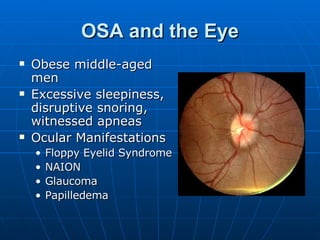
OSA and the Eye Obese middle-aged men Excessive sleepiness, disruptive snoring, witnessed apneas Ocular Manifestations Floppy Eyelid Syndrome NAION Glaucoma Papilledema
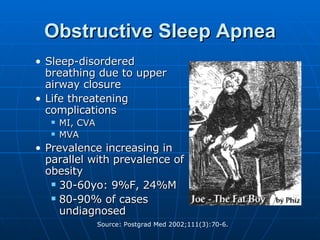
Obstructive Sleep Apnea Sleep-disordered breathing due to upper airway closure Life threatening complications MI, CVA MVA  Prevalence increasing in parallel with prevalence of obesity 30-60yo: 9%F, 24%M 80-90% of cases undiagnosed
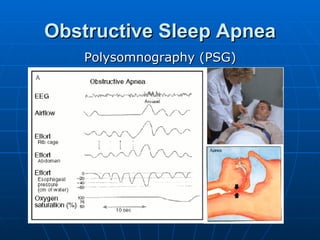
Obstructive Sleep Apnea Polysomnography (PSG)
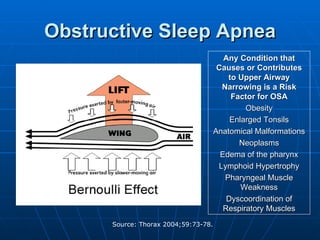
Obstructive Sleep Apnea Any Condition that Causes or Contributes to Upper Airway Narrowing is a Risk Factor for OSA Obesity Enlarged Tonsils Anatomical Malformations Neoplasms Edema of the pharynx Lymphoid Hypertrophy Pharyngeal Muscle Weakness Dyscoordination of Respiratory Muscles
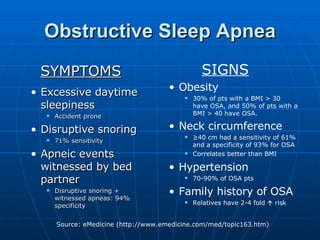
Obstructive Sleep Apnea SYMPTOMS Excessive daytime sleepiness Accident prone Disruptive snoring 71% sensitivity Apneic events witnessed by bed partner Disruptive snoring + witnessed apneas: 94% specificity SIGNS Obesity 30% of pts with a BMI > 30 have OSA, and 50% of pts with a BMI > 40 have OSA. Neck circumference   ≥ 40 cm had a sensitivity of 61% and a specificity of 93% for OSA Correlates better than BMI Hypertension 70-90% of OSA pts Family history of OSA Relatives have 2-4 fold    risk
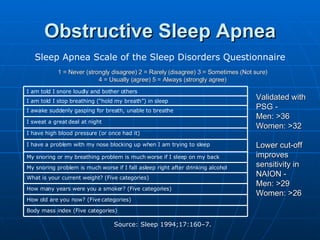
Obstructive Sleep Apnea Sleep Apnea Scale of the Sleep Disorders Questionnaire 1 = Never  (strongly disagree)   2 = Rarely   (disagree) 3 = Sometimes (Not sure) 4 = Usually (agree) 5 = Always (strongly agree) Validated with PSG - Men: >36 Women: >32 Lower cut-off  improves  sensitivity in  NAION - Men: >29 Women: >26 Body mass index (Five categories) How old are you now? (Five categories) How many years were you a smoker? (Five categories) What is your current weight? (Five categories) My snoring problem is much worse if I fall asleep right after drinking alcohol My snoring or my breathing problem is much worse if I sleep on my back I have a problem with my nose blocking up when I am trying to sleep I have high blood pressure (or once had it) I sweat a great deal at night I awake suddenly gasping for breath, unable to breathe I am told I stop breathing (“hold my breath”) in sleep I am told I snore loudly and bother others
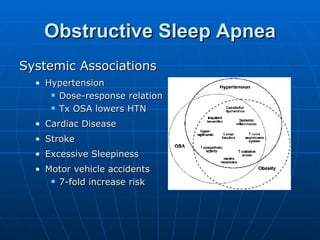
Obstructive Sleep Apnea Systemic Associations Hypertension Dose-response relation Tx OSA lowers HTN Cardiac Disease Stroke Excessive Sleepiness Motor vehicle accidents 7-fold increase risk
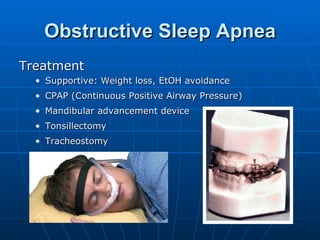
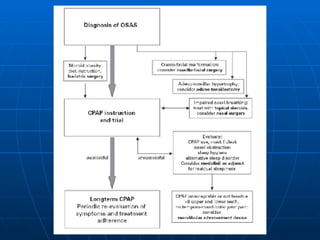
Obstructive Sleep Apnea Treatment Supportive: Weight loss, EtOH avoidance CPAP (Continuous Positive Airway Pressure) Mandibular advancement device Tonsillectomy Tracheostomy
 
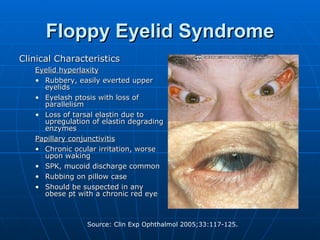
Floppy Eyelid Syndrome Clinical Characteristics Eyelid hyperlaxity Rubbery, easily everted upper eyelids Eyelash ptosis with loss of parallelism Loss of tarsal elastin due to upregulation of elastin degrading enzymes Papillary conjunctivitis Chronic ocular irritation, worse upon waking  SPK, mucoid discharge common Rubbing on pillow case Should be suspected in any obese pt with a chronic red eye
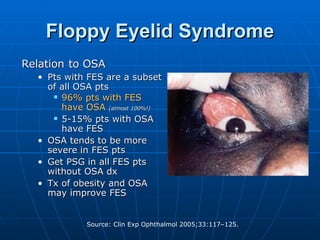
Floppy Eyelid Syndrome Relation   to OSA Pts with FES are a subset of all OSA pts 96% pts with FES have OSA  (almost 100%!) 5-15% pts with OSA have FES OSA tends to be more severe in FES pts Get PSG in all FES pts without OSA dx Tx of obesity and OSA may improve FES
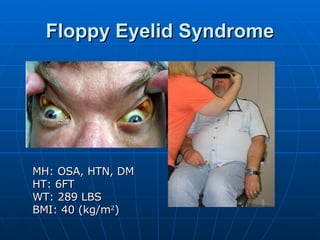
Floppy Eyelid Syndrome MH: OSA, HTN, DM HT: 6FT WT: 289 LBS BMI: 40 (kg/m 2 )
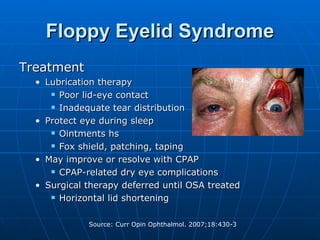
Floppy Eyelid Syndrome Treatment Lubrication therapy Poor lid-eye contact Inadequate tear distribution Protect eye during sleep Ointments hs Fox shield, patching, taping May improve or resolve with CPAP CPAP-related dry eye complications Surgical therapy deferred until OSA treated Horizontal lid shortening
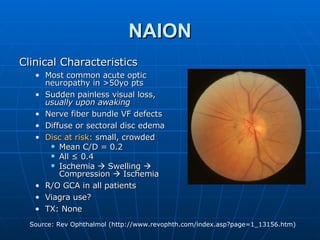
NAION Clinical Characteristics Most common acute optic neuropathy in >50yo pts Sudden painless visual loss,  usually upon awaking Nerve fiber bundle VF defects Diffuse or sectoral disc edema Disc at risk:  small, crowded Mean C/D = 0.2 All ≤ 0.4 Ischemia    Swelling    Compression    Ischemia R/O GCA in all patients Viagra use? TX: None
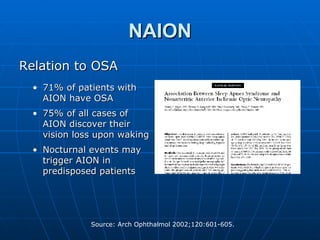
NAION Relation to OSA 71% of patients with AION have OSA 75% of all cases of AION discover their vision loss upon waking Nocturnal events may trigger AION in predisposed patients
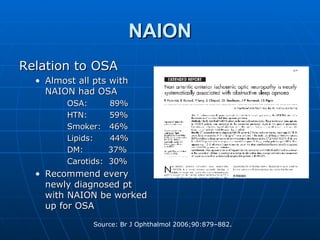
NAION Relation to OSA Almost all pts with NAION had OSA OSA:  89% HTN:  59% Smoker:  46% Lipids:  44% DM:  37% Carotids:  30% Recommend every newly diagnosed pt with NAION be worked up for OSA
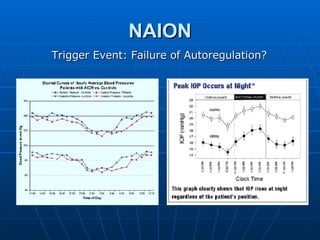
NAION Trigger Event: Failure of Autoregulation?
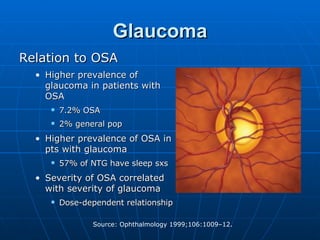
Glaucoma Relation to OSA Higher prevalence of glaucoma in patients with OSA 7.2% OSA 2% general pop Higher prevalence of OSA in pts with glaucoma 57% of NTG have sleep sxs Severity of OSA correlated with severity of glaucoma Dose-dependent relationship
 
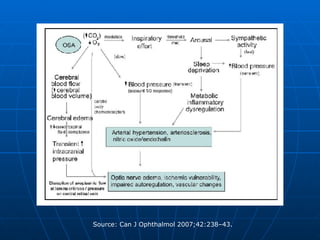
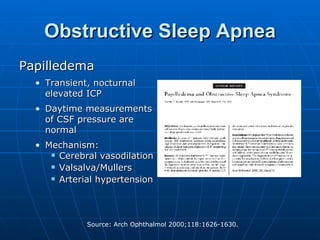
Obstructive Sleep Apnea Papilledema Transient, nocturnal elevated ICP  Daytime measurements of CSF pressure are normal Mechanism: Cerebral vasodilation Valsalva/Mullers Arterial hypertension
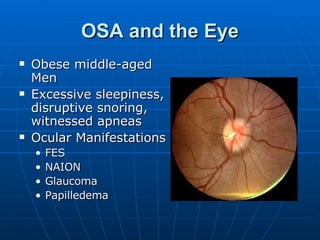
OSA and the Eye Obese middle-aged Men Excessive sleepiness, disruptive snoring, witnessed apneas Ocular Manifestations FES NAION Glaucoma Papilledema
Thank You!

Sleep Apnea and the Eye

  • 1.
    Sleep Apnea &the Eye Rick Trevino, OD VA Outpatient Clinic Evansville, IN
  • 2.
    Disclosures: None Interestedinfluence peddlers please see me afterward.
  • 3.
    OSA and theEye Obese middle-aged men Excessive sleepiness, disruptive snoring, witnessed apneas Ocular Manifestations Floppy Eyelid Syndrome NAION Glaucoma Papilledema
  • 4.
    Obstructive Sleep ApneaSleep-disordered breathing due to upper airway closure Life threatening complications MI, CVA MVA Prevalence increasing in parallel with prevalence of obesity 30-60yo: 9%F, 24%M 80-90% of cases undiagnosed
  • 5.
    Obstructive Sleep ApneaPolysomnography (PSG)
  • 6.
    Obstructive Sleep ApneaAny Condition that Causes or Contributes to Upper Airway Narrowing is a Risk Factor for OSA Obesity Enlarged Tonsils Anatomical Malformations Neoplasms Edema of the pharynx Lymphoid Hypertrophy Pharyngeal Muscle Weakness Dyscoordination of Respiratory Muscles
  • 7.
    Obstructive Sleep ApneaSYMPTOMS Excessive daytime sleepiness Accident prone Disruptive snoring 71% sensitivity Apneic events witnessed by bed partner Disruptive snoring + witnessed apneas: 94% specificity SIGNS Obesity 30% of pts with a BMI > 30 have OSA, and 50% of pts with a BMI > 40 have OSA. Neck circumference ≥ 40 cm had a sensitivity of 61% and a specificity of 93% for OSA Correlates better than BMI Hypertension 70-90% of OSA pts Family history of OSA Relatives have 2-4 fold  risk
  • 8.
    Obstructive Sleep ApneaSleep Apnea Scale of the Sleep Disorders Questionnaire 1 = Never (strongly disagree) 2 = Rarely (disagree) 3 = Sometimes (Not sure) 4 = Usually (agree) 5 = Always (strongly agree) Validated with PSG - Men: >36 Women: >32 Lower cut-off improves sensitivity in NAION - Men: >29 Women: >26 Body mass index (Five categories) How old are you now? (Five categories) How many years were you a smoker? (Five categories) What is your current weight? (Five categories) My snoring problem is much worse if I fall asleep right after drinking alcohol My snoring or my breathing problem is much worse if I sleep on my back I have a problem with my nose blocking up when I am trying to sleep I have high blood pressure (or once had it) I sweat a great deal at night I awake suddenly gasping for breath, unable to breathe I am told I stop breathing (“hold my breath”) in sleep I am told I snore loudly and bother others
  • 9.
    Obstructive Sleep ApneaSystemic Associations Hypertension Dose-response relation Tx OSA lowers HTN Cardiac Disease Stroke Excessive Sleepiness Motor vehicle accidents 7-fold increase risk
  • 10.
    Obstructive Sleep ApneaTreatment Supportive: Weight loss, EtOH avoidance CPAP (Continuous Positive Airway Pressure) Mandibular advancement device Tonsillectomy Tracheostomy
  • 11.
  • 12.
    Floppy Eyelid SyndromeClinical Characteristics Eyelid hyperlaxity Rubbery, easily everted upper eyelids Eyelash ptosis with loss of parallelism Loss of tarsal elastin due to upregulation of elastin degrading enzymes Papillary conjunctivitis Chronic ocular irritation, worse upon waking SPK, mucoid discharge common Rubbing on pillow case Should be suspected in any obese pt with a chronic red eye
  • 13.
    Floppy Eyelid SyndromeRelation to OSA Pts with FES are a subset of all OSA pts 96% pts with FES have OSA (almost 100%!) 5-15% pts with OSA have FES OSA tends to be more severe in FES pts Get PSG in all FES pts without OSA dx Tx of obesity and OSA may improve FES
  • 14.
    Floppy Eyelid SyndromeMH: OSA, HTN, DM HT: 6FT WT: 289 LBS BMI: 40 (kg/m 2 )
  • 15.
    Floppy Eyelid SyndromeTreatment Lubrication therapy Poor lid-eye contact Inadequate tear distribution Protect eye during sleep Ointments hs Fox shield, patching, taping May improve or resolve with CPAP CPAP-related dry eye complications Surgical therapy deferred until OSA treated Horizontal lid shortening
  • 16.
    NAION Clinical CharacteristicsMost common acute optic neuropathy in >50yo pts Sudden painless visual loss, usually upon awaking Nerve fiber bundle VF defects Diffuse or sectoral disc edema Disc at risk: small, crowded Mean C/D = 0.2 All ≤ 0.4 Ischemia  Swelling  Compression  Ischemia R/O GCA in all patients Viagra use? TX: None
  • 17.
    NAION Relation toOSA 71% of patients with AION have OSA 75% of all cases of AION discover their vision loss upon waking Nocturnal events may trigger AION in predisposed patients
  • 18.
    NAION Relation toOSA Almost all pts with NAION had OSA OSA: 89% HTN: 59% Smoker: 46% Lipids: 44% DM: 37% Carotids: 30% Recommend every newly diagnosed pt with NAION be worked up for OSA
  • 19.
    NAION Trigger Event:Failure of Autoregulation?
  • 20.
    Glaucoma Relation toOSA Higher prevalence of glaucoma in patients with OSA 7.2% OSA 2% general pop Higher prevalence of OSA in pts with glaucoma 57% of NTG have sleep sxs Severity of OSA correlated with severity of glaucoma Dose-dependent relationship
  • 21.
  • 22.
    Obstructive Sleep ApneaPapilledema Transient, nocturnal elevated ICP Daytime measurements of CSF pressure are normal Mechanism: Cerebral vasodilation Valsalva/Mullers Arterial hypertension
  • 23.
    OSA and theEye Obese middle-aged Men Excessive sleepiness, disruptive snoring, witnessed apneas Ocular Manifestations FES NAION Glaucoma Papilledema
  • 24.