Obstructive Sleep
Apnea
What is OSA?
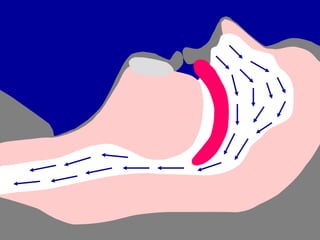
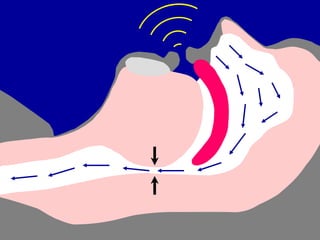
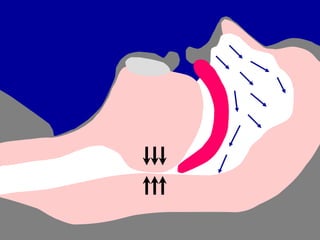
OSA is a syndrome characterized by
frequent episodes of upper airway
obstruction during sleep, associated with
recurrent arousals, oxygen desaturation,
and daytime symptoms
OSA is not a disease in itself, but rather a
final common pathway of many disorders
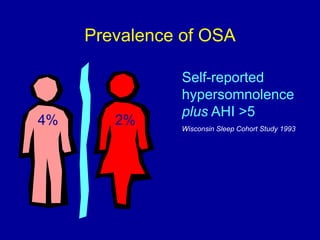
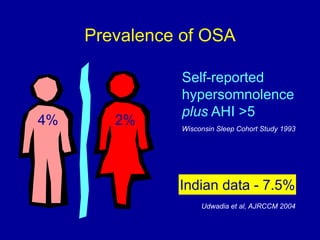
Prevalence of OSA
Self-reported
hypersomnolence
plus AHI >5
4% 2% Wisconsin Sleep Cohort Study 1993
Indian data - 7.5%
Udwadia et al, AJRCCM 2004
Self-reported
hypersomnolence
plus AHI >5
Wisconsin Sleep Cohort Study 1993
4% 2%
Prevalence of OSA
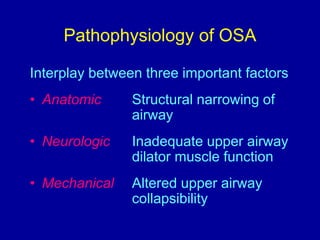
Pathophysiology of OSA
Interplay between three important factors
• Anatomic Structural narrowing of
airway
• Neurologic Inadequate upper airway
dilator muscle function
• Mechanical Altered upper airway
collapsibility
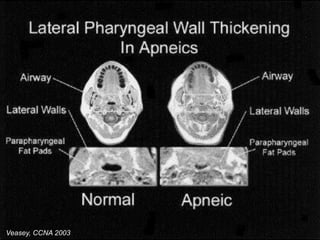
Anatomical narrowing
• Excessive adipose tissue around pharynx
• Increase in soft tissue volume (e.g. enlarged
tonsils, macroglossia, acromegaly)
• Craniofacial anomalies (e.g. micrognathia,
retrognathia, TM joint degeneration)
• Other minor abnormalities (e.g. differences
in airway shape and orientation, inferiorly
displaced hyoid bone, enlarged soft palate)
Veasey, CCNA 2003
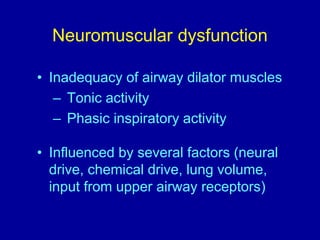
Neuromuscular dysfunction
• Inadequacy of airway dilator muscles
– Tonic activity
– Phasic inspiratory activity
• Influenced by several factors (neural
drive, chemical drive, lung volume,
input from upper airway receptors)
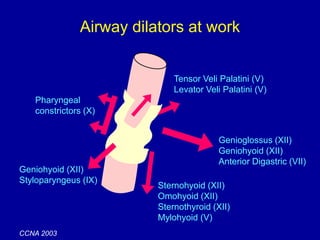
Tensor Veli Palatini (V)
Levator Veli Palatini (V)
Genioglossus (XII)
Geniohyoid (XII)
Anterior Digastric (VII)
Sternohyoid (XII)
Omohyoid (XII)
Sternothyroid (XII)
Mylohyoid (V)
Geniohyoid (XII)
Styloparyngeus (IX)
Pharyngeal
constrictors (X)
Airway dilators at work
CCNA 2003
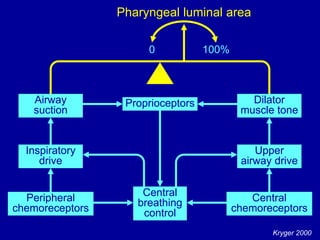
Peripheral
chemoreceptors
Central
chemoreceptors
Inspiratory
drive
Airway
suction
Dilator
muscle tone
Upper
airway drive
Proprioceptors
Central
breathing
control
100%
0
Pharyngeal luminal area
Kryger 2000
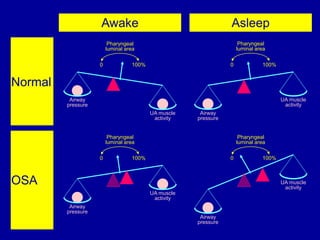
Awake Asleep
Pharyngeal
luminal area
Airway
pressure
UA muscle
activity
Pharyngeal
luminal area
Airway
pressure
UA muscle
activity
0 100%
0 100%
Normal
Pharyngeal
luminal area
Airway
pressure
UA muscle
activity
Pharyngeal
luminal area
Airway
pressure
UA muscle
activity
0 100%
0 100%
OSA
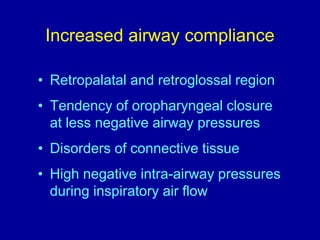
Increased airway compliance
• Retropalatal and retroglossal region
• Tendency of oropharyngeal closure
at less negative airway pressures
• Disorders of connective tissue
• High negative intra-airway pressures
during inspiratory air flow
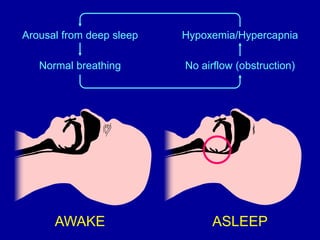
ASLEEP
AWAKE
Normal breathing
Hypoxemia/Hypercapnia
Arousal from deep sleep
No airflow (obstruction)
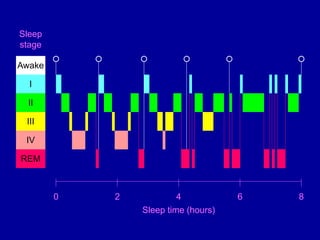
I
II
III
IV
REM
Awake
2
0 4 6 8
Sleep time (hours)
Sleep
stage
The initial history
• Interview both patient and bed partner
• Majority of patients present with
– excessive daytime sleepiness
– neuropsychiatric symptoms
– cardiorespiratory features
• Diagnosis is often missed even though
patients have had symptoms for years
• Sleep at night is fragmented
• Tendency to fall asleep during day
– In inappropriate settings
– At inappropriate times
– Without realizing
• Severity correlates with intensity
of nocturnal apnea
• Epworth Sleepiness Scale (ESS)
Excessive Daytime Sleepiness
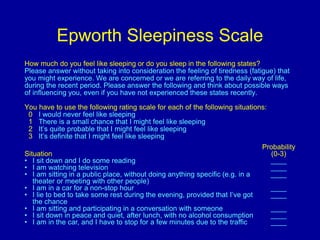
Epworth Sleepiness Scale
How much do you feel like sleeping or do you sleep in the following states?
Please answer without taking into consideration the feeling of tiredness (fatigue) that
you might experience. We are concerned or we are referring to the daily way of life,
during the recent period. Please answer the following and think about possible ways
of influencing you, even if you have not experienced these states recently.
You have to use the following rating scale for each of the following situations:
0 I would never feel like sleeping
1 There is a small chance that I might feel like sleeping
2 It’s quite probable that I might feel like sleeping
3 It’s definite that I might feel like sleeping
Situation
Probability
(0-3)
• I sit down and I do some reading ____
• I am watching television ____
• I am sitting in a public place, without doing anything specific (e.g. in a
theater or meeting with other people)
____
• I am in a car for a non-stop hour ____
• I lie to bed to take some rest during the evening, provided that I’ve got
the chance
____
• I am sitting and participating in a conversation with someone ____
• I sit down in peace and quiet, after lunch, with no alcohol consumption ____
• I am in the car, and I have to stop for a few minutes due to the traffic ____
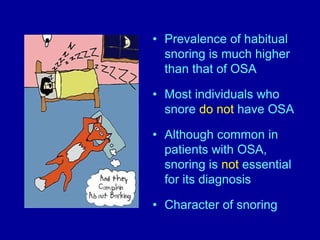
• Prevalence of habitual
snoring is much higher
than that of OSA
• Most individuals who
snore do not have OSA
• Although common in
patients with OSA,
snoring is not essential
for its diagnosis
• Character of snoring
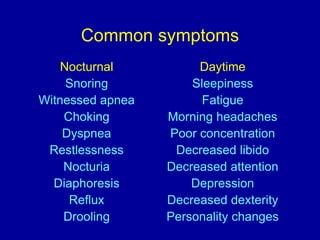
Common symptoms
Nocturnal Daytime
Snoring Sleepiness
Witnessed apnea Fatigue
Choking Morning headaches
Dyspnea Poor concentration
Restlessness Decreased libido
Nocturia Decreased attention
Diaphoresis Depression
Reflux Decreased dexterity
Drooling Personality changes
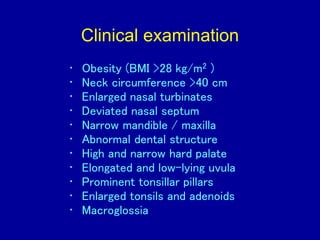
Clinical examination
• Obesity (BMI >28 kg/m2 )
• Neck circumference >40 cm
• Enlarged nasal turbinates
• Deviated nasal septum
• Narrow mandible / maxilla
• Abnormal dental structure
• High and narrow hard palate
• Elongated and low-lying uvula
• Prominent tonsillar pillars
• Enlarged tonsils and adenoids
• Macroglossia
Risk factors
• Obesity
• Advancing age
• Male gender
• Positive family history
• Race
• Alcohol ingestion
• Sedative use
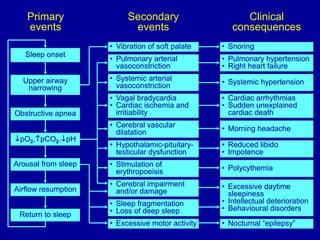
Primary
events
Secondary
events
Clinical
consequences
• Vibration of soft palate • Snoring
• Pulmonary arterial
vasoconstriction
• Pulmonary hypertension
• Right heart failure
• Systemic arterial
vasoconstriction • Systemic hypertension
• Vagal bradycardia
• Cardiac ischemia and
irritiability
• Cardiac arrhythmias
• Sudden unexplained
cardiac death
• Cerebral vascular
dilatation • Morning headache
• Hypothalamic-pituitary-
testicular dysfunction
• Reduced libido
• Impotence
• Stimulation of
erythropoeisis • Polycythemia
• Cerebral impairment
and/or damage
• Excessive daytime
sleepiness
• Intellectual deterioration
• Behavioural disorders
• Sleep fragmentation
• Loss of deep sleep
• Excessive motor activity • Nocturnal “epilepsy”
Sleep onset
Upper airway
narrowing
Obstructive apnea
ipO2,hpCO2,ipH
Arousal from sleep
Airflow resumption
Return to sleep
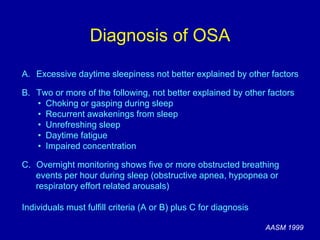
Diagnosis of OSA
A. Excessive daytime sleepiness not better explained by other factors
B. Two or more of the following, not better explained by other factors
• Choking or gasping during sleep
• Recurrent awakenings from sleep
• Unrefreshing sleep
• Daytime fatigue
• Impaired concentration
C. Overnight monitoring shows five or more obstructed breathing
events per hour during sleep (obstructive apnea, hypopnea or
respiratory effort related arousals)
Individuals must fulfill criteria (A or B) plus C for diagnosis
AASM 1999
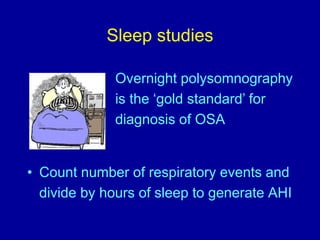
Sleep studies
• Count number of respiratory events and
divide by hours of sleep to generate AHI
Overnight polysomnography
is the ‘gold standard’ for
diagnosis of OSA
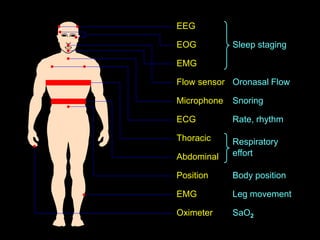
Sleep staging
Oronasal Flow
Snoring
Rate, rhythm
Respiratory
effort
Body position
Leg movement
SaO2
EEG
EOG
Flow sensor
EMG
Microphone
ECG
Thoracic
Abdominal
Position
EMG
Oximeter
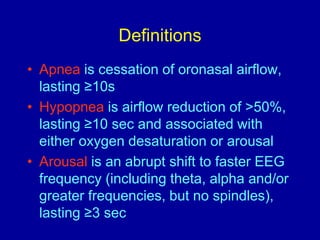
Definitions
• Apnea is cessation of oronasal airflow,
lasting ≥10s
• Hypopnea is airflow reduction of >50%,
lasting ≥10 sec and associated with
either oxygen desaturation or arousal
• Arousal is an abrupt shift to faster EEG
frequency (including theta, alpha and/or
greater frequencies, but no spindles),
lasting ≥3 sec
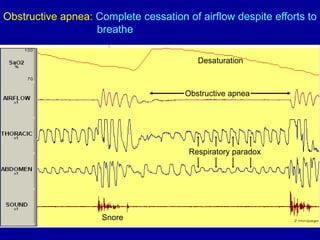
Obstructive apnea
Desaturation
Respiratory paradox
Snore
Obstructive apnea: Complete cessation of airflow despite efforts to
breathe
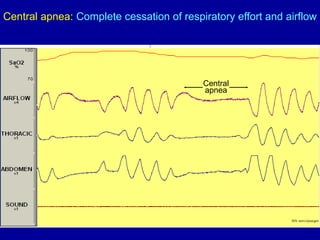
Central
apnea
Central apnea: Complete cessation of respiratory effort and airflow
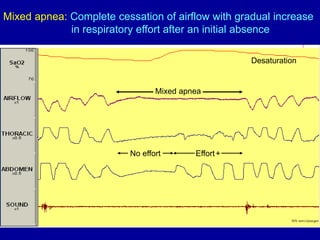
Mixed apnea: Complete cessation of airflow with gradual increase
in respiratory effort after an initial absence
Mixed apnea
No effort Effort+
Desaturation
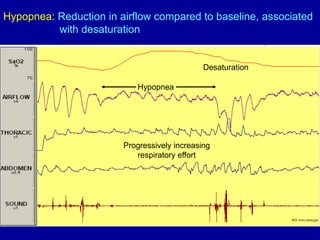
Hypopnea
Desaturation
Progressively increasing
respiratory effort
Hypopnea: Reduction in airflow compared to baseline, associated
with desaturation
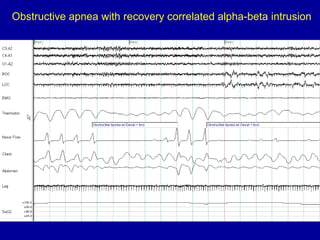
Obstructive apnea with recovery correlated alpha-beta intrusion
• Standard vs. portable equipment
• Technician-attended studies
• Definitions of respiratory events
(desaturation, arousal, etc.)
• Categorization of severity
• Whole-night vs. split-night studies
Controversies in PSG
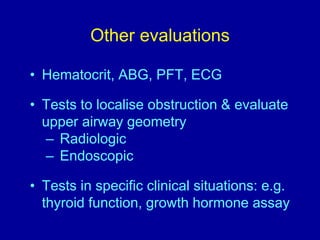
Other evaluations
• Hematocrit, ABG, PFT, ECG
• Tests to localise obstruction & evaluate
upper airway geometry
– Radiologic
– Endoscopic
• Tests in specific clinical situations: e.g.
thyroid function, growth hormone assay
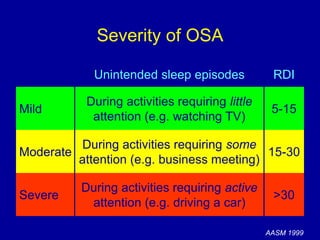
Severity of OSA
Unintended sleep episodes RDI
Mild
During activities requiring little
attention (e.g. watching TV)
5-15
Moderate
During activities requiring some
attention (e.g. business meeting)
15-30
Severe
During activities requiring active
attention (e.g. driving a car)
>30
AASM 1999
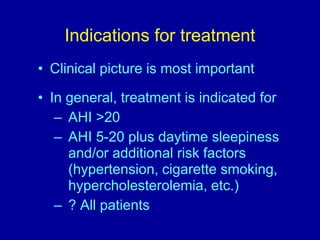
Indications for treatment
• Clinical picture is most important
• In general, treatment is indicated for
– AHI >20
– AHI 5-20 plus daytime sleepiness
and/or additional risk factors
(hypertension, cigarette smoking,
hypercholesterolemia, etc.)
– ? All patients
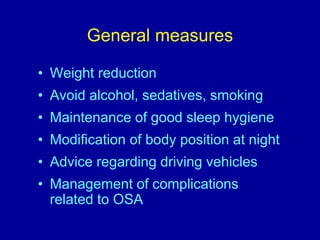
General measures
• Weight reduction
• Avoid alcohol, sedatives, smoking
• Maintenance of good sleep hygiene
• Modification of body position at night
• Advice regarding driving vehicles
• Management of complications
related to OSA
Treatment of specific conditions
Upper airway obstruction
• Nasal obstruction
• Enlarged tonsils or adenoids
• Face skeletal abnormality
Systemic disorders
• Hypothyroidism • Acromegaly
• Sarcoidosis • Lymphoma
Treatment when no specific
cause can be ascertained
• Nasal CPAP – therapy of choice
• Other measures
– Pharmacological agents
– Mechanical devices
– Surgical procedures
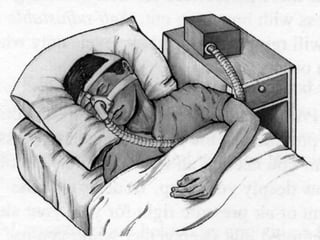
Nasal CPAP therapy for OSA
• Currently the treatment of choice
• Important considerations
– Comfortable and tight-fitting mask
– Use all night and every night
– Use during daytime naps also
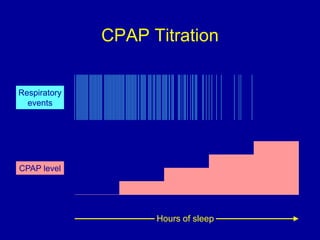
• Majority require 6 - 12 cm H2O
• Level of CPAP should be determined
objectively while patient is sleeping
Respiratory
events
CPAP level
CPAP Titration
Hours of sleep
Nasal CPAP systems
• Fixed level
• Self-titrating
• Other ‘extras’
– Ramp feature
– Humidification
• BiPAP systems
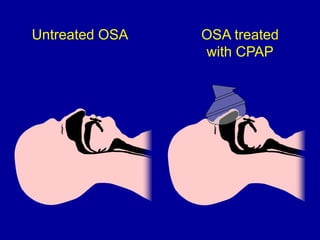
Untreated OSA OSA treated
with CPAP
Benefits of CPAP therapy
• Improvement in neuropsychiatric
function
• Lessening of daytime sleepiness
• Amelioration of
– Nocturnal desaturation
– Ventilatory-related arousals
– Nocturnal dysrhythmias
– Pulmonary hypertension
– Systemic hypertension
Pharmacological therapy
• Protriptyline
• Oxygen
• Other agents with doubtful role
– Stimulants: amphetamines, Modafinil
– Serotonin agonists: Buspirone
• Agents with no therapeutic indications
(progesterone, acetazolamide, naloxone,
theophylline, almitrine, bromocriptine)
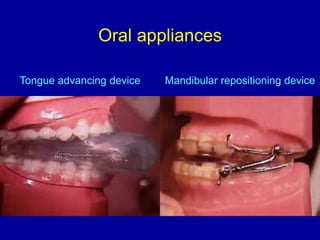
Oral appliances
Mandibular repositioning device
Tongue advancing device
Surgical treatment
• Tracheostomy
• Palatal surgery
– Uvulopalatopharyngoplasty
– Laser assisted procedure
• Maxillofacial surgery
– Genioglossal advancement
– Maxillomandibular advancement
Role of non-CPAP therapy
• Less effective, less accepted, and less
tolerated
• May be considered for
– individuals with clearly reversible
causes of OSA (e.g. deformities)
– individuals who have failed or who
refuse CPAP treatment
– treatment of mild OSA (?)
SUMMARY
• OSA is one presentation in a spectrum
of sleep-related breathing disorders
• Anatomic, neurologic and mechanical
factors all involved in pathogenesis
• Polysomnography is the gold standard
for establishing diagnosis
• Nasal CPAP therapy is treatment of
choice in patients without any specific
underlying cause
THANK YOU

Obstructive Sleep Apnea | Jindal Chest Clinic

  • 1.
  • 3.
    What is OSA? OSAis a syndrome characterized by frequent episodes of upper airway obstruction during sleep, associated with recurrent arousals, oxygen desaturation, and daytime symptoms OSA is not a disease in itself, but rather a final common pathway of many disorders
  • 4.
    Prevalence of OSA Self-reported hypersomnolence plusAHI >5 4% 2% Wisconsin Sleep Cohort Study 1993
  • 5.
    Indian data -7.5% Udwadia et al, AJRCCM 2004 Self-reported hypersomnolence plus AHI >5 Wisconsin Sleep Cohort Study 1993 4% 2% Prevalence of OSA
  • 6.
    Pathophysiology of OSA Interplaybetween three important factors • Anatomic Structural narrowing of airway • Neurologic Inadequate upper airway dilator muscle function • Mechanical Altered upper airway collapsibility
  • 7.
    Anatomical narrowing • Excessiveadipose tissue around pharynx • Increase in soft tissue volume (e.g. enlarged tonsils, macroglossia, acromegaly) • Craniofacial anomalies (e.g. micrognathia, retrognathia, TM joint degeneration) • Other minor abnormalities (e.g. differences in airway shape and orientation, inferiorly displaced hyoid bone, enlarged soft palate)
  • 8.
  • 9.
    Neuromuscular dysfunction • Inadequacyof airway dilator muscles – Tonic activity – Phasic inspiratory activity • Influenced by several factors (neural drive, chemical drive, lung volume, input from upper airway receptors)
  • 10.
    Tensor Veli Palatini(V) Levator Veli Palatini (V) Genioglossus (XII) Geniohyoid (XII) Anterior Digastric (VII) Sternohyoid (XII) Omohyoid (XII) Sternothyroid (XII) Mylohyoid (V) Geniohyoid (XII) Styloparyngeus (IX) Pharyngeal constrictors (X) Airway dilators at work CCNA 2003
  • 11.
  • 12.
    Awake Asleep Pharyngeal luminal area Airway pressure UAmuscle activity Pharyngeal luminal area Airway pressure UA muscle activity 0 100% 0 100% Normal Pharyngeal luminal area Airway pressure UA muscle activity Pharyngeal luminal area Airway pressure UA muscle activity 0 100% 0 100% OSA
  • 13.
    Increased airway compliance •Retropalatal and retroglossal region • Tendency of oropharyngeal closure at less negative airway pressures • Disorders of connective tissue • High negative intra-airway pressures during inspiratory air flow
  • 14.
  • 15.
    I II III IV REM Awake 2 0 4 68 Sleep time (hours) Sleep stage
  • 16.
    The initial history •Interview both patient and bed partner • Majority of patients present with – excessive daytime sleepiness – neuropsychiatric symptoms – cardiorespiratory features • Diagnosis is often missed even though patients have had symptoms for years
  • 17.
    • Sleep atnight is fragmented • Tendency to fall asleep during day – In inappropriate settings – At inappropriate times – Without realizing • Severity correlates with intensity of nocturnal apnea • Epworth Sleepiness Scale (ESS) Excessive Daytime Sleepiness
  • 18.
    Epworth Sleepiness Scale Howmuch do you feel like sleeping or do you sleep in the following states? Please answer without taking into consideration the feeling of tiredness (fatigue) that you might experience. We are concerned or we are referring to the daily way of life, during the recent period. Please answer the following and think about possible ways of influencing you, even if you have not experienced these states recently. You have to use the following rating scale for each of the following situations: 0 I would never feel like sleeping 1 There is a small chance that I might feel like sleeping 2 It’s quite probable that I might feel like sleeping 3 It’s definite that I might feel like sleeping Situation Probability (0-3) • I sit down and I do some reading ____ • I am watching television ____ • I am sitting in a public place, without doing anything specific (e.g. in a theater or meeting with other people) ____ • I am in a car for a non-stop hour ____ • I lie to bed to take some rest during the evening, provided that I’ve got the chance ____ • I am sitting and participating in a conversation with someone ____ • I sit down in peace and quiet, after lunch, with no alcohol consumption ____ • I am in the car, and I have to stop for a few minutes due to the traffic ____
  • 19.
    • Prevalence ofhabitual snoring is much higher than that of OSA • Most individuals who snore do not have OSA • Although common in patients with OSA, snoring is not essential for its diagnosis • Character of snoring
  • 23.
    Common symptoms Nocturnal Daytime SnoringSleepiness Witnessed apnea Fatigue Choking Morning headaches Dyspnea Poor concentration Restlessness Decreased libido Nocturia Decreased attention Diaphoresis Depression Reflux Decreased dexterity Drooling Personality changes
  • 24.
    Clinical examination • Obesity(BMI >28 kg/m2 ) • Neck circumference >40 cm • Enlarged nasal turbinates • Deviated nasal septum • Narrow mandible / maxilla • Abnormal dental structure • High and narrow hard palate • Elongated and low-lying uvula • Prominent tonsillar pillars • Enlarged tonsils and adenoids • Macroglossia
  • 25.
    Risk factors • Obesity •Advancing age • Male gender • Positive family history • Race • Alcohol ingestion • Sedative use
  • 26.
    Primary events Secondary events Clinical consequences • Vibration ofsoft palate • Snoring • Pulmonary arterial vasoconstriction • Pulmonary hypertension • Right heart failure • Systemic arterial vasoconstriction • Systemic hypertension • Vagal bradycardia • Cardiac ischemia and irritiability • Cardiac arrhythmias • Sudden unexplained cardiac death • Cerebral vascular dilatation • Morning headache • Hypothalamic-pituitary- testicular dysfunction • Reduced libido • Impotence • Stimulation of erythropoeisis • Polycythemia • Cerebral impairment and/or damage • Excessive daytime sleepiness • Intellectual deterioration • Behavioural disorders • Sleep fragmentation • Loss of deep sleep • Excessive motor activity • Nocturnal “epilepsy” Sleep onset Upper airway narrowing Obstructive apnea ipO2,hpCO2,ipH Arousal from sleep Airflow resumption Return to sleep
  • 27.
    Diagnosis of OSA A.Excessive daytime sleepiness not better explained by other factors B. Two or more of the following, not better explained by other factors • Choking or gasping during sleep • Recurrent awakenings from sleep • Unrefreshing sleep • Daytime fatigue • Impaired concentration C. Overnight monitoring shows five or more obstructed breathing events per hour during sleep (obstructive apnea, hypopnea or respiratory effort related arousals) Individuals must fulfill criteria (A or B) plus C for diagnosis AASM 1999
  • 28.
    Sleep studies • Countnumber of respiratory events and divide by hours of sleep to generate AHI Overnight polysomnography is the ‘gold standard’ for diagnosis of OSA
  • 29.
    Sleep staging Oronasal Flow Snoring Rate,rhythm Respiratory effort Body position Leg movement SaO2 EEG EOG Flow sensor EMG Microphone ECG Thoracic Abdominal Position EMG Oximeter
  • 30.
    Definitions • Apnea iscessation of oronasal airflow, lasting ≥10s • Hypopnea is airflow reduction of >50%, lasting ≥10 sec and associated with either oxygen desaturation or arousal • Arousal is an abrupt shift to faster EEG frequency (including theta, alpha and/or greater frequencies, but no spindles), lasting ≥3 sec
  • 31.
    Obstructive apnea Desaturation Respiratory paradox Snore Obstructiveapnea: Complete cessation of airflow despite efforts to breathe
  • 32.
    Central apnea Central apnea: Completecessation of respiratory effort and airflow
  • 33.
    Mixed apnea: Completecessation of airflow with gradual increase in respiratory effort after an initial absence Mixed apnea No effort Effort+ Desaturation
  • 34.
    Hypopnea Desaturation Progressively increasing respiratory effort Hypopnea:Reduction in airflow compared to baseline, associated with desaturation
  • 35.
    Obstructive apnea withrecovery correlated alpha-beta intrusion
  • 36.
    • Standard vs.portable equipment • Technician-attended studies • Definitions of respiratory events (desaturation, arousal, etc.) • Categorization of severity • Whole-night vs. split-night studies Controversies in PSG
  • 37.
    Other evaluations • Hematocrit,ABG, PFT, ECG • Tests to localise obstruction & evaluate upper airway geometry – Radiologic – Endoscopic • Tests in specific clinical situations: e.g. thyroid function, growth hormone assay
  • 38.
    Severity of OSA Unintendedsleep episodes RDI Mild During activities requiring little attention (e.g. watching TV) 5-15 Moderate During activities requiring some attention (e.g. business meeting) 15-30 Severe During activities requiring active attention (e.g. driving a car) >30 AASM 1999
  • 39.
    Indications for treatment •Clinical picture is most important • In general, treatment is indicated for – AHI >20 – AHI 5-20 plus daytime sleepiness and/or additional risk factors (hypertension, cigarette smoking, hypercholesterolemia, etc.) – ? All patients
  • 40.
    General measures • Weightreduction • Avoid alcohol, sedatives, smoking • Maintenance of good sleep hygiene • Modification of body position at night • Advice regarding driving vehicles • Management of complications related to OSA
  • 41.
    Treatment of specificconditions Upper airway obstruction • Nasal obstruction • Enlarged tonsils or adenoids • Face skeletal abnormality Systemic disorders • Hypothyroidism • Acromegaly • Sarcoidosis • Lymphoma
  • 42.
    Treatment when nospecific cause can be ascertained • Nasal CPAP – therapy of choice • Other measures – Pharmacological agents – Mechanical devices – Surgical procedures
  • 44.
    Nasal CPAP therapyfor OSA • Currently the treatment of choice • Important considerations – Comfortable and tight-fitting mask – Use all night and every night – Use during daytime naps also • Majority require 6 - 12 cm H2O • Level of CPAP should be determined objectively while patient is sleeping
  • 45.
  • 46.
    Nasal CPAP systems •Fixed level • Self-titrating • Other ‘extras’ – Ramp feature – Humidification • BiPAP systems
  • 47.
    Untreated OSA OSAtreated with CPAP
  • 48.
    Benefits of CPAPtherapy • Improvement in neuropsychiatric function • Lessening of daytime sleepiness • Amelioration of – Nocturnal desaturation – Ventilatory-related arousals – Nocturnal dysrhythmias – Pulmonary hypertension – Systemic hypertension
  • 49.
    Pharmacological therapy • Protriptyline •Oxygen • Other agents with doubtful role – Stimulants: amphetamines, Modafinil – Serotonin agonists: Buspirone • Agents with no therapeutic indications (progesterone, acetazolamide, naloxone, theophylline, almitrine, bromocriptine)
  • 50.
    Oral appliances Mandibular repositioningdevice Tongue advancing device
  • 51.
    Surgical treatment • Tracheostomy •Palatal surgery – Uvulopalatopharyngoplasty – Laser assisted procedure • Maxillofacial surgery – Genioglossal advancement – Maxillomandibular advancement
  • 52.
    Role of non-CPAPtherapy • Less effective, less accepted, and less tolerated • May be considered for – individuals with clearly reversible causes of OSA (e.g. deformities) – individuals who have failed or who refuse CPAP treatment – treatment of mild OSA (?)
  • 53.
    SUMMARY • OSA isone presentation in a spectrum of sleep-related breathing disorders • Anatomic, neurologic and mechanical factors all involved in pathogenesis • Polysomnography is the gold standard for establishing diagnosis • Nasal CPAP therapy is treatment of choice in patients without any specific underlying cause
  • 54.