SLEEP DISORDERED
BREATHING/
OBSTRUCTIVE SLEEP
APNEA
JHANSI NALAMATI MD
TYPES
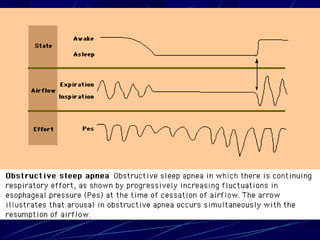
Obstructive Sleep Apnea
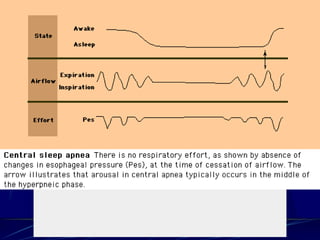
Central Sleep Apnea
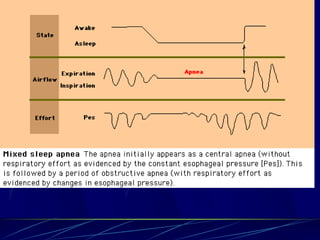
Mixed Apnea
Upper Airway Resistance Syndrome
(UARS)
Historical background
Apnea- literally means “without breath”
Pickwickian papers fat boy “Joe”
Osler and later Burwell applied the
name “Pickwickian Syndrome” to
patients with Obesity, Hypersomnolence
and signs of Chronic hypoventilation
Historical (contd.)
Sleep apnea -Rediscovered by Gestaut and
co- workers in 1965 by simultaneously
recording sleep and breathing in a
“Pickwickian” patient and described all 3
types of apnea.
Postulated that sleepiness is due to repetitive
arousals associated with resumption of
breathing that terminated the apneic events.
Historical(contd.)
First description of successful Tx of
OSA by tracheostomy followed in 1969.
First Tx with CPAP – in 1980’s soon
after NIPPV was described by Charles
Collins of Australia
Definition of Apnea
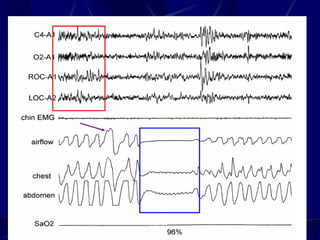
Apnea-Cessation of breathing(air flow)
for 10 seconds
Hypopnea- decreased in the airflow by
30-50%, and associated with an arousal
and a drop in oxygen desaturation by 3-
4%
Prevalence
9% of men and 4% of women, in one
study of state employees had AHI of 15
events/hr
12 million people in the US have OSA
Pathophysiology
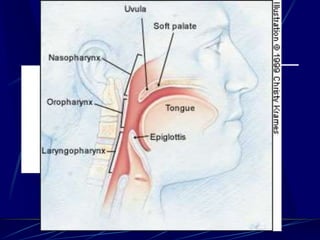
Pharynx is abnormal in size or
collapsibility.
As an organ for speech and deglutition
it must be able to change shape and
close
As a conduit for airflow it must resist
collapse
Pathophysiology(contd.)
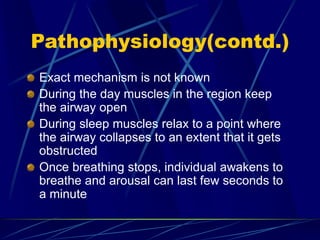
Exact mechanism is not known
During the day muscles in the region keep
the airway open
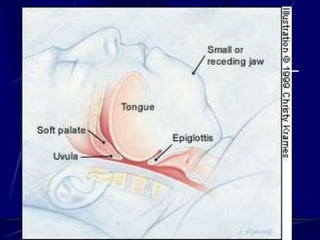
During sleep muscles relax to a point where
the airway collapses to an extent that it gets
obstructed
Once breathing stops, individual awakens to
breathe and arousal can last few seconds to
a minute
Risk factors for OSA
Obesity
Age- middle aged men and post-
menopausal women
Older age- due to loss of muscle mass
and tone
? Family Hx of OSA
Risk factors (contd.)
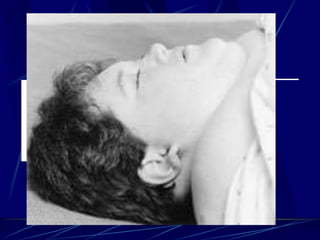
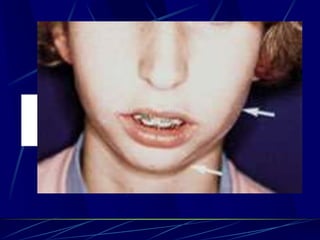
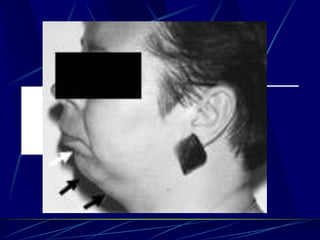
Anatomic abnormalities- receding chin,
?Nasal congestion, ? DNS
Enlarged Tonsils and adenoids esp.in
children
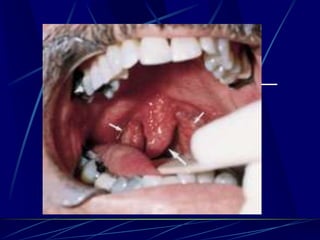
Enlarged and inflammed uvula,
worsened by chronic smoking, GERD
Acromegaly
Risk factors (contd.)
Amyloidosis, post- polio syndrome,
neuromuscular disorders
Marfan’s syndrome, Down’s syndrome
Use of alcohol and sedatives that relax
the upper airway
Increased neck circumference > 16
inches in women and 18 inches in men
Symptoms
Most of the symptoms are from
disruption of normal sleep architecture
Excessive Daytime Sleepiness (EDS)-
falling asleep even in stimulating
environment, during a conversation,
eating, business meeting
H/O Snoring
Symptoms (contd.)
Non- restorative sleep
Automobile Accidents
Personality changes
Decreased Memory
Erectile Dysfunction
Frequent Nocturnal Awakening
Symptoms(contd.)
Drowsy Driver Syndrome
Polyuria
Early morning headache
Dry mouth
Signs
Loud Snoring
Witnessed apneas
Obesity
HTN
Metabolic syndrome
Increased Neck circumference
Anatomic Abnormalities
SHHS
Sleep heart health study- initiated by
NIH in 1996 and initial data shows that
treatment of SBD improved outcomes in
control of HTN, CHF atherogenesis,
glycemic control
Screening for OSA
2 of the three symptoms- EDS, loud
Snoring, Witnessed Apneas
High Score on ESS(Epworth Sleepiness
Score)>12, or Stanford Sleepiness
Score
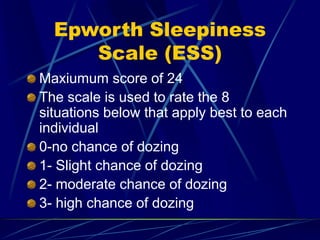
Epworth Sleepiness
Scale (ESS)
Maxiumum score of 24
The scale is used to rate the 8
situations below that apply best to each
individual
0-no chance of dozing
1- Slight chance of dozing
2- moderate chance of dozing
3- high chance of dozing
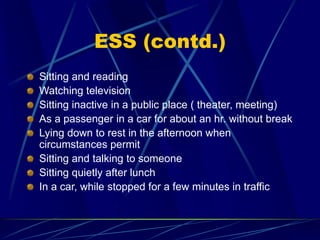
ESS (contd.)
Sitting and reading
Watching television
Sitting inactive in a public place ( theater, meeting)
As a passenger in a car for about an hr. without break
Lying down to rest in the afternoon when
circumstances permit
Sitting and talking to someone
Sitting quietly after lunch
In a car, while stopped for a few minutes in traffic
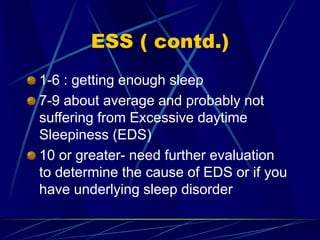
ESS ( contd.)
1-6 : getting enough sleep
7-9 about average and probably not
suffering from Excessive daytime
Sleepiness (EDS)
10 or greater- need further evaluation
to determine the cause of EDS or if you
have underlying sleep disorder
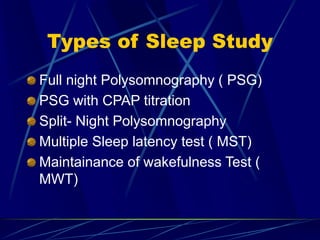
Types of Sleep Study
Full night Polysomnography ( PSG)
PSG with CPAP titration
Split- Night Polysomnography
Multiple Sleep latency test ( MST)
Maintainance of wakefulness Test (
MWT)
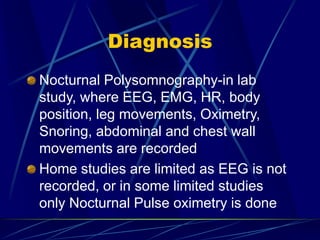
Diagnosis
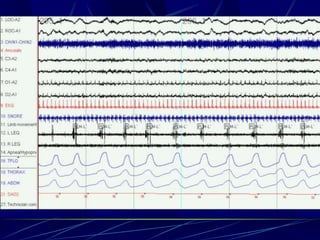
Nocturnal Polysomnography-in lab
study, where EEG, EMG, HR, body
position, leg movements, Oximetry,
Snoring, abdominal and chest wall
movements are recorded
Home studies are limited as EEG is not
recorded, or in some limited studies
only Nocturnal Pulse oximetry is done
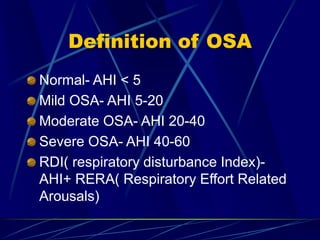
Definition of OSA
Normal- AHI < 5
Mild OSA- AHI 5-20
Moderate OSA- AHI 20-40
Severe OSA- AHI 40-60
RDI( respiratory disturbance Index)-
AHI+ RERA( Respiratory Effort Related
Arousals)
UARS
Upper Airway Resistance Syndrome
Cannot be diagnosed with PSG
Repetitive arousals that probably result
from increased Respiratory effort and
high resistance in the airway
Can be diagnosed by measuring
esophageal pressure (Pes)
Medical Complications
Uncontrolled HTN
Diminished quality of life from chronic
sleep deprivation
Increase risk for CVA
Worsening of CAD and CHF
Treatment
Behavioral Tx- weight loss
Sleep hygeine
Avoiding alcohol too close to bedtime
Avoid sedatives and hypnotics,
narcotics
Avoid caffeine
Treatment(contd.)
Positional Tx- helpful with Primary
snoring
Positive Airway pressure (CPAP or
BiPAP)
ENT Surgery
Oral appliances
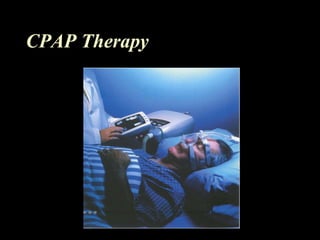
Positive airway pressure
Effective, Non-invasive
Mask fit, air seal, comfort and
humidification are important
Nasal mask, full face- masks, nasal
pillows, Nasal aire prongs
Complications of CPAP
Local dermatitis
Air leak, nasal congestion,rhinorrhea
Dry eyes
Nose bleed
Aerophagia
Rare- tympanic rupture, pneumothorax
Compliance is the biggest issue
Surgery
Except tracheostomy,helps only mild to
moderate cases or only primary snoring
Not curative for OSA
Somnoplasty- office procedure-
radiofrequency ablation of the soft
palate- only for snoring
Surgery( contd.)
LAUP- laser assisted uvuloplasty, only
for snoring, office procedure
UPPP (UP3)- (Uvulo-palato-pharyngo-
plasty)
Complicated surgery
Patients have to observed in the
hospital overnight
UPPP(contd.)
Decreases AHI by only 50%
Complications include- nasal
regurgitation of fluids, pharyngeal
stensosis
In children- tonsillectomy and
adenoidectomy alone is curative
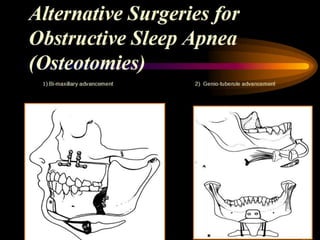
Jaw surgery
Useful for retrognathia, involves partial
excision of maxilla or mandible
Genioplasty
Complicated surgery
Bariatric surgery
Gastric bypass
Weight loss and decrease in adipose
tissue of the parapharyngeal region
leads to improvement or cure of OSA
Weight loss has to be at least 20-30lbs
before any change in AHI can be seen
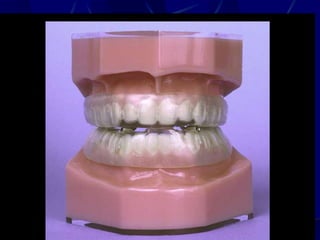
Oral appliances
Devices that are worn during sleep that
retract the jaw and alleviate upper
airway obstruction
Tongue retaining devices for people with
macroglossia
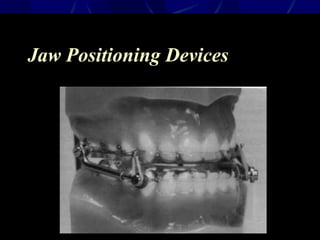
Jaw Positioning Devices
CPAP Therapy
CPAP Therapy
Positive impact on subjective sleepiness
and depression (in RCTs)
Fatigue, generic health related quality of
life, vigilance, driving performance are
all improved ( prospective trials)
These parameters are sensitive to Tx
duration and compliance
Commercial driving and
OSA
OSA has to be effectively treated
before clearing the patient for work
Objective documentation of regular
CPAP use and testing by Multiple sleep
latency test and/or MWT( Maintainance
of Wakefulness Test)

SLEEP+DISORDERED+BREATHING- DrNalamati 5-13-09.ppt

  • 1.
  • 2.
    TYPES Obstructive Sleep Apnea CentralSleep Apnea Mixed Apnea Upper Airway Resistance Syndrome (UARS)
  • 6.
    Historical background Apnea- literallymeans “without breath” Pickwickian papers fat boy “Joe” Osler and later Burwell applied the name “Pickwickian Syndrome” to patients with Obesity, Hypersomnolence and signs of Chronic hypoventilation
  • 7.
    Historical (contd.) Sleep apnea-Rediscovered by Gestaut and co- workers in 1965 by simultaneously recording sleep and breathing in a “Pickwickian” patient and described all 3 types of apnea. Postulated that sleepiness is due to repetitive arousals associated with resumption of breathing that terminated the apneic events.
  • 8.
    Historical(contd.) First description ofsuccessful Tx of OSA by tracheostomy followed in 1969. First Tx with CPAP – in 1980’s soon after NIPPV was described by Charles Collins of Australia
  • 9.
    Definition of Apnea Apnea-Cessationof breathing(air flow) for 10 seconds Hypopnea- decreased in the airflow by 30-50%, and associated with an arousal and a drop in oxygen desaturation by 3- 4%
  • 10.
    Prevalence 9% of menand 4% of women, in one study of state employees had AHI of 15 events/hr 12 million people in the US have OSA
  • 11.
    Pathophysiology Pharynx is abnormalin size or collapsibility. As an organ for speech and deglutition it must be able to change shape and close As a conduit for airflow it must resist collapse
  • 12.
    Pathophysiology(contd.) Exact mechanism isnot known During the day muscles in the region keep the airway open During sleep muscles relax to a point where the airway collapses to an extent that it gets obstructed Once breathing stops, individual awakens to breathe and arousal can last few seconds to a minute
  • 15.
    Risk factors forOSA Obesity Age- middle aged men and post- menopausal women Older age- due to loss of muscle mass and tone ? Family Hx of OSA
  • 16.
    Risk factors (contd.) Anatomicabnormalities- receding chin, ?Nasal congestion, ? DNS Enlarged Tonsils and adenoids esp.in children Enlarged and inflammed uvula, worsened by chronic smoking, GERD Acromegaly
  • 17.
    Risk factors (contd.) Amyloidosis,post- polio syndrome, neuromuscular disorders Marfan’s syndrome, Down’s syndrome Use of alcohol and sedatives that relax the upper airway Increased neck circumference > 16 inches in women and 18 inches in men
  • 22.
    Symptoms Most of thesymptoms are from disruption of normal sleep architecture Excessive Daytime Sleepiness (EDS)- falling asleep even in stimulating environment, during a conversation, eating, business meeting H/O Snoring
  • 23.
    Symptoms (contd.) Non- restorativesleep Automobile Accidents Personality changes Decreased Memory Erectile Dysfunction Frequent Nocturnal Awakening
  • 24.
  • 25.
    Signs Loud Snoring Witnessed apneas Obesity HTN Metabolicsyndrome Increased Neck circumference Anatomic Abnormalities
  • 26.
    SHHS Sleep heart healthstudy- initiated by NIH in 1996 and initial data shows that treatment of SBD improved outcomes in control of HTN, CHF atherogenesis, glycemic control
  • 27.
    Screening for OSA 2of the three symptoms- EDS, loud Snoring, Witnessed Apneas High Score on ESS(Epworth Sleepiness Score)>12, or Stanford Sleepiness Score
  • 28.
    Epworth Sleepiness Scale (ESS) Maxiumumscore of 24 The scale is used to rate the 8 situations below that apply best to each individual 0-no chance of dozing 1- Slight chance of dozing 2- moderate chance of dozing 3- high chance of dozing
  • 29.
    ESS (contd.) Sitting andreading Watching television Sitting inactive in a public place ( theater, meeting) As a passenger in a car for about an hr. without break Lying down to rest in the afternoon when circumstances permit Sitting and talking to someone Sitting quietly after lunch In a car, while stopped for a few minutes in traffic
  • 30.
    ESS ( contd.) 1-6: getting enough sleep 7-9 about average and probably not suffering from Excessive daytime Sleepiness (EDS) 10 or greater- need further evaluation to determine the cause of EDS or if you have underlying sleep disorder
  • 31.
    Types of SleepStudy Full night Polysomnography ( PSG) PSG with CPAP titration Split- Night Polysomnography Multiple Sleep latency test ( MST) Maintainance of wakefulness Test ( MWT)
  • 32.
    Diagnosis Nocturnal Polysomnography-in lab study,where EEG, EMG, HR, body position, leg movements, Oximetry, Snoring, abdominal and chest wall movements are recorded Home studies are limited as EEG is not recorded, or in some limited studies only Nocturnal Pulse oximetry is done
  • 35.
    Definition of OSA Normal-AHI < 5 Mild OSA- AHI 5-20 Moderate OSA- AHI 20-40 Severe OSA- AHI 40-60 RDI( respiratory disturbance Index)- AHI+ RERA( Respiratory Effort Related Arousals)
  • 36.
    UARS Upper Airway ResistanceSyndrome Cannot be diagnosed with PSG Repetitive arousals that probably result from increased Respiratory effort and high resistance in the airway Can be diagnosed by measuring esophageal pressure (Pes)
  • 37.
    Medical Complications Uncontrolled HTN Diminishedquality of life from chronic sleep deprivation Increase risk for CVA Worsening of CAD and CHF
  • 38.
    Treatment Behavioral Tx- weightloss Sleep hygeine Avoiding alcohol too close to bedtime Avoid sedatives and hypnotics, narcotics Avoid caffeine
  • 39.
    Treatment(contd.) Positional Tx- helpfulwith Primary snoring Positive Airway pressure (CPAP or BiPAP) ENT Surgery Oral appliances
  • 40.
    Positive airway pressure Effective,Non-invasive Mask fit, air seal, comfort and humidification are important Nasal mask, full face- masks, nasal pillows, Nasal aire prongs
  • 41.
    Complications of CPAP Localdermatitis Air leak, nasal congestion,rhinorrhea Dry eyes Nose bleed Aerophagia Rare- tympanic rupture, pneumothorax Compliance is the biggest issue
  • 42.
    Surgery Except tracheostomy,helps onlymild to moderate cases or only primary snoring Not curative for OSA Somnoplasty- office procedure- radiofrequency ablation of the soft palate- only for snoring
  • 43.
    Surgery( contd.) LAUP- laserassisted uvuloplasty, only for snoring, office procedure UPPP (UP3)- (Uvulo-palato-pharyngo- plasty) Complicated surgery Patients have to observed in the hospital overnight
  • 44.
    UPPP(contd.) Decreases AHI byonly 50% Complications include- nasal regurgitation of fluids, pharyngeal stensosis In children- tonsillectomy and adenoidectomy alone is curative
  • 45.
    Jaw surgery Useful forretrognathia, involves partial excision of maxilla or mandible Genioplasty Complicated surgery
  • 46.
    Bariatric surgery Gastric bypass Weightloss and decrease in adipose tissue of the parapharyngeal region leads to improvement or cure of OSA Weight loss has to be at least 20-30lbs before any change in AHI can be seen
  • 47.
    Oral appliances Devices thatare worn during sleep that retract the jaw and alleviate upper airway obstruction Tongue retaining devices for people with macroglossia
  • 48.
  • 51.
  • 52.
    CPAP Therapy Positive impacton subjective sleepiness and depression (in RCTs) Fatigue, generic health related quality of life, vigilance, driving performance are all improved ( prospective trials) These parameters are sensitive to Tx duration and compliance
  • 53.
    Commercial driving and OSA OSAhas to be effectively treated before clearing the patient for work Objective documentation of regular CPAP use and testing by Multiple sleep latency test and/or MWT( Maintainance of Wakefulness Test)