



Sleep Disorders from Pediatrics
to Geriatrics
Sandra R. Coulson
MS, ST, Ed, COM
WAKE UP,
SNORING IS
DANGEROUS!
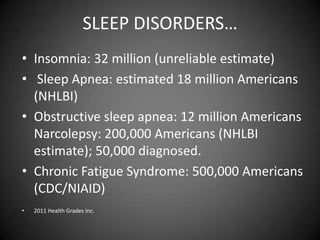
SLEEP DISORDERS…
• Insomnia: 32 million (unreliable estimate)
• Sleep Apnea: estimated 18 million Americans
(NHLBI)
• Obstructive sleep apnea: 12 million Americans
Narcolepsy: 200,000 Americans (NHLBI
estimate); 50,000 diagnosed.
• Chronic Fatigue Syndrome: 500,000 Americans
(CDC/NIAID)
•

2011 Health Grades Inc.
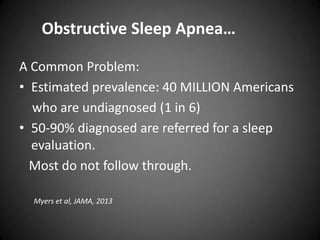
Obstructive Sleep Apnea…
A Common Problem:
• Estimated prevalence: 40 MILLION Americans
who are undiagnosed (1 in 6)
• 50-90% diagnosed are referred for a sleep
evaluation.
Most do not follow through.
Myers et al, JAMA, 2013
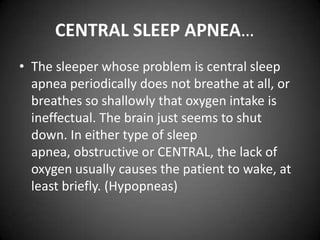
CENTRAL SLEEP APNEA…
• The sleeper whose problem is central sleep
apnea periodically does not breathe at all, or
breathes so shallowly that oxygen intake is
ineffectual. The brain just seems to shut
down. In either type of sleep
apnea, obstructive or CENTRAL, the lack of
oxygen usually causes the patient to wake, at
least briefly. (Hypopneas)
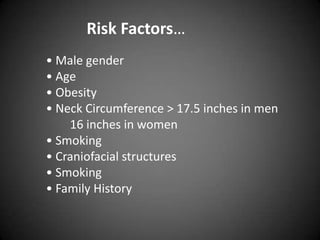
Risk Factors…
• Male gender
• Age
• Obesity
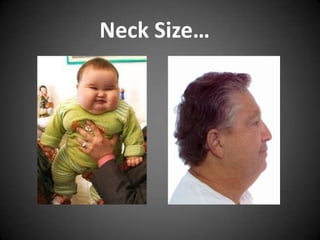
• Neck Circumference > 17.5 inches in men
16 inches in women
• Smoking
• Craniofacial structures
• Smoking
• Family History
Risk Factors…
• High blood pressure.
• High blood pressure in lungs.
• Abnormal heart rhythm, heart
failure, coronary artery disease (CAD), or
stroke.
• Depression.
• Diabetes.
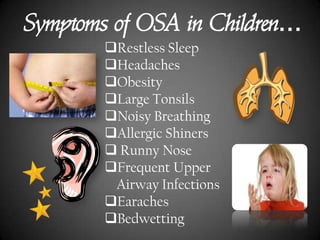
Symptoms of OSA in Children…
Restless Sleep
Headaches
Obesity
Large Tonsils
Noisy Breathing
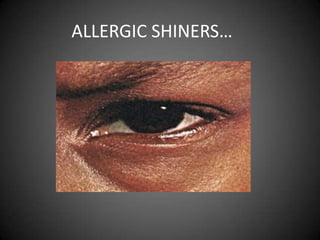
Allergic Shiners
 Runny Nose
Frequent Upper
Airway Infections
Earaches
Bedwetting
Symptoms of Sleep Apnea in Adults
and Children…

Daytime Symptoms:
• Excessive Daytime Sleepiness
• Depression / Anxiety / ADHD
• Morning Headache
• Dry, Irritated Throat & Raspy Voice
• Social and Workplace Issues
• Short Attention Span, Hot Temper, Impulsive,
Memory Problems
Symptoms of Sleep Apnea in Adults
and Children…
Nighttime Symptoms:
• Snoring
• Witnessed Breathing Pauses
• Frequent Awakenings
• Frequent episodes of Bedwetting
• Insomnia
Screening
Questionnaire…
•
•
•
•
•

Do you snore?
Are you sleepy during the daytime?
Do you have headaches or sore throats in the AM?
Has anyone witnessed apneas or respiratory gasps?
Do you not get ‘enough sleep’ despite adequate time
in bed?
• If they answer any affirmatively, use the “EPWORTH
SLEEPINESS SCALE” TO ASSES SEVERITY. We give this
to everyone!
Is It a COLD or an ALLERGY?
• Cold:
• Runny nose and sneezing last 1-3 days; if cold symptoms persist for more
than a week, see a doctor - you may have complications such
• as bronchitis or sinusitis
•
• Sore throat and / or coughing
•
• General malaise -fever, muscle aches, chills, sweats, loss of
appetite, fatigue -which indicate an infection
•
• Burning sensation in nose, often accompanied by nasal/sinus tenderness
•
• Mucus can become yellow, green, thick, foul-smelling or bloody
• Allergy:
• Persistent watering of nose and eyes lasts anywhere from a few
weeks to several months, depending on the allergen
• Itchiness of the nose, eyes and roof of the mouth or back of throat
• General feeling of well-being, except for areas experiencing allergic
symptoms; appetite usually is not diminished
• In most cases, sinuses are not painful or tender
• Mucus is watery and clear
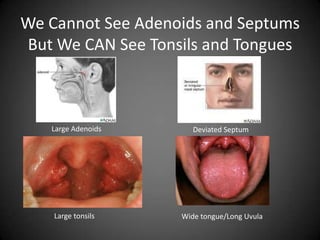
We Cannot See Adenoids and Septums
But We CAN See Tonsils and Tongues

Large Adenoids

Deviated Septum

Large tonsils

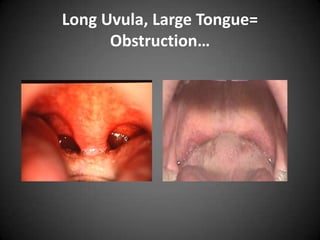
Wide tongue/Long Uvula
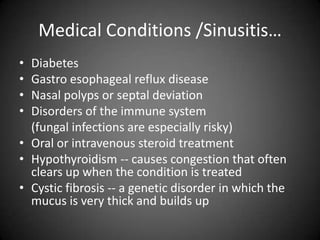
Medical Conditions /Sinusitis…
•
•
•
•

Diabetes
Gastro esophageal reflux disease
Nasal polyps or septal deviation
Disorders of the immune system
(fungal infections are especially risky)
• Oral or intravenous steroid treatment
• Hypothyroidism -- causes congestion that often
clears up when the condition is treated
• Cystic fibrosis -- a genetic disorder in which the
mucus is very thick and builds up
Sleep Disorders Can
Cause Other Serious
Diseases:
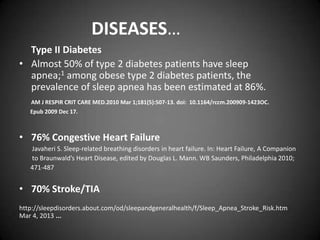
DISEASES…
Type II Diabetes
• Almost 50% of type 2 diabetes patients have sleep
apnea;1 among obese type 2 diabetes patients, the
prevalence of sleep apnea has been estimated at 86%.
AM J RESPIR CRIT CARE MED.2010 Mar 1;181(5):507-13. doi: 10.1164/rccm.200909-1423OC.
Epub 2009 Dec 17.

• 76% Congestive Heart Failure
Javaheri S. Sleep-related breathing disorders in heart failure. In: Heart Failure, A Companion
to Braunwald’s Heart Disease, edited by Douglas L. Mann. WB Saunders, Philadelphia 2010;
471-487

• 70% Stroke/TIA
http://sleepdisorders.about.com/od/sleepandgeneralhealth/f/Sleep_Apnea_Stroke_Risk.htm
Mar 4, 2013 ...
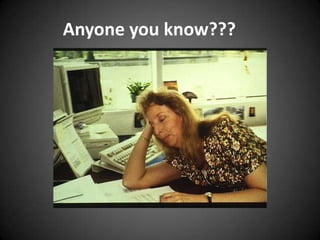
Anyone you know???
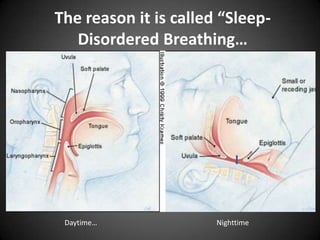
The reason it is called “SleepDisordered Breathing…

Daytime…

Nighttime
If you suspect Sleep Apnea…

What do you look for?
Determine Etiological Factors which would
prevent the success of a therapy program
BY BEING PART OF A team!
1. Deviated Septum
2. Enlarged Turbinates
3. Polyps
4. Enlarged Adenoids and / or Tonsils
5. Allergic Rhinitis and / or Sinusitis
6. Vaulted -Narrow Palatal Arch Formation

REFER! Ask Questions
Questions…
• Neck Size
• Morning headaches?
• Impaired memory/intellectual
performance
• Restless sleep?
• Nocturia? (Bedwetting)
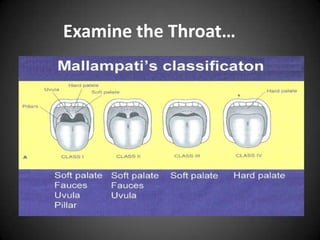
Examine the Throat…
Medical History…

• Snores at night/naps
• Throat infections
• Ear infections
• Stops breathing
• Has halitosis
ALLERGIC SHINERS…
Long Uvula, Large Tongue=
Obstruction…
Neck Size…
Medical problems associated with
SLEEP DISORDERD BREATHING…
•
•
•
•
•
•
•
•
•

Obesity
Excessive sleepiness
Depression
Hypertension
Cardiovascular disease
Diabetes
Stroke
Cognitive impairment
Cerebrovascular disease
CARDIOVASCULAR
LINKS…
• 5.7 million people in the US have heart failure
{American Heart Association Statistics}
• 76% of Heart Failure Patients have SDB
• Heart Failure is the MOST expensive disorder to treat
• Obstructive Sleep Apnea is noted in 49% of atrial
fibrillation patients and 30% of cardiovascular
patients
• OSA presents in 70% of heart attack patients
Mortality Links…

• SDB is associated with a 3-fold
increase in mortality risk
• Severe sleep apnea raises
premature death risk by 46%
Mood Disorder and Apnea…
• 54.1% of Bipolar patients were found to
be at risk for OSA
• Sleep apnea associated with major depression
(2.4% in men, 5.4% in women)
• Treatment of OSA ameliorates symptoms
in the short and long term
Soreca, Bipolar Disord, 2012

Wheaton, Sleep, 2012
Scjwartz, J Clin Sleep Med, 2007
Restless Legs Syndrome and
Periodic Limb Movements…
• Periodic Leg Movements (PLMD)
• Restless Legs Syndrome (RLS)
Movement disorder (Rest increases
symptoms)
• Sensory Motor Syndrome
Cardiovascular Risk and RLS…
• 2 times greater risk of heart and
cardiovascular disease
• Women with RLS for 3 years are at greater
risk for heart disease
• Older Men with RLS are 67% times more
likely to have a stroke than those without
Li,RCircuLlatioSn,2013
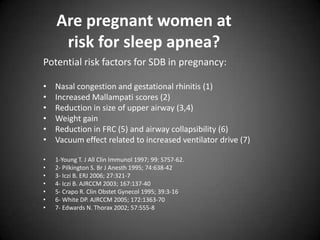
Are pregnant women at
risk for sleep apnea?
Potential risk factors for SDB in pregnancy:
•
•
•
•
•
•

Nasal congestion and gestational rhinitis (1)
Increased Mallampati scores (2)
Reduction in size of upper airway (3,4)
Weight gain
Reduction in FRC (5) and airway collapsibility (6)
Vacuum effect related to increased ventilator drive (7)

•
•
•
•
•
•
•

1-Young T. J All Clin Immunol 1997; 99: S757-62.
2- Pilkington S. Br J Anesth 1995; 74:638-42
3- Iczi B. ERJ 2006; 27:321-7
4- Iczi B. AJRCCM 2003; 167:137-40
5- Crapo R. Clin Obstet Gynecol 1995; 39:3-16
6- White DP. AJRCCM 2005; 172:1363-70
7- Edwards N. Thorax 2002; 57:555-8
Consequences of Apnea for
Pregnant Women…
• Pregnancy associated with lower residual
volume and lower functional residual
capacity (FRC)
• Lower oxygen reserve because of lower
FRC and higher oxygen consumption
Preeclampsia…

PEC is an important cause of:
•
•
•
•
•

Infant prematurity
Neonatal morbidity
Maternal morbidity and mortality
Maternal ICU admissions
Precursor of cardiovascular disease
Consequences of Apnea on Fetus:
• Concern for fetal wellbeing with recurrent
desaturations and possible hypoventilation
(Data from high altitude residents strongly
suggests risk of growth restriction and
PEC with chronic hypoxia)
(Doctors in Denver are very aware of the risks!)
Gestational Diabetes…
Diabetes occurring during pregnancy
• 30-50% of women with GDM end up
developing DM later in life
• GDM is cause for infant morbidity
• Other complications
Reflux - Another Issue…
• In a study presented at the 70th Annual
Scientific Meeting of the American College of
Gastroenterology, 81 patients with
documented sleep complaints at least three
nights per week underwent polysomnographic
sleep evaluations. 26 percent had acid reflux.
Of those who suffered with reflux, 94 percent
of the recorded reflux events were associated
with arousal from sleep or awakening.
Is this a chicken or an egg?
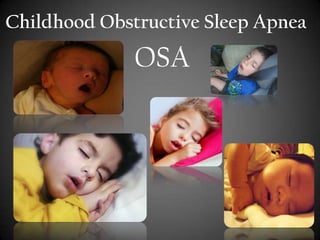
Childhood Obstructive Sleep Apnea

OSA
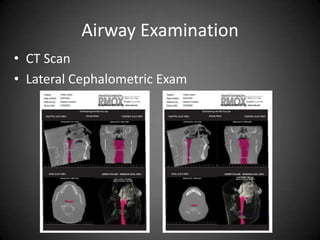
Airway Examination
• CT Scan
• Lateral Cephalometric Exam
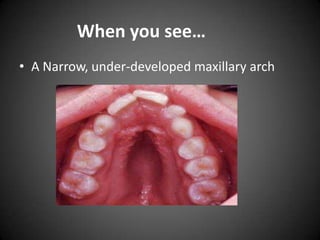
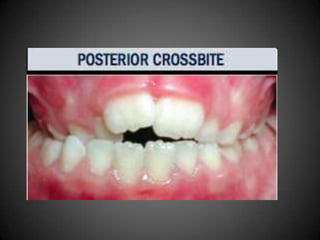
When you see…
• A Narrow, under-developed maxillary arch
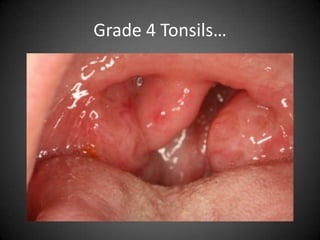
Grade 4 Tonsils…
• If the tonsils are not treated or
removed, it is certain to be an
Orthodontic nightmare and a
total relapse case.
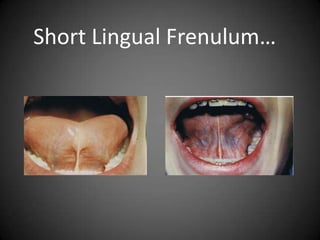
Short Lingual Frenulum…
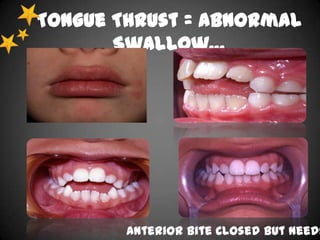
Tongue Thrust = Abnormal
Swallow…

Anterior Bite Closed But needs
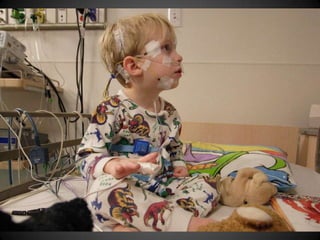
•Sleep Studies…
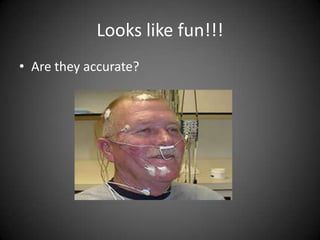
Looks like fun!!!
• Are they accurate?
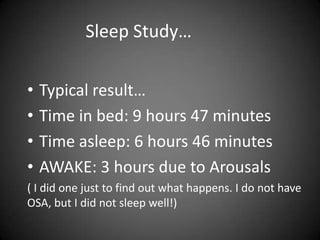
Sleep Study…
•
•
•
•

Typical result…
Time in bed: 9 hours 47 minutes
Time asleep: 6 hours 46 minutes
AWAKE: 3 hours due to Arousals

( I did one just to find out what happens. I do not have
OSA, but I did not sleep well!)
Treatment

Modalities
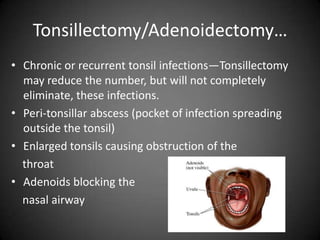
Tonsillectomy/Adenoidectomy…
• Chronic or recurrent tonsil infections—Tonsillectomy
may reduce the number, but will not completely
eliminate, these infections.
• Peri-tonsillar abscess (pocket of infection spreading
outside the tonsil)
• Enlarged tonsils causing obstruction of the
throat
• Adenoids blocking the
nasal airway
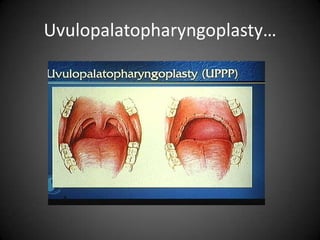
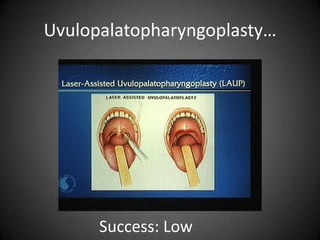
Uvulopalatopharyngoplasty…
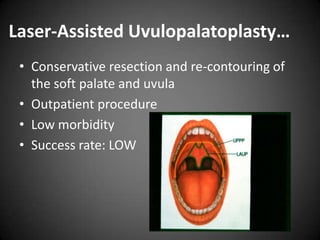
Laser-Assisted Uvulopalatoplasty…
• Conservative resection and re-contouring of
the soft palate and uvula
• Outpatient procedure
• Low morbidity
• Success rate: LOW
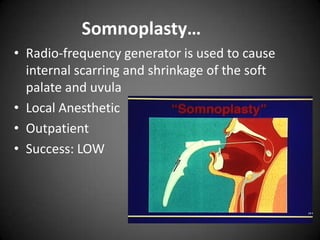
Somnoplasty…
• Radio-frequency generator is used to cause
internal scarring and shrinkage of the soft
palate and uvula
• Local Anesthetic
• Outpatient
• Success: LOW
Uvulopalatopharyngoplasty…

Success: Low
Maxillofacial SURGERY…
• Inferior Sagittal Osteotomy with HYOID
suspension
• Ramus osteotomy
• Mandibular sub apical osteotomy
• Maxillary-mandibular advancement
• Tracheostomy
Success Rate: Moderate…Very Costly…Often
not covered by insurance
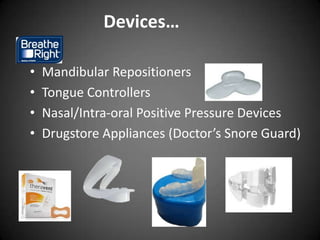
Devices…
•
•
•
•

Mandibular Repositioners
Tongue Controllers
Nasal/Intra-oral Positive Pressure Devices
Drugstore Appliances (Doctor’s Snore Guard)
Issues with Medications…
• Benzodiazepines, hypnotics, narcotics
may relax the airway more in patients
who have sleep apnea.
• Narcotics can contribute to central sleep
apnea.
A GREAT TEAM…
Dentist
Orthodontist
Pediatric Dentist
Pediatrician
Physician
Breathing Specialist
Osteopath
Cranio-Sachral Therapist
Myofunctional Therapist
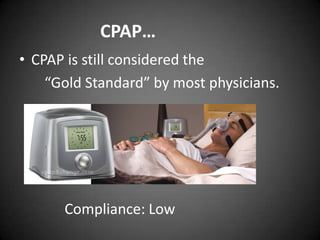
CPAP…
• CPAP is still considered the
“Gold Standard” by most physicians.

Compliance: Low
Myofunctional Therapy with
a TEAM APPROACH


Helps to minimize snoring by training the
tongue to rest in a normal posture

Changes head and neck posture which
opens the airway
Allows for better nasal breathing (noses
are ‘use them or lose them’)
Changes sleep behavior with better sleep
rejuvenation

Changes facial esthetics

CHANGES LIVES!
APP for Patient’s Monitoring
Their OWN Snoring…

SNORELAB.COM
for IPHONES

Snoreclock.com
for DROIDS
SNORELAB.COM…
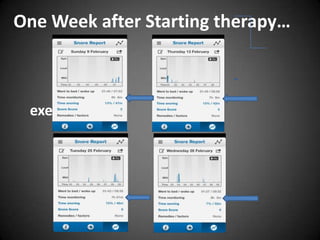
• This woman snored so loudly that her whole
family wore ear plugs to sleep!
• She started the exercise program and went to
Seattle to care for her elderly mother.
• She has sent a “SNORE REPORT” every day!
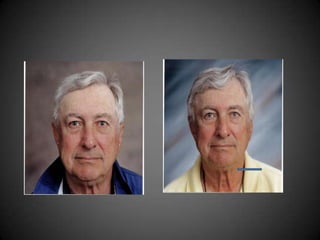
One Week after Starting therapy…

exercises
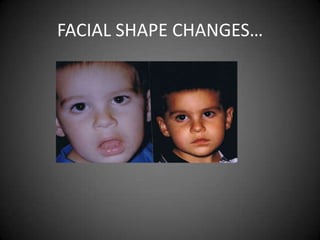
FACIAL SHAPE CHANGES…
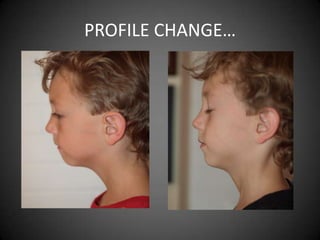
PROFILE CHANGE…
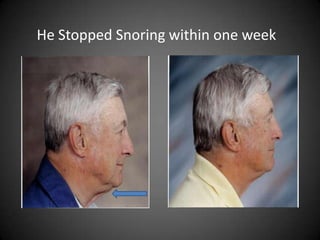
He Stopped Snoring within one week
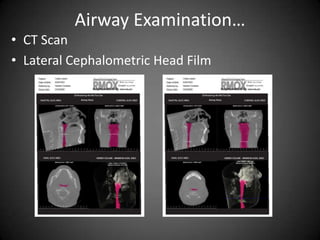
Airway Examination…
• CT Scan
• Lateral Cephalometric Head Film
Summary…
• Successful treatment of snoring and
sleep apnea is totally dependent
upon an accurate diagnosis of the
region of obstruction and treatment
that is directed at the ETIOLOGY!
Sleep…
“[Sleep is] the golden chain that ties
health and our bodies together.”
Thomas Dekker (1572-1632)
Sandy Coulson Sleep Disorder Spreecast

Sandy Coulson Sleep Disorder Spreecast

  • 2.
    Sleep Disorders fromPediatrics to Geriatrics Sandra R. Coulson MS, ST, Ed, COM
  • 3.
  • 4.
    SLEEP DISORDERS… • Insomnia:32 million (unreliable estimate) • Sleep Apnea: estimated 18 million Americans (NHLBI) • Obstructive sleep apnea: 12 million Americans Narcolepsy: 200,000 Americans (NHLBI estimate); 50,000 diagnosed. • Chronic Fatigue Syndrome: 500,000 Americans (CDC/NIAID) • 2011 Health Grades Inc.
  • 5.
    Obstructive Sleep Apnea… ACommon Problem: • Estimated prevalence: 40 MILLION Americans who are undiagnosed (1 in 6) • 50-90% diagnosed are referred for a sleep evaluation. Most do not follow through. Myers et al, JAMA, 2013
  • 6.
    CENTRAL SLEEP APNEA… •The sleeper whose problem is central sleep apnea periodically does not breathe at all, or breathes so shallowly that oxygen intake is ineffectual. The brain just seems to shut down. In either type of sleep apnea, obstructive or CENTRAL, the lack of oxygen usually causes the patient to wake, at least briefly. (Hypopneas)
  • 7.
    Risk Factors… • Malegender • Age • Obesity • Neck Circumference > 17.5 inches in men 16 inches in women • Smoking • Craniofacial structures • Smoking • Family History
  • 8.
    Risk Factors… • Highblood pressure. • High blood pressure in lungs. • Abnormal heart rhythm, heart failure, coronary artery disease (CAD), or stroke. • Depression. • Diabetes.
  • 9.
    Symptoms of OSAin Children… Restless Sleep Headaches Obesity Large Tonsils Noisy Breathing Allergic Shiners  Runny Nose Frequent Upper Airway Infections Earaches Bedwetting
  • 10.
    Symptoms of SleepApnea in Adults and Children… Daytime Symptoms: • Excessive Daytime Sleepiness • Depression / Anxiety / ADHD • Morning Headache • Dry, Irritated Throat & Raspy Voice • Social and Workplace Issues • Short Attention Span, Hot Temper, Impulsive, Memory Problems
  • 11.
    Symptoms of SleepApnea in Adults and Children… Nighttime Symptoms: • Snoring • Witnessed Breathing Pauses • Frequent Awakenings • Frequent episodes of Bedwetting • Insomnia
  • 12.
    Screening Questionnaire… • • • • • Do you snore? Areyou sleepy during the daytime? Do you have headaches or sore throats in the AM? Has anyone witnessed apneas or respiratory gasps? Do you not get ‘enough sleep’ despite adequate time in bed? • If they answer any affirmatively, use the “EPWORTH SLEEPINESS SCALE” TO ASSES SEVERITY. We give this to everyone!
  • 13.
    Is It aCOLD or an ALLERGY? • Cold: • Runny nose and sneezing last 1-3 days; if cold symptoms persist for more than a week, see a doctor - you may have complications such • as bronchitis or sinusitis • • Sore throat and / or coughing • • General malaise -fever, muscle aches, chills, sweats, loss of appetite, fatigue -which indicate an infection • • Burning sensation in nose, often accompanied by nasal/sinus tenderness • • Mucus can become yellow, green, thick, foul-smelling or bloody
  • 14.
    • Allergy: • Persistentwatering of nose and eyes lasts anywhere from a few weeks to several months, depending on the allergen • Itchiness of the nose, eyes and roof of the mouth or back of throat • General feeling of well-being, except for areas experiencing allergic symptoms; appetite usually is not diminished • In most cases, sinuses are not painful or tender • Mucus is watery and clear
  • 15.
    We Cannot SeeAdenoids and Septums But We CAN See Tonsils and Tongues Large Adenoids Deviated Septum Large tonsils Wide tongue/Long Uvula
  • 16.
    Medical Conditions /Sinusitis… • • • • Diabetes Gastroesophageal reflux disease Nasal polyps or septal deviation Disorders of the immune system (fungal infections are especially risky) • Oral or intravenous steroid treatment • Hypothyroidism -- causes congestion that often clears up when the condition is treated • Cystic fibrosis -- a genetic disorder in which the mucus is very thick and builds up
  • 17.
    Sleep Disorders Can CauseOther Serious Diseases:
  • 18.
    DISEASES… Type II Diabetes •Almost 50% of type 2 diabetes patients have sleep apnea;1 among obese type 2 diabetes patients, the prevalence of sleep apnea has been estimated at 86%. AM J RESPIR CRIT CARE MED.2010 Mar 1;181(5):507-13. doi: 10.1164/rccm.200909-1423OC. Epub 2009 Dec 17. • 76% Congestive Heart Failure Javaheri S. Sleep-related breathing disorders in heart failure. In: Heart Failure, A Companion to Braunwald’s Heart Disease, edited by Douglas L. Mann. WB Saunders, Philadelphia 2010; 471-487 • 70% Stroke/TIA http://sleepdisorders.about.com/od/sleepandgeneralhealth/f/Sleep_Apnea_Stroke_Risk.htm Mar 4, 2013 ...
  • 19.
  • 20.
    The reason itis called “SleepDisordered Breathing… Daytime… Nighttime
  • 21.
    If you suspectSleep Apnea… What do you look for?
  • 22.
    Determine Etiological Factorswhich would prevent the success of a therapy program BY BEING PART OF A team! 1. Deviated Septum 2. Enlarged Turbinates 3. Polyps 4. Enlarged Adenoids and / or Tonsils 5. Allergic Rhinitis and / or Sinusitis 6. Vaulted -Narrow Palatal Arch Formation REFER! Ask Questions
  • 23.
    Questions… • Neck Size •Morning headaches? • Impaired memory/intellectual performance • Restless sleep? • Nocturia? (Bedwetting)
  • 24.
  • 25.
    Medical History… • Snoresat night/naps • Throat infections • Ear infections • Stops breathing • Has halitosis
  • 26.
  • 27.
    Long Uvula, LargeTongue= Obstruction…
  • 28.
  • 29.
    Medical problems associatedwith SLEEP DISORDERD BREATHING… • • • • • • • • • Obesity Excessive sleepiness Depression Hypertension Cardiovascular disease Diabetes Stroke Cognitive impairment Cerebrovascular disease
  • 30.
    CARDIOVASCULAR LINKS… • 5.7 millionpeople in the US have heart failure {American Heart Association Statistics} • 76% of Heart Failure Patients have SDB • Heart Failure is the MOST expensive disorder to treat • Obstructive Sleep Apnea is noted in 49% of atrial fibrillation patients and 30% of cardiovascular patients • OSA presents in 70% of heart attack patients
  • 31.
    Mortality Links… • SDBis associated with a 3-fold increase in mortality risk • Severe sleep apnea raises premature death risk by 46%
  • 32.
    Mood Disorder andApnea… • 54.1% of Bipolar patients were found to be at risk for OSA • Sleep apnea associated with major depression (2.4% in men, 5.4% in women) • Treatment of OSA ameliorates symptoms in the short and long term Soreca, Bipolar Disord, 2012 Wheaton, Sleep, 2012 Scjwartz, J Clin Sleep Med, 2007
  • 33.
    Restless Legs Syndromeand Periodic Limb Movements… • Periodic Leg Movements (PLMD) • Restless Legs Syndrome (RLS) Movement disorder (Rest increases symptoms) • Sensory Motor Syndrome
  • 34.
    Cardiovascular Risk andRLS… • 2 times greater risk of heart and cardiovascular disease • Women with RLS for 3 years are at greater risk for heart disease • Older Men with RLS are 67% times more likely to have a stroke than those without Li,RCircuLlatioSn,2013
  • 35.
    Are pregnant womenat risk for sleep apnea? Potential risk factors for SDB in pregnancy: • • • • • • Nasal congestion and gestational rhinitis (1) Increased Mallampati scores (2) Reduction in size of upper airway (3,4) Weight gain Reduction in FRC (5) and airway collapsibility (6) Vacuum effect related to increased ventilator drive (7) • • • • • • • 1-Young T. J All Clin Immunol 1997; 99: S757-62. 2- Pilkington S. Br J Anesth 1995; 74:638-42 3- Iczi B. ERJ 2006; 27:321-7 4- Iczi B. AJRCCM 2003; 167:137-40 5- Crapo R. Clin Obstet Gynecol 1995; 39:3-16 6- White DP. AJRCCM 2005; 172:1363-70 7- Edwards N. Thorax 2002; 57:555-8
  • 36.
    Consequences of Apneafor Pregnant Women… • Pregnancy associated with lower residual volume and lower functional residual capacity (FRC) • Lower oxygen reserve because of lower FRC and higher oxygen consumption
  • 37.
    Preeclampsia… PEC is animportant cause of: • • • • • Infant prematurity Neonatal morbidity Maternal morbidity and mortality Maternal ICU admissions Precursor of cardiovascular disease
  • 38.
    Consequences of Apneaon Fetus: • Concern for fetal wellbeing with recurrent desaturations and possible hypoventilation (Data from high altitude residents strongly suggests risk of growth restriction and PEC with chronic hypoxia) (Doctors in Denver are very aware of the risks!)
  • 39.
    Gestational Diabetes… Diabetes occurringduring pregnancy • 30-50% of women with GDM end up developing DM later in life • GDM is cause for infant morbidity • Other complications
  • 40.
    Reflux - AnotherIssue… • In a study presented at the 70th Annual Scientific Meeting of the American College of Gastroenterology, 81 patients with documented sleep complaints at least three nights per week underwent polysomnographic sleep evaluations. 26 percent had acid reflux. Of those who suffered with reflux, 94 percent of the recorded reflux events were associated with arousal from sleep or awakening.
  • 41.
    Is this achicken or an egg?
  • 42.
  • 43.
    Airway Examination • CTScan • Lateral Cephalometric Exam
  • 44.
    When you see… •A Narrow, under-developed maxillary arch
  • 46.
  • 47.
    • If thetonsils are not treated or removed, it is certain to be an Orthodontic nightmare and a total relapse case.
  • 48.
  • 49.
    Tongue Thrust =Abnormal Swallow… Anterior Bite Closed But needs
  • 50.
  • 52.
    Looks like fun!!! •Are they accurate?
  • 53.
    Sleep Study… • • • • Typical result… Timein bed: 9 hours 47 minutes Time asleep: 6 hours 46 minutes AWAKE: 3 hours due to Arousals ( I did one just to find out what happens. I do not have OSA, but I did not sleep well!)
  • 54.
  • 55.
    Tonsillectomy/Adenoidectomy… • Chronic orrecurrent tonsil infections—Tonsillectomy may reduce the number, but will not completely eliminate, these infections. • Peri-tonsillar abscess (pocket of infection spreading outside the tonsil) • Enlarged tonsils causing obstruction of the throat • Adenoids blocking the nasal airway
  • 56.
  • 57.
    Laser-Assisted Uvulopalatoplasty… • Conservativeresection and re-contouring of the soft palate and uvula • Outpatient procedure • Low morbidity • Success rate: LOW
  • 58.
    Somnoplasty… • Radio-frequency generatoris used to cause internal scarring and shrinkage of the soft palate and uvula • Local Anesthetic • Outpatient • Success: LOW
  • 59.
  • 60.
    Maxillofacial SURGERY… • InferiorSagittal Osteotomy with HYOID suspension • Ramus osteotomy • Mandibular sub apical osteotomy • Maxillary-mandibular advancement • Tracheostomy Success Rate: Moderate…Very Costly…Often not covered by insurance
  • 61.
    Devices… • • • • Mandibular Repositioners Tongue Controllers Nasal/Intra-oralPositive Pressure Devices Drugstore Appliances (Doctor’s Snore Guard)
  • 62.
    Issues with Medications… •Benzodiazepines, hypnotics, narcotics may relax the airway more in patients who have sleep apnea. • Narcotics can contribute to central sleep apnea.
  • 63.
    A GREAT TEAM… Dentist Orthodontist PediatricDentist Pediatrician Physician Breathing Specialist Osteopath Cranio-Sachral Therapist Myofunctional Therapist
  • 64.
    CPAP… • CPAP isstill considered the “Gold Standard” by most physicians. Compliance: Low
  • 65.
    Myofunctional Therapy with aTEAM APPROACH  Helps to minimize snoring by training the tongue to rest in a normal posture Changes head and neck posture which opens the airway Allows for better nasal breathing (noses are ‘use them or lose them’) Changes sleep behavior with better sleep rejuvenation Changes facial esthetics CHANGES LIVES!
  • 66.
    APP for Patient’sMonitoring Their OWN Snoring… SNORELAB.COM for IPHONES Snoreclock.com for DROIDS
  • 67.
    SNORELAB.COM… • This womansnored so loudly that her whole family wore ear plugs to sleep! • She started the exercise program and went to Seattle to care for her elderly mother. • She has sent a “SNORE REPORT” every day!
  • 68.
    One Week afterStarting therapy… exercises
  • 69.
  • 70.
  • 71.
    He Stopped Snoringwithin one week
  • 73.
    Airway Examination… • CTScan • Lateral Cephalometric Head Film
  • 74.
    Summary… • Successful treatmentof snoring and sleep apnea is totally dependent upon an accurate diagnosis of the region of obstruction and treatment that is directed at the ETIOLOGY!
  • 75.
    Sleep… “[Sleep is] thegolden chain that ties health and our bodies together.” Thomas Dekker (1572-1632)