Obstructive sleep apnea
Ammarin wichitpan
5th year medical student
23 August 2018
Outline
• CASE
• Definition
• Pathophysiology
• Approach to the patient
CASE
A 67-year-old man with a long-standing
history of snoring noted that, in recent
years, the snoring had worsened so much
that his wife banned him from their
bedroom. Since his retirement, he gained
20 pounds, and knee problems reduced his
physical activity. His nasal allergies also
had worsened. He noted increased fatigue,
daytime sleepiness, and some trouble
concentrating. He reported following a
medication regimen as treatment for
hypertension, but he otherwise denied
having any medical problems. He had a
Physical examination showed nasal
congestion with moderately swollen, pale
turbinates and no purulent discharge. The
septum was midline. Oropharyngeal
examination showed no tonsils and a low
soft palate with elongated uvula that tended
to collapse against the posterior aspect of
the pharynx and abutted the base of tongue.
Fiberoptic laryngeal examination showed a
normal larynx with moderate collapse of the
lateral pharyngeal walls in “blocked”
inspiration (a reverse Müller's maneuver
whereby the patient holds his nose, closes his
mouth, and attempts to breathe inward). He
had a short, thick neck and was overweight.
Definition
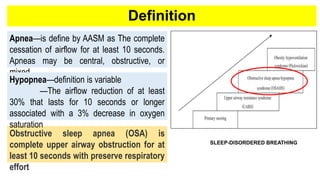
Obstructive sleep apnea (OSA) is
complete upper airway obstruction for at
least 10 seconds with preserve respiratory
effort
SLEEP-DISORDERED BREATHING
Apnea—is define by AASM as The complete
cessation of airflow for at least 10 seconds.
Apneas may be central, obstructive, or
mixed.
Hypopnea—definition is variable
—The airflow reduction of at least
30% that lasts for 10 seconds or longer
associated with a 3% decrease in oxygen
saturation
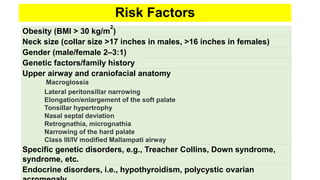
Risk Factors
Obesity (BMI > 30 kg/m
2
)
Neck size (collar size >17 inches in males, >16 inches in females)
Gender (male/female 2–3:1)
Genetic factors/family history
Upper airway and craniofacial anatomy
Macroglossia
Lateral peritonsillar narrowing
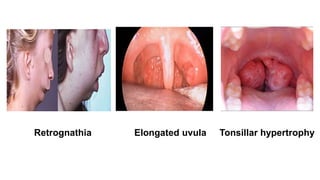
Elongation/enlargement of the soft palate
Tonsillar hypertrophy
Nasal septal deviation
Retrognathia, micrognathia
Narrowing of the hard palate
Class III/IV modified Mallampati airway
Specific genetic disorders, e.g., Treacher Collins, Down syndrome,
syndrome, etc.
Endocrine disorders, i.e., hypothyroidism, polycystic ovarian
Retrognathia Elongated uvula Tonsillar hypertrophy
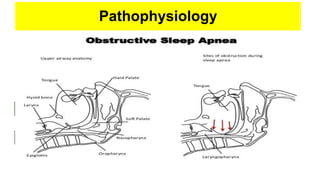
Pathophysiology
Sleep
Obstructive
apnea
ChemoreceptorSleep arousal
Upper airway
tone
Upper airway
tone
Resumption of
airflow
Upper airway
resistance/collap
sibility
Hypoxia,
Hypercapnia,
Acidosis
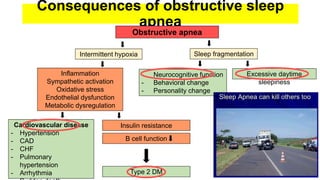
Consequences of obstructive sleep
apnea
Obstructive apnea
Intermittent hypoxia Sleep fragmentation
Inflammation
Sympathetic activation
Oxidative stress
Endothelial dysfunction
Metabolic dysregulation
Insulin resistance
B cell function
Type 2 DM
Excessive daytime
sleepiness
- Neurocognitive function
- Behavioral change
- Personality change
Cardiovascular disease
- Hypertension
- CAD
- CHF
- Pulmonary
hypertension
- Arrhythmia
APPROACH TO THE PATIENT
•HISTORY
•PHYSICAL FINDINGS
•LABORATORY INVESTIGATION
•DIAGNOSTIC TESTING
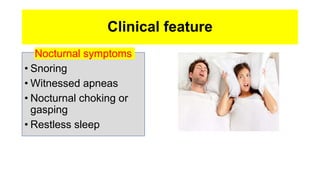
Clinical feature
Nocturnal symptoms
• Snoring
• Witnessed apneas
• Nocturnal choking or
gasping
• Restless sleep
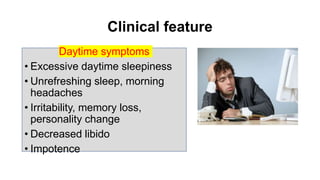
Clinical feature
Daytime symptoms
• Excessive daytime sleepiness
• Unrefreshing sleep, morning
headaches
• Irritability, memory loss,
personality change
• Decreased libido
• Impotence
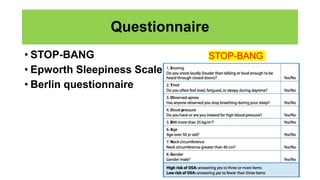
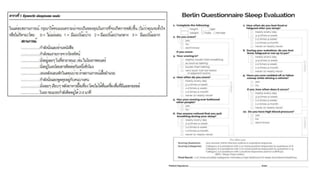
Questionnaire
• STOP-BANG
• Epworth Sleepiness Scale
• Berlin questionnaire
STOP-BANG
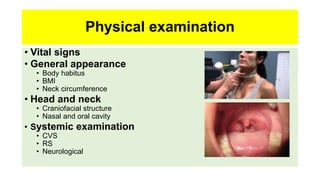
Physical examination
• Vital signs
• General appearance
• Body habitus
• BMI
• Neck circumference
• Head and neck
• Craniofacial structure
• Nasal and oral cavity
• Systemic examination
• CVS
• RS
• Neurological
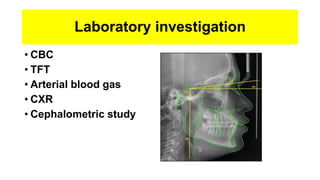
Laboratory investigation
• CBC
• TFT
• Arterial blood gas
• CXR
• Cephalometric study
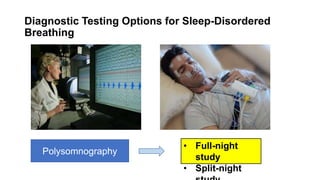
Diagnostic Testing Options for Sleep-Disordered
Breathing
Polysomnography
• Full-night
study
• Split-night
Polysomnography
LEVELS Parameters Measured
I [Standard attend in-lab PSG] EEG, EOG, EMG, ECG, airflow,
respiratory effort, O2 saturation, usually
video (all conducted in a sleep
laboratory with a sleep professional
present)
II [Comprehensive portable Minimum of seven channels including
EEG, EOG, chin EMG, ECG/HR,
respiratory effort, and O2 saturation
III [Modified portable sleep
apnea testing]
Minimum of four channels including
ECG/HR, O2 saturation and at least
The American Academy of Sleep medicine [AASM] has defined four levels of sleep studies.
Standard attended PSG
o Total sleep time
o Sleep efficiency
o Sleep stage
percentage
o Sleep latency
o Arousals
o Apnea
o Hypopnea
o Respiratory effort
related
arousal[RERA]
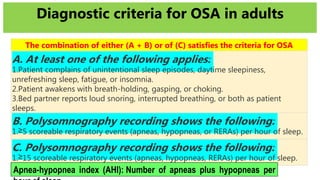
Diagnostic criteria for OSA in adults
The combination of either (A + B) or of (C) satisfies the criteria for OSA
A. At least one of the following applies:
1.Patient complains of unintentional sleep episodes, daytime sleepiness,
unrefreshing sleep, fatigue, or insomnia.
2.Patient awakens with breath-holding, gasping, or choking.
3.Bed partner reports loud snoring, interrupted breathing, or both as patient
sleeps.
B. Polysomnography recording shows the following:
1.≥5 scoreable respiratory events (apneas, hypopneas, or RERAs) per hour of sleep.
C. Polysomnography recording shows the following:
1.≥15 scoreable respiratory events (apneas, hypopneas, RERAs) per hour of sleep.
Apnea-hypopnea index (AHI): Number of apneas plus hypopneas per
Obstructive Sleep Apnea/Hypopnea Syndrome
(OSAHS): Quantification and Severity Scale
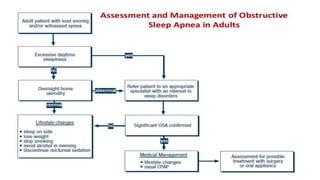
TREATMENT
• The decision to treat OSA should be based on its severity, related
symptoms, and medical comorbidities. Treating moderate-to-severe
disease (defined as AHI ≥15)
Behaviora
l
modificati
ons
Continuous
Positive
Airway
Pressure
Surgery
Behavioral modifications
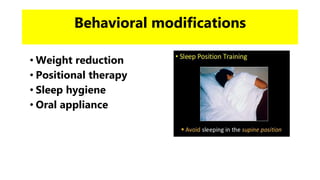
• Weight reduction
• Positional therapy
• Sleep hygiene
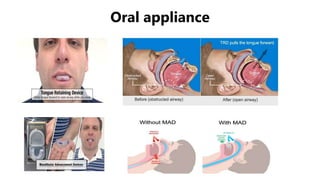
• Oral appliance
Oral appliance
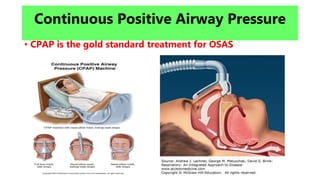
Continuous Positive Airway Pressure
• CPAP is the gold standard treatment for OSAS
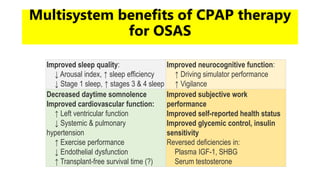
Improved sleep quality:
↓ Arousal index, ↑ sleep efficiency
↓ Stage 1 sleep, ↑ stages 3 & 4 sleep
Improved neurocognitive function:
↑ Driving simulator performance
↑ Vigilance
Decreased daytime somnolence
Improved cardiovascular function:
↑ Left ventricular function
↓ Systemic & pulmonary
hypertension
↑ Exercise performance
↓ Endothelial dysfunction
↑ Transplant-free survival time (?)
Improved subjective work
performance
Improved self-reported health status
Improved glycemic control, insulin
sensitivity
Reversed deficiencies in:
Plasma IGF-1, SHBG
Serum testosterone
Multisystem benefits of CPAP therapy
for OSAS
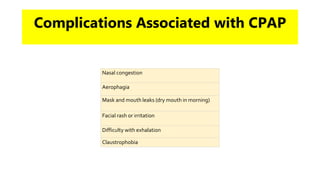
Complications Associated with CPAP
Nasal congestion
Aerophagia
Mask and mouth leaks (dry mouth in morning)
Facial rash or irritation
Difficulty with exhalation
Claustrophobia
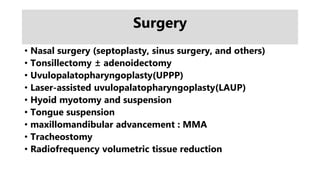
Surgery
• Nasal surgery (septoplasty, sinus surgery, and others)
• Tonsillectomy ± adenoidectomy
• Uvulopalatopharyngoplasty(UPPP)
• Laser-assisted uvulopalatopharyngoplasty(LAUP)
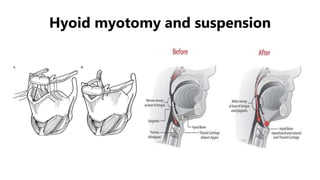
• Hyoid myotomy and suspension
• Tongue suspension
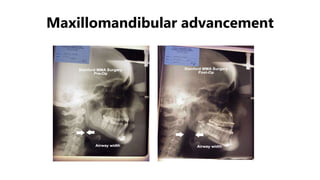
• maxillomandibular advancement : MMA
• Tracheostomy
• Radiofrequency volumetric tissue reduction
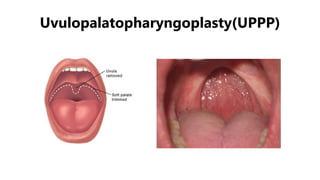
Uvulopalatopharyngoplasty(UPPP)
Hyoid myotomy and suspension
Maxillomandibular advancement
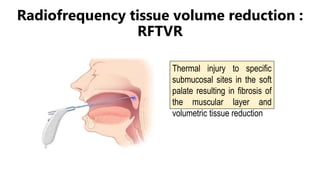
Radiofrequency tissue volume reduction :
RFTVR
Thermal injury to specific
submucosal sites in the soft
palate resulting in fibrosis of
the muscular layer and
volumetric tissue reduction
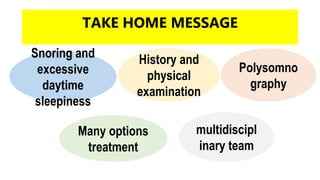
TAKE HOME MESSAGE
Snoring and
excessive
daytime
sleepiness
History and
physical
examination
Polysomno
graphy
Many options
treatment
multidiscipl
inary team
References

Obstructive sleep apnea

  • 1.
    Obstructive sleep apnea Ammarinwichitpan 5th year medical student 23 August 2018
  • 2.
    Outline • CASE • Definition •Pathophysiology • Approach to the patient
  • 3.
    CASE A 67-year-old manwith a long-standing history of snoring noted that, in recent years, the snoring had worsened so much that his wife banned him from their bedroom. Since his retirement, he gained 20 pounds, and knee problems reduced his physical activity. His nasal allergies also had worsened. He noted increased fatigue, daytime sleepiness, and some trouble concentrating. He reported following a medication regimen as treatment for hypertension, but he otherwise denied having any medical problems. He had a
  • 4.
    Physical examination showednasal congestion with moderately swollen, pale turbinates and no purulent discharge. The septum was midline. Oropharyngeal examination showed no tonsils and a low soft palate with elongated uvula that tended to collapse against the posterior aspect of the pharynx and abutted the base of tongue. Fiberoptic laryngeal examination showed a normal larynx with moderate collapse of the lateral pharyngeal walls in “blocked” inspiration (a reverse Müller's maneuver whereby the patient holds his nose, closes his mouth, and attempts to breathe inward). He had a short, thick neck and was overweight.
  • 5.
    Definition Obstructive sleep apnea(OSA) is complete upper airway obstruction for at least 10 seconds with preserve respiratory effort SLEEP-DISORDERED BREATHING Apnea—is define by AASM as The complete cessation of airflow for at least 10 seconds. Apneas may be central, obstructive, or mixed. Hypopnea—definition is variable —The airflow reduction of at least 30% that lasts for 10 seconds or longer associated with a 3% decrease in oxygen saturation
  • 6.
    Risk Factors Obesity (BMI> 30 kg/m 2 ) Neck size (collar size >17 inches in males, >16 inches in females) Gender (male/female 2–3:1) Genetic factors/family history Upper airway and craniofacial anatomy Macroglossia Lateral peritonsillar narrowing Elongation/enlargement of the soft palate Tonsillar hypertrophy Nasal septal deviation Retrognathia, micrognathia Narrowing of the hard palate Class III/IV modified Mallampati airway Specific genetic disorders, e.g., Treacher Collins, Down syndrome, syndrome, etc. Endocrine disorders, i.e., hypothyroidism, polycystic ovarian
  • 7.
    Retrognathia Elongated uvulaTonsillar hypertrophy
  • 8.
    Pathophysiology Sleep Obstructive apnea ChemoreceptorSleep arousal Upper airway tone Upperairway tone Resumption of airflow Upper airway resistance/collap sibility Hypoxia, Hypercapnia, Acidosis
  • 10.
    Consequences of obstructivesleep apnea Obstructive apnea Intermittent hypoxia Sleep fragmentation Inflammation Sympathetic activation Oxidative stress Endothelial dysfunction Metabolic dysregulation Insulin resistance B cell function Type 2 DM Excessive daytime sleepiness - Neurocognitive function - Behavioral change - Personality change Cardiovascular disease - Hypertension - CAD - CHF - Pulmonary hypertension - Arrhythmia
  • 12.
    APPROACH TO THEPATIENT •HISTORY •PHYSICAL FINDINGS •LABORATORY INVESTIGATION •DIAGNOSTIC TESTING
  • 13.
    Clinical feature Nocturnal symptoms •Snoring • Witnessed apneas • Nocturnal choking or gasping • Restless sleep
  • 14.
    Clinical feature Daytime symptoms •Excessive daytime sleepiness • Unrefreshing sleep, morning headaches • Irritability, memory loss, personality change • Decreased libido • Impotence
  • 15.
    Questionnaire • STOP-BANG • EpworthSleepiness Scale • Berlin questionnaire STOP-BANG
  • 17.
    Physical examination • Vitalsigns • General appearance • Body habitus • BMI • Neck circumference • Head and neck • Craniofacial structure • Nasal and oral cavity • Systemic examination • CVS • RS • Neurological
  • 18.
    Laboratory investigation • CBC •TFT • Arterial blood gas • CXR • Cephalometric study
  • 19.
    Diagnostic Testing Optionsfor Sleep-Disordered Breathing Polysomnography • Full-night study • Split-night
  • 20.
    Polysomnography LEVELS Parameters Measured I[Standard attend in-lab PSG] EEG, EOG, EMG, ECG, airflow, respiratory effort, O2 saturation, usually video (all conducted in a sleep laboratory with a sleep professional present) II [Comprehensive portable Minimum of seven channels including EEG, EOG, chin EMG, ECG/HR, respiratory effort, and O2 saturation III [Modified portable sleep apnea testing] Minimum of four channels including ECG/HR, O2 saturation and at least The American Academy of Sleep medicine [AASM] has defined four levels of sleep studies.
  • 21.
    Standard attended PSG oTotal sleep time o Sleep efficiency o Sleep stage percentage o Sleep latency o Arousals o Apnea o Hypopnea o Respiratory effort related arousal[RERA]
  • 22.
    Diagnostic criteria forOSA in adults The combination of either (A + B) or of (C) satisfies the criteria for OSA A. At least one of the following applies: 1.Patient complains of unintentional sleep episodes, daytime sleepiness, unrefreshing sleep, fatigue, or insomnia. 2.Patient awakens with breath-holding, gasping, or choking. 3.Bed partner reports loud snoring, interrupted breathing, or both as patient sleeps. B. Polysomnography recording shows the following: 1.≥5 scoreable respiratory events (apneas, hypopneas, or RERAs) per hour of sleep. C. Polysomnography recording shows the following: 1.≥15 scoreable respiratory events (apneas, hypopneas, RERAs) per hour of sleep. Apnea-hypopnea index (AHI): Number of apneas plus hypopneas per
  • 23.
    Obstructive Sleep Apnea/HypopneaSyndrome (OSAHS): Quantification and Severity Scale
  • 24.
    TREATMENT • The decisionto treat OSA should be based on its severity, related symptoms, and medical comorbidities. Treating moderate-to-severe disease (defined as AHI ≥15) Behaviora l modificati ons Continuous Positive Airway Pressure Surgery
  • 25.
    Behavioral modifications • Weightreduction • Positional therapy • Sleep hygiene • Oral appliance
  • 26.
  • 27.
    Continuous Positive AirwayPressure • CPAP is the gold standard treatment for OSAS
  • 28.
    Improved sleep quality: ↓Arousal index, ↑ sleep efficiency ↓ Stage 1 sleep, ↑ stages 3 & 4 sleep Improved neurocognitive function: ↑ Driving simulator performance ↑ Vigilance Decreased daytime somnolence Improved cardiovascular function: ↑ Left ventricular function ↓ Systemic & pulmonary hypertension ↑ Exercise performance ↓ Endothelial dysfunction ↑ Transplant-free survival time (?) Improved subjective work performance Improved self-reported health status Improved glycemic control, insulin sensitivity Reversed deficiencies in: Plasma IGF-1, SHBG Serum testosterone Multisystem benefits of CPAP therapy for OSAS
  • 29.
    Complications Associated withCPAP Nasal congestion Aerophagia Mask and mouth leaks (dry mouth in morning) Facial rash or irritation Difficulty with exhalation Claustrophobia
  • 30.
    Surgery • Nasal surgery(septoplasty, sinus surgery, and others) • Tonsillectomy ± adenoidectomy • Uvulopalatopharyngoplasty(UPPP) • Laser-assisted uvulopalatopharyngoplasty(LAUP) • Hyoid myotomy and suspension • Tongue suspension • maxillomandibular advancement : MMA • Tracheostomy • Radiofrequency volumetric tissue reduction
  • 31.
  • 32.
  • 33.
  • 34.
    Radiofrequency tissue volumereduction : RFTVR Thermal injury to specific submucosal sites in the soft palate resulting in fibrosis of the muscular layer and volumetric tissue reduction
  • 36.
    TAKE HOME MESSAGE Snoringand excessive daytime sleepiness History and physical examination Polysomno graphy Many options treatment multidiscipl inary team
  • 37.