Top Ten AMD Stories of 2008 Rick Trevino, OD Evansville VA Clinic http://richardtrevino.net and early 2009
Top Ten AMD Stories 1. 2. 3. 4. 5. 6. 7. 8. 9. 10. Topical Therapy Baseline Characteristics 10. 9.
Baseline Characteristics AREDS: Progression Risk Factors Significant predictors of AMD progression  Age Smoking AREDS-formula supplement treatment Severity of AMD at initial presentation
Baseline Characteristics AREDS: Progression Risk Factors Rate of advanced AMD at 10 years based on presence of  large drusen or pigmentary changes  at initial exam: Absent:  1%   Present:  72%   Persons predisposed to progression have more severe AMD right from the start  Genetic predisposition? Identify at-risk patients early
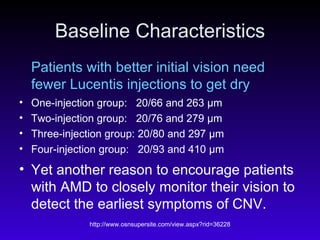
Baseline Characteristics Patients with better initial vision need fewer Lucentis injections to get dry Retrospective study of 62 patients receiving Lucentis for wet AMD with 1yr follow-up Number of injections required to achieve full resolution of macular fluid with a single Lucentis injection related to baseline characteristics
Baseline Characteristics Patients with better initial vision need fewer Lucentis injections to get dry One-injection group:  20/66 and 263  µ m Two-injection group:  20/76 and 279  µ m Three-injection group: 20/80 and 297  µ m Four-injection group:  20/93 and 410  µ m Yet another reason to encourage patients with AMD to closely monitor their vision to detect the earliest symptoms of CNV.
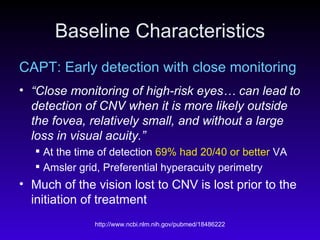
Baseline Characteristics CAPT: Early detection with close monitoring “ Close monitoring of high-risk eyes… can lead to detection of CNV when it is more likely outside the fovea, relatively small, and without a large loss in visual acuity.” At the time of detection  69% had 20/40 or better  VA Amsler grid, Preferential hyperacuity perimetry Much of the vision lost to CNV is lost prior to the initiation of treatment
Top Ten AMD Stories 1. 2. 3. 4. 5. 6. 7. 8. 9. 10. Topical Therapy Baseline Characteristics Modifiable Risk Factors
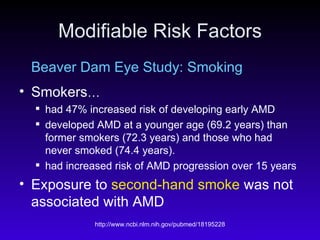
Modifiable Risk Factors Beaver Dam Eye Study: Smoking Smokers … had 47% increased risk of developing early AMD  developed AMD at a younger age (69.2 years) than former smokers (72.3 years) and those who had never smoked (74.4 years).  had increased risk of AMD progression over 15 years Exposure to  second-hand smoke  was not associated with AMD
Modifiable Risk Factors EU political movement underway to place  warnings on cigarette packets  about the risk of blindness  "We are seeking to convince the European Commission of the public health importance of the hazards of smoking on the eyes and for warnings along those lines to now appear on cigarette packets."
Modifiable Risk Factors Atherosclerosis Risk in Communities Study: Obesity Decreasing abdominal obesity lowers AMD risk Population-based study of over 12,500 persons Middle-aged persons with a  ≥ 3% reduction in WHR were less likely to have AMD All participants: 29% lower risk  Initially obese participants: 59% lower risk "Our findings suggest a role of weight loss in preventing the development of AMD."
 
Modifiable Risk Factors Vigorous Exercise Decreases Risk of AMD Running has a significant protective effect on the development of AMD 40,000 runners followed for 7.7 years The relative risk for AMD decreased 10% for every kilometer per day that the person ran Compared with persons who averaged <2 km/d:  Running 2-4 km/d had 19% lower risk  Running 4 km/d had 42% to 54% lower risk
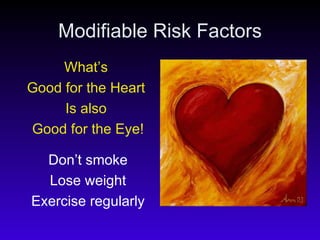
Modifiable Risk Factors What’s  Good for the Heart  Is also  Good for the Eye! Don’t smoke Lose weight Exercise regularly
Top Ten AMD Stories Topical Therapy Baseline Characteristics Modifiable Risk Factors Cataract and AMD 1. 2. 3. 4. 5. 6. 7. 8. 9. 10.
Cataract and AMD EUREYE: Sunlight increases risk of AMD in persons with low antioxidant levels Population-based study of 4700 people in 7 European countries High sunlight exposure and low serum antioxidant levels associated with  4-fold increased risk  of wet AMD Sunlight not hazardous if antioxidant levels are adequate  Risk greatest with low levels of zeaxanthin, vitamin E, and vitamin C
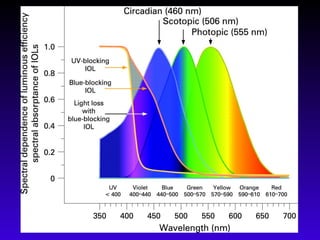
Cataract and AMD Blue-blocker IOLs may impair vision Color perception  and  contrast sensitivity  may be impaired by yellow IOLs 48 eyes of 24 consecutive patients with age-related cataract. Implanted a blue-light-filtering IOL in one eye and a UV-filtering IOL in their other eye Blue-light-filtering IOLs had worse contrast acuity and lower foveal thresholds than the UV-filtering IOLs
Cataract and AMD Blue-blocker IOLs may impair vision The negative consequences of blue-blocking IOLs may out weight theoretical advantages “ The relationship between blue light and AMD is speculative and not proven by available evidence.”  Centers for Medicare and Medicaid Services Blue-blocker IOLs may upset the  circadian rhythm , causing insomnia, daytime sleepiness, depression, and poor concentration
 
Cataract and AMD AREDS: CE does not increase the risk of AMD progression There is no clinically important increased risk of progression to advanced AMD after cataract surgery Contrary to the results of some older population-based studies (Beaver Dam, Blue Mountain) AREDS is the only prospective study in which the severity of AMD was documented before and after cataract surgery in a large number of cases with more than 5 years of regular follow-up
Top Ten AMD Stories Topical Therapy Baseline Characteristics Modifiable Risk Factors Cataract and AMD Photodynamic Therapy 1. 2. 3. 4. 5. 6. 7. 8. 9. 10.
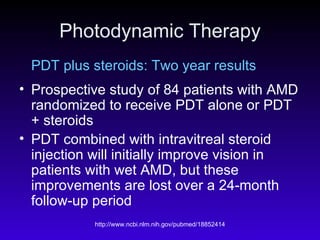
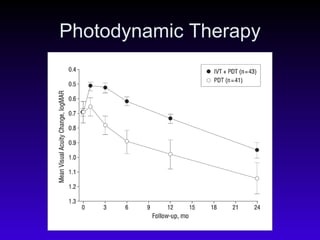
Photodynamic Therapy PDT plus steroids: Two year results Prospective study of 84 patients with AMD randomized to receive PDT alone or PDT + steroids PDT combined with intravitreal steroid injection will initially improve vision in patients with wet AMD, but these improvements are lost over a 24-month follow-up period
Photodynamic Therapy
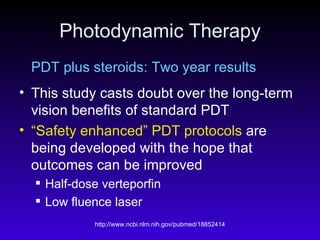
Photodynamic Therapy PDT plus steroids: Two year results This study casts doubt over the long-term vision benefits of standard PDT “ Safety enhanced” PDT protocols  are being developed with the hope that outcomes can be improved Half-dose verteporfin Low fluence laser
Top Ten AMD Stories 1. 2. 3. 4. 5. 6. 7. 8. 9. 10. Topical Therapy Baseline Characteristics Modifiable Risk Factors Cataract and AMD Photodynamic Therapy Retinal Prostheses
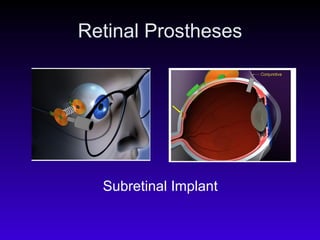
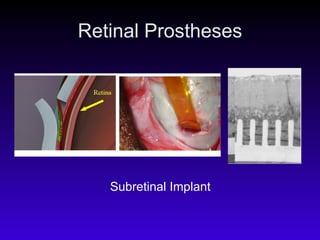
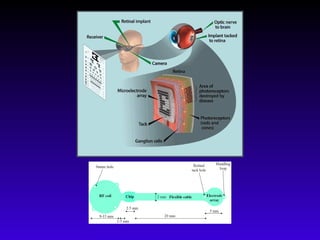
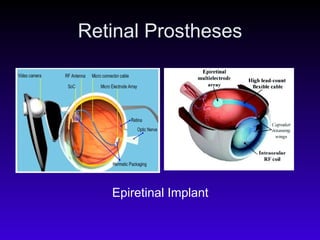
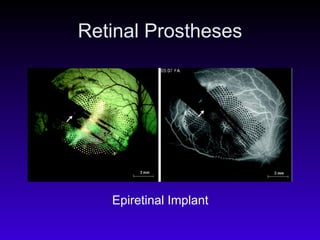
Retinal Prostheses General Concepts Generate phosphenes through direct electrical stimulation of retinal cells  Requires healthy ganglion cells Not suitable for diseases such as glaucoma  Two types of implants: Epiretinal implant: Stimulate ganglion cells  Subretinal implant: Stimulate inner nuclear layer
Retinal Prostheses Engineering Approaches Implanted Multielectrode Array (MEA)  Implant stimulating electrodes Use transcutaneous telemetry to transfer data and power to electrodes.  Image capture and processing takes place externally.  Usually implanted epiretinally  and stimulate retinal ganglion cells directly.
Retinal Prostheses Engineering Approaches Microphotodiode array (MPDA)  Implant optoelectronic devices that directly convert light into electricity “ Artificial photoreceptors” Usually implanted subretinally  and stimulates inner nuclear layer cells Takes advantage of existing image processing functions of the retina
Retinal Prostheses Engineering Approaches Biochemical prosthesis  Virally re-engineer ganglion and/or bipolar cells to become light sensitive.  Early development, at least 5 years away from commercialization
Retinal Prostheses Subretinal Implant
 
Retinal Prostheses Epiretinal Implant
Retinal Prosthesis Commercial Development Ongoing long-term implantation clinical trials: Second Sight   Epiretinal MEA  Argus I: 16-electrode device  Argus II: 60-electrode device (improved spatial resolution)  Intelligent Medical Implants   Epiretinal MEA  Features an “adaptive retinal encoder” to assist with adjustment of stimulation parameters for individual patients  Epiret   Epiretinal 25-electrode MEA
Retinal Prostheses Commercial Development Three companies aim to release commercial devices before the end of 2010  Second Sight Intelligent Medical Implants Retina Implant Subretinal MPDA  Hybrid device incorporating both light amplification and electrical stimulation functions
Top Ten AMD Stories 1. 2. 3. 4. 5. 6. 7. 8. 9. 10. Topical Therapy Baseline Characteristics Modifiable Risk Factors Cataract and AMD Photodynamic Therapy Retinal Prostheses Lutein
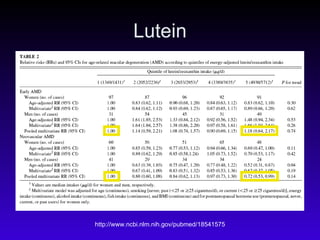
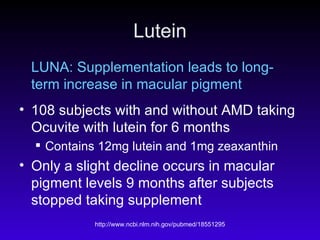
Lutein LUNA: Supplementation leads to long-term increase in macular pigment 108 subjects with and without AMD taking Ocuvite with lutein for 6 months Contains 12mg lutein and 1mg zeaxanthin Only a slight decline occurs in macular pigment levels 9 months after subjects stopped taking supplement
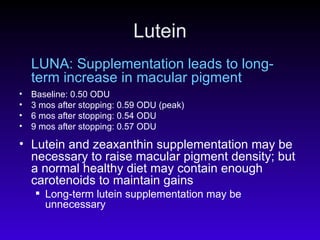
Lutein LUNA: Supplementation leads to long-term increase in macular pigment Baseline: 0.50 ODU 3 mos after stopping: 0.59 ODU (peak) 6 mos after stopping: 0.54 ODU 9 mos after stopping: 0.57 ODU Lutein and zeaxanthin supplementation may be necessary to raise macular pigment density; but a normal healthy diet may contain enough carotenoids to maintain gains Long-term lutein supplementation may be unnecessary
Lutein Lutein not protective against early AMD Nurses' Health Study and The Health Professionals Follow-up Study   A prospective study of dietary habits and health status of 113,000 persons followed for 18 years Lutein intake not associated with  early AMD  risk Nonsignificant and nonlinear association between lutein intake and  neovascular AMD  risk
Lutein
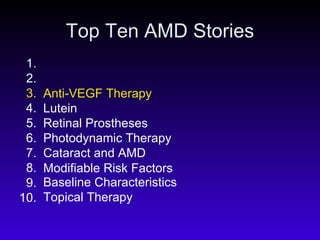
Top Ten AMD Stories 1. 2. 3. 4. 5. 6. 7. 8. 9. 10. Topical Therapy Baseline Characteristics Modifiable Risk Factors Cataract and AMD Photodynamic Therapy Retinal Prostheses Lutein Anti-VEGF Therapy
Anti-VEGF Therapy Evolving anti-VEGF treatment protocols Despite excellent outcomes, monthly injections of anti-VEGF drugs are undesirable because: It is inconvenient and time-consuming Costly Risk of complications of injections A number of studies are investigating ways to  decrease the number of injections without compromising clinical outcomes .
Anti-VEGF Therapy Evolving anti-VEGF treatment protocols Combination Therapy Anti-VEGF + PDT Anti-VEGF + PDT + Steroid Injection Schedule  PIER: Quarterly injections, worse outcomes PrONTO: PRN based on 5 criteria 5.6 injections over 12 mos with good outcomes Treat and Extend: OCT and biomicroscopy
Anti-VEGF Therapy Evolving anti-VEGF treatment protocols CATT: PRN based on signs of active CNV Lucentis vs. Avastin: Head-to-head “ Relaxed” PrONTO retreatment criteria  Rely primarily upon OCT and biomicroscopy Results available in 2011 Published studies have not yet clearly established an anti-VEGF treatment standard   What’s really needed are better anti-VEGF drugs
Anti-VEGF Therapy VEGF Trap-Eye New anti-VEGF drug to treat wet AMD  Higher affinity for VEGF than any currently available drug Binds all sub-types of VEGF  Risk to choriocapillaris from long-term total VEGF blockade? Phase 3 Clinical Trial: VIEW Study Head-to-head with Lucentis Fixed vs variable dosing
Anti-VEGF Therapy Is there a visual acuity benefit of late  anti-VEGF therapy for wet AMD? YES Avastin therapy can improve vision in patients with long-standing low vision secondary to wet AMD http://www.ncbi.nlm.nih.gov/pubmed/18664935  NO Vision did not significantly improve in patients that had advanced lesions that were fibrotic or had been previously treated by other means  http://www.ncbi.nlm.nih.gov/pubmed/18937801
Top Ten AMD Stories Topical Therapy Baseline Characteristics Modifiable Risk Factors Cataract and AMD Photodynamic Therapy Retinal Prostheses Lutein Anti-VEGF Therapy Genetics 1. 2. 3. 4. 5. 6. 7. 8. 9. 10.
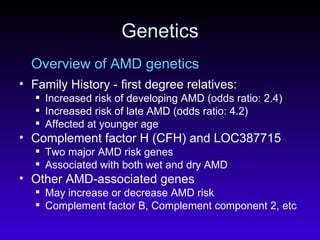
Genetics Overview of AMD genetics Family History - first degree relatives: Increased risk of developing AMD (odds ratio: 2.4) Increased risk of late AMD (odds ratio: 4.2)  Affected at younger age Complement factor H (CFH) and LOC387715 Two major AMD risk genes Associated with both wet and dry AMD  Other AMD-associated genes May increase or decrease AMD risk Complement factor B, Complement component 2, etc
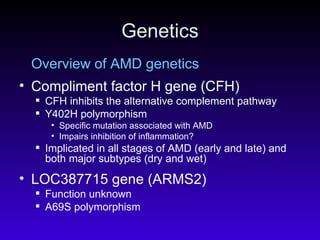
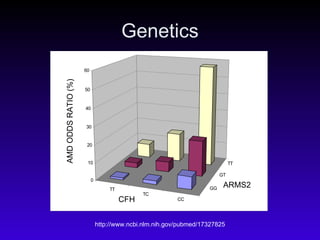
Genetics Overview of AMD genetics Compliment factor H gene (CFH) CFH inhibits the alternative complement pathway Y402H polymorphism  Specific mutation associated with AMD Impairs inhibition of inflammation? Implicated in all stages of AMD (early and late) and both major subtypes (dry and wet) LOC387715 gene (ARMS2) Function unknown A69S polymorphism
Genetics AMD ODDS RATIO (%) CFH ARMS2
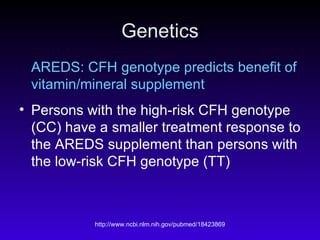
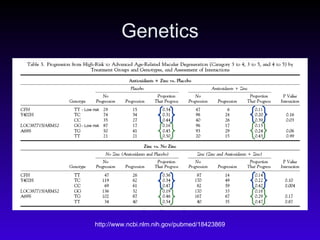
Genetics AREDS: CFH genotype predicts benefit of vitamin/mineral supplement Persons with the high-risk CFH genotype (CC) have a smaller treatment response to the AREDS supplement than persons with the low-risk CFH genotype (TT)
Genetics - Low risk - Low risk
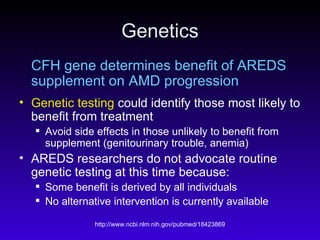
Genetics CFH gene determines benefit of AREDS supplement on AMD progression Genetic testing  could identify those most likely to benefit from treatment  Avoid side effects in those unlikely to benefit from supplement (genitourinary trouble, anemia) AREDS researchers do not advocate routine genetic testing at this time because: Some benefit is derived by all individuals No alternative intervention is currently available
Top Ten AMD Stories 1. 2. 3. 4. 5. 6. 7. 8. 9. 10. Topical Therapy Baseline Characteristics Modifiable Risk Factors Cataract and AMD Photodynamic Therapy Retinal Prostheses Lutein Anti-VEGF Therapy Genetics Fish Oil
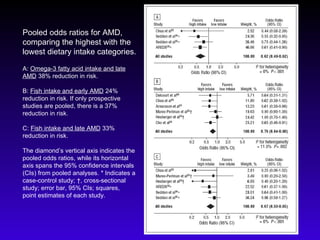
Fish Oil Meta-analysis: consumption of omega-3 fatty acids cuts risk of AMD   Literature review finds that consumption of foods rich in omega-3 fatty acids and fish intake twice or more per week may prevent AMD Only examined papers that investigated use of fish oil in the  primary prevention  of AMD  Primary prevention: No sign of AMD at start of study 9 papers met inclusion criteria. None were RCTs
Pooled odds ratios for AMD, comparing the highest with the lowest dietary intake categories.   A:  Omega-3 fatty acid intake and late AMD  38% reduction in risk.  B:  Fish intake and early AMD  24% reduction in risk. If only prospective studies are pooled, there is a 37% reduction in risk. C:  Fish intake and late AMD  33% reduction in risk.  The diamond’s vertical axis indicates the pooled odds ratios, while its horizontal axis spans the 95% confidence intervals (CIs) from pooled analyses. * Indicates a case-control study; †, cross-sectional study; error bar, 95% CIs; squares, point estimates of each study.
Fish Oil Meta-analysis: consumption of omega-3 fatty acids cuts risk of AMD This study found  highly statistically significant  pooled estimates that omega-3 fatty acids and fish are associated with a reduced risk of both early and late AMD  “ Routine recommendation of omega-3 fatty acid and fish intake for AMD prevention is not warranted until additional information from prospective studies and RCTs emerges. ”
Fish Oil AREDS: Fish oil consumption cuts risk of progression of both wet and dry AMD Fish oil decreases the risk of progression to advanced stages of both wet and dry AMD by  30% over 12 years Secondary prevention : All AREDS participants had AMD at start of study.
Fish Oil AREDS: Fish oil consumption cuts risk of progression of both wet and dry AMD AREDS vitamin/mineral supplement Effective for a narrow range of AMD patients Potential for undesirable side effects Contraindicated for smokers Fish oil  No serious adverse effects (mild anticoagulant) Appears to be effective in both primary and secondary prevention of the disease
Top Ten AMD Stories 1. 2. 3. 4. 5. 6. 7. 8. 9. 10. Topical Therapy Baseline Characteristics Modifiable Risk Factors Cataract and AMD Photodynamic Therapy Retinal Prostheses Lutein Anti-VEGF Therapy Genetics Fish Oil
Top Ten AMD Stories Thank You!

Top AMD Stories: 2008

  • 1.
    Top Ten AMDStories of 2008 Rick Trevino, OD Evansville VA Clinic http://richardtrevino.net and early 2009
  • 2.
    Top Ten AMDStories 1. 2. 3. 4. 5. 6. 7. 8. 9. 10. Topical Therapy Baseline Characteristics 10. 9.
  • 3.
    Baseline Characteristics AREDS:Progression Risk Factors Significant predictors of AMD progression Age Smoking AREDS-formula supplement treatment Severity of AMD at initial presentation
  • 4.
    Baseline Characteristics AREDS:Progression Risk Factors Rate of advanced AMD at 10 years based on presence of large drusen or pigmentary changes at initial exam: Absent: 1% Present: 72% Persons predisposed to progression have more severe AMD right from the start Genetic predisposition? Identify at-risk patients early
  • 5.
    Baseline Characteristics Patientswith better initial vision need fewer Lucentis injections to get dry Retrospective study of 62 patients receiving Lucentis for wet AMD with 1yr follow-up Number of injections required to achieve full resolution of macular fluid with a single Lucentis injection related to baseline characteristics
  • 6.
    Baseline Characteristics Patientswith better initial vision need fewer Lucentis injections to get dry One-injection group: 20/66 and 263 µ m Two-injection group: 20/76 and 279 µ m Three-injection group: 20/80 and 297 µ m Four-injection group: 20/93 and 410 µ m Yet another reason to encourage patients with AMD to closely monitor their vision to detect the earliest symptoms of CNV.
  • 7.
    Baseline Characteristics CAPT:Early detection with close monitoring “ Close monitoring of high-risk eyes… can lead to detection of CNV when it is more likely outside the fovea, relatively small, and without a large loss in visual acuity.” At the time of detection 69% had 20/40 or better VA Amsler grid, Preferential hyperacuity perimetry Much of the vision lost to CNV is lost prior to the initiation of treatment
  • 8.
    Top Ten AMDStories 1. 2. 3. 4. 5. 6. 7. 8. 9. 10. Topical Therapy Baseline Characteristics Modifiable Risk Factors
  • 9.
    Modifiable Risk FactorsBeaver Dam Eye Study: Smoking Smokers … had 47% increased risk of developing early AMD developed AMD at a younger age (69.2 years) than former smokers (72.3 years) and those who had never smoked (74.4 years). had increased risk of AMD progression over 15 years Exposure to second-hand smoke was not associated with AMD
  • 10.
    Modifiable Risk FactorsEU political movement underway to place warnings on cigarette packets about the risk of blindness &quot;We are seeking to convince the European Commission of the public health importance of the hazards of smoking on the eyes and for warnings along those lines to now appear on cigarette packets.&quot;
  • 11.
    Modifiable Risk FactorsAtherosclerosis Risk in Communities Study: Obesity Decreasing abdominal obesity lowers AMD risk Population-based study of over 12,500 persons Middle-aged persons with a ≥ 3% reduction in WHR were less likely to have AMD All participants: 29% lower risk Initially obese participants: 59% lower risk &quot;Our findings suggest a role of weight loss in preventing the development of AMD.&quot;
  • 12.
  • 13.
    Modifiable Risk FactorsVigorous Exercise Decreases Risk of AMD Running has a significant protective effect on the development of AMD 40,000 runners followed for 7.7 years The relative risk for AMD decreased 10% for every kilometer per day that the person ran Compared with persons who averaged <2 km/d: Running 2-4 km/d had 19% lower risk Running 4 km/d had 42% to 54% lower risk
  • 14.
    Modifiable Risk FactorsWhat’s Good for the Heart Is also Good for the Eye! Don’t smoke Lose weight Exercise regularly
  • 15.
    Top Ten AMDStories Topical Therapy Baseline Characteristics Modifiable Risk Factors Cataract and AMD 1. 2. 3. 4. 5. 6. 7. 8. 9. 10.
  • 16.
    Cataract and AMDEUREYE: Sunlight increases risk of AMD in persons with low antioxidant levels Population-based study of 4700 people in 7 European countries High sunlight exposure and low serum antioxidant levels associated with 4-fold increased risk of wet AMD Sunlight not hazardous if antioxidant levels are adequate Risk greatest with low levels of zeaxanthin, vitamin E, and vitamin C
  • 17.
    Cataract and AMDBlue-blocker IOLs may impair vision Color perception and contrast sensitivity may be impaired by yellow IOLs 48 eyes of 24 consecutive patients with age-related cataract. Implanted a blue-light-filtering IOL in one eye and a UV-filtering IOL in their other eye Blue-light-filtering IOLs had worse contrast acuity and lower foveal thresholds than the UV-filtering IOLs
  • 18.
    Cataract and AMDBlue-blocker IOLs may impair vision The negative consequences of blue-blocking IOLs may out weight theoretical advantages “ The relationship between blue light and AMD is speculative and not proven by available evidence.” Centers for Medicare and Medicaid Services Blue-blocker IOLs may upset the circadian rhythm , causing insomnia, daytime sleepiness, depression, and poor concentration
  • 19.
  • 20.
    Cataract and AMDAREDS: CE does not increase the risk of AMD progression There is no clinically important increased risk of progression to advanced AMD after cataract surgery Contrary to the results of some older population-based studies (Beaver Dam, Blue Mountain) AREDS is the only prospective study in which the severity of AMD was documented before and after cataract surgery in a large number of cases with more than 5 years of regular follow-up
  • 21.
    Top Ten AMDStories Topical Therapy Baseline Characteristics Modifiable Risk Factors Cataract and AMD Photodynamic Therapy 1. 2. 3. 4. 5. 6. 7. 8. 9. 10.
  • 22.
    Photodynamic Therapy PDTplus steroids: Two year results Prospective study of 84 patients with AMD randomized to receive PDT alone or PDT + steroids PDT combined with intravitreal steroid injection will initially improve vision in patients with wet AMD, but these improvements are lost over a 24-month follow-up period
  • 23.
  • 24.
    Photodynamic Therapy PDTplus steroids: Two year results This study casts doubt over the long-term vision benefits of standard PDT “ Safety enhanced” PDT protocols are being developed with the hope that outcomes can be improved Half-dose verteporfin Low fluence laser
  • 25.
    Top Ten AMDStories 1. 2. 3. 4. 5. 6. 7. 8. 9. 10. Topical Therapy Baseline Characteristics Modifiable Risk Factors Cataract and AMD Photodynamic Therapy Retinal Prostheses
  • 26.
    Retinal Prostheses GeneralConcepts Generate phosphenes through direct electrical stimulation of retinal cells Requires healthy ganglion cells Not suitable for diseases such as glaucoma Two types of implants: Epiretinal implant: Stimulate ganglion cells Subretinal implant: Stimulate inner nuclear layer
  • 27.
    Retinal Prostheses EngineeringApproaches Implanted Multielectrode Array (MEA) Implant stimulating electrodes Use transcutaneous telemetry to transfer data and power to electrodes. Image capture and processing takes place externally. Usually implanted epiretinally and stimulate retinal ganglion cells directly.
  • 28.
    Retinal Prostheses EngineeringApproaches Microphotodiode array (MPDA) Implant optoelectronic devices that directly convert light into electricity “ Artificial photoreceptors” Usually implanted subretinally and stimulates inner nuclear layer cells Takes advantage of existing image processing functions of the retina
  • 29.
    Retinal Prostheses EngineeringApproaches Biochemical prosthesis Virally re-engineer ganglion and/or bipolar cells to become light sensitive. Early development, at least 5 years away from commercialization
  • 30.
  • 31.
  • 32.
  • 33.
  • 34.
  • 35.
    Retinal Prosthesis CommercialDevelopment Ongoing long-term implantation clinical trials: Second Sight Epiretinal MEA Argus I: 16-electrode device Argus II: 60-electrode device (improved spatial resolution) Intelligent Medical Implants Epiretinal MEA Features an “adaptive retinal encoder” to assist with adjustment of stimulation parameters for individual patients Epiret Epiretinal 25-electrode MEA
  • 36.
    Retinal Prostheses CommercialDevelopment Three companies aim to release commercial devices before the end of 2010 Second Sight Intelligent Medical Implants Retina Implant Subretinal MPDA Hybrid device incorporating both light amplification and electrical stimulation functions
  • 37.
    Top Ten AMDStories 1. 2. 3. 4. 5. 6. 7. 8. 9. 10. Topical Therapy Baseline Characteristics Modifiable Risk Factors Cataract and AMD Photodynamic Therapy Retinal Prostheses Lutein
  • 38.
    Lutein LUNA: Supplementationleads to long-term increase in macular pigment 108 subjects with and without AMD taking Ocuvite with lutein for 6 months Contains 12mg lutein and 1mg zeaxanthin Only a slight decline occurs in macular pigment levels 9 months after subjects stopped taking supplement
  • 39.
    Lutein LUNA: Supplementationleads to long-term increase in macular pigment Baseline: 0.50 ODU 3 mos after stopping: 0.59 ODU (peak) 6 mos after stopping: 0.54 ODU 9 mos after stopping: 0.57 ODU Lutein and zeaxanthin supplementation may be necessary to raise macular pigment density; but a normal healthy diet may contain enough carotenoids to maintain gains Long-term lutein supplementation may be unnecessary
  • 40.
    Lutein Lutein notprotective against early AMD Nurses' Health Study and The Health Professionals Follow-up Study A prospective study of dietary habits and health status of 113,000 persons followed for 18 years Lutein intake not associated with early AMD risk Nonsignificant and nonlinear association between lutein intake and neovascular AMD risk
  • 41.
  • 42.
    Top Ten AMDStories 1. 2. 3. 4. 5. 6. 7. 8. 9. 10. Topical Therapy Baseline Characteristics Modifiable Risk Factors Cataract and AMD Photodynamic Therapy Retinal Prostheses Lutein Anti-VEGF Therapy
  • 43.
    Anti-VEGF Therapy Evolvinganti-VEGF treatment protocols Despite excellent outcomes, monthly injections of anti-VEGF drugs are undesirable because: It is inconvenient and time-consuming Costly Risk of complications of injections A number of studies are investigating ways to decrease the number of injections without compromising clinical outcomes .
  • 44.
    Anti-VEGF Therapy Evolvinganti-VEGF treatment protocols Combination Therapy Anti-VEGF + PDT Anti-VEGF + PDT + Steroid Injection Schedule PIER: Quarterly injections, worse outcomes PrONTO: PRN based on 5 criteria 5.6 injections over 12 mos with good outcomes Treat and Extend: OCT and biomicroscopy
  • 45.
    Anti-VEGF Therapy Evolvinganti-VEGF treatment protocols CATT: PRN based on signs of active CNV Lucentis vs. Avastin: Head-to-head “ Relaxed” PrONTO retreatment criteria Rely primarily upon OCT and biomicroscopy Results available in 2011 Published studies have not yet clearly established an anti-VEGF treatment standard What’s really needed are better anti-VEGF drugs
  • 46.
    Anti-VEGF Therapy VEGFTrap-Eye New anti-VEGF drug to treat wet AMD Higher affinity for VEGF than any currently available drug Binds all sub-types of VEGF Risk to choriocapillaris from long-term total VEGF blockade? Phase 3 Clinical Trial: VIEW Study Head-to-head with Lucentis Fixed vs variable dosing
  • 47.
    Anti-VEGF Therapy Isthere a visual acuity benefit of late anti-VEGF therapy for wet AMD? YES Avastin therapy can improve vision in patients with long-standing low vision secondary to wet AMD http://www.ncbi.nlm.nih.gov/pubmed/18664935 NO Vision did not significantly improve in patients that had advanced lesions that were fibrotic or had been previously treated by other means http://www.ncbi.nlm.nih.gov/pubmed/18937801
  • 48.
    Top Ten AMDStories Topical Therapy Baseline Characteristics Modifiable Risk Factors Cataract and AMD Photodynamic Therapy Retinal Prostheses Lutein Anti-VEGF Therapy Genetics 1. 2. 3. 4. 5. 6. 7. 8. 9. 10.
  • 49.
    Genetics Overview ofAMD genetics Family History - first degree relatives: Increased risk of developing AMD (odds ratio: 2.4) Increased risk of late AMD (odds ratio: 4.2) Affected at younger age Complement factor H (CFH) and LOC387715 Two major AMD risk genes Associated with both wet and dry AMD Other AMD-associated genes May increase or decrease AMD risk Complement factor B, Complement component 2, etc
  • 50.
    Genetics Overview ofAMD genetics Compliment factor H gene (CFH) CFH inhibits the alternative complement pathway Y402H polymorphism Specific mutation associated with AMD Impairs inhibition of inflammation? Implicated in all stages of AMD (early and late) and both major subtypes (dry and wet) LOC387715 gene (ARMS2) Function unknown A69S polymorphism
  • 51.
    Genetics AMD ODDSRATIO (%) CFH ARMS2
  • 52.
    Genetics AREDS: CFHgenotype predicts benefit of vitamin/mineral supplement Persons with the high-risk CFH genotype (CC) have a smaller treatment response to the AREDS supplement than persons with the low-risk CFH genotype (TT)
  • 53.
    Genetics - Lowrisk - Low risk
  • 54.
    Genetics CFH genedetermines benefit of AREDS supplement on AMD progression Genetic testing could identify those most likely to benefit from treatment Avoid side effects in those unlikely to benefit from supplement (genitourinary trouble, anemia) AREDS researchers do not advocate routine genetic testing at this time because: Some benefit is derived by all individuals No alternative intervention is currently available
  • 55.
    Top Ten AMDStories 1. 2. 3. 4. 5. 6. 7. 8. 9. 10. Topical Therapy Baseline Characteristics Modifiable Risk Factors Cataract and AMD Photodynamic Therapy Retinal Prostheses Lutein Anti-VEGF Therapy Genetics Fish Oil
  • 56.
    Fish Oil Meta-analysis:consumption of omega-3 fatty acids cuts risk of AMD Literature review finds that consumption of foods rich in omega-3 fatty acids and fish intake twice or more per week may prevent AMD Only examined papers that investigated use of fish oil in the primary prevention of AMD Primary prevention: No sign of AMD at start of study 9 papers met inclusion criteria. None were RCTs
  • 57.
    Pooled odds ratiosfor AMD, comparing the highest with the lowest dietary intake categories. A: Omega-3 fatty acid intake and late AMD 38% reduction in risk. B: Fish intake and early AMD 24% reduction in risk. If only prospective studies are pooled, there is a 37% reduction in risk. C: Fish intake and late AMD 33% reduction in risk. The diamond’s vertical axis indicates the pooled odds ratios, while its horizontal axis spans the 95% confidence intervals (CIs) from pooled analyses. * Indicates a case-control study; †, cross-sectional study; error bar, 95% CIs; squares, point estimates of each study.
  • 58.
    Fish Oil Meta-analysis:consumption of omega-3 fatty acids cuts risk of AMD This study found highly statistically significant pooled estimates that omega-3 fatty acids and fish are associated with a reduced risk of both early and late AMD “ Routine recommendation of omega-3 fatty acid and fish intake for AMD prevention is not warranted until additional information from prospective studies and RCTs emerges. ”
  • 59.
    Fish Oil AREDS:Fish oil consumption cuts risk of progression of both wet and dry AMD Fish oil decreases the risk of progression to advanced stages of both wet and dry AMD by 30% over 12 years Secondary prevention : All AREDS participants had AMD at start of study.
  • 60.
    Fish Oil AREDS:Fish oil consumption cuts risk of progression of both wet and dry AMD AREDS vitamin/mineral supplement Effective for a narrow range of AMD patients Potential for undesirable side effects Contraindicated for smokers Fish oil No serious adverse effects (mild anticoagulant) Appears to be effective in both primary and secondary prevention of the disease
  • 61.
    Top Ten AMDStories 1. 2. 3. 4. 5. 6. 7. 8. 9. 10. Topical Therapy Baseline Characteristics Modifiable Risk Factors Cataract and AMD Photodynamic Therapy Retinal Prostheses Lutein Anti-VEGF Therapy Genetics Fish Oil
  • 62.
    Top Ten AMDStories Thank You!