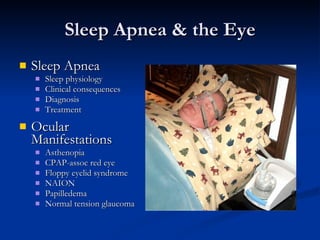
Sleep Apnea  & the Eye Rick Trevino, OD VA Outpatient Clinic Evansville, IN [email_address]
Sleep Apnea & the Eye Sleep Apnea Sleep physiology Clinical consequences Diagnosis Treatment Ocular Manifestations Asthenopia CPAP-assoc red eye Floppy eyelid syndrome NAION Papilledema Normal tension glaucoma
Online Resources Lecture Notes http://richardtrevino.net/sleepapnea Powerpoint Slides http://www.slideshare.net/rhodopsin Free Texts http://jfponline.com (Aug 2008) http://pubs.nrc-cnrc.gc.ca/cjo  Can J Ophthalmol 2007;42(2):238-43
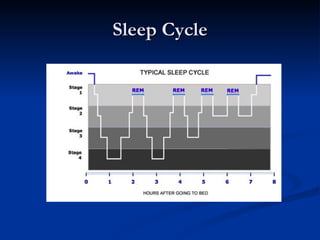
Sleep Cycle
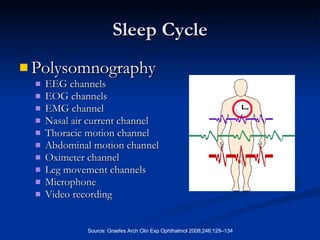
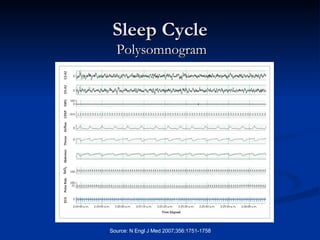
Sleep Cycle Polysomnography EEG channels  EOG channels  EMG channel Nasal air current channel  Thoracic motion channel  Abdominal motion channel Oximeter channel Leg movement channels Microphone Video recording
Sleep Cycle Polysomnogram
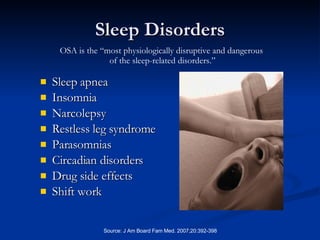
Sleep Disorders Sleep apnea  Insomnia Narcolepsy Restless leg syndrome Parasomnias Circadian disorders Drug side effects Shift work OSA is the “most physiologically disruptive and dangerous  of the sleep-related disorders.”
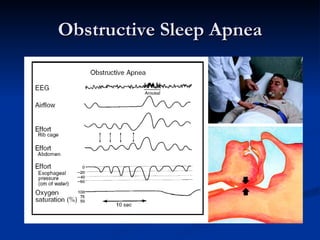
Obstructive Sleep Apnea
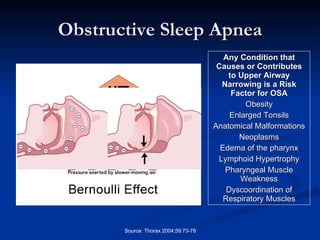
Obstructive Sleep Apnea Any Condition that Causes or Contributes to Upper Airway Narrowing is a Risk Factor for OSA Obesity Enlarged Tonsils Anatomical Malformations Neoplasms Edema of the pharynx Lymphoid Hypertrophy Pharyngeal Muscle Weakness Dyscoordination of Respiratory Muscles
Obstructive Sleep Apnea Excessive daytime sleepiness Most common symptom Disruptive snoring Also gasping/snorting during arousals Apneic events witnessed by bed partner Disruptive snoring + witnessed apneas: 94% specificity Obesity 30% of pts with a BMI > 30 have OSA, and 50% of pts with a BMI > 40 have OSA. Neck circumference   ≥ 40 cm had a sensitivity of 61% and a specificity of 93% for OSA Correlates better than BMI Male 2-3x more common than female Family history of OSA Relatives have 2-4 fold    risk Clinical Characteristics
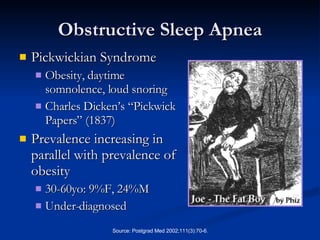
Obstructive Sleep Apnea Pickwickian Syndrome Obesity, daytime somnolence, loud snoring Charles Dicken’s “Pickwick Papers” (1837) Prevalence increasing in parallel with prevalence of obesity 30-60yo: 9%F, 24%M Under-diagnosed
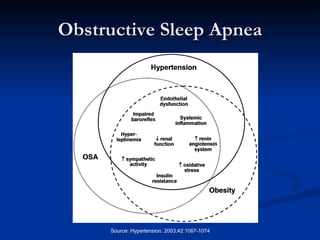
Obstructive Sleep Apnea Cardiovascular Disease HTN, CAD/MI, CHF, Arrhythmia Stroke Obesity Metabolic Syndrome Other Diseases Morning headache,  Eye , Liver, Kidney, others Cognitive and Emotional Impaired mental functioning Depression Mood alteration Effects on bed partners Disruptive snoring Accidents Drowsy driving Workplace Clinical   Consequences
Obstructive Sleep Apnea
Obstructive Sleep Apnea History Sleepiness assessment Disruptive snoring Witnessed apneas Physical Obesity Neck circumference Throat/Mouth exam PSG Gold Standard Respiratory Disturbance Index Clinical Evaluation
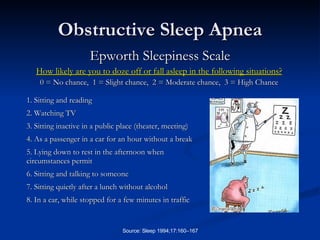
Obstructive Sleep Apnea Epworth Sleepiness Scale How likely are you to doze off or fall asleep in the following situations? 0 = No chance,  1 = Slight chance,  2 = Moderate chance,  3 = High Chance 1. Sitting and reading 2. Watching TV 3. Sitting inactive in a public place (theater, meeting) 4. As a passenger in a car for an hour without a break 5. Lying down to rest in the afternoon when  circumstances permit 6. Sitting and talking to someone 7. Sitting quietly after a lunch without alcohol 8. In a car, while stopped for a few minutes in traffic
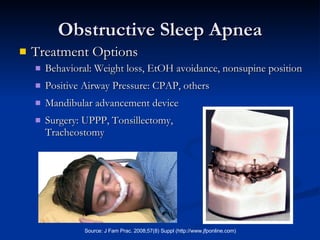
Obstructive Sleep Apnea Treatment Options Behavioral: Weight loss, EtOH avoidance, nonsupine position Positive Airway Pressure: CPAP, others Mandibular advancement device Surgery: UPPP, Tonsillectomy, Tracheostomy
 
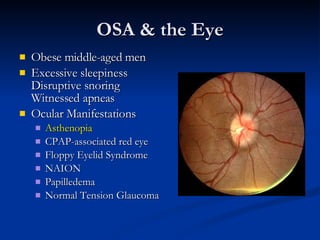
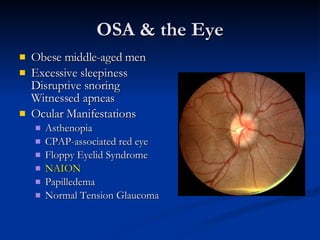
OSA & the Eye Obese middle-aged men Excessive sleepiness Disruptive snoring  Witnessed apneas Ocular Manifestations Asthenopia CPAP-associated red eye Floppy Eyelid Syndrome NAION Papilledema Normal Tension Glaucoma
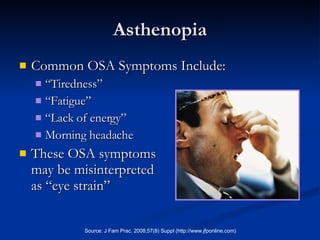
Asthenopia Common OSA Symptoms Include: “Tiredness”  “Fatigue”  “Lack of energy” Morning headache These OSA symptoms  may be misinterpreted  as “eye strain”
Asthenopia Common OSA-associated asthenopic symptoms Unexplained symptoms of blur Vision is 20/20 but the  patient is c/o blur Misinterpreting what is seen Incorrect recording or  copying Eye strain and/or fatigue Headaches Worse in the morning
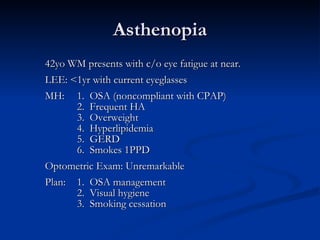
Asthenopia 42yo WM presents with c/o eye fatigue at near. LEE: <1yr with current eyeglasses MH: 1.  OSA (noncompliant with CPAP) 2.  Frequent HA 3.  Overweight 4.  Hyperlipidemia 5.  GERD 6.  Smokes 1PPD Optometric Exam: Unremarkable Plan:  1.  OSA management 2.  Visual hygiene 3.  Smoking cessation

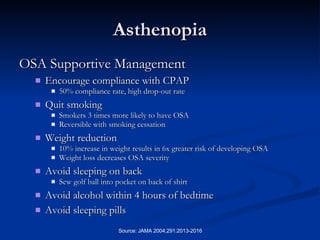
Asthenopia OSA Supportive Management Encourage compliance with CPAP 50% compliance rate, high drop-out rate Quit smoking Smokers 3 times more likely to have OSA Reversible with smoking cessation Weight reduction 10% increase in weight results in 6x greater risk of developing OSA  Weight loss decreases OSA severity Avoid sleeping on back Sew golf ball into pocket on back of shirt Avoid alcohol within 4 hours of bedtime Avoid sleeping pills
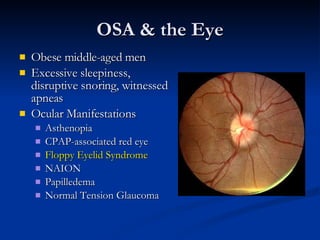
OSA & the Eye Obese middle-aged men Excessive sleepiness Disruptive snoring  Witnessed apneas Ocular Manifestations Asthenopia CPAP-associated red eye Floppy Eyelid Syndrome NAION Papilledema Normal Tension Glaucoma
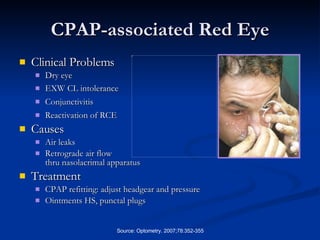
CPAP-associated Red Eye Clinical Problems Dry eye EXW CL intolerance   Conjunctivitis Reactivation of RCE  Causes Air leaks Retrograde air flow  thru nasolacrimal apparatus Treatment CPAP refitting: adjust headgear and pressure Ointments HS, punctal plugs
OSA & the Eye Obese middle-aged men Excessive sleepiness, disruptive snoring, witnessed apneas Ocular Manifestations Asthenopia CPAP-associated red eye Floppy Eyelid Syndrome NAION Papilledema Normal Tension Glaucoma
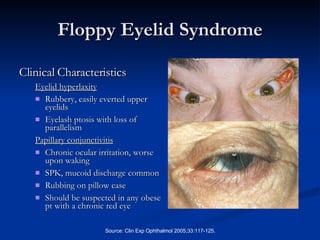
Floppy Eyelid Syndrome Clinical Characteristics Eyelid hyperlaxity Rubbery, easily everted upper eyelids Eyelash ptosis with loss of parallelism Papillary conjunctivitis Chronic ocular irritation, worse upon waking  SPK, mucoid discharge common Rubbing on pillow case Should be suspected in any obese pt with a chronic red eye
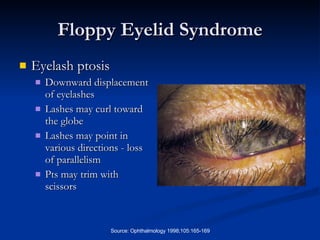
Floppy Eyelid Syndrome Eyelash ptosis Downward displacement of eyelashes Lashes may curl toward the globe Lashes may point in various directions - loss of parallelism Pts may trim with scissors
Floppy Eyelid Syndrome
Floppy Eyelid Syndrome Pathophysiology Loss of elastic fibers in tarsus and skin of lid Upregulation of elastin-degrading enzymes (matrix metalloproteinases) Caused by repeated mechanical trauma, possibly eye rubbing or sleeping with the face buried in the pillow
Floppy Eyelid Syndrome Treatment Lubrication therapy Poor lid-eye contact Inadequate tear distribution Protect eye during sleep Ointments HS Fox shield, patching, taping May improve or resolve  with CPAP Surgical therapy deferred until OSA treated Horizontal lid shortening
Floppy Eyelid Syndrome Relation to OSA Pts with FES are a subset of all OSA pts 96% pts with FES have OSA   (almost 100%!) 5-15% pts with OSA have FES OSA tends to be more severe in pts with FES
OSA & the Eye Obese middle-aged men Excessive sleepiness Disruptive snoring  Witnessed apneas Ocular Manifestations Asthenopia CPAP-associated red eye Floppy Eyelid Syndrome NAION Papilledema Normal Tension Glaucoma
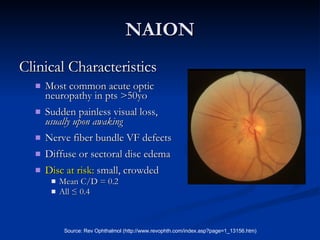
NAION Clinical Characteristics Most common acute optic neuropathy in pts >50yo Sudden painless visual loss,  usually upon awaking Nerve fiber bundle VF defects Diffuse or sectoral disc edema Disc at risk:  small, crowded Mean C/D = 0.2 All ≤ 0.4
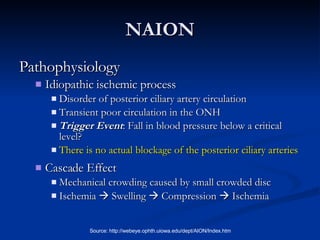
NAION Pathophysiology Idiopathic ischemic process  Disorder of posterior ciliary artery circulation Transient poor circulation in the ONH Trigger Event : Fall in blood pressure below a critical level? There is no actual blockage of the posterior ciliary arteries Cascade Effect Mechanical crowding caused by small crowded disc Ischemia    Swelling    Compression    Ischemia
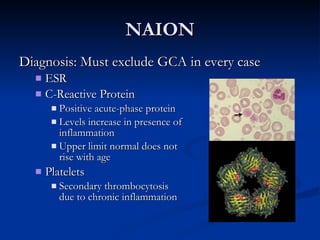
Diagnosis: Must exclude GCA in every case ESR C-Reactive Protein Positive acute-phase protein Levels increase in presence of  inflammation  Upper limit normal does not  rise with age  Platelets Secondary thrombocytosis  due to chronic inflammation NAION
NAION Treatment Aspirin Decreases incidence in fellow eye at 2 years, but not at 5 years Surgical decompression No benefit (Ischemic Optic Neuropathy Decompression Trial) Control of predisposing systemic disease   May slow progression or reduce incidence in fellow eye Hypertension, Diabetes, Hyperlipidemia Avoid  phosphodiesterase 5 inhibitors (Viagra, Levitra, Cialis) May increase risk of NAION in fellow eye
NAION Medicolegal obligation to inform pts of risk to fellow eye
NAION Relation to OSA Mojon (2002) Behbehani (2005) Palombi (2006) Li (2007)
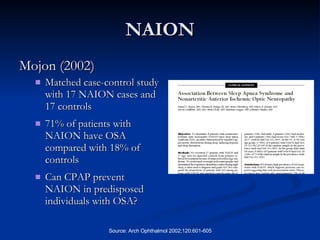
NAION Mojon (2002) Matched case-control study with 17 NAION cases and 17 controls  71% of patients with NAION have OSA compared with 18% of controls Can CPAP prevent NAION in predisposed individuals with OSA?
NAION Behbehani (2005) Report of 3 patients that developed NAION while using CPAP for OSA Concluded that CPAP does not prevent NAION in patients with OSA Questions role of OSA in development of NAION
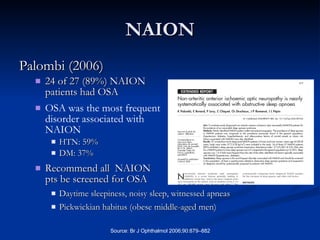
NAION Palombi (2006) 24 of 27 (89%) NAION  patients had OSA OSA was the most frequent  disorder associated with  NAION HTN: 59% DM: 37% Recommend all  NAION  pts be screened for OSA Daytime sleepiness, noisy sleep, witnessed apneas Pickwickian habitus (obese middle-aged men)
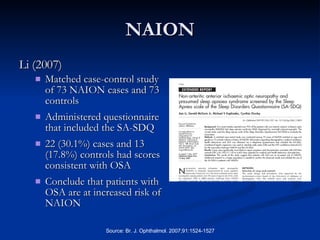
NAION Li (2007) Matched case-control study of 73 NAION cases and 73 controls  Administered questionnaire that included the SA-SDQ  22 (30.1%) cases and 13 (17.8%) controls had scores consistent with OSA Conclude that patients with OSA are at increased risk of NAION
OSA & the Eye Obese middle-aged men Excessive sleepiness Disruptive snoring Witnessed apneas Ocular Manifestations Asthenopia CPAP-associated red eye Floppy Eyelid Syndrome NAION Papilledema Normal Tension Glaucoma
Papilledema Clinical Characteristics Disc swelling associated with increased ICP Symptoms of elevated ICP: Headache, tinnitus, TOV  Chronic papilledema (months) may lead to optic atrophy and vision loss
Papilledema Work-up Urgent MRI or CT scan Lumbar puncture if imaging normal Idiopathic Intracranial  Hypertension “ Pseudotumor cerebri” Syndrome of elevated ICP,  papilledema, normal MRI/CT,  normal CSF Secondary pseudotumor cerebri  syndromes  Venous sinus thrombosis,  vitamin A toxicity, COPD,  OSA   Tx: Diamox 250mg po QID , Underlying cause if known
Papilledema Relation to OSA 4 pts with vision loss, unexplained disc edema and OSA ICP is normal during the day but elevated at night Apneas were occurring despite CPAP – require surgical tx Hypercapnia-induced cerebral vasodilatation elevates ICP Intermittent ↑ ICP can cause sustained papilledema Papilledema resolved with successful tx of OSA
OSA & the Eye Obese middle-aged men Excessive sleepiness Disruptive snoring  Witnessed apneas Ocular Manifestations Asthenopia CPAP-associated red eye Floppy Eyelid Syndrome NAION Papilledema Normal Tension Glaucoma
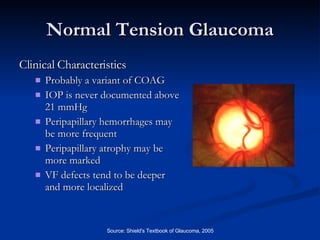
Normal Tension Glaucoma Clinical Characteristics Probably a variant of COAG IOP is never documented above 21 mmHg  Peripapillary hemorrhages may be more frequent Peripapillary atrophy may be more marked  VF defects tend to be deeper and more localized
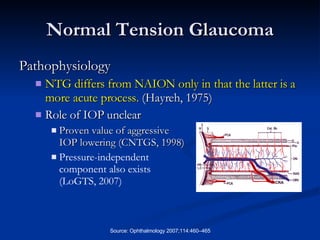
Normal Tension Glaucoma Pathophysiology NTG differs from NAION only in that the latter is a more acute process.  (Hayreh, 1975) Role of IOP unclear Proven value of aggressive  IOP lowering (CNTGS, 1998) Pressure-independent  component also exists  (LoGTS, 2007)
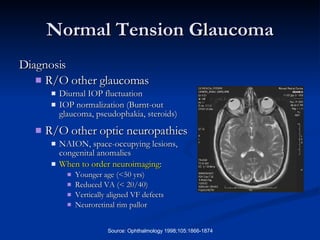
Normal Tension Glaucoma Diagnosis R/O other glaucomas Diurnal IOP fluctuation IOP normalization (Burnt-out glaucoma, pseudophakia, steroids) R/O other optic neuropathies NAION, space-occupying lesions, congenital anomalies When to order neuroimaging :  Younger age (<50 yrs) Reduced VA (< 20/40) Vertically aligned VF defects Neuroretinal rim pallor
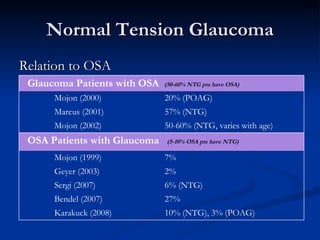
Normal Tension Glaucoma Relation to OSA 10% (NTG), 3% (POAG) Karakuck (2008) 27% Bendel (2007) 6% (NTG) Sergi (2007) 2% Geyer (2003) Mojon (1999) Mojon (2002) Marcus (2001) Mojon (2000) 7% OSA Patients with Glaucoma  (5-10% OSA pts have NTG) 50-60% (NTG, varies with age) 57% (NTG) 20% (POAG) Glaucoma Patients with OSA  (50-60% NTG pts have OSA)
Normal Tension Glaucoma OSA May Cause VF Loss Without Glaucoma VF loss may occur due to optic nerve damage caused by cerebral ischemia and intermittent ICP elevation Batisse (2004) Eye exam on 35 consecutive patients undergoing PSG  VF mean deviation correlated with RDI Tsang  (2006) Compared VF and ONH changes between 41 pts with moderate-severe OSA with 35 age-matched controls  In OSA pts the VF indices were significantly subnormal Karakucuk (2008)  Eye exams and orbital blood flow studies on 31 pts with OSA and 25 normal control subjects  VF defects were detected in 10 pts despite normal eye exam.
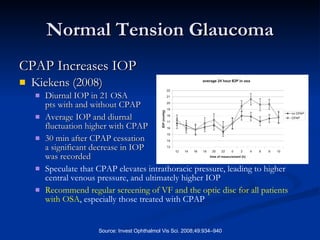
Normal Tension Glaucoma CPAP Increases IOP Kiekens (2008) Diurnal IOP in 21 OSA  pts with and without CPAP Average IOP and diurnal  fluctuation higher with CPAP  30 min after CPAP cessation  a significant decrease in IOP  was recorded  Speculate that CPAP elevates intrathoracic pressure, leading to higher central venous pressure, and ultimately higher IOP Recommend regular screening of VF and the optic disc for all patients with OSA , especially those treated with CPAP
 
Thank You!

Sleep Apnea and the Eye - 2008

  • 1.
    Sleep Apnea & the Eye Rick Trevino, OD VA Outpatient Clinic Evansville, IN [email_address]
  • 2.
    Sleep Apnea &the Eye Sleep Apnea Sleep physiology Clinical consequences Diagnosis Treatment Ocular Manifestations Asthenopia CPAP-assoc red eye Floppy eyelid syndrome NAION Papilledema Normal tension glaucoma
  • 3.
    Online Resources LectureNotes http://richardtrevino.net/sleepapnea Powerpoint Slides http://www.slideshare.net/rhodopsin Free Texts http://jfponline.com (Aug 2008) http://pubs.nrc-cnrc.gc.ca/cjo Can J Ophthalmol 2007;42(2):238-43
  • 4.
  • 5.
    Sleep Cycle PolysomnographyEEG channels EOG channels EMG channel Nasal air current channel Thoracic motion channel Abdominal motion channel Oximeter channel Leg movement channels Microphone Video recording
  • 6.
  • 7.
    Sleep Disorders Sleepapnea Insomnia Narcolepsy Restless leg syndrome Parasomnias Circadian disorders Drug side effects Shift work OSA is the “most physiologically disruptive and dangerous of the sleep-related disorders.”
  • 8.
  • 9.
    Obstructive Sleep ApneaAny Condition that Causes or Contributes to Upper Airway Narrowing is a Risk Factor for OSA Obesity Enlarged Tonsils Anatomical Malformations Neoplasms Edema of the pharynx Lymphoid Hypertrophy Pharyngeal Muscle Weakness Dyscoordination of Respiratory Muscles
  • 10.
    Obstructive Sleep ApneaExcessive daytime sleepiness Most common symptom Disruptive snoring Also gasping/snorting during arousals Apneic events witnessed by bed partner Disruptive snoring + witnessed apneas: 94% specificity Obesity 30% of pts with a BMI > 30 have OSA, and 50% of pts with a BMI > 40 have OSA. Neck circumference ≥ 40 cm had a sensitivity of 61% and a specificity of 93% for OSA Correlates better than BMI Male 2-3x more common than female Family history of OSA Relatives have 2-4 fold  risk Clinical Characteristics
  • 11.
    Obstructive Sleep ApneaPickwickian Syndrome Obesity, daytime somnolence, loud snoring Charles Dicken’s “Pickwick Papers” (1837) Prevalence increasing in parallel with prevalence of obesity 30-60yo: 9%F, 24%M Under-diagnosed
  • 12.
    Obstructive Sleep ApneaCardiovascular Disease HTN, CAD/MI, CHF, Arrhythmia Stroke Obesity Metabolic Syndrome Other Diseases Morning headache, Eye , Liver, Kidney, others Cognitive and Emotional Impaired mental functioning Depression Mood alteration Effects on bed partners Disruptive snoring Accidents Drowsy driving Workplace Clinical Consequences
  • 13.
  • 14.
    Obstructive Sleep ApneaHistory Sleepiness assessment Disruptive snoring Witnessed apneas Physical Obesity Neck circumference Throat/Mouth exam PSG Gold Standard Respiratory Disturbance Index Clinical Evaluation
  • 15.
    Obstructive Sleep ApneaEpworth Sleepiness Scale How likely are you to doze off or fall asleep in the following situations? 0 = No chance, 1 = Slight chance, 2 = Moderate chance, 3 = High Chance 1. Sitting and reading 2. Watching TV 3. Sitting inactive in a public place (theater, meeting) 4. As a passenger in a car for an hour without a break 5. Lying down to rest in the afternoon when circumstances permit 6. Sitting and talking to someone 7. Sitting quietly after a lunch without alcohol 8. In a car, while stopped for a few minutes in traffic
  • 16.
    Obstructive Sleep ApneaTreatment Options Behavioral: Weight loss, EtOH avoidance, nonsupine position Positive Airway Pressure: CPAP, others Mandibular advancement device Surgery: UPPP, Tonsillectomy, Tracheostomy
  • 17.
  • 18.
    OSA & theEye Obese middle-aged men Excessive sleepiness Disruptive snoring Witnessed apneas Ocular Manifestations Asthenopia CPAP-associated red eye Floppy Eyelid Syndrome NAION Papilledema Normal Tension Glaucoma
  • 19.
    Asthenopia Common OSASymptoms Include: “Tiredness” “Fatigue” “Lack of energy” Morning headache These OSA symptoms may be misinterpreted as “eye strain”
  • 20.
    Asthenopia Common OSA-associatedasthenopic symptoms Unexplained symptoms of blur Vision is 20/20 but the patient is c/o blur Misinterpreting what is seen Incorrect recording or copying Eye strain and/or fatigue Headaches Worse in the morning
  • 21.
    Asthenopia 42yo WMpresents with c/o eye fatigue at near. LEE: <1yr with current eyeglasses MH: 1. OSA (noncompliant with CPAP) 2. Frequent HA 3. Overweight 4. Hyperlipidemia 5. GERD 6. Smokes 1PPD Optometric Exam: Unremarkable Plan: 1. OSA management 2. Visual hygiene 3. Smoking cessation
  • 22.
    Asthenopia OSA SupportiveManagement Encourage compliance with CPAP 50% compliance rate, high drop-out rate Quit smoking Smokers 3 times more likely to have OSA Reversible with smoking cessation Weight reduction 10% increase in weight results in 6x greater risk of developing OSA Weight loss decreases OSA severity Avoid sleeping on back Sew golf ball into pocket on back of shirt Avoid alcohol within 4 hours of bedtime Avoid sleeping pills
  • 23.
    OSA & theEye Obese middle-aged men Excessive sleepiness Disruptive snoring Witnessed apneas Ocular Manifestations Asthenopia CPAP-associated red eye Floppy Eyelid Syndrome NAION Papilledema Normal Tension Glaucoma
  • 24.
    CPAP-associated Red EyeClinical Problems Dry eye EXW CL intolerance Conjunctivitis Reactivation of RCE Causes Air leaks Retrograde air flow thru nasolacrimal apparatus Treatment CPAP refitting: adjust headgear and pressure Ointments HS, punctal plugs
  • 25.
    OSA & theEye Obese middle-aged men Excessive sleepiness, disruptive snoring, witnessed apneas Ocular Manifestations Asthenopia CPAP-associated red eye Floppy Eyelid Syndrome NAION Papilledema Normal Tension Glaucoma
  • 26.
    Floppy Eyelid SyndromeClinical Characteristics Eyelid hyperlaxity Rubbery, easily everted upper eyelids Eyelash ptosis with loss of parallelism Papillary conjunctivitis Chronic ocular irritation, worse upon waking SPK, mucoid discharge common Rubbing on pillow case Should be suspected in any obese pt with a chronic red eye
  • 27.
    Floppy Eyelid SyndromeEyelash ptosis Downward displacement of eyelashes Lashes may curl toward the globe Lashes may point in various directions - loss of parallelism Pts may trim with scissors
  • 28.
  • 29.
    Floppy Eyelid SyndromePathophysiology Loss of elastic fibers in tarsus and skin of lid Upregulation of elastin-degrading enzymes (matrix metalloproteinases) Caused by repeated mechanical trauma, possibly eye rubbing or sleeping with the face buried in the pillow
  • 30.
    Floppy Eyelid SyndromeTreatment Lubrication therapy Poor lid-eye contact Inadequate tear distribution Protect eye during sleep Ointments HS Fox shield, patching, taping May improve or resolve with CPAP Surgical therapy deferred until OSA treated Horizontal lid shortening
  • 31.
    Floppy Eyelid SyndromeRelation to OSA Pts with FES are a subset of all OSA pts 96% pts with FES have OSA (almost 100%!) 5-15% pts with OSA have FES OSA tends to be more severe in pts with FES
  • 32.
    OSA & theEye Obese middle-aged men Excessive sleepiness Disruptive snoring Witnessed apneas Ocular Manifestations Asthenopia CPAP-associated red eye Floppy Eyelid Syndrome NAION Papilledema Normal Tension Glaucoma
  • 33.
    NAION Clinical CharacteristicsMost common acute optic neuropathy in pts >50yo Sudden painless visual loss, usually upon awaking Nerve fiber bundle VF defects Diffuse or sectoral disc edema Disc at risk: small, crowded Mean C/D = 0.2 All ≤ 0.4
  • 34.
    NAION Pathophysiology Idiopathicischemic process Disorder of posterior ciliary artery circulation Transient poor circulation in the ONH Trigger Event : Fall in blood pressure below a critical level? There is no actual blockage of the posterior ciliary arteries Cascade Effect Mechanical crowding caused by small crowded disc Ischemia  Swelling  Compression  Ischemia
  • 35.
    Diagnosis: Must excludeGCA in every case ESR C-Reactive Protein Positive acute-phase protein Levels increase in presence of inflammation Upper limit normal does not rise with age Platelets Secondary thrombocytosis due to chronic inflammation NAION
  • 36.
    NAION Treatment AspirinDecreases incidence in fellow eye at 2 years, but not at 5 years Surgical decompression No benefit (Ischemic Optic Neuropathy Decompression Trial) Control of predisposing systemic disease May slow progression or reduce incidence in fellow eye Hypertension, Diabetes, Hyperlipidemia Avoid phosphodiesterase 5 inhibitors (Viagra, Levitra, Cialis) May increase risk of NAION in fellow eye
  • 37.
    NAION Medicolegal obligationto inform pts of risk to fellow eye
  • 38.
    NAION Relation toOSA Mojon (2002) Behbehani (2005) Palombi (2006) Li (2007)
  • 39.
    NAION Mojon (2002)Matched case-control study with 17 NAION cases and 17 controls 71% of patients with NAION have OSA compared with 18% of controls Can CPAP prevent NAION in predisposed individuals with OSA?
  • 40.
    NAION Behbehani (2005)Report of 3 patients that developed NAION while using CPAP for OSA Concluded that CPAP does not prevent NAION in patients with OSA Questions role of OSA in development of NAION
  • 41.
    NAION Palombi (2006)24 of 27 (89%) NAION patients had OSA OSA was the most frequent disorder associated with NAION HTN: 59% DM: 37% Recommend all NAION pts be screened for OSA Daytime sleepiness, noisy sleep, witnessed apneas Pickwickian habitus (obese middle-aged men)
  • 42.
    NAION Li (2007)Matched case-control study of 73 NAION cases and 73 controls Administered questionnaire that included the SA-SDQ 22 (30.1%) cases and 13 (17.8%) controls had scores consistent with OSA Conclude that patients with OSA are at increased risk of NAION
  • 43.
    OSA & theEye Obese middle-aged men Excessive sleepiness Disruptive snoring Witnessed apneas Ocular Manifestations Asthenopia CPAP-associated red eye Floppy Eyelid Syndrome NAION Papilledema Normal Tension Glaucoma
  • 44.
    Papilledema Clinical CharacteristicsDisc swelling associated with increased ICP Symptoms of elevated ICP: Headache, tinnitus, TOV Chronic papilledema (months) may lead to optic atrophy and vision loss
  • 45.
    Papilledema Work-up UrgentMRI or CT scan Lumbar puncture if imaging normal Idiopathic Intracranial Hypertension “ Pseudotumor cerebri” Syndrome of elevated ICP, papilledema, normal MRI/CT, normal CSF Secondary pseudotumor cerebri syndromes Venous sinus thrombosis, vitamin A toxicity, COPD, OSA Tx: Diamox 250mg po QID , Underlying cause if known
  • 46.
    Papilledema Relation toOSA 4 pts with vision loss, unexplained disc edema and OSA ICP is normal during the day but elevated at night Apneas were occurring despite CPAP – require surgical tx Hypercapnia-induced cerebral vasodilatation elevates ICP Intermittent ↑ ICP can cause sustained papilledema Papilledema resolved with successful tx of OSA
  • 47.
    OSA & theEye Obese middle-aged men Excessive sleepiness Disruptive snoring Witnessed apneas Ocular Manifestations Asthenopia CPAP-associated red eye Floppy Eyelid Syndrome NAION Papilledema Normal Tension Glaucoma
  • 48.
    Normal Tension GlaucomaClinical Characteristics Probably a variant of COAG IOP is never documented above 21 mmHg Peripapillary hemorrhages may be more frequent Peripapillary atrophy may be more marked VF defects tend to be deeper and more localized
  • 49.
    Normal Tension GlaucomaPathophysiology NTG differs from NAION only in that the latter is a more acute process. (Hayreh, 1975) Role of IOP unclear Proven value of aggressive IOP lowering (CNTGS, 1998) Pressure-independent component also exists (LoGTS, 2007)
  • 50.
    Normal Tension GlaucomaDiagnosis R/O other glaucomas Diurnal IOP fluctuation IOP normalization (Burnt-out glaucoma, pseudophakia, steroids) R/O other optic neuropathies NAION, space-occupying lesions, congenital anomalies When to order neuroimaging : Younger age (<50 yrs) Reduced VA (< 20/40) Vertically aligned VF defects Neuroretinal rim pallor
  • 51.
    Normal Tension GlaucomaRelation to OSA 10% (NTG), 3% (POAG) Karakuck (2008) 27% Bendel (2007) 6% (NTG) Sergi (2007) 2% Geyer (2003) Mojon (1999) Mojon (2002) Marcus (2001) Mojon (2000) 7% OSA Patients with Glaucoma (5-10% OSA pts have NTG) 50-60% (NTG, varies with age) 57% (NTG) 20% (POAG) Glaucoma Patients with OSA (50-60% NTG pts have OSA)
  • 52.
    Normal Tension GlaucomaOSA May Cause VF Loss Without Glaucoma VF loss may occur due to optic nerve damage caused by cerebral ischemia and intermittent ICP elevation Batisse (2004) Eye exam on 35 consecutive patients undergoing PSG VF mean deviation correlated with RDI Tsang (2006) Compared VF and ONH changes between 41 pts with moderate-severe OSA with 35 age-matched controls In OSA pts the VF indices were significantly subnormal Karakucuk (2008) Eye exams and orbital blood flow studies on 31 pts with OSA and 25 normal control subjects VF defects were detected in 10 pts despite normal eye exam.
  • 53.
    Normal Tension GlaucomaCPAP Increases IOP Kiekens (2008) Diurnal IOP in 21 OSA pts with and without CPAP Average IOP and diurnal fluctuation higher with CPAP 30 min after CPAP cessation a significant decrease in IOP was recorded Speculate that CPAP elevates intrathoracic pressure, leading to higher central venous pressure, and ultimately higher IOP Recommend regular screening of VF and the optic disc for all patients with OSA , especially those treated with CPAP
  • 54.
  • 55.

Editor's Notes

  • #2 Being a political year, let me first say: My name is Rick Trevino and I approve that message. SLEEP APNEA IS A NEWLY DISCOVERED DISEASE (1966) - Most prevalent disease discovered in the 20 th century – 20% of adult population in Western countries THE MOST COMMON “MEDICAL” SLEEP DISORDER - excluding shift-work and self-induced sleepiness (late night partying) IT IS NOT ONLY THE MOST COMMON SLEEP DISORDER, BUT ALSO THE MOST PHYSIOLOGICALLY DISRUPTIVE AND DANGEROUS SLEEP DISORDER - Life threatening disease: A recently published longitudinal study found pts with severe OSA had 3-4x the death rate of persons without OSA. - Wide spread effects throughout the body – As we shall see, not even the somewhat remote and esoteric world of eye care is immune from the influences of this devastating disease