Sleep Apnea
Sleep Apnea
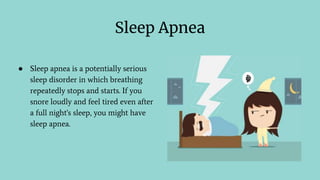
● Sleep apnea is a potentially serious
sleep disorder in which breathing
repeatedly stops and starts. If you
snore loudly and feel tired even after
a full night's sleep, you might have
sleep apnea.
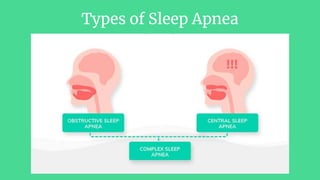
Types of Sleep Apnea
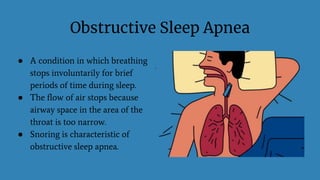
Obstructive Sleep Apnea
● A condition in which breathing
stops involuntarily for brief
periods of time during sleep.
● The flow of air stops because
airway space in the area of the
throat is too narrow.
● Snoring is characteristic of
obstructive sleep apnea.
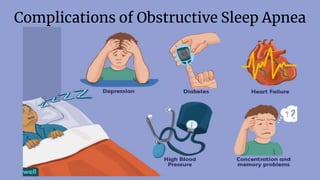
Complications of Obstructive Sleep Apnea
Symptoms of Obstructive Sleep Apnea
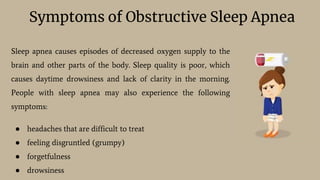
Sleep apnea causes episodes of decreased oxygen supply to the
brain and other parts of the body. Sleep quality is poor, which
causes daytime drowsiness and lack of clarity in the morning.
People with sleep apnea may also experience the following
symptoms:
● headaches that are difficult to treat
● feeling disgruntled (grumpy)
● forgetfulness
● drowsiness
Risk Factors of Obstructive Sleep Apnea
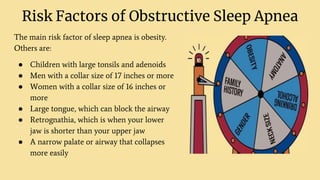
The main risk factor of sleep apnea is obesity.
Others are:
● Children with large tonsils and adenoids
● Men with a collar size of 17 inches or more
● Women with a collar size of 16 inches or
more
● Large tongue, which can block the airway
● Retrognathia, which is when your lower
jaw is shorter than your upper jaw
● A narrow palate or airway that collapses
more easily
Diagnosis of Obstructive Sleep Apnea
● Polysomnography
○ Electroencephalogram (EEG)
○ Electro-oculogram (EOM),
○ Electromyogram (EMG)
○ Electrocardiogram (EKG or ECG)
○ Pulse oximetry test
○ Arterial blood gas analysis (ABG)
Treatment of Obstructive Sleep Apnea
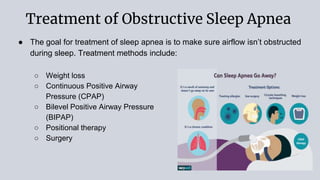
● The goal for treatment of sleep apnea is to make sure airflow isn’t obstructed
during sleep. Treatment methods include:
○ Weight loss
○ Continuous Positive Airway
Pressure (CPAP)
○ Bilevel Positive Airway Pressure
(BIPAP)
○ Positional therapy
○ Surgery
Central Sleep Apnea
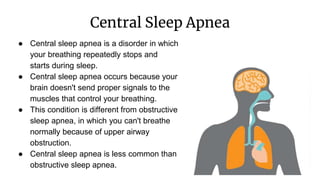
● Central sleep apnea is a disorder in which
your breathing repeatedly stops and
starts during sleep.
● Central sleep apnea occurs because your
brain doesn't send proper signals to the
muscles that control your breathing.
● This condition is different from obstructive
sleep apnea, in which you can't breathe
normally because of upper airway
obstruction.
● Central sleep apnea is less common than
obstructive sleep apnea.
Symptoms of Central Sleep Apnea
● Common signs and symptoms of central sleep apnea include:
○ Observed episodes of stopped breathing or abnormal breathing patterns
during sleep
○ Abrupt awakenings accompanied by shortness of breath
○ Shortness of breath that's relieved by sitting up
○ Difficulty staying asleep (insomnia)
○ Excessive daytime sleepiness (hypersomnia)
○ Chest pain at night
○ Difficulty concentrating
○ Mood changes
○ Morning headaches
○ Snoring
○ Lower tolerance for exercise
Risk Factors
● Gender
● Age.
● Heart disorders.
● Stroke,brain tumor or a structural brainstem lesion.
● High altitude.
● Opioid use.
● CPAP.
Diagnosis
● Polysomnography
Treatment
● Addressing associated medical problems
● Reduction of opioid medications
● Continuous positive airway pressure (CPAP)
● Adaptive servo-ventilation (ASV)
● Bilevel positive airway pressure (BPAP)
● Supplemental oxygen
● Medications
Complex Sleep Apnea
● Starts as Central sleep apnea
● Treatments and diagnosis are approx same.
● Not so common.
Sleep apnea

Sleep apnea

  • 1.
  • 2.
    Sleep Apnea ● Sleepapnea is a potentially serious sleep disorder in which breathing repeatedly stops and starts. If you snore loudly and feel tired even after a full night's sleep, you might have sleep apnea.
  • 3.
  • 4.
    Obstructive Sleep Apnea ●A condition in which breathing stops involuntarily for brief periods of time during sleep. ● The flow of air stops because airway space in the area of the throat is too narrow. ● Snoring is characteristic of obstructive sleep apnea.
  • 5.
  • 6.
    Symptoms of ObstructiveSleep Apnea Sleep apnea causes episodes of decreased oxygen supply to the brain and other parts of the body. Sleep quality is poor, which causes daytime drowsiness and lack of clarity in the morning. People with sleep apnea may also experience the following symptoms: ● headaches that are difficult to treat ● feeling disgruntled (grumpy) ● forgetfulness ● drowsiness
  • 7.
    Risk Factors ofObstructive Sleep Apnea The main risk factor of sleep apnea is obesity. Others are: ● Children with large tonsils and adenoids ● Men with a collar size of 17 inches or more ● Women with a collar size of 16 inches or more ● Large tongue, which can block the airway ● Retrognathia, which is when your lower jaw is shorter than your upper jaw ● A narrow palate or airway that collapses more easily
  • 8.
    Diagnosis of ObstructiveSleep Apnea ● Polysomnography ○ Electroencephalogram (EEG) ○ Electro-oculogram (EOM), ○ Electromyogram (EMG) ○ Electrocardiogram (EKG or ECG) ○ Pulse oximetry test ○ Arterial blood gas analysis (ABG)
  • 9.
    Treatment of ObstructiveSleep Apnea ● The goal for treatment of sleep apnea is to make sure airflow isn’t obstructed during sleep. Treatment methods include: ○ Weight loss ○ Continuous Positive Airway Pressure (CPAP) ○ Bilevel Positive Airway Pressure (BIPAP) ○ Positional therapy ○ Surgery
  • 10.
    Central Sleep Apnea ●Central sleep apnea is a disorder in which your breathing repeatedly stops and starts during sleep. ● Central sleep apnea occurs because your brain doesn't send proper signals to the muscles that control your breathing. ● This condition is different from obstructive sleep apnea, in which you can't breathe normally because of upper airway obstruction. ● Central sleep apnea is less common than obstructive sleep apnea.
  • 11.
    Symptoms of CentralSleep Apnea ● Common signs and symptoms of central sleep apnea include: ○ Observed episodes of stopped breathing or abnormal breathing patterns during sleep ○ Abrupt awakenings accompanied by shortness of breath ○ Shortness of breath that's relieved by sitting up ○ Difficulty staying asleep (insomnia) ○ Excessive daytime sleepiness (hypersomnia) ○ Chest pain at night ○ Difficulty concentrating ○ Mood changes ○ Morning headaches ○ Snoring ○ Lower tolerance for exercise
  • 12.
    Risk Factors ● Gender ●Age. ● Heart disorders. ● Stroke,brain tumor or a structural brainstem lesion. ● High altitude. ● Opioid use. ● CPAP.
  • 13.
    Diagnosis ● Polysomnography Treatment ● Addressingassociated medical problems ● Reduction of opioid medications ● Continuous positive airway pressure (CPAP) ● Adaptive servo-ventilation (ASV) ● Bilevel positive airway pressure (BPAP) ● Supplemental oxygen ● Medications
  • 14.
    Complex Sleep Apnea ●Starts as Central sleep apnea ● Treatments and diagnosis are approx same. ● Not so common.