AMBO UNIVERSIT
Y
WOLISO CAMPUS
DEPARTMENT:- NURSING
ASSIGNMENT OF PSYCHIAT
RY
BREATHING RELA
TED SLEEP DISOR
DERS
Outline
1. Definition of Breathing Related Sleep D
isorder
2. Obstructive sleep Apnea
3. Central Sleep Apnea
4. Hypoventilation Sleep Apnea
BREATHING RELATED S
LEEP DISORDER
Is general term for breathing difficulties
occuring during sleep.
Is defined as abnormal breathing during
sleep.
Obstructive Sleep Apnea
(OSA)
OSA is characterized by apneas and hy
popneas, which are caused by partial
or complete collapse of the upper airwa
ys.
OSA is the commonest of all Breathing R
elated Sleep Disorder and is characterize
d by recurrent
partial or complete collapse of pharynx c
ausing
cessation or impairment of breathing suc
h as
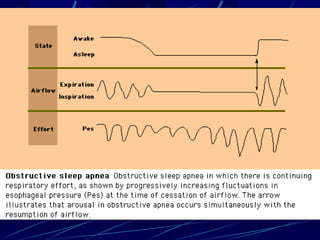
During these pauses, an individual’s bre
athing may be significantly reduced or c
ompletely stopped for a period ranging f
rom a few seconds to up to a minute.
These episodes can occur multiple tim
es a night, often leading to fragmented
and non-restorative sleep.
As a result, people with OSA often f
eel unrefreshed and excessively sle
epy during the day.
Pathophysiology
Pharynx is abnormal in size or collapsibi
lity.
As an organ for speech and deglutition i
t must be able to change shape and clo
se
As a conduit for airflow it must resist coll
apse
Pathophysiology(contd.)
Exact mechanism is not known
During the day muscles in the region keep th
e airway open
During sleep muscles relax to a point where t
he airway collapses to an extent that it gets o
bstructed
Once breathing stops, individual awakens to
breathe and arousal can last few seconds to
a minute
Risk factors for OSA
Obesity
Age- middle aged men and post- menop
ausal women
Older age- due to loss of muscle mass
and tone
Family Hx of OSA
Symptoms
Insomnia or disrupted sleep
Difficulty concentrating and problems
with memory
Morning headaches
Irritability and mood swings
Waking up frequently at night to urinat
e
Signs
Loud Snoring
Witnessed apneas
Obesity
HTN
Metabolic syndrome
Increased Neck circumference
Anatomic Abnormalities
Screening for OSA
2 of the three symptoms- EDS, loud Sn
oring, Witnessed Apneas
High Score on ESS(Epworth Sleepiness
Score)>12, or Stanford Sleepiness Sco
re
Diagnosis
Nocturnal Polysomnography-in lab stud
y, where EEG, EMG, HR, body position,
leg movements, Oximetry, Snoring, abd
ominal and chest wall movements are r
ecorded
Home studies are limited as EEG is not
recorded, or in some limited studies onl
y Nocturnal Pulse oximetry is done
Medical Complications
Uncontrolled HTN
Diminished quality of life from chronic sl
eep deprivation
Increase risk for CVA
Worsening of CAD and CHF
Treatment
Behavioral Tx- weight loss
Sleep hygeine
Avoiding alcohol too close to bedtime
Avoid sedatives and hypnotics, narcotic
s
Avoid caffeine
Central Sleep Apnea
Is form of apnea in which breathing effor
t is not detected, in contrast to obstructi
ve apnea, in which attempts at breathin
g are vigorous.
Many people are unaware of their nightti
me breathing patterns, so these episode
s of abnormal breathing may go unnotice
d or are only noticed by a partner or care
giver.
symptoms of central sle
ep apnea
Tiredness
Fatigue
Lack of energy
Memory problems
Attention or concentration issues
Headaches after waking up
Trouble breathing during the day
Difficulty swallowing
Changes to the voice
Numbness or weakness
Does Central Sleep Apnea Cause
Snoring?
Almost everyone snores every once in a
while, and between 28% and 44% of ad
ults snore on a regular basis. Snoring c
an be a sign of sleep apnea, but in most
cases, snoring is not related to an under
lying sleep disorder.
While some people with central sleep a
pnea snore, their snoring is typically les
s severe than in people who have obstr
uctive sleep apnea.
Risk Factors for Central Sleep
Apnea
A variety of factors can increase a perso
n's risk of developing central sleep apne
a. For example, CSA occurs more often
in people over 65 years old and in men
and people assigned male at birth. Cert
ain medical conditions that affect breathi
ng also increase the risk of developing c
entral sleep apnea, including:
Cont.......
Birth defects
Heart failure
Abnormal heart rhythms
Kidney failure
Hypothyroidism
Stroke
Brain infection
Brain tumor
Cont...
Medications and other substances that can in
crease the risk of central sleep apnea or exac
erbate the condition include:
Prescription opioids
Heroin and other illegal opioids
Alcohol
Benzodiazepines
Antidepressants
Seizure medications
Muscle relaxants
Diagnosing Central Sleep Apn
ea
To diagnose central sleep apnea, a doct
or often begins by collecting a person’s
medical history, conducting a physical e
xam, and ordering tests to find the caus
e of abnormal breathing. To confirm a di
agnosis, the doctor may also recommen
d a sleep study.
Cont......
A sleep study is an important tool for dia
gnosing sleep disorders. During a sleep
study, a person is hooked up to a variet
y of monitoring devices that record breat
hing, heart rate, and other measuremen
ts.
Central Sleep Apnea Treat
ment
Treatment for central sleep apnea depe
nds on the cause of the condition.

Positive airway pressure (PAP) therapy: PAP ther
apy includes several different types, including CP
AP, ASV, and BiPAP. These are all methods of d
elivering pressurized air to keep the airway open
during sleep.
Supplemental oxygen: Supplemental oxygen deli
vers extra oxygen to help correct breathing disrup
tions and normalize oxygen levels in the blood. S
upplemental oxygen may be used alone or at the
same time as PAP therapy.
Sleep-Related Hypoventilat
ion
is an umbrella term for a group of disord
ers involving insufficient breathing durin
g sleep. This disordered breathing can o
ccur when a person is sleeping at any ti
me of day or night, including while they
nap.
Cont......
During hypoventilation, a person’s CO2
levels rise because they do not exhale fr
equently enough. Hypoventilation increa
ses the risks of a heartbeat that is too sl
ow and of insufficient oxygen and exces
s acid in the blood.
Common Symptoms of Sleep-Rela
ted Hypoventilation
Insufficient breathing, either too slow or
too shallow, is the key symptom among
all of the different types of sleep-related
hypoventilation. Other symptoms may
occur among several kinds of sleep-rel
ated hypoventilation disorders.
Cont......
High carbon dioxide levels: Because hy
poventilation involves slowed breathing,
it can cause high levels of CO2 in the bl
ood.
Low oxygen levels: A common effect of
reduced breathing is insufficient oxygen
in the blood.
Bluish skin: Without enough oxygen in t
he blood, people with hypoventilation m
ay have skin with a blue tinge.
Cont...
Shortness of breath: Some people with
hypoventilation disorders experience sh
ortness of breath or painful breathing.
Obstructive sleep apnea and related sy
mptoms: People with a sleep-related hy
poventilation disorder may also have O
SA and experience its symptoms, includ
ing daytime sleepiness, loud snoring, an
d making choking sounds while sleeping
.
Causes Sleep-Related Hypove
ntilation
The causes of sleep-related hypoventila
tion vary among its different types. For e
xample, a variation in a gene that affect
s breathing function can cause congenit
al central hypoventilation syndrome and
late-onset central hypoventilation syndr
ome.
Cont.....
Certain medical disorders, family patter
ns, and medications can also lead to sle
ep-related hypoventilation. People with
obesity, for instance, are more likely to
have obesity hypoventilation syndrome,
while people whose parents have CCH
S have a higher chance of developing th
at disorder themselves.
Diagnosis of Sleep-Related Hypov
entilation
If your health care provider suspects sle
ep-related hypoventilation, they may be
gin by giving you a physical exam and d
iscussing your symptoms.
Then they may suggest testing to confir
m the diagnosis and rule out other disor
ders.
Cont.....
Testing usually involves a sleep study,
which reveals details about your breathi
ng and the way your body functions whe
n you sleep.
A sleep study measures brain activity, b
reathing patterns, muscle movement, an
d levels of carbon dioxide and oxygen in
the bloodstream.
Treatment
Treatment for hypoventilation often involves tr
eating both the slowed breathing itself and un
derlying issues that may contribute to the con
dition. Your health care provider can help you
determine what treatments are best for your s
ituation.
Positive Airway Pressure In some cases, your
doctor may recommend positive airway press
ure (PAP) therapy as part of your treatment pl
an. PAP therapy requires wearing a mask tha
t provides a stream of pressurized air while y
ou sleep.
T
HANK YOU!

BRSD 1st.pptx

  • 1.
    AMBO UNIVERSIT Y WOLISO CAMPUS DEPARTMENT:-NURSING ASSIGNMENT OF PSYCHIAT RY
  • 3.
  • 4.
    Outline 1. Definition ofBreathing Related Sleep D isorder 2. Obstructive sleep Apnea 3. Central Sleep Apnea 4. Hypoventilation Sleep Apnea
  • 5.
    BREATHING RELATED S LEEPDISORDER Is general term for breathing difficulties occuring during sleep. Is defined as abnormal breathing during sleep.
  • 6.
    Obstructive Sleep Apnea (OSA) OSAis characterized by apneas and hy popneas, which are caused by partial or complete collapse of the upper airwa ys. OSA is the commonest of all Breathing R elated Sleep Disorder and is characterize d by recurrent partial or complete collapse of pharynx c ausing cessation or impairment of breathing suc h as
  • 7.
    During these pauses,an individual’s bre athing may be significantly reduced or c ompletely stopped for a period ranging f rom a few seconds to up to a minute. These episodes can occur multiple tim es a night, often leading to fragmented and non-restorative sleep. As a result, people with OSA often f eel unrefreshed and excessively sle epy during the day.
  • 9.
    Pathophysiology Pharynx is abnormalin size or collapsibi lity. As an organ for speech and deglutition i t must be able to change shape and clo se As a conduit for airflow it must resist coll apse
  • 10.
    Pathophysiology(contd.) Exact mechanism isnot known During the day muscles in the region keep th e airway open During sleep muscles relax to a point where t he airway collapses to an extent that it gets o bstructed Once breathing stops, individual awakens to breathe and arousal can last few seconds to a minute
  • 11.
    Risk factors forOSA Obesity Age- middle aged men and post- menop ausal women Older age- due to loss of muscle mass and tone Family Hx of OSA
  • 12.
    Symptoms Insomnia or disruptedsleep Difficulty concentrating and problems with memory Morning headaches Irritability and mood swings Waking up frequently at night to urinat e
  • 13.
    Signs Loud Snoring Witnessed apneas Obesity HTN Metabolicsyndrome Increased Neck circumference Anatomic Abnormalities
  • 14.
    Screening for OSA 2of the three symptoms- EDS, loud Sn oring, Witnessed Apneas High Score on ESS(Epworth Sleepiness Score)>12, or Stanford Sleepiness Sco re
  • 15.
    Diagnosis Nocturnal Polysomnography-in labstud y, where EEG, EMG, HR, body position, leg movements, Oximetry, Snoring, abd ominal and chest wall movements are r ecorded Home studies are limited as EEG is not recorded, or in some limited studies onl y Nocturnal Pulse oximetry is done
  • 16.
    Medical Complications Uncontrolled HTN Diminishedquality of life from chronic sl eep deprivation Increase risk for CVA Worsening of CAD and CHF
  • 17.
    Treatment Behavioral Tx- weightloss Sleep hygeine Avoiding alcohol too close to bedtime Avoid sedatives and hypnotics, narcotic s Avoid caffeine
  • 18.
    Central Sleep Apnea Isform of apnea in which breathing effor t is not detected, in contrast to obstructi ve apnea, in which attempts at breathin g are vigorous. Many people are unaware of their nightti me breathing patterns, so these episode s of abnormal breathing may go unnotice d or are only noticed by a partner or care giver.
  • 19.
    symptoms of centralsle ep apnea Tiredness Fatigue Lack of energy Memory problems Attention or concentration issues Headaches after waking up Trouble breathing during the day Difficulty swallowing Changes to the voice Numbness or weakness
  • 20.
    Does Central SleepApnea Cause Snoring? Almost everyone snores every once in a while, and between 28% and 44% of ad ults snore on a regular basis. Snoring c an be a sign of sleep apnea, but in most cases, snoring is not related to an under lying sleep disorder. While some people with central sleep a pnea snore, their snoring is typically les s severe than in people who have obstr uctive sleep apnea.
  • 21.
    Risk Factors forCentral Sleep Apnea A variety of factors can increase a perso n's risk of developing central sleep apne a. For example, CSA occurs more often in people over 65 years old and in men and people assigned male at birth. Cert ain medical conditions that affect breathi ng also increase the risk of developing c entral sleep apnea, including:
  • 22.
    Cont....... Birth defects Heart failure Abnormalheart rhythms Kidney failure Hypothyroidism Stroke Brain infection Brain tumor
  • 23.
    Cont... Medications and othersubstances that can in crease the risk of central sleep apnea or exac erbate the condition include: Prescription opioids Heroin and other illegal opioids Alcohol Benzodiazepines Antidepressants Seizure medications Muscle relaxants
  • 24.
    Diagnosing Central SleepApn ea To diagnose central sleep apnea, a doct or often begins by collecting a person’s medical history, conducting a physical e xam, and ordering tests to find the caus e of abnormal breathing. To confirm a di agnosis, the doctor may also recommen d a sleep study.
  • 25.
    Cont...... A sleep studyis an important tool for dia gnosing sleep disorders. During a sleep study, a person is hooked up to a variet y of monitoring devices that record breat hing, heart rate, and other measuremen ts.
  • 26.
    Central Sleep ApneaTreat ment Treatment for central sleep apnea depe nds on the cause of the condition. Positive airway pressure (PAP) therapy: PAP ther apy includes several different types, including CP AP, ASV, and BiPAP. These are all methods of d elivering pressurized air to keep the airway open during sleep. Supplemental oxygen: Supplemental oxygen deli vers extra oxygen to help correct breathing disrup tions and normalize oxygen levels in the blood. S upplemental oxygen may be used alone or at the same time as PAP therapy.
  • 27.
    Sleep-Related Hypoventilat ion is anumbrella term for a group of disord ers involving insufficient breathing durin g sleep. This disordered breathing can o ccur when a person is sleeping at any ti me of day or night, including while they nap.
  • 28.
    Cont...... During hypoventilation, aperson’s CO2 levels rise because they do not exhale fr equently enough. Hypoventilation increa ses the risks of a heartbeat that is too sl ow and of insufficient oxygen and exces s acid in the blood.
  • 29.
    Common Symptoms ofSleep-Rela ted Hypoventilation Insufficient breathing, either too slow or too shallow, is the key symptom among all of the different types of sleep-related hypoventilation. Other symptoms may occur among several kinds of sleep-rel ated hypoventilation disorders.
  • 30.
    Cont...... High carbon dioxidelevels: Because hy poventilation involves slowed breathing, it can cause high levels of CO2 in the bl ood. Low oxygen levels: A common effect of reduced breathing is insufficient oxygen in the blood. Bluish skin: Without enough oxygen in t he blood, people with hypoventilation m ay have skin with a blue tinge.
  • 31.
    Cont... Shortness of breath:Some people with hypoventilation disorders experience sh ortness of breath or painful breathing. Obstructive sleep apnea and related sy mptoms: People with a sleep-related hy poventilation disorder may also have O SA and experience its symptoms, includ ing daytime sleepiness, loud snoring, an d making choking sounds while sleeping .
  • 32.
    Causes Sleep-Related Hypove ntilation Thecauses of sleep-related hypoventila tion vary among its different types. For e xample, a variation in a gene that affect s breathing function can cause congenit al central hypoventilation syndrome and late-onset central hypoventilation syndr ome.
  • 33.
    Cont..... Certain medical disorders,family patter ns, and medications can also lead to sle ep-related hypoventilation. People with obesity, for instance, are more likely to have obesity hypoventilation syndrome, while people whose parents have CCH S have a higher chance of developing th at disorder themselves.
  • 34.
    Diagnosis of Sleep-RelatedHypov entilation If your health care provider suspects sle ep-related hypoventilation, they may be gin by giving you a physical exam and d iscussing your symptoms. Then they may suggest testing to confir m the diagnosis and rule out other disor ders.
  • 35.
    Cont..... Testing usually involvesa sleep study, which reveals details about your breathi ng and the way your body functions whe n you sleep. A sleep study measures brain activity, b reathing patterns, muscle movement, an d levels of carbon dioxide and oxygen in the bloodstream.
  • 36.
    Treatment Treatment for hypoventilationoften involves tr eating both the slowed breathing itself and un derlying issues that may contribute to the con dition. Your health care provider can help you determine what treatments are best for your s ituation. Positive Airway Pressure In some cases, your doctor may recommend positive airway press ure (PAP) therapy as part of your treatment pl an. PAP therapy requires wearing a mask tha t provides a stream of pressurized air while y ou sleep.
  • 37.