SLEEP APNEA 2017
UPDATE ON EVALUATION
AND MANAGEMENT
February 22, 2017
Disclosures
Marc L Benton, MD, FAASM, FCCP
• Medical Director, The Sleep Disorders Center at
Summit Medical Group, Madison, NJ.
Kerry Kelley, RN, RRT, RPSGT
• Manager – Sleep Services
• The Sleep Disorders Center at Summit Medical
Group, Madison, NJ.
Sleep Apnea - 2017 Update
• Introduction
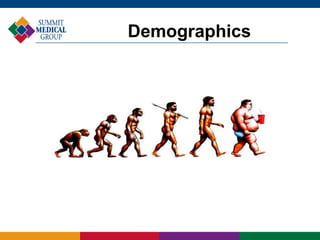
• Demographics
• Pathophysiology
• Risk Assessment
• Evaluation Process
• Treatment Options
• Optimizing Outcomes
• Introduction
• Demographics
• Pathophysiology
• Risk Assessment
• Evaluation Process
• Treatment Options
• Optimizing Outcomes
Sleep Apnea - 2017 Update
Sleep affects, and in turn is affected by, almost every
physiological and psychological process, i.e.,
 Physical performance – work, school, life
 The ability to socially and emotionally relate to others
 Improving learning and memory
 Reduction in health problems and optimization of health
 Functioning in a safe, efficient and effective way
The Three R’s
Rejuvenate, Restore, Re-energize
Sleep Apnea - Introduction
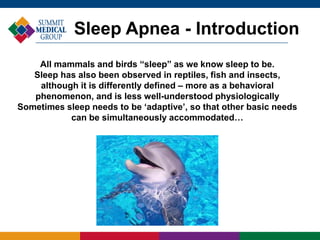
All mammals and birds “sleep” as we know sleep to be.
Sleep has also been observed in reptiles, fish and insects,
although it is differently defined – more as a behavioral
phenomenon, and is less well-understood physiologically
Sometimes sleep needs to be ‘adaptive’, so that other basic needs
can be simultaneously accommodated…
Sleep Apnea - Introduction
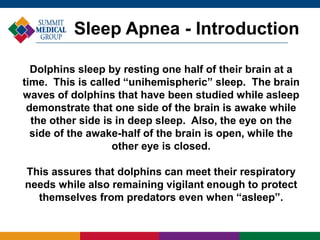
Dolphins sleep by resting one half of their brain at a
time. This is called “unihemispheric” sleep. The brain
waves of dolphins that have been studied while asleep
demonstrate that one side of the brain is awake while
the other side is in deep sleep. Also, the eye on the
side of the awake-half of the brain is open, while the
other eye is closed.
This assures that dolphins can meet their respiratory
needs while also remaining vigilant enough to protect
themselves from predators even when “asleep”.
Sleep Apnea - Introduction
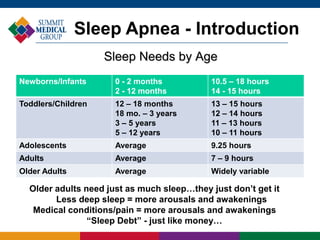
Sleep Needs by Age
Newborns/Infants 0 - 2 months
2 - 12 months
10.5 – 18 hours
14 - 15 hours
Toddlers/Children 12 – 18 months
18 mo. – 3 years
3 – 5 years
5 – 12 years
13 – 15 hours
12 – 14 hours
11 – 13 hours
10 – 11 hours
Adolescents Average 9.25 hours
Adults Average 7 – 9 hours
Older Adults Average Widely variable
Older adults need just as much sleep…they just don’t get it
Less deep sleep = more arousals and awakenings
Medical conditions/pain = more arousals and awakenings
“Sleep Debt” - just like money…
Sleep Apnea - Introduction
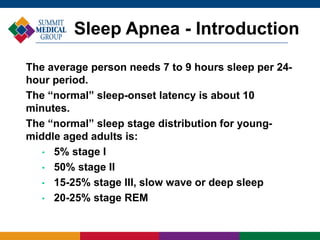
The average person needs 7 to 9 hours sleep per 24-
hour period.
The “normal” sleep-onset latency is about 10
minutes.
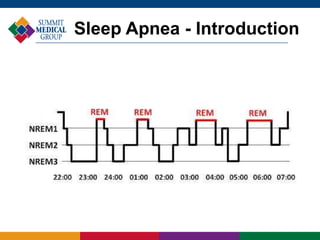
The “normal” sleep stage distribution for young-
middle aged adults is:
• 5% stage I
• 50% stage II
• 15-25% stage III, slow wave or deep sleep
• 20-25% stage REM
Sleep Apnea - Introduction
84 SLEEP DISORDERS
IMPACTING
OVER 100 MILLION AMERICANS
Sleep Apnea - Introduction
Classifications of sleep disorders:
• Sleep-related breathing disorders
• Insomnia
• Central sleep apnea
• Circadian rhythm sleep disorders
• Parasomnias
• Sleep-related movement disorders
• Narcolepsy
Sleep Apnea - Introduction
• Introduction
• Demographics
• Pathophysiology
• Risk Assessment
• Evaluation Process
• Treatment Options
• Optimizing Outcomes
Sleep Apnea - 2017 Update
• Prevalence:
 True frequency depends upon
definitions/cutoffs
 Increasing incidence from 18-45 y/o
 Plateau incidence over 55 y/o
 Males > Females
 AA > Caucasians - obesity, cardiovascular
disease and hypertension
 Asian = Caucasian despite lower BMI – narrow
anterior airway, recessed lower jaw
Demographics
• Common factors that impact the frequency and
severity of sleep apnea:
 Body mass index (BMI)
 Physical characteristics – airway structure,
craniofacial abnormalities
 Family history – inherited structural
abnormalities, genetically prone to airway
collapse
 Age – loss of muscle tone
 Medical conditions – respiratory issues, muscular
and diaphragm issues
Demographics
• OSA prevalence is estimated to be about
25% in adult males, 9-13% females
• 80-90% OSA currently undiagnosed
• The worsening epidemic of obesity in the
United States guarantees a large at-risk
population
• The prevalence of obesity is still
increasing, although the rate of that
increase is slowing
Demographics
Demographics
• Introduction
• Demographics
• Pathophysiology
• Risk Assessment
• Evaluation Process
• Treatment Options
• Optimizing Outcomes
Sleep Apnea - 2017 Update
Definition of Sleep:
• A normal, reversible, recurring
behavioral state of disengagement and
unresponsiveness to the environment
that is characterized by typical changes
in the electroencephalogram.
Pathophysiology
• Apnea: cessation of airflow for at least 10
seconds and an arousal from sleep
• Hypopnea: diminished effort in breathing
lasting at least 10 seconds and associated
with a 3 or 4% oxygen desaturation and an
arousal from sleep
• Respiratory Event-Related Arousal (RERA):
diminished effort in breathing resulting in an
arousal from sleep
Pathophysiology
Respiratory Disturbances - Definitions
• Apnea: cessation of airflow for at least 10
seconds and an arousal from sleep
• Hypopnea: diminished effort in breathing
lasting at least 10 seconds and associated
with a 3 or 4% oxygen desaturation and an
arousal from sleep
• Respiratory Event-Related Arousal (RERA):
diminished effort in breathing resulting in an
arousal from sleep
Pathophysiology
Respiratory Disturbances - Definitions
• Apnea: cessation of airflow for at least 10
seconds and an arousal from sleep
• Hypopnea: diminished effort in breathing
lasting at least 10 seconds and associated
with a 3 or 4% oxygen desaturation and an
arousal from sleep
• Respiratory Event-Related Arousal
(RERA): diminished effort in breathing
resulting in an arousal from sleep
Pathophysiology
Respiratory Disturbances - Definitions
• Apnea: cessation of airflow for at least 10
seconds and an arousal from sleep
• Hypopnea: diminished effort in breathing
lasting at least 10 seconds and associated
with a 3 or 4% oxygen desaturation and an
arousal from sleep
• Respiratory Event-Related Arousal (RERA):
diminished effort in breathing resulting in an
arousal from sleep
Pathophysiology
Respiratory Disturbances - Definitions
Apnea-Hypopnea Index (AHI):
• the number of apneas and hypopneas per
hour of sleep
Respiratory Disturbance Index (RDI):
• the number of apneas + hypopneas + RERA’s
per hour of sleep
Pathophysiology
Respiratory Disturbances - Definitions
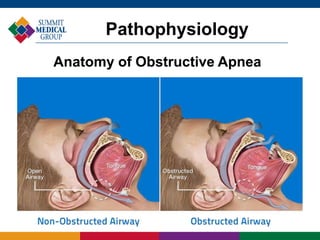
Pathophysiology
Anatomy of Obstructive Apnea
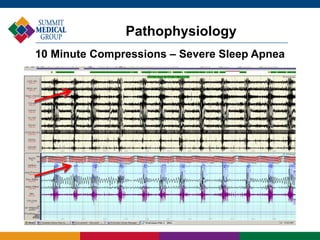
Pathophysiology
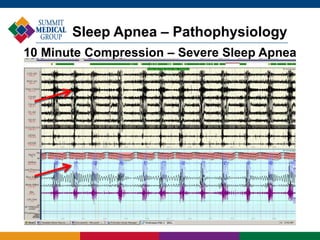
10 Minute Compressions – Severe Sleep Apnea
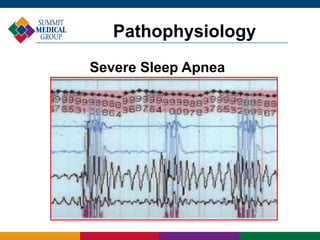
Pathophysiology
Severe Sleep Apnea
• Introduction
• Demographics
• Pathophysiology
• Risk Assessment
• Evaluation Process
• Treatment Options
• Optimizing Outcomes
Sleep Apnea - 2017 Update
Common complaints:
• Loud snoring, irregular breathing
• Problems initiating sleep
• Problems maintaining sleep
• Non-restorative sleep
• Early morning awakenings
• Excessive daytime sleepiness
• Nighttime urination
• Restless legs
Risk Assessment
Body-type profiling:
• Elevated BMI
• Compromised airway
• Large tongue
• Hypertrophied tonsils
• Recessed jaw
• Broad/short neck
• Family history
Risk Assessment
Medical co-morbidities:
• Cardiac disorders
• Endocrine/metabolic disorders
• Neurologic disorders
• Psychiatric disorders
• Pre-operative evaluation
• Chronic pain
• Pregnancy
Risk Assessment
Every day problems:
• Motor vehicle accidents – trains, planes,
autos
• Industrial accidents/errors
• High-risk occupations
• Compromised work or school
performance
• Sexual dysfunction
• Athletic performance
Risk Assessment
OSA and children:
• Poorly tolerated
• School performance
• Attention deficit disorders
• Learning disorders
• Behavioral disorders
• Attendance problems
• Bedwetting
Risk Assessment
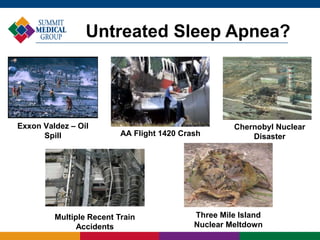
Exxon Valdez – Oil
Spill
Chernobyl Nuclear
Disaster
Three Mile Island
Nuclear Meltdown
AA Flight 1420 Crash
Multiple Recent Train
Accidents
Untreated Sleep Apnea?
 Routine medical/dental provider
evaluation
 Validated questionnaires
 Family/friend concerns
 Occupational/licensing screening
Risk Assessment
Screening Tools
• Introduction
• Demographics
• Pathophysiology
• Risk Assessment
• Evaluation Process
• Treatment Options
• Optimizing Outcomes
Sleep Apnea - 2017 Update
What testing is appropriate?
• Home/portable vs. in-lab
Who/what decides what testing is done?
• Medical provider
• Insurance company
• Medical conditions
• Prior sleep history
Evaluation Process
Sleep Apnea Testing
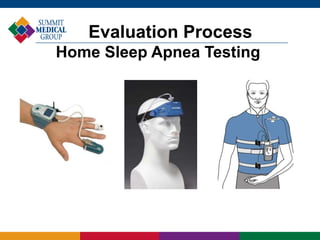
Evaluation Process
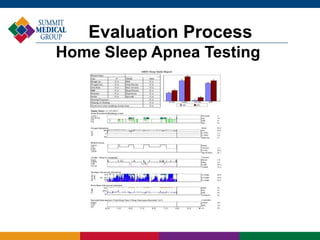
Home Sleep Apnea Testing
Evaluation Process
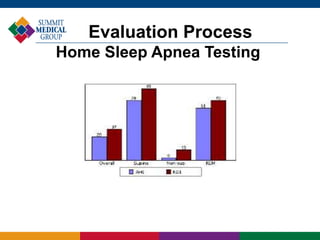
Home Sleep Apnea Testing
Evaluation Process
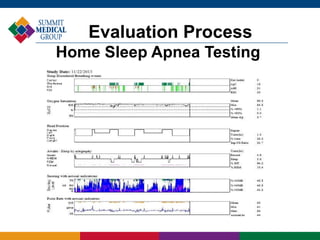
Home Sleep Apnea Testing
Evaluation Process
Home Sleep Apnea Testing
Evaluation Process
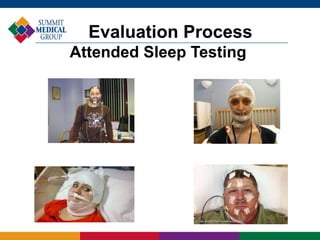
Attended Sleep Testing
Types of attended sleep studies
• Diagnostic
• Therapeutic
• Split-night
• NPSG + MSLT
• MWT
• MATRx
Evaluation Process
Attended Sleep Testing
• Introduction
• Demographics
• Pathophysiology
• Risk Assessment
• Evaluation Process
• Treatment Options
• Optimizing Outcomes
Sleep Apnea - 2017 Update
• Positive Airway Pressure therapy
• Dental appliances
• Surgery
• Weight loss
• Nasal valves
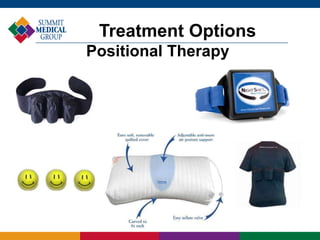
• Positional therapy
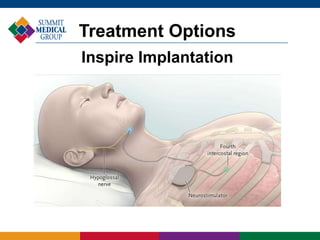
• Implantable neurostimulator
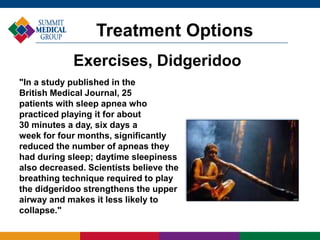
• Exercises/Didgeridoo
• Combination therapy
Treatment Options
Treatment Options
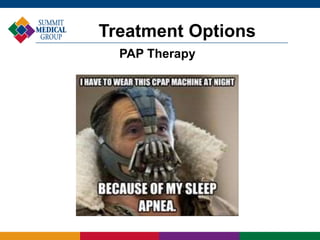
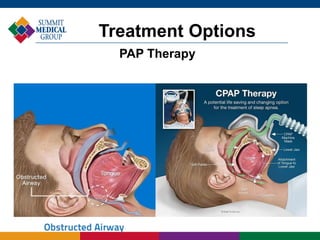
PAP Therapy
Treatment Options
PAP Therapy
Treatment Options
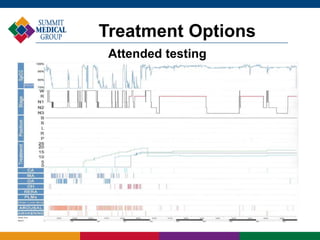
Attended testing
Treatment Options
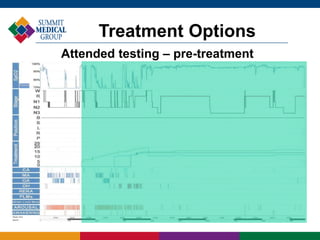
Attended testing – pre-treatment
Treatment Options
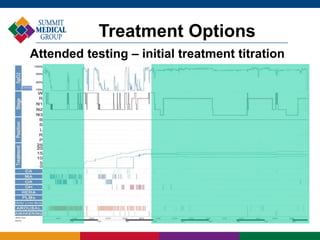
Attended testing – initial treatment titration
Treatment Options
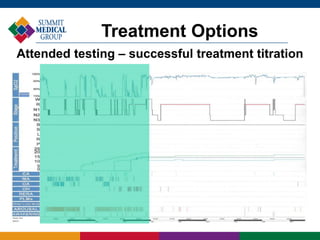
Attended testing – successful treatment titration
Sleep Apnea – Pathophysiology
10 Minute Compression – Severe Sleep Apnea
Sleep Apnea – Pathophysiology
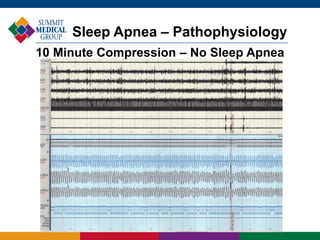
10 Minute Compression – No Sleep Apnea
Treatment Options
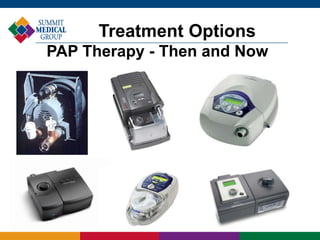
PAP Therapy - Then and Now
Treatment Options
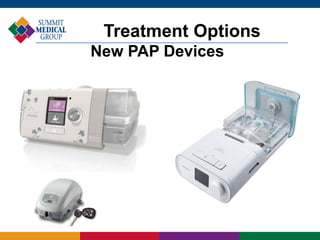
New PAP Devices
Treatment Options
PAP Therapy
• Auto-PAP
• CPAP
• CPAP with C-Flex
• BiPAP
• BiPAP with BiFlex
• AVAPS
• BiPAP-SV
Treatment Options
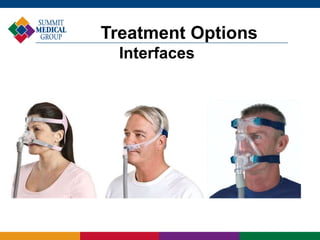
Interfaces
Treatment Options
PAP Therapy
Upsides:
• Best outcomes, especially in more severe OSA
• Detailed feedback on efficacy and compliance
• Widely varied and customizable treatment options
Downsides:
• Requires maintenance (cleaning and parts replacement)
• Side effects (sinus issues, air-swallowing, dry mouth)
• Problems with equipment suppliers
• Less portable
Treatment Options
Oral Appliance Therapy
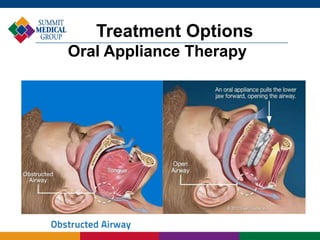
Treatment Options
Oral Appliance Therapy
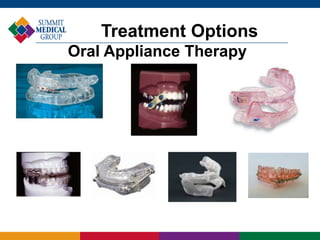
Treatment Options
Oral Appliance Therapy
Treatment Options
Oral Appliance Therapy
Upsides:
• Easier to manage
• More portable
• Less likely to exacerbate sinus problems
Downsides:
• Less likely to be effective, especially in more severe cases
• No feedback regarding efficacy
• Provider variability in proficiency
• Cost
• Side effects
Sleep 2013 Oct 1;36(10):1517-25, 1525A
Treatment Options
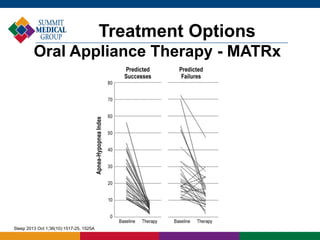
Oral Appliance Therapy - MATRx
• Procedures
• Nasal surgery
• Tonsillectomy
• UP3
• LAUP
• Somnoplasty
• Pillar procedure
• Tongue ablation
• Tongue or hyoid advancement
• Mandibular advancement
• Tracheostomy
Treatment Options
Upper Airway Surgery
Weight loss strategies
 Bariatric medical evaluation
 Bariatric surgery
• Gastric sleeve
• Lap band surgery
• Roux-en-y gastric bypass surgery
Treatment Options
Weight Loss
Treatment Options
Positional Therapy
Treatment Options
Inspire Implantation
"In a study published in the
British Medical Journal, 25
patients with sleep apnea who
practiced playing it for about
30 minutes a day, six days a
week for four months, significantly
reduced the number of apneas they
had during sleep; daytime sleepiness
also decreased. Scientists believe the
breathing technique required to play
the didgeridoo strengthens the upper
airway and makes it less likely to
collapse."
Treatment Options
Exercises, Didgeridoo
Treatment Options
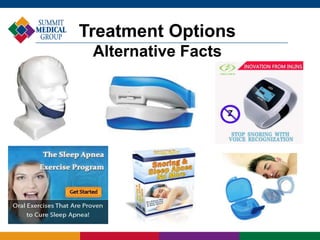
Alternative Facts
• Introduction
• Demographics
• Pathophysiology
• Risk Assessment
• Evaluation Process
• Treatment Options
• Optimizing Outcomes
Sleep Apnea - 2017 Update
• Good data, good decisions
• Education, education, education
• Close follow-up through initial phases of
therapy
• Compliance tracking
• Manage the home care (DME) issues
• Train and utilize Compliance Specialists
• Long term follow-up
Optimizing Outcomes
• Get good data, make good decisions
 The correct treatment of the wrong problem is
the incorrect treatment
 Perform high-quality diagnostic and
therapeutic sleep studies, and make sure the
results are consistent with clinical
expectations
 Getting prior test results and treatment
information can be very useful
 Know when an attended sleep study is
necessary, and fight to get it done
Optimizing Outcomes
• Education, education, education
 For the patient, for the providers, and the staff
 The better-informed the patient is, the better
patient they will be (usually)
 Education can help the patient assume some
ownership of the problem, which should
facilitate better outcomes
 Providing regular and constructive feedback to
the patient can be invaluable
Optimizing Outcomes
• Close follow-up through initial phases of
therapy
 Performance in the first week and first month
most commonly predict long-term outcomes
 You cannot find solutions until you are aware
that there is a problem
 Fixing problems earlier rather than later
improves patient satisfaction, outcomes, and
retention
 Early feedback and additional education help
prevent the development of behavior patterns
that undermine successful treatment
Optimizing Outcomes
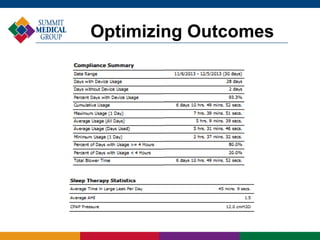
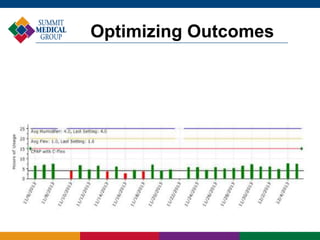
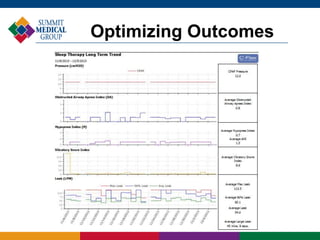
• Compliance tracking
 The ability to obtain accurate
usage/compliance and treatment efficacy data
has revolutionized the treatment of OSA
 Patient’s subjective assessments of their
status is often useful but frequently incorrect
 Acquiring compliance and efficacy data, and
acting on it as needed is the current standard-
of-care in sleep medicine
 Acquiring and integrating real-time compliance
data into the patient record is becoming easier
and more beneficial to patients and providers
Optimizing Outcomes
• Manage the equipment issues
 This is often the weak link in managing OSA
treatment
 This is by far the most common thing that
patients complain about
 It contributes to poor outcomes, abandoned
therapy, and patient migration to other doctors
 Investing the time and effort in knowing which
companies to use, which to avoid, and how to
get the patients the services that they need is
key
Optimizing Outcomes
• Train and utilize Compliance Specialists
 In order to optimize outcomes and patient
satisfaction, it is necessary to have personnel
who are able to turn failures into successes,
and problems into solutions
 This requires expertise, experience, insight,
observational and communication skills, along
with the time and tools to perform the work
that is required
 Developing and customizing algorithms,
cultivating relationships with patients and
being accessible and helpful will always result
in a better product
Optimizing Outcomes
Treatment Options
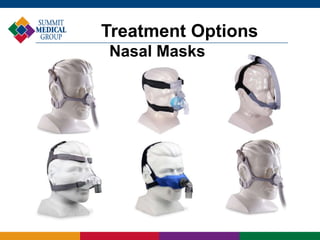
Nasal Masks
Treatment Options
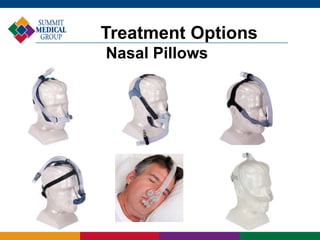
Nasal Pillows
Treatment Options
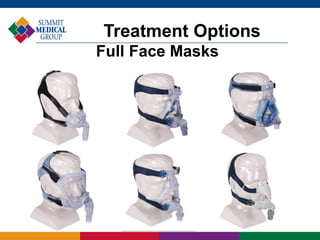
Full Face Masks
Optimizing Outcomes
Optimizing Outcomes
Optimizing Outcomes
Optimizing Outcomes
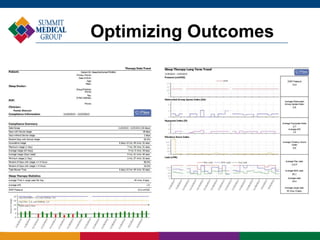
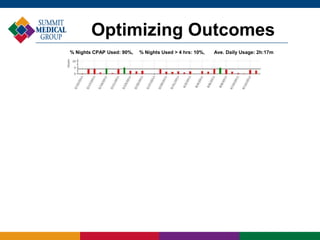
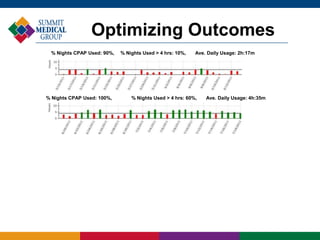
% Nights CPAP Used: 90%, % Nights Used > 4 hrs: 10%, Ave. Daily Usage: 2h:17m
Optimizing Outcomes
% Nights CPAP Used: 90%, % Nights Used > 4 hrs: 10%, Ave. Daily Usage: 2h:17m
Optimizing Outcomes
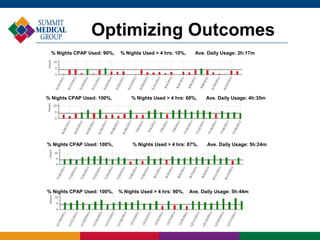
% Nights CPAP Used: 100%, % Nights Used > 4 hrs: 60%, Ave. Daily Usage: 4h:35m
% Nights CPAP Used: 90%, % Nights Used > 4 hrs: 10%, Ave. Daily Usage: 2h:17m
Optimizing Outcomes
% Nights CPAP Used: 100%, % Nights Used > 4 hrs: 60%, Ave. Daily Usage: 4h:35m
% Nights CPAP Used: 100%, % Nights Used > 4 hrs: 87%, Ave. Daily Usage: 5h:24m
% Nights CPAP Used: 100%, % Nights Used > 4 hrs: 90%, Ave. Daily Usage: 5h:44m
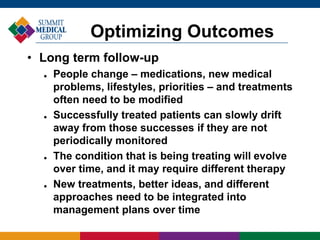
• Long term follow-up
 People change – medications, new medical
problems, lifestyles, priorities – and treatments
often need to be modified
 Successfully treated patients can slowly drift
away from those successes if they are not
periodically monitored
 The condition that is being treating will evolve
over time, and it may require different therapy
 New treatments, better ideas, and different
approaches need to be integrated into
management plans over time
Optimizing Outcomes

Sleep Apnea – 2017 Update on Evaluation and Management

  • 1.
    SLEEP APNEA 2017 UPDATEON EVALUATION AND MANAGEMENT February 22, 2017
  • 2.
    Disclosures Marc L Benton,MD, FAASM, FCCP • Medical Director, The Sleep Disorders Center at Summit Medical Group, Madison, NJ. Kerry Kelley, RN, RRT, RPSGT • Manager – Sleep Services • The Sleep Disorders Center at Summit Medical Group, Madison, NJ.
  • 3.
    Sleep Apnea -2017 Update • Introduction • Demographics • Pathophysiology • Risk Assessment • Evaluation Process • Treatment Options • Optimizing Outcomes
  • 4.
    • Introduction • Demographics •Pathophysiology • Risk Assessment • Evaluation Process • Treatment Options • Optimizing Outcomes Sleep Apnea - 2017 Update
  • 5.
    Sleep affects, andin turn is affected by, almost every physiological and psychological process, i.e.,  Physical performance – work, school, life  The ability to socially and emotionally relate to others  Improving learning and memory  Reduction in health problems and optimization of health  Functioning in a safe, efficient and effective way The Three R’s Rejuvenate, Restore, Re-energize Sleep Apnea - Introduction
  • 6.
    All mammals andbirds “sleep” as we know sleep to be. Sleep has also been observed in reptiles, fish and insects, although it is differently defined – more as a behavioral phenomenon, and is less well-understood physiologically Sometimes sleep needs to be ‘adaptive’, so that other basic needs can be simultaneously accommodated… Sleep Apnea - Introduction
  • 7.
    Dolphins sleep byresting one half of their brain at a time. This is called “unihemispheric” sleep. The brain waves of dolphins that have been studied while asleep demonstrate that one side of the brain is awake while the other side is in deep sleep. Also, the eye on the side of the awake-half of the brain is open, while the other eye is closed. This assures that dolphins can meet their respiratory needs while also remaining vigilant enough to protect themselves from predators even when “asleep”. Sleep Apnea - Introduction
  • 8.
    Sleep Needs byAge Newborns/Infants 0 - 2 months 2 - 12 months 10.5 – 18 hours 14 - 15 hours Toddlers/Children 12 – 18 months 18 mo. – 3 years 3 – 5 years 5 – 12 years 13 – 15 hours 12 – 14 hours 11 – 13 hours 10 – 11 hours Adolescents Average 9.25 hours Adults Average 7 – 9 hours Older Adults Average Widely variable Older adults need just as much sleep…they just don’t get it Less deep sleep = more arousals and awakenings Medical conditions/pain = more arousals and awakenings “Sleep Debt” - just like money… Sleep Apnea - Introduction
  • 9.
    The average personneeds 7 to 9 hours sleep per 24- hour period. The “normal” sleep-onset latency is about 10 minutes. The “normal” sleep stage distribution for young- middle aged adults is: • 5% stage I • 50% stage II • 15-25% stage III, slow wave or deep sleep • 20-25% stage REM Sleep Apnea - Introduction
  • 10.
    Sleep Apnea -Introduction
  • 11.
    84 SLEEP DISORDERS IMPACTING OVER100 MILLION AMERICANS Sleep Apnea - Introduction
  • 12.
    Classifications of sleepdisorders: • Sleep-related breathing disorders • Insomnia • Central sleep apnea • Circadian rhythm sleep disorders • Parasomnias • Sleep-related movement disorders • Narcolepsy Sleep Apnea - Introduction
  • 13.
    • Introduction • Demographics •Pathophysiology • Risk Assessment • Evaluation Process • Treatment Options • Optimizing Outcomes Sleep Apnea - 2017 Update
  • 14.
    • Prevalence:  Truefrequency depends upon definitions/cutoffs  Increasing incidence from 18-45 y/o  Plateau incidence over 55 y/o  Males > Females  AA > Caucasians - obesity, cardiovascular disease and hypertension  Asian = Caucasian despite lower BMI – narrow anterior airway, recessed lower jaw Demographics
  • 15.
    • Common factorsthat impact the frequency and severity of sleep apnea:  Body mass index (BMI)  Physical characteristics – airway structure, craniofacial abnormalities  Family history – inherited structural abnormalities, genetically prone to airway collapse  Age – loss of muscle tone  Medical conditions – respiratory issues, muscular and diaphragm issues Demographics
  • 16.
    • OSA prevalenceis estimated to be about 25% in adult males, 9-13% females • 80-90% OSA currently undiagnosed • The worsening epidemic of obesity in the United States guarantees a large at-risk population • The prevalence of obesity is still increasing, although the rate of that increase is slowing Demographics
  • 17.
  • 18.
    • Introduction • Demographics •Pathophysiology • Risk Assessment • Evaluation Process • Treatment Options • Optimizing Outcomes Sleep Apnea - 2017 Update
  • 19.
    Definition of Sleep: •A normal, reversible, recurring behavioral state of disengagement and unresponsiveness to the environment that is characterized by typical changes in the electroencephalogram. Pathophysiology
  • 20.
    • Apnea: cessationof airflow for at least 10 seconds and an arousal from sleep • Hypopnea: diminished effort in breathing lasting at least 10 seconds and associated with a 3 or 4% oxygen desaturation and an arousal from sleep • Respiratory Event-Related Arousal (RERA): diminished effort in breathing resulting in an arousal from sleep Pathophysiology Respiratory Disturbances - Definitions
  • 21.
    • Apnea: cessationof airflow for at least 10 seconds and an arousal from sleep • Hypopnea: diminished effort in breathing lasting at least 10 seconds and associated with a 3 or 4% oxygen desaturation and an arousal from sleep • Respiratory Event-Related Arousal (RERA): diminished effort in breathing resulting in an arousal from sleep Pathophysiology Respiratory Disturbances - Definitions
  • 22.
    • Apnea: cessationof airflow for at least 10 seconds and an arousal from sleep • Hypopnea: diminished effort in breathing lasting at least 10 seconds and associated with a 3 or 4% oxygen desaturation and an arousal from sleep • Respiratory Event-Related Arousal (RERA): diminished effort in breathing resulting in an arousal from sleep Pathophysiology Respiratory Disturbances - Definitions
  • 23.
    • Apnea: cessationof airflow for at least 10 seconds and an arousal from sleep • Hypopnea: diminished effort in breathing lasting at least 10 seconds and associated with a 3 or 4% oxygen desaturation and an arousal from sleep • Respiratory Event-Related Arousal (RERA): diminished effort in breathing resulting in an arousal from sleep Pathophysiology Respiratory Disturbances - Definitions
  • 24.
    Apnea-Hypopnea Index (AHI): •the number of apneas and hypopneas per hour of sleep Respiratory Disturbance Index (RDI): • the number of apneas + hypopneas + RERA’s per hour of sleep Pathophysiology Respiratory Disturbances - Definitions
  • 25.
  • 26.
  • 27.
  • 28.
    • Introduction • Demographics •Pathophysiology • Risk Assessment • Evaluation Process • Treatment Options • Optimizing Outcomes Sleep Apnea - 2017 Update
  • 29.
    Common complaints: • Loudsnoring, irregular breathing • Problems initiating sleep • Problems maintaining sleep • Non-restorative sleep • Early morning awakenings • Excessive daytime sleepiness • Nighttime urination • Restless legs Risk Assessment
  • 30.
    Body-type profiling: • ElevatedBMI • Compromised airway • Large tongue • Hypertrophied tonsils • Recessed jaw • Broad/short neck • Family history Risk Assessment
  • 31.
    Medical co-morbidities: • Cardiacdisorders • Endocrine/metabolic disorders • Neurologic disorders • Psychiatric disorders • Pre-operative evaluation • Chronic pain • Pregnancy Risk Assessment
  • 32.
    Every day problems: •Motor vehicle accidents – trains, planes, autos • Industrial accidents/errors • High-risk occupations • Compromised work or school performance • Sexual dysfunction • Athletic performance Risk Assessment
  • 33.
    OSA and children: •Poorly tolerated • School performance • Attention deficit disorders • Learning disorders • Behavioral disorders • Attendance problems • Bedwetting Risk Assessment
  • 34.
    Exxon Valdez –Oil Spill Chernobyl Nuclear Disaster Three Mile Island Nuclear Meltdown AA Flight 1420 Crash Multiple Recent Train Accidents Untreated Sleep Apnea?
  • 35.
     Routine medical/dentalprovider evaluation  Validated questionnaires  Family/friend concerns  Occupational/licensing screening Risk Assessment Screening Tools
  • 36.
    • Introduction • Demographics •Pathophysiology • Risk Assessment • Evaluation Process • Treatment Options • Optimizing Outcomes Sleep Apnea - 2017 Update
  • 37.
    What testing isappropriate? • Home/portable vs. in-lab Who/what decides what testing is done? • Medical provider • Insurance company • Medical conditions • Prior sleep history Evaluation Process Sleep Apnea Testing
  • 38.
  • 39.
  • 40.
  • 41.
  • 42.
  • 43.
    Types of attendedsleep studies • Diagnostic • Therapeutic • Split-night • NPSG + MSLT • MWT • MATRx Evaluation Process Attended Sleep Testing
  • 44.
    • Introduction • Demographics •Pathophysiology • Risk Assessment • Evaluation Process • Treatment Options • Optimizing Outcomes Sleep Apnea - 2017 Update
  • 45.
    • Positive AirwayPressure therapy • Dental appliances • Surgery • Weight loss • Nasal valves • Positional therapy • Implantable neurostimulator • Exercises/Didgeridoo • Combination therapy Treatment Options
  • 46.
  • 47.
  • 48.
  • 49.
  • 50.
    Treatment Options Attended testing– initial treatment titration
  • 51.
    Treatment Options Attended testing– successful treatment titration
  • 52.
    Sleep Apnea –Pathophysiology 10 Minute Compression – Severe Sleep Apnea
  • 53.
    Sleep Apnea –Pathophysiology 10 Minute Compression – No Sleep Apnea
  • 54.
  • 55.
  • 56.
    Treatment Options PAP Therapy •Auto-PAP • CPAP • CPAP with C-Flex • BiPAP • BiPAP with BiFlex • AVAPS • BiPAP-SV
  • 57.
  • 58.
    Treatment Options PAP Therapy Upsides: •Best outcomes, especially in more severe OSA • Detailed feedback on efficacy and compliance • Widely varied and customizable treatment options Downsides: • Requires maintenance (cleaning and parts replacement) • Side effects (sinus issues, air-swallowing, dry mouth) • Problems with equipment suppliers • Less portable
  • 59.
  • 60.
  • 61.
  • 62.
    Treatment Options Oral ApplianceTherapy Upsides: • Easier to manage • More portable • Less likely to exacerbate sinus problems Downsides: • Less likely to be effective, especially in more severe cases • No feedback regarding efficacy • Provider variability in proficiency • Cost • Side effects
  • 63.
    Sleep 2013 Oct1;36(10):1517-25, 1525A Treatment Options Oral Appliance Therapy - MATRx
  • 64.
    • Procedures • Nasalsurgery • Tonsillectomy • UP3 • LAUP • Somnoplasty • Pillar procedure • Tongue ablation • Tongue or hyoid advancement • Mandibular advancement • Tracheostomy Treatment Options Upper Airway Surgery
  • 65.
    Weight loss strategies Bariatric medical evaluation  Bariatric surgery • Gastric sleeve • Lap band surgery • Roux-en-y gastric bypass surgery Treatment Options Weight Loss
  • 66.
  • 67.
  • 68.
    "In a studypublished in the British Medical Journal, 25 patients with sleep apnea who practiced playing it for about 30 minutes a day, six days a week for four months, significantly reduced the number of apneas they had during sleep; daytime sleepiness also decreased. Scientists believe the breathing technique required to play the didgeridoo strengthens the upper airway and makes it less likely to collapse." Treatment Options Exercises, Didgeridoo
  • 69.
  • 70.
    • Introduction • Demographics •Pathophysiology • Risk Assessment • Evaluation Process • Treatment Options • Optimizing Outcomes Sleep Apnea - 2017 Update
  • 71.
    • Good data,good decisions • Education, education, education • Close follow-up through initial phases of therapy • Compliance tracking • Manage the home care (DME) issues • Train and utilize Compliance Specialists • Long term follow-up Optimizing Outcomes
  • 72.
    • Get gooddata, make good decisions  The correct treatment of the wrong problem is the incorrect treatment  Perform high-quality diagnostic and therapeutic sleep studies, and make sure the results are consistent with clinical expectations  Getting prior test results and treatment information can be very useful  Know when an attended sleep study is necessary, and fight to get it done Optimizing Outcomes
  • 73.
    • Education, education,education  For the patient, for the providers, and the staff  The better-informed the patient is, the better patient they will be (usually)  Education can help the patient assume some ownership of the problem, which should facilitate better outcomes  Providing regular and constructive feedback to the patient can be invaluable Optimizing Outcomes
  • 74.
    • Close follow-upthrough initial phases of therapy  Performance in the first week and first month most commonly predict long-term outcomes  You cannot find solutions until you are aware that there is a problem  Fixing problems earlier rather than later improves patient satisfaction, outcomes, and retention  Early feedback and additional education help prevent the development of behavior patterns that undermine successful treatment Optimizing Outcomes
  • 75.
    • Compliance tracking The ability to obtain accurate usage/compliance and treatment efficacy data has revolutionized the treatment of OSA  Patient’s subjective assessments of their status is often useful but frequently incorrect  Acquiring compliance and efficacy data, and acting on it as needed is the current standard- of-care in sleep medicine  Acquiring and integrating real-time compliance data into the patient record is becoming easier and more beneficial to patients and providers Optimizing Outcomes
  • 76.
    • Manage theequipment issues  This is often the weak link in managing OSA treatment  This is by far the most common thing that patients complain about  It contributes to poor outcomes, abandoned therapy, and patient migration to other doctors  Investing the time and effort in knowing which companies to use, which to avoid, and how to get the patients the services that they need is key Optimizing Outcomes
  • 77.
    • Train andutilize Compliance Specialists  In order to optimize outcomes and patient satisfaction, it is necessary to have personnel who are able to turn failures into successes, and problems into solutions  This requires expertise, experience, insight, observational and communication skills, along with the time and tools to perform the work that is required  Developing and customizing algorithms, cultivating relationships with patients and being accessible and helpful will always result in a better product Optimizing Outcomes
  • 78.
  • 79.
  • 80.
  • 81.
  • 82.
  • 83.
  • 84.
  • 85.
    % Nights CPAPUsed: 90%, % Nights Used > 4 hrs: 10%, Ave. Daily Usage: 2h:17m Optimizing Outcomes
  • 86.
    % Nights CPAPUsed: 90%, % Nights Used > 4 hrs: 10%, Ave. Daily Usage: 2h:17m Optimizing Outcomes % Nights CPAP Used: 100%, % Nights Used > 4 hrs: 60%, Ave. Daily Usage: 4h:35m
  • 87.
    % Nights CPAPUsed: 90%, % Nights Used > 4 hrs: 10%, Ave. Daily Usage: 2h:17m Optimizing Outcomes % Nights CPAP Used: 100%, % Nights Used > 4 hrs: 60%, Ave. Daily Usage: 4h:35m % Nights CPAP Used: 100%, % Nights Used > 4 hrs: 87%, Ave. Daily Usage: 5h:24m % Nights CPAP Used: 100%, % Nights Used > 4 hrs: 90%, Ave. Daily Usage: 5h:44m
  • 88.
    • Long termfollow-up  People change – medications, new medical problems, lifestyles, priorities – and treatments often need to be modified  Successfully treated patients can slowly drift away from those successes if they are not periodically monitored  The condition that is being treating will evolve over time, and it may require different therapy  New treatments, better ideas, and different approaches need to be integrated into management plans over time Optimizing Outcomes

Editor's Notes

  • #35 $3.5 bil clean up, $5 bil in legal and settlement costs