Skin Cancer Understanding the disease Treatment options Results
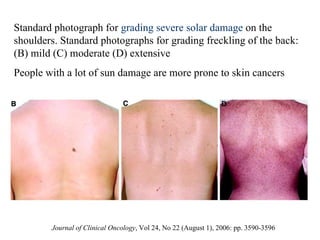
Standard photograph for  grading severe solar damage  on the shoulders. Standard photographs for grading freckling of the back: (B) mild (C) moderate (D) extensive People with a lot of sun damage are more prone to skin cancers Journal of Clinical Oncology , Vol 24, No 22 (August 1), 2006: pp. 3590-3596
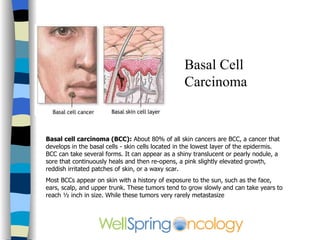
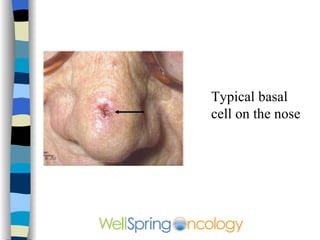
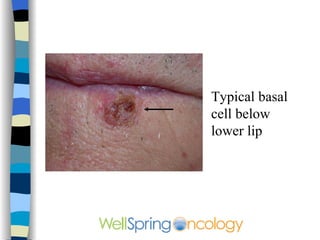
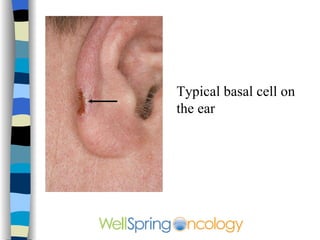
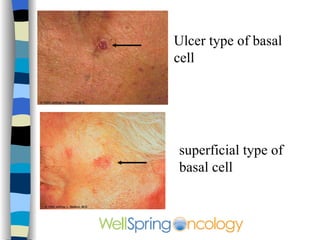
Basal Cell Carcinoma Basal cell carcinoma (BCC):  About 80% of all skin cancers are BCC, a cancer that develops in the basal cells - skin cells located in the lowest layer of the epidermis. BCC can take several forms. It can appear as a shiny translucent or pearly nodule, a sore that continuously heals and then re-opens, a pink slightly elevated growth, reddish irritated patches of skin, or a waxy scar.  Most BCCs appear on skin with a history of exposure to the sun, such as the face, ears, scalp, and upper trunk. These tumors tend to grow slowly and can take years to reach ½ inch in size. While these tumors very rarely metastasize
Typical basal cell on the nose
Typical basal cell below lower lip
Typical basal cell on the ear
Ulcer type of basal cell superficial type of basal cell
Classic presentation of basal cell
Classic superficial basal cell
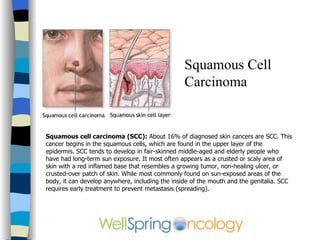
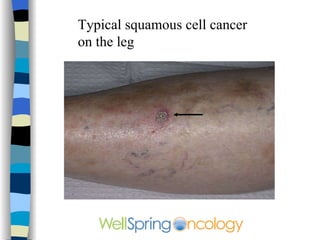
Squamous Cell Carcinoma Squamous cell carcinoma (SCC):  About 16% of diagnosed skin cancers are SCC. This cancer begins in the squamous cells, which are found in the upper layer of the epidermis. SCC tends to develop in fair-skinned middle-aged and elderly people who have had long-term sun exposure. It most often appears as a crusted or scaly area of skin with a red inflamed base that resembles a growing tumor, non-healing ulcer, or crusted-over patch of skin. While most commonly found on sun-exposed areas of the body, it can develop anywhere, including the inside of the mouth and the genitalia. SCC requires early treatment to prevent metastasis (spreading).
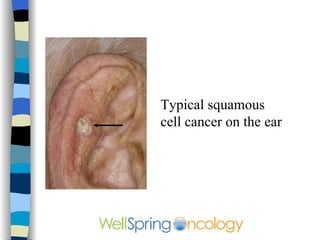
Typical squamous cell cancer on the ear
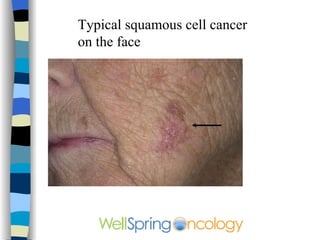
Typical squamous cell cancer on the face and scalp
Squamous Cancer of the Lower Lip
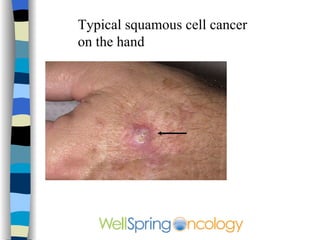
Typical squamous cell cancer on the hand
More advanced squamous cell cancer  on the finger
Typical squamous cell cancer on the leg
Typical appearance of a well differentiated squamous cancer on the shin called keratoacanthoma
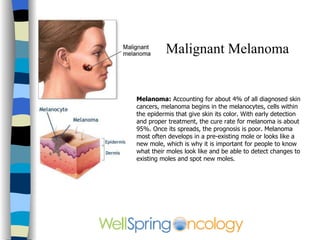
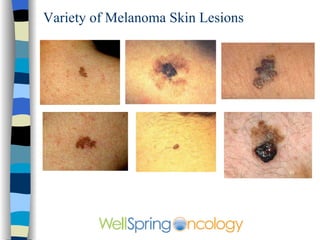
Malignant Melanoma Melanoma:  Accounting for about 4% of all diagnosed skin cancers, melanoma begins in the melanocytes, cells within the epidermis that give skin its color. With early detection and proper treatment, the cure rate for melanoma is about 95%. Once its spreads, the prognosis is poor. Melanoma most often develops in a pre-existing mole or looks like a new mole, which is why it is important for people to know what their moles look like and be able to detect changes to existing moles and spot new moles.
Distribution of superficial spreading melanoma of the skin in men and women.
Superficial spreading melanomas in all stages of development. The small early lesions have irregular borders, irregular pigmentation, and   small white areas indicating regression. The largest tumors show an accentuation of all of these features. 
Superficial Spreading Melanoma
Nodular Melanoma
Lentigo Maligna Melanoma
Variety of Melanoma Skin Lesions
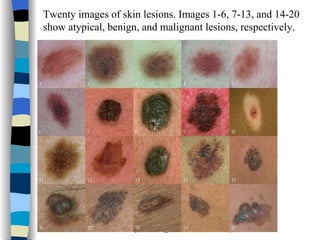
Twenty images of skin lesions. Images 1-6, 7-13, and 14-20 show atypical, benign, and malignant lesions, respectively.


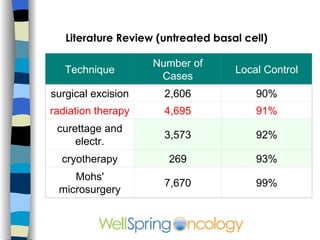
Literature Review (untreated basal cell) Technique Number of Cases Local Control surgical excision 2,606 90% radiation therapy 4,695 91% curettage and electr. 3,573 92% cryotherapy 269 93% Mohs' microsurgery 7,670 99%
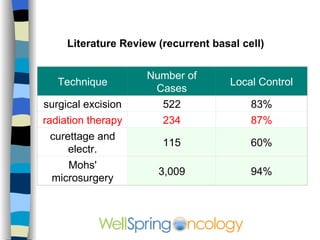
Literature Review (recurrent basal cell) Technique Number of Cases Local Control surgical excision 522 83% radiation therapy 234 87% curettage and electr. 115 60% Mohs' microsurgery 3,009 94%
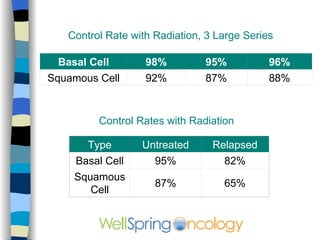
Control Rate with Radiation, 3 Large Series Control Rates with Radiation Basal Cell 98% 95% 96% Squamous Cell 92% 87% 88% Type Untreated Relapsed Basal Cell 95% 82% Squamous Cell 87% 65%
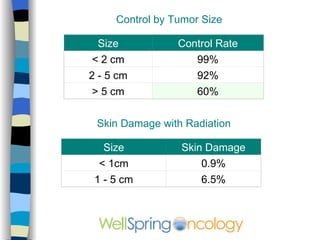
Control   by Tumor Size Skin Damage with Radiation Size Control Rate < 2 cm 99% 2 - 5 cm 92% > 5 cm 60% Size Skin Damage < 1cm 0.9% 1 - 5 cm 6.5%
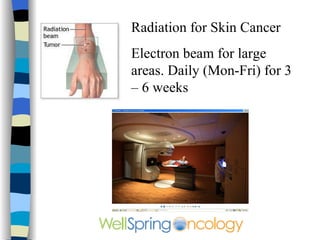
Radiation for Skin Cancer Electron beam for large areas. Daily (Mon-Fri) for 3 – 6 weeks
With electron beam then skin will get moderately sun-burned by the last day, but usually heals up in 2 to 3 weeks
 
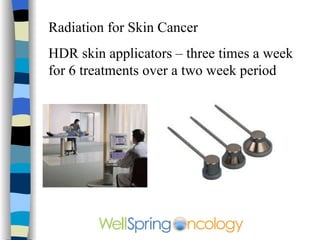
Radiation for Skin Cancer HDR skin applicators – three times a week for 6 treatments over a two week period
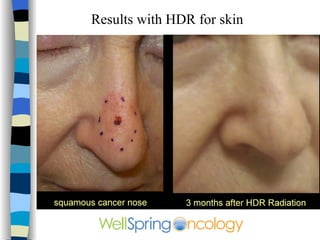
Results with HDR for skin
Results with HDR Skin applicator for small basal cell cancers on the face
Small squamous cancer of the chin, appearance 3.5 weeks after radiation (HDR)
Results with Radiation
Results with HDR for skin on shin
Radiation can be used for large areas of small recurrent basal cell cancers Area treated with electrons Appearance of skin two weeks after completion
Even large or neglected skin cancers usually heal well with radiation
Appearance at 2 months
Appearance at 3 months
Radiation for areas difficult to operate, squamous cancer of the finger before and 19 days after electron beam
Squamous Cancer of the Ear Helix The radiation healed the cancer and prevented further destruction of the ear
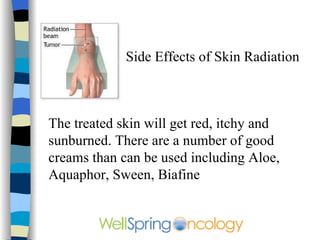
Side Effects of Skin Radiation The treated skin will get red, itchy and sunburned. There are a number of good creams than can be used including Aloe, Aquaphor, Sween, Biafine.  The skin reaction may show up in a delayed manner (worse at 1-2 weeks) and may develop slight, superficial ulceration or crusting, but heals quickly (1-2 weeks) except the shin which heals more slowly
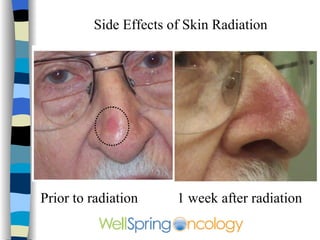
Side Effects of Skin Radiation most people get mild sun burn effect , but some get blistering or crusting (scab formation) but they heal quickly Prior to radiation  1 week after radiation
Side Effects of Skin Radiation Prior to radiation  last day of radiation
Typical delayed reaction where the lesion forms a scab at 1 – 2 weeks after completion, the scab usually falls off in another week or two
Radiation side effects may show up in delayed manner after HDR Basal cell Last day Three weeks later Three months later
 
Delayed Skin Reaction with HDR
Skin reaction is often delayed with HDR and can take several weeks to return completely back to normal
 
Typical Time pattern for skin healing with HDR
 
Lesions on shin may heal more slowly
Typical delayed reaction with superficial ulceration but quick healing, the small ‘hole’ at the biopsy site may take 2-3 months to disappear
Skin healing over the shin in an elderly woman
Skin cancers on the shin in an elderly patient may take several months to heal
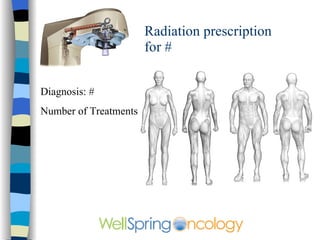
Radiation prescription for # Diagnosis: # Number of Treatments: #

Skin Cancer

  • 1.
    Skin Cancer Understandingthe disease Treatment options Results
  • 2.
    Standard photograph for grading severe solar damage on the shoulders. Standard photographs for grading freckling of the back: (B) mild (C) moderate (D) extensive People with a lot of sun damage are more prone to skin cancers Journal of Clinical Oncology , Vol 24, No 22 (August 1), 2006: pp. 3590-3596
  • 3.
    Basal Cell CarcinomaBasal cell carcinoma (BCC): About 80% of all skin cancers are BCC, a cancer that develops in the basal cells - skin cells located in the lowest layer of the epidermis. BCC can take several forms. It can appear as a shiny translucent or pearly nodule, a sore that continuously heals and then re-opens, a pink slightly elevated growth, reddish irritated patches of skin, or a waxy scar. Most BCCs appear on skin with a history of exposure to the sun, such as the face, ears, scalp, and upper trunk. These tumors tend to grow slowly and can take years to reach ½ inch in size. While these tumors very rarely metastasize
  • 4.
    Typical basal cellon the nose
  • 5.
    Typical basal cellbelow lower lip
  • 6.
  • 7.
    Ulcer type ofbasal cell superficial type of basal cell
  • 8.
  • 9.
  • 10.
    Squamous Cell CarcinomaSquamous cell carcinoma (SCC): About 16% of diagnosed skin cancers are SCC. This cancer begins in the squamous cells, which are found in the upper layer of the epidermis. SCC tends to develop in fair-skinned middle-aged and elderly people who have had long-term sun exposure. It most often appears as a crusted or scaly area of skin with a red inflamed base that resembles a growing tumor, non-healing ulcer, or crusted-over patch of skin. While most commonly found on sun-exposed areas of the body, it can develop anywhere, including the inside of the mouth and the genitalia. SCC requires early treatment to prevent metastasis (spreading).
  • 11.
    Typical squamous cellcancer on the ear
  • 12.
    Typical squamous cellcancer on the face and scalp
  • 13.
    Squamous Cancer ofthe Lower Lip
  • 14.
    Typical squamous cellcancer on the hand
  • 15.
    More advanced squamouscell cancer on the finger
  • 16.
    Typical squamous cellcancer on the leg
  • 17.
    Typical appearance ofa well differentiated squamous cancer on the shin called keratoacanthoma
  • 18.
    Malignant Melanoma Melanoma: Accounting for about 4% of all diagnosed skin cancers, melanoma begins in the melanocytes, cells within the epidermis that give skin its color. With early detection and proper treatment, the cure rate for melanoma is about 95%. Once its spreads, the prognosis is poor. Melanoma most often develops in a pre-existing mole or looks like a new mole, which is why it is important for people to know what their moles look like and be able to detect changes to existing moles and spot new moles.
  • 19.
    Distribution of superficialspreading melanoma of the skin in men and women.
  • 20.
    Superficial spreading melanomasin all stages of development. The small early lesions have irregular borders, irregular pigmentation, and small white areas indicating regression. The largest tumors show an accentuation of all of these features. 
  • 21.
  • 22.
  • 23.
  • 24.
    Variety of MelanomaSkin Lesions
  • 25.
    Twenty images ofskin lesions. Images 1-6, 7-13, and 14-20 show atypical, benign, and malignant lesions, respectively.
  • 26.
  • 27.
  • 28.
  • 29.
  • 30.
  • 31.
    Literature Review (untreatedbasal cell) Technique Number of Cases Local Control surgical excision 2,606 90% radiation therapy 4,695 91% curettage and electr. 3,573 92% cryotherapy 269 93% Mohs' microsurgery 7,670 99%
  • 32.
    Literature Review (recurrentbasal cell) Technique Number of Cases Local Control surgical excision 522 83% radiation therapy 234 87% curettage and electr. 115 60% Mohs' microsurgery 3,009 94%
  • 33.
    Control Rate withRadiation, 3 Large Series Control Rates with Radiation Basal Cell 98% 95% 96% Squamous Cell 92% 87% 88% Type Untreated Relapsed Basal Cell 95% 82% Squamous Cell 87% 65%
  • 34.
    Control by Tumor Size Skin Damage with Radiation Size Control Rate < 2 cm 99% 2 - 5 cm 92% > 5 cm 60% Size Skin Damage < 1cm 0.9% 1 - 5 cm 6.5%
  • 35.
    Radiation for SkinCancer Electron beam for large areas. Daily (Mon-Fri) for 3 – 6 weeks
  • 36.
    With electron beamthen skin will get moderately sun-burned by the last day, but usually heals up in 2 to 3 weeks
  • 37.
  • 38.
    Radiation for SkinCancer HDR skin applicators – three times a week for 6 treatments over a two week period
  • 39.
  • 40.
  • 41.
    Results with HDRSkin applicator for small basal cell cancers on the face
  • 42.
    Small squamous cancerof the chin, appearance 3.5 weeks after radiation (HDR)
  • 43.
  • 44.
    Results with HDRfor skin on shin
  • 45.
    Results with HDRfor skin on shin
  • 46.
    Radiation can beused for large areas of small recurrent basal cell cancers Area treated with electrons Appearance of skin two weeks after completion
  • 47.
    Even large orneglected skin cancers usually heal well with radiation
  • 48.
  • 49.
  • 50.
    Radiation for areasdifficult to operate, squamous cancer of the finger before and 19 days after electron beam
  • 51.
    Squamous Cancer ofthe Ear Helix The radiation healed the cancer and prevented further destruction of the ear
  • 52.
    Side Effects ofSkin Radiation The treated skin will get red, itchy and sunburned. There are a number of good creams than can be used including Aloe, Aquaphor, Sween, Biafine. The skin reaction may show up in a delayed manner (worse at 1-2 weeks) and may develop slight, superficial ulceration or crusting, but heals quickly (1-2 weeks) except the shin which heals more slowly
  • 53.
    Side Effects ofSkin Radiation most people get mild sun burn effect , but some get blistering or crusting (scab formation) but they heal quickly Prior to radiation 1 week after radiation
  • 54.
    Side Effects ofSkin Radiation Prior to radiation last day of radiation
  • 55.
    Typical delayed reactionwhere the lesion forms a scab at 1 – 2 weeks after completion, the scab usually falls off in another week or two
  • 56.
    Radiation side effectsmay show up in delayed manner after HDR Basal cell Last day Three weeks later Three months later
  • 57.
  • 58.
  • 59.
    Skin reaction isoften delayed with HDR and can take several weeks to return completely back to normal
  • 60.
  • 61.
    Typical Time patternfor skin healing with HDR
  • 62.
  • 63.
    Lesions on shinmay heal more slowly
  • 64.
    Typical delayed reactionwith superficial ulceration but quick healing, the small ‘hole’ at the biopsy site may take 2-3 months to disappear
  • 65.
    Skin healing overthe shin in an elderly woman
  • 66.
    Skin cancers onthe shin in an elderly patient may take several months to heal
  • 67.
    Radiation prescription for# Diagnosis: # Number of Treatments: #
  • 68.
    Radiation prescription for# Diagnosis: # Number of Treatments: #