Presented by:
Ms. Elizabeth M.Sc (N)
Asst. Professor,
Dept of MSN
NNC, GNSU.
Connective tissue is a broad term that includes bone, cartilage, fat,
vascular, or hematopoietic tissues
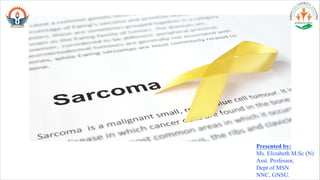
SARCOMA
The word sarcoma is derived from the Greek sarkōma MEANS "fleshy"
A sarcoma is a malignant tumor, a type of cancer that arises from
connective tissue. Bone and soft tissues can be found nearly
everywhere in the body, a sarcoma can start in any part of the body.
• 60% begin in an arm or leg
• 30% start in the torso or abdomen
• 10% occur in the head or neck
Both children and adults can develop a sarcoma.
Epidemiology
• It is rare, accounting for about 1% of all adult cancers.
• sarcomas represent about 15% of all childhood cancers.
TYPES
Sarcomas are typically divided into two major groups:
1. bone sarcomas
2. soft-tissue sarcomas
Bone sarcoma includes
• Osteosarcoma
• Chondrosarcoma
• Ewing sarcoma
• Hemangioendothelioma
• Angiosarcoma
• Fibrosarcoma/myofibrosarcoma
• Chordoma
Soft tissue sarcoma includes..
Soft-tissue sarcomas (STS) are a group of cancers that begin in the
connective tissues that support and connect the body, including:
Blood vessels, adipose cells, Lining of joints, Lymph vessels, Muscle,
Nerves, Tendons
Name of Sarcoma Related Normal Tissue Type
Angiosarcoma Blood or lymph vessels
Ewing tumors tumor of stem cells
Fibrosarcoma Fibroblasts (connective tissue)
Gastrointestinal stromal tumor (GIST) Specialized neuromuscular cells of the
digestive tract
Liposarcoma Fat tissue
Leiomyosarcoma Smooth muscle
Kaposi sarcoma Blood vessels
Myxofibrosarcoma Connective tissue
Rhabdomyosarcoma Skeletal muscle
Neurofibrosarcoma nerve endings
Causes
• Unknown
• Exposure to ionizing radiation
• Alkylating agents chemotherapeutic medicines
• Inherited genetic syndromes
• Paget's disease of bone
• Exposure to vinyl chloride, Arsenic
• Kaposi's sarcoma
• lymphedema
Clinical feature
• bone pain, especially at night, and swelling around the site of the tumor.
• Firm, painless lumps or nodules.
• any lumps that are larger than 2 inches (5 centimeters), grow larger, or are painful,
regardless of their location. People with a sarcoma that starts in the abdomen
may not have any symptoms, or they may have pain or a sense of fullness.
• Pain
Classification
• Localized - tumor is only in 1 area of the body.
• Locally advanced - the tumor involves or attaches to nearby tissues or organs.
• Metastatic - the sarcoma has spread to parts of the body far away from where
the sarcoma started
Staging
• Stage I: The tumor is small and low grade (GX or G1).
• Stage II: The tumor is small and higher grade (G2 or G3).
• Stage III: The tumor is larger and higher grade (G2 or G3). Stage IV:
The cancer has spread to other parts of the body
• Stage IV: The cancer has spread to other parts of the body.
Diagnosis
• history and physical examination
• Laboratory studies - ↑ alkaline phosphatase levels, ↑ESR
• Biopsy
• X-ray - to look at lumps under the skin or other organs in the body.
• MRI studies and radioisotope bone scans - to determine whether a sarcoma can be
removed with surgery.
• Computed tomography (CT) imaging - to measure the tumor’s size
Treatment
• Surgery
• Radiotherapy
• Immunotherapeutic
• Chemotherapy - the cytotoxic agent cyclophosphamide
Doxorubicin, Epirubicin, Ifosfamide, Gemcitabine, Docetaxel,
Trabectedin, Eribulin, Dacarbazine
Targeted therapy - It targets the cancer’s specific genes, proteins, or the tissue
environment that contributes to cancer growth and survival, usually by blocking the
action of proteins in cells. This type of treatment blocks the growth and spread of
cancer cells and limits damage to healthy cells.
e.g - Imatinib, Pazopanib, Tazemetostat, Pexidartinib
Immunotherapy also called biologic therapy, is designed to boost the body's
natural defenses to fight the cancer. It uses materials made either by the body or in a
laboratory to improve, target, or restore immune system function
Rehabilitation
Rehabilitation can also help a person cope with the social and
emotional effects

Sarcoma

  • 1.
    Presented by: Ms. ElizabethM.Sc (N) Asst. Professor, Dept of MSN NNC, GNSU.
  • 2.
    Connective tissue isa broad term that includes bone, cartilage, fat, vascular, or hematopoietic tissues
  • 3.
    SARCOMA The word sarcomais derived from the Greek sarkōma MEANS "fleshy" A sarcoma is a malignant tumor, a type of cancer that arises from connective tissue. Bone and soft tissues can be found nearly everywhere in the body, a sarcoma can start in any part of the body. • 60% begin in an arm or leg • 30% start in the torso or abdomen • 10% occur in the head or neck Both children and adults can develop a sarcoma.
  • 4.
    Epidemiology • It israre, accounting for about 1% of all adult cancers. • sarcomas represent about 15% of all childhood cancers.
  • 5.
    TYPES Sarcomas are typicallydivided into two major groups: 1. bone sarcomas 2. soft-tissue sarcomas
  • 6.
    Bone sarcoma includes •Osteosarcoma • Chondrosarcoma • Ewing sarcoma • Hemangioendothelioma • Angiosarcoma • Fibrosarcoma/myofibrosarcoma • Chordoma
  • 7.
    Soft tissue sarcomaincludes.. Soft-tissue sarcomas (STS) are a group of cancers that begin in the connective tissues that support and connect the body, including: Blood vessels, adipose cells, Lining of joints, Lymph vessels, Muscle, Nerves, Tendons
  • 8.
    Name of SarcomaRelated Normal Tissue Type Angiosarcoma Blood or lymph vessels Ewing tumors tumor of stem cells Fibrosarcoma Fibroblasts (connective tissue) Gastrointestinal stromal tumor (GIST) Specialized neuromuscular cells of the digestive tract Liposarcoma Fat tissue Leiomyosarcoma Smooth muscle Kaposi sarcoma Blood vessels Myxofibrosarcoma Connective tissue Rhabdomyosarcoma Skeletal muscle Neurofibrosarcoma nerve endings
  • 9.
    Causes • Unknown • Exposureto ionizing radiation • Alkylating agents chemotherapeutic medicines • Inherited genetic syndromes • Paget's disease of bone • Exposure to vinyl chloride, Arsenic • Kaposi's sarcoma • lymphedema
  • 10.
    Clinical feature • bonepain, especially at night, and swelling around the site of the tumor. • Firm, painless lumps or nodules. • any lumps that are larger than 2 inches (5 centimeters), grow larger, or are painful, regardless of their location. People with a sarcoma that starts in the abdomen may not have any symptoms, or they may have pain or a sense of fullness. • Pain
  • 11.
    Classification • Localized -tumor is only in 1 area of the body. • Locally advanced - the tumor involves or attaches to nearby tissues or organs. • Metastatic - the sarcoma has spread to parts of the body far away from where the sarcoma started
  • 12.
    Staging • Stage I:The tumor is small and low grade (GX or G1). • Stage II: The tumor is small and higher grade (G2 or G3). • Stage III: The tumor is larger and higher grade (G2 or G3). Stage IV: The cancer has spread to other parts of the body • Stage IV: The cancer has spread to other parts of the body.
  • 13.
    Diagnosis • history andphysical examination • Laboratory studies - ↑ alkaline phosphatase levels, ↑ESR • Biopsy • X-ray - to look at lumps under the skin or other organs in the body. • MRI studies and radioisotope bone scans - to determine whether a sarcoma can be removed with surgery. • Computed tomography (CT) imaging - to measure the tumor’s size
  • 14.
    Treatment • Surgery • Radiotherapy •Immunotherapeutic • Chemotherapy - the cytotoxic agent cyclophosphamide Doxorubicin, Epirubicin, Ifosfamide, Gemcitabine, Docetaxel, Trabectedin, Eribulin, Dacarbazine
  • 15.
    Targeted therapy -It targets the cancer’s specific genes, proteins, or the tissue environment that contributes to cancer growth and survival, usually by blocking the action of proteins in cells. This type of treatment blocks the growth and spread of cancer cells and limits damage to healthy cells. e.g - Imatinib, Pazopanib, Tazemetostat, Pexidartinib Immunotherapy also called biologic therapy, is designed to boost the body's natural defenses to fight the cancer. It uses materials made either by the body or in a laboratory to improve, target, or restore immune system function
  • 16.
    Rehabilitation Rehabilitation can alsohelp a person cope with the social and emotional effects