CRITICAL THINKING
FLORENCE F.A. OBONYO HAWA
MPH KRN KRM KRCHN
1
What is critical thinking?
 Critical thinking might be described as the ability to engage in reflective
and independent thinking. Think for yourself
 it requires use of your ability to reason.
 It is about being an active learner rather than a passive recipient of
information.
Florence Obonyo Hawa MPH
2
Definition of critical thinking
It is the ability to think clearly and rationally, understanding the
logical connection between ideas.
or
It is the process of making decisions that are aimed at solving
problems.
Florence Obonyo Hawa MPH
3
How do critical thinkers think?
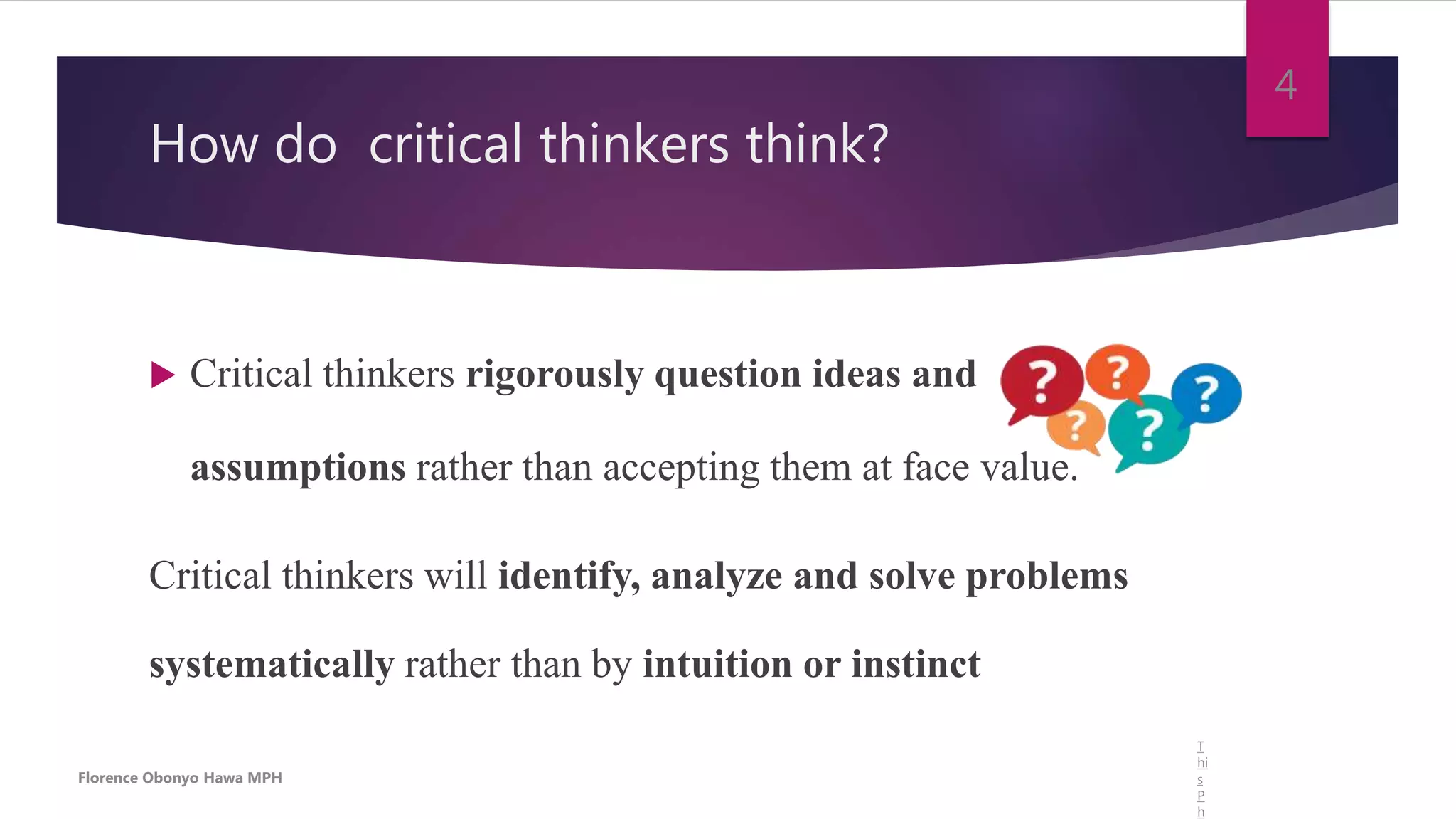
 Critical thinkers rigorously question ideas and
assumptions rather than accepting them at face value.
Critical thinkers will identify, analyze and solve problems
systematically rather than by intuition or instinct
Florence Obonyo Hawa MPH
4
T
hi
s
P
h
Someone with critical thinking skills
can:
 Understand the links between ideas.
 Determine the importance and relevance of arguments and
ideas.
 Recognize, build and appraise arguments.
 Identify inconsistencies and errors in reasoning.
Florence Obonyo Hawa MPH
5
A critical thinker can:
 Approach problems in a consistent and systematic way.
 Reflects on the justification of their own assumptions, beliefs and values.
 Thinks about things in such a manner that enables one to get the best possible
solution in the circumstances .
It is a way of thinking about whatever is presently occupying your mind so
that you come to the best possible decision.
Florence Obonyo Hawa MPH
6
Qualities of a good critical thinker
i. Solves problems as they crop up.
ii. Does not pile assignments . beats the deadline.
iii. Contributes to the learning process by conducting research, reading and
making notes.
iv. Attends visiting professor’s/ other scholarly presentations
v. Is a good listener . listens to other people’s views critically and extracts
relevant points .
vi. Weighs contributions before making them.
vii. Is an effective problem solver.

Florence Obonyo Hawa MPH
7
Importance of Critical Thinking
 It provides you with an intellectual approach to any kind of
information you come across.
 It plays a fundamental role in making choices both at the
college level financially, in your relations as well as in
career choice
Florence Obonyo Hawa MPH
8
Importance of critical thinking
1) Helps in evaluating and improving your own
thinking processes
A person develops the ability to communicate effectively with others while
trying to come up with solutions to different problems.
It results in better grades and improved relationships with your peers.
Florence Obonyo Hawa MPH
9
Importance of Critical Thinking
2) Intellectual Self-Improvement
helps you to think open-mindedly in situations that require analytical
thinking and assessment, when you come across something you
don’t know or understand.
explore the depths of the given information and try to comprehend.
Florence Obonyo Hawa MPH
10
Importance of critical thinking..3
3) Helps in dealing with stressful situations
One may face challenges e.g. language barrier or difference in
culture. you can easily come up with solutions that may help you
deal with stressful situations in a more effective way.
Florence Obonyo Hawa MPH
11
Importance of Critical Thinking..4
4 )Raise Vital Questions and Find Solutions to Problems
gather and assess relevant information. You can then come
up with abstract ideas, interpret them effectively and come to
well researched conclusions and solutions.eg why do people
wear face masks on their chin to prevent covid 19 infection?
Florence Obonyo Hawa MPH
12
Critical thinking helps one to:
 Become a Better Team Player: it allows you to:
 develop your team work skills and to be a great listener and collaborator
 interact better with your peers ,
 solve any possible conflicts or problems that may arise in your day-to-day life .
Florence Obonyo Hawa MPH
13
Three main components of Critical Thinking
1) Mental operations,
2) knowledge, and
3) attitude.
Florence Obonyo Hawa MPH
14
This Photo by Unknown Author is licensed under CC
BY-NC
Mental Operations
Mental Operations include activities such as decision making and
reasoning that are used to find or create meaning.
We engage in activities that require solutions based on sound rationale and
development of evidence based outcomes
The result of these mental operations is creative and appropriate problem
so1ving.
Florence Obonyo Hawa MPH
15
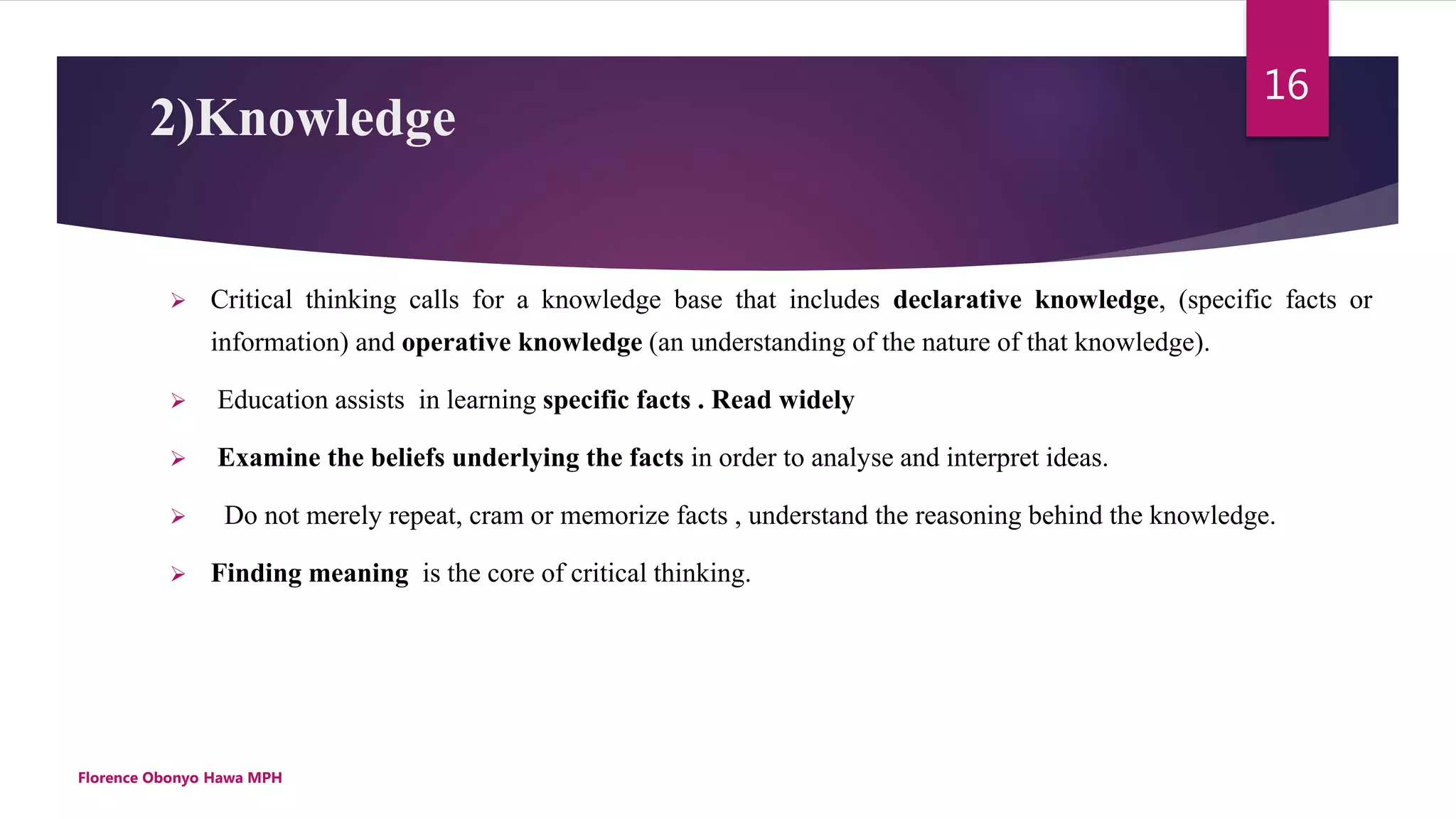
2)Knowledge
 Critical thinking calls for a knowledge base that includes declarative knowledge, (specific facts or
information) and operative knowledge (an understanding of the nature of that knowledge).
 Education assists in learning specific facts . Read widely
 Examine the beliefs underlying the facts in order to analyse and interpret ideas.
 Do not merely repeat, cram or memorize facts , understand the reasoning behind the knowledge.
 Finding meaning is the core of critical thinking.
Florence Obonyo Hawa MPH
16
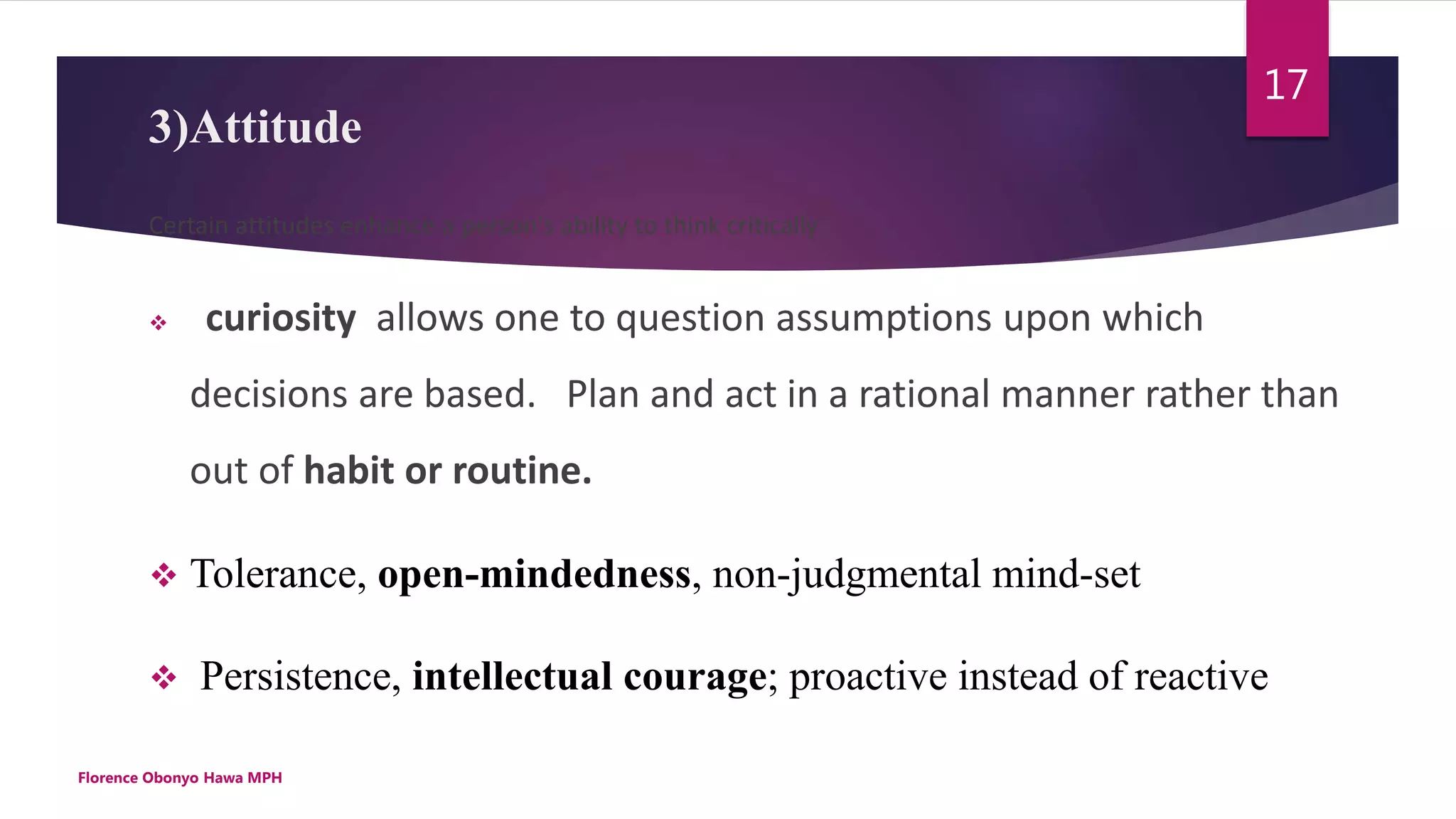
3)Attitude
Certain attitudes enhance a person's ability to think critically
 curiosity allows one to question assumptions upon which
decisions are based. Plan and act in a rational manner rather than
out of habit or routine.
 Tolerance, open-mindedness, non-judgmental mind-set
 Persistence, intellectual courage; proactive instead of reactive
Florence Obonyo Hawa MPH
17
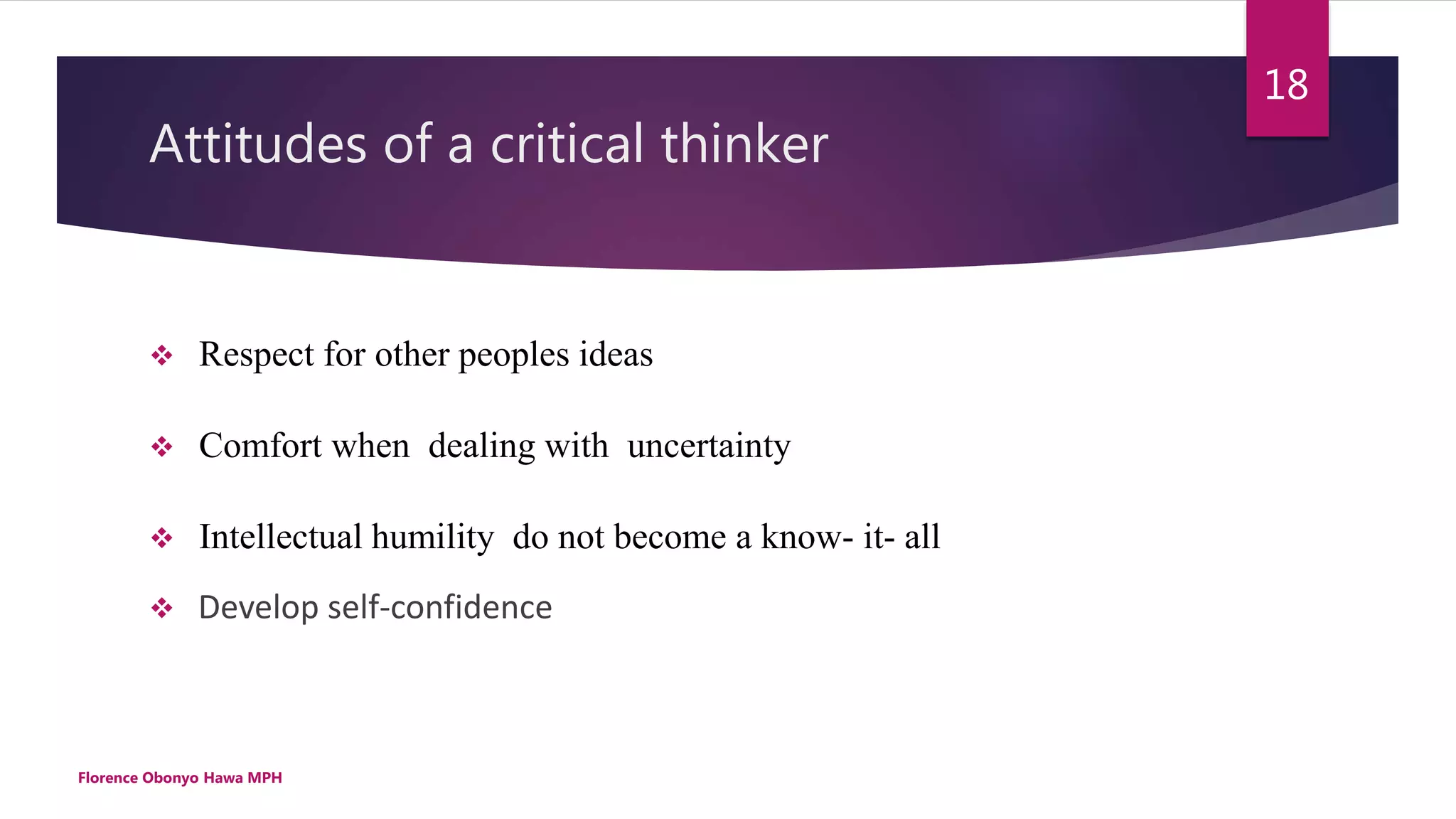
Attitudes of a critical thinker
 Respect for other peoples ideas
 Comfort when dealing with uncertainty
 Intellectual humility do not become a know- it- all
 Develop self-confidence
Florence Obonyo Hawa MPH
18
Phases of critical thinking
i. There must be a trigger event
i. Appraisal of the situation: What, How,which, why?
ii. Exploration: look for new ideas, solutions, and approaches
iii. Integration: disseminate the new information to change ways of doing things
Florence Obonyo Hawa MPH
19
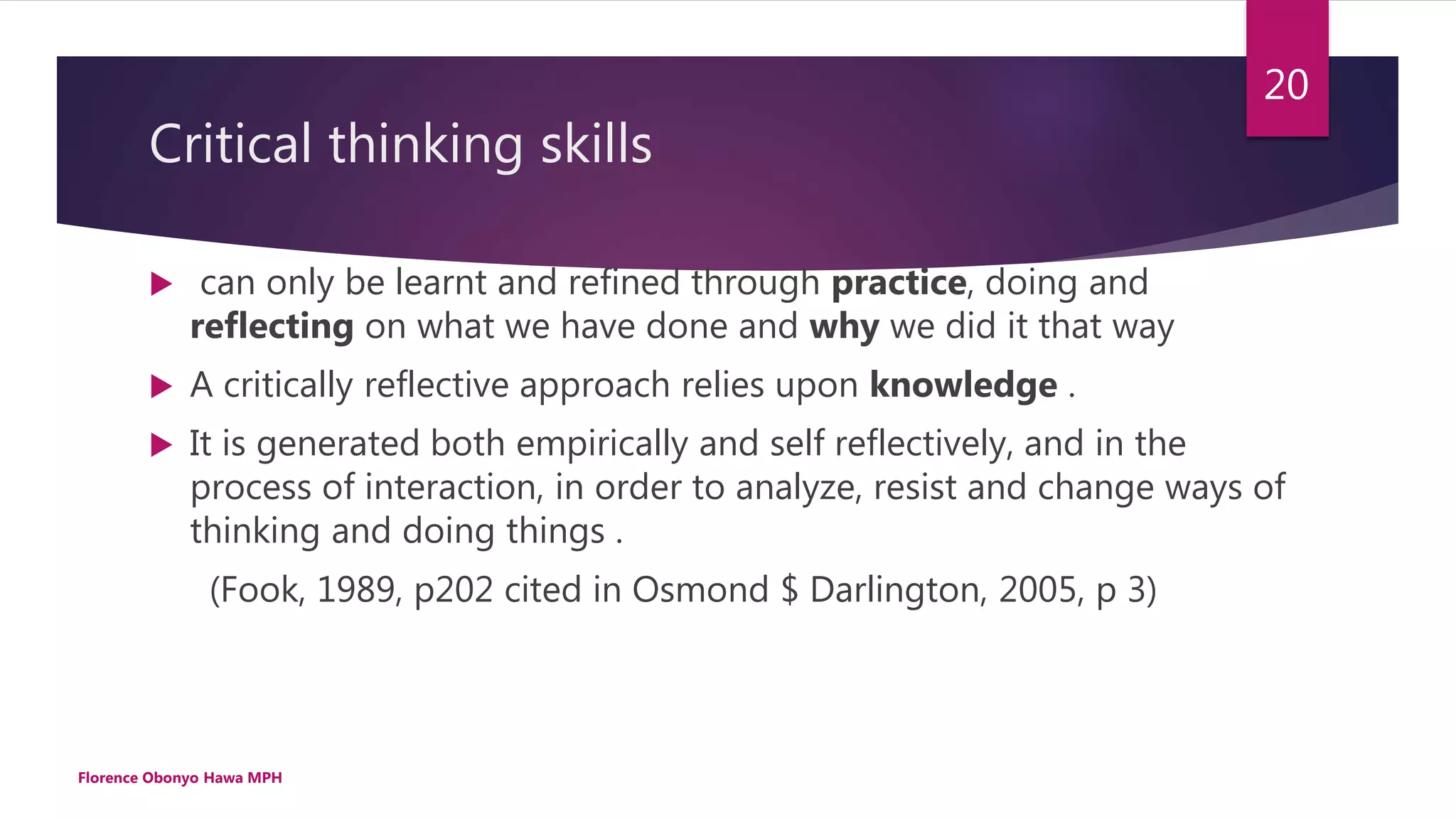
Critical thinking skills
 can only be learnt and refined through practice, doing and
reflecting on what we have done and why we did it that way
 A critically reflective approach relies upon knowledge .
 It is generated both empirically and self reflectively, and in the
process of interaction, in order to analyze, resist and change ways of
thinking and doing things .
(Fook, 1989, p202 cited in Osmond $ Darlington, 2005, p 3)
Florence Obonyo Hawa MPH
20

Develop critical thinking skills

  • 1.
    CRITICAL THINKING FLORENCE F.A.OBONYO HAWA MPH KRN KRM KRCHN 1
  • 2.
    What is criticalthinking?  Critical thinking might be described as the ability to engage in reflective and independent thinking. Think for yourself  it requires use of your ability to reason.  It is about being an active learner rather than a passive recipient of information. Florence Obonyo Hawa MPH 2
  • 3.
    Definition of criticalthinking It is the ability to think clearly and rationally, understanding the logical connection between ideas. or It is the process of making decisions that are aimed at solving problems. Florence Obonyo Hawa MPH 3
  • 4.
    How do criticalthinkers think?  Critical thinkers rigorously question ideas and assumptions rather than accepting them at face value. Critical thinkers will identify, analyze and solve problems systematically rather than by intuition or instinct Florence Obonyo Hawa MPH 4 T hi s P h
  • 5.
    Someone with criticalthinking skills can:  Understand the links between ideas.  Determine the importance and relevance of arguments and ideas.  Recognize, build and appraise arguments.  Identify inconsistencies and errors in reasoning. Florence Obonyo Hawa MPH 5
  • 6.
    A critical thinkercan:  Approach problems in a consistent and systematic way.  Reflects on the justification of their own assumptions, beliefs and values.  Thinks about things in such a manner that enables one to get the best possible solution in the circumstances . It is a way of thinking about whatever is presently occupying your mind so that you come to the best possible decision. Florence Obonyo Hawa MPH 6
  • 7.
    Qualities of agood critical thinker i. Solves problems as they crop up. ii. Does not pile assignments . beats the deadline. iii. Contributes to the learning process by conducting research, reading and making notes. iv. Attends visiting professor’s/ other scholarly presentations v. Is a good listener . listens to other people’s views critically and extracts relevant points . vi. Weighs contributions before making them. vii. Is an effective problem solver.  Florence Obonyo Hawa MPH 7
  • 8.
    Importance of CriticalThinking  It provides you with an intellectual approach to any kind of information you come across.  It plays a fundamental role in making choices both at the college level financially, in your relations as well as in career choice Florence Obonyo Hawa MPH 8
  • 9.
    Importance of criticalthinking 1) Helps in evaluating and improving your own thinking processes A person develops the ability to communicate effectively with others while trying to come up with solutions to different problems. It results in better grades and improved relationships with your peers. Florence Obonyo Hawa MPH 9
  • 10.
    Importance of CriticalThinking 2) Intellectual Self-Improvement helps you to think open-mindedly in situations that require analytical thinking and assessment, when you come across something you don’t know or understand. explore the depths of the given information and try to comprehend. Florence Obonyo Hawa MPH 10
  • 11.
    Importance of criticalthinking..3 3) Helps in dealing with stressful situations One may face challenges e.g. language barrier or difference in culture. you can easily come up with solutions that may help you deal with stressful situations in a more effective way. Florence Obonyo Hawa MPH 11
  • 12.
    Importance of CriticalThinking..4 4 )Raise Vital Questions and Find Solutions to Problems gather and assess relevant information. You can then come up with abstract ideas, interpret them effectively and come to well researched conclusions and solutions.eg why do people wear face masks on their chin to prevent covid 19 infection? Florence Obonyo Hawa MPH 12
  • 13.
    Critical thinking helpsone to:  Become a Better Team Player: it allows you to:  develop your team work skills and to be a great listener and collaborator  interact better with your peers ,  solve any possible conflicts or problems that may arise in your day-to-day life . Florence Obonyo Hawa MPH 13
  • 14.
    Three main componentsof Critical Thinking 1) Mental operations, 2) knowledge, and 3) attitude. Florence Obonyo Hawa MPH 14 This Photo by Unknown Author is licensed under CC BY-NC
  • 15.
    Mental Operations Mental Operationsinclude activities such as decision making and reasoning that are used to find or create meaning. We engage in activities that require solutions based on sound rationale and development of evidence based outcomes The result of these mental operations is creative and appropriate problem so1ving. Florence Obonyo Hawa MPH 15
  • 16.
    2)Knowledge  Critical thinkingcalls for a knowledge base that includes declarative knowledge, (specific facts or information) and operative knowledge (an understanding of the nature of that knowledge).  Education assists in learning specific facts . Read widely  Examine the beliefs underlying the facts in order to analyse and interpret ideas.  Do not merely repeat, cram or memorize facts , understand the reasoning behind the knowledge.  Finding meaning is the core of critical thinking. Florence Obonyo Hawa MPH 16
  • 17.
    3)Attitude Certain attitudes enhancea person's ability to think critically  curiosity allows one to question assumptions upon which decisions are based. Plan and act in a rational manner rather than out of habit or routine.  Tolerance, open-mindedness, non-judgmental mind-set  Persistence, intellectual courage; proactive instead of reactive Florence Obonyo Hawa MPH 17
  • 18.
    Attitudes of acritical thinker  Respect for other peoples ideas  Comfort when dealing with uncertainty  Intellectual humility do not become a know- it- all  Develop self-confidence Florence Obonyo Hawa MPH 18
  • 19.
    Phases of criticalthinking i. There must be a trigger event i. Appraisal of the situation: What, How,which, why? ii. Exploration: look for new ideas, solutions, and approaches iii. Integration: disseminate the new information to change ways of doing things Florence Obonyo Hawa MPH 19
  • 20.
    Critical thinking skills can only be learnt and refined through practice, doing and reflecting on what we have done and why we did it that way  A critically reflective approach relies upon knowledge .  It is generated both empirically and self reflectively, and in the process of interaction, in order to analyze, resist and change ways of thinking and doing things . (Fook, 1989, p202 cited in Osmond $ Darlington, 2005, p 3) Florence Obonyo Hawa MPH 20