Chapter-4
LISTENING
Venkatesh.N
Koshys Institute of Management
Studies
Listening
• What is listening? Why is it important for us
to learn listening skill? In this lesson, we will
know how effective listening can bring
benefit to our life and what are the steps to
become effective listeners.
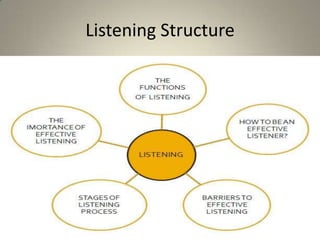
Listening Structure
The Steps of listening…..
1.Look at the person, and suspend other things you
are doing. (pay attention)
2. Listen not merely to the words, but the feeling
content. (Speaker’s words, feelings)
3. Be sincerely interested in what the other person
is talking about. (the subject,matter,information)
4. Restate what the person said.(understand)
5. Ask clarification questions once in a
while(confirm)
6. Be aware of your own feelings and strong
opinions.
7. If you have to state your views, say them only
after you have listened.(feedback to the sender)
The Process of Listening
• Sensing
• Interpreting
• Evaluating
• Responding
Professor Venkatesh N
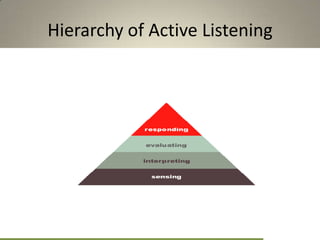
Hierarchy of Active Listening
1. SENSING
• Begins by hearing, seeing and receiving the verbal and
nonverbal aspects of the message.
• Concentration is required in this phase.
• The receiver's positive body language help the sender
deliver the message properly.
2. INTERPRETING
• After receiving the message, receiver must interpret
and place it in meaningful context.
• The speakers speech is linked to the verbal and non-
verbal elements of the message.
• Interpreting helps insure that the receiver is
understanding corresponds to the sender's meaning.
Contud….
3.EVALUATING
• Active listening occurs at the evaluation phase after the
interpretation phase.
• The receiver must sort fact from opinion.
• The receiver needs to judge the message based on its
strengths and weaknesses and how well it is liked or
disliked.
• The evaluation phase consists of both logical and emotional
components.
4. RESPONDING
• Two-way communication requires the receiver to respond
to the sender. It provides feedback to the sender on how
well the message has conveyed and encourages further
interaction between the two parties.
• Responses can be both verbal and non-verbal.
Importance of Active Listening
• Respect
• Trust
• Productivity
• Accuracy
• Enhances Relationships
• Conflict Resolution
Contund…..
• Learning
• Confidence
• Innovative solutions
• Reduces negative assumptions
BARRIERS TO EFFECTIVE LISTENING
BARRIERS TO GOOD LISTENING
A barrier is anything that gets in the way
of clear communication. Below is a list of
barriers that are listed in three categories.
The three types of barriers are
physical,
psychological and
semantic.
BARRIERS TO GOOD LISTENING
• Physical Barriers consist of any sound that
prevents a person from being heard. Physical
noise interferes with a speaker’s ability to
send messages and with an audience’s ability
to receive them.
• Examples: whispers, (Speak very softly using
one's breath rather than one's throat, esp. for
the sake of secrecy.) cheers, passing cars or
intercom interruptions
Barriers of listening..
BARRIERS TO GOOD LISTENING
• Psychological Barriers consist of thoughts and
feelings that distract people from listening to what
is said are called psychological. The noise interferes
with the audience’s concentration and ability to
hear a speaker’s presentation.
• Examples: people not paying attention because
they are absorbed in their own thoughts, jumping
to conclusions, faking attention, yielding to
distractions, over-reacting to emotional words and
tuning out topics that one considers to be dull.
BARRIERS TO GOOD LISTENING
• Semantic Barriers are interferences that are caused
by words that trigger strong negative feelings
against the speaker or the content of the speech is
called semantic noise. Semantic noise leads to
misunderstanding, as well as unpleasant and
distracting nonverbal feedback from the audience.
Listen-Listen man……
How to Improve Listening Skills
• "We were given two
ears but only one
mouth, because
listening is twice as
hard as talking."
So what to do?
• Listen to something you enjoy
• Listen for the main ideas
• Listen for specific information
• Identify stresses and reductions
• Get meaning from context
Con’t
• Most beginners get difficulty due to the lack of
vocabularies, pronunciation and grammar.
- Listen to the cassette without reading the text/
dialogue once or twice. When you find difficulty in
grasping the meaning, listen again while scrutinizing the
text/ dialogue.
- Pay attention carefully to the pronunciation and
intonation. If you want to improve your pronunciation,
listen and repeat the dialogue/ text by pausing each
sentence.
How to improve listening skills in
English
Con’t
• After listening to the text/ dialogue, do the exercise
and check your answer with the answer-key or with
your teacher.
- If you watch TV, select the English program/ film.
Listen to the dialogue carefully without reading the
translation (text).
- Listen to English songs and learn the words. If you
like singing, memorize the words and sing them.
- Practice the above tips everyday although only half
an hour. By practicing the listening exercises many
times, your listening will improve faster.
Con’t
• Mentally put yourself in other person’s shoes
• Spend more time listening than talking
• Listen unconsciously to radio, television, movie.
• Ask questions
• Don’t translate – create barrier between speaker and
listener
• Encourage the speaker, provide feedback and
paraphrase to show you are listening
• Don't need to know a lot about a subject to have a
conversation but a desire to learn, understand and
make things interesting
• Take notes, analyze, paraphrase, summarize and ask for
clarification
Con’t
• Judge content, not delivery, i.e. what they
say, not how they say it
• Listen optimistically – don't lose interest
straight away
• Do not jump to conclusions
• Concentrate – don't start dreaming – and
keep eye contact
• Do not think ahead of the speaker – you
will lose track
Con’t
• Work at listening – be alert and alive
• Keep emotions under control when
listening
• Open your mind – practice accepting new
information
• Breathe slowly and deeply
• Relax physically, get comfortable
My experience
• Listen/sing English songs
• Listen to radio, tapes, internet, movies, television. If fine, I
listen attentively; if not, I will just listen relaxingly
• Listen to different fields
• Talk to foreigners, friends.
• Use resources available: internet, tapes, CDs, movies, movie.
Copy files to computers, ipods, mp3, mp4 to listen at home,
on travel…
• Set a goal when listening or talking
• Remember “Failure is mother of success”. Allow ourselves to
make mistakes. Don’t worry! The game is still long!
Listen to wide range of audio
materials
• Listen to wide range of audio
materials
Since the recorded texts in
MUET may include dialogues,
radio talk shows, etc, the
more types of audio
materials you have listened,
the more prepared you are.
Listen to radio talk shows
• This is another effective
way to boost your
listening skill. Tune in to
your favorite radio station
and enjoy the talk shows.
Listen to conversation in the movies
• When watching movies,
sitcoms or dramas, instead
of reading the subtitles, you
should listen to
the conversation between
the actors. If English is not
your mother tongue, you
may find it quite hard to
start. Try to train yourself
not to read the subtitles
but listen carefully to what
the actors are talking about
in
Call Centers
• Strong communication skills are a
must for growing of any
organization or for achieving
complete success of any individual.
In a call center arena effective
listening skills are a prerequisite for
efficient performance. With
excellent listening skills of call
center staff the businesses can
ensure that an accuracy and
efficiency level of business
processes can be attained and
therefore, productive level can be
maximized.
Thank you
The end
Thank
You
All the
Best for
your 1st
internals
With faith you believe and when you
believe you achieve.
Thank
you
All
K
I
M S

4th chapter listening.

  • 1.
  • 2.
    Listening • What islistening? Why is it important for us to learn listening skill? In this lesson, we will know how effective listening can bring benefit to our life and what are the steps to become effective listeners.
  • 3.
  • 4.
    The Steps oflistening….. 1.Look at the person, and suspend other things you are doing. (pay attention) 2. Listen not merely to the words, but the feeling content. (Speaker’s words, feelings) 3. Be sincerely interested in what the other person is talking about. (the subject,matter,information) 4. Restate what the person said.(understand) 5. Ask clarification questions once in a while(confirm) 6. Be aware of your own feelings and strong opinions. 7. If you have to state your views, say them only after you have listened.(feedback to the sender)
  • 6.
    The Process ofListening • Sensing • Interpreting • Evaluating • Responding
  • 7.
  • 8.
  • 9.
    Hierarchy of ActiveListening 1. SENSING • Begins by hearing, seeing and receiving the verbal and nonverbal aspects of the message. • Concentration is required in this phase. • The receiver's positive body language help the sender deliver the message properly. 2. INTERPRETING • After receiving the message, receiver must interpret and place it in meaningful context. • The speakers speech is linked to the verbal and non- verbal elements of the message. • Interpreting helps insure that the receiver is understanding corresponds to the sender's meaning.
  • 10.
    Contud…. 3.EVALUATING • Active listeningoccurs at the evaluation phase after the interpretation phase. • The receiver must sort fact from opinion. • The receiver needs to judge the message based on its strengths and weaknesses and how well it is liked or disliked. • The evaluation phase consists of both logical and emotional components. 4. RESPONDING • Two-way communication requires the receiver to respond to the sender. It provides feedback to the sender on how well the message has conveyed and encourages further interaction between the two parties. • Responses can be both verbal and non-verbal.
  • 12.
    Importance of ActiveListening • Respect • Trust • Productivity • Accuracy • Enhances Relationships • Conflict Resolution
  • 13.
    Contund….. • Learning • Confidence •Innovative solutions • Reduces negative assumptions
  • 14.
  • 15.
    BARRIERS TO GOODLISTENING A barrier is anything that gets in the way of clear communication. Below is a list of barriers that are listed in three categories. The three types of barriers are physical, psychological and semantic.
  • 17.
    BARRIERS TO GOODLISTENING • Physical Barriers consist of any sound that prevents a person from being heard. Physical noise interferes with a speaker’s ability to send messages and with an audience’s ability to receive them. • Examples: whispers, (Speak very softly using one's breath rather than one's throat, esp. for the sake of secrecy.) cheers, passing cars or intercom interruptions
  • 18.
  • 19.
    BARRIERS TO GOODLISTENING • Psychological Barriers consist of thoughts and feelings that distract people from listening to what is said are called psychological. The noise interferes with the audience’s concentration and ability to hear a speaker’s presentation. • Examples: people not paying attention because they are absorbed in their own thoughts, jumping to conclusions, faking attention, yielding to distractions, over-reacting to emotional words and tuning out topics that one considers to be dull.
  • 20.
    BARRIERS TO GOODLISTENING • Semantic Barriers are interferences that are caused by words that trigger strong negative feelings against the speaker or the content of the speech is called semantic noise. Semantic noise leads to misunderstanding, as well as unpleasant and distracting nonverbal feedback from the audience.
  • 21.
  • 22.
    How to ImproveListening Skills • "We were given two ears but only one mouth, because listening is twice as hard as talking."
  • 23.
    So what todo? • Listen to something you enjoy • Listen for the main ideas • Listen for specific information • Identify stresses and reductions • Get meaning from context
  • 24.
    Con’t • Most beginnersget difficulty due to the lack of vocabularies, pronunciation and grammar. - Listen to the cassette without reading the text/ dialogue once or twice. When you find difficulty in grasping the meaning, listen again while scrutinizing the text/ dialogue. - Pay attention carefully to the pronunciation and intonation. If you want to improve your pronunciation, listen and repeat the dialogue/ text by pausing each sentence.
  • 25.
    How to improvelistening skills in English
  • 26.
    Con’t • After listeningto the text/ dialogue, do the exercise and check your answer with the answer-key or with your teacher. - If you watch TV, select the English program/ film. Listen to the dialogue carefully without reading the translation (text). - Listen to English songs and learn the words. If you like singing, memorize the words and sing them. - Practice the above tips everyday although only half an hour. By practicing the listening exercises many times, your listening will improve faster.
  • 27.
    Con’t • Mentally putyourself in other person’s shoes • Spend more time listening than talking • Listen unconsciously to radio, television, movie. • Ask questions • Don’t translate – create barrier between speaker and listener • Encourage the speaker, provide feedback and paraphrase to show you are listening • Don't need to know a lot about a subject to have a conversation but a desire to learn, understand and make things interesting • Take notes, analyze, paraphrase, summarize and ask for clarification
  • 28.
    Con’t • Judge content,not delivery, i.e. what they say, not how they say it • Listen optimistically – don't lose interest straight away • Do not jump to conclusions • Concentrate – don't start dreaming – and keep eye contact • Do not think ahead of the speaker – you will lose track
  • 30.
    Con’t • Work atlistening – be alert and alive • Keep emotions under control when listening • Open your mind – practice accepting new information • Breathe slowly and deeply • Relax physically, get comfortable
  • 31.
    My experience • Listen/singEnglish songs • Listen to radio, tapes, internet, movies, television. If fine, I listen attentively; if not, I will just listen relaxingly • Listen to different fields • Talk to foreigners, friends. • Use resources available: internet, tapes, CDs, movies, movie. Copy files to computers, ipods, mp3, mp4 to listen at home, on travel… • Set a goal when listening or talking • Remember “Failure is mother of success”. Allow ourselves to make mistakes. Don’t worry! The game is still long!
  • 34.
    Listen to widerange of audio materials • Listen to wide range of audio materials Since the recorded texts in MUET may include dialogues, radio talk shows, etc, the more types of audio materials you have listened, the more prepared you are.
  • 35.
    Listen to radiotalk shows • This is another effective way to boost your listening skill. Tune in to your favorite radio station and enjoy the talk shows.
  • 36.
    Listen to conversationin the movies • When watching movies, sitcoms or dramas, instead of reading the subtitles, you should listen to the conversation between the actors. If English is not your mother tongue, you may find it quite hard to start. Try to train yourself not to read the subtitles but listen carefully to what the actors are talking about in
  • 37.
    Call Centers • Strongcommunication skills are a must for growing of any organization or for achieving complete success of any individual. In a call center arena effective listening skills are a prerequisite for efficient performance. With excellent listening skills of call center staff the businesses can ensure that an accuracy and efficiency level of business processes can be attained and therefore, productive level can be maximized.
  • 39.
    Thank you The end Thank You Allthe Best for your 1st internals
  • 40.
    With faith youbelieve and when you believe you achieve. Thank you All K I M S