Guide to Poetry
1. PROSE VS POETRY
2. PARTS OF A POEM
3. TYPES OF CLASSICAL POETRY
4. REPEATING SOUNDS
4.1.Alliteration, Consonance, and Assonance
4.2.Internal Rhyme
4.3.End-Rhyme
4.4.Rhyme Scheme
5. SCANSION
5.1.Repeating Meter
5.2.Repeating Rhythm
6. THEME VS TOPIC
6.1.Theme
6.2.Topic
7. SAMPLE TEST QUESTIONS
1. PROSE VS POETRY
What is prose? What is poetry?
Demonstrate your understanding:
 Can you define these two using your own words?
 Can you show how they are different from each other?
 Can you give examples of prose and poetry?
2. PARTS OF A POEM
Title
What’s the title of this poem? 
Answer: Invictus
Byline
Where is this poem’s byline located? 
Answer: at the bottom
Line
How many lines are in this poem? 
Answer: 16
Stanza
Definition:
Number of lines that
form a group of a
poem.
How many stanzas in this poem?
Answer: Four
Significance: We
use stanza to separate
each part of the poem.
3. TYPES OF CLASSICAL POETRY
Note: Free verse is not the same is blank verse.
Source: http://slideplayer.com/slide/4087408/
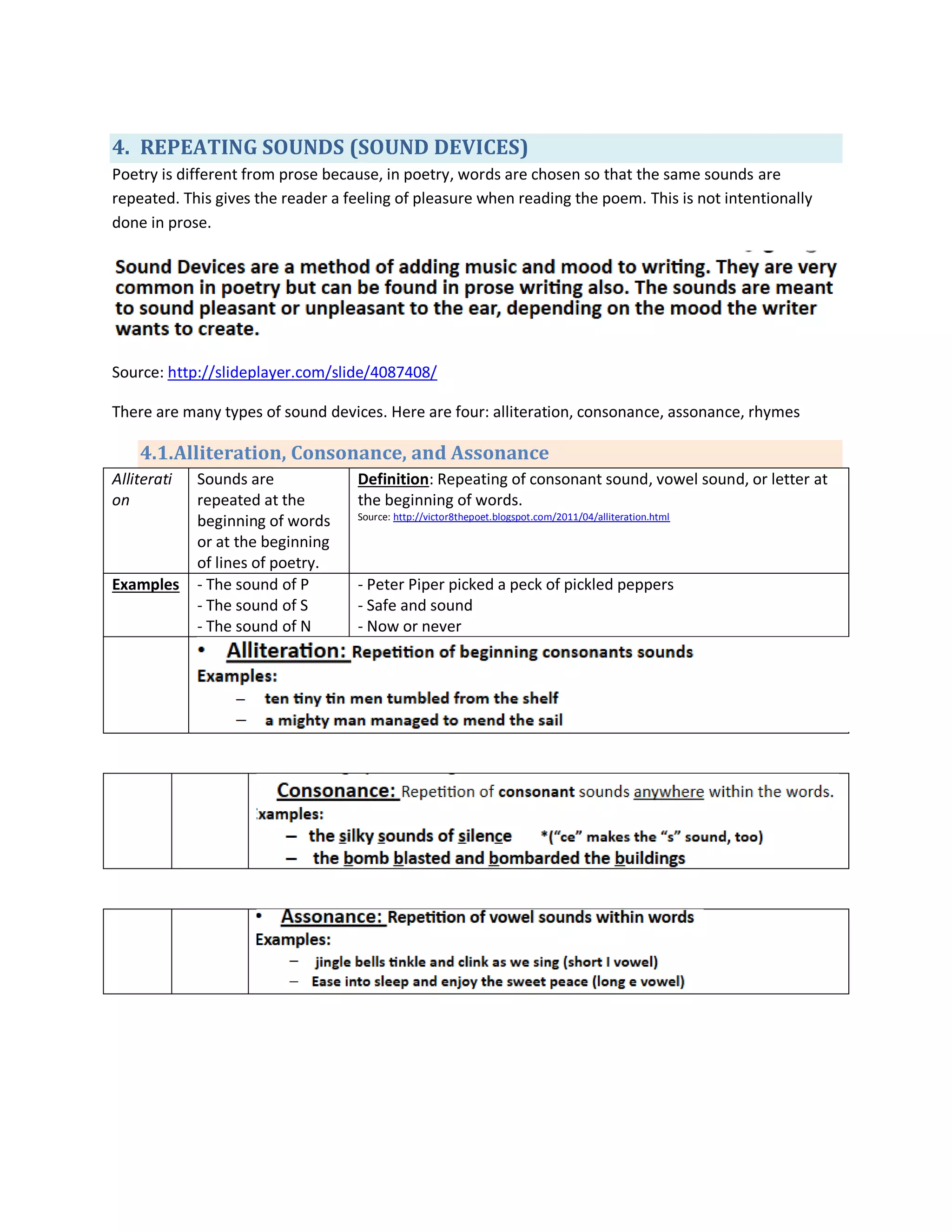
4. REPEATING SOUNDS (SOUND DEVICES)
Poetry is different from prose because, in poetry, words are chosen so that the same sounds are
repeated. This gives the reader a feeling of pleasure when reading the poem. This is not intentionally
done in prose.
Source: http://slideplayer.com/slide/4087408/
There are many types of sound devices. Here are four: alliteration, consonance, assonance, rhymes
4.1.Alliteration, Consonance, and Assonance
Alliterati
on
Sounds are
repeated at the
beginning of words
or at the beginning
of lines of poetry.
Definition: Repeating of consonant sound, vowel sound, or letter at
the beginning of words.
Source: http://victor8thepoet.blogspot.com/2011/04/alliteration.html
Examples - The sound of P
- The sound of S
- The sound of N
- Peter Piper picked a peck of pickled peppers
- Safe and sound
- Now or never
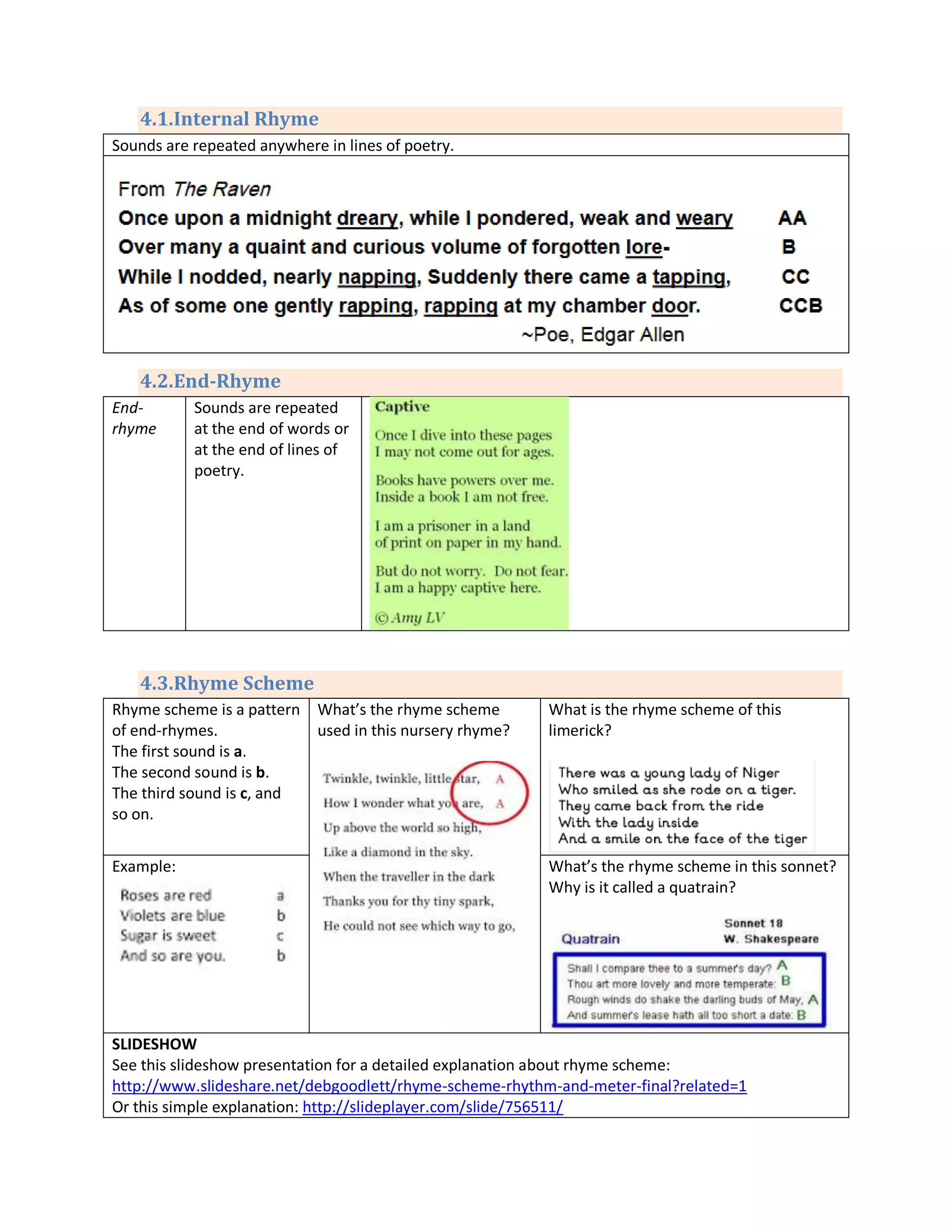
4.1.Internal Rhyme
Sounds are repeated anywhere in lines of poetry.
4.2.End-Rhyme
End-
rhyme
Sounds are repeated
at the end of words or
at the end of lines of
poetry.
4.3.Rhyme Scheme
Rhyme scheme is a pattern
of end-rhymes.
The first sound is a.
The second sound is b.
The third sound is c, and
so on.
What’s the rhyme scheme
used in this nursery rhyme?
What is the rhyme scheme of this
limerick?
Example: What’s the rhyme scheme in this sonnet?
Why is it called a quatrain?
SLIDESHOW
See this slideshow presentation for a detailed explanation about rhyme scheme:
http://www.slideshare.net/debgoodlett/rhyme-scheme-rhythm-and-meter-final?related=1
Or this simple explanation: http://slideplayer.com/slide/756511/
5. Scansion
Scansion is drawing the rhythm and meter of a poem by using symbols for rhythm, meter, and pauses.
For a detailed explanation of scansion, visit this page: http://awinlanguage.blogspot.com.tr/2012/04/basic-
versification-of-poetry.html. For a quick reference, visit this page: http://server.riverdale.k12.or.us/~bblack/meter.html
5.1.Meter
Definition A pattern of rhythm - stressed
and unstressed syllables.
Source: http://poetrypoem.blogspot.com/2011/04/meter.html
See the source for more explanations.
Significance
1
We use meter to help the reader
enjoy the poem better. When
they read it out loud, it sounds
like a song.
How to name
poetic
meters
Source: http://www.writingrhymeandmeter.com/?page_id=1908
See the source for more explanations.
Significance
2
Meter creates rhythm in a poem. It makes the poem more interesting and meaningful
when the words and syllables have stressed and unstressed tone.
Significance
3
Meter is very important when being delivered orally to the audience. When syllables
are stressed while reciting, important ideas are emphasizes which helps poet convey
their message to readers.
Significance
4
It's boring when there's no meter while reciting poem because there would be no
feelings and thoughts deliver to the audience. If a people speak without meter, they're
like robots.
Source: http://victor8thepoet.blogspot.com/2011/04/meter.html
5.2. Rhythm
Definition The up and down sound of your voice when you
read a poem.
How to write the
rhythm
The unaccented syllable can be a short, straight
line instead of a curved line.
Symbols used Instead of the symbol for a short syllable here,
use the symbol for the accented syllable above.
Source:
http://poetrypoem.blogspot.com/201
1/04/meter.html
List of common
rhythms
When accented and unaccented (or long and
short) syllables are combined, they create
rhythms. These are the most common rhythms
in poetry.
Source:
http://poetrypoem.blogspot.com/201
1/04/meter.html
Significance We use rhythm when we read poems to show the feelings and expressions of
the poem and to attract the listeners. When we read with rhythm, it gives
more emotion to the listeners and readers.
Example
See this source for explanations:
http://classroom.synonym.com/meter-
poetry-2468.html
A list of 12 types
Source:
https://yuanfields.wordpress.com/c
ategory/learning-poetry/
SLIDESHOW
See this slideshow for a more detailed explanation about rhythm in poetry:
http://www.slideshare.net/jweber0205/ropppt-1
Another list of 12
typesSource:http://www.google.com/imgres?imgurl=https://s-media-cache-
ak0.pinimg.com/236x/29/c8/b2/29c8b25e4b648de3488aaf786be578f8.jpg&imgrefurl=http
s://www.pinterest.com/chiekochick/poetry-
unit/&h=219&w=236&tbnid=zYtBJgFTeXL1jM:&zoom=1&docid=NeI0oFMa9MqnkM&ei=tb
GOVf7OEsTcmgXZ8ICgDA&tbm=isch&ved=0CHkQMyhSMFI
6. Theme VS Topic
In short: A topic is a noun only. There can be one or many topics in a literary piece. On the other hand,
theme is an idea that repeats throughout one poem or one story, even when the topics change at each
part of the poem or story.
For example: In this plot diagram of a story, there are different topics. In the main conflict, the topic is
unhappiness. In the climax, the topic is missed opportunity. In the falling action, the topic is self-
recrimination. However, the theme remains the same at every part of the plot: boy meets girl.
6.1.Topic
The topic of a poem or story is usually a noun or noun phrase. A noun phrase is a group of words that
serves as one noun. There is no verb:
 love
 death
 separation
 complete victory (noun phrase)
 unknown fears (noun phrase)
A poem or story may have many topics.
6.2.Theme
The theme of a poem or story is usually in any of these three forms:
1. a noun + an action (verb): love hurts
2. a noun + an action + a receiver of the action (direct object):
 love conquers all
 faith can move mountains
 boy meets girl
3. a noun + a description (adjective) after a verb form of “to be” (is, are, will be, was, were, can be,
may be, or the negative forms of these verbs):
 blood is thicker than water
 choice is freedom
 to be educated is to be free
 less is more
 life before was better than life today
A story or a poem will have one major theme repeating throughout the different parts of the poem or
story.
A literary piece can have one or many topics. A theme, on the other hand, is an idea that repeats
throughout the literary piece. For example, even if the topics change, the theme is still present.
7. Sample Test Questions
The prelims will have several sections. One section is Poetry Analysis. Sample questions:
 The heartbroken boy working in a girl’s dorm says: “Water, water everywhere / Not any drop to
drink” referring to his single status. This is an allusion to the poem _____ by _____.
 How many lines per stanza can be found in The Song of the Galley?
 What is the theme of Sonnet of Petrarch?
 What topics can be found in the first stanza of Giacomo Leopardi’s Infinite?
 What type of poem is The Iliad?
 What type of poem is The Aenid?
 What is the rhyme scheme used in Martial’s Procrastination?
 What is the scansion used in To Licinius?
 How many stanzas are in Lucretius’ De Rerum Natural?
 What is the rhyme scheme used in Horace’s Odes?
 What is the rhyme scheme used in De Ronsard’s Fragment of a Sonnet?
 What is scansion is used in the first five lines of Lermontov’s The Princess of the Tide?
 What sound devices can be found in the second stanza of Coleridge’s The Rime of the Ancient
Mariner?
 What rhyme scheme does Emily Dickinson use in her poem Bring Me the Sunset in a Cup?
Another section in the prelims is titled Story Analysis. Here are sample test questions. (Please refer to
your Literature Guide)
 Who or what is the protagonist in Aeschylus’ The Seven Against Thebes?
 In Moliere’s The Misantrophe, what type of character is Philinte?
 Who or what is the antagonist in Apuleius’ The Story of Cupid and Psyche?
 What is the main conflict in Book XII of The Aenid?
 What are the topics of Buzatti’s The Tartar Steppe?
 What is the physical setting of Calvino’s The Baron in the Trees?
 Who is the romantic angle in Ariosto’s Orlando Furioso?
 In de Maupassant’s The False Gems, what is the climax?
 Who or what is the antagonist in Goethe’s Faust?
Other sections of the prelims are:
 Write the stress marks of each word *‘ for stressed syllables] [- for unstressed syllables]
 Vocabulary: Allusions
 The Importance of Literature

Guide to Poetry (Part 1)

  • 1.
    Guide to Poetry 1.PROSE VS POETRY 2. PARTS OF A POEM 3. TYPES OF CLASSICAL POETRY 4. REPEATING SOUNDS 4.1.Alliteration, Consonance, and Assonance 4.2.Internal Rhyme 4.3.End-Rhyme 4.4.Rhyme Scheme 5. SCANSION 5.1.Repeating Meter 5.2.Repeating Rhythm 6. THEME VS TOPIC 6.1.Theme 6.2.Topic 7. SAMPLE TEST QUESTIONS 1. PROSE VS POETRY What is prose? What is poetry? Demonstrate your understanding:  Can you define these two using your own words?  Can you show how they are different from each other?  Can you give examples of prose and poetry?
  • 2.
    2. PARTS OFA POEM Title What’s the title of this poem?  Answer: Invictus Byline Where is this poem’s byline located?  Answer: at the bottom Line How many lines are in this poem?  Answer: 16 Stanza Definition: Number of lines that form a group of a poem. How many stanzas in this poem? Answer: Four Significance: We use stanza to separate each part of the poem.
  • 3.
    3. TYPES OFCLASSICAL POETRY Note: Free verse is not the same is blank verse. Source: http://slideplayer.com/slide/4087408/
  • 5.
    4. REPEATING SOUNDS(SOUND DEVICES) Poetry is different from prose because, in poetry, words are chosen so that the same sounds are repeated. This gives the reader a feeling of pleasure when reading the poem. This is not intentionally done in prose. Source: http://slideplayer.com/slide/4087408/ There are many types of sound devices. Here are four: alliteration, consonance, assonance, rhymes 4.1.Alliteration, Consonance, and Assonance Alliterati on Sounds are repeated at the beginning of words or at the beginning of lines of poetry. Definition: Repeating of consonant sound, vowel sound, or letter at the beginning of words. Source: http://victor8thepoet.blogspot.com/2011/04/alliteration.html Examples - The sound of P - The sound of S - The sound of N - Peter Piper picked a peck of pickled peppers - Safe and sound - Now or never
  • 6.
    4.1.Internal Rhyme Sounds arerepeated anywhere in lines of poetry. 4.2.End-Rhyme End- rhyme Sounds are repeated at the end of words or at the end of lines of poetry. 4.3.Rhyme Scheme Rhyme scheme is a pattern of end-rhymes. The first sound is a. The second sound is b. The third sound is c, and so on. What’s the rhyme scheme used in this nursery rhyme? What is the rhyme scheme of this limerick? Example: What’s the rhyme scheme in this sonnet? Why is it called a quatrain? SLIDESHOW See this slideshow presentation for a detailed explanation about rhyme scheme: http://www.slideshare.net/debgoodlett/rhyme-scheme-rhythm-and-meter-final?related=1 Or this simple explanation: http://slideplayer.com/slide/756511/
  • 7.
    5. Scansion Scansion isdrawing the rhythm and meter of a poem by using symbols for rhythm, meter, and pauses. For a detailed explanation of scansion, visit this page: http://awinlanguage.blogspot.com.tr/2012/04/basic- versification-of-poetry.html. For a quick reference, visit this page: http://server.riverdale.k12.or.us/~bblack/meter.html 5.1.Meter Definition A pattern of rhythm - stressed and unstressed syllables. Source: http://poetrypoem.blogspot.com/2011/04/meter.html See the source for more explanations. Significance 1 We use meter to help the reader enjoy the poem better. When they read it out loud, it sounds like a song. How to name poetic meters Source: http://www.writingrhymeandmeter.com/?page_id=1908 See the source for more explanations. Significance 2 Meter creates rhythm in a poem. It makes the poem more interesting and meaningful when the words and syllables have stressed and unstressed tone. Significance 3 Meter is very important when being delivered orally to the audience. When syllables are stressed while reciting, important ideas are emphasizes which helps poet convey their message to readers. Significance 4 It's boring when there's no meter while reciting poem because there would be no feelings and thoughts deliver to the audience. If a people speak without meter, they're like robots. Source: http://victor8thepoet.blogspot.com/2011/04/meter.html
  • 8.
    5.2. Rhythm Definition Theup and down sound of your voice when you read a poem. How to write the rhythm The unaccented syllable can be a short, straight line instead of a curved line. Symbols used Instead of the symbol for a short syllable here, use the symbol for the accented syllable above. Source: http://poetrypoem.blogspot.com/201 1/04/meter.html List of common rhythms When accented and unaccented (or long and short) syllables are combined, they create rhythms. These are the most common rhythms in poetry. Source: http://poetrypoem.blogspot.com/201 1/04/meter.html Significance We use rhythm when we read poems to show the feelings and expressions of the poem and to attract the listeners. When we read with rhythm, it gives more emotion to the listeners and readers. Example See this source for explanations: http://classroom.synonym.com/meter- poetry-2468.html A list of 12 types Source: https://yuanfields.wordpress.com/c ategory/learning-poetry/ SLIDESHOW See this slideshow for a more detailed explanation about rhythm in poetry: http://www.slideshare.net/jweber0205/ropppt-1 Another list of 12 typesSource:http://www.google.com/imgres?imgurl=https://s-media-cache- ak0.pinimg.com/236x/29/c8/b2/29c8b25e4b648de3488aaf786be578f8.jpg&imgrefurl=http s://www.pinterest.com/chiekochick/poetry- unit/&h=219&w=236&tbnid=zYtBJgFTeXL1jM:&zoom=1&docid=NeI0oFMa9MqnkM&ei=tb GOVf7OEsTcmgXZ8ICgDA&tbm=isch&ved=0CHkQMyhSMFI
  • 9.
    6. Theme VSTopic In short: A topic is a noun only. There can be one or many topics in a literary piece. On the other hand, theme is an idea that repeats throughout one poem or one story, even when the topics change at each part of the poem or story. For example: In this plot diagram of a story, there are different topics. In the main conflict, the topic is unhappiness. In the climax, the topic is missed opportunity. In the falling action, the topic is self- recrimination. However, the theme remains the same at every part of the plot: boy meets girl.
  • 10.
    6.1.Topic The topic ofa poem or story is usually a noun or noun phrase. A noun phrase is a group of words that serves as one noun. There is no verb:  love  death  separation  complete victory (noun phrase)  unknown fears (noun phrase) A poem or story may have many topics. 6.2.Theme The theme of a poem or story is usually in any of these three forms: 1. a noun + an action (verb): love hurts 2. a noun + an action + a receiver of the action (direct object):  love conquers all  faith can move mountains  boy meets girl 3. a noun + a description (adjective) after a verb form of “to be” (is, are, will be, was, were, can be, may be, or the negative forms of these verbs):  blood is thicker than water  choice is freedom  to be educated is to be free  less is more  life before was better than life today A story or a poem will have one major theme repeating throughout the different parts of the poem or story. A literary piece can have one or many topics. A theme, on the other hand, is an idea that repeats throughout the literary piece. For example, even if the topics change, the theme is still present.
  • 11.
    7. Sample TestQuestions The prelims will have several sections. One section is Poetry Analysis. Sample questions:  The heartbroken boy working in a girl’s dorm says: “Water, water everywhere / Not any drop to drink” referring to his single status. This is an allusion to the poem _____ by _____.  How many lines per stanza can be found in The Song of the Galley?  What is the theme of Sonnet of Petrarch?  What topics can be found in the first stanza of Giacomo Leopardi’s Infinite?  What type of poem is The Iliad?  What type of poem is The Aenid?  What is the rhyme scheme used in Martial’s Procrastination?  What is the scansion used in To Licinius?  How many stanzas are in Lucretius’ De Rerum Natural?  What is the rhyme scheme used in Horace’s Odes?  What is the rhyme scheme used in De Ronsard’s Fragment of a Sonnet?  What is scansion is used in the first five lines of Lermontov’s The Princess of the Tide?  What sound devices can be found in the second stanza of Coleridge’s The Rime of the Ancient Mariner?  What rhyme scheme does Emily Dickinson use in her poem Bring Me the Sunset in a Cup? Another section in the prelims is titled Story Analysis. Here are sample test questions. (Please refer to your Literature Guide)  Who or what is the protagonist in Aeschylus’ The Seven Against Thebes?  In Moliere’s The Misantrophe, what type of character is Philinte?  Who or what is the antagonist in Apuleius’ The Story of Cupid and Psyche?  What is the main conflict in Book XII of The Aenid?  What are the topics of Buzatti’s The Tartar Steppe?  What is the physical setting of Calvino’s The Baron in the Trees?  Who is the romantic angle in Ariosto’s Orlando Furioso?  In de Maupassant’s The False Gems, what is the climax?  Who or what is the antagonist in Goethe’s Faust? Other sections of the prelims are:  Write the stress marks of each word *‘ for stressed syllables] [- for unstressed syllables]  Vocabulary: Allusions  The Importance of Literature