SKILL OF WRITING INSTRUCTIONAL
OBJECTIVES
BY DR. GOGGI GUPTA
M.sc (chemistry),M.Ed Ph.d (Education ),PGEDEMA
IMPORTANT QUESTIONS
 ‘‘What is the purpose of this instruction?’’
 ‘‘How can learners demonstrate their understanding of
 the material?’’
 ‘‘How can you assess whether the learners have
 mastered the content?’’
 ‘‘If you have good test items, do you really need
 objectives?’’
 ‘‘Don’t instructors know what needs to be taught in a
 course?’’
 ‘‘What types of content and performance are specified
 in the objectives?’’
Meaning of Objectives: Objectives are the means to achieve the
aims. Objectives are the steps towards the attainment of aims..
 According to B.S. BLOOM, “an objective is the
desired goal or outcome at which instruction is
aimed”
 Characteristics of Good Objectives
 ● Objectives should be specific and precise.
 ● It should be attainable.
 ● It should be based on psychological principles.
 ● It should lead to the development of the pupils.
 ● It should be helpful in acquiring democratic aims.
 ● it should modify the behavior of the students.
 be useful.
WRITING OBJECTIVES IN THE COGNITIVE DOMAIN
BEHAVIORALOBJECTIVES
 A behavioral objective is a precise statement
that
answers the question.
 ‘‘What behavior can the learner demonstrate to
 indicate that he or she has mastered the
knowledge or skills specified in the instruction?’’
 Ask yourself this question each time you start to
 formulate an objective;
 your answer will guide your efforts.
REASONS FOR FRAMING OBJECTIVES
 Objectives are based on the results of the
task
analysis and provide a refinement and
implementation of the needs of and/or goals
for a project
MAGER’S ABCD MODEL FOR INSTRUCTIONAL
OBJECTIVES:
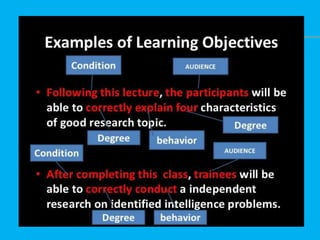
1. Audience (A) – Who? Who are your learners?
2. Behavior (B) – What? What do you expect them to be able to do? This should be an overt,
observable behavior, even if the actual behavior is covert or mental in nature. If you can't see
it, hear it, touch it, taste it, or smell it, you can't be sure your audience really learned it.
3. Condition (C) – How? Under what circumstances or context will the learning occur? What
will the student be given or already be expected to know to accomplish the learning?
4. Degree (D) – How much? How much will be accomplished, how well will the behavior need
to be performed, and to what level? Do you want total mastery (100%), do you want them to
respond correctly 80% of the time, etc. A common (and totally non-scientific) setting is 80%
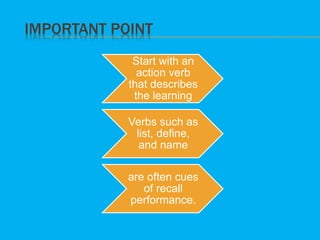
IMPORTANT POINT
Start with an
action verb
that describes
the learning
Verbs such as
list, define,
and name
are often cues
of recall
performance.
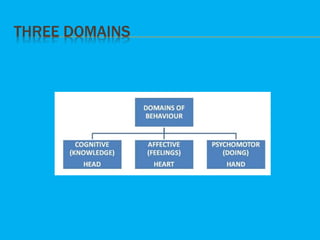
THREE DOMAINS
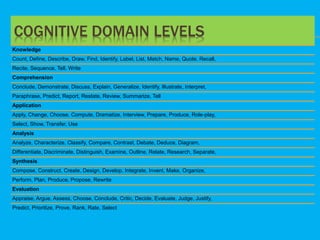
COGNITIVE DOMAIN LEVELS
Knowledge
Count, Define, Describe, Draw, Find, Identify, Label, List, Match, Name, Quote, Recall,
Recite, Sequence, Tell, Write
Comprehension
Conclude, Demonstrate, Discuss, Explain, Generalize, Identify, Illustrate, Interpret,
Paraphrase, Predict, Report, Restate, Review, Summarize, Tell
Application
Apply, Change, Choose, Compute, Dramatize, Interview, Prepare, Produce, Role-play,
Select, Show, Transfer, Use
Analysis
Analyze, Characterize, Classify, Compare, Contrast, Debate, Deduce, Diagram,
Differentiate, Discriminate, Distinguish, Examine, Outline, Relate, Research, Separate,
Synthesis
Compose, Construct, Create, Design, Develop, Integrate, Invent, Make, Organize,
Perform, Plan, Produce, Propose, Rewrite
Evaluation
Appraise, Argue, Assess, Choose, Conclude, Critic, Decide, Evaluate, Judge, Justify,
Predict, Prioritize, Prove, Rank, Rate, Select
WRITING OBJECTIVES FOR THE
AFFECTIVE DOMAIN
• The affective domain
encompasses more abstract
behaviors (e.g., attitudes, feelings,
and appreciations) that are
relatively difficult to
observe and measure.
WRITING OBJECTIVES IN THE
PSYCHOMOTOR DOMAIN
Psychomotor skills
are the most easily
observed of the
three domains.
Thanks

Skill of writing objectives

  • 1.
    SKILL OF WRITINGINSTRUCTIONAL OBJECTIVES BY DR. GOGGI GUPTA M.sc (chemistry),M.Ed Ph.d (Education ),PGEDEMA
  • 2.
    IMPORTANT QUESTIONS  ‘‘Whatis the purpose of this instruction?’’  ‘‘How can learners demonstrate their understanding of  the material?’’  ‘‘How can you assess whether the learners have  mastered the content?’’  ‘‘If you have good test items, do you really need  objectives?’’  ‘‘Don’t instructors know what needs to be taught in a  course?’’  ‘‘What types of content and performance are specified  in the objectives?’’
  • 3.
    Meaning of Objectives:Objectives are the means to achieve the aims. Objectives are the steps towards the attainment of aims..  According to B.S. BLOOM, “an objective is the desired goal or outcome at which instruction is aimed”  Characteristics of Good Objectives  ● Objectives should be specific and precise.  ● It should be attainable.  ● It should be based on psychological principles.  ● It should lead to the development of the pupils.  ● It should be helpful in acquiring democratic aims.  ● it should modify the behavior of the students.  be useful.
  • 4.
    WRITING OBJECTIVES INTHE COGNITIVE DOMAIN BEHAVIORALOBJECTIVES  A behavioral objective is a precise statement that answers the question.  ‘‘What behavior can the learner demonstrate to  indicate that he or she has mastered the knowledge or skills specified in the instruction?’’  Ask yourself this question each time you start to  formulate an objective;  your answer will guide your efforts.
  • 5.
    REASONS FOR FRAMINGOBJECTIVES  Objectives are based on the results of the task analysis and provide a refinement and implementation of the needs of and/or goals for a project
  • 6.
    MAGER’S ABCD MODELFOR INSTRUCTIONAL OBJECTIVES: 1. Audience (A) – Who? Who are your learners? 2. Behavior (B) – What? What do you expect them to be able to do? This should be an overt, observable behavior, even if the actual behavior is covert or mental in nature. If you can't see it, hear it, touch it, taste it, or smell it, you can't be sure your audience really learned it. 3. Condition (C) – How? Under what circumstances or context will the learning occur? What will the student be given or already be expected to know to accomplish the learning? 4. Degree (D) – How much? How much will be accomplished, how well will the behavior need to be performed, and to what level? Do you want total mastery (100%), do you want them to respond correctly 80% of the time, etc. A common (and totally non-scientific) setting is 80%
  • 7.
    IMPORTANT POINT Start withan action verb that describes the learning Verbs such as list, define, and name are often cues of recall performance.
  • 8.
  • 9.
    COGNITIVE DOMAIN LEVELS Knowledge Count,Define, Describe, Draw, Find, Identify, Label, List, Match, Name, Quote, Recall, Recite, Sequence, Tell, Write Comprehension Conclude, Demonstrate, Discuss, Explain, Generalize, Identify, Illustrate, Interpret, Paraphrase, Predict, Report, Restate, Review, Summarize, Tell Application Apply, Change, Choose, Compute, Dramatize, Interview, Prepare, Produce, Role-play, Select, Show, Transfer, Use Analysis Analyze, Characterize, Classify, Compare, Contrast, Debate, Deduce, Diagram, Differentiate, Discriminate, Distinguish, Examine, Outline, Relate, Research, Separate, Synthesis Compose, Construct, Create, Design, Develop, Integrate, Invent, Make, Organize, Perform, Plan, Produce, Propose, Rewrite Evaluation Appraise, Argue, Assess, Choose, Conclude, Critic, Decide, Evaluate, Judge, Justify, Predict, Prioritize, Prove, Rank, Rate, Select
  • 11.
    WRITING OBJECTIVES FORTHE AFFECTIVE DOMAIN • The affective domain encompasses more abstract behaviors (e.g., attitudes, feelings, and appreciations) that are relatively difficult to observe and measure.
  • 12.
    WRITING OBJECTIVES INTHE PSYCHOMOTOR DOMAIN Psychomotor skills are the most easily observed of the three domains.
  • 17.