Learning Objective
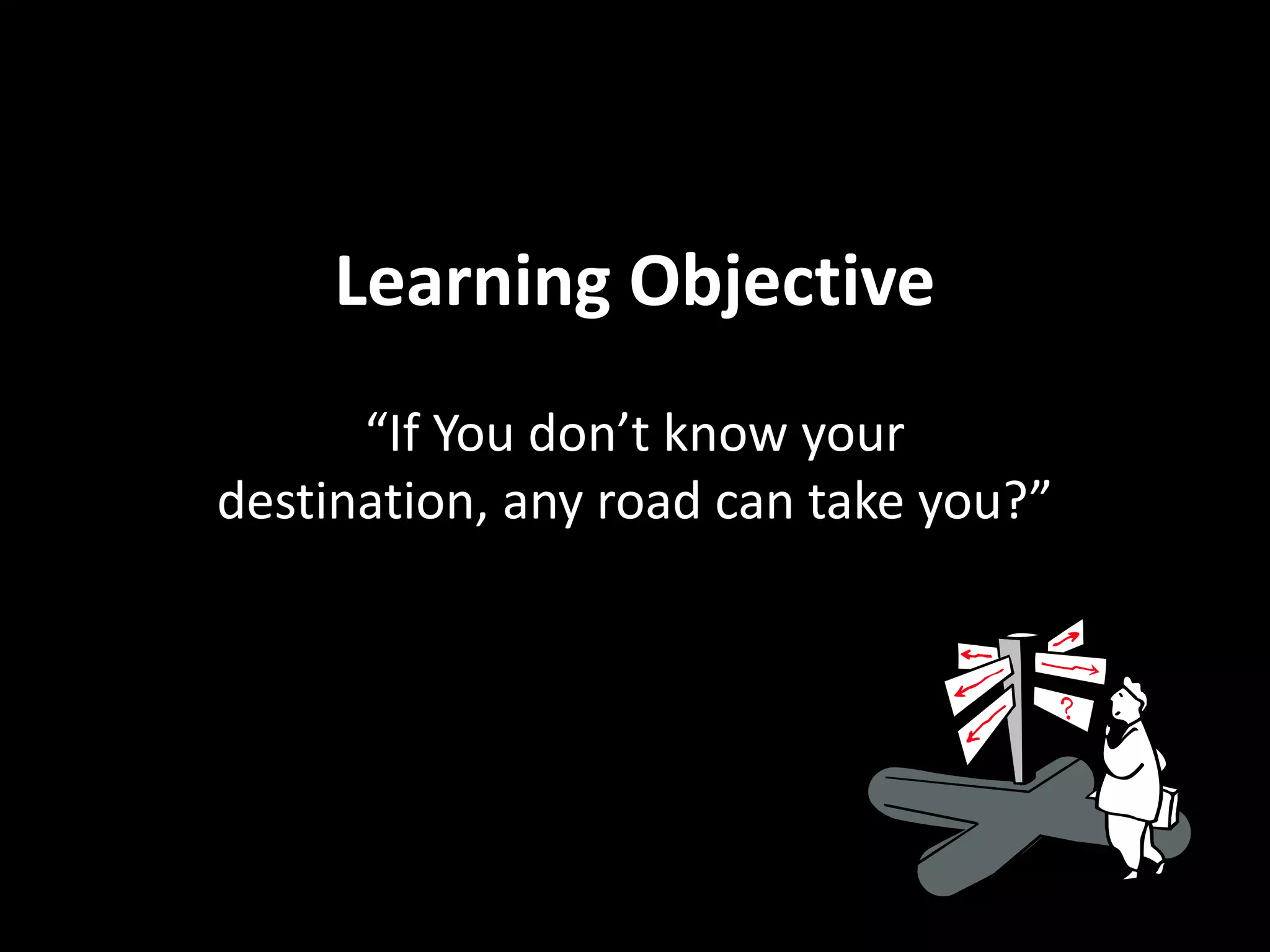
      “If You don’t know your
destination, any road can take you?”
What Is a Learning Objective?
• A learning objective is a statement of what the learner will
  know, understand, or be able to do as a result of engaging in a
  learning activity.
• Well-written learning objectives are essential to building a strong
  foundation in the development of training materials.
Goals vs. Objectives
• The difference between goals and objectives is that goals are
  broad, generalized statements of instructional intent, while
  objectives are specific, measurable outcomes that help a learner
  achieve the goals. For example:
• Goal        The overall goal of this presentation is to help
      participants understand how to write SMART
      learning objectives.
• Objectives: The objectives of this presentation is to help
      participants identify action verbs that should not be
      included in writing SMART learning objectives.
         » Describe the importance of writing SMART learning
           objectives.
Why Are Learning Objectives
               Important?
Developing learning objectives is one of the most critical steps in the
  training development process. Well-constructed learning
  objectives enable :
 trainers to choose appropriate methods, assessment and
  evaluation tools that accurately reflect the course,
 trainees to know what new information or skills they will be
  learning. They can take more responsibility for their own learning
  when they know what they are expected to achieve they will
  learn, and
 Stakeholders to know what will be achieved (knowledge, skills
  and attitudes) through the training programs.
Potential Problems with Learning
               Objectives
• Could limit learning if learning outcomes are
  written within a very narrow framework –lack
  of intellectual challenge to learners
• Could give rise to confusion among students
  and staff if guidelines are not adhered to
  when drawing up learning outcomes.

  • (So, learning objectives must be clear and
                   measurable.)
How to Write Learning Objectives?
• Here you should consider what exactly you
  would like trainees to be able to do by the end of
  the training session.
  – In what ways will students be “different” when they
    finish the course?
  – What should students be able to DO with the
    knowledge and skills gained in the course?
  – What do students need to KNOW in order to do the
    things they should be able to do when they finish the
    course?
  – What types of Attitudes students need to develop?
Components of Learning Objectives
• Educational theorist Robert Mager in his 1962
  book on “Preparing Instructional Objectives”
  created a clear framework for developing
  learning objectives, in which they are
  constructed around four main components:
  ABCD model
      (audience, behavior, condition, and
  Degree)
• Audience: refers to Participants/trainees/
  Students ” – (reminding you that the focus is
Cont’d
• Behavior (observable action verb): Choose an
  action verb that best describes the type of behavior
  that the learner needs to display after the training.
                                                     AV
• These might include “list,” “explain,” or “identify.”
• The action verb is the most important component of
  the learning objective because it indicates what will
  be accomplished through the training.
• Try to avoid verbs such as “understand,” “know,” or
  “increase awareness of,” as these are not easily
  measurable.
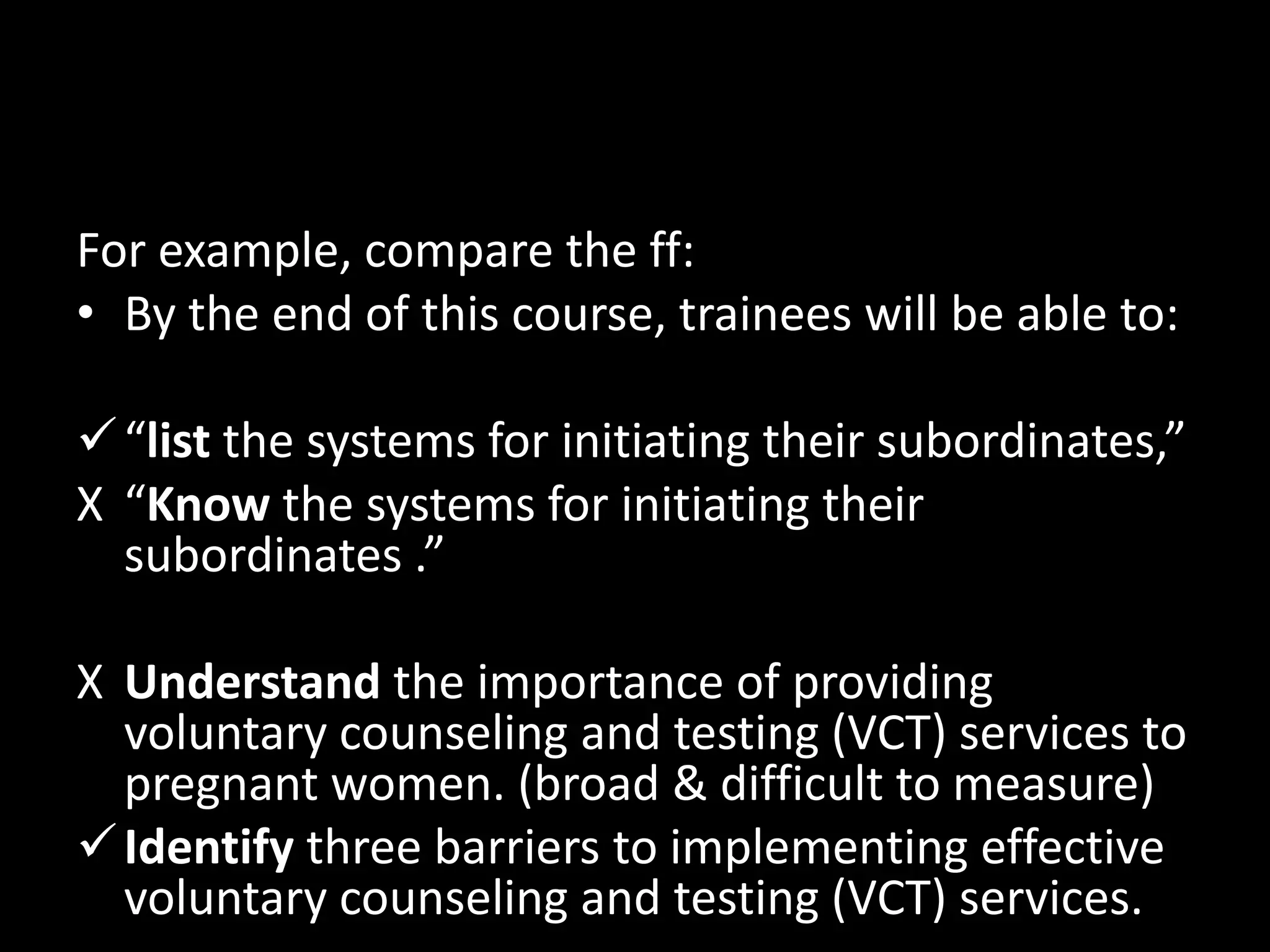
For example, compare the ff:
• By the end of this course, trainees will be able to:

 “list the systems for initiating their subordinates,”
X “Know the systems for initiating their
  subordinates .”

X Understand the importance of providing
  voluntary counseling and testing (VCT) services to
  pregnant women. (broad & difficult to measure)
 Identify three barriers to implementing effective
  voluntary counseling and testing (VCT) services.
Cont’d
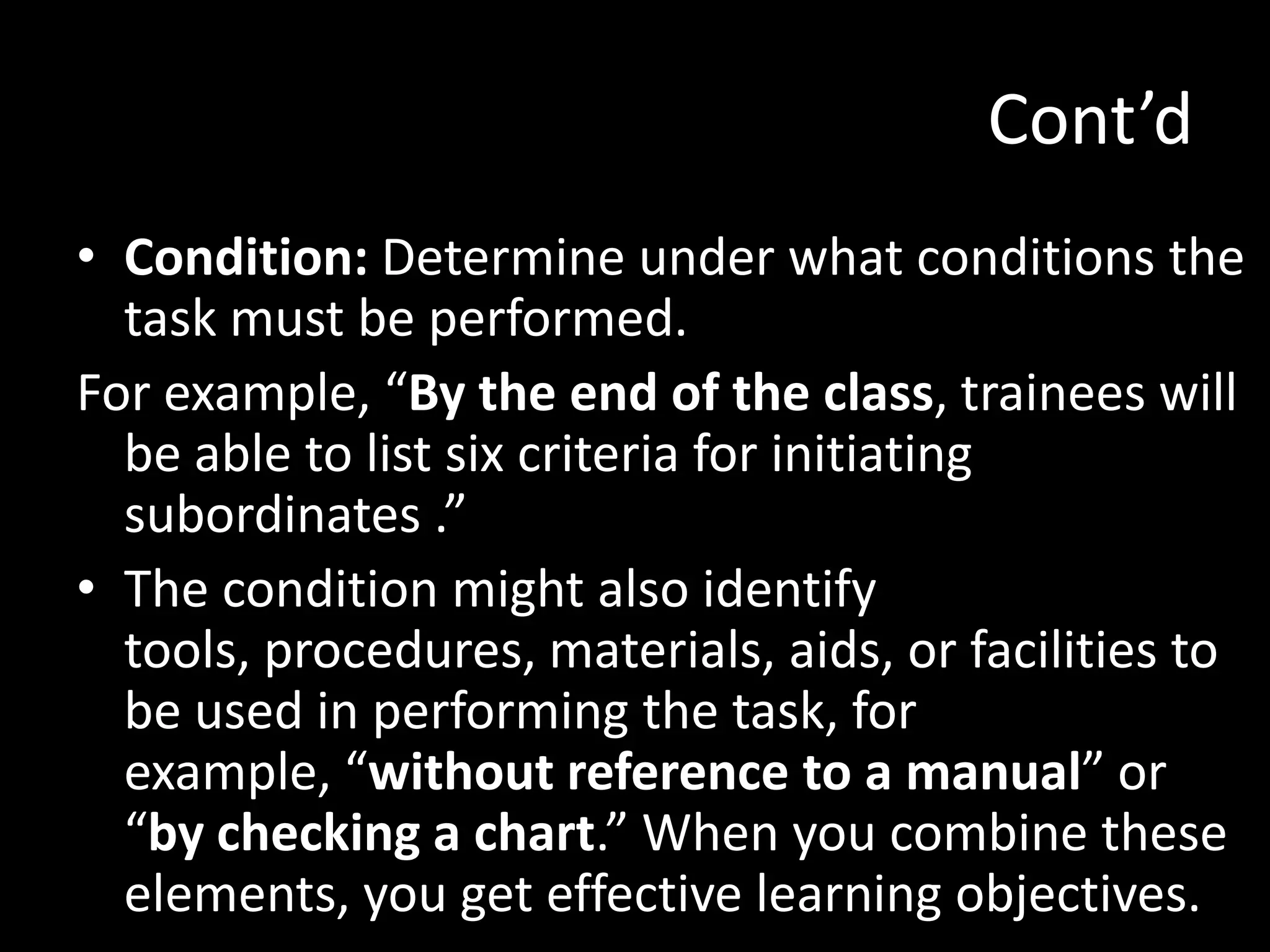
• Condition: Determine under what conditions the
  task must be performed.
For example, “By the end of the class, trainees will
  be able to list six criteria for initiating
  subordinates .”
• The condition might also identify
  tools, procedures, materials, aids, or facilities to
  be used in performing the task, for
  example, “without reference to a manual” or
  “by checking a chart.” When you combine these
  elements, you get effective learning objectives.
Cont’d
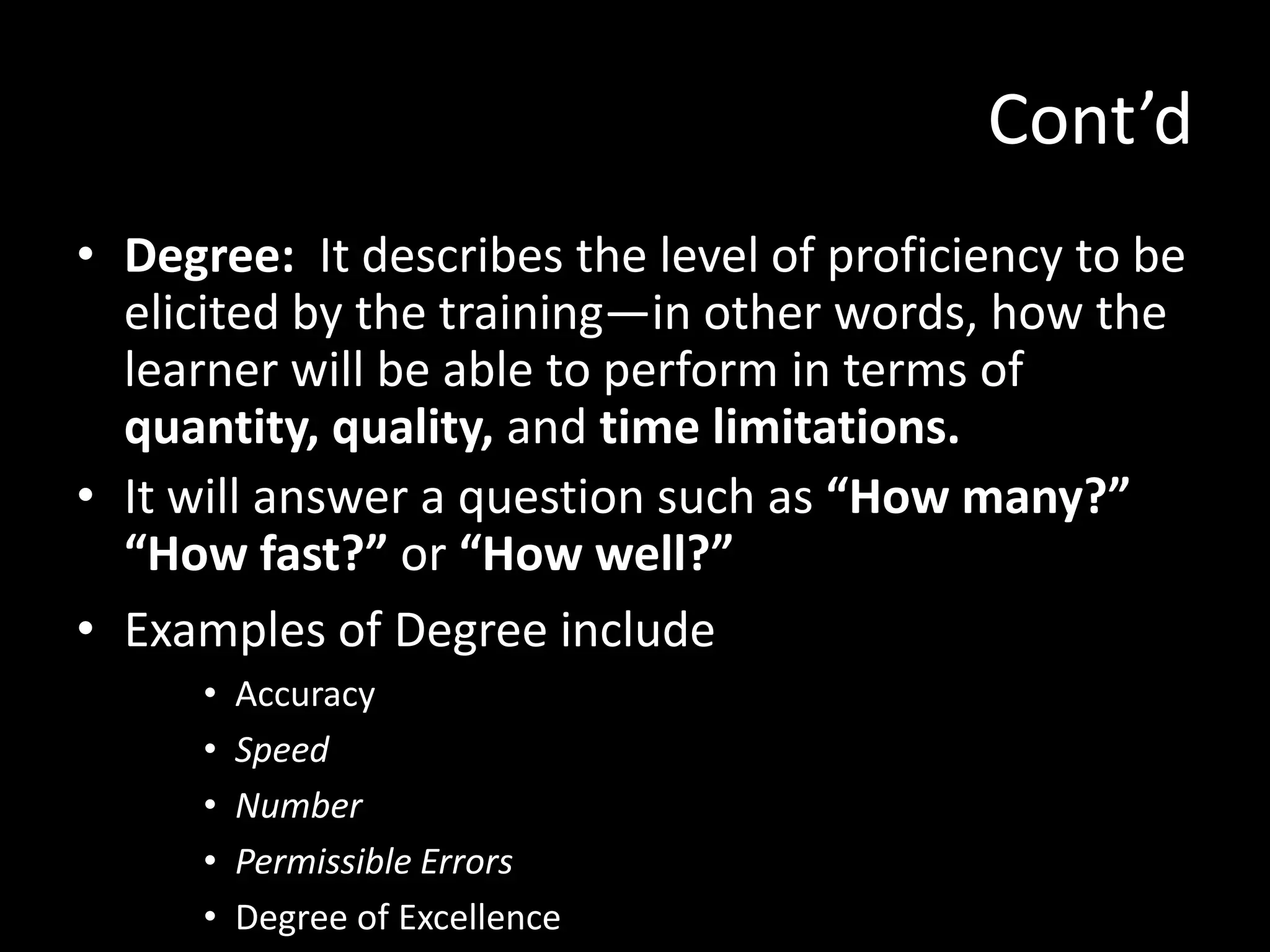
• Degree: It describes the level of proficiency to be
  elicited by the training—in other words, how the
  learner will be able to perform in terms of
  quantity, quality, and time limitations.
• It will answer a question such as “How many?”
  “How fast?” or “How well?”
• Examples of Degree include
      •   Accuracy
      •   Speed
      •   Number
      •   Permissible Errors
      •   Degree of Excellence
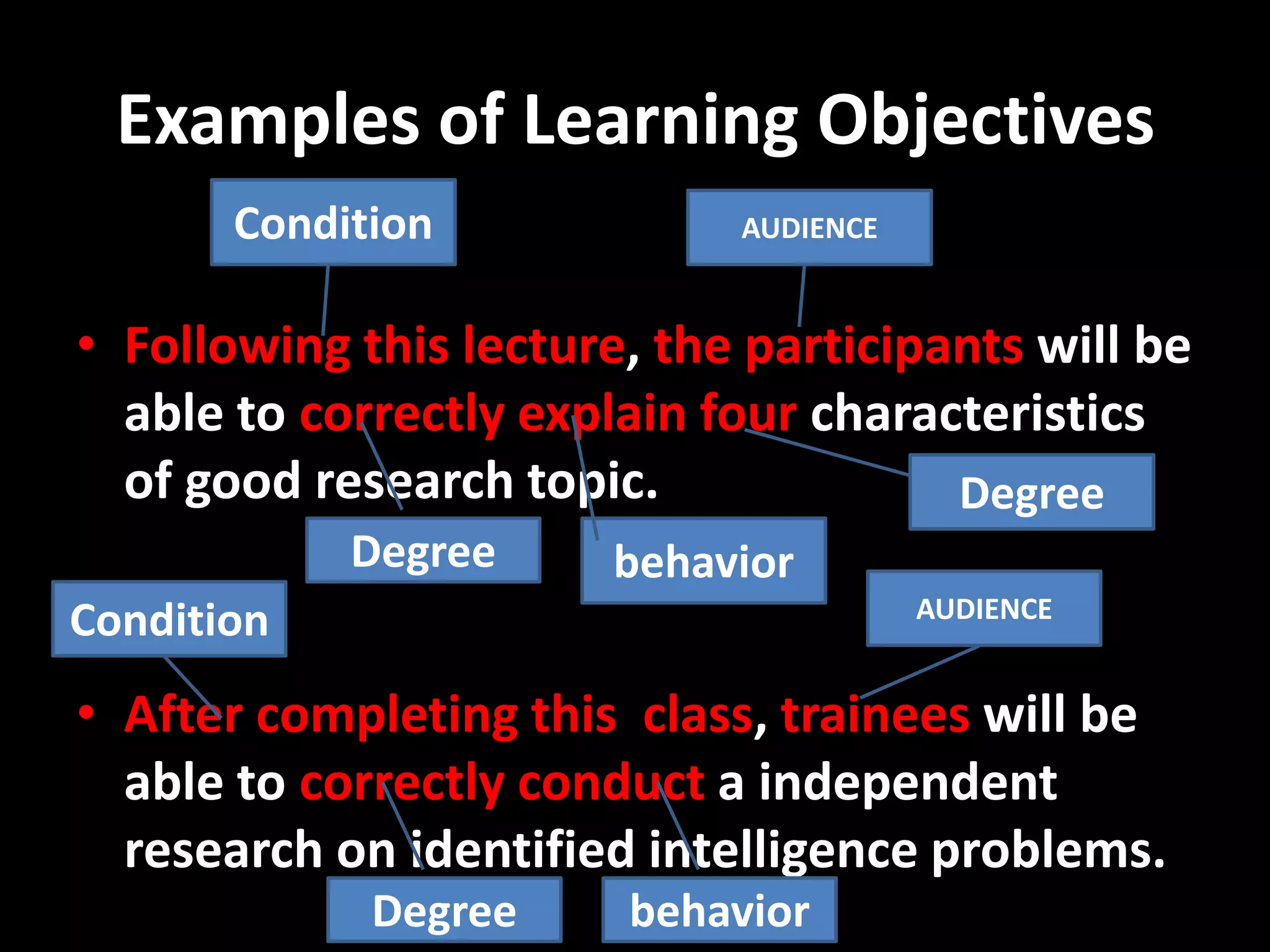
Examples of Learning Objectives
       Condition             AUDIENCE


• Following this lecture, the participants will be
  able to correctly explain four characteristics
  of good research topic.              Degree
            Degree      behavior
                                        AUDIENCE
Condition
• After completing this class, trainees will be
  able to correctly conduct a independent
  research on identified intelligence problems.
             Degree     behavior
Making Learning Objectives “SMART”
• Use SMART as a checklist to help ensure that you have
  considered each item in formulating learning objectives.
• Effective learning objectives are SMART:
  Specific, Measurable, Action-oriented, Reasonable, and
  Time bound.
 Specific means that the learning objective describes the
  knowledge, attitudes, or skills that a learner should be
  able to demonstrate following exposure to a learning
  activity.
 Measurable means that achievement of learning
  objectives can be measured by test
  items, observation, problem-solving exercises, or other
  evaluation methods during or after the training.
Cont’d
 Action-oriented means that the objective includes
  an action verb that demonstrates change or
  acquisition of knowledge, attitudes, or skills.
 Reasonable means that the objective reflects
  realistic expectations of knowledge, attitude, or
  behavior acquisition/change given the conditions
  for instruction (e.g., time and scope of training).
 Time-bound means that the objective specifies a
  time frame in which learners are expected to
  achieve the learning objective(s)—usually by the end
  of the training.
Examples of SMART objectives
• After the end of this course(time-bound),
  participants will describe (action-oriented) four
  factors (specific, measurable, reasonable) that
  increase the risk of HIV transmission in women.
• After attending the class and studying the
  assigned handouts (time-bound, reasonable),
  participants will list (action-oriented) three types
  of tests (specific, measurable) performed in
  Ethiopia to detect HIV.
Examples of poorly written objectives
             (not SMART)
1. After completing the course, the trainees will be able to have
    adequate knowledge of counter terrorism.
• This objective is time-bound, The action verb is “have,” which is
   not specific. Simply stating “adequate knowledge” is difficult to
   determine if it is reasonable or not. It is not specific enough to
   measure.
2. Trainees able to understand the functions of EW at all levels.
• This objective is not time-bound, which makes it difficult to
   determine if it is reasonable or not. The verb, “understand,” is not
   an action verb and is not easy to measure.
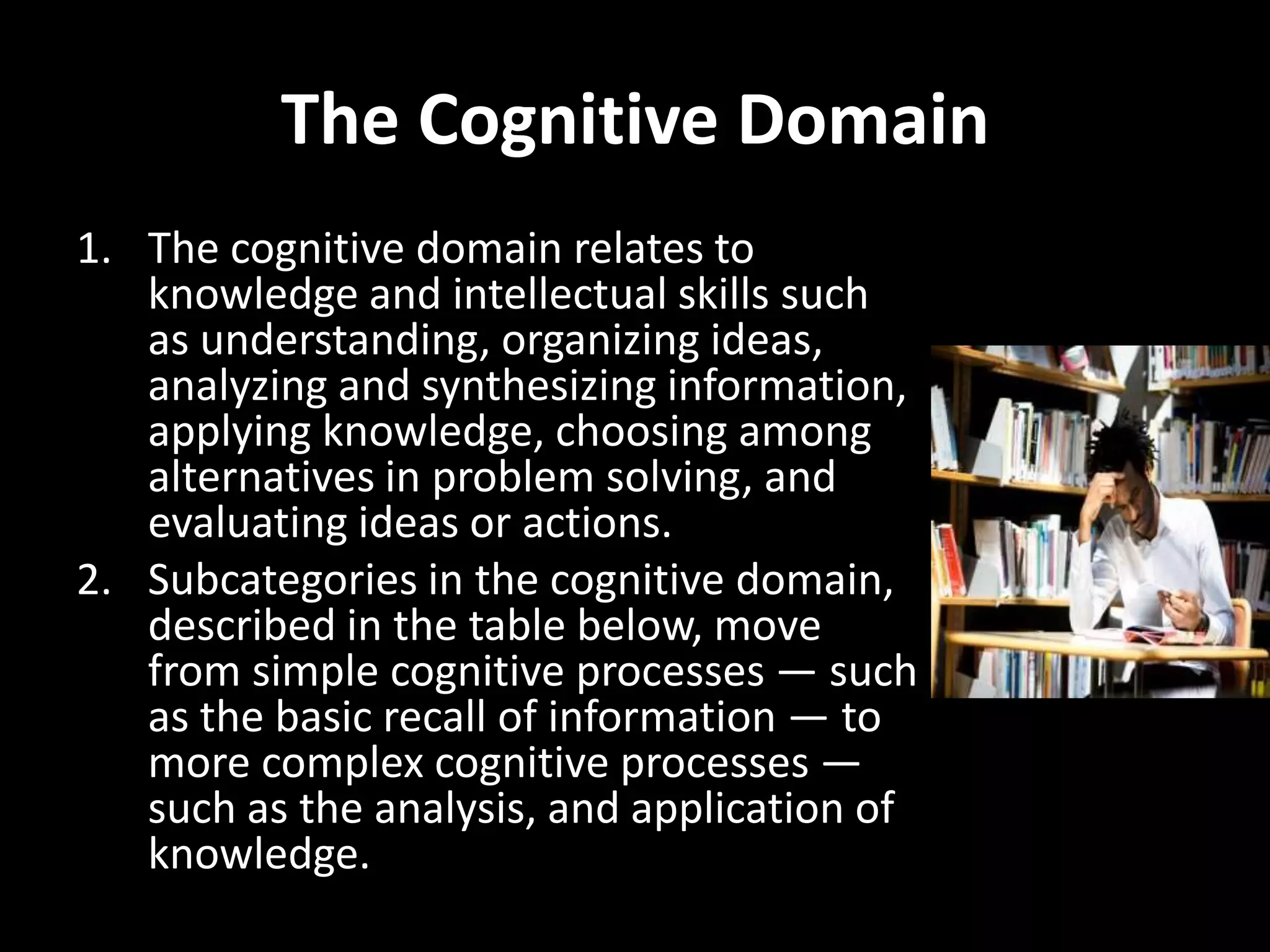
The Cognitive Domain
1. The cognitive domain relates to
   knowledge and intellectual skills such
   as understanding, organizing ideas,
   analyzing and synthesizing information,
   applying knowledge, choosing among
   alternatives in problem solving, and
   evaluating ideas or actions.
2. Subcategories in the cognitive domain,
   described in the table below, move
   from simple cognitive processes — such
   as the basic recall of information — to
   more complex cognitive processes —
   such as the analysis, and application of
   knowledge.
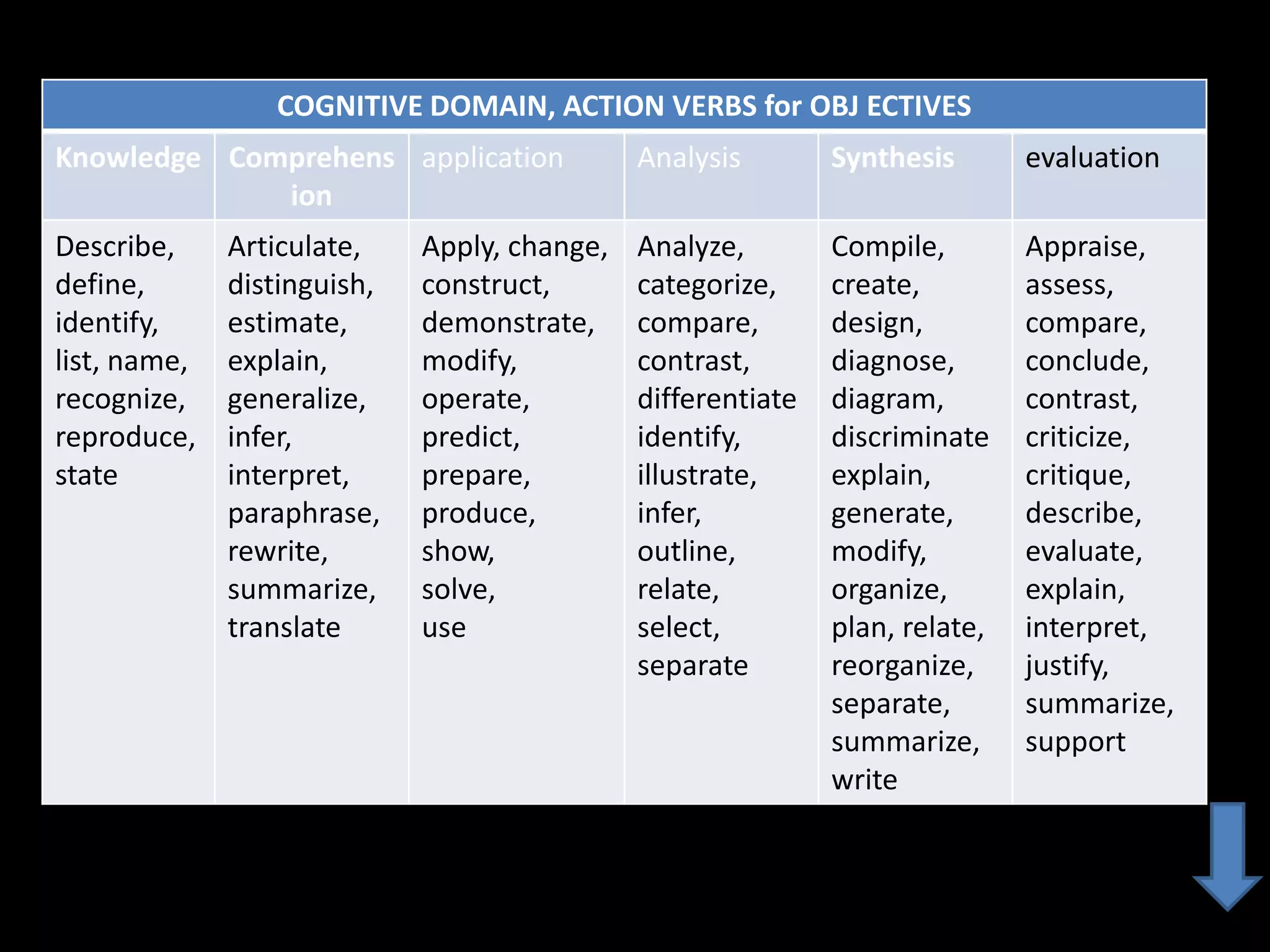
COGNITIVE DOMAIN, ACTION VERBS for OBJ ECTIVES
Knowledge Comprehens application              Analysis        Synthesis       evaluation
             ion
Describe,     Articulate,    Apply, change,   Analyze,        Compile,        Appraise,
define,       distinguish,   construct,       categorize,     create,         assess,
identify,     estimate,      demonstrate,     compare,        design,         compare,
list, name,   explain,       modify,          contrast,       diagnose,       conclude,
recognize,    generalize,    operate,         differentiate   diagram,        contrast,
reproduce,    infer,         predict,         identify,       discriminate    criticize,
state         interpret,     prepare,         illustrate,     explain,        critique,
              paraphrase,    produce,         infer,          generate,       describe,
              rewrite,       show,            outline,        modify,         evaluate,
              summarize,     solve,           relate,         organize,       explain,
              translate      use              select,         plan, relate,   interpret,
                                              separate        reorganize,     justify,
                                                              separate,       summarize,
                                                              summarize,      support
                                                              write
The Affective Domain
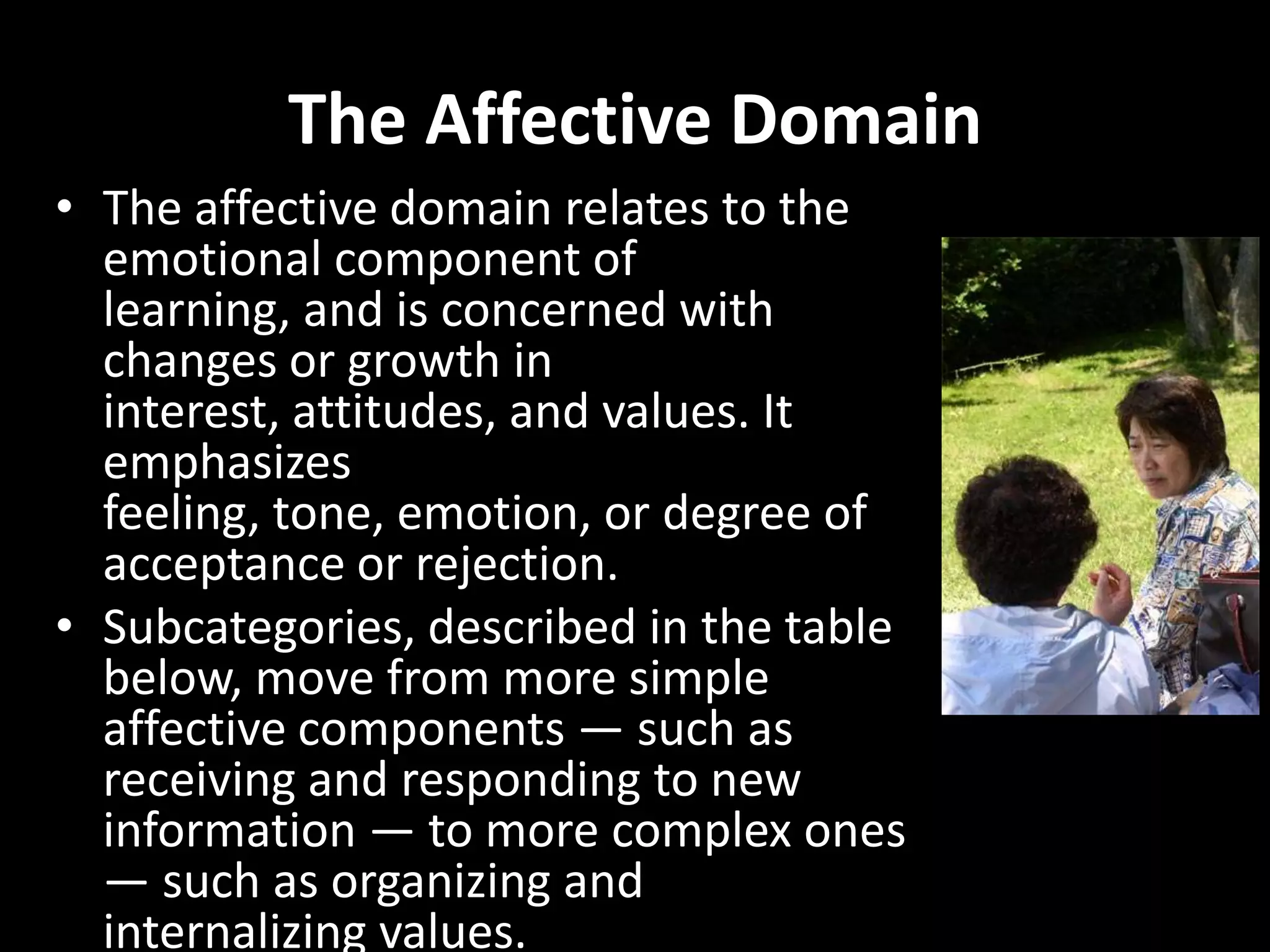
• The affective domain relates to the
  emotional component of
  learning, and is concerned with
  changes or growth in
  interest, attitudes, and values. It
  emphasizes
  feeling, tone, emotion, or degree of
  acceptance or rejection.
• Subcategories, described in the table
  below, move from more simple
  affective components — such as
  receiving and responding to new
  information — to more complex ones
  — such as organizing and
  internalizing values.
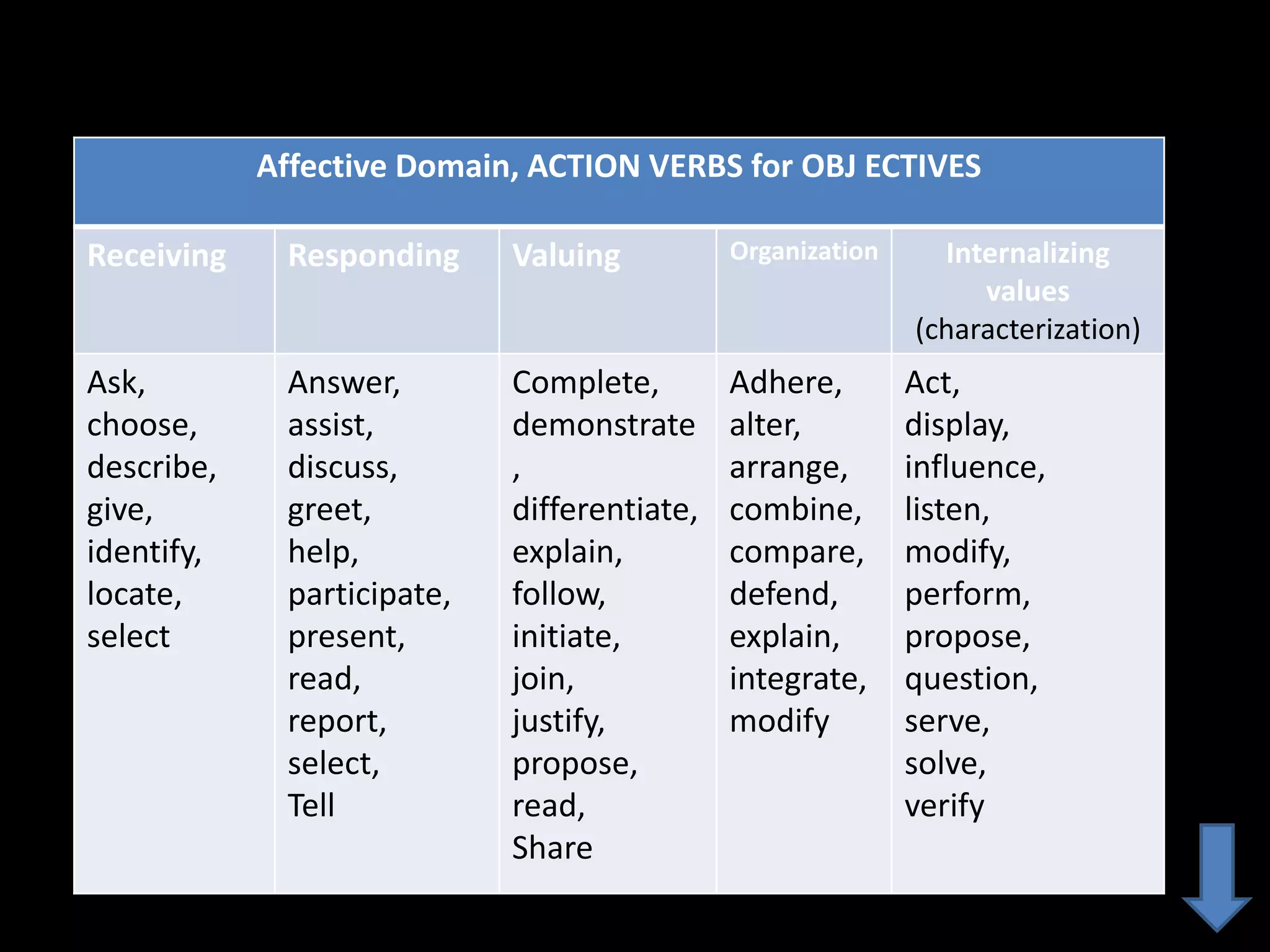
Affective Domain, ACTION VERBS for OBJ ECTIVES

Receiving    Responding     Valuing          Organization     Internalizing
                                                                 values
                                                            (characterization)
Ask,         Answer,        Complete,        Adhere,        Act,
choose,      assist,        demonstrate      alter,         display,
describe,    discuss,       ,                arrange,       influence,
give,        greet,         differentiate,   combine,       listen,
identify,    help,          explain,         compare,       modify,
locate,      participate,   follow,          defend,        perform,
select       present,       initiate,        explain,       propose,
             read,          join,            integrate,     question,
             report,        justify,         modify         serve,
             select,        propose,                        solve,
             Tell           read,                           verify
                            Share
The Psychomotor Domain
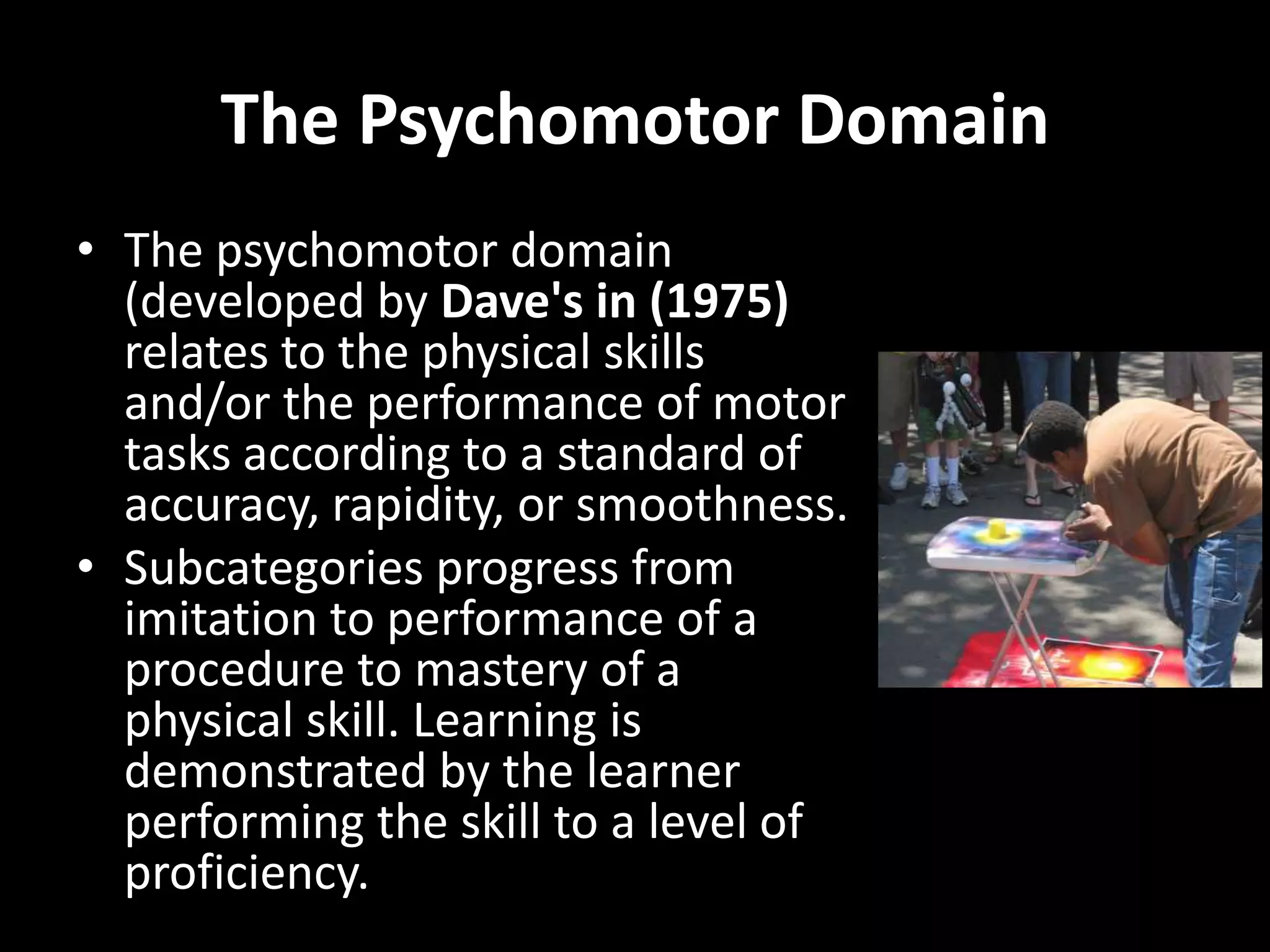
• The psychomotor domain
  (developed by Dave's in (1975)
  relates to the physical skills
  and/or the performance of motor
  tasks according to a standard of
  accuracy, rapidity, or smoothness.
• Subcategories progress from
  imitation to performance of a
  procedure to mastery of a
  physical skill. Learning is
  demonstrated by the learner
  performing the skill to a level of
  proficiency.
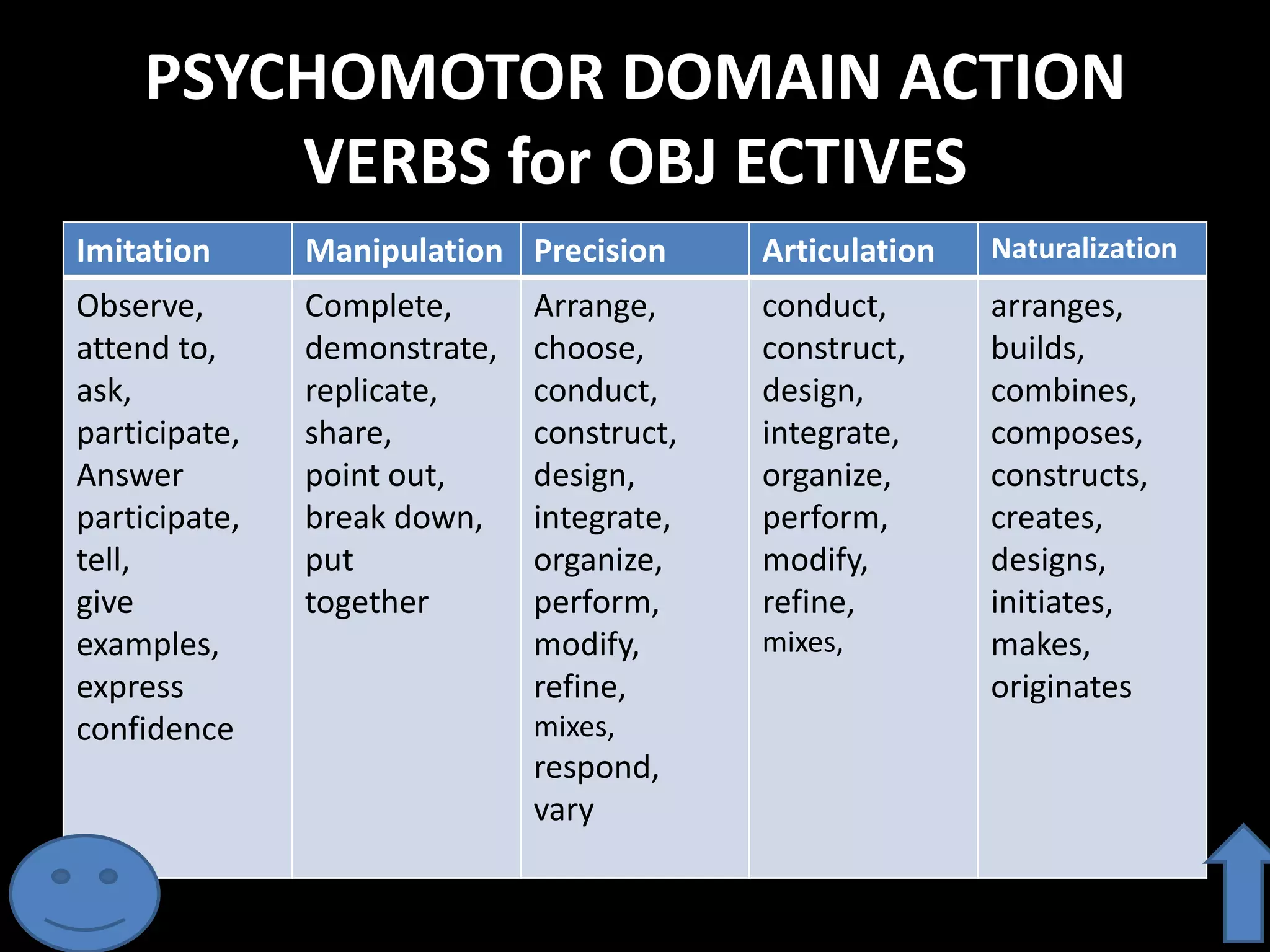
PSYCHOMOTOR DOMAIN ACTION
        VERBS for OBJ ECTIVES
Imitation      Manipulation Precision      Articulation   Naturalization
Observe,       Complete,      Arrange,     conduct,       arranges,
attend to,     demonstrate,   choose,      construct,     builds,
ask,           replicate,     conduct,     design,        combines,
participate,   share,         construct,   integrate,     composes,
Answer         point out,     design,      organize,      constructs,
participate,   break down,    integrate,   perform,       creates,
tell,          put            organize,    modify,        designs,
give           together       perform,     refine,        initiates,
examples,                     modify,      mixes,         makes,
express                       refine,                     originates
confidence                    mixes,
                              respond,
                              vary

Course objectives

  • 1.
    Learning Objective “If You don’t know your destination, any road can take you?”
  • 2.
    What Is aLearning Objective? • A learning objective is a statement of what the learner will know, understand, or be able to do as a result of engaging in a learning activity. • Well-written learning objectives are essential to building a strong foundation in the development of training materials.
  • 3.
    Goals vs. Objectives •The difference between goals and objectives is that goals are broad, generalized statements of instructional intent, while objectives are specific, measurable outcomes that help a learner achieve the goals. For example: • Goal The overall goal of this presentation is to help participants understand how to write SMART learning objectives. • Objectives: The objectives of this presentation is to help participants identify action verbs that should not be included in writing SMART learning objectives. » Describe the importance of writing SMART learning objectives.
  • 4.
    Why Are LearningObjectives Important? Developing learning objectives is one of the most critical steps in the training development process. Well-constructed learning objectives enable :  trainers to choose appropriate methods, assessment and evaluation tools that accurately reflect the course,  trainees to know what new information or skills they will be learning. They can take more responsibility for their own learning when they know what they are expected to achieve they will learn, and  Stakeholders to know what will be achieved (knowledge, skills and attitudes) through the training programs.
  • 5.
    Potential Problems withLearning Objectives • Could limit learning if learning outcomes are written within a very narrow framework –lack of intellectual challenge to learners • Could give rise to confusion among students and staff if guidelines are not adhered to when drawing up learning outcomes. • (So, learning objectives must be clear and measurable.)
  • 6.
    How to WriteLearning Objectives? • Here you should consider what exactly you would like trainees to be able to do by the end of the training session. – In what ways will students be “different” when they finish the course? – What should students be able to DO with the knowledge and skills gained in the course? – What do students need to KNOW in order to do the things they should be able to do when they finish the course? – What types of Attitudes students need to develop?
  • 7.
    Components of LearningObjectives • Educational theorist Robert Mager in his 1962 book on “Preparing Instructional Objectives” created a clear framework for developing learning objectives, in which they are constructed around four main components: ABCD model (audience, behavior, condition, and Degree) • Audience: refers to Participants/trainees/ Students ” – (reminding you that the focus is
  • 8.
    Cont’d • Behavior (observableaction verb): Choose an action verb that best describes the type of behavior that the learner needs to display after the training. AV • These might include “list,” “explain,” or “identify.” • The action verb is the most important component of the learning objective because it indicates what will be accomplished through the training. • Try to avoid verbs such as “understand,” “know,” or “increase awareness of,” as these are not easily measurable.
  • 9.
    For example, comparethe ff: • By the end of this course, trainees will be able to:  “list the systems for initiating their subordinates,” X “Know the systems for initiating their subordinates .” X Understand the importance of providing voluntary counseling and testing (VCT) services to pregnant women. (broad & difficult to measure)  Identify three barriers to implementing effective voluntary counseling and testing (VCT) services.
  • 10.
    Cont’d • Condition: Determineunder what conditions the task must be performed. For example, “By the end of the class, trainees will be able to list six criteria for initiating subordinates .” • The condition might also identify tools, procedures, materials, aids, or facilities to be used in performing the task, for example, “without reference to a manual” or “by checking a chart.” When you combine these elements, you get effective learning objectives.
  • 11.
    Cont’d • Degree: Itdescribes the level of proficiency to be elicited by the training—in other words, how the learner will be able to perform in terms of quantity, quality, and time limitations. • It will answer a question such as “How many?” “How fast?” or “How well?” • Examples of Degree include • Accuracy • Speed • Number • Permissible Errors • Degree of Excellence
  • 12.
    Examples of LearningObjectives Condition AUDIENCE • Following this lecture, the participants will be able to correctly explain four characteristics of good research topic. Degree Degree behavior AUDIENCE Condition • After completing this class, trainees will be able to correctly conduct a independent research on identified intelligence problems. Degree behavior
  • 13.
    Making Learning Objectives“SMART” • Use SMART as a checklist to help ensure that you have considered each item in formulating learning objectives. • Effective learning objectives are SMART: Specific, Measurable, Action-oriented, Reasonable, and Time bound.  Specific means that the learning objective describes the knowledge, attitudes, or skills that a learner should be able to demonstrate following exposure to a learning activity.  Measurable means that achievement of learning objectives can be measured by test items, observation, problem-solving exercises, or other evaluation methods during or after the training.
  • 14.
    Cont’d  Action-oriented meansthat the objective includes an action verb that demonstrates change or acquisition of knowledge, attitudes, or skills.  Reasonable means that the objective reflects realistic expectations of knowledge, attitude, or behavior acquisition/change given the conditions for instruction (e.g., time and scope of training).  Time-bound means that the objective specifies a time frame in which learners are expected to achieve the learning objective(s)—usually by the end of the training.
  • 15.
    Examples of SMARTobjectives • After the end of this course(time-bound), participants will describe (action-oriented) four factors (specific, measurable, reasonable) that increase the risk of HIV transmission in women. • After attending the class and studying the assigned handouts (time-bound, reasonable), participants will list (action-oriented) three types of tests (specific, measurable) performed in Ethiopia to detect HIV.
  • 16.
    Examples of poorlywritten objectives (not SMART) 1. After completing the course, the trainees will be able to have adequate knowledge of counter terrorism. • This objective is time-bound, The action verb is “have,” which is not specific. Simply stating “adequate knowledge” is difficult to determine if it is reasonable or not. It is not specific enough to measure. 2. Trainees able to understand the functions of EW at all levels. • This objective is not time-bound, which makes it difficult to determine if it is reasonable or not. The verb, “understand,” is not an action verb and is not easy to measure.
  • 17.
    The Cognitive Domain 1.The cognitive domain relates to knowledge and intellectual skills such as understanding, organizing ideas, analyzing and synthesizing information, applying knowledge, choosing among alternatives in problem solving, and evaluating ideas or actions. 2. Subcategories in the cognitive domain, described in the table below, move from simple cognitive processes — such as the basic recall of information — to more complex cognitive processes — such as the analysis, and application of knowledge.
  • 18.
    COGNITIVE DOMAIN, ACTIONVERBS for OBJ ECTIVES Knowledge Comprehens application Analysis Synthesis evaluation ion Describe, Articulate, Apply, change, Analyze, Compile, Appraise, define, distinguish, construct, categorize, create, assess, identify, estimate, demonstrate, compare, design, compare, list, name, explain, modify, contrast, diagnose, conclude, recognize, generalize, operate, differentiate diagram, contrast, reproduce, infer, predict, identify, discriminate criticize, state interpret, prepare, illustrate, explain, critique, paraphrase, produce, infer, generate, describe, rewrite, show, outline, modify, evaluate, summarize, solve, relate, organize, explain, translate use select, plan, relate, interpret, separate reorganize, justify, separate, summarize, summarize, support write
  • 19.
    The Affective Domain •The affective domain relates to the emotional component of learning, and is concerned with changes or growth in interest, attitudes, and values. It emphasizes feeling, tone, emotion, or degree of acceptance or rejection. • Subcategories, described in the table below, move from more simple affective components — such as receiving and responding to new information — to more complex ones — such as organizing and internalizing values.
  • 20.
    Affective Domain, ACTIONVERBS for OBJ ECTIVES Receiving Responding Valuing Organization Internalizing values (characterization) Ask, Answer, Complete, Adhere, Act, choose, assist, demonstrate alter, display, describe, discuss, , arrange, influence, give, greet, differentiate, combine, listen, identify, help, explain, compare, modify, locate, participate, follow, defend, perform, select present, initiate, explain, propose, read, join, integrate, question, report, justify, modify serve, select, propose, solve, Tell read, verify Share
  • 21.
    The Psychomotor Domain •The psychomotor domain (developed by Dave's in (1975) relates to the physical skills and/or the performance of motor tasks according to a standard of accuracy, rapidity, or smoothness. • Subcategories progress from imitation to performance of a procedure to mastery of a physical skill. Learning is demonstrated by the learner performing the skill to a level of proficiency.
  • 22.
    PSYCHOMOTOR DOMAIN ACTION VERBS for OBJ ECTIVES Imitation Manipulation Precision Articulation Naturalization Observe, Complete, Arrange, conduct, arranges, attend to, demonstrate, choose, construct, builds, ask, replicate, conduct, design, combines, participate, share, construct, integrate, composes, Answer point out, design, organize, constructs, participate, break down, integrate, perform, creates, tell, put organize, modify, designs, give together perform, refine, initiates, examples, modify, mixes, makes, express refine, originates confidence mixes, respond, vary