Guided by - Dr. Rahimi sir
Presented by - Vikash Yadav
Bone – a quick overview
• Composite of extracellular matrix proteins
• Cellular components
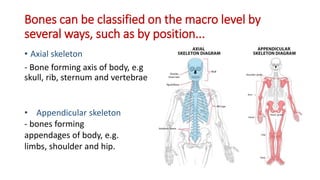
Bones can be classified on the macro level by
several ways, such as by position...
• Axial skeleton
- Bone forming axis of body, e.g
skull, rib, sternum and vertebrae
• Appendicular skeleton
- bones forming
appendages of body, e.g.
limbs, shoulder and hip.
or by shapes...
• Long Bones
- longer than they are wide (e.g humerus)
• Short bones
- cube shaped, e.g. bones in wrist and ankle
• Flat bones
- Thin, flattened and a bit curved (e.g sternum and most skull bones)
• Irregular bones
- Complicated shapes (e.g vertebrae, maxilla and mandible)
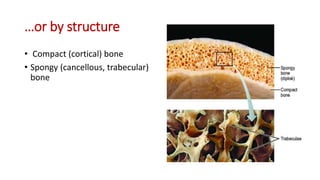
…or by structure
• Compact (cortical) bone
• Spongy (cancellous, trabecular)
bone
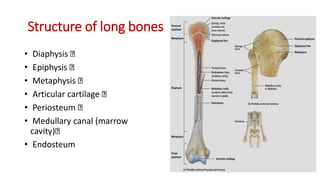
Structure of long bones
• Diaphysis
• Epiphysis
• Metaphysis
• Articular cartilage
• Periosteum
• Medullary canal (marrow
cavity)
• Endosteum
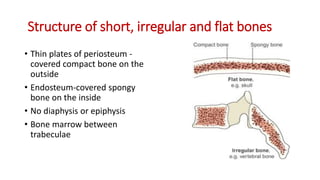
Structure of short, irregular and flat bones
• Thin plates of periosteum -
covered compact bone on the
outside
• Endosteum-covered spongy
bone on the inside
• No diaphysis or epiphysis
• Bone marrow between
trabeculae
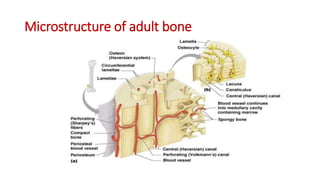
Microstructure of adult bone
Composition of bone
• ~1/3 organic
- Collagen fiber matrix (~88%) organized around lamellae
- Non-collagen (~12%); Glycoproteins, proteoglycans, lipids, etc)
• ~1/3 inorganic (mineral)
- Mostly dense calcium phosphate in the form of highly insoluble
crystals of hydroxyapatite
• ~1/3 water
• Cells – osteoblasts, osteoclasts, osteocytes, bone lining cells
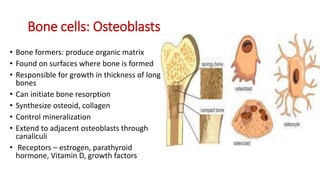
Bone cells: Osteoblasts
• Bone formers: produce organic matrix
• Found on surfaces where bone is formed
• Responsible for growth in thickness of long
bones
• Can initiate bone resorption
• Synthesize osteoid, collagen
• Control mineralization
• Extend to adjacent osteoblasts through
canaliculi
• Receptors – estrogen, parathyroid
hormone, Vitamin D, growth factors
Bone cells : Osteocytes
• Entrapped osteoblasts
• Most numerous bone cell
• Derived from osteoblast that is no
longer synthesizing collagen
• Function: Maintenance of bone
Bone cells: Osteoclasts
• Large multinucleated cell
• Plays active role in bone resorption during
bone remodelling
• Precursors: monocytes from marrow or
blood
• Found in notches or indentations in bone
(Howship’s lacunae) – excavations
• Contain the enzyme acid phosphatase
• Receptors: calcitonin, estrogen (indirect)
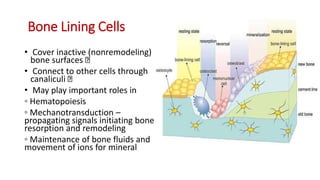
Bone Lining Cells
• Cover inactive (nonremodeling)
bone surfaces
• Connect to other cells through
canaliculi
• May play important roles in
◦ Hematopoiesis
◦ Mechanotransduction –
propagating signals initiating bone
resorption and remodeling
◦ Maintenance of bone fluids and
movement of ions for mineral
Bone Structure and Composition.pptx

Bone Structure and Composition.pptx

  • 1.
    Guided by -Dr. Rahimi sir Presented by - Vikash Yadav
  • 2.
    Bone – aquick overview • Composite of extracellular matrix proteins • Cellular components
  • 3.
    Bones can beclassified on the macro level by several ways, such as by position... • Axial skeleton - Bone forming axis of body, e.g skull, rib, sternum and vertebrae • Appendicular skeleton - bones forming appendages of body, e.g. limbs, shoulder and hip.
  • 4.
    or by shapes... •Long Bones - longer than they are wide (e.g humerus) • Short bones - cube shaped, e.g. bones in wrist and ankle • Flat bones - Thin, flattened and a bit curved (e.g sternum and most skull bones) • Irregular bones - Complicated shapes (e.g vertebrae, maxilla and mandible)
  • 5.
    …or by structure •Compact (cortical) bone • Spongy (cancellous, trabecular) bone
  • 6.
    Structure of longbones • Diaphysis • Epiphysis • Metaphysis • Articular cartilage • Periosteum • Medullary canal (marrow cavity) • Endosteum
  • 7.
    Structure of short,irregular and flat bones • Thin plates of periosteum - covered compact bone on the outside • Endosteum-covered spongy bone on the inside • No diaphysis or epiphysis • Bone marrow between trabeculae
  • 8.
  • 9.
    Composition of bone •~1/3 organic - Collagen fiber matrix (~88%) organized around lamellae - Non-collagen (~12%); Glycoproteins, proteoglycans, lipids, etc) • ~1/3 inorganic (mineral) - Mostly dense calcium phosphate in the form of highly insoluble crystals of hydroxyapatite • ~1/3 water • Cells – osteoblasts, osteoclasts, osteocytes, bone lining cells
  • 10.
    Bone cells: Osteoblasts •Bone formers: produce organic matrix • Found on surfaces where bone is formed • Responsible for growth in thickness of long bones • Can initiate bone resorption • Synthesize osteoid, collagen • Control mineralization • Extend to adjacent osteoblasts through canaliculi • Receptors – estrogen, parathyroid hormone, Vitamin D, growth factors
  • 11.
    Bone cells :Osteocytes • Entrapped osteoblasts • Most numerous bone cell • Derived from osteoblast that is no longer synthesizing collagen • Function: Maintenance of bone
  • 12.
    Bone cells: Osteoclasts •Large multinucleated cell • Plays active role in bone resorption during bone remodelling • Precursors: monocytes from marrow or blood • Found in notches or indentations in bone (Howship’s lacunae) – excavations • Contain the enzyme acid phosphatase • Receptors: calcitonin, estrogen (indirect)
  • 13.
    Bone Lining Cells •Cover inactive (nonremodeling) bone surfaces • Connect to other cells through canaliculi • May play important roles in ◦ Hematopoiesis ◦ Mechanotransduction – propagating signals initiating bone resorption and remodeling ◦ Maintenance of bone fluids and movement of ions for mineral