SCHOOL OF ARCHITECTURE, BUILDING AND DESIGN
BACHELOR OF QUANTITY SURVEYING (HONOURS)
AUGUST INTAKE 2015
SEMESTER 1
NAME: DEONG KHAI KEAT
STUDENT ID: 0320055
MEASUREMENT I ( Ms Ang Fuey Ling )
CONSTRUCTIONTECHNOLOGYI ( Azrina Binti Md Yaakob )
BUILDING MATERIALS( Myzatul Aishah Binti Kamarazaly )
TITLE NO.
Introduction. 3
Objectives. 4
Content and Technical Observation 5-8
Photo and Description 9-10
Learning Out come and Conclusion 11
Introduction
For this assignment is an individual assignment, we
are required to visit an construction site which is held
on 26th of June, we are required to gather at Taylor's
Lakeside University at 8am for attendance before
going to the site. The visit was organized by our 3
lecturers, Miss Ang, Miss Azrina, and Miss Aishah.
We are required to wear proper attire which are
long pants, covered shoes and white helmet. The site
is located at around Rawang area which is located at
Sekyen 2A, Antara Gapi, Hulu Selangor which has a
journey of around 1 hour from the campus.
After we arrive the site, the contractor brief us and
told us what not to do on the site for our safety
purposes. After that, contractor took us around the site,
explaining to us about the construction.
Objective
 To gain more knowledge from the site visit
 To understand how the construction process go
on.
 Explore and identify various types of building
materials and technology on site
 To explore and identify various types of building
materials and technology on site.
 To emphasize the importance of safety on site
 To recognize the items measurable for sub-
structure and reinforced concrete frame works
 To discover the types of construction
technologies used in real life.
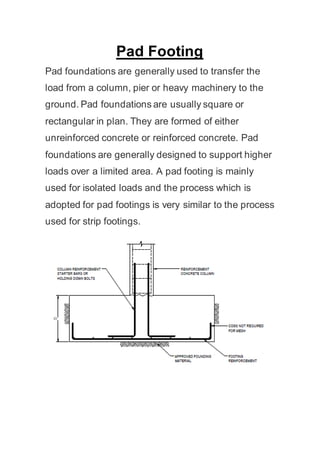
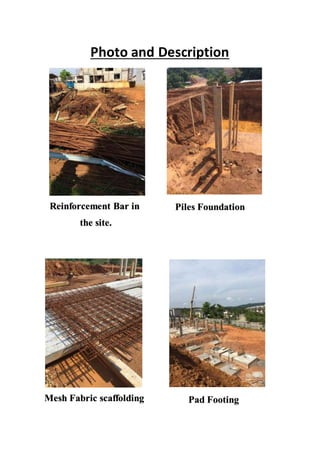
Pad Footing
Pad foundations are generally used to transfer the
load from a column, pier or heavy machinery to the
ground. Pad foundations are usually square or
rectangular in plan. They are formed of either
unreinforced concrete or reinforced concrete. Pad
foundations are generally designed to support higher
loads over a limited area. A pad footing is mainly
used for isolated loads and the process which is
adopted for pad footings is very similar to the process
used for strip footings.
Construction of Pad Footing
1. Site Clearance
2. Excavation
3. Lean Concrete
4. Formwork for Pad Footing
5. Add some spacer blocks
6. Reinforcement Bar
7. Concrete for Pad Footing
8. Remove Formwork
The process of construction RC pad footing begin with
pegging the site. After pegging the site, we need to
excavate to the desired level. Next, we need to put layer
of lean concrete provide a level surface, where Pad
foundation can be placed. After that, we need to build a
formwork for pad to mold the pad footing shape. Spacer
block are required to place before the reinforcement been
laid. Before we put reinforcement bar, we need put fill in
concrete cover to provide thermal insulation, which
protects the reinforcement bars from fire. After concrete
cover, we can start to put reinforcement bar. Once we
place all reinforcement bar, we can fill up concrete into
the formwork. Last, when the concrete has the sufficient
strength, we can remove all the formwork.
Materials involved in constructing a
Pad Footing
-Concrete
Concrete is a composite material composed of aggregate
bonded together with a fluid cement which hardens over
time. Base on the information from contractor, the building
on site is using Grade30. The ratio of Grade30 is 1:1:2
which is very strong.
-Reinforcement bar
Reinforcement bar is structures to strengthen and hold the
concrete in tension. Rebar's surface is often patterned to
form a better bond with the concrete. There are 2 type of
rebar which is High Tensile Rebar and Mild Steel rebar. In
the site, they are using High Tensile Rebar because it is a
standard reinforcing steel rod that is used as a tension
device in concrete structures to strengthen and hold the
concrete together. It is incredibly versatile and very long
lasting. It is able to be cut to desired size and welded into
position.
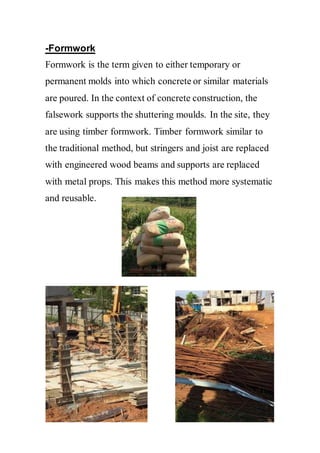
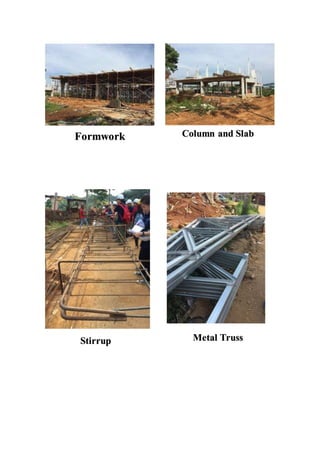
-Formwork
Formwork is the term given to either temporary or
permanent molds into which concrete or similar materials
are poured. In the context of concrete construction, the
falsework supports the shuttering moulds. In the site, they
are using timber formwork. Timber formwork similar to
the traditional method, but stringers and joist are replaced
with engineered wood beams and supports are replaced
with metal props. This makes this method more systematic
and reusable.
Photo and Description
Reinforcement Bar in
the site.
Piles Foundation
Mesh Fabric scaffolding Pad Footing
Formwork
Metal TrussStirrup
s
Column and Slab
Learning Out Come
Throughout the site visit, I have seen the basic
process of a construction and how the workers work
on the site. This site visit has provide us the basic
knowledge on construction site and this has help us
further understanding on what we had study in class.
I learnt about the building materials and able to
identify different types of building materials as well as
the technology being used on site. I understand more
and can recognize many of the items for sub-
structure and reinforced concrete frame works. It was
a great experience and fun to me.

Site Report

  • 1.
    SCHOOL OF ARCHITECTURE,BUILDING AND DESIGN BACHELOR OF QUANTITY SURVEYING (HONOURS) AUGUST INTAKE 2015 SEMESTER 1 NAME: DEONG KHAI KEAT STUDENT ID: 0320055 MEASUREMENT I ( Ms Ang Fuey Ling ) CONSTRUCTIONTECHNOLOGYI ( Azrina Binti Md Yaakob ) BUILDING MATERIALS( Myzatul Aishah Binti Kamarazaly )
  • 2.
    TITLE NO. Introduction. 3 Objectives.4 Content and Technical Observation 5-8 Photo and Description 9-10 Learning Out come and Conclusion 11
  • 3.
    Introduction For this assignmentis an individual assignment, we are required to visit an construction site which is held on 26th of June, we are required to gather at Taylor's Lakeside University at 8am for attendance before going to the site. The visit was organized by our 3 lecturers, Miss Ang, Miss Azrina, and Miss Aishah. We are required to wear proper attire which are long pants, covered shoes and white helmet. The site is located at around Rawang area which is located at Sekyen 2A, Antara Gapi, Hulu Selangor which has a journey of around 1 hour from the campus. After we arrive the site, the contractor brief us and told us what not to do on the site for our safety purposes. After that, contractor took us around the site, explaining to us about the construction.
  • 4.
    Objective  To gainmore knowledge from the site visit  To understand how the construction process go on.  Explore and identify various types of building materials and technology on site  To explore and identify various types of building materials and technology on site.  To emphasize the importance of safety on site  To recognize the items measurable for sub- structure and reinforced concrete frame works  To discover the types of construction technologies used in real life.
  • 5.
    Pad Footing Pad foundationsare generally used to transfer the load from a column, pier or heavy machinery to the ground. Pad foundations are usually square or rectangular in plan. They are formed of either unreinforced concrete or reinforced concrete. Pad foundations are generally designed to support higher loads over a limited area. A pad footing is mainly used for isolated loads and the process which is adopted for pad footings is very similar to the process used for strip footings.
  • 6.
    Construction of PadFooting 1. Site Clearance 2. Excavation 3. Lean Concrete 4. Formwork for Pad Footing 5. Add some spacer blocks 6. Reinforcement Bar 7. Concrete for Pad Footing 8. Remove Formwork The process of construction RC pad footing begin with pegging the site. After pegging the site, we need to excavate to the desired level. Next, we need to put layer of lean concrete provide a level surface, where Pad foundation can be placed. After that, we need to build a formwork for pad to mold the pad footing shape. Spacer block are required to place before the reinforcement been laid. Before we put reinforcement bar, we need put fill in concrete cover to provide thermal insulation, which protects the reinforcement bars from fire. After concrete cover, we can start to put reinforcement bar. Once we place all reinforcement bar, we can fill up concrete into the formwork. Last, when the concrete has the sufficient strength, we can remove all the formwork.
  • 7.
    Materials involved inconstructing a Pad Footing -Concrete Concrete is a composite material composed of aggregate bonded together with a fluid cement which hardens over time. Base on the information from contractor, the building on site is using Grade30. The ratio of Grade30 is 1:1:2 which is very strong. -Reinforcement bar Reinforcement bar is structures to strengthen and hold the concrete in tension. Rebar's surface is often patterned to form a better bond with the concrete. There are 2 type of rebar which is High Tensile Rebar and Mild Steel rebar. In the site, they are using High Tensile Rebar because it is a standard reinforcing steel rod that is used as a tension device in concrete structures to strengthen and hold the concrete together. It is incredibly versatile and very long lasting. It is able to be cut to desired size and welded into position.
  • 8.
    -Formwork Formwork is theterm given to either temporary or permanent molds into which concrete or similar materials are poured. In the context of concrete construction, the falsework supports the shuttering moulds. In the site, they are using timber formwork. Timber formwork similar to the traditional method, but stringers and joist are replaced with engineered wood beams and supports are replaced with metal props. This makes this method more systematic and reusable.
  • 9.
    Photo and Description ReinforcementBar in the site. Piles Foundation Mesh Fabric scaffolding Pad Footing
  • 10.
  • 11.
    Learning Out Come Throughoutthe site visit, I have seen the basic process of a construction and how the workers work on the site. This site visit has provide us the basic knowledge on construction site and this has help us further understanding on what we had study in class. I learnt about the building materials and able to identify different types of building materials as well as the technology being used on site. I understand more and can recognize many of the items for sub- structure and reinforced concrete frame works. It was a great experience and fun to me.