1
SCHOOL OF ARCHITECTURE, BUILDING AND DESIGN
BACHELOR OF QUANTITY SURVEYING (HONOURS)
AUGUST INTAKE 2015
SEMESTER 1
NAME: DEONG KHAI KEAT
STUDENT ID: 0320055
CONSTRUCTION TECHNOLOGY I ( Azrina Binti Md Yaakob )
2
TITLE NO.
Introduction. 3
Objectives. 4
Content and Technical Observation 5-7
Photo and Description 8-9
Learning Out come and Conclusion 10
3
Introduction
For this assignment is an individual assignment, we
are required to study on Brick Wall.
This is a report on a video incorporating all the
learning outcomes of the construction site, the
introduction of the site and technical observations
made on site.
Items to be considered are:
a) How a brick wall is constructed?
b) What are the machineries, plants and tools
involved in constructing a brick wall?
4
Objective
 To gain more knowledge from video
 To understand how the construction process go
on.
 Explore and identify various types of building
materials and technology in video
 To discover the types of construction
technologies used in real life.
 Understand the basics of the construction
process.
 Witness the usage of construction equipment on
site including mechanical plants.
 Explore and identify various types of building
materials and technology on site.
 Explain the construction of buildings and the
scientific principles that underpin the design and
construction.
5
Brick Wall
Bricks are the most popular form of walling unit. Bricks
are chiefly made from burnt clay or shale, sand or flint
and calcium silicate or of concrete moulded in various
ways to form blocks of suitable and defined
dimensions.
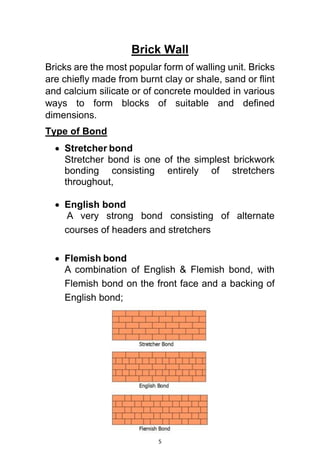
Type of Bond
 Stretcher bond
Stretcher bond is one of the simplest brickwork
bonding consisting entirely of stretchers
throughout,
 English bond
A very strong bond consisting of alternate
courses of headers and stretchers
 Flemish bond
A combination of English & Flemish bond, with
Flemish bond on the front face and a backing of
English bond;
6
Construction of Brick Wall
First, we need to measure the height of your wall. In
this case, we're building a brick wall that’s
perpendicular to an existing wall, so we have to make
sure that it fits properly. After you’ve laid a solid
foundation for your bricks, work out how many courses
of bricks you want. Mark out the height of each course
on a piece of wood, so that you can use it as a guide
to make sure it’s straight and so you can use this as
your gauge rod. Use a spirit level to make sure it’s
straight.
Second, Setting up a level line, make sure your bricks
are laid level. Feed the string line behind the piece of
wood that is clamped to the wall, at the level you want
your first course of bricks to be. Pull the string to the
other wall and clamp it off, making sure that it’s tight
and is level.
Next, lay a small bed of mortar for your first brick to
lie on and use the spirit level to make sure it’s level.
Place a small amount of mortar on the top of the first
brick and place another brick on top of it. Carefully pull
the string line under this brick, this will give you the
straight line you need to lay your first course of bricks.
Lay a bed of mortar on the solid foundation for your
wall. Apply mortar to the side of the bricks but feather it
away from the sides. Lay the bricks next to each other
in a straight line and use your spirit level to make sure
it’s flat.
Last, lay your first brick, so that it’s staggered and
have one brick sitting on top of two bricks. Use your
spirit level to make sure it’s flat. Place mortar on the
side of the bricks and lay them next to each other.
Repeat this until your wall has reached the height you
want.
7
Materials involved in constructing a
Brick Wall
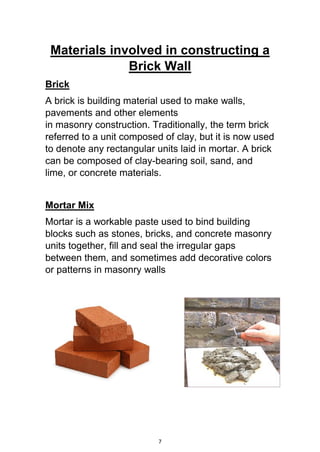
Brick
A brick is building material used to make walls,
pavements and other elements
in masonry construction. Traditionally, the term brick
referred to a unit composed of clay, but it is now used
to denote any rectangular units laid in mortar. A brick
can be composed of clay-bearing soil, sand, and
lime, or concrete materials.
Mortar Mix
Mortar is a workable paste used to bind building
blocks such as stones, bricks, and concrete masonry
units together, fill and seal the irregular gaps
between them, and sometimes add decorative colors
or patterns in masonry walls
8
Machineries, Plants and Tools involved
in constructing a Brick Wall
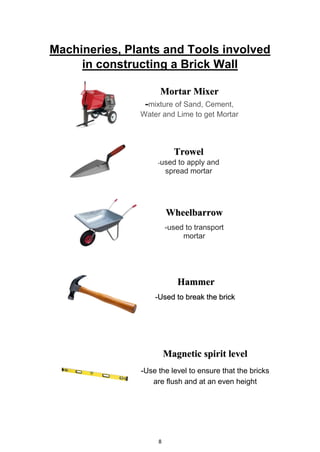
Hammer
-Used to break the brick
Magnetic spirit level
-Use the level to ensure that the bricks
are flush and at an even height
Trowel
-used to apply and
spread mortar
Mortar Mixer
-mixture of Sand, Cement,
Water and Lime to get Mortar
Wheelbarrow
-used to transport
mortar
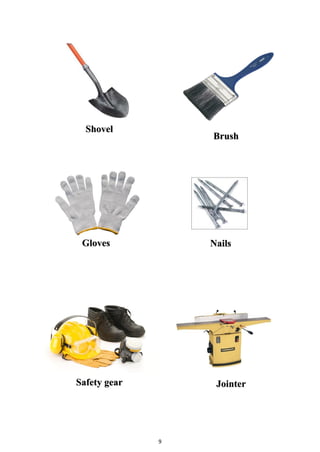
9
Jointer
Brush
Shovel
Safety gear
Gloves Nails
10
Learning Out Come
Throughout the video, I have seen the basic
process of a construction and how the workers work
in the video. This video has provide us the basic
knowledge on construction site and this has help us
further understanding on what we had study in class.
I learnt about the building materials and able to
identify different types of building materials as well as
the technology being used on site. I understand more
and can recognize many of the items for brick wall. It
was a great experience.

SITE REPORT (CT).pdf

  • 1.
    1 SCHOOL OF ARCHITECTURE,BUILDING AND DESIGN BACHELOR OF QUANTITY SURVEYING (HONOURS) AUGUST INTAKE 2015 SEMESTER 1 NAME: DEONG KHAI KEAT STUDENT ID: 0320055 CONSTRUCTION TECHNOLOGY I ( Azrina Binti Md Yaakob )
  • 2.
    2 TITLE NO. Introduction. 3 Objectives.4 Content and Technical Observation 5-7 Photo and Description 8-9 Learning Out come and Conclusion 10
  • 3.
    3 Introduction For this assignmentis an individual assignment, we are required to study on Brick Wall. This is a report on a video incorporating all the learning outcomes of the construction site, the introduction of the site and technical observations made on site. Items to be considered are: a) How a brick wall is constructed? b) What are the machineries, plants and tools involved in constructing a brick wall?
  • 4.
    4 Objective  To gainmore knowledge from video  To understand how the construction process go on.  Explore and identify various types of building materials and technology in video  To discover the types of construction technologies used in real life.  Understand the basics of the construction process.  Witness the usage of construction equipment on site including mechanical plants.  Explore and identify various types of building materials and technology on site.  Explain the construction of buildings and the scientific principles that underpin the design and construction.
  • 5.
    5 Brick Wall Bricks arethe most popular form of walling unit. Bricks are chiefly made from burnt clay or shale, sand or flint and calcium silicate or of concrete moulded in various ways to form blocks of suitable and defined dimensions. Type of Bond  Stretcher bond Stretcher bond is one of the simplest brickwork bonding consisting entirely of stretchers throughout,  English bond A very strong bond consisting of alternate courses of headers and stretchers  Flemish bond A combination of English & Flemish bond, with Flemish bond on the front face and a backing of English bond;
  • 6.
    6 Construction of BrickWall First, we need to measure the height of your wall. In this case, we're building a brick wall that’s perpendicular to an existing wall, so we have to make sure that it fits properly. After you’ve laid a solid foundation for your bricks, work out how many courses of bricks you want. Mark out the height of each course on a piece of wood, so that you can use it as a guide to make sure it’s straight and so you can use this as your gauge rod. Use a spirit level to make sure it’s straight. Second, Setting up a level line, make sure your bricks are laid level. Feed the string line behind the piece of wood that is clamped to the wall, at the level you want your first course of bricks to be. Pull the string to the other wall and clamp it off, making sure that it’s tight and is level. Next, lay a small bed of mortar for your first brick to lie on and use the spirit level to make sure it’s level. Place a small amount of mortar on the top of the first brick and place another brick on top of it. Carefully pull the string line under this brick, this will give you the straight line you need to lay your first course of bricks. Lay a bed of mortar on the solid foundation for your wall. Apply mortar to the side of the bricks but feather it away from the sides. Lay the bricks next to each other in a straight line and use your spirit level to make sure it’s flat. Last, lay your first brick, so that it’s staggered and have one brick sitting on top of two bricks. Use your spirit level to make sure it’s flat. Place mortar on the side of the bricks and lay them next to each other. Repeat this until your wall has reached the height you want.
  • 7.
    7 Materials involved inconstructing a Brick Wall Brick A brick is building material used to make walls, pavements and other elements in masonry construction. Traditionally, the term brick referred to a unit composed of clay, but it is now used to denote any rectangular units laid in mortar. A brick can be composed of clay-bearing soil, sand, and lime, or concrete materials. Mortar Mix Mortar is a workable paste used to bind building blocks such as stones, bricks, and concrete masonry units together, fill and seal the irregular gaps between them, and sometimes add decorative colors or patterns in masonry walls
  • 8.
    8 Machineries, Plants andTools involved in constructing a Brick Wall Hammer -Used to break the brick Magnetic spirit level -Use the level to ensure that the bricks are flush and at an even height Trowel -used to apply and spread mortar Mortar Mixer -mixture of Sand, Cement, Water and Lime to get Mortar Wheelbarrow -used to transport mortar
  • 9.
  • 10.
    10 Learning Out Come Throughoutthe video, I have seen the basic process of a construction and how the workers work in the video. This video has provide us the basic knowledge on construction site and this has help us further understanding on what we had study in class. I learnt about the building materials and able to identify different types of building materials as well as the technology being used on site. I understand more and can recognize many of the items for brick wall. It was a great experience.