SCHOOL OF ARCHITECHURAL, BUILDING AND DESIGN
BACHELOR OF QUANTITY SURVEYING (HONOURS)
Integrated Assignment
Measurement 1(QSB 60104)
Construction Technology 1(BLD 60104)
Building Materials(BLD 62003)
Site Visit Report
STUDENT NAME: CHONG HUI YIK
STUDENT ID: 0326165
DATE OF SUBMISSION: 27/11/2015
Index
NO. TITLE PAGES
1. Introduction & Details 1
2. Objective 2
3. Contents and Technical Observations 3-8
4. Photo Descriptions 9-10
5. Conclusion 11
Introduction
The title of this assignment is technical site visit to site. In this assignment, we
are required to have a site visit and produce a site report for this construction site visit.
This activity was organized by our lecturer, Ms. Ang Fuey Lin. The location of the site
that we visited is at Hulu Selangor. This is an individual assignment which is combining
with 3 subjects. There are Measurement 1, Building Material and Construction
Technology. This construction proposed to build 96 units 2 floors of semi detached
house, there are divided into 3 types, which is 38 units in type 1, 12 units in type 2 which
is (split up & spilt down) and 10 units of type 3.
On 19 November 2015, all of the semester one students have attended the site
visit. We gathered at 8am and set off to the site at 8:30am. We are required to wear
safety helmet, long pants and sport shoes while visit the site construction.
Details of the Construction Site
1) Project: Proposed to build 96 units of semi detached with 2 floors in three types.
2) Building Teams
 Developers: Perbadanan Kemajuan Negeri Selangor (PKNS)
 Architect: Zain Hamzah Architect
 Structural Engineer: Wawasan Bersatu Sdn. Bhd
 Infra Engineer: Wawasan Bersatu Sdn. Bhd
 M&E Engineering: ZNVA & Associated
 Quantity Surveyor: MCM Associates Sdn. Bhd
 Contractor: AJ- Corp Sdn. Bhd
Objective
The objectives of site visit are:
 Understand the basics of the construction process
 Witness the usage of construction equipment on site including mechanical plants.
 Explore and identity various types of building materials and technology on site.
 Awareness of the important of safety on site and understanding of safety
problems and site conditions
 Ability to communicate with the construction team members on site and to feel
the importance of teamwork in the building team.
 To enable students to understand the building structure and the sequences of
constructing a building.
 To let students to experience the actual working environment and know more
about the knowledge on site.
 To gain the knowledge of construction technology and understand about the
construction process.
 Ability to communicate with the construction team members on site and to feel
the importance of teamwork in the building team.
Contents &Technical Observation
At the entrance of the construction site, there is a project information board.The action
of the project information board is to mention the character of the contractor who
involved in the project
At the site, it’s very hot. Therefore, there is providing a small cabin room near the site.
This room is for construction team to discuss or meeting at the site and also a place for
storage doucuments.
The site is divided into 3 types, but we have only visited 2a and 2b area. 2a is higher
level which is required 1200mm excavations starting from reduce level whereas 2b is
lower level which is required 2800mm excavation starting from reduce level . 2a area
has finished pad footing construction but 2b area haven’t start pad footing construction.
The projectinformationboard
the placedat the entrance of
the site.
Accommodationforworkers
Planof the site.
Pad Footing
Introduction
The foundation of a structure is defined as a part of the structure in direct contact with
the ground and which transmits the load of the building to the ground. Foundations can
be classified as shallow and deep foundations. These can be further divided into many
types of foundations.
How to choose a suitable foundation? The main conditions governing the choice of
foundation for a structure comprise:
a) Function of the structure and loads it must carry
b) The sub surface condition
c) Cost of foundation in comparison with cost of the superstructure
Pad Footing
For this construction site, they are using pad footing. Pad footing is used to support
individual or multiple columns, spreading the load to the ground below. They are
generally square or rectangular in plan. The shape in plan will be dictated by the
arrangement of the columns and the load to be transferred into the soil.
Foundation
Shallow
Shallow
Deep
ep
Shallow
Shallow
Shallow
Footing
Shallow
Raft
Shallow
Shallow
Shallow
Strip Pile
Shallow
Pad Footing on site.
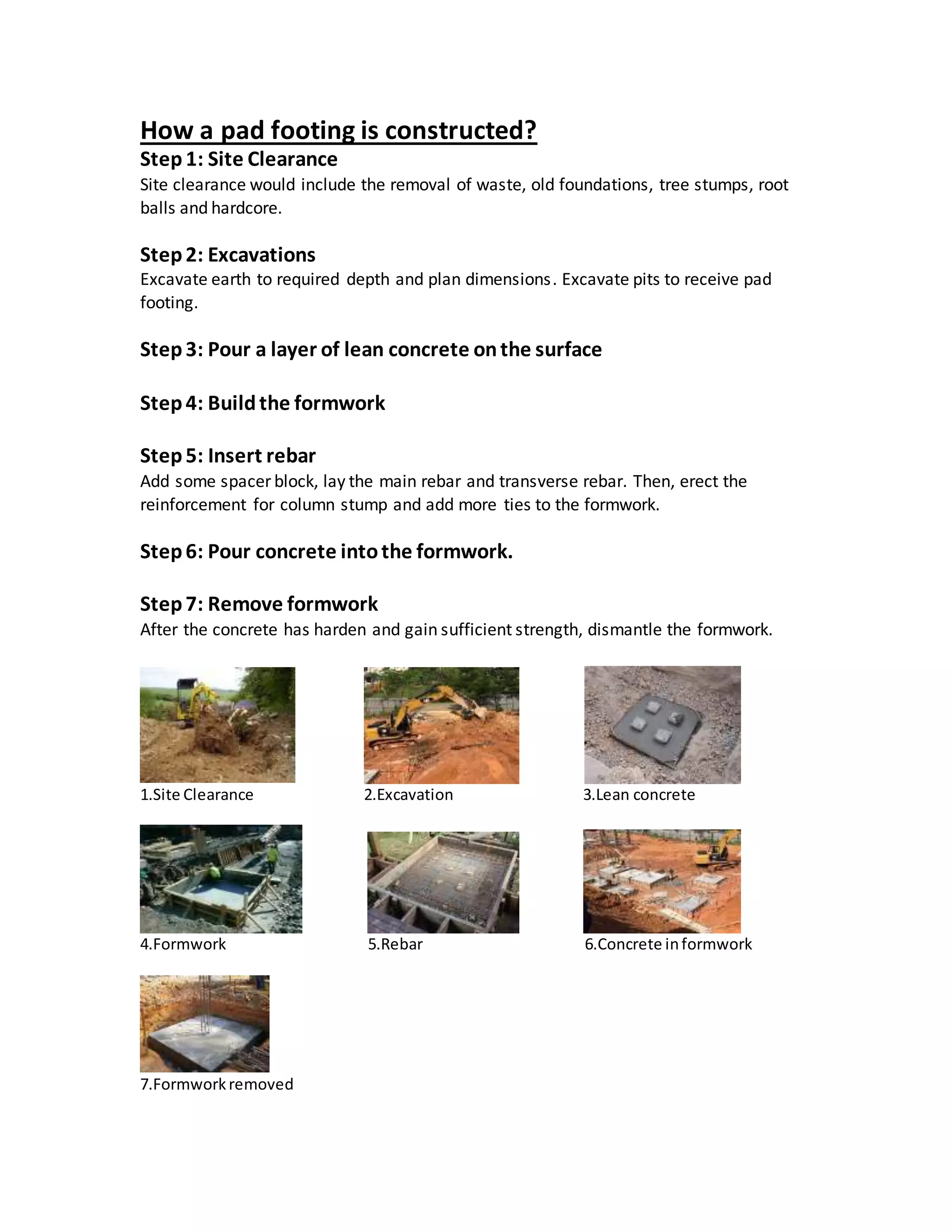
How a pad footing is constructed?
Step 1: Site Clearance
Site clearance would include the removal of waste, old foundations, tree stumps, root
balls and hardcore.
Step2: Excavations
Excavate earth to required depth and plan dimensions. Excavate pits to receive pad
footing.
Step3: Pour a layer of lean concrete onthe surface
Step4: Buildthe formwork
Step5: Insert rebar
Add some spacer block, lay the main rebar and transverse rebar. Then, erect the
reinforcement for column stump and add more ties to the formwork.
Step6: Pour concrete intothe formwork.
Step7: Remove formwork
After the concrete has harden and gain sufficient strength, dismantle the formwork.
1.Site Clearance 2.Excavation 3.Lean concrete
4.Formwork 5.Rebar 6.Concrete informwork
7.Formworkremoved
Materials
Concrete
Introduction
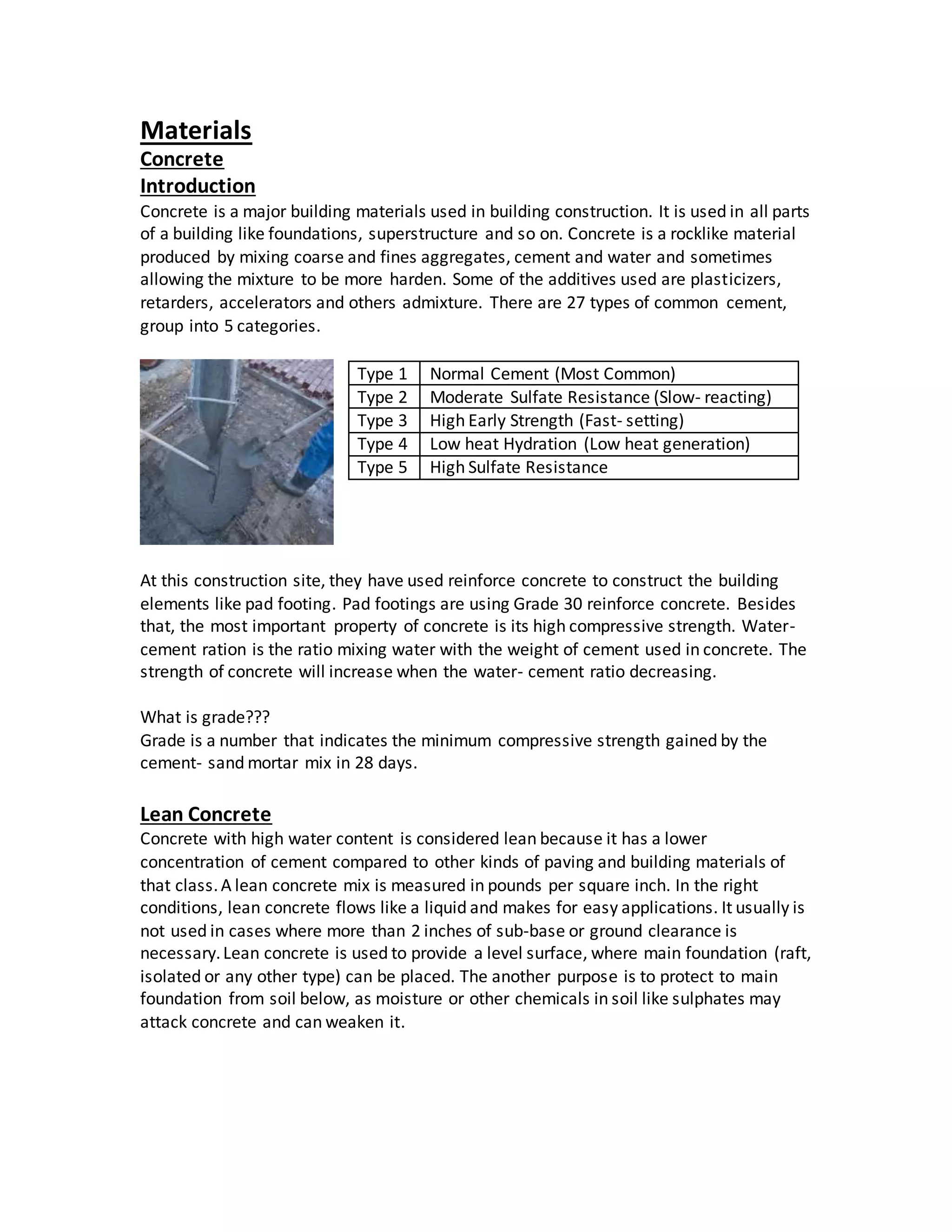
Concrete is a major building materials used in building construction. It is used in all parts
of a building like foundations, superstructure and so on. Concrete is a rocklike material
produced by mixing coarse and fines aggregates, cement and water and sometimes
allowing the mixture to be more harden. Some of the additives used are plasticizers,
retarders, accelerators and others admixture. There are 27 types of common cement,
group into 5 categories.
At this construction site, they have used reinforce concrete to construct the building
elements like pad footing. Pad footings are using Grade 30 reinforce concrete. Besides
that, the most important property of concrete is its high compressive strength. Water-
cement ration is the ratio mixing water with the weight of cement used in concrete. The
strength of concrete will increase when the water- cement ratio decreasing.
What is grade???
Grade is a number that indicates the minimum compressive strength gained by the
cement- sand mortar mix in 28 days.
Lean Concrete
Concrete with high water content is considered lean because it has a lower
concentration of cement compared to other kinds of paving and building materials of
that class.A lean concrete mix is measured in pounds per square inch. In the right
conditions, lean concrete flows like a liquid and makes for easy applications. It usually is
not used in cases where more than 2 inches of sub-base or ground clearance is
necessary.Lean concrete is used to provide a level surface, where main foundation (raft,
isolated or any other type) can be placed. The another purpose is to protect to main
foundation from soil below, as moisture or other chemicals in soil like sulphates may
attack concrete and can weaken it.
Type 1 Normal Cement (Most Common)
Type 2 Moderate Sulfate Resistance (Slow- reacting)
Type 3 High Early Strength (Fast- setting)
Type 4 Low heat Hydration (Low heat generation)
Type 5 High Sulfate Resistance
Formwork
Formwork is an ancillary construction, used as a mould for a structure. Into this mould,
fresh concrete is placed only to harden subsequently. The construction of formwork
takes time and involves expenditure up to 20 to 25% of the cost of the structure or even
more. Design of these temporary structures are made to economic expenditure. The
operation of removing the formwork is known as stripping. Stripped formwork can be
reused. Reusable forms are known as panel forms and non-usable are called stationary
forms.
A good formwork should satisfy the following requirements:
1. It should be strong enough to withstand all types of dead and live loads.
2. It should be rigidly constructed and efficiently propped and braced both
horizontally and vertically, so as to retain its shape.
3. The joints in the formwork should be tight against leakage of cement grout.
4. Construction of formwork should permit removal of various parts in desired
sequences without damage to the concrete.
5. The material of the formwork should be cheap, easily available and should be
suitable for reuse.
6. The formwork should be set accurately to the desired line and levels should have
plane surface.
7. It should be as light as possible.
8. The material of the formwork should not warp or get distorted when exposed to
the elements.
9. It should rest on firm base.
Timber is the most common material for formwork and it’s also applied in this
construction site.
Timber for formwork should satisfy the following requirement:
It should be
1. well seasoned
2. light in weight
3. easily workable with nails without splitting
4. free from loose knots
Rebar
Concrete is a material that is very strong in compression, but relatively weak in tension.
To compensate for this imbalance in concrete's behavior, rebar is cast into it to carry the
tensile loads. Rebar is common steel reinforcing bar, an important component of
reinforced concrete. It is usually formed from mild steel, and is given ridges for better
frictional adhesion to the concrete. However, high tensile steel is used in this
construction site and it is Y16. High tensile steel commonly used as a tensioning device
in reinforced concrete and reinforced masonry structures holding the concrete in
compression. It is usually formed from carbon steel, and is given ridges for better
mechanical anchoring into the concrete.
Photo Descriptions
IndependentScaffolding
The workersare removingthe
formwork.
Thisworkeristyingthe stirrupson
rebar.
Workeris drivingonsite with
bigvehicle.
Pilesinsection3
Formwork forfloorslab.
Rebarcage
The instructoris explainingthe planforus.
Conclusion
After visited the site, I’ve learned more useful knowledge about the construction
and how is the things being constructed. I found that it is interesting when I saw the
things like pad footing, rebar, big vehicles, excavated trench and others became real in
front of me instead of only learn them through notes. I’ve learn about how a pad footing
being constructed and how is the formwork removed by worker after the concrete is
harden. I very appreciate that Mr.Mohd. Hafizi Mohammad was leading us and explain
to us patiently. Moreover, I also appreciate that Ms Ang Fuey Lin and Ms Azrina have
organized this activity for us to learn more outside the book.
I found that teamwork is very important. Coorperation and communication
between the workers and contractor is needed. Without teamwork, the construction
building will not be completed on time and won’t process fluency.
Moreover, safety is very important at construction site. Safety helmet is needed
when we visit to construction site to ensure our safety. The safety of a building is also
very important for people who staying inside, our responsible is to provide them a
safety and comfortable building. Therefore, as a professional and responsible building
team, we should not cheating on workmanship and materials.
In a conclusion, I have learned so much things which is became real instead of
only study on notes. I believe that this is a nice experience for us. I feel respect and
appreciate to those workers who willing to work hard under the sun and also the
contractors who are working on site. They are responsible and knowledgable. I wish I
could become a successful quantity surveyor like them. Thank you.

Site report

  • 1.
    SCHOOL OF ARCHITECHURAL,BUILDING AND DESIGN BACHELOR OF QUANTITY SURVEYING (HONOURS) Integrated Assignment Measurement 1(QSB 60104) Construction Technology 1(BLD 60104) Building Materials(BLD 62003) Site Visit Report STUDENT NAME: CHONG HUI YIK STUDENT ID: 0326165 DATE OF SUBMISSION: 27/11/2015
  • 2.
    Index NO. TITLE PAGES 1.Introduction & Details 1 2. Objective 2 3. Contents and Technical Observations 3-8 4. Photo Descriptions 9-10 5. Conclusion 11
  • 3.
    Introduction The title ofthis assignment is technical site visit to site. In this assignment, we are required to have a site visit and produce a site report for this construction site visit. This activity was organized by our lecturer, Ms. Ang Fuey Lin. The location of the site that we visited is at Hulu Selangor. This is an individual assignment which is combining with 3 subjects. There are Measurement 1, Building Material and Construction Technology. This construction proposed to build 96 units 2 floors of semi detached house, there are divided into 3 types, which is 38 units in type 1, 12 units in type 2 which is (split up & spilt down) and 10 units of type 3. On 19 November 2015, all of the semester one students have attended the site visit. We gathered at 8am and set off to the site at 8:30am. We are required to wear safety helmet, long pants and sport shoes while visit the site construction. Details of the Construction Site 1) Project: Proposed to build 96 units of semi detached with 2 floors in three types. 2) Building Teams  Developers: Perbadanan Kemajuan Negeri Selangor (PKNS)  Architect: Zain Hamzah Architect  Structural Engineer: Wawasan Bersatu Sdn. Bhd  Infra Engineer: Wawasan Bersatu Sdn. Bhd  M&E Engineering: ZNVA & Associated  Quantity Surveyor: MCM Associates Sdn. Bhd  Contractor: AJ- Corp Sdn. Bhd
  • 4.
    Objective The objectives ofsite visit are:  Understand the basics of the construction process  Witness the usage of construction equipment on site including mechanical plants.  Explore and identity various types of building materials and technology on site.  Awareness of the important of safety on site and understanding of safety problems and site conditions  Ability to communicate with the construction team members on site and to feel the importance of teamwork in the building team.  To enable students to understand the building structure and the sequences of constructing a building.  To let students to experience the actual working environment and know more about the knowledge on site.  To gain the knowledge of construction technology and understand about the construction process.  Ability to communicate with the construction team members on site and to feel the importance of teamwork in the building team.
  • 5.
    Contents &Technical Observation Atthe entrance of the construction site, there is a project information board.The action of the project information board is to mention the character of the contractor who involved in the project At the site, it’s very hot. Therefore, there is providing a small cabin room near the site. This room is for construction team to discuss or meeting at the site and also a place for storage doucuments. The site is divided into 3 types, but we have only visited 2a and 2b area. 2a is higher level which is required 1200mm excavations starting from reduce level whereas 2b is lower level which is required 2800mm excavation starting from reduce level . 2a area has finished pad footing construction but 2b area haven’t start pad footing construction. The projectinformationboard the placedat the entrance of the site. Accommodationforworkers Planof the site.
  • 6.
    Pad Footing Introduction The foundationof a structure is defined as a part of the structure in direct contact with the ground and which transmits the load of the building to the ground. Foundations can be classified as shallow and deep foundations. These can be further divided into many types of foundations. How to choose a suitable foundation? The main conditions governing the choice of foundation for a structure comprise: a) Function of the structure and loads it must carry b) The sub surface condition c) Cost of foundation in comparison with cost of the superstructure Pad Footing For this construction site, they are using pad footing. Pad footing is used to support individual or multiple columns, spreading the load to the ground below. They are generally square or rectangular in plan. The shape in plan will be dictated by the arrangement of the columns and the load to be transferred into the soil. Foundation Shallow Shallow Deep ep Shallow Shallow Shallow Footing Shallow Raft Shallow Shallow Shallow Strip Pile Shallow Pad Footing on site.
  • 7.
    How a padfooting is constructed? Step 1: Site Clearance Site clearance would include the removal of waste, old foundations, tree stumps, root balls and hardcore. Step2: Excavations Excavate earth to required depth and plan dimensions. Excavate pits to receive pad footing. Step3: Pour a layer of lean concrete onthe surface Step4: Buildthe formwork Step5: Insert rebar Add some spacer block, lay the main rebar and transverse rebar. Then, erect the reinforcement for column stump and add more ties to the formwork. Step6: Pour concrete intothe formwork. Step7: Remove formwork After the concrete has harden and gain sufficient strength, dismantle the formwork. 1.Site Clearance 2.Excavation 3.Lean concrete 4.Formwork 5.Rebar 6.Concrete informwork 7.Formworkremoved
  • 8.
    Materials Concrete Introduction Concrete is amajor building materials used in building construction. It is used in all parts of a building like foundations, superstructure and so on. Concrete is a rocklike material produced by mixing coarse and fines aggregates, cement and water and sometimes allowing the mixture to be more harden. Some of the additives used are plasticizers, retarders, accelerators and others admixture. There are 27 types of common cement, group into 5 categories. At this construction site, they have used reinforce concrete to construct the building elements like pad footing. Pad footings are using Grade 30 reinforce concrete. Besides that, the most important property of concrete is its high compressive strength. Water- cement ration is the ratio mixing water with the weight of cement used in concrete. The strength of concrete will increase when the water- cement ratio decreasing. What is grade??? Grade is a number that indicates the minimum compressive strength gained by the cement- sand mortar mix in 28 days. Lean Concrete Concrete with high water content is considered lean because it has a lower concentration of cement compared to other kinds of paving and building materials of that class.A lean concrete mix is measured in pounds per square inch. In the right conditions, lean concrete flows like a liquid and makes for easy applications. It usually is not used in cases where more than 2 inches of sub-base or ground clearance is necessary.Lean concrete is used to provide a level surface, where main foundation (raft, isolated or any other type) can be placed. The another purpose is to protect to main foundation from soil below, as moisture or other chemicals in soil like sulphates may attack concrete and can weaken it. Type 1 Normal Cement (Most Common) Type 2 Moderate Sulfate Resistance (Slow- reacting) Type 3 High Early Strength (Fast- setting) Type 4 Low heat Hydration (Low heat generation) Type 5 High Sulfate Resistance
  • 9.
    Formwork Formwork is anancillary construction, used as a mould for a structure. Into this mould, fresh concrete is placed only to harden subsequently. The construction of formwork takes time and involves expenditure up to 20 to 25% of the cost of the structure or even more. Design of these temporary structures are made to economic expenditure. The operation of removing the formwork is known as stripping. Stripped formwork can be reused. Reusable forms are known as panel forms and non-usable are called stationary forms. A good formwork should satisfy the following requirements: 1. It should be strong enough to withstand all types of dead and live loads. 2. It should be rigidly constructed and efficiently propped and braced both horizontally and vertically, so as to retain its shape. 3. The joints in the formwork should be tight against leakage of cement grout. 4. Construction of formwork should permit removal of various parts in desired sequences without damage to the concrete. 5. The material of the formwork should be cheap, easily available and should be suitable for reuse. 6. The formwork should be set accurately to the desired line and levels should have plane surface. 7. It should be as light as possible. 8. The material of the formwork should not warp or get distorted when exposed to the elements. 9. It should rest on firm base. Timber is the most common material for formwork and it’s also applied in this construction site. Timber for formwork should satisfy the following requirement: It should be 1. well seasoned 2. light in weight 3. easily workable with nails without splitting 4. free from loose knots
  • 10.
    Rebar Concrete is amaterial that is very strong in compression, but relatively weak in tension. To compensate for this imbalance in concrete's behavior, rebar is cast into it to carry the tensile loads. Rebar is common steel reinforcing bar, an important component of reinforced concrete. It is usually formed from mild steel, and is given ridges for better frictional adhesion to the concrete. However, high tensile steel is used in this construction site and it is Y16. High tensile steel commonly used as a tensioning device in reinforced concrete and reinforced masonry structures holding the concrete in compression. It is usually formed from carbon steel, and is given ridges for better mechanical anchoring into the concrete.
  • 11.
    Photo Descriptions IndependentScaffolding The workersareremovingthe formwork. Thisworkeristyingthe stirrupson rebar. Workeris drivingonsite with bigvehicle.
  • 12.
  • 13.
    Conclusion After visited thesite, I’ve learned more useful knowledge about the construction and how is the things being constructed. I found that it is interesting when I saw the things like pad footing, rebar, big vehicles, excavated trench and others became real in front of me instead of only learn them through notes. I’ve learn about how a pad footing being constructed and how is the formwork removed by worker after the concrete is harden. I very appreciate that Mr.Mohd. Hafizi Mohammad was leading us and explain to us patiently. Moreover, I also appreciate that Ms Ang Fuey Lin and Ms Azrina have organized this activity for us to learn more outside the book. I found that teamwork is very important. Coorperation and communication between the workers and contractor is needed. Without teamwork, the construction building will not be completed on time and won’t process fluency. Moreover, safety is very important at construction site. Safety helmet is needed when we visit to construction site to ensure our safety. The safety of a building is also very important for people who staying inside, our responsible is to provide them a safety and comfortable building. Therefore, as a professional and responsible building team, we should not cheating on workmanship and materials. In a conclusion, I have learned so much things which is became real instead of only study on notes. I believe that this is a nice experience for us. I feel respect and appreciate to those workers who willing to work hard under the sun and also the contractors who are working on site. They are responsible and knowledgable. I wish I could become a successful quantity surveyor like them. Thank you.