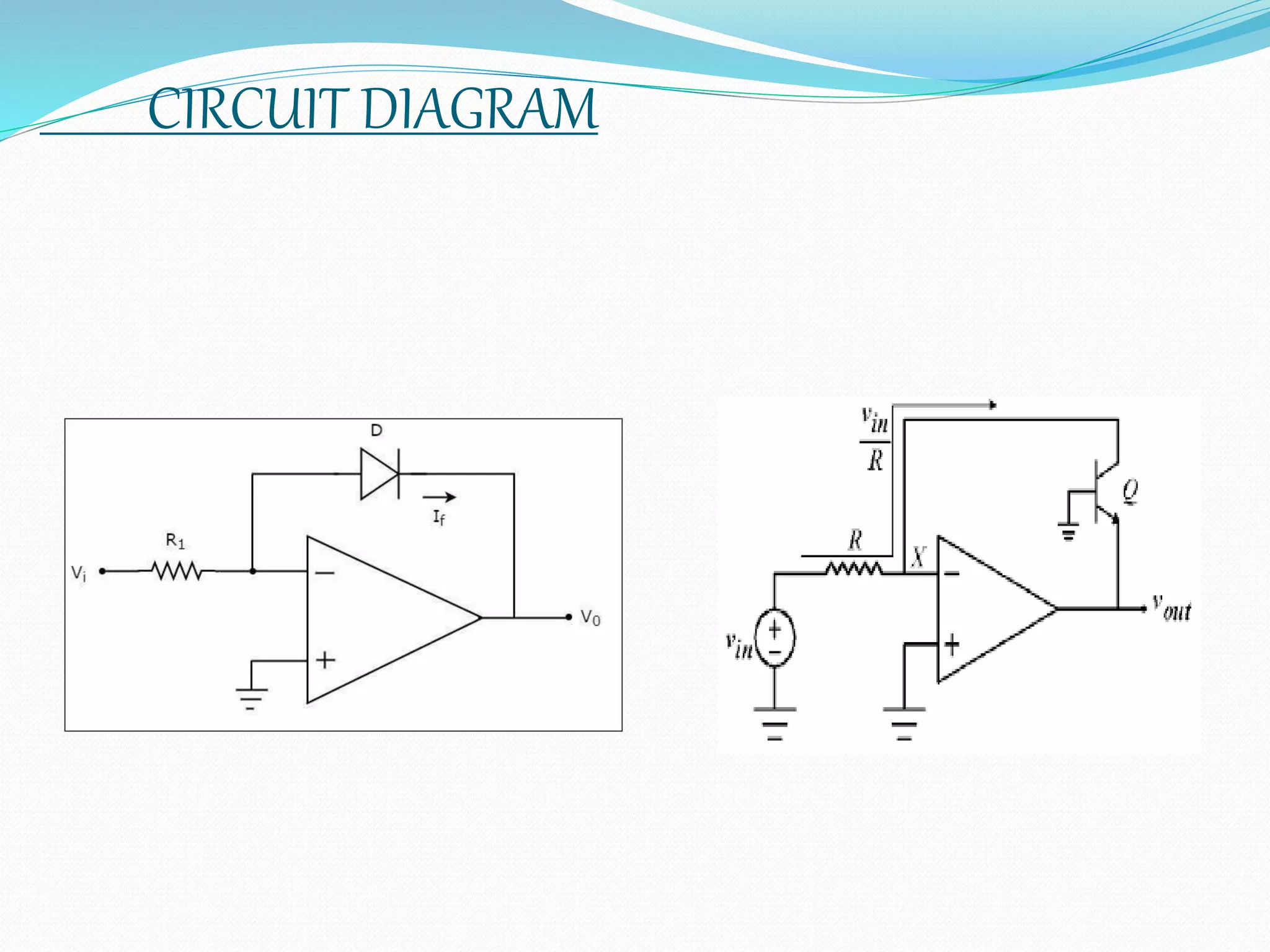
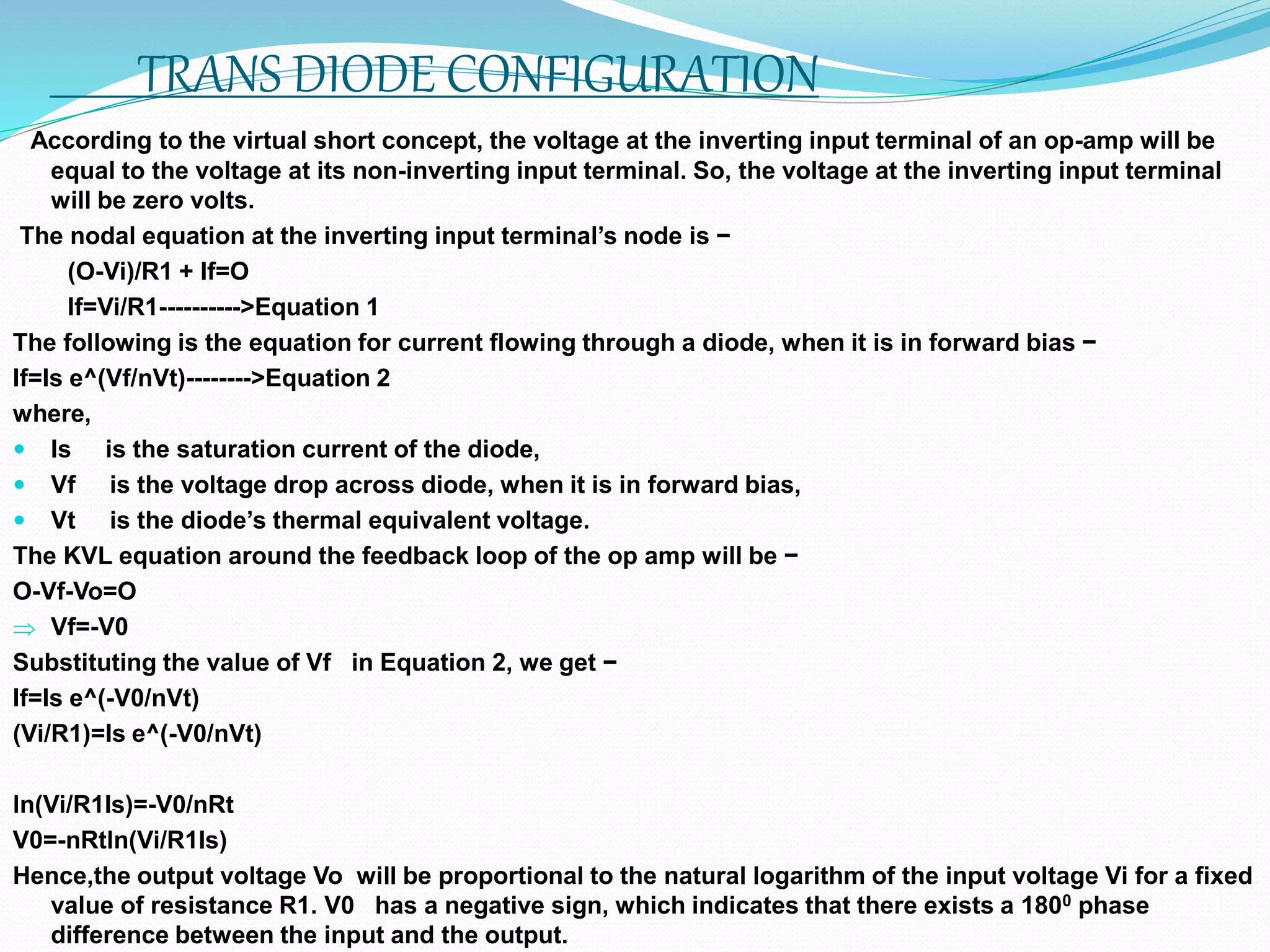
This presentation discusses logarithmic amplifiers, which are electronic devices that convert an exponential input signal into a linear output response. Logarithmic amplifiers are useful for processing signals that vary widely in amplitude, such as in radio frequency communication and audio applications, as they can compress a wide dynamic input range into a more manageable linear output range. The presentation covers the basic circuit diagram of a logarithmic amplifier using a transistor diode configuration, and explains that the output voltage is proportional to the natural logarithm of the input voltage for a fixed resistance value. Applications of logarithmic amplifiers include mathematical operations, decibel measurement, and true RMS conversion.