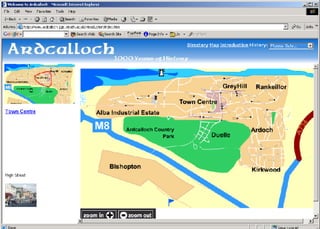
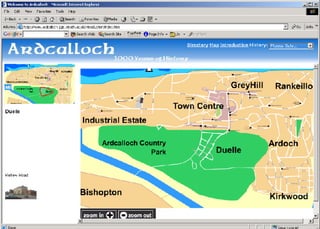
Simulations, learning and the metaverse: changing cultures in legal education Professor Paul Maharg
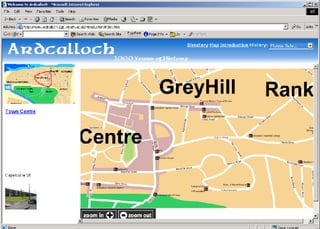
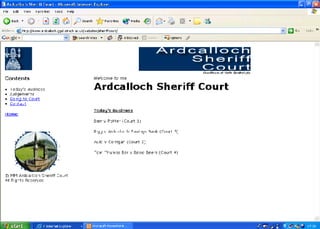
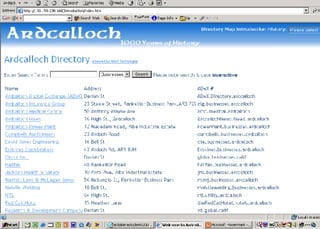
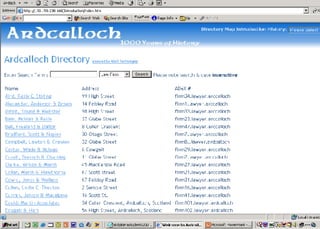
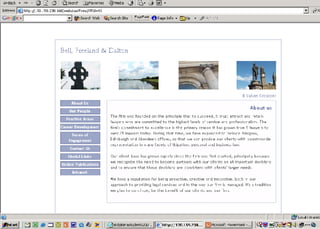
Structure of session Origins... simulation in Ardcalloch.   (15 mins) SIMPLE: update, overview of project and tools, with examples   (15 mins + 10 mins Q&A) Professional learning...?  Wireframe and discussion of resourcing  (15 mins)
simulations in legal learning… Are  close to the world of practice , but safe from the (possible) realities of malpractice and negligent representation.  Enable students to practise legal transactions , discuss the transactions with other tutors, students, and use a variety of instruments or tools, online or textual, to help them understand the nature and consequences of their actions Facilitate a wide variety of assessment , from high-stakes assignments with automatic fail points, to coursework that can double as a learning zone and an assessment assignment Encourage collaborative learning .  The guilds and groups of hunters in multi-player online games can be replicated for very different purposes in legal education. Students begin to  see the potential for the C in ICT ; and that technology is not merely a matter of word-processed essays & quizzes, but a  form of learning that changes quite fundamentally what and how they learn .
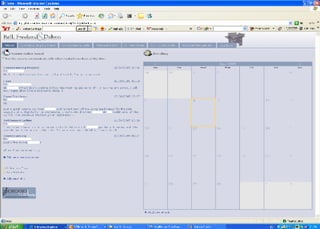
scope of the implementation


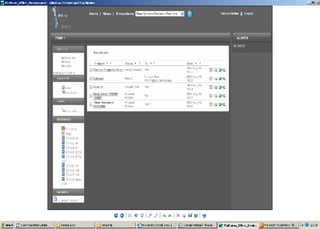
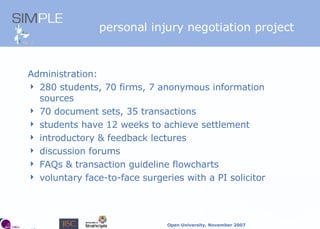
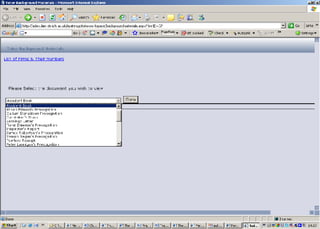
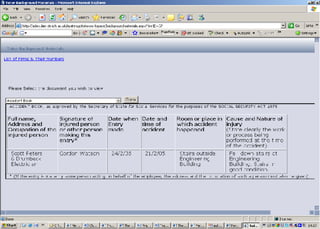
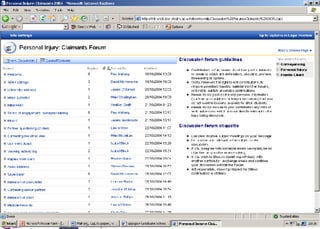
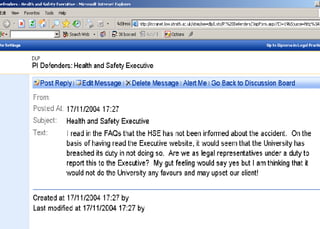
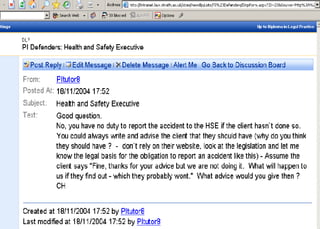
personal injury  negotiation project Administration: 280 students, 70 firms, 7 anonymous information sources 70 document sets, 35 transactions students have 12 weeks to achieve settlement introductory & feedback lectures discussion forums FAQs & transaction guideline flowcharts voluntary face-to-face surgeries with a PI solicitor
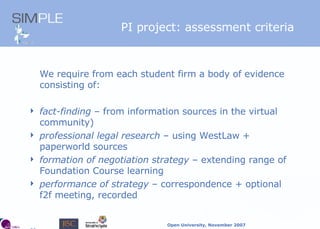
PI project: assessment criteria We require from each student firm a body of evidence consisting of: fact-finding  – from information sources in the virtual community) professional legal research  – using WestLaw + paperworld sources formation of negotiation strategy  – extending range of Foundation Course learning performance of strategy  –  correspondence + optional f2f meeting, recorded


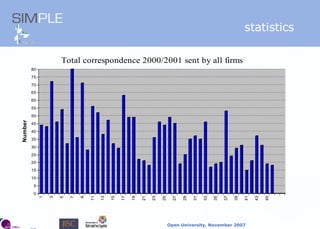
statistics
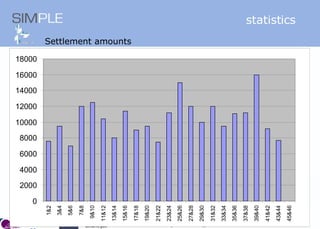
statistics
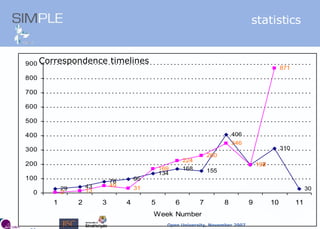
statistics
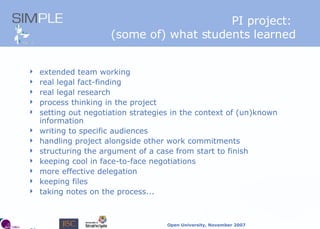
PI project:  (some of) what students learned extended team working real legal fact-finding real legal research process thinking in the project setting out negotiation strategies in the context of (un)known information writing to specific audiences handling project alongside other work commitments structuring the argument of a case from start to finish keeping cool in face-to-face negotiations more effective delegation keeping files taking notes on the process...
PI project: what students would have done differently… ‘ In tackling this project I think that our group made two main mistakes.  The first mistake we made was in approaching the task as law students as opposed to Lawyers.  By this I mean we tried to find the answer and work our way back.  Immediately we were thinking about claims and quantum and blame.  I don't think we actually initiated a claim until a week before the final settlement.  I think the phrase "like a bull in a china shop" would aptly describe the way we approached the problem.  […]  Our group knew what area of law and tests to apply yet we ended up often being ahead of ourselves and having to back-pedal The second mistake we made was estimating how long it would take to gather information.  We started our project quite late on and began to run out of time towards the end.  None of us appreciated the length of time it would take to gather information and on top of this we would often have to write two or three letters to the same person as the initial letter would not ask the right question.’
PI project: what students would have done differently… ‘ At the beginning we thought we perhaps lost sight of the fact that we had a client whom we had a duty to advise and inform.  On reflection we should have issued terms of engagement and advised the client better in monetary terms what the likely outcome was going to be.’ ‘ […] unlike other group projects I was involved in at undergraduate level I feel that I derived genuine benefit from this exercise in several ways: 1. reinforcing letter-writing, negotiation, time-management and IT skills 2. conducting legal research into issues of quantum working effectively in a group as a group - not delegating tasks at the first meeting and then putting together pieces of work at the second meeting.’ Student comment on the  environment …
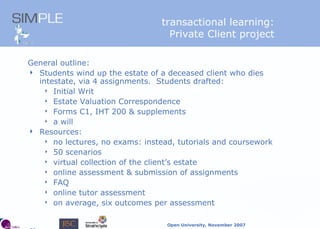
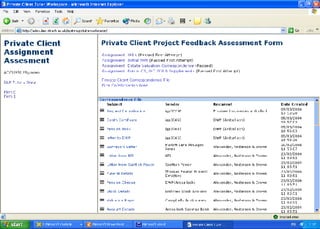
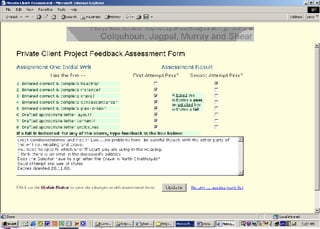
transactional learning: Private Client project General outline: Students wind up the estate of a deceased client who dies intestate, via 4 assignments.  Students drafted: Initial Writ Estate Valuation Correspondence Forms C1, IHT 200 & supplements a will Resources: no lectures, no exams: instead, tutorials and coursework 50 scenarios virtual collection of the client’s estate online assessment & submission of assignments FAQ online tutor assessment on average, six outcomes per assessment
 
 
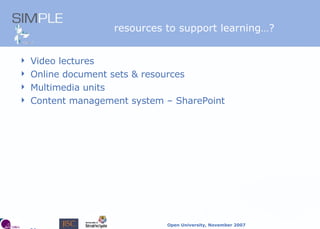
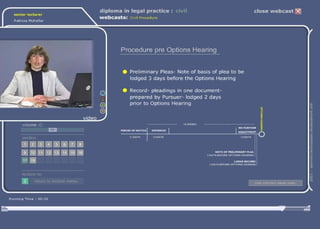
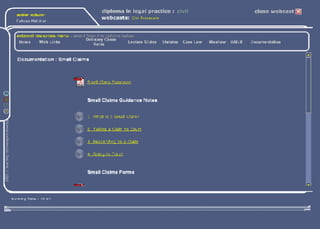
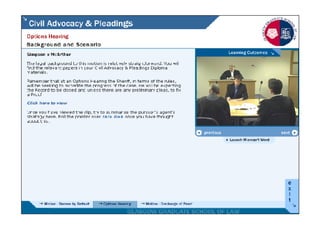
Video lectures Online document sets & resources Multimedia units Content management system – SharePoint resources to support learning…?


student feedback Paperworld student Preferred f2f lectures Didn’t use learning tools in the CD or online environment Used books, not e-resources Took verbatim notes from the webcasts Only listened to the webcasts once E-world student Comfortable using the webcast environment Used online information Used a word-processor to type notes Viewed and reviewed the webcasts Used the learning tools, eg speak-fast button We found that most students adopted a position somewhere along the spectrum of these two poles, and the position was variable depending on purpose of use.
authenticity as transactional learning Characteristics in our practice define transactional learning for us as: active learning,   based on doing legal transactions,  involving reflection on learning,  deep collaborative learning, and  requiring holistic or process learning, as well as ethical and professional learning.
What is SIMPLE?
general aim of the SIMPLE platform Enable staff and students to manage the educational and organizational issues that arise from the implementation of this environment, in particular those of: personalized learning  in a professional environment social presence  and  collaborative learning use of  simulation spaces  in programmes of study, and the relation between simulation spaces and other learning spaces on a programme, including paper-based and online resources, face-to-face classes, and administration use of  rich media  in online simulations – video, graphics, text, comms., etc. authenticity  in the design of simulation tasks, and effective  assessment  of professional learning
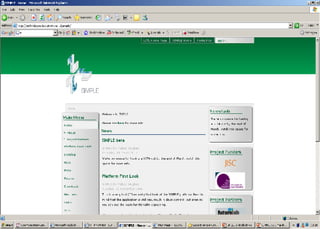
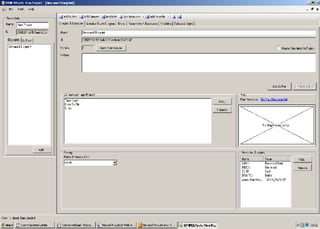
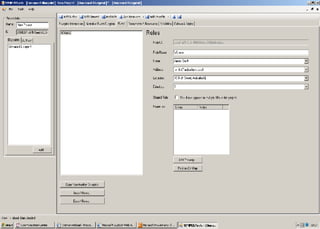
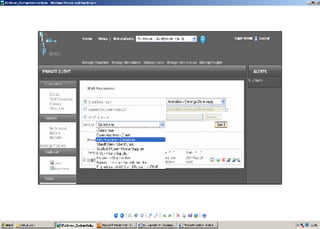
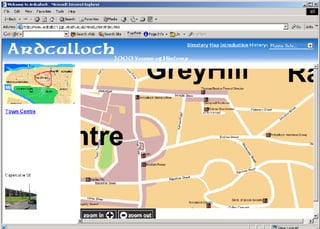
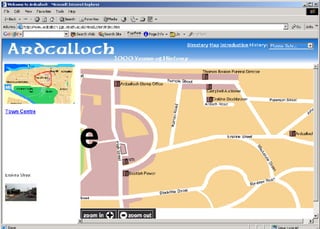
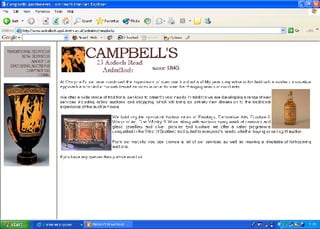
what does the SIMPLE platform   help you to do? Simulate professional tasks within an authentic environment. Provide academic staff with software tools to design and build simulation blueprint and collate all of the resources required.  Provide a map and directory for a virtual town  Enable communication between students and simulated characters/staff. Offer monitoring and mentoring functions.
what will our SIMPLE project   do? Develop teaching, learning and assessment templates, including curriculum guidelines Develop a process and tools which allow for highly structured, closed boundary simulations as well as loosely-structured, open-field simulations Develop and integrate other approaches to e-learning with the SIMPLE platform. Evaluate student and staff experiences in using the simulation environment
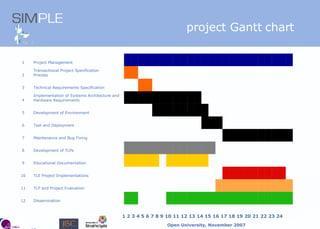
project Gantt chart 1 2 3 4 5 6 7 8 9 10 11 12 13 14 15 16 17 18 19 20 21 22 23 24 1 Project Management                                                 2 Transactional Project Specification Process     3 Technical Requirements Specification     4 Implementation of Systems Architecture and Hardware Requirements                       5 Development of Environment                 6 Test and Deployment       7 Maintenance and Bug Fixing                     8 Development of TLPs                           9 Educational Documentation                       10 TLE Project Implementations                   11 TLP and Project Evaluation                       12 Dissemination                                        
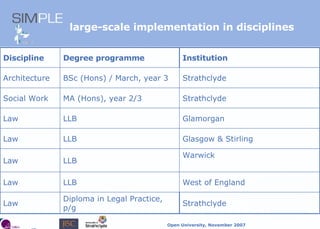
large-scale implementation in disciplines Discipline Degree programme Institution Architecture BSc (Hons) / March, year 3 Strathclyde Social Work MA (Hons), year 2/3 Strathclyde Law LLB Glamorgan Law LLB Glasgow & Stirling Law LLB Warwick Law LLB West of England Law Diploma in Legal Practice, p/g Strathclyde
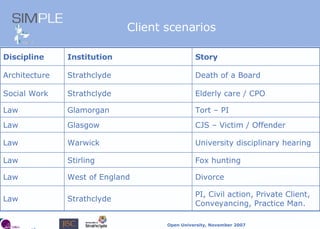
Client scenarios Discipline Institution Story Architecture Strathclyde Death of a Board Social Work Strathclyde Elderly care / CPO Law Glamorgan Tort – PI Law Glasgow CJS – Victim / Offender Law Warwick University disciplinary hearing Law Stirling Fox hunting Law West of England Divorce Law Strathclyde PI, Civil action, Private Client, Conveyancing, Practice Man.
evaluation of student experience activity theory base learner logs and staff logs interviews with students and staff – academic & administrative learner focus groups within each Dept course use cases of learning within and across the participating Schools comparison use-cases of student experience within SIMPLE and more traditional approaches to learning & assessment
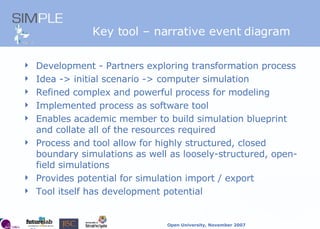
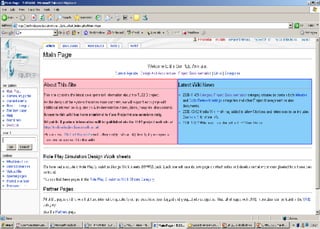
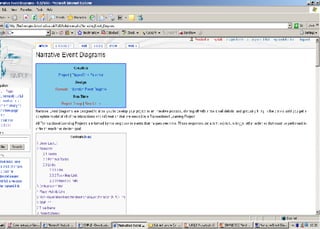
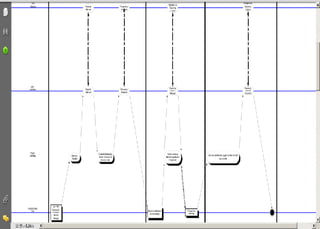
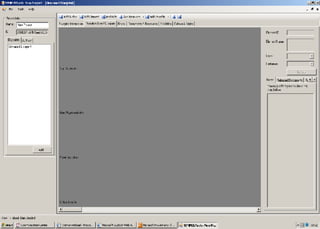
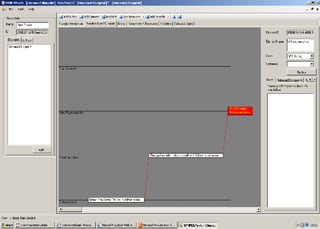
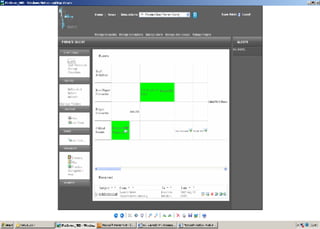
Tools: Development - Partners exploring transformation process  Idea -> initial scenario -> computer simulation  Refined complex and powerful process for modeling Implemented process as software tool  Enables academic member to build simulation blueprint and collate all of the resources required Process and tool allow for highly structured, closed boundary simulations as well as loosely-structured, open-field simulations  Provides potential for simulation import / export Tool itself has development potential Key tool – narrative event diagram
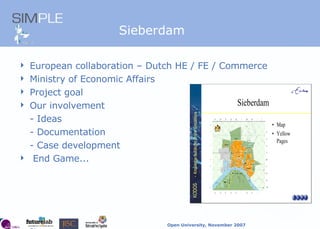
Sieberdam European collaboration – Dutch HE / FE / Commerce Ministry of Economic Affairs Project goal Our involvement - Ideas - Documentation - Case development End Game...
Community of practice Collaborative, between staff and students at different institutions, in different professions International – in our increasingly globalized jurisdictions we need to enable our students to work with others Liaison with institutions & students in developing countries Collaboration with other forms of simulation, eg standardized clients On-line repository of blueprints Second wave partners


The Warwick Project Fictional town Warwickshire/West Midlands- Merridew 24 students- 6 groups Level 2 Enhance student advocacy, negotiation skills, reflection, class participation Students are part of a firm in addition to being a witness in another simulation
Features of the Scenario Real time interviews. Statements checked on line Scenario based on alleged assault by a student on a lecturer at Meridian University. To avoid publicity the university opts for an internal Disciplinary Hearing Student Firms prosecute/defend
Pilot Project June 2007 4 Students & one tutor/manager Run over 10 days Student Guide Evaluation: Mainly functionality
How do you think  the use of SIMPLE will alter the module  as a whole? The fact that the lecturers can observe the casework will be a little intimidating but it may also make the groups more organised  ability to access all the necessary information from any computer   … a strong addition to the course. Sometimes the course was a little difficult to perceive and understanding the way things fitted together was also problematic ... SIMPLE will help to solve some of these problems by really embedding the case studies in something concrete
How would you rate the complexity of the software when completing tasks?   Simple- 2 students  Average – 2 students It was straightforward; anyone who has used email should be fine? This will be relative to the computer experience of each particular student
In what ways do you think the software  will improve the Law in Practice module  at Warwick, if at all? the software will make students feel some professionalism about their work and visualise the narrative of their case   It will just make for a stronger foundation from which students can conduct their cases. I think it would also reduce the need for groups to meet so often because tasks could be completed in a construct to which everyone has access. The incessant meetings were, I think, a great hindrance to my experience of the module . It will safeguard against losses of information (e.g. irresponsible group member), unless there are general technical problems with the system.
Do you think the computer software  will alter the group dynamics at all  within the Law in Practice Module?  As the name of the person who carries out each task is recorded, it will encourage more participation as credit will be able to be given to those in the group who have actually done the work
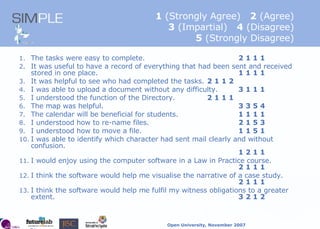
1  (Strongly Agree)  2  (Agree)   3  (Impartial)  4  (Disagree)   5  (Strongly Disagree) The tasks were easy to complete. 2 1 1 1 It was useful to have a record of everything that had been sent and received stored in one place. 1 1 1 1 It was helpful to see who had completed the tasks. 2 1 1 2   I was able to upload a document without any difficulty. 3 1 1 1   I understood the function of the Directory. 2 1 1 1   The map was helpful. 3 3 5 4 The calendar will be beneficial for students. 1 1 1 1  I understood how to re-name files. 2 1 5 3   I understood how to move a file. 1 1 5 1  I was able to identify which character had sent mail clearly and without confusion.  1 2 1 1 I would enjoy using the computer software in a Law in Practice course.  2 1 1 1 I think the software would help me visualise the narrative of a case study.   2 1 1 1 I think the software would help me fulfil my witness obligations to a greater extent. 3 2 1 2
Comments / Questions...
Simulation  and professional learning
simulations in legal learning… Are  close to the world of practice , but safe from the (possible) realities of malpractice and negligent representation.  Enable students to practise legal transactions , discuss the transactions with other tutors, students, and use a variety of instruments or tools, online or textual, to help them understand the nature and consequences of their actions Facilitate a wide variety of assessment , from high-stakes assignments with automatic fail points, to coursework that can double as a learning zone and an assessment assignment Encourage collaborative learning .  The guilds and groups of hunters in multi-player online games can be replicated for very different purposes in legal education. Students begin to  see the potential for the C in ICT ; and that technology is not merely a matter of word-processed essays & quizzes, but a  form of learning that changes quite fundamentally what and how they learn .
professional learning and simulation...? Relies on critical integration of resources and transactional learning Three views:  topic transactional simulative  Knowledge management & training would then consist of moving between these three elements

Simulation, learning and the metaverse

  • 1.
    Simulations, learning andthe metaverse: changing cultures in legal education Professor Paul Maharg
  • 2.
    Structure of sessionOrigins... simulation in Ardcalloch.  (15 mins) SIMPLE: update, overview of project and tools, with examples  (15 mins + 10 mins Q&A) Professional learning...? Wireframe and discussion of resourcing (15 mins)
  • 3.
    simulations in legallearning… Are close to the world of practice , but safe from the (possible) realities of malpractice and negligent representation. Enable students to practise legal transactions , discuss the transactions with other tutors, students, and use a variety of instruments or tools, online or textual, to help them understand the nature and consequences of their actions Facilitate a wide variety of assessment , from high-stakes assignments with automatic fail points, to coursework that can double as a learning zone and an assessment assignment Encourage collaborative learning . The guilds and groups of hunters in multi-player online games can be replicated for very different purposes in legal education. Students begin to see the potential for the C in ICT ; and that technology is not merely a matter of word-processed essays & quizzes, but a form of learning that changes quite fundamentally what and how they learn .
  • 4.
    scope of theimplementation
  • 5.
  • 6.
  • 7.
  • 8.
  • 9.
  • 10.
  • 11.
  • 12.
  • 13.
  • 14.
  • 15.
  • 16.
  • 17.
  • 18.
  • 19.
    personal injury negotiation project Administration: 280 students, 70 firms, 7 anonymous information sources 70 document sets, 35 transactions students have 12 weeks to achieve settlement introductory & feedback lectures discussion forums FAQs & transaction guideline flowcharts voluntary face-to-face surgeries with a PI solicitor
  • 20.
    PI project: assessmentcriteria We require from each student firm a body of evidence consisting of: fact-finding – from information sources in the virtual community) professional legal research – using WestLaw + paperworld sources formation of negotiation strategy – extending range of Foundation Course learning performance of strategy – correspondence + optional f2f meeting, recorded
  • 21.
  • 22.
  • 23.
  • 24.
  • 25.
  • 26.
  • 27.
  • 28.
  • 29.
  • 30.
    PI project: (some of) what students learned extended team working real legal fact-finding real legal research process thinking in the project setting out negotiation strategies in the context of (un)known information writing to specific audiences handling project alongside other work commitments structuring the argument of a case from start to finish keeping cool in face-to-face negotiations more effective delegation keeping files taking notes on the process...
  • 31.
    PI project: whatstudents would have done differently… ‘ In tackling this project I think that our group made two main mistakes. The first mistake we made was in approaching the task as law students as opposed to Lawyers. By this I mean we tried to find the answer and work our way back. Immediately we were thinking about claims and quantum and blame. I don't think we actually initiated a claim until a week before the final settlement. I think the phrase "like a bull in a china shop" would aptly describe the way we approached the problem. […] Our group knew what area of law and tests to apply yet we ended up often being ahead of ourselves and having to back-pedal The second mistake we made was estimating how long it would take to gather information. We started our project quite late on and began to run out of time towards the end. None of us appreciated the length of time it would take to gather information and on top of this we would often have to write two or three letters to the same person as the initial letter would not ask the right question.’
  • 32.
    PI project: whatstudents would have done differently… ‘ At the beginning we thought we perhaps lost sight of the fact that we had a client whom we had a duty to advise and inform. On reflection we should have issued terms of engagement and advised the client better in monetary terms what the likely outcome was going to be.’ ‘ […] unlike other group projects I was involved in at undergraduate level I feel that I derived genuine benefit from this exercise in several ways: 1. reinforcing letter-writing, negotiation, time-management and IT skills 2. conducting legal research into issues of quantum working effectively in a group as a group - not delegating tasks at the first meeting and then putting together pieces of work at the second meeting.’ Student comment on the environment …
  • 33.
    transactional learning: PrivateClient project General outline: Students wind up the estate of a deceased client who dies intestate, via 4 assignments. Students drafted: Initial Writ Estate Valuation Correspondence Forms C1, IHT 200 & supplements a will Resources: no lectures, no exams: instead, tutorials and coursework 50 scenarios virtual collection of the client’s estate online assessment & submission of assignments FAQ online tutor assessment on average, six outcomes per assessment
  • 34.
  • 35.
  • 36.
    Video lectures Onlinedocument sets & resources Multimedia units Content management system – SharePoint resources to support learning…?
  • 37.
  • 38.
  • 39.
  • 40.
    student feedback Paperworldstudent Preferred f2f lectures Didn’t use learning tools in the CD or online environment Used books, not e-resources Took verbatim notes from the webcasts Only listened to the webcasts once E-world student Comfortable using the webcast environment Used online information Used a word-processor to type notes Viewed and reviewed the webcasts Used the learning tools, eg speak-fast button We found that most students adopted a position somewhere along the spectrum of these two poles, and the position was variable depending on purpose of use.
  • 41.
    authenticity as transactionallearning Characteristics in our practice define transactional learning for us as: active learning, based on doing legal transactions, involving reflection on learning, deep collaborative learning, and requiring holistic or process learning, as well as ethical and professional learning.
  • 42.
  • 43.
    general aim ofthe SIMPLE platform Enable staff and students to manage the educational and organizational issues that arise from the implementation of this environment, in particular those of: personalized learning in a professional environment social presence and collaborative learning use of simulation spaces in programmes of study, and the relation between simulation spaces and other learning spaces on a programme, including paper-based and online resources, face-to-face classes, and administration use of rich media in online simulations – video, graphics, text, comms., etc. authenticity in the design of simulation tasks, and effective assessment of professional learning
  • 44.
    what does theSIMPLE platform help you to do? Simulate professional tasks within an authentic environment. Provide academic staff with software tools to design and build simulation blueprint and collate all of the resources required. Provide a map and directory for a virtual town Enable communication between students and simulated characters/staff. Offer monitoring and mentoring functions.
  • 45.
    what will ourSIMPLE project do? Develop teaching, learning and assessment templates, including curriculum guidelines Develop a process and tools which allow for highly structured, closed boundary simulations as well as loosely-structured, open-field simulations Develop and integrate other approaches to e-learning with the SIMPLE platform. Evaluate student and staff experiences in using the simulation environment
  • 46.
    project Gantt chart1 2 3 4 5 6 7 8 9 10 11 12 13 14 15 16 17 18 19 20 21 22 23 24 1 Project Management                                                 2 Transactional Project Specification Process     3 Technical Requirements Specification     4 Implementation of Systems Architecture and Hardware Requirements                       5 Development of Environment                 6 Test and Deployment       7 Maintenance and Bug Fixing                     8 Development of TLPs                           9 Educational Documentation                       10 TLE Project Implementations                   11 TLP and Project Evaluation                       12 Dissemination                                        
  • 47.
    large-scale implementation indisciplines Discipline Degree programme Institution Architecture BSc (Hons) / March, year 3 Strathclyde Social Work MA (Hons), year 2/3 Strathclyde Law LLB Glamorgan Law LLB Glasgow & Stirling Law LLB Warwick Law LLB West of England Law Diploma in Legal Practice, p/g Strathclyde
  • 48.
    Client scenarios DisciplineInstitution Story Architecture Strathclyde Death of a Board Social Work Strathclyde Elderly care / CPO Law Glamorgan Tort – PI Law Glasgow CJS – Victim / Offender Law Warwick University disciplinary hearing Law Stirling Fox hunting Law West of England Divorce Law Strathclyde PI, Civil action, Private Client, Conveyancing, Practice Man.
  • 49.
    evaluation of studentexperience activity theory base learner logs and staff logs interviews with students and staff – academic & administrative learner focus groups within each Dept course use cases of learning within and across the participating Schools comparison use-cases of student experience within SIMPLE and more traditional approaches to learning & assessment
  • 50.
    Tools: Development -Partners exploring transformation process Idea -> initial scenario -> computer simulation Refined complex and powerful process for modeling Implemented process as software tool Enables academic member to build simulation blueprint and collate all of the resources required Process and tool allow for highly structured, closed boundary simulations as well as loosely-structured, open-field simulations Provides potential for simulation import / export Tool itself has development potential Key tool – narrative event diagram
  • 51.
    Sieberdam European collaboration– Dutch HE / FE / Commerce Ministry of Economic Affairs Project goal Our involvement - Ideas - Documentation - Case development End Game...
  • 52.
    Community of practiceCollaborative, between staff and students at different institutions, in different professions International – in our increasingly globalized jurisdictions we need to enable our students to work with others Liaison with institutions & students in developing countries Collaboration with other forms of simulation, eg standardized clients On-line repository of blueprints Second wave partners
  • 53.
  • 54.
  • 55.
  • 56.
  • 57.
  • 58.
  • 59.
  • 60.
  • 61.
  • 62.
  • 63.
  • 64.
    The Warwick ProjectFictional town Warwickshire/West Midlands- Merridew 24 students- 6 groups Level 2 Enhance student advocacy, negotiation skills, reflection, class participation Students are part of a firm in addition to being a witness in another simulation
  • 65.
    Features of theScenario Real time interviews. Statements checked on line Scenario based on alleged assault by a student on a lecturer at Meridian University. To avoid publicity the university opts for an internal Disciplinary Hearing Student Firms prosecute/defend
  • 66.
    Pilot Project June2007 4 Students & one tutor/manager Run over 10 days Student Guide Evaluation: Mainly functionality
  • 67.
    How do youthink the use of SIMPLE will alter the module as a whole? The fact that the lecturers can observe the casework will be a little intimidating but it may also make the groups more organised ability to access all the necessary information from any computer … a strong addition to the course. Sometimes the course was a little difficult to perceive and understanding the way things fitted together was also problematic ... SIMPLE will help to solve some of these problems by really embedding the case studies in something concrete
  • 68.
    How would yourate the complexity of the software when completing tasks? Simple- 2 students Average – 2 students It was straightforward; anyone who has used email should be fine? This will be relative to the computer experience of each particular student
  • 69.
    In what waysdo you think the software will improve the Law in Practice module at Warwick, if at all? the software will make students feel some professionalism about their work and visualise the narrative of their case It will just make for a stronger foundation from which students can conduct their cases. I think it would also reduce the need for groups to meet so often because tasks could be completed in a construct to which everyone has access. The incessant meetings were, I think, a great hindrance to my experience of the module . It will safeguard against losses of information (e.g. irresponsible group member), unless there are general technical problems with the system.
  • 70.
    Do you thinkthe computer software will alter the group dynamics at all within the Law in Practice Module? As the name of the person who carries out each task is recorded, it will encourage more participation as credit will be able to be given to those in the group who have actually done the work
  • 71.
    1 (StronglyAgree) 2 (Agree) 3 (Impartial) 4 (Disagree) 5 (Strongly Disagree) The tasks were easy to complete. 2 1 1 1 It was useful to have a record of everything that had been sent and received stored in one place. 1 1 1 1 It was helpful to see who had completed the tasks. 2 1 1 2 I was able to upload a document without any difficulty. 3 1 1 1 I understood the function of the Directory. 2 1 1 1 The map was helpful. 3 3 5 4 The calendar will be beneficial for students. 1 1 1 1 I understood how to re-name files. 2 1 5 3 I understood how to move a file. 1 1 5 1 I was able to identify which character had sent mail clearly and without confusion. 1 2 1 1 I would enjoy using the computer software in a Law in Practice course. 2 1 1 1 I think the software would help me visualise the narrative of a case study. 2 1 1 1 I think the software would help me fulfil my witness obligations to a greater extent. 3 2 1 2
  • 72.
  • 73.
    Simulation andprofessional learning
  • 74.
    simulations in legallearning… Are close to the world of practice , but safe from the (possible) realities of malpractice and negligent representation. Enable students to practise legal transactions , discuss the transactions with other tutors, students, and use a variety of instruments or tools, online or textual, to help them understand the nature and consequences of their actions Facilitate a wide variety of assessment , from high-stakes assignments with automatic fail points, to coursework that can double as a learning zone and an assessment assignment Encourage collaborative learning . The guilds and groups of hunters in multi-player online games can be replicated for very different purposes in legal education. Students begin to see the potential for the C in ICT ; and that technology is not merely a matter of word-processed essays & quizzes, but a form of learning that changes quite fundamentally what and how they learn .
  • 75.
    professional learning andsimulation...? Relies on critical integration of resources and transactional learning Three views: topic transactional simulative Knowledge management & training would then consist of moving between these three elements